

Computer Aided Detection Market Size and Forecast — 2026-2033
Overview
Computer Aided Detection (CAD) software is a set of algorithms that uses pattern recognition method assisting physicians with interpretation of medical images. Increasing number of patients opting for diagnostic imaging techniques is expected to propel the volume of image data to be analysed. It is a diagnostic analysis technology, which assists physicians in reducing detection errors.
CAD software is helpful in diagnosis of several diseases, such as cancer, coronary artery disease, cardiovascular diseases, and neurological diseases through imaging modalities, such as X-Rays imaging, Magnetic Resonance Imaging ultrasound imaging, and computed tomography. It helps in accurate detection of chronic diseases in early stages, reducing mortality rates due to cancer, cardiovascular, and neurological diseases.
Computer Aided Detection Market Size and Forecast – 2026 – 2033
The Computer Aided Detection Market size is estimated to be valued at USD 3.94 billion in 2026 and is expected to reach USD 9.11 billion by 2033, exhibiting a compound annual growth rate (CAGR) of 12.7% from 2026 to 2033.
Key Takeaways
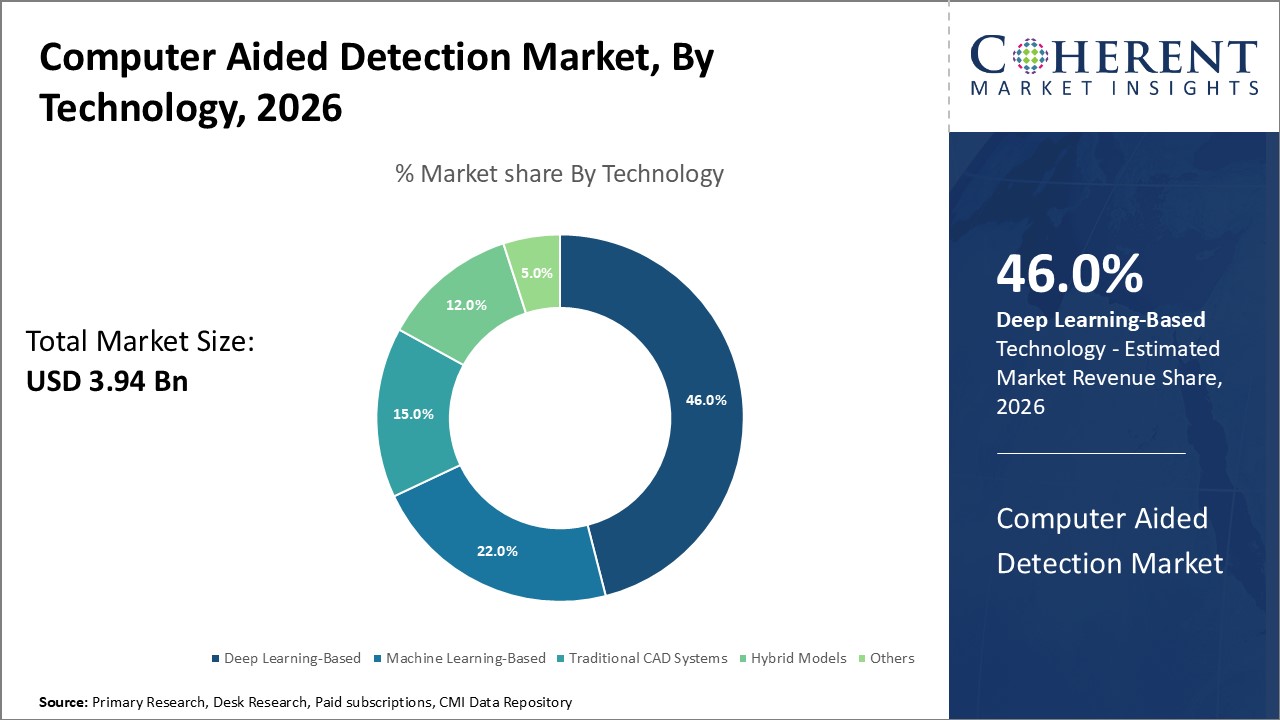
By Technology segment, deep learning-based solutions dominate with a 46% market share due to superior accuracy and faster processing, while hybrid models demonstrate the fastest growth driven by integration of multiple AI techniques.
Oncology application contribute the largest revenue percentage, primarily through breast and lung cancer detection, with pulmonology expected to grow fastest due to escalating lung-related diseases.
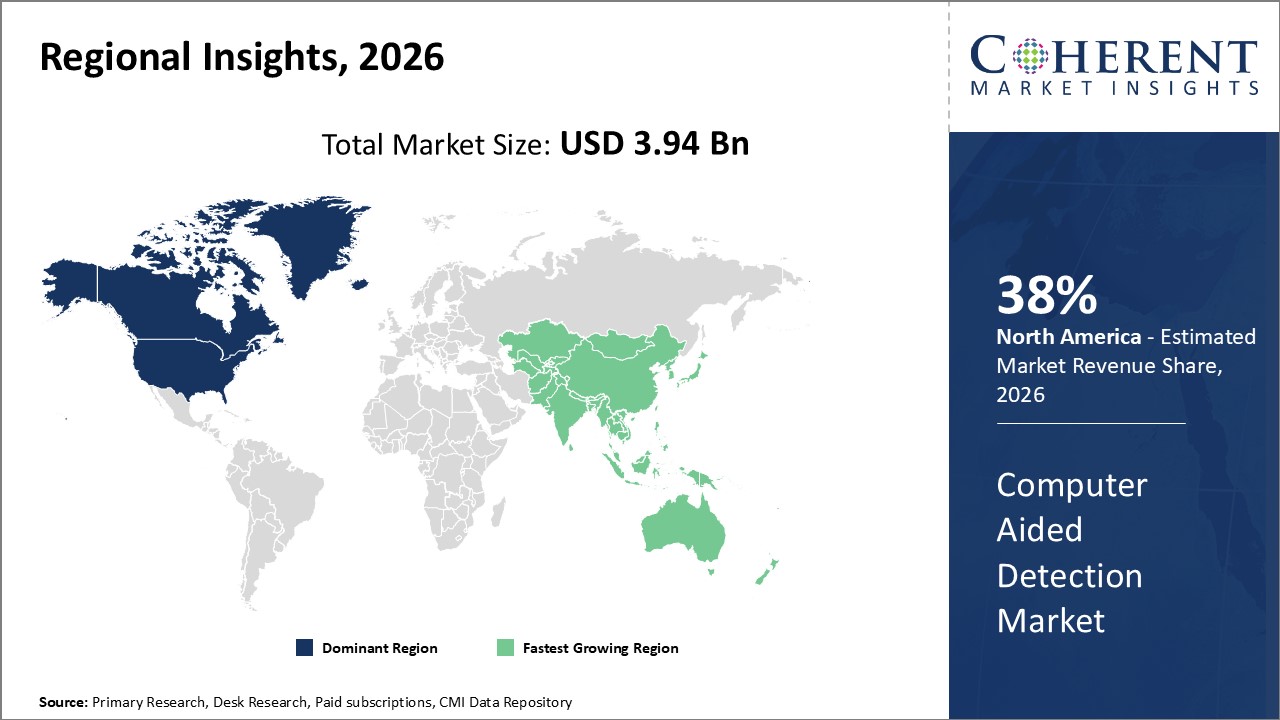
North America maintains dominance in market share at 38%, supported by regulatory approvals and advanced healthcare infrastructure.
Asia Pacific presents the fastest-growing regional market with a CAGR surpassing 14%, fueled by government digitization initiatives and expanding healthcare coverage in countries like China and India.
Computer Aided Detection Market – Segmentation Analysis
Computer Aided Detection Market Insights, By Technology
In terms of Technology the market is segmented into Deep Learning-Based, Machine Learning-Based, Traditional CAD Systems, Hybrid Models, and Others among this Deep Learning-Based dominate the market share with approximately 46%. Deep learning CAD systems lead due to their ability to handle large datasets and deliver superior accuracy, driving market revenue across oncology and pulmonology applications primarily.
Computer Aided Detection Market Insights, By Application
In terms of Application the market is segmented into Oncology, Pulmonology, Cardiology, Radiology, and Others, with Oncology dominating the market share at nearly 40% due to its critical role in breast and lung cancer detection using CAD. Oncology drives significant market revenue growth backed by sustained screening programs and research funding globally.
Computer Aided Detection Market Insights, By End-User
In terms of End-User the market is segmented into Hospitals & Clinics, Diagnostic Centers, Ambulatory Surgical Centers, Research Institutes, and Others, wherein Hospitals & Clinics dominate the market share driven by integrated care settings, advanced imaging facilities, and large patient volumes.
Computer Aided Detection Market Insights, By Geography
North America Computer Aided Detection Market Analysis and Trends
In North America, the dominance in the Computer Aided Detection Market is driven by advanced healthcare infrastructure, favorable reimbursement policies, and accelerated regulatory approvals for AI-based diagnostic tools. North America accounts for an estimated 38% of the industry share, supported by the robust presence of market companies such as Siemens Healthineers and GE Healthcare investing heavily in R&D. The prevalence of chronic diseases, coupled with government initiatives like the U.S. NIH’s AI in Healthcare grants, further sustains North America’s commanding position.
Asia Pacific Computer Aided Detection Market Analysis and Trends
The Asia Pacific exhibits the fastest growth with a CAGR over 14%, propelled by rapidly expanding healthcare infrastructure, rising chronic disease burden, and increasing adoption of digital health technologies. Government policies in China and India promoting AI-driven healthcare modernization are key accelerators, alongside significant investments from companies such as Philips Healthcare and Canon Medical Systems expanding localization of CAD solutions. The increasing number of diagnostic centers and imaging facilities in urban and semi-urban areas contributes meaningfully to the expanding regional market.
Computer Aided Detection Market Outlook for Key Countries
United States Computer Aided Detection Market Analysis and Trends
The USA’s Computer Aided Detection market is characterized by high technology adoption rates and an extensive healthcare ecosystem facilitating rapid integration of AI-based CAD platforms. Clinical studies across prominent cancer centers in the U.S. demonstrated a 28% increase in early detection accuracy using CAD technologies, driving substantial market size growth. Leading companies such as IBM and Hologic have engaged in strategic collaborations with academic institutions for model training and validation, enhancing solution effectiveness and uptake. Furthermore, government funding exceeding USD 200 million in 2026 towards digital health innovation underpins strong market growth strategies and expanding market share.
China Computer Aided Detection Market Analysis and Trends
China's Computer Aided Detection market is witnessing significant expansion propelled by government initiatives like “Healthy China 2030” aiming to digitize healthcare and improve diagnostic capabilities nationwide. National screening programs implemented in 2025 increased demand for CAD solutions in oncology and pulmonology subsegments, improving CAD system adoption by over 35% in urban hospitals. Market players such as Philips Healthcare and Fujifilm have localized product development and partnered with public hospitals, accelerating integration efforts. The surge in AI expertise and investments from local tech firms complement government support, making China a critical fast-growing market for computer aided detection technologies.
Analyst Opinion
Advanced Algorithm Performance Significantly Boosts Market Growth: The implementation of convolutional neural networks (CNNs) and enhanced deep learning models has increased detection accuracy by approximately 25% in breast cancer diagnostics alone during 2025, as reported in clinical trials at leading hospitals in Europe and North America. This improvement underpins market revenue, signaling robust demand for AI-driven CAD solutions.
Expanding Use Case Adoption in Pulmonology and Cardiology Fuels Demand: Adoption rates of CAD systems for lung nodule detection increased by 31% in major medical centers across the U.S. in 2026, driven by rising lung cancer incidence and national screening programs. Similarly, cardiovascular CAD applications have seen a 23% rise due to real-time plaque identification improvements, contributing to revenue growth and market size expansion.
Regulatory Approvals and Government Initiatives Are Market Catalysts: FDA approvals for multiple CAD software platforms in 2025 have streamlined their clinical integration across North America, directly influencing market share increases for compliant solutions. Additionally, government funding for AI in healthcare, such as the U.S. Health AI Grant Program investing over USD 200 million in 2026, further accelerates innovation and market growth strategies.
Shifts in Diagnostic Imaging Equipment Integration Drive Competitive Dynamics: There is a 15% year-on-year rise in PACS vendors integrating CAD platforms to enhance imaging workflows, evidenced by partnerships between major imaging hardware manufacturers and software providers in Asia Pacific in 2025. This ecosystem expansion indicates stronger market dynamics and facilitates broader penetration of CAD tools in emerging markets.
- Current Industry Events of 2026
- Market Size Estimation
- Regional Breakdown
- Competitive Landscape
- Customer Intelligence
- Segmental Analysis
- Pricing Analysis
- Key Market Drivers, Challenges & Future Trends
- Customized Insights Section
Market Scope
| Report Coverage | Details | ||
|---|---|---|---|
| Base Year: | 2025 | Market Size in 2026: | USD 3.94 billion |
| Historical Data for: | 2020 To 2024 | Forecast Period: | 2026 To 2033 |
| Forecast Period 2026 to 2033 CAGR: | 12.7% | 2033 Value Projection: | USD 9.11 billion |
| Geographies covered: |
| ||
| Segments covered: |
| ||
| Companies covered: | Agfa-Gevaert NV, Siemens Healthineers AG, GE Healthcare, Philips Healthcare, IBM Corporation, Hologic, Inc., Fujifilm Holdings Corporation, Canon Medical Systems Corporation, iCAD, Inc., CureMetrix, Optellum Ltd. | ||
| Growth Drivers: |
| ||
Growth factors
Key growth drivers fueling computer aided detection market expansion include the widespread adoption of AI and machine learning technologies, which has accelerated diagnostic accuracy and efficiency, evidenced by a 30% reduction in false positives during trials in 2026. Increasing prevalence of chronic diseases like cancer and cardiovascular conditions globally has raised demand for early detection systems, with oncology applications accounting for nearly 40% of market revenue in 2025. Government initiatives promoting digital health infrastructure and reimbursement policies, especially in regions like North America and Europe, are streamlining CAD integration in healthcare ecosystems. Furthermore, rising investments from private equity into AI-driven diagnostics firms, exceeding USD 500 million globally in 2026, underscore strong market growth momentum.
Computer Aided Detection Market Development
- In June 2026, The World Health Organization (WHO) allowed six software solutions for use in computer-aided detection (CAD) of tuberculosis (TB) on chest X-rays during TB screening. One of the most important strategies now available to close the global gap in TB case detection is systematic screening using chest X-ray and CAD.
Market Trends
Recent years have seen a pronounced shift towards cloud-based CAD solutions that enable scalable and cost-effective diagnostic services, with cloud adoption increasing by 40% among imaging centres globally in 2026. Interoperability standards such as DICOM and HL7 integration are rapidly evolving, facilitating seamless data exchange between CAD systems and electronic health records (EHR), as reflected in increased vendor collaborations in Europe and North America. Moreover, AI explainability and model transparency have become critical trends, with markets responding positively to CAD platforms providing interpretable results, leading to higher clinician trust and adoption—evidenced by a 25% boost in usage rates during 2025 clinical validations.
Key Players
Agfa-Gevaert NV
Siemens Healthineers AG
GE Healthcare
Philips Healthcare
Hologic, Inc.
Fujifilm Holdings Corporation
Canon Medical Systems Corporation
iCAD, Inc.
CureMetrix
Optellum Ltd.
Several leading companies have adopted aggressive growth strategies recently. Siemens Healthineers expanded its portfolio by integrating AI-powered CAD solutions in their imaging devices, resulting in a 21% increase in North American market revenue in 2025. Hologic, Inc. initiated strategic acquisitions of smaller AI-focused CAD startups, consolidating their presence in breast cancer detection, evidenced by a 16% improvement in market share in Europe during 2026. GE Healthcare focuses on alliances with cloud service providers to facilitate CAD deployment via SaaS models, a strategy that boosted their Asia Pacific revenue by 19% in 2025.
Computer Aided Detection Market Future Outlook
The Computer Aided Detection (CAD) market is an innovative sector within healthcare technology that utilizes advanced algorithms and artificial intelligence to assist medical professionals in identifying abnormalities in diagnostic imaging tests such as X-rays, CT scans, and MRIs. These systems enhance diagnostic accuracy by providing an additional layer of analysis, helping to reduce errors and improve patient outcomes. The market is driven by rising cancer rates, increasing health awareness, and the growing volume of diagnostic imaging data, which elevates the risk of missed abnormalities.
Technological advancements in AI and machine learning have expanded CAD applications beyond traditional uses in radiology to include various chronic diseases, thus broadening its impact. Additionally, the development of brain computer interface technology is revolutionizing healthcare by enabling direct communication between the brain and external devices, which enhances diagnostic and therapeutic possibilities. Key end users include hospitals and clinics, which benefit from sophisticated infrastructure and skilled professionals, supporting widespread CAD adoption.
Geographically, regions like North America and Asia-Pacific are leading due to advanced healthcare infrastructure, government initiatives, and increased healthcare spending, while other regions are also witnessing growth driven by modernization of healthcare systems and rising awareness. The integration of CAD with other medical technologies and the focus on early disease detection continue to propel the market forward. Despite challenges such as high system costs, ongoing innovations and increasing application areas are expected to sustain market expansion.
Historical Analysis
The historical analysis of the Computer Aided Detection (CAD) market revealed that the technology evolved significantly over the past two decades, particularly in the field of cancer screening and diagnostic imaging. The initial developments began with early CAD systems designed for screening mammography, which received regulatory approval in the late 1990s. These early systems digitized film mammograms and automatically analyzed images to detect suspicious areas, helping radiologists improve cancer detection rates. Over the years, CAD technology expanded beyond mammography to include other imaging modalities such as thoracic CT and digital radiography.
Advancements in artificial intelligence and machine learning further enhanced the accuracy, reliability, and range of applications of CAD systems. The market also witnessed consolidation, with major medical technology companies leading innovation and acquiring smaller specialized firms. Increasing awareness of cancer diagnosis, government initiatives, and continuous technological improvements collectively drove the sustained growth and adoption of CAD throughout its history. The evolution of CAD continued to focus on broadening clinical applications, improving diagnostic workflows, and integrating AI capabilities to meet the rising demand for early and precise detection of various diseases.
Sources
Primary Research interviews:
Imaging Center Directors
Hospital Procurement Managers
AI/ML Engineers in Medical Imaging
Databases:
Web of Science
ClinicalTrials.gov
National Cancer Database (NCDB)
Magazines:
AuntMinnie
Imaging Technology News (ITN)
Radiology Today
Journals:
European Radiology
Medical Image Analysis
Academic Radiology
Newspapers:
The Guardian (Healthcare & Science)
The Wall Street Journal (Health & Tech)
The Economic Times (Healthcare)
Associations:
European Society of Radiology (ESR)
American College of Radiology (ACR)
Society for Imaging Informatics in Medicine (SIIM)
Get access to 250+ pages report
Every segment, forecast, competitor profile and data table behind the analysis above — available for instant download.
- ESOMAR Member
- ISO 9001:2015 Certified
- D-U-N-S Registered
- GDPR & CCPA Compliant
Missing comfort of reading report in your local language? Find your preferred language:
Transform your Strategy with Exclusive Trending Reports
Frequently Asked Questions
Leading market players include Agfa-Gevaert NV, Siemens Healthineers AG, GE Healthcare, Philips Healthcare, IBM Corporation, Hologic, Inc., Fujifilm Holdings Corporation, Canon Medical Systems Corporation, iCAD, Inc., CureMetrix, Optellum Ltd., with competitive strategies centered around AI integration, strategic acquisitions, and cloud deployment to enhance market share.
The market size is expected to grow from USD 3.94 billion in 2026 to USD 9.11 billion by 2033, reflecting a CAGR of 12.7%.
Hospitals and clinics lead the end-user segment, especially in oncology and pulmonology applications, driven by increasing deployment of CAD systems in clinical workflows.
Trends indicate a growing shift towards cloud-based CAD solutions, AI algorithm explainability, and interoperability with EHR systems, resulting in enhanced diagnostic efficiency and clinician acceptance.
Competition focuses on technological innovation, regulatory compliance, and geographic expansion. Challenges include data privacy concerns, integration complexities, and high initial costs of AI-based platforms.
Leading companies adopt partnerships with imaging device manufacturers, SaaS delivery models, and acquisitions of niche AI startups to accelerate innovation and expand market penetration.