

Deep Learning Market Size & Forecast 2026 – 2033
Deep learning market is estimated to be valued at USD 21,032.4 Mn in 2026, growing at a CAGR of 32.9% and is expected to reach USD 152,400.0 Mn.
Key Takeaways
- Based on Component, the Software segment is projected to account for 47.2% of the market share in 2026, primarily due to its essential role in developing, deploying, and optimizing AI models.
- Based on Application, the Image Recognition segment is expected to capture the largest share of the deep learning market in 2026, largely due to its ability to process and analyze visual data across industries.
- Based on End User, the Automotive segment is projected to hold the highest share of the market in 2026, due to the adoption of advanced driver-assistance systems (ADAS) and autonomous vehicle technologies.
- Based on Region, North America is set to lead the global deep learning market in 2026, with a 40% While, Asia Pacific, with a 26.5% share, will be the fastest growing region.
Market Overview
Deep learning, a subset of machine learning based on artificial intelligence (AI) neural networks with representation learning, is increasingly being adopted across various industries. Neural networks mimic the human brain to recognize relationships within data, enabling solutions for data validation, sales forecasting, customer research, and risk management. Deep learning encompasses supervised, semi-supervised, and unsupervised learning approaches to handle complex data structures efficiently. Its applications span numerous sectors, including automotive, where algorithms detect traffic signals, stop signs, and pedestrians to enhance safety and reduce accidents.
Current Events and their Impact on the Deep Learning Market
Current Event | Description and its Impact |
Global AI Regulatory Framework Implementation |
|
Enterprise AI Adoption Barriers and Organizational Resistance |
|
Microeconomic And Macroeconomic Factors Affecting the Deep Learning Market
Microeconomic Factors
- Rising Enterprise Adoption
- Businesses in sectors like healthcare, finance, retail, and automotive are increasingly deploying deep learning for predictive analytics, fraud detection, medical imaging, and automation. This enterprise-driven demand creates strong commercial pull.
- Cost of Implementation and ROI Pressure
- High costs of training advanced models, maintaining GPUs/TPUs, and acquiring skilled AI engineers impact adoption, especially for SMEs. Firms evaluate ROI carefully before scaling solutions.
- Talent Availability
- The shortage of skilled professionals in AI and deep learning (data scientists, ML engineers, AI researchers) creates bottlenecks, influencing adoption speed and cost structures.
- Vendor Ecosystem and Competition
- Dominance of key players (Google, Microsoft, NVIDIA, IBM, Amazon) shapes pricing, accessibility of tools, and availability of pre-trained models. Startups offering niche applications increase competitive intensity.
- Customer-Specific Use Cases
- Varying needs across industries—such as autonomous driving in automotive, precision medicine in healthcare, or recommendation systems in retail, directly shape product innovation and market fragmentation.
Macroeconomic Factors
- Global Digital Transformation
- Accelerated investments in AI, cloud computing, and IoT by both public and private sectors worldwide are pushing adoption of deep learning across industries.
- Economic Growth and Industry 4.0
- Expansion of manufacturing, logistics, and smart cities under Industry 4.0 initiatives increases demand for AI-driven automation and deep learning systems.
- Government Policies and Investments
- Nations such as the U.S., China, the UK, and GCC countries are rolling out AI strategies, offering funding, and setting up AI research hubs, fueling market growth.
- Data Explosion
- The exponential growth of structured and unstructured data from IoT devices, social media, healthcare systems, and e-commerce creates a foundation for deep learning applications.
- Current Industry Events of 2026
- Market Size Estimation
- Regional Breakdown
- Competitive Landscape
- Customer Intelligence
- Segmental Analysis
- Pricing Analysis
- Key Market Drivers, Challenges & Future Trends
- Customized Insights Section
Segmental Insights
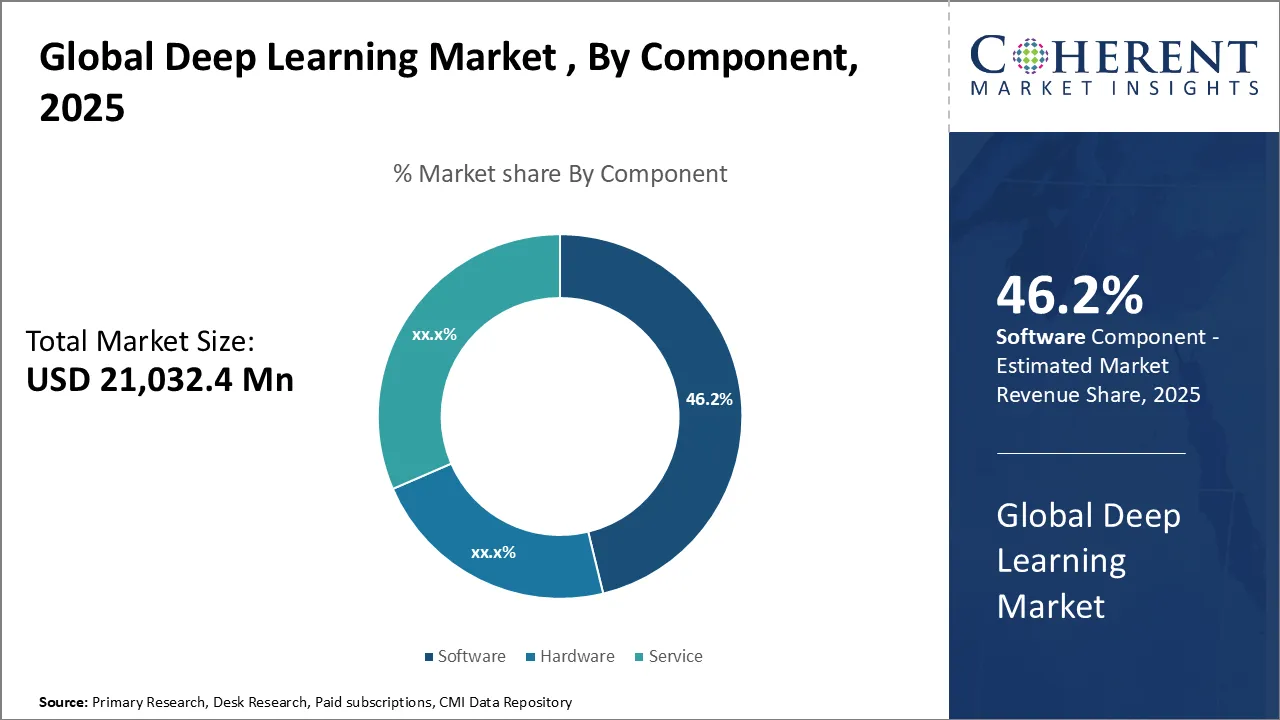
Deep Learning Market Insights, By Component, Software Leads as IT Develops, Deploys and Optimize AI models
In terms of component, the software segment is projected to hold 47.2% share of the market in 2026, primarily due to its essential role in developing, deploying, and optimizing AI models. Deep learning relies on specialized software frameworks, libraries, and platforms, such as TensorFlow, PyTorch, and Keras, that enable the design of neural networks, training on large datasets, and execution of complex computations efficiently. The demand for deep learning software is fueled by data-driven applications across industries like healthcare, automotive, finance, and retail, where businesses require predictive insights, automation, and advanced decision-making. Additionally, software is critical for model training and optimization, integration with cloud computing and IoT devices, and seamless deployment in production environments. Continuous research and innovation in AI also require flexible software capable of supporting new algorithms and experimentation. These factors collectively drive the deep learning market demand, as organizations increasingly adopt AI technologies to enhance operational efficiency and innovation.
For instance, in August 2024, Zebra Technologies has enhanced its Aurora machine vision software suite with advanced deep learning capabilities to address complex visual inspection challenges in manufacturing. The updated suite includes a new training engine, deep learning optical character recognition (OCR), and anomaly detection tools for defect and assembly verification. Aurora Vision Studio now offers over 3,000 pre-programmed filters and a drag-and-drop interface, enabling engineers to develop applications without coding.
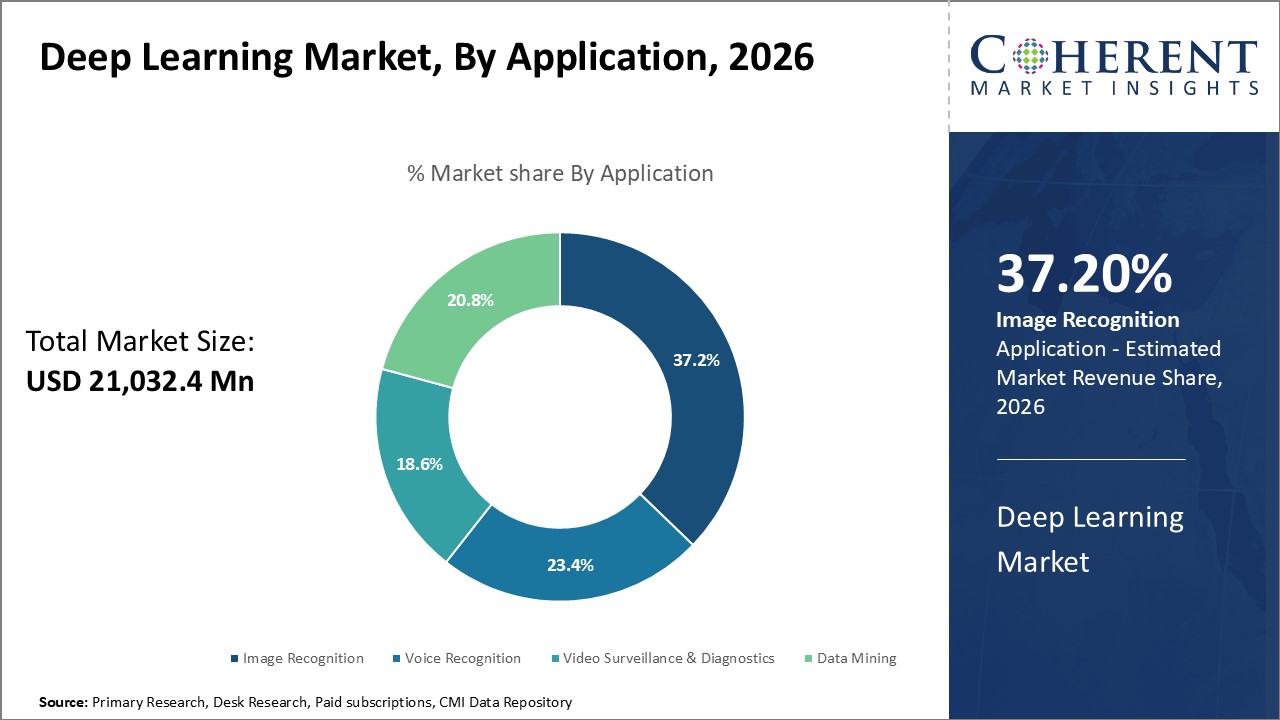
Deep Learning Market Insights, By Application, Image Recognition Segment Dominates Due to its Ability to Process and Analyze Visual Data
In terms of application, the image recognition segment is expected to hold the largest share in the global deep learning market in 2026, largely due to its ability to process and analyze visual data across industries. In healthcare, it aids disease diagnosis through medical imaging, while in automotive, it powers autonomous vehicle navigation. Retail and e-commerce use it for visual search and inventory management, and security systems apply it for facial recognition and threat detection. The need for automation, real-time decision-making, and advanced computing is driving the deep learning market growth for image recognition solutions.
For instance, in December 2023, Panasonic Holdings Corporation developed an advanced image recognition AI featuring a novel classification algorithm adept at handling multimodal data variations, such as differences in object appearance due to factors like orientation, lighting, and background. Panasonic's new algorithm employs a two-dimensional orthonormal matrix, enabling the AI to capture a broader range of image variations within the same category.
Deep Learning Market Insights, By End User, Automotive Segment Dominates Due to Adoption in ADAS and Autonomous Vehicle Technologies
In terms of end user, the automotive segment is projected to account for the highest share of the market in 2026, due to the adoption of advanced driver-assistance systems (ADAS) and autonomous vehicle technologies. Deep learning enables vehicles to detect traffic signals, pedestrians, obstacles, and other vehicles for safer and more efficient driving. Applications include lane detection, collision avoidance, adaptive cruise control, and predictive maintenance. The push for fully autonomous vehicles is accelerating investments in AI-powered perception and real-time decision-making, making automotive a key contributor to market growth.
For instance, in June 2025, NVIDIA announced the full-scale rollout of its DRIVE autonomous vehicle (AV) software platform at GTC Paris during VivaTech. This comprehensive, safety-certified system integrates real-time sensor fusion and over-the-air updates, supporting advanced driver-assistance features for Level 2++ and Level 3 vehicles. The platform comprises NVIDIA DGX systems for AI model training, Omniverse and Cosmos platforms for simulation, and the DRIVE AGX in-vehicle computer for real-time data processing. Embracing an end-to-end model approach, the software utilizes deep learning and foundation models to enable human-like decision-making.
Regional Insights
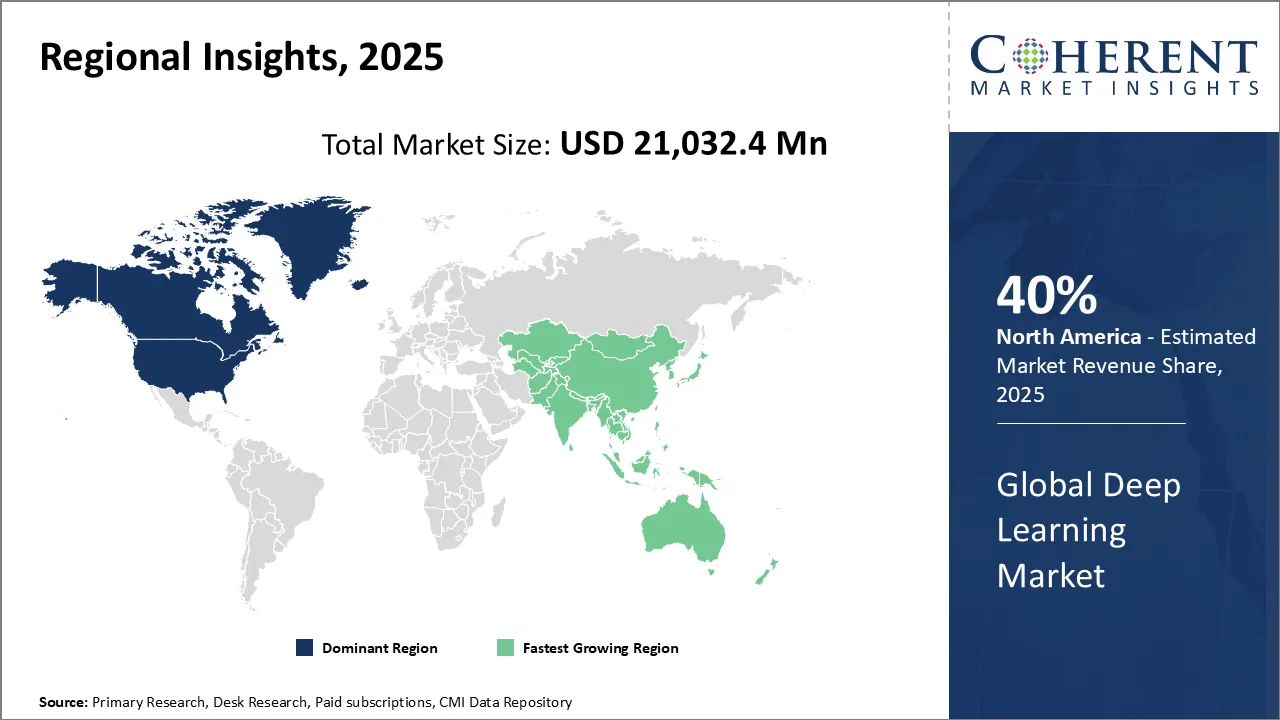
North America Deep Learning Market Analysis & Trends
The North America region is projected to lead the market with a 40% share in 2026, due to a combination of technological, industrial, and economic factors. The region is home to tech giants such as Google, Microsoft, Amazon, and NVIDIA, which invest heavily in deep learning research, development, and deployment, driving widespread adoption across multiple sectors. Advanced IT infrastructure, high-speed networks, and access to massive datasets further support large-scale implementation of AI solutions.
For instance, in December 2024, GE HealthCare expanded its Effortless Recon DL portfolio, unveiled three advanced deep learning-powered imaging reconstruction techniques designed to enhance clinical workflows and diagnostic precision. Introduced at RSNA 2024, Sonic DL for 3D enables MRI scans up to 86 percent faster, while Clarify DL enriches bone SPECT image quality rated superior in 98 percent of clinical evaluations and TrueFidelity DL with a cardiac kernel delivers high-definition, low-dose CT imaging.
Asia Pacific Deep Learning Market Analysis & Trends
The Asia Pacific region is expected to exhibit the fastest growth in the market contributing 26.5% share in 2026, driven by large-scale digital transformation, strong government initiatives, and massive data generation from e-commerce, mobile usage, and digital payments. Countries such as China, Japan, South Korea, and India are leading adoption through investments in AI strategies, R&D hubs, and startup ecosystems. Deep learning is being widely applied in manufacturing automation, robotics, healthcare diagnostics, financial risk management, and autonomous vehicles, with China and Japan at the forefront of healthcare imaging and automotive AI.
For instance, in July 2026, Indosat Ooredoo Hutchison’s enterprise arm, Indosat Business, introduced Vision AI, a next-generation surveillance platform powered by artificial intelligence and deep learning. Designed to enhance security, operational efficiency, and data-driven decision-making, Vision AI analyzes real-time video, detects patterns, and delivers early warnings, shifting from passive monitoring to proactive insights. The modular solution includes AI-ready cameras, an AI box, 3D stereo sensors, and customizable training, and effortlessly integrates with both existing and new CCTV setups.
Deep Learning Market Outlook Country-Wise
The U.S. Deep Learning Market Trends
The United States dominates the deep learning ecosystem, driven by massive investments from leading technology companies such as Google, Microsoft, Meta, Amazon, and NVIDIA. The strong presence of cloud infrastructure providers has further accelerated adoption across key sectors, including healthcare, autonomous vehicles, and financial services. In addition, government support for AI integration in defense and national security continues to fuel market demand. The country’s thriving startup ecosystem, supported by significant venture capital funding, is also fostering rapid innovation and deployment of deep learning solutions across industries.
For instance, in December 2024, Canon Medical Systems USA unveiled its AI-powered Automation Platform, a zero-click, deep-learning solution that optimizes clinical workflows from scanner to clinical decision-making. The platform features Stroke CT, Stroke MR, and Chest Pain CT packages with real-time alerts, mobile DICOM viewing, and cybersecure deployment tailored to emergency settings. Such innovations are proliferating the market demand.
The U.K. Deep Learning Market Trends
The U.K. is emerging as a key hub for deep learning adoption, driven by strong investments in AI innovation centers located in London, Cambridge, and Manchester. Demand is fueled by the growing use of deep learning across fintech, healthcare, particularly NHS-backed AI programs and cybersecurity. Supportive government initiatives, including the UK AI Strategy and funding for advanced research, are further strengthening the market. Moreover, leading universities such as Oxford, Cambridge, and Imperial College serve as global R&D centers, positioning the U.K. as a prominent contributor to deep learning advancements.
For instance, in February 2026, Thales unveiled cortAIx UK, a new UK-based hub staffed with 200 highly skilled AI and data specialists to advance deep learning-driven solutions in defence and security applications. Embedded within the global cortAIx network, now numbering over 600 experts, the UK centre aims to strengthen AI capabilities aligned with the British government’s AI Opportunities Action Plan.
China Deep Learning Market Trends
China has positioned AI as a national priority with the ambition to become the global leader by 2030. The government is making massive investments in AI R&D, particularly in areas such as autonomous driving, surveillance, and smart city projects. Leading Chinese tech giants including Baidu, Tencent, Alibaba, and Huawei are deeply integrating deep learning into applications across e-commerce, social media, and logistics. Furthermore, the country’s vast digital population generates immense volumes of data, which provides a critical advantage for training models and accelerating deep learning innovation.
For instance, in January 2026, Chinese technology startup DeepSeek unveiled two advanced large language models (LLMs) that rival U.S. competitors, while demanding just a fraction of the computing power and cost. Thanks to supportive government policies, generous funding, and a strong pipeline of AI talent, DeepSeek’s models achieved high performance through innovative deep learning techniques.
GCC Countries Deep Learning Market Trends
GCC countries are increasingly adopting AI and deep learning as part of their economic diversification strategies, such as Saudi Vision 2030 and the UAE AI Strategy 2031. A major share of this adoption is driven by large-scale smart city initiatives like NEOM in Saudi Arabia and Dubai Smart City, alongside critical applications in oil and gas predictive maintenance and advanced security systems. Furthermore, these nations are making heavy investments in AI infrastructure, cloud computing, and data centers to reduce dependency on hydrocarbons. Deep learning technologies are also witnessing strong uptake in banking, healthcare, and surveillance, contributing to steady market demand across the region.
For instance, in January 2026, Dubai Police signed a memorandum of understanding (MoU) with Riverbed Technology to enhance both applications and infrastructure development. Under the agreement, Riverbed will introduce advanced technical solutions, ensure ongoing training, and promote knowledge transfer to Dubai Police staff in support of the force’s AI strategic ambitions. Brigadier Khalid AlRazooqi, General Director of the Artificial Intelligence Department and CIO at Dubai Police, emphasized the agency’s aim to lead globally through cutting-edge artificial intelligence and deep learning capabilities.
Market Report Scope
Deep Learning Market Report Coverage
| Report Coverage | Details | ||
|---|---|---|---|
| Base Year: | 2025 | Market Size in 2026: | USD 21,032.4 Mn |
| Historical Data for: | 2020 To 2024 | Forecast Period: | 2026 To 2033 |
| Forecast Period 2026 to 2033 CAGR: | 32.9% | 2033 Value Projection: | USD 152,400.0 Mn |
| Geographies covered: |
| ||
| Segments covered: |
| ||
| Companies covered: | Advanced Micro Devices, Inc., ARM Ltd., Clarifai, Inc., Entilic, Inc., IBM, Intel Corporation, Microsoft and NVIDIA Corporation | ||
| Growth Drivers: |
| ||
| Restraints & Challenges: |
| ||
Deep Learning Market Driver
- Increasing adoption of advanced technologies owing to rising security concerns
Increasing adoption of advanced technologies driven by rising security concerns is significantly fueling the growth of the deep learning market. Organizations across industries are integrating deep learning algorithms to enhance security measures, as these technologies excel in identifying anomalies, detecting threats, and preventing fraudulent activities in real time. In financial services, deep learning models are widely used for fraud detection and transaction monitoring, while in cybersecurity, they help in identifying malware patterns and phishing attempts with higher accuracy. Similarly, in surveillance and public safety, deep learning-powered image and video recognition systems enable authorities to track suspicious activities and improve response times.
With growing reliance on digital platforms and sensitive data exchanges, the need for intelligent and proactive security solutions continues to surge, strengthening the scope of deep learning market research and highlighting its critical role in future security frameworks. For instance, in June 2025, Deep Instinct’s sixth-edition Voice of SecOps Report, titled “Angel or Adversary,” reveals the dual nature of AI in cybersecurity. While 86% of organizations expanded AI use in Security Operations, only one-third of respondents could define basic AI terms 38% couldn’t distinguish machine learning from deep learning, signaling a stark knowledge gap. The study finds AI-powered threats, phishing, deepfake impersonations, cloud or local storage attacks, on the rise, prompting 82% to adopt a prevention-first posture.
Deep Learning Market Opportunity
- Generative AI and Advanced Natural Language Processing (NLP)
Generative AI models, powered by deep learning, are revolutionizing how organizations create and process content. Applications such as text generation, image synthesis, automated video creation, and speech-to-text conversion are witnessing strong adoption across industries. In customer-facing roles, advanced Natural Language Processing models enable highly personalized chatbots, virtual assistants, and real-time translation tools, significantly improving customer engagement. Moreover, enterprises are leveraging deep learning-based NLP for analyzing unstructured data, sentiment analysis, and knowledge management. With businesses increasingly seeking automation in communication and content workflows, the deep learning market forecast highlights generative AI and NLP as major growth opportunities shaping the future of AI adoption.
For instance, in February 2025, NVIDIA’s Deep Learning Institute (DLI) has teamed up with Dartmouth College to launch a new Generative AI Teaching Kit aimed at bolstering deep learning education for university students. The kit provides lecture materials, hands-on labs, Jupyter notebooks, knowledge checks, and self-paced online courses with certification, all centered on natural language processing, large language models, diffusion imaging, and GPU-accelerated workflows.
Analyst Opinion (Expert Opinion)
Deep learning has moved beyond research into a core enabler of enterprise transformation. Its dominance in NLP and multimodal AI is evident, with Gartner projecting 80% of enterprises will adopt generative AI APIs by 2026, reshaping productivity and decision-making.
In healthcare, CNNs now achieve 94%+ diagnostic accuracy in imaging, surpassing human specialists in some cancer detection tasks, while pharmaceutical pipelines increasingly rely on deep learning. In automotive, Tesla’s FSD and ADAS innovations from OEMs highlight its role in real-time perception and safety systems.
On the infrastructure side, AI chips are redefining semiconductors, with NVIDIA confirming that demand for GPUs for AI now exceeds gaming GPUs, while Intel and AMD accelerate AI-specific hardware. This shift alleviates compute bottlenecks, unlocking broader adoption.
Regulation, particularly the EU AI Act, may initially slow deployment but ultimately fosters trust and compliance, vital for scaling in sensitive sectors.
Overall, deep learning is emerging as a strategic differentiator, driving competitive advantage in industries from finance to mobility. The market is entering a phase of disciplined yet exponential adoption, underpinned by powerful compute and sectoral validation.
Speak to the analyst
Want personalized insights?
Take the findings above to one of our principal consultants, or have the report rebuilt around the segments, geographies and competitors you actually track.
Recent Developments
- In August 2025, The Simons Foundation unveiled the Simons Collaboration on the Physics of Learning and Neural Computation, led by Stanford’s Surya Ganguli. The multi-disciplinary effort will combine physics, mathematics, theoretical neuroscience, and computer science to probe how large neural networks learn, reason, and imagine, essentially treating modern AI and deep learning systems as complex physical systems.
- In July 2025, IIT Madras, through its technology innovation hub IITM Pravartak and in partnership with TimesPro, launched a seven-month Advanced Certificate in Applied Artificial Intelligence and Deep Learning aimed at professionals seeking industry-ready AI skills. The program, featuring nine modules, including machine learning, deep learning, statistical reasoning, generative AI, and cybersecurity, delivers live online sessions and a capstone project.
- In June 2025, TOMRA Mining launched CONTAIN™, its new deep learning–based ore-sorting solution optimized for inclusion-type ores. Built in-house using convolutional neural networks, CONTAIN™ analyzes X-ray imagery in real time to detect subsurface minerals, like tungsten, nickel and tin with precision traditional systems lack.
- In November 2024, Indian Institute of Technology Kanpur unveiled a four-week online certificate programme on Python for Artificial Intelligence, Machine Learning and Deep Learning. Delivered via Zoom, the course includes hands-on training with Python packages like NumPy, Pandas, Scikit-learn, TensorFlow and Keras.
Market Segmentation
- By Component (Revenue, USD Mn, 2021 - 2033)
- Hardware
- Software
- Service
- Installation Service
- Integration Service
- Maintenance & Support Service
- By Application (Revenue, USD Mn, 2021 - 2033)
- Image Recognition
- Voice Recognition
- Video Surveillance & Diagnostics
- Data Mining
- By End User (Revenue, USD Mn, 2021 - 2033)
- Automotive
- Aerospace & Defense
- BFSI
- Healthcare
- Manufacturing
- Retail
- Others
- By Region (Revenue, USD Mn, 2021 - 2033)
- North America
- U.S.
- Canada
- Latin America
- Brazil
- Argentina
- Mexico
- Rest of Latin America
- Europe
- Germany
- U.K.
- Spain
- France
- Italy
- Russia
- Rest of Europe
- Asia Pacific
- China
- India
- Japan
- Australia
- South Korea
- ASEAN
- Rest of Asia Pacific
- Middle East
- GCC Countries
- Israel
- Rest of Middle East
- Africa
- South Africa
- North Africa
- Central Africa
- North America
- Deep Learning Market Companies
- Advanced Micro Devices, Inc.
- ARM Ltd.
- Clarifai, Inc.
- Entilic, Inc.
- IBM
- Intel Corporation
- Microsoft
- NVIDIA Corporation
Sources
Primary Research Interviews from the following stakeholders
Stakeholders
- Interviews with AI solution developers, enterprise IT teams, cloud service providers, system integrators, and research lab heads across leading global markets.
Specific Stakeholders
- AI and ML leads at technology companies (e.g., Google, Microsoft, NVIDIA)
- Data science and AI teams at retail and e-commerce chains (e.g., Amazon, Walmart, Alibaba)
- IT and R&D heads at automotive OEMs and autonomous vehicle developers (e.g., Tesla, Toyota, Waymo)
- Healthcare and biomedical AI project leads at hospitals and research institutes (e.g., Mayo Clinic, AIIMS, Karolinska Institute)
- AI platform and solution architects at cloud providers (e.g., AWS, Azure, Google Cloud)
- University and research lab professors in computer vision, NLP, and deep learning (e.g., MIT, Stanford, Tsinghua University)
- Product managers at AI chip and hardware vendors (e.g., Intel, AMD, NVIDIA, Graphcore)
Databases
- World Trade Organization (WTO) Trade Statistics
- UN Comtrade Database
- Ministry of Electronics and Information Technology (MeitY), India
- Bureau of Economic Analysis (U.S.)
- Eurostat
- China Customs Statistics
- Korea Customs Service Data Portal
- Japan External Trade Organization (JETRO)
- Directorate General of Commercial Intelligence and Statistics (DGCIS), India
Magazines
- AI Magazine
- MIT Technology Review – AI Section
- VentureBeat – AI & Machine Learning
- Synced Review
- The Gradient
- TechRadar Pro – AI & Enterprise Tech
- IEEE Spectrum – Artificial Intelligence
Journals
- IEEE Transactions on Neural Networks and Learning Systems
- Journal of Machine Learning Research (JMLR)
- Neural Networks (Elsevier)
- Pattern Recognition Letters
- Artificial Intelligence (Elsevier)
- ACM Transactions on Intelligent Systems and Technology (ACM TIST)
Newspapers
- The Wall Street Journal – Tech & AI
- The Economic Times – Technology & Industry
- The Hindu Business Line – Tech & Innovation
- Financial Times – AI & Emerging Tech
- Nikkei Asia – AI, Electronics & Supply Chain
- South China Morning Post – Technology & AI
Associations
- Association for the Advancement of Artificial Intelligence (AAAI)
- IEEE Computational Intelligence Society
- Partnership on AI
- Machine Intelligence Research Institute (MIRI)
- Indian AI Society (IAIS)
- European AI Alliance
Public Domain Sources
- Ministry of Electronics and IT (Government of India)
- National Institute of Standards and Technology (NIST), U.S.
- Ministry of Economy, Trade and Industry (METI), Japan
- U.S. International Trade Commission (USITC)
- NITI Aayog – AI Reports
- India Investment Grid – AI & Technology Sector
- EU Digital Strategy Reports
Proprietary Elements
- CMI Data Analytics Tool, and Proprietary CMI Existing Repository of information for last 8 years
Get access to 250+ pages report
Every segment, forecast, competitor profile and data table behind the analysis above — available for instant download.
- ESOMAR Member
- ISO 9001:2015 Certified
- D-U-N-S Registered
- GDPR & CCPA Compliant
Missing comfort of reading report in your local language? Find your preferred language:
Transform your Strategy with Exclusive Trending Reports
Frequently Asked Questions
The global Deep Learning Market size was valued at USD 21,032.4 Mn in 2026 and is anticipated to reach USD 152,400.0 Mn in 2033.
The increasing adoption of advanced technologies such as artificial intelligence and machine learning is expected to drive growth of the deep learning market during the forecast period.
The Automotive segment held the largest market share among end user.
North America region held the largest share in the global deep learning market in 2026, accounting for 40% share in terms of value.
Key players operating in the global deep learning market include Advanced Micro Devices, Inc., ARM Ltd., Clarifai, Inc., Entilic, Inc., IBM, Intel Corporation, Microsoft and NVIDIA Corporation.
Deep learning in marketing uses neural networks to aNAlyze customer data, predict behavior, optimize campaigns, and enhance persoNAlization strategies effectively.
Yes, ChatGPT is built on deep learning, specifically transformer-based neural networks, eNAbling NAtural language understanding and text generation capabilities.