

AI Search Engines Market Size and Forecast — 2026-2033
The Global AI Search Engines Market is expected to be valued at USD 49.83 Billion in 2026 and reach USD 110.52 Billion by 2033, exhibiting a compound annual growth rate (CAGR) of 14.2% from 2026 to 2033.
Key Takeaways of the Global AI Search Engines Market:
- The web search segment is expected to lead the market holding a share of 62.7% in 2026.
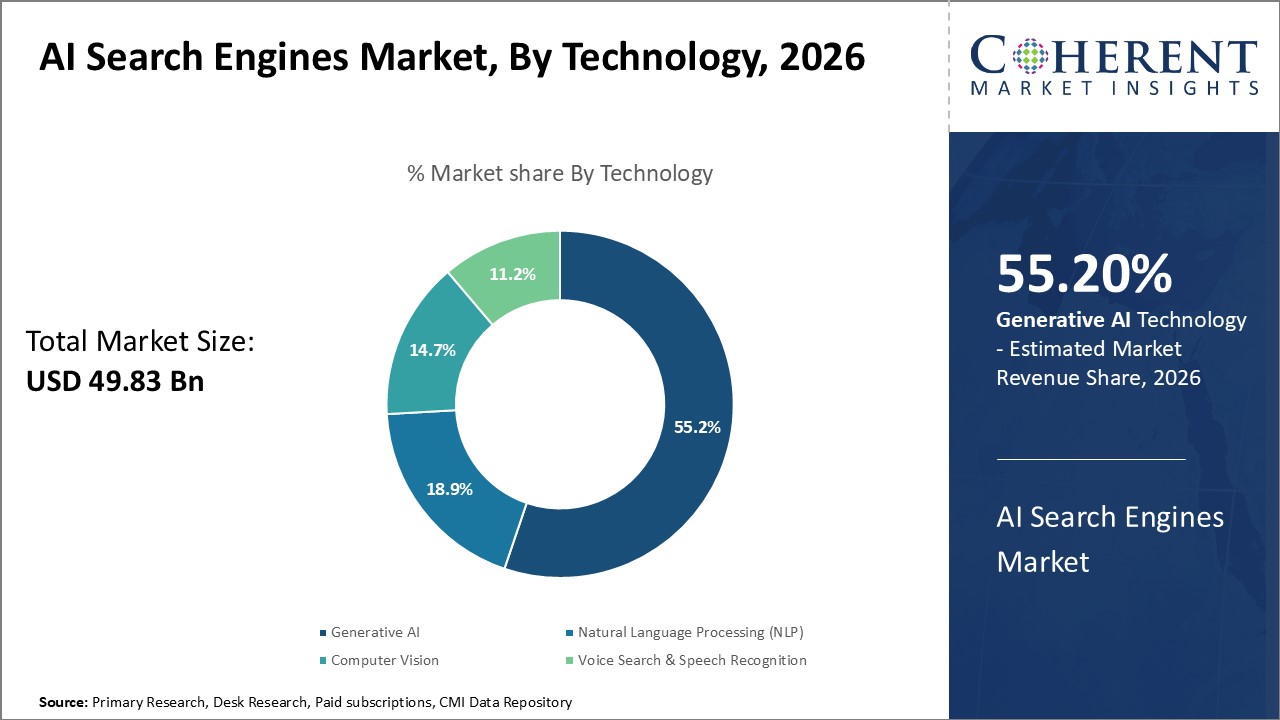
- The generative AI segment is projected to dominate with a share of 55.2% in 2026.
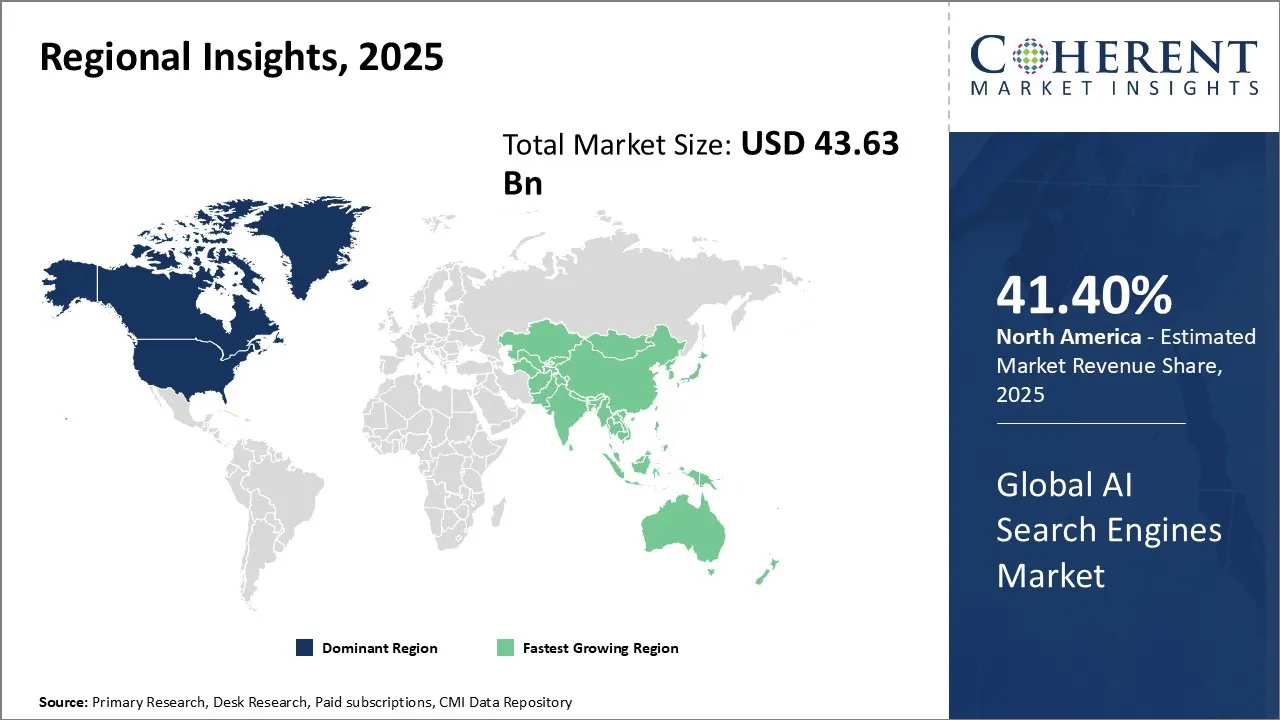
- North America is expected to lead the market with a share of 41. 4% in 2026. Asia Pacific, holding a share of 19.3% in 2026, is projected to be the fastest growing region.
Market Overview
AI search engines leverage machine learning and deep learning technologies to understand user intent and deliver more personalized and relevant search results. The adoption of AI in search has helped search engines to answer complex questions which were not possible a few years ago.
Application Insights
Application Insights - Web Users' Growing Reliance on Search Engines for Daily Tasks
In terms of application, the web search segment is expected to contribute the highest share of 62.7% in the global AI search engines market in 2026 owing to users' growing reliance on search engines for a variety of daily tasks. Search engines have become the primary starting point for finding information on the internet as they offer a quick and easy way to look up questions, translate words, find local businesses and services, check weather and traffic conditions, and others.
As people's lives become increasingly digital, searching online has become an indispensable part of everyday activities like looking up recipes in the kitchen, researching products to purchase, getting directions while traveling, or answering random questions that pop into one's mind. Search engines powered by AI understand users' intent behind queries and can return highly relevant results from billions of webpages instantly. This saves users a huge amount of time that would otherwise be spent browsing multiple websites.
The personalization capabilities of AI search are also a big driver of their usage. Search engines can understand individual users' preferences, locations, search histories, and patterns to surface the most pertinent and customized results. For example, local users may see more local business listings or real-time traffic updates for their city. Repeat users are shown updates to prior queries as AI enhances understanding over time.
Technology Insights
Technology Insights – Generative AI's Ability to Understand Complex Queries
In terms of technology, the generative AI segment is expected to contribute the highest share of 55.2% in the global AI search engines market in 2026 owing to its ability to understand highly complex, conversational queries. While traditional keyword-based search works well for simple lookups, users increasingly expect answers to explain concepts in depth or handle ambiguous, multi-faceted questions.
Generative AI models are capable of natural language understanding on par with, and in some cases better than humans. Large transformer-based language models pre-trained on mammoth datasets have achieved strong language representation skills. They can comprehend the meaning and context behind intricate questions, discern different possible interpretations, and then synthesize a coherent response drawing from their vast knowledge bases.
By applying techniques like conceptual search and self-supervised learning, generative AI engines can gather the intent and salient information needed even from ambiguous queries involving several entities or concepts. They can discuss topics conversationally instead of providing a single link. This provides a more useful search experience that satisfies the human curiosity behind complicated queries.
Regional Insights
North America AI Search Engines Market Trends
North America, holding a share of 41.4% in 2026, is expected to dominate the AI search engines market. This lead can be attributed to strong technological advancements and high adoption of emerging technologies across various industries in countries like the U.S. and Canada. Supportive government policies towards AI research & development along with the presence of major tech companies investing heavily in AI have boosted the market growth.
Some of the prominent players in the region include Google, Microsoft, Anthropic, and Algolia. Google has been at the forefront of AI-powered search with its flagship Google Search engine, leveraging machine learning and natural language processing. Microsoft also offers AI search through Bing and Azure Cognitive Services. Startups like Anthropic are contributing with specialized AI tools for enterprises.
Asia Pacific AI Search Engines Market Trends
The Asia Pacific region, holding a share of 19.3% in 2026, is expected to exhibit the fastest growth, led by countries like China, India, and Japan. Significant government initiatives towards digital transformation along with a rapidly growing internet user base are fueling the demand. For instance, the 'Made in China 2026' strategy has accelerated AI integration across industries.
Major regional tech giants, such as Baidu, Alibaba, and Tencent, have been investing heavily in AI and are increasingly incorporating search capabilities powered by advanced algorithms. In India, companies like Quertle and Artificial have developed AI-based vertical search solutions catering to local language content.
AI Search Engines Market Outlook for Key Countries
U.S. AI Search Engines Market Trends
The U.S. AI search engines market continues to be at the forefront driven by the presence of tech leaders and focus on innovation. While Google Search maintains its dominance, other players are enhancing their capabilities around specialized AI solutions. Microsoft's Bing has improved with features like image search and conversational capabilities. Startups are exploring niche areas, with Anthropic working on constitutional AI techniques for safety.
China AI Search Engines Market Trends
China AI search engines market is witnessing significant growth backed by government policies and digital spending. Major local giants are launching new AI-powered services at an aggressive pace. Baidu has introduced innovations in areas like healthcare search through Baike Research. Alibaba utilizes AI within verticals like e-commerce and fintech through platforms like Taobao. Tencent also offers AI assistants through WeChat.
India AI Search Engines Market Trends
India AI search engines market is projected to expand rapidly over the next decade led by a large internet user base and growing entrepreneurial activity. Both global and local companies are investing in developing solutions tailored for India. Quertle has solutions focused on vernacular search leveraging language models. Google has launched initiatives like Google Assistant in various Indian languages.
Japan AI Search Engines Market Trends
Japan continues to be an important market driven by technology exports. While players like Yahoo Japan and Rakuten dominate general search, other global and regional corporations are increasingly focusing on industrial and enterprise applications powered by AI. For example, Hitachi offers AI-based solutions for manufacturing through its Lumada platform.
Market Players, Key Development, and Competitive Intelligence
Key Developments:
- On April 7, 2025, Google, a popular search engine, added multimodal capabilities to its new AI Mode feature, letting users ask questions using images
- In November 2023, Microsoft, a tech giant, rebranded Bing Chat to Copilot, to better compete with ChatGPT
Top Strategies Followed by Global AI Search Engines Market Players
- Established Players: Leading companies focus on generative AI innovation, strategic acquisitions, and integration of Large Language Models (LLMs) into legacy search platforms to maintain dominance and improve contextual relevance.
- Google (Alphabet) launched Search Generative Experience (SGE), integrating Large Language Model (LLMs) like Gemini to enhance real-time, multimodal search results and reduce user click-through time.
- Amazon is upgrading Alexa’s search capabilities with custom-built LLMs and has introduced deeper contextual search for smart devices.
- Mid-level Players: Mid-sized players emphasize regional expansion, strategic partnerships, and vertical-specific search solutions to gain competitive ground and diversify revenue streams.
- Perplexity AI partnered with publishers and content creators via a Revenue Sharing Program, differentiating its search engine with ad-revenue transparency and high-quality source referencing.
- Glean Technologies expanded into European and Asian markets with its enterprise AI search solution, focusing on internal knowledge retrieval systems for large organizations.
- com introduced YouPro, offering AI customization, privacy-first features, and developer tools aimed at professionals and educators.
- Small-scale Players: Smaller players adopt niche market targeting, open-source or privacy-focused platforms, and AI search customization to stand out in a competitive landscape.
- Brave Search enhanced its privacy-first AI search engine by integrating its own summarizer tool and removing dependency on external APIs (like Bing), focusing on user privacy and decentralization.
- Neeva (prior to its acquisition by Snowflake) focused on a subscription-based, ad-free AI search model, positioning itself as a consumer-friendly alternative to ad-dominant engines.
- Andi Search (a newer startup) targeted Gen Z users with conversational search interfaces and visual results, prioritizing UI/UX over traditional list-based search layouts.
Emerging Startups – AI Search Engines Industry Ecosystem
- Innovative Technologies: Startups are pushing the boundaries of search capabilities using generative AI, real-time indexing, and multimodal inputs to deliver cutting-edge user experiences.
- Perplexity AI offers an AI-native search engine powered by LLMs with real-time citation-based responses and a conversational interface, redefining how users interact with search engines.
- Andi Search provides a visual and conversational search experience, focusing on real-time information and summaries without relying on traditional blue-link formats.
- Sustainable Solutions: New entrants are embracing privacy-first architectures, open-source models, and ethical AI approaches to comply with regulatory frameworks and gain user trust.
- Brave Search, developed by Brave Software, emphasizes privacy and decentralization, avoiding data harvesting and enabling an independent index without reliance on Google or Bing APIs.
- Neeva AI (before its acquisition) pioneered a subscription-based, ad-free search engine model with AI summaries, promoting user-centric and ethical monetization practices.
- Niche Targets: Startups are carving out a presence by focusing on specialized domains such as enterprise search, academic data, developer tools, or custom AI agent ecosystems.
- Glean Technologies offers AI-powered enterprise search solutions that help employees retrieve internal knowledge across platforms like Slack, Google Workspace, and Notion.
- Phind (formerly Elicit AI) targets software developers and researchers, providing technical search powered by LLMs to produce code-level or academic-grade responses.
- Current Industry Events of 2026
- Market Size Estimation
- Regional Breakdown
- Competitive Landscape
- Customer Intelligence
- Segmental Analysis
- Pricing Analysis
- Key Market Drivers, Challenges & Future Trends
- Customized Insights Section
Market Report Scope
AI Search Engines Market Report Coverage
| Report Coverage | Details | ||
|---|---|---|---|
| Base Year: | 2025 | Market Size in 2026: | USD 49.83 Bn |
| Historical Data for: | 2020 To 2024 | Forecast Period: | 2026 To 2033 |
| Forecast Period 2026 to 2033 CAGR: | 14.2% | 2033 Value Projection: | USD 110.52 Bn |
| Geographies covered: |
| ||
| Segments covered: |
| ||
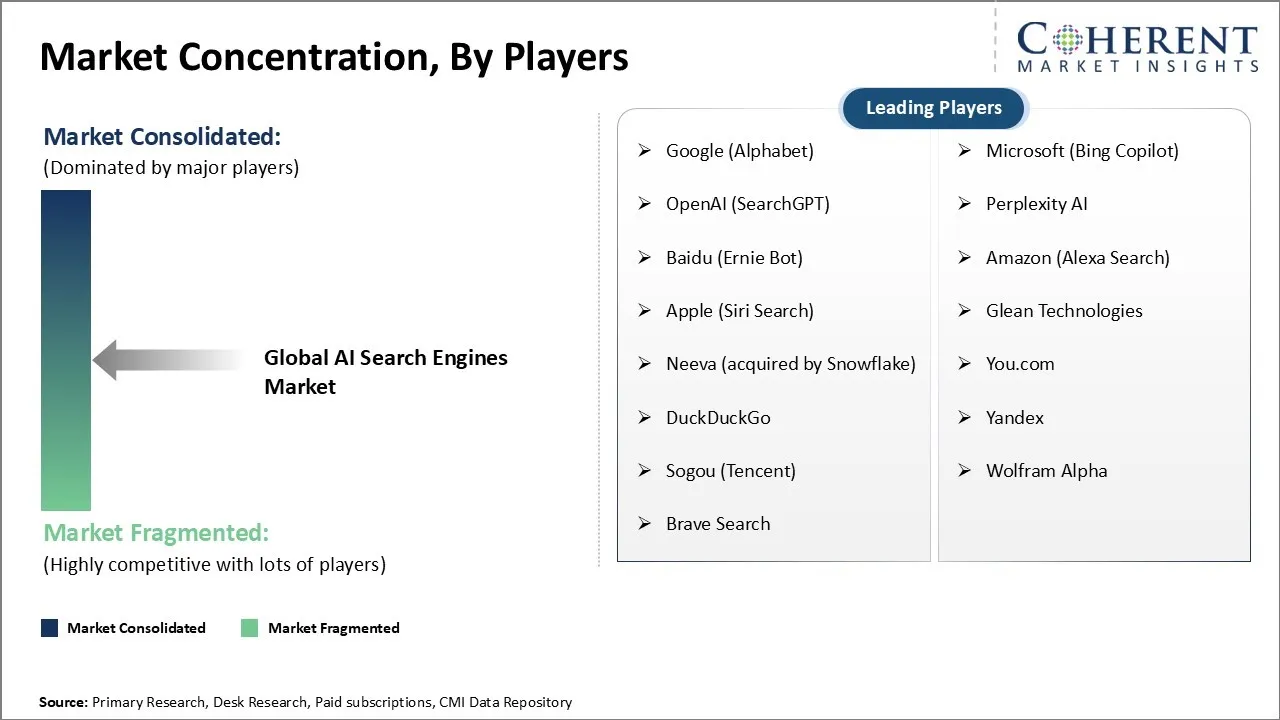
| Companies covered: | Google (Alphabet), Microsoft (Bing Copilot), OpenAI (SearchGPT), Perplexity AI, Baidu (Ernie Bot), Amazon (Alexa Search), Apple (Siri Search), Glean Technologies, Neeva (acquired by Snowflake), You.com, DuckDuckGo, Yandex, Sogou (Tencent), Wolfram Alpha, and Brave Search | ||
| Growth Drivers: |
| ||
| Restraints & Challenges: |
| ||
Market Dynamics
Global AI Search Engines Market Driver - Integration of AI into mainstream search platforms
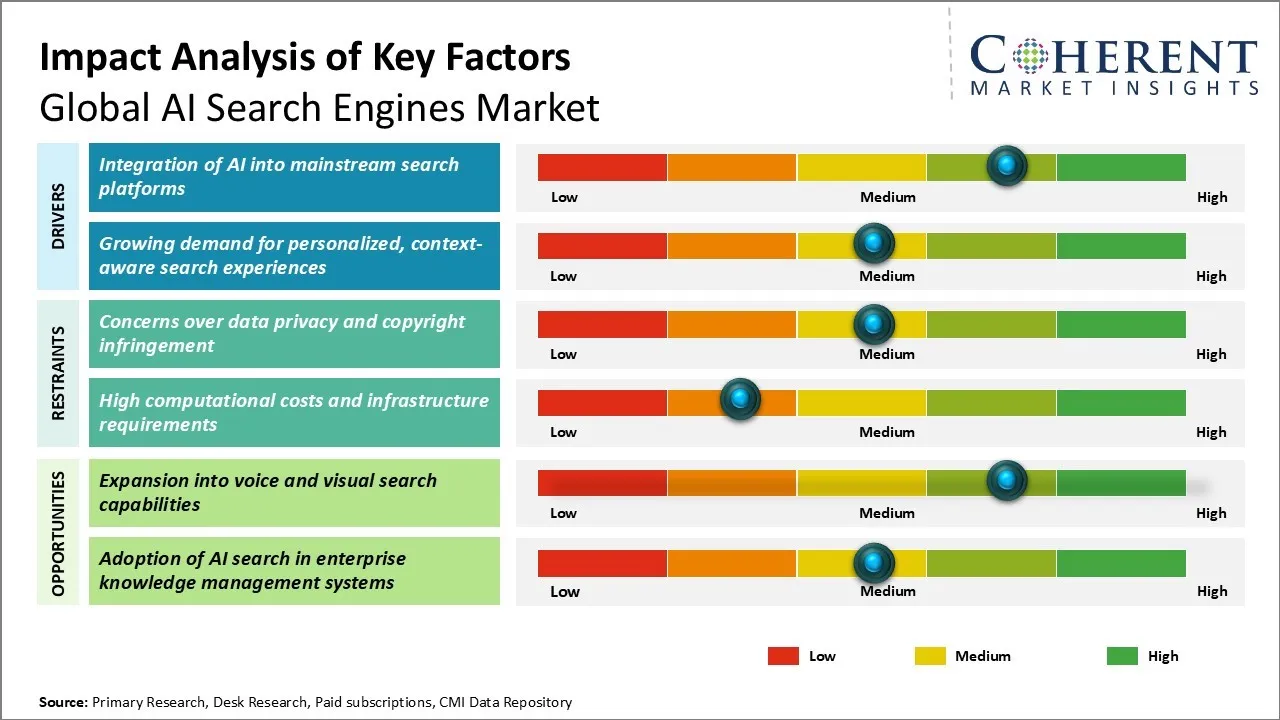
The integration of artificial intelligence capabilities into mainstream search platforms is expected to be a key driver for the global AI search engines market during the forecast period. Major tech companies are increasingly focusing on incorporating AI functionalities like natural language processing, computer vision, and machine learning algorithms into their core search engines to improve search relevance and deliver more personalized search experiences for users. This enables tech platforms to gain a deeper understanding of user's search intents and context to return more meaningful and customized results. As AI proficiency of search platforms enhances over time, it is likely to strengthen user engagement while addressing a wide range of routine search queries more efficiently without human involvement. The seamless integration of AI and machine learning techniques can thus provide a differentiated search experience and help tech giants sustain their leadership in the evolving search industry.
Global AI Search Engines Market Challenge - Concerns over data privacy and copyright infringement
One of the major challenges being faced by the global AI search engines market is concerns over data privacy and copyright infringement. As AI search engines rely heavily on collecting user data and learning from huge amounts of online content to improve their services, there are growing worries about potential misuse of personal data and unauthorized use of copyrighted materials. Many users are hesitant to use certain AI search tools because they lack transparency in how the platforms store, share and utilize their data. On the copyright front, rights holders have raised reasonable concerns that AI may be infringing copyright unintentionally through automated indexing and learning from webpages. If not addressed properly through ethical protocols and regulations, these issues can undermine user trust in AI technologies and negatively impact market growth. Resolving privacy standards and intellectual property management will be critical for the industry to gain wider user acceptance and tap into the market potential.
Global AI Search Engines Market Opportunity - Expansion into voice and visual search capabilities
One of the major opportunities available for the global AI search engines market is expansion into voice and visual search capabilities. Currently, most AI search is still based on typing text queries, but with advancements in technologies like computer vision and natural language processing, search is evolving beyond keywords. Leveraging capabilities like voice assistants, image recognition, and augmented reality, AI search platforms can start understanding queries in human voice or images/videos. This opens up a whole new dimension of searching online visually or verbally without typing. As consumer preferences shift towards more natural and multimedia experiences, AI search engines that integrate emerging modalities will be able to gain a competitive edge. More personalized and contextual search results through voices and images also allows for a richer user experience. Transitioning to a multi-modal approach thus presents a substantial opportunity for market leaders to engage users in new innovative ways.
Analyst Opinion (Expert Opinion)
- The AI search engines market is projected to witness robust growth over the forecast period, driven by the increasing demand for personalized, context-aware, and real-time search results across web, enterprise, and voice platforms. The rapid integration of generative AI and large language models into search engines is reshaping how users interact with digital content, marking a significant evolution beyond traditional keyword-based search.
- A key challenge to the market’s growth lies in concerns around data privacy, misinformation, and the ethical use of AI-generated content. As search results increasingly rely on algorithmic interpretation, regulatory scrutiny and user trust will play a critical role in the adoption of AI search technologies.
- North America is expected to maintain its leadership in the AI search engines market due to its strong concentration of major players like Google, Microsoft, and OpenAI, as well as a tech-savvy consumer base and mature digital infrastructure. Meanwhile, Asia Pacific is poised to be the fastest-growing region, driven by expanding internet penetration, a surge in mobile-first users, and growing investments in AI research and development.
Speak to the analyst
Want personalized insights?
Take the findings above to one of our principal consultants, or have the report rebuilt around the segments, geographies and competitors you actually track.
Market Segmentation
- Application Insights (Revenue, USD Bn, 2021 - 2033)
- Web Search
- Enterprise Search
- Voice & Visual Search
- Others
- Technology Insights (Revenue, USD Bn, 2021 - 2033)
- Generative AI
- Natural Language Processing (NLP)
- Computer Vision
- Voice Search & Speech Recognition
- Regional Insights (Revenue, USD Bn, 2021 - 2033)
- North America
- U.S.
- Canada
- Latin America
- Brazil
- Argentina
- Mexico
- Rest of Latin America
- Europe
- Germany
- U,K.
- Spain
- France
- Italy
- Russia
- Rest of Europe
- Asia Pacific
- China
- India
- Japan
- Australia
- South Korea
- ASEAN
- Rest of Asia Pacific
- Middle East
- GCC Countries
- Israel
- Rest of Middle East
- Africa
- South Africa
- North Africa
- Central Africa
- North America
- Key Players Insights
- Google (Alphabet)
- Microsoft (Bing Copilot)
- OpenAI (SearchGPT)
- Perplexity AI
- Baidu (Ernie Bot)
- Amazon (Alexa Search)
- Apple (Siri Search)
- Glean Technologies
- Neeva (acquired by Snowflake)
- You.com
- DuckDuckGo
- Yandex
- Sogou (Tencent)
- Wolfram Alpha
- Brave Search
Get access to 250+ pages report
Every segment, forecast, competitor profile and data table behind the analysis above — available for instant download.
- ESOMAR Member
- ISO 9001:2015 Certified
- D-U-N-S Registered
- GDPR & CCPA Compliant
Missing comfort of reading report in your local language? Find your preferred language:
Transform your Strategy with Exclusive Trending Reports
Frequently Asked Questions
The global AI search engines market is expected to be valued at USD 49.83 Billion in 2026 and reach USD 110.52 Billion by 2033.
The CAGR of the global AI search engines market is projected to be 14.10% from 2026 to 2033.
Integration of AI into mainstream search platforms and growing demand for personalized, context-aware search experiences are the major factors driving the growth of the global AI search engines market.
Concerns over data privacy and copyright infringement and high computational costs and infrastructure requirements are the major factors hampering the growth of the global AI search engines market.
In terms of application, the web search segment is expected to dominate the market revenue share in 2026.
Google (Alphabet), Microsoft (Bing Copilot), OpenAI (SearchGPT), Perplexity AI, Baidu (Ernie Bot), Amazon (Alexa Search), Apple (Siri Search), Glean Technologies, Neeva (acquired by Snowflake), You.com, DuckDuckGo, Yandex, Sogou (Tencent), Wolfram Alpha, and Brave Search are the major players.
North America is expected to lead the global AI search engines market in 2026, holding a share of 41.4%.