

Automated Machine Learning Market Size and Trends
Global automated machine learning market is estimated to be valued at USD 6.90 Bn in 2026 and is expected to reach USD 110.56 Bn by 2033, exhibiting a compound annual growth rate (CAGR) of 48.6% from 2026 to 2033.
Key Takeaways of the Global Automated Machine Learning Market
- By application, the data processing segment is projected to dominate the automated machine learning market, contributing 40.7% market share in 2026.
- By offering, the solution segment is expected to lead the market, accounting for 55.7% share in 2026.
- By vertical, the banking, financial services, and insurance segment is anticipated to hold the largest share, comprising 39.8% of the market in 2026.
- By region, North America remains the dominant player in the automated machine learning market and is estimated to account for 41. 7% of the global market share in 2026.
Market Overview
The global automated machine learning market is poised for robust growth through 2033, driven by the rising demand for democratized data science, accelerated AI adoption, and the need for rapid, scalable model development across industries. Automated machine learning is transforming the AI landscape by simplifying complex machine learning workflows, reducing reliance on specialized data scientists, and enabling intelligent automation at scale.
As enterprises seek to improve operational efficiency and broaden access to advanced analytics, automated machine learning is emerging as a strategic enabler. Its growing adoption is fueled by the rise of low-code/no-code platforms, real-time model deployment capabilities, and improvements in model interpretability. These innovations are helping organizations overcome traditional barriers such as skills shortages, integration complexities, and time-consuming development cycles.
However, challenges remain. Concerns around data quality, limited explainability of model outputs, and difficulties in integrating automated machine learning with legacy systems continue to pose hurdles. Despite these issues, ongoing advancements in areas like federated learning, explainable AI, and real-time automation are expected to accelerate adoption and firmly position automated machine learning as a core component of enterprise AI strategies in the years ahead.
AI Impacts on the Automated Machine Learning Market
The automated machine learning market is undergoing significant transformation with the integration of artificial intelligence, enabling faster model development, enhanced accuracy, and broader accessibility across industries. AI-powered automated machine learning platforms streamline data preprocessing, feature engineering, model selection, and hyperparameter tuning, making advanced machine learning more accessible to non-experts while improving model performance. This convergence is accelerating innovation, reducing time-to-insight, and expanding AI adoption across sectors such as healthcare, finance, retail, and manufacturing.
- In February 2025, DataRobot introduced several major features in its AI platform, including “time-aware data wrangling,” Universal SHAP for time series, and simplified “Talk to my data” agent templates. These updates improved AutoML workflows by offering clearer model explainability and streamlined interaction with data, enabling practitioners to generate insights faster with minimal effort.
- At Snowflake Summit 2024 in June, H2O.ai introduced native H2O AutoML and generative AI applications directly in the Snowflake Marketplace. This integration enabled users to run AutoML workflows and generative analytics without moving data—making advanced AI accessible within existing data ecosystems.
Market Concentration and Competitive Landscape
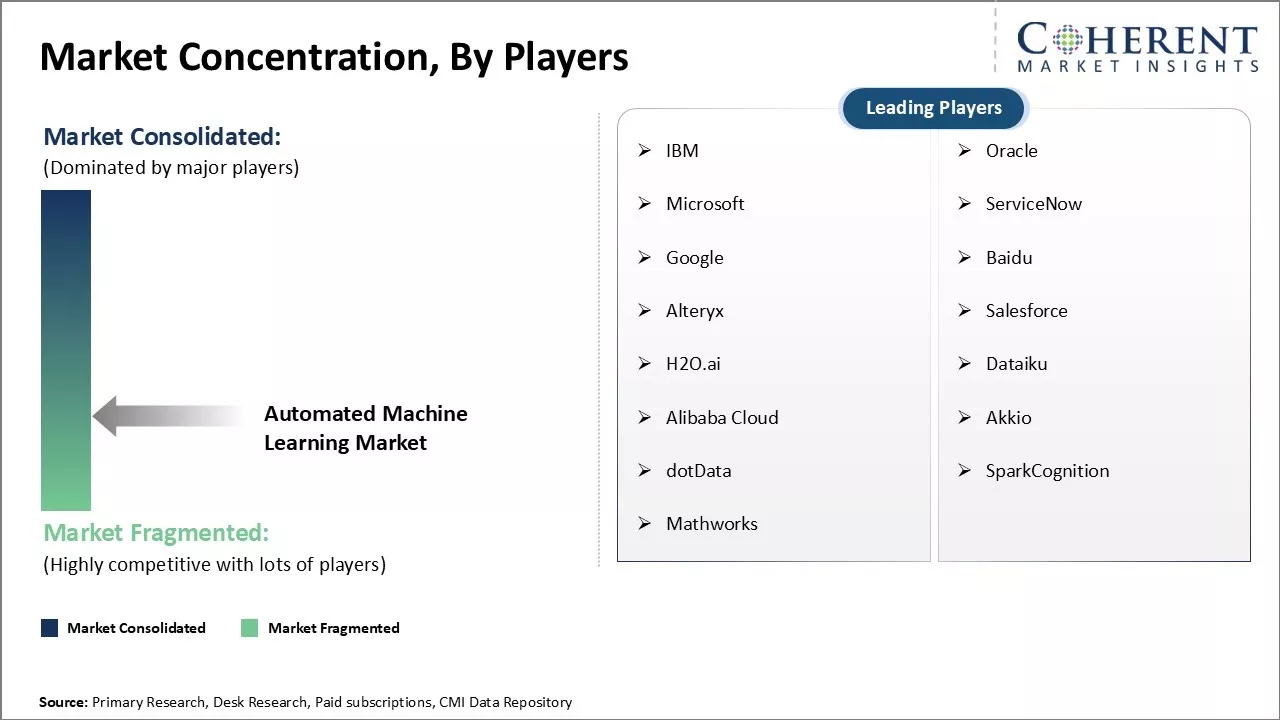
- Leading players such as IBM Corporation, Microsoft Corporation, Google LLC, Oracle Corporation, Salesforce Inc., and H2O.ai have established a dominant presence in the global automated machine learning market. These companies leverage strong cloud platforms, advanced machine learning frameworks, and expansive customer bases to offer comprehensive automated machine learning solutions that streamline model building, training, and deployment across industries. Their ability to integrate automated machine learning with broader AI ecosystems enables superior scalability and performance, securing their leadership positions.
- While the automated machine learning market demonstrates characteristics of consolidation at the top, it also comprises a wide array of agile and innovative players, including Alteryx Inc., Dataiku, dotData, Akkio, MathWorks, SparkCognition, Baidu, and ServiceNow. This results in a moderately consolidated structure where global tech giants coexist with specialized automated machine learning vendors and emerging AI solution providers. Competitive dynamics are shaped by rapid advancements in AI explainability, real-time model training, no-code/low-code accessibility, and cross-industry partnerships aimed at expanding automated machine learning use cases.
- Current Industry Events of 2026
- Market Size Estimation
- Regional Breakdown
- Competitive Landscape
- Customer Intelligence
- Segmental Analysis
- Pricing Analysis
- Key Market Drivers, Challenges & Future Trends
- Customized Insights Section
Current Events and Their Impact on the Automated Machine Learning Market
Current Events | Description and its impact |
DataRobot Named a Leader in the 2025 Gartner Magic Quadrant |
|
Meta Acquires 49% Stake in Scale AI for USD 14.8 Billion |
|

Market Trend: Automated Machine Learning Democratizing Data-Driven Decision Making
The automated machine learning market is growing rapidly as organizations seek to harness big data for more informed decision making. Traditional machine learning methods often require extensive manual processes and technical expertise, which can be a barrier for mid-sized and smaller companies lacking dedicated data science teams.
Automated machine learning addresses this challenge by automating key tasks such as data preparation, model selection, and tuning—making advanced analytics accessible to non-experts. These tools are enabling broader adoption of machine learning across industries, helping businesses unlock insights faster and with fewer resources.
As demand rises for efficient, scalable, and user-friendly AI solutions, automated machine learning is becoming a core component of modern data strategies and digital transformation efforts.
Market Opportunity: Scope of Customizing Automated Machine Learning Workflows for Specific Domains
There is a growing opportunity to develop customized automated machine learning workflows tailored to specific industry use cases. While general-purpose automated machine learning tools have simplified the model development process, domain-specific customization enables better alignment with industry requirements by incorporating relevant features and parameters. Targeted applications such as predictive maintenance, fraud detection, and customer churn prediction benefit significantly from specialized workflows that enhance model accuracy and relevance. This customization appeals to enterprises with unique data challenges and supports the growing demand for flexible, configurable automated machine learning solutions. As AI adoption deepens across sectors, the need for verticalized automated machine learning offerings is expected to increase, creating new growth avenues for solution providers.
Segment Analysis
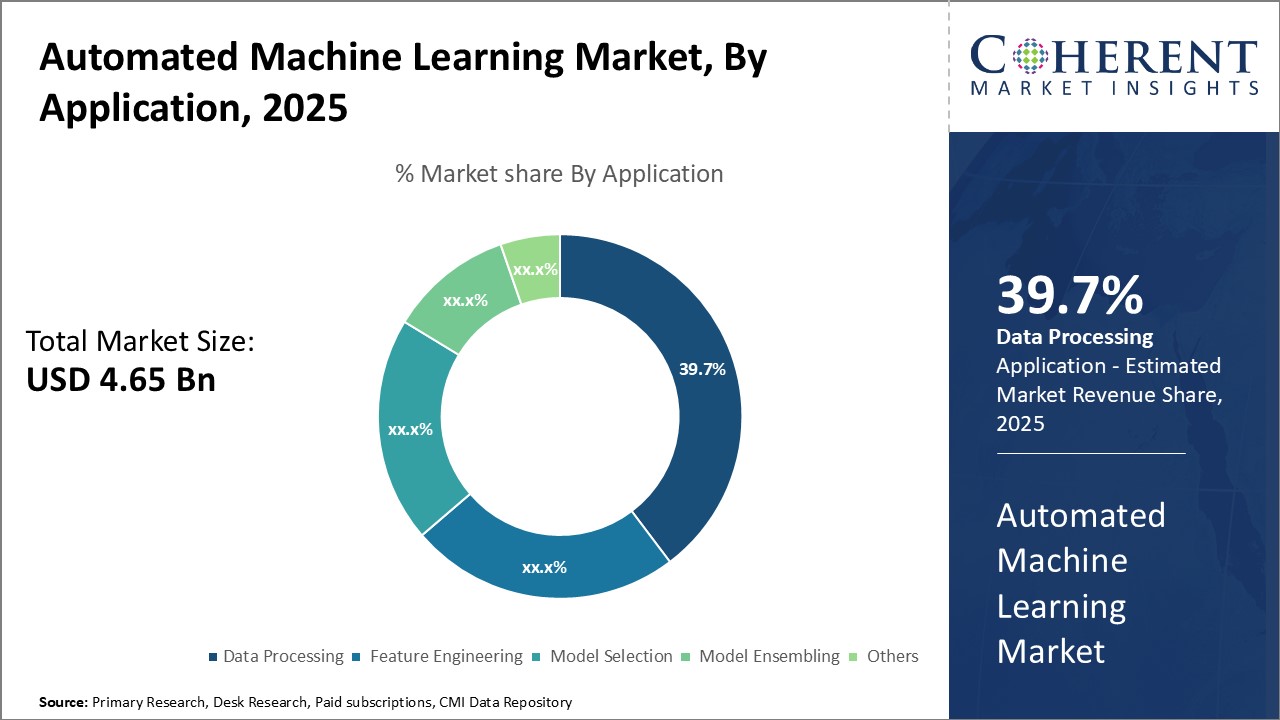
Global Automated Machine Learning Market Insights, By Application - Automation of Laborious Tasks Drives Data Processing’s Dominance
By Application, Data Processing segment is expected to contribute the highest share of 40.7% in 2026 owing to the automation it provides for tedious data cleaning and formatting tasks. As machine learning models require large volumes of high-quality structured data to learn from, the data preprocessing stage is notoriously labor-intensive as it involves activities like data sourcing, cleaning, merging, filtering and encoding.
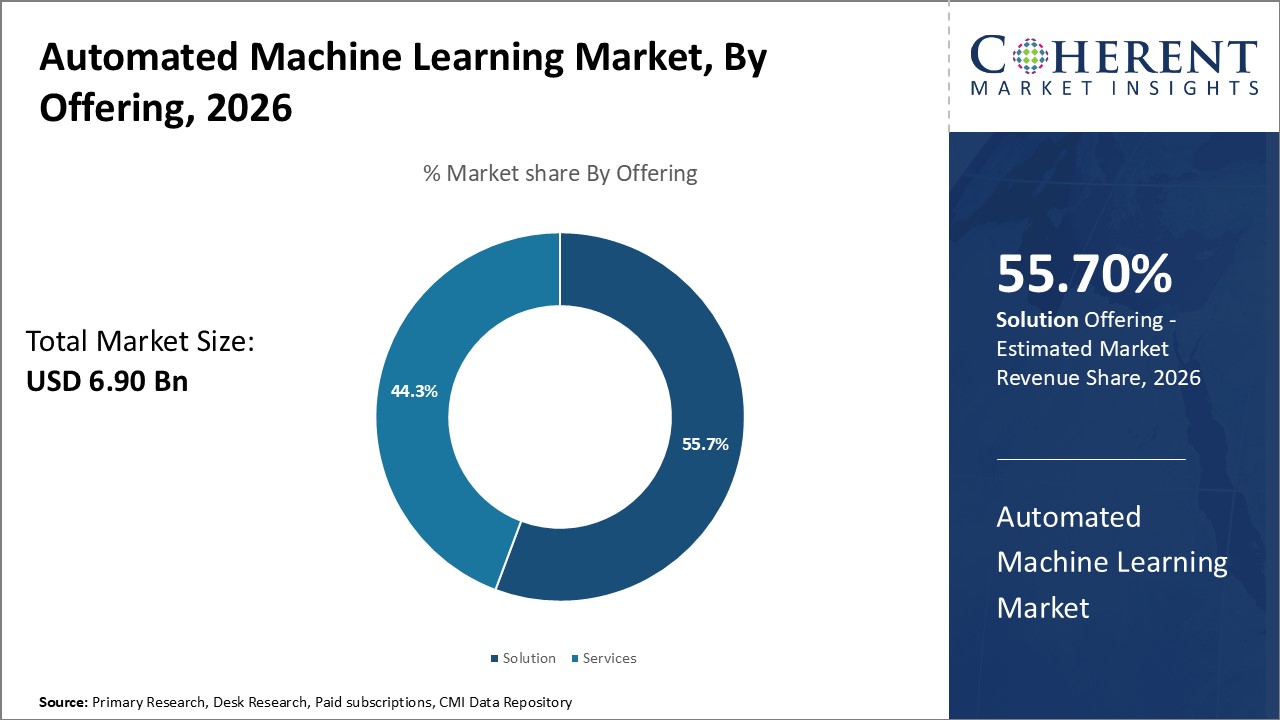
Global Automated Machine Learning Market Insights, By Offering - Demand for Packaged Solutions Drives Solution’s Leadership
By offering, the solution segment is expected to contribute the highest share of 55.7% in 2026 owing to the convenience and standardization it provides organizations. While consulting services enable custom development of automated machine learning workflows, solutions offer packaged applications that can be deployed straight out of the box. This plug-and-play functionality addresses a key barrier to AI adoption as it eliminates the need for in-house AI expertise and specialized resource requirements.
Global Automated Machine Learning Market Insights, By Vertical - Expanding Data-driven Businesses Drive Adoption in BFSI Sector
By Vertical, the BFSI segment is expected to contribute the highest share of 39.8% in 2026 due to the data-intensive and dynamic nature of banking, financial services and insurance businesses. With growing digitization across channels, BFSI operators are accumulating vast volumes of customer and transactional data from both traditional and emerging digital touchpoints. At the same time, customer preferences and risk profiles are also evolving rapidly with changing economic conditions, regulations and competitive forces.
Regional Insights
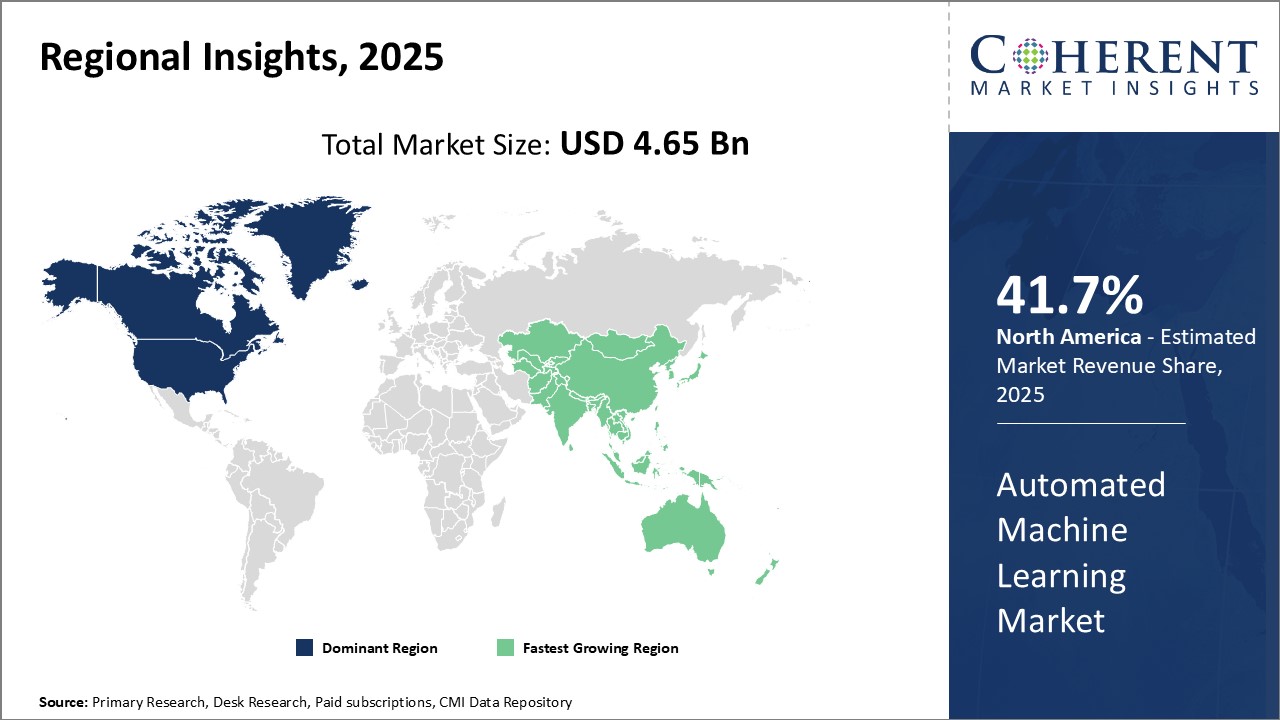
North America Automated Machine Learning Market Analysis and Trends
North America is projected to hold a dominant 41.7% share of the global automated machine learning market in 2026, driven by strong AI infrastructure, early adoption of digital health technologies, and significant investment from public and private healthcare sectors. The presence of major tech firms like Google, IBM, and Microsoft further supports the region’s leadership in healthcare AI innovation.
Healthcare providers across the U.S. and Canada are leveraging automated machine learning for applications such as early disease detection, clinical decision support, and patient risk stratification—where rapid and accurate analysis of large datasets is critical.
Government policies such as the 21st Century Cures Act, which promotes AI-driven interoperability and real-time data access, are further supporting automated machine learning adoption. With continued investment in healthcare digital transformation, North America is expected to maintain its leadership in the global automated machine learning market.
Asia Pacific Automated Machine Learning Market Analysis and Trends
The Asia Pacific region is expected to account for 34.8% market share in 2026, driven by extensive tech startup ecosystem in countries like India and China, increasing digitization across industries, and government initiatives to develop homegrown AI technologies. Several local companies are emerging as important contributors with competitive offerings.
U.S. Automated Machine Learning Market Analysis and Trends
The U.S. automated machine learning market continues to be fueled by heavy investments from corporate and venture capital funding into new technologies. Companies like Google and Microsoft have introduced many innovative solutions. The trend towards user-friendly automated machine learning is having a notable impact on the structure of the U.S. market. While specialized AI vendors still lead for highly complex enterprise needs, the proliferation of easy-to-use tools is lowering the barrier of entry and expanding the potential customer base beyond large corporations.
China Automated Machine Learning Market Analysis and Trends
China's market is scaling rapidly as local AI champions ramp up automated ML capabilities for applications across various sectors important for the country's development priorities. Players like Alibaba and Baidu are at the forefront of these efforts. Major technology hubs in countries like Beijing, Shanghai, Shenzhen and Hangzhou have seen a proliferation of startups developing automated machine learning tools tailored for specific domains and use cases.
India Automated Machine Learning Market Analysis and Trends
India continues to lead with its technical talent pool and collaborative AI research environment. Startups like Anthropic are leveraging these strengths to build competitive products. The automated machine learning market in India has seen significant growth and transformation over the past few years. As machine learning and AI technologies become more widely adopted across various industries, there is a rising demand for tools and platforms that make machine learning more accessible for everyone.
Pricing Analysis of the Automated Machine Learning Market
- Service Cost by AutoML Application Type
- Predictive Analytics Models (e.g., patient risk scoring, readmission prediction)
AutoML platforms offering plug-and-play predictive modeling tools for healthcare analytics are typically priced based on usage metrics such as number of models, data volume, or user licenses.
- Typical pricing ranges: USD 1,000 to 5,000/month per healthcare use case or department.
- Example: A hospital using AutoML for readmission prediction across three departments may pay ~USD 12,000/month.
- Diagnostic Imaging & Medical Classification Models
AutoML tools integrated into radiology or pathology workflows for image classification are priced at a premium due to processing complexity and compliance requirements.
- Typical pricing ranges: USD 0.10 to 0.50 per image or a monthly license between USD 5,000 and 20,000 depending on volume and resolution.
- Example: A diagnostic lab analyzing 30,000 images/month at USD 0.20/image would pay ~USD 6,000/month.
- Operational Optimization Models (e.g., staffing, resource planning)
These models are often part of enterprise AI solutions for hospitals, priced on a per-module or per-facility basis.
- Typical pricing ranges: USD 2,000 to 10,000/month per facility.
- Example: A multi-hospital system optimizing ICU staffing might pay USD 25,000/month across three units.
- Operational and Maintenance Costs
- Integration and Deployment Fees
AutoML vendors may charge one-time setup fees for integrating their platform with hospital systems such as Electronic Health Records (EHRs) or Picture Archiving and Communication System (PACS).
- Typical pricing: USD 5,000 to 50,000 depending on system complexity and customization.
- Example: A large hospital integrating AutoML with three data sources may incur a USD 20,000 setup fee.
- Data Security, HIPAA/GDPR Compliance
For compliance with healthcare data protection laws, vendors often include secure data pipelines and audit trails in premium offerings.
- Markup: Adds 15–30% to base cost.
- Example: A HIPAA-compliant AutoML plan may cost USD 6,500/month compared to USD 5,000/month for a non-compliant tier.
- Value-Added Services and Markups
- Model Monitoring, Explainability, and Auto-Retraining
Advanced features like drift detection, model explainability (e.g., SHAP values), and retraining automation are typically sold as add-ons.
- Pricing: USD 1,000 to 5,000/month depending on features and data volume.
- Example: A provider using explainability tools alongside diagnostic models may pay an additional USD 3,000/month.
- Premium Support and SLA Guarantees
Healthcare-grade SLAs include 24/7 technical support, downtime protection, and regulatory audit assistance.
- Markup: 20–30% on base subscription costs.
- Example: A USD 10,000/month base license could rise to USD 13,000/month with full SLA coverage and priority support.
Market Report Scope
Automated Machine Learning Market Report Coverage
| Report Coverage | Details | ||
|---|---|---|---|
| Base Year: | 2025 | Market Size in 2026: | USD 6.90 Bn |
| Historical Data for: | 2020 To 2024 | Forecast Period: | 2026 To 2033 |
| Forecast Period 2026 to 2033 CAGR: | 48.6% | 2033 Value Projection: | USD 110.56 Bn |
| Geographies covered: |
| ||
| Segments covered: |
| ||
| Companies covered: | IBM, Oracle, Microsoft, ServiceNow, Google, Baidu, Alteryx, Salesforce, H2O.ai, Dataiku, Alibaba Cloud, Akkio, dotData, SparkCognition, and Mathworks | ||
| Growth Drivers: |
| ||
| Restraints & Challenges: |
| ||
Automated Machine Learning Industry News
- In February 2023, IBM acquired StepZen, a company specializing in a GraphQL server that allows developers to build APIs quickly and with less code, enhancing IBM's capabilities in hybrid cloud and AI. This acquisition is part of IBM's strategy to drive innovation in data, AI, and automation solutions, complementing their existing offerings in API management and data integration, as highlighted by senior vice president Kareem Yusuf.
- In September 2023, Fujitsu Limited and the Linux Foundation marked the official launch of Fujitsu’s automated machine learning and AI fairness technologies as open source software (OSS) ahead of Open Source Summit Europe 2023, running in Bilbao, Spain, from September 19-21, 2023. The two projects will offer users access to software that automatically generates code for new machine learning models, as well as a technology that addresses latent biases in training data.
Analyst View
- The automated machine learning market is poised for exponential growth through 2032, driven by the urgent demand for democratized AI, fast model deployment, and cost-efficient predictive analytics. AutoML is evolving from a niche tool to a core enabler of enterprise-wide AI strategies, empowering non-experts to develop and operationalize machine learning models with minimal coding or statistical knowledge.
- The market is being transformed by innovations in natural language interfaces, explainable AI (XAI), and real-time learning frameworks, which are lowering the barriers to adoption while ensuring regulatory compliance and model transparency—especially critical in regulated sectors such as healthcare, BFSI, and public services.
- North America continues to lead the AutoML market due to early enterprise digitization, robust AI R&D ecosystems, and favorable government policies. However, Asia Pacific is emerging as the next high-growth frontier, driven by aggressive digital transformation in countries like India, China, and Singapore, as well as expanding AI-focused government funding and startup activity.
- The next wave of growth will be shaped by domain-specific AutoML platforms, tailored to industries such as manufacturing (predictive maintenance), finance (fraud detection), and healthcare (diagnostics and triage). Enterprises are increasingly prioritizing verticalized solutions over generic tools to ensure contextual accuracy, performance, and compliance.
- On the innovation front, AutoML vendors are integrating generative AI, multimodal learning, and cloud-native deployment into their platforms. This is leading to a convergence of AutoML with LLMs and generative analytics—making it possible to not only automate modeling but also explain, interact, and iterate on models via natural language or visual prompts.
- The competitive landscape is moderately consolidated at the top, with players like Google, Microsoft, IBM, and H2O.ai dominating the ecosystem. However, the rise of low-code/no-code AI tools and open-source AutoML libraries is opening doors for smaller vendors and startups to gain traction via specialized, affordable, and integrable offerings.
- As businesses navigate digital transformation and seek more scalable, interpretable, and industry-aligned AI, AutoML will remain a critical pillar in the journey toward intelligent automation, improved decision-making, and accelerated innovation across global markets.
Market Segmentation
- By Application Insights (Revenue, USD Bn, 2021 - 2033)
- Data Processing
- Feature Engineering
- Model Selection
- Model Ensembling
- Others
- By Offering Insights (Revenue, USD Bn, 2021 - 2033)
- Solution
- Services
- By Vertical Insights (Revenue, USD Bn, 2021 - 2033)
- BFSI
- Retail & E-commerce
- Healthcare & Life Sciences
- IT & Ites
- Others
- Regional Insights (Revenue, USD Bn, 2021 - 2033)
- North America
- U.S.
- Canada
- Latin America
- Brazil
- Argentina
- Mexico
- Rest of Latin America
- Europe
- Germany
- U.K.
- Spain
- France
- Italy
- Russia
- Rest of Europe
- Asia Pacific
- China
- India
- Japan
- Australia
- South Korea
- ASEAN
- Rest of Asia Pacific
- Middle East
- GCC Countries
- Israel
- Rest of Middle East
- Africa
- South Africa
- North Africa
- Central Africa
- Key Players Insights
- IBM
- Oracle
- Microsoft
- ServiceNow
- Baidu
- Alteryx
- Salesforce
- H2O.ai
- Dataiku
- Alibaba Cloud
- Akkio
- dotData
- SparkCognition
- Mathworks
Sources
Stakeholders:
- AutoML Platform Providers
- AI Infrastructure Providers and Cloud Service Vendors
- Data Science Teams, MLOps Engineers, and Citizen Data Scientists
- Industry-Specific Software Vendors (e.g., healthcare, BFSI, retail, manufacturing)
- System Integrators and IT Consulting Firms
- Enterprises and SMBs adopting AI for analytics, forecasting, and automation
- Academic Institutions and Research Labs focusing on applied ML automation
Primary Sources:
- Interviews with Heads of AI, Chief Data Officers (CDOs), and ML Ops Leads across BFSI, healthcare, and tech industries (2022–2025)
- Product announcements and technical disclosures from AutoML solution providers
- Case studies on AutoML deployment in healthcare, finance, and e-commerce
- Executive sessions and panels from events such as AutoML Conference 2025, NVIDIA GTC, Google Cloud Next, and Snowflake Summit
Secondary Sources:
- Official company blogs, whitepapers, product roadmaps, and GitHub repositories
- Industry news outlets such as VentureBeat AI, TechCrunch AI, Analytics India Magazine, and The Sequence
- Academic publications from NeurIPS, ICML, KDD, and AutoML-related arXiv preprints
Proprietary Elements:
- CMI Data Analytics Tool: Proprietary analytics tool to analyze real-time market trends, consumer behavior, and technology adoption in market
- Proprietary CMI Existing Repository of Information for Last 8 Years
- Internal AutoML Adoption Tracker for BFSI, healthcare, retail, and manufacturing sectors (2021–2025)
- Custom market sizing models by use case (e.g., predictive analytics, image classification, forecasting automation)
Get access to 250+ pages report
Every segment, forecast, competitor profile and data table behind the analysis above — available for instant download.
- ESOMAR Member
- ISO 9001:2015 Certified
- D-U-N-S Registered
- GDPR & CCPA Compliant
Missing comfort of reading report in your local language? Find your preferred language:
Transform your Strategy with Exclusive Trending Reports
Frequently Asked Questions
The automated machine learning market is estimated to be valued at USD 6.90 Bn in 2026, and is expected to reach USD 110.56 Bn by 2033.
The CAGR of the automated machine learning market is projected to be 48.6% from 2026 to 2033.
Need for data-driven decision making and ease of use and accessibility of machine learning are the major factors driving the growth of the automated machine learning market.
Data quality issues hampering automated machine learning outputs and model accuracy and reliability concerns are the major factors hampering the growth of the automated machine learning market.
In terms of Application, Data Processing segment is estimated to dominate the market revenue share in 2026.
IBM, Oracle, Microsoft, ServiceNow, Google, Baidu, Alteryx, Salesforce, H2O.ai, Dataiku, Alibaba Cloud, Akkio, dotData, SparkCognition, and Mathworks are the major players.
North America is expected to lead the automated machine learning market in 2026.