

Crisis Emergency And Incident Management Platforms Market Size and Share Analysis - Growth Trends and Forecast (2026 - 2033)
The crisis emergency and incident management platforms market includes software platforms and services used to support emergency planning, incident response, and crisis coordination across organizations. These platforms help users manage events such as natural disasters, security incidents, cyber threats, and operational disruptions through communication systems, emergency notifications, geospatial tools, and response management solutions. The market covers web-based emergency management software, first responder communication systems, surveillance solutions, disaster recovery systems, consulting services, training programs, and other technologies used by government, defense, enterprises, and public safety organizations.
Crisis management is the process by which an organization manages disruptive and unexpected events that pose a threat to the organization or its stakeholders. Crisis, emergency, and incident management platforms are digital solutions that help organizations prepare for, respond to, and recover from potential disruptions. These platforms are used across various end-use verticals, including Banking, Financial Services, and Insurance (BFSI), energy and utilities, aviation, healthcare and life sciences, government and defense, hospitality, transportation and logistics, telecom and IT, among others.
Key Statistics at a Glance
Metric | Value |
Market Size (2026) | USD 113,385.9 million |
Forecast Value (2033) | USD 170,490.5 million |
CAGR (2026–2033) | 6.0% |
Top End User Segment (2026) | Government and Defense — 26% market share |
Leading Communication Technology Segment (2026) | First Responder Communication Systems — 40% market share |
Leading Region (2026) | North America — 38% market share |
Fastest-Growing Region | Asia Pacific — 7.5% CAGR (2026–2033) |
Key Players | Honeywell International Inc.; Intergraph Corporation; Lockheed Martin Corporation; Environmental System Research Institute, Inc.; Motorola Solution Inc.; Guardly; Rockwell Collins, Inc.; Iridium Communication Inc.; Siemens AG |
Global Crisis Emergency And Incident Management Platforms Market Size and Revenue Forecast 2026–2033
The global crisis emergency and incident management platforms market size is estimated at USD 113,385.9 Mn in 2026 and is projected to reach USD 170,490.5 Mn by 2033, expanding at a CAGR of 6.0% during the forecast period (2026–2033). This steady growth is attributable to increasing frequency of natural disasters, cyberattacks, public safety incidents, and business disruptions, which are driving organizations and governments to adopt advanced crisis management solutions.
Key Takeaways from the Crisis Emergency And Incident Management Platforms Market Report
- Government and defense segment is expected to account for the largest market revenue share of 26% in 2026 due to rising disaster risks, geopolitical uncertainties, and government investments in emergency response capabilities. For example, UNDRR’s 2025 Global Assessment Report highlights that disasters cause over US$2.3 trillion in annual economic losses globally, driving governments to increase investments in disaster preparedness and emergency response capabilities.
- First responder communication systems are slated to lead the market with a share of 40% in 2026 as emergency agencies increasingly require reliable communication networks during natural disasters, accidents, and security incidents. FirstNet Authority reported that its public safety broadband network supports over 30,000 agencies and 6.5 Mn connections, highlighting the rising need for dedicated communication systems for first responders.
- North America is expected to emerge as the dominating player in the global crisis emergency and incident management platforms market at 38% by 2026 on account of well-developed emergency response infrastructure, investments made by governments, and higher adoption rate of cloud-based incident management platforms. In the U.S., for instance, FEMA provided more than USD 3 billion via its resilience grants in 2024.
- Asia Pacific, registering a CAGR of 7.5%, is anticipated to emerge as the fastest-growing market for crisis emergency and incident management platforms during the forecast period due to increasing disaster preparedness investments, smart city initiatives, and adoption of advanced emergency response solutions across emerging economies.
Crisis Emergency And Incident Management Platforms Market Overview
The global crisis emergency and incident management platforms market is expected to grow steadily during the forecast period. This is primarily due to increasing frequency of natural disasters, cyberattacks, and operational disruptions as well as rising need for real-time incident response, business continuity planning, and effective emergency coordination solutions. Growing adoption of cloud-based platforms, smart city initiatives, and digital transformation across government agencies and enterprises is also supporting market expansion.
Expansion of smart city projects and critical infrastructure modernization is driving the deployment of connected emergency management platforms integrated with surveillance, sensors, and public safety networks. Likewise, increased cyber risks and the need for business continuity have motivated organizations to adopt platforms that will help manage cyber and physical incidents.
Adoption of artificial intelligence (AI) and automation is expected to boost growth of the crisis emergency and incident management platforms market during the forecast period. AI-powered crisis management platforms are gaining traction due to their tendency to analyze large volumes of data, predict risks, automate alerts, and support faster emergency responses.
AI-driven analytics improve situational awareness during complex incidents. For example, in June 2026, Motorola Solutions expanded its AI capabilities for 911 emergency response systems. The new AI solutions are designed to help emergency teams improve response times and manage critical incidents more effectively.
Segmental Insights
- Current Industry Events of 2026
- Market Size Estimation
- Regional Breakdown
- Competitive Landscape
- Customer Intelligence
- Segmental Analysis
- Pricing Analysis
- Key Market Drivers, Challenges & Future Trends
- Customized Insights Section
Which End User Vertical Dominates the Global Market?
Government and Defense Segment Leads the Market with Over One-Fourth Share
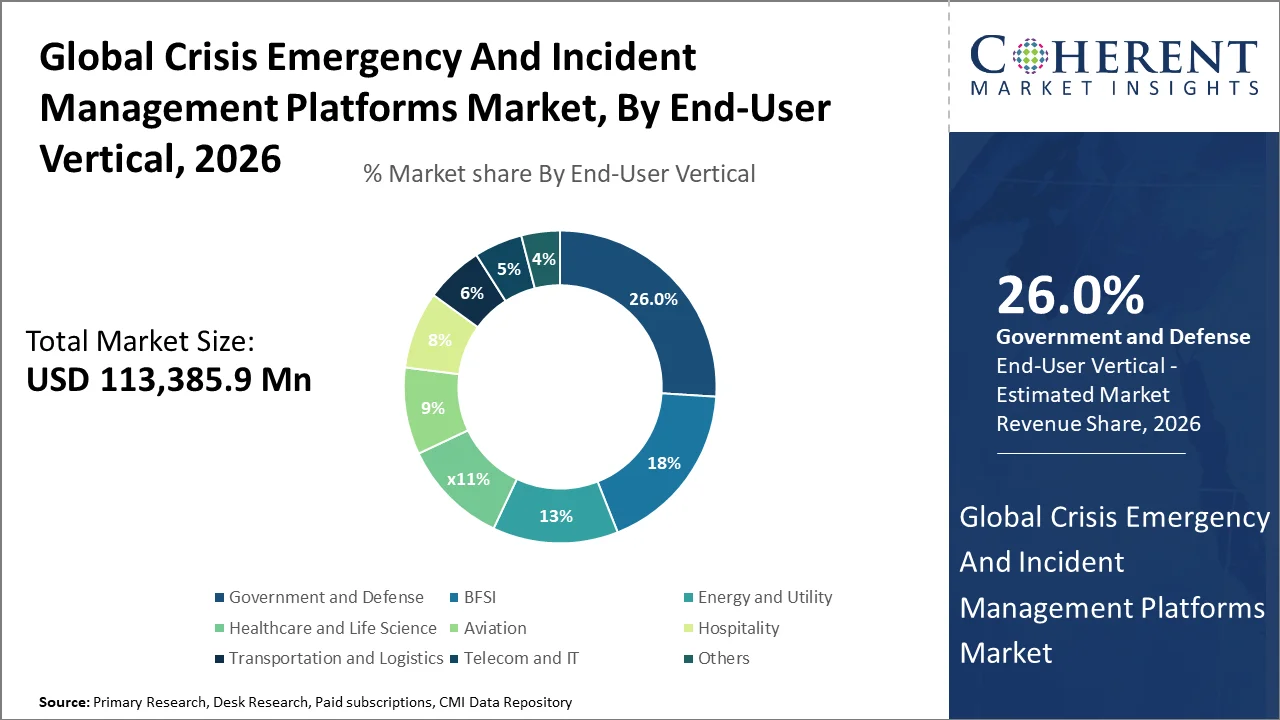
Based on end user vertical, government and defense segment is slated to lead the market, accounting for a revenue share of 26% in 2026. This dominance can be attributed to increasing need for advanced crisis response, emergency communication, and incident coordination solutions across government agencies and defense organizations.
Increasing geopolitical conflicts, natural disasters, cybersecurity risks, and increasing emphasis on public safety infrastructure are driving governments to use an integrated platform for situation awareness and effective emergency response operations. In addition, increasing funding in smart cities and national security projects is also increasing the adoption of crisis emergency and incident management platforms.
According to the United Nations Office for Disaster Risk Reduction (UNDRR), disasters caused approximately USD 330 billion in global economic losses in 2023. The growing economic impact of disasters is encouraging governments to strengthen emergency preparedness and adopt advanced crisis management platforms that support real-time coordination, resource allocation, and faster response operations.
Which Communication Technology Holds the Largest Market Share?
Demand Remains High for First Responder Communication Systems
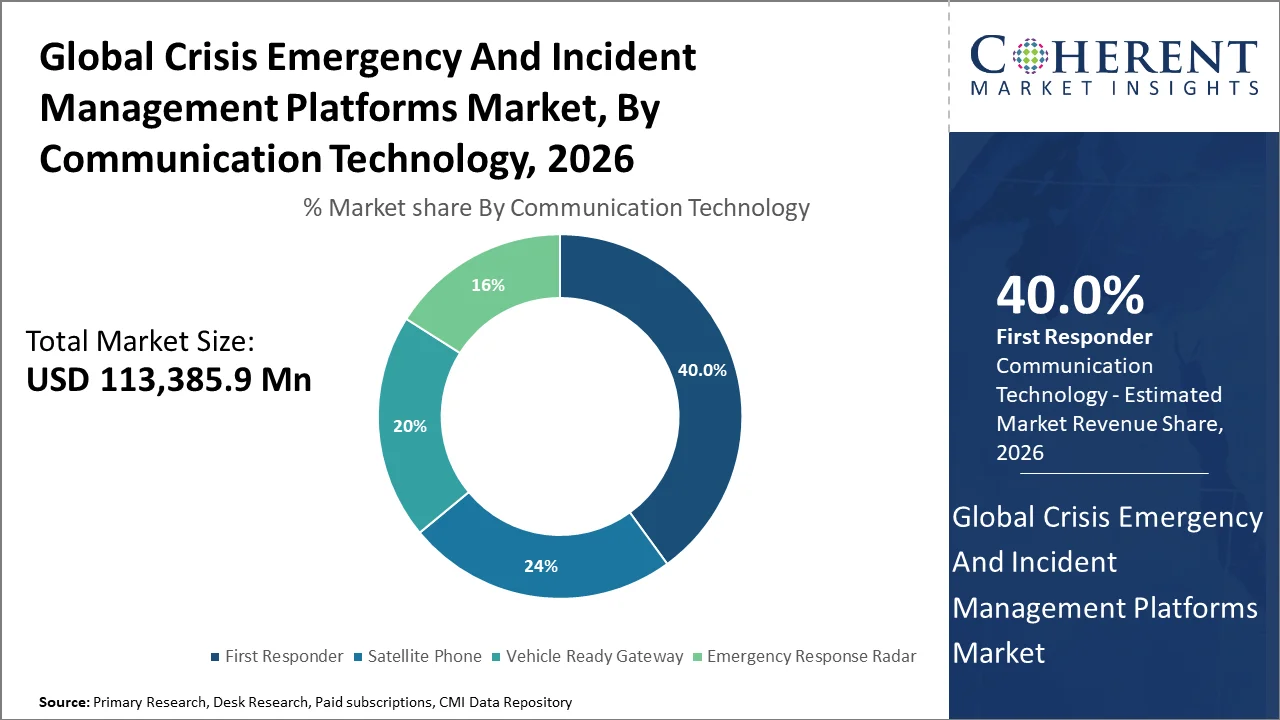
By communication technology, first responder segment is expected to retain its market dominance, capturing a share of 40% in 2026. This is mostly due to growing need for reliable and real-time communication systems among emergency personnel, law enforcement agencies, firefighters, and medical responders.
Increasing investments in public safety infrastructure, adoption of advanced communication networks, and rising frequency of natural disasters and critical incidents are also driving demand for first responder communication solutions. These systems enable faster coordination, improved situational awareness, and efficient resource management during emergency response operations.
Crisis Emergency And Incident Management Platforms Market Growth Drivers
Rising Frequency of Natural Disasters
Increasing frequency of natural disasters and public safety incidents is fueling growth of the crisis emergency and incident management platforms market. Events such as floods, wildfires, earthquakes, cyberattacks, and industrial accidents are becoming more common worldwide, increasing the demand for advanced emergency management platforms that enable faster response, coordination, and recovery.
According to the World Meteorological Organization, weather, climate, and water-related disasters have increased nearly fivefold over the past 50 years. The rising frequency and complexity of these events are increasing adoption of crisis emergency and incident management platforms to improve preparedness, communication, and response coordination.
Crisis Emergency And Incident Management Platforms Market Opportunities
Growing Government Investments in Emergency Preparedness
Governments across the world are increasing investments in emergency preparedness to better manage rising natural disasters and public safety risks. Similarly, stricter regulations related to disaster response, risk management, and business continuity are encouraging organizations to adopt integrated incident management solutions. This is expected to create lucrative growth opportunities for the crisis emergency and incident management platforms market during the forecast period.
Crisis Emergency And Incident Management Platforms Market Trends
Shift Towards Cloud-Based Platforms
Increasing adoption of cloud-based platforms is a key growth-shaping trend in the crisis emergency and incident management platforms market. Cloud-based solutions are gaining traction as they provide real-time communication, remote accessibility, faster deployment, and scalable emergency response capabilities across multiple locations. These platforms help organizations improve coordination as well as enhance operational efficiency and manage critical incidents more effectively during emergencies.
Current Events and Their Impact on the Crisis Emergency And Incident Management Platforms Market
Current Event | Description and its Impact |
U.S. Cybersecurity Regulations for Critical Infrastructure |
|
Growing Use of AI in Emergency Response |
|
Regional Insights
Rising Surgical Volumes Driving Market Demand in North America
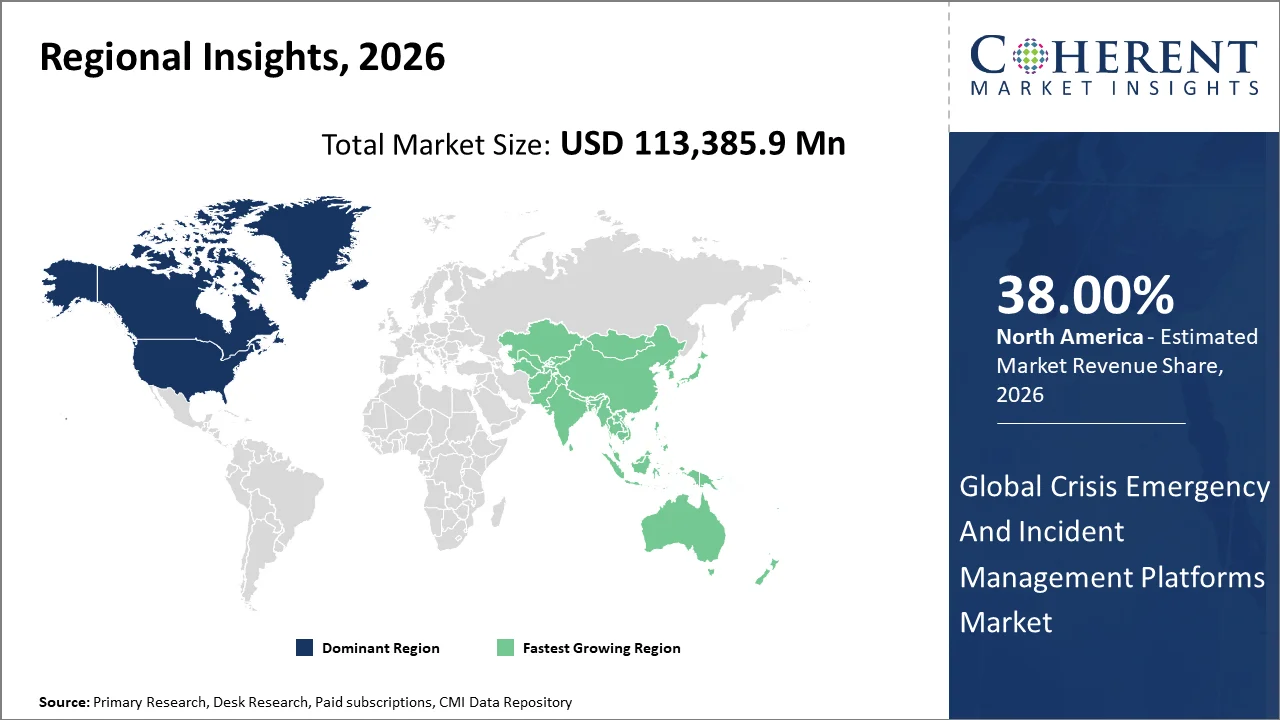
North America is expected to hold around 38% of the global crisis emergency and incident management platforms market share in 2026. This dominance is attributed to increasing focus on disaster preparedness, rising cybersecurity threats, strict regulatory requirements, and growing adoption of cloud-based emergency response solutions across government agencies and enterprises.
Growing cybersecurity incidents are a playing a key role in boosting North America crisis emergency and incident management platforms market. According to the Federal Bureau of Investigation Internet Crime Complaint Center (IC3), the U.S. reported 859,532 complaints related to cybercrime in 2024, with reported losses exceeding USD 16.6 billion, highlighting the increasing need for effective incident response and crisis management solutions.
Asia Pacific Crisis Emergency and Incident Management Platforms Market
Asia Pacific crisis emergency and incident management platforms market is poised to record a CAGR of 7.5% throughout the forecast period. This is mostly due to increasing digital transformation, rising frequency of natural disasters, expanding smart city initiatives, and growing investments in public safety infrastructure.
Nations like China, India, and Japan are focusing on improving emergency communication systems and strengthening disaster response capabilities. This, in turn, is expected to fuel demand for integrated crisis management platforms in the coming years. Similarly, rising disaster risks are driving adoption of emergency management technologies in Asia Pacific.
According to UNDRR, more than 140 disasters affected 64 million people across Asia and the Pacific in 2022, highlighting the need for better early warning and response systems. Governments and organizations are adopting digital platforms to improve emergency coordination, incident tracking, and disaster preparedness.
Crisis Emergency And Incident Management Platforms Market Outlook – Country-wise
U.S. Crisis Emergency And Incident Management Platforms Market Forecast
The United States is anticipated to remain a leading market for crisis emergency and incident management platforms throughout the forecast period. This can be attributed to growing adoption of advanced emergency response technologies by government agencies, enterprises, and critical infrastructure operators to improve preparedness and real-time incident coordination.
Increasing concerns related to cybersecurity threats, natural disasters, workplace emergencies, and public safety risks are encouraging organizations to invest in integrated incident management solutions. In addition, the presence of major technology providers and strong regulatory focus on emergency preparedness also supports market growth in the country.
China Crisis Emergency And Incident Management Platforms Market Trends
The crisis emergency and incident management platforms market in China is projected to grow steadily during the forecast period. This growth is due to increasing focus on disaster preparedness, public safety management, and digital transformation across government and enterprise sectors.
Rising risks from natural disasters such as floods, earthquakes, and extreme weather events are encouraging organizations to adopt advanced incident management solutions for faster response and coordination. In addition, China’s smart city development initiatives and growing adoption of cloud computing, artificial intelligence, and IoT-based monitoring systems are supporting market expansion.
Who are the Major Companies in the Crisis Emergency And Incident Management Platforms Market?
Company | Headquarters | Key Brands | Market Segment |
Motorola Solutions, Inc. | Chicago, Illinois, U.S. | CommandCentral; PremierOne | Public safety software, first responder communication, emergency response platforms |
Honeywell International Inc. | Charlotte, North Carolina, U.S. | Honeywell Connected Safety | Safety systems, emergency management, industrial incident solutions |
Environmental Systems Research Institute, Inc. (Esri) | Redlands, California, U.S. | ArcGIS Platform | Geospatial technology, emergency mapping, disaster response solutions |
Siemens AG | Munich, Germany | Siemens Smart Infrastructure | Infrastructure safety, building safety, digital management solutions |
Lockheed Martin Corporation | Bethesda, Maryland, U.S. | C4ISR Solutions | Defense systems, command and control, mission-critical response solutions |
Iridium Communications Inc. | McLean, Virginia, U.S. | Iridium Certus | Satellite communication and emergency connectivity solutions |
Key Strategies Adopted by Industry Players:
Top crisis emergency and incident management companies are adopting various organic and inorganic strategies to boost their sales as well as gain a competitive edge in the industry. These include launch of new products and services, partnerships, mergers, acquisitions, distribution agreements, collaborations, and joint ventures.
- In June 2026, Honeywell expanded its fire and life safety portfolio with new smoke control and connected safety solutions. The innovations are designed to improve emergency response as well as support better management of fire safety systems.
- In June 2026, Motorola Solutions expanded its AI capabilities for 911 emergency response systems. The new AI solutions are designed to help emergency teams improve response times and manage critical incidents more effectively.
- In June 2025, EY launched new AI-powered risk-management solutions on the EY.ai Agentic Platform. The solutions help organizations manage complex risks by using artificial intelligence and advanced analytics.
- In June 2025, AT&T introduced new features for its ESInet platform supporting Next Generation 9-1-1 services. The update enables emergency call centers to receive photos, videos, and vehicle crash data to improve incident response.
Market Report Scope
Crisis Emergency And Incident Management Platforms Market Report Coverage
| Report Coverage | Details | ||
|---|---|---|---|
| Base Year: | 2025 | Market Size in 2026: | USD 113,385.9 Mn |
| Historical Data for: | 2020 To 2024 | Forecast Period: | 2026 To 2033 |
| Forecast Period 2026 to 2033 CAGR: | 6.0% | 2033 Value Projection: | USD 170,490.5 Mn |
| Geographies covered: |
| ||
| Segments covered: |
| ||
| Companies covered: | Honeywell International Inc., Intergraph Corporation, Lockheed Martin Corporation, Environmental System Research Institute, Inc., Motorola Solution Inc., Guardly, Rockwell Collins, Inc., Iridium Communication Inc., and Siemens AG | ||
| Growth Drivers: |
| ||
| Restraints & Challenges: |
| ||
Analyst Opinion (Expert Opinion)
- Crisis management platforms are becoming more important as organizations face increasing cyberattacks, natural disasters, and operational disruptions. Businesses are investing in real-time response tools to improve preparedness and reduce downtime.
- Digital transformation and cloud adoption are accelerating the use of incident management platforms, as organizations prefer scalable solutions that enable faster communication, coordination, and recovery during emergencies.
- According to IBM Cost of a Data Breach Report 2024, the global average cost of a data breach reached USD 4.88 Million in 2024. This rising financial impact is encouraging organizations to adopt stronger incident response and crisis management solutions.
- Regulatory requirements and the emphasis being laid on business continuity have forced organizations to adopt a systemized approach to emergency responses. This is creating greater demand for software that can help organizations comply with regulations and make quick decisions.
Speak to the analyst
Want personalized insights?
Take the findings above to one of our principal consultants, or have the report rebuilt around the segments, geographies and competitors you actually track.
Market Segmentation
- By End-User Vertical Insights ( Revenue, USD Mn, 2021 - 2033)
- BFSI
- Energy and Utility
- Healthcare and Life Science
- Government and Defense
- Aviation
- Hospitality
- Transportation and Logistics
- Telecom and IT
- Others
- By Communication Technology Insights ( Revenue, USD Mn, 2021 - 2033)
- First Responder
- Satellite Phone
- Vehicle Ready Gateway
- Emergency Response Radar
- By System and Platform Insights ( Revenue, USD Mn, 2021 - 2033)
- Web Based Emergency Management Software
- Geospatial Technology
- Emergency Notification Service
- Surveillance System
- Hazmat Technology
- Backup and Disaster Recovery System
- Earthquake/Seismic Warning System
- Traffic Incident Management
- Remote Weather Monitoring System
- Database Management Systems (DB MS)
- By Service Insights ( Revenue, USD Mn, 2021 - 2033)
- Consulting
- Emergency Operation Center (EOC) Design and Integration
- Training and Simulation
- Public Information Services
- By Region Insights ( Revenue, USD Mn, 2021 - 2033)
- North America
- U.S.
- Canada
- Latin America
- Brazil
- Argentina
- Mexico
- Rest of Latin America
- Europe
- Germany
- U.K.
- Spain
- France
- Italy
- Russia
- Rest of Europe
- Asia Pacific
- China
- India
- Japan
- Australia
- South Korea
- ASEAN
- Rest of Asia Pacific
- Middle East
- GCC
- Israel
- Rest of Middle East
- Africa
- North Africa
- Central Africa
- South Africa
- North America
Sources
Primary Research interviews
- Interviews with industry professionals, technology providers, cybersecurity experts, emergency management specialists, government officials, and enterprise risk management executives.
Databases
- Company annual reports
- Investor presentations
- Regulatory filings
- Government databases
- Cybersecurity incident databases
- Technology adoption databases
- Public business intelligence databases
Magazines
- InformationWeek
- CIO Magazine
- CSO Online
- Security Magazine
- Government Technology
- Emergency Management Magazine
- Other technology and risk management publications
Journals
- Journal of Emergency Management
- International Journal of Disaster Risk Reduction
- Safety Science
- Journal of Homeland Security and Emergency Management
- Related technology and disaster management journals
Newspapers
- Reuters
- The Wall Street Journal
- The New York Times
- The Guardian
- Financial Times
- Other global business and technology news publications
Associations
- International Association of Emergency Managers (IAEM)
- National Emergency Management Association (NEMA)
- Disaster Recovery Institute International (DRII)
- Business Continuity Institute (BCI)
- Other emergency management and resilience organizations
Public Domain sources
- Government emergency management agencies
- Cybersecurity authorities
- Disaster response organizations
- Public safety departments
- Regulatory bodies
- Company websites
- Press releases
- Product documentation
- Publicly available industry reports
Proprietary Elements
- CMI Data Analytics Tool
- Proprietary CMI Existing Repository of information for last 10 years
Get access to 250+ pages report
Every segment, forecast, competitor profile and data table behind the analysis above — available for instant download.
- ESOMAR Member
- ISO 9001:2015 Certified
- D-U-N-S Registered
- GDPR & CCPA Compliant
Missing comfort of reading report in your local language? Find your preferred language:
Transform your Strategy with Exclusive Trending Reports
Frequently Asked Questions
The global Crisis Emergency And Incident Management Platforms Market size is estimated to reach USD 113,385.9 Mn in 2026.
The global Crisis Emergency And Incident Management Platforms Market value is expected to reach USD 170,490.5 Mn by 2033.
The global Crisis Emergency And Incident Management Platforms Market is poised to exhibit a CAGR of 6.0% from 2026 to 2033.
Key growth drivers include increasing natural disasters, cybersecurity threats, public safety incidents, and operational disruptions.
Government and defense segment is expected to lead the market with a share of 26% in 2026.
The first responder communication systems segment is expected to lead the communication technology category with a 40% market share in 2026.
Some major companies in the Crisis Emergency And Incident Management Platforms Market include Honeywell International Inc., Intergraph Corporation, Lockheed Martin Corporation, Environmental System Research Institute, Inc., Motorola Solution Inc., Guardly, Rockwell Collins, Inc., Iridium Communication Inc., and Siemens AG.