

India Cyber Security Market Size and Forecast – 2026 - 2033
The India Cyber Security Market is estimated to be valued at USD 11.90 Bn in 2026 and is expected to reach USD 22.90 Bn by 2033, exhibiting a compound annual growth rate (CAGR) of 9.8% from 2026 to 2033.
Key Takeaways of the India Cyber Security Market
- The hardware segment leads the market holding an estimated share of 60.5 % in 2026.
- Rising cyber attack volume (e.g. ransomware targeting BFSI) and regulatory mandates (e.g. DPDPA, data localization) are major drivers for the market.
Market Overview
The market is seeing a shift towards integrated and AI-driven security solutions that make possible real-time threat detection and automated response capabilities. Organizations are working on cybersecurity frameworks that comply with global standards because of increasing regulatory mandates and the rise in remote work models. Increased spending on cloud security, network security, and endpoint protection can be seen, alongside growing awareness about data privacy and the critical need to safeguard against sophisticated cyberattacks.
Current Events and Its Impact
Current Events | Description and its impact |
Geopolitical and Trade Developments |
|
Regulatory & Data Protection Mandates |
|
Economic & Infrastructure Trends |
|
Segmental Insights
- Current Industry Events of 2026
- Market Size Estimation
- Regional Breakdown
- Competitive Landscape
- Customer Intelligence
- Segmental Analysis
- Pricing Analysis
- Key Market Drivers, Challenges & Future Trends
- Customized Insights Section
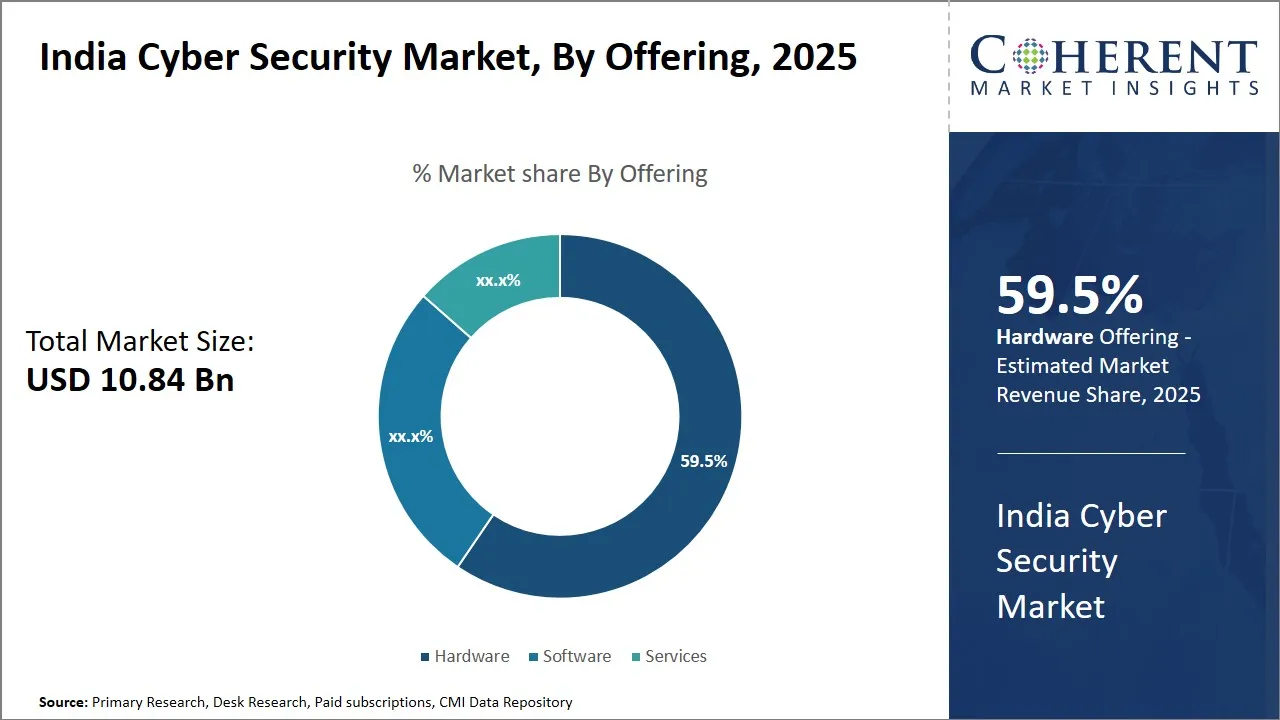
India Cyber Security Market Insights, by Offering - Hardware Leads, owing to Escalating Infrastructure Security Demands
Hardware is expected to contribute the highest share of 60.5% in the market in 2026. With the fast digital transformation seen in businesses and government operations, organizations are spending greatly on physical security components such as firewalls, intrusion detection systems, unified threat management devices, and encryption hardware to safeguard their critical assets.
One of the key drivers for the hardware segment’s dominance is the increasing sophistication of cyber threats targeting network infrastructure. Organizations need advanced hardware solutions capable of real-time threat detection and prevention to protect from complex attacks such as Distributed Denial of Service (DDoS), malware, and ransomware. Hardware appliances designed for network security provide faster processing and low latency protection, which is important for enterprises handling sensitive data and high volumes of online transactions.
Also, regulatory compliance frameworks in India, including data protection and privacy mandates, are pushing organizations to adopt secure hardware solutions and make data storage and transmission more secure. This has created a lot of demand for encryption modules and secure access devices, and hardware-based authentication systems.
To add, large-scale government initiatives associated with digitization and cyber resilience have added to the procurement of cybersecurity hardware assets for critical infrastructure sectors. Public sector organizations prioritize hardware deployment as a backbone for secure digital environments.
Impact of AI on the India Cybersecurity Market
Artificial Intelligence (AI) is transforming India’s cybersecurity landscape by enabling faster, more adaptive, and predictive defense mechanisms. AI-driven systems can detect anomalies and malicious behavior in real time, minimizing response times and reducing dependency on manual monitoring. Machine learning algorithms are being deployed in Security Operations Centers (SOCs) to analyze vast volumes of log data and network traffic, helping detect advanced persistent threats and zero-day vulnerabilities that traditional systems may miss. Indian firms across BFSI, healthcare, and IT sectors are increasingly adopting AI-based security tools to counter evolving threats and maintain compliance with new regulations like the Digital Personal Data Protection Act (DPDPA).
Tata Consultancy Services (TCS has integrated AI into its cybersecurity offerings to provide proactive threat intelligence and automated incident response across client networks. Their Cyber Defense Suite uses AI and ML to improve threat detection accuracy while reducing false positives.
Market Players, Key Development, and Competitive Intelligence
Key Developments
- In June 2025, U.S.-based networking solutions company, Netgear, announced its acquisition of India-based cybersecurity startup, Exium, to enhance its integrated services for managed service providers (MSPs) and customers.
- In May 2025, Check Point Software Technologies announced the launch of its India-based data residency instance of Check Point Harmony SASE, reinforcing its commitment to enabling secure digital transformation for Indian enterprises. This new instance brings localized, cloud-delivered network security—designed to address India’s regulatory environment and growing demand for scalable, secure, and compliant cloud adoption.
- In March 2025, Zero Defend Security unveiled Vastav AI, India's first deepfake detection system, marking a significant advancement in cybersecurity. This cloud-based platform employs advanced machine learning, forensic analysis, and metadata inspection to identify AI-generated videos, images, and audio with a reported accuracy of 99%.
- In October 2023, at the 9th edition of Google for India event, the company announced DigiKavach, a solution aimed at keeping Indian users safe online. Digikavach is a collaborative effort wherein Google will work with industry partners and experts to share insights and combat online financial fraud.
Top Strategies Followed by the India Cyber Security Market Players
- Established players dominate the scene through substantial investments in research and development (R&D), driving innovation to deliver high-performance, cutting-edge cybersecurity products tailored to address evolving threats.
- Tata Consultancy Services (TCS) developed its Cyber Defense Suite with advanced AI/ML capabilities as part of its sustained investment in cybersecurity R&D. The suite offers zero-trust architecture, adaptive authentication, and predictive threat analytics, addressing the growing need for end-to-end enterprise-grade protection.
- Mid-level players in the India cyber security market navigate competition by focusing on cost-effective solutions that strike a balance between quality and affordability.
- Sequretek, a Mumbai-based cybersecurity firm, launched Cyber Risk Management-as-a-Service (CRMaaS) targeted at Indian SMEs. Their subscription-based model provides endpoint security, SIEM, and compliance tools at a fraction of the cost of global alternatives, making advanced protection accessible to smaller organizations.
- Small-scale players in the industry employ a different strategy, carving out niche segments by concentrating on specialized features or highly innovative products that cater to specific cybersecurity needs.
- Sequretek, a Mumbai-based cybersecurity firm, launched Cyber Risk Management-as-a-Service (CRMaaS) targeted at Indian SMEs. Their subscription-based model provides endpoint security, SIEM, and compliance tools at a fraction of the cost of global alternatives, making advanced protection accessible to smaller organizations.
Market Report Scope
India Cyber Security Market Report Coverage
| Report Coverage | Details | ||
|---|---|---|---|
| Base Year: | 2025 | Market Size in 2026: | USD 11.90 Bn |
| Historical Data for: | 2020 To 2024 | Forecast Period: | 2026 To 2033 |
| Forecast Period 2026 to 2033 CAGR: | 9.8% | 2033 Value Projection: | USD 22.90 Bn |
| Segments covered: |
| ||
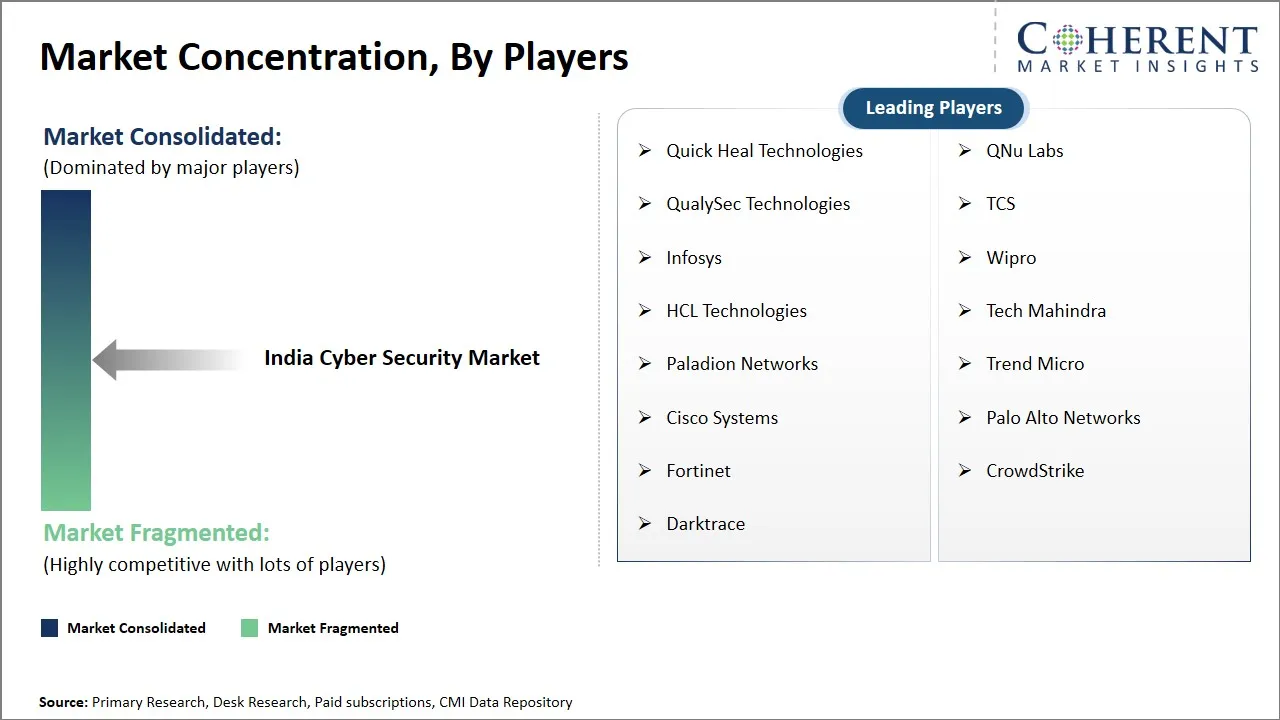
| Companies covered: | Quick Heal Technologies, QNu Labs, QualySec Technologies, TCS, Infosys, Wipro, HCL Technologies, Tech Mahindra, Paladion Networks, Trend Micro, Cisco Systems, Palo Alto Networks, Fortinet, CrowdStrike, and Darktrace | ||
| Growth Drivers: |
| ||
| Restraints & Challenges: |
| ||
Market Dynamics
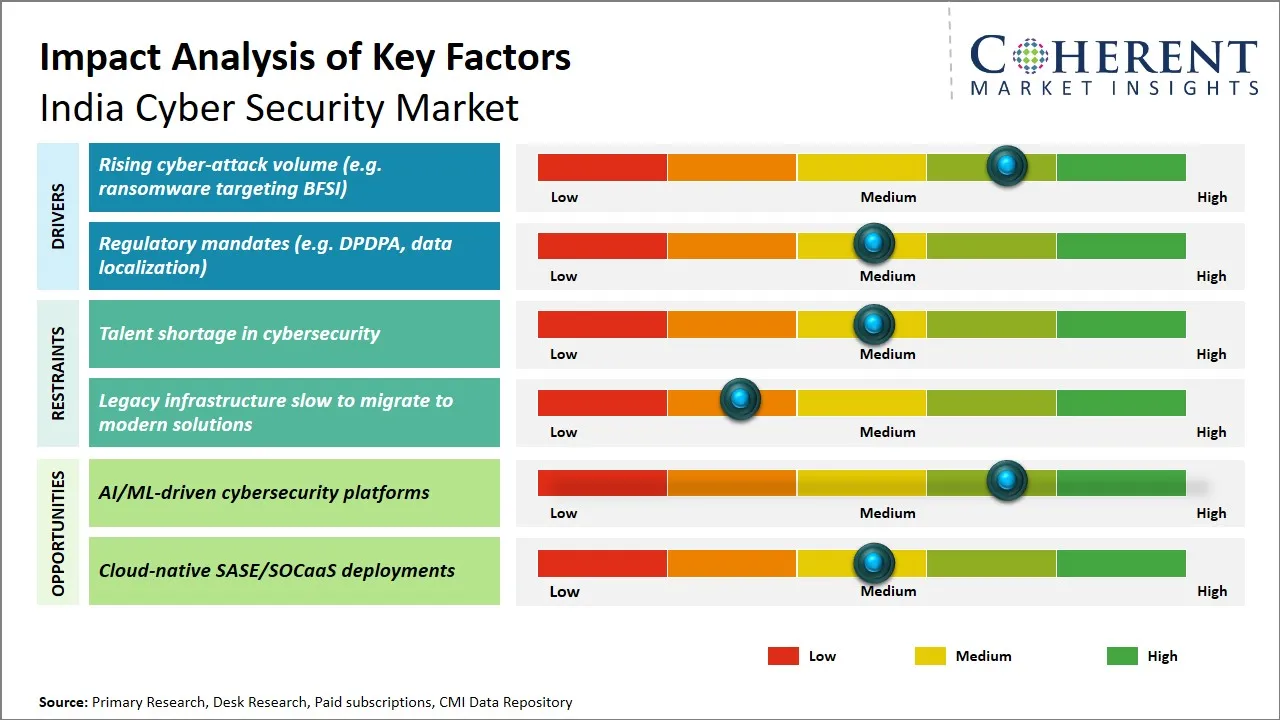
India Cyber Security Market Driver - Rising Cyber ‑ attack Volume (e.g. ransomware targeting BFSI)
As BFSI institutions become prime targets because of the sensitivity and volume of financial data they handle, the repercussions of successful breaches are severe, ranging from financial losses to reputational damage and regulatory penalties. In November 2023, IDFC First Bank saw a ransomware attack that temporarily disrupted internal systems and customer services. Customer data was not leaked but the incident showed vulnerabilities in core banking IT infrastructure and led to regulatory scrutiny.
This rise in ransomware attacks, which often affects operations by encrypting vital data and demanding hefty ransoms, has pushed enterprises to spend on threat intelligence, endpoint security, and incident response capabilities. To add, the growing digital transformation initiatives seen in different industries have expanded the attack surface, making cybersecurity a critical priority to safeguard against escalating risks and protect sensitive information across connected networks.
India Cyber Security Market Opportunity – AI/ML-Driven Cybersecurity Platforms in the India Market
As cyber threats become increasingly sophisticated and complex, traditional security measures often struggle to provide real-time threat detection and response. AI/ML-driven cybersecurity platforms offer advanced capabilities such as predictive threat intelligence, automated incident response, and adaptive learning to spot new and evolving threats with greater accuracy and speed. In India, rapid digital transformation can be seen in sectors including banking, finance, telecommunications, and government services, which is driving an increased demand for more intelligent and scalable cybersecurity solutions. The country is seeing increasing internet user base, coupled with rising cybercrime incidents, which is creating a need for proactive threat mitigation strategies made possible by AI and ML algorithms. In March 2024, Quick Heal Technologies launched its "Hawk AI XDR Platform", a next-generation detection and response system powered by machine learning.
To add, India’s large pool of tech talent and growing startup ecosystem focused on AI innovation encourage the development and deployment of localized AI/ML cybersecurity technologies tailored to regional threat landscapes. These platforms can efficiently monitor vast amounts of data generated in real-time, enabling organizations to anticipate attacks and minimize potential damages. Also, regulatory frameworks for data protection and privacy push enterprises to spend on AI-powered cybersecurity infrastructure, adding to market growth.
Analyst Opinion (Expert Opinion)
- The BFSI sector, despite being the highest spender, continues to face big challenges because of legacy systems that lack agility against modern threats. The frequency and complexity of ransomware and phishing attacks targeting banks and insurance firms have increased a lot, resulting in regulatory interventions by the RBI. Because of all this, financial institutions are spending greatly on zero-trust frameworks, AI-driven fraud detection, and Security Operations Center (SOC) modernization to become more protected.
- The healthcare sector is seeing a shift toward digital health records, telemedicine, and online diagnostics. This has made hospitals and clinics bigger targets for cybercriminals. With cases of data breaches and phishing attempts becoming more and more common, healthcare providers are now opting for cybersecurity tools at a fast rate. There can be seen an emphasis on becoming compliant with HIPAA-equivalent standards, securing Electronic Health Records (EHR), and tightening access control.
- Meanwhile, IT and SaaS companies are focusing on securing cloud-native infrastructure, DevSecOps pipelines, and remote working environments. Tools like SASE, CNAPPs, and EDR/XDR are in high demand to support scalable, hybrid deployments.
Speak to the analyst
Want personalized insights?
Take the findings above to one of our principal consultants, or have the report rebuilt around the segments, geographies and competitors you actually track.
Market Segmentation
- Offering Insights (Revenue, USD Bn, 2021 - 2033)
- Hardware
- Software
- Services
- Key Players Insights
- Quick Heal Technologies
- QNu Labs
- QualySec Technologies
- TCS
- Infosys
- Wipro
- HCL Technologies
- Tech Mahindra
- Paladion Networks
- Trend Micro
- Cisco Systems
- Palo Alto Networks
- Fortinet
- CrowdStrike
- Darktrace
Sources
Primary Research Interviews
Stakeholders
- IT Infrastructure Heads from Banking and Financial Institutions (e.g., CTOs at Private Banks)
- Healthcare CIOs and IT Security Managers (from hospitals and digital health platforms)
- CISOs and Cybersecurity Consultants from Major IT/ITES Enterprises
- Data Protection Officers in E-commerce and FinTech Startups
- Cloud Security Architects and Managed Security Service Providers (MSSPs)
- Cyber Law Experts and Compliance Officers (specializing in DPDPA and CERT-In guidelines)
Databases
- National Cyber Crime Reporting Portal – India
- Cybersecurity Knowledge Base (CyberKBase India)
- Indian Tech Infrastructure Register (ITIR Database)
- Asia-Pacific ICT Indicators Dataset (APII DataSet)
Magazines
- Cyber Defense Today
- IndiaTech Security Review
- Infosec Weekly Asia
- Digital Shield Magazine
Journals
- Journal of Information Security & Privacy – India Chapter
- Cybersecurity & Risk Management Review (APAC)
- Journal of AI and Emerging Threats
- Enterprise Data Security Journal
Newspapers
- The Economic Times – Tech Section
- CyberNews India
- Tech Observer – Security Edition
- The Hindu Business Line – Digital Affairs
Associations
- Data Security Council of India (DSCI)
- Cybersecurity Consortium of India (CCI)
- National Association for Secure Digital India (NASDI)
- Asia Pacific Cyber Risk Advisory Forum (APCRAF)
- Indian Network Security Council (INSC)
Public Domain Sources
- Ministry of Electronics & Information Technology (MeitY) – India
- CERT-In (Indian Computer Emergency Response Team)
- NASSCOM Tech R&D Reports
- World Bank – Digital Economy Indicators
- ResearchGate (selected India-based cybersecurity papers)
Proprietary Elements
- CMI Data Analytics Tool, Proprietary CMI Existing Repository of information for last 8 years
Get access to 250+ pages report
Every segment, forecast, competitor profile and data table behind the analysis above — available for instant download.
- ESOMAR Member
- ISO 9001:2015 Certified
- D-U-N-S Registered
- GDPR & CCPA Compliant
Missing comfort of reading report in your local language? Find your preferred language:
Transform your Strategy with Exclusive Trending Reports
Frequently Asked Questions
The India cyber security market is estimated to be valued at USD 11.90 billion in 2026 and is expected to reach USD 22.90 billion by 2033.
The CAGR of India cyber security market is projected to be 9.8% from 2026 to 2033.
Rising cyber‑attack volume (e.g. ransomware targeting BFSI) and Regulatory mandates (e.g. DPDPA, data localization) are the major factor driving the growth of India cyber security market.
Talent shortage in cybersecurity and Legacy infrastructure slow to migrate to modern solutions are the major factor hampering the growth of India cyber security market.
In terms of offering, hardware is estimated to dominate the market revenue share in 2026.
Quick Heal Technologies, QNu Labs, QualySec Technologies, TCS, Infosys, Wipro, HCL Technologies, Tech Mahindra, Paladion Networks, Trend Micro, Cisco Systems, Palo Alto Networks, Fortinet, CrowdStrike, and Darktrace are the major players in the India cyber security market.
AI and ML are being used for threat detection, behavior analytics, and automated response, helping organizations identify and neutralize threats in real time.