

Location-based Services Market Size and Forecast – 2026 to 2033
Location-based Services Market is estimated to be valued at USD 53,869.5 Mn in 2026 and is expected to reach USD 1,78,853.7 Mn in 2033, exhibiting a compound annual growth rate (CAGR) of 18.9% from 2026 to 2033.
Key Takeaways
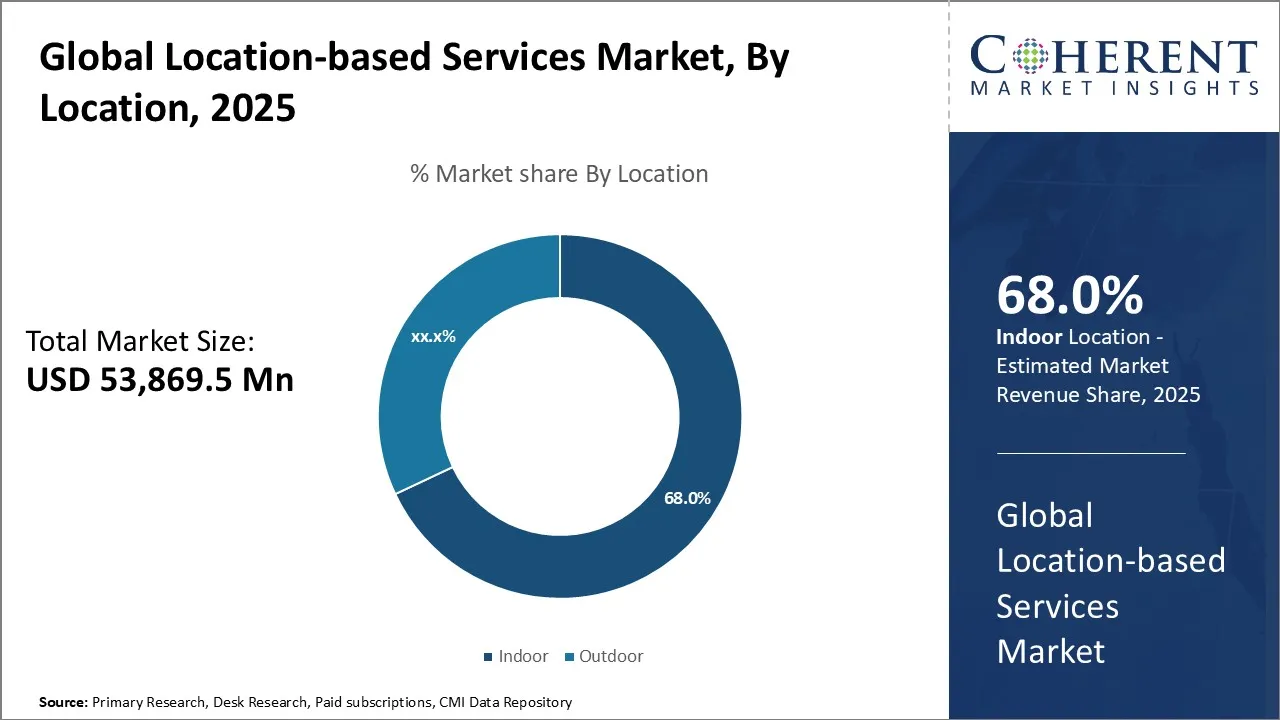
- By Location, Indoor hold the largest market share of 69% in 2026 owing to the rising smartphone & IOT device penetration
- By End User Industry, Retail expected to hold largest market share in 2026 owing to its personalized marketing & proximity-based promotions.
- By Region, North America dominates the overall market with an estimated share of 31% in 2026 owing to the high smartphone & connected-device penetration.
Market Overview
The Location-based Services market is rapidly expanding as businesses and consumers increasingly use real-time geographic data to improve decision-making, navigation, and engagement. Rising smartphone adoption, advanced positioning technologies, and growing use across retail, transportation, logistics, and public safety fuel this momentum. IoT systems, mapping platforms, and analytics tools further enhance LBS by enabling personalized services, asset tracking, and operational efficiency. As digital ecosystems advance, LBS plays an ever-greater role across industries.
Current Events and Its Impact on the Location-based Services Market
Current Events | Description and its impact |
Geopolitical Tensions and Regulatory Changes |
|
Technological Advancements and Integration |
|
Cybersecurity and Privacy Concerns |
|
Segmental Insights
- Current Industry Events of 2026
- Market Size Estimation
- Regional Breakdown
- Competitive Landscape
- Customer Intelligence
- Segmental Analysis
- Pricing Analysis
- Key Market Drivers, Challenges & Future Trends
- Customized Insights Section
Location-based Services Market Insights, By Location - Indoor contribute the highest share of the market owing to its growth of smart buildings
Indoor hold the largest market share of 69% in 2026. Indoor location-based services are gaining traction as organizations increasingly use precise, real-time positioning to improve navigation, asset tracking, and customer engagement inside enclosed environments. Expanding use of smartphones, IoT devices, and connected infrastructure drives the deployment of indoor technologies such as Wi-Fi, BLE beacons, and sensor fusion. Retailers, airports, hospitals, and warehouses actively adopt these systems to boost operational efficiency, enhance user experiences, and optimize space utilization. Advances in analytics and automation continue to accelerate demand for indoor LBS solutions. For instance, in December 2024, IndoorAtlas has launched a platform that uses Earth’s natural magnetic fields to create highly accurate location-based mobile apps without relying on WiFi or GPS.
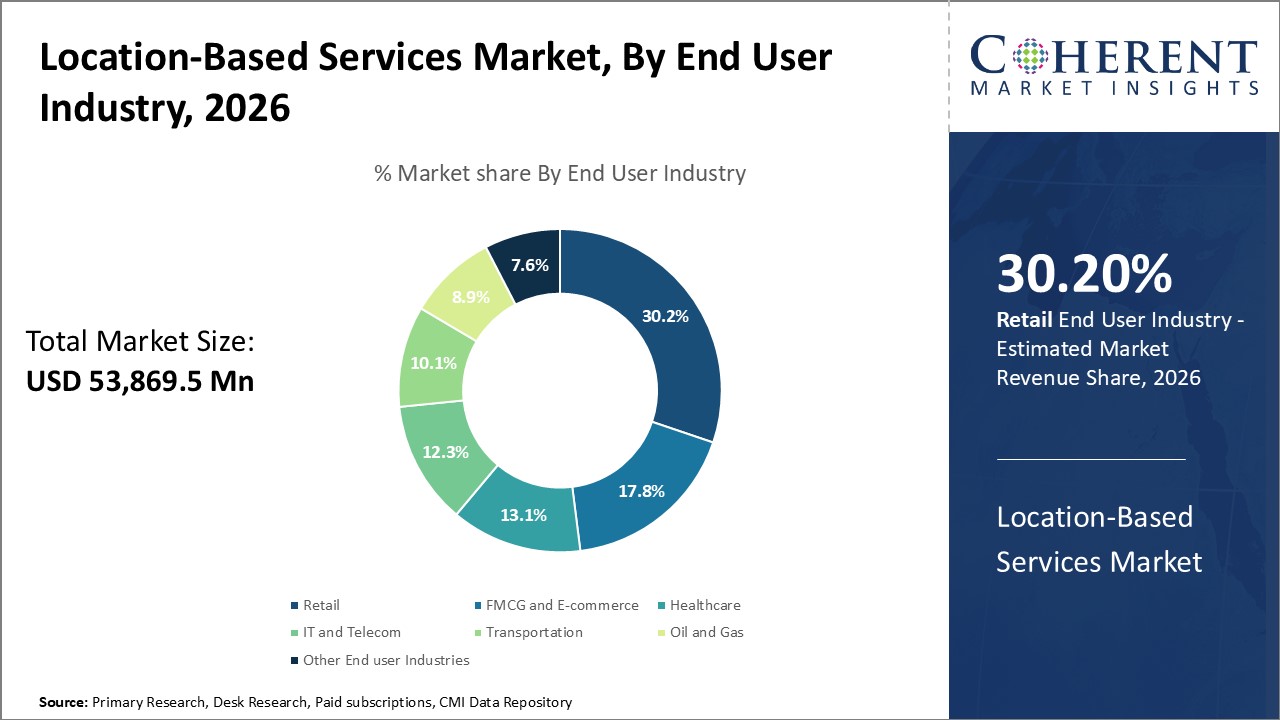
Location-based Services Market Insights, By End User Industry - Retail contributes the highest share of the market owing to its seamless integration with IoT
Location-based services in retail continue to grow as stores actively use real-time location data to improve customer experience and streamline operations. Retailers apply LBS to deliver personalized promotions, guide shoppers through stores, and enhance engagement, enabling customers to locate products quickly and receive relevant offers. These solutions also help analyze foot traffic, maintain inventory accuracy, and speed up order fulfillment. With increasing adoption of smart technologies and mobile-first strategies, retailers rely on LBS to boost convenience, refine store layouts, and connect digital and physical shopping experiences. For instance, in July 2025, Wildix’s x-hoppers, the AI-powered retail communications platform, launched its fully embedded agentic AI suite across all deployments, enabling frontline teams to act in real time, hands-free, and without switching screens or using manual tools, while streamlining operations, reducing theft, and enhancing customer experience.
Regional Insights
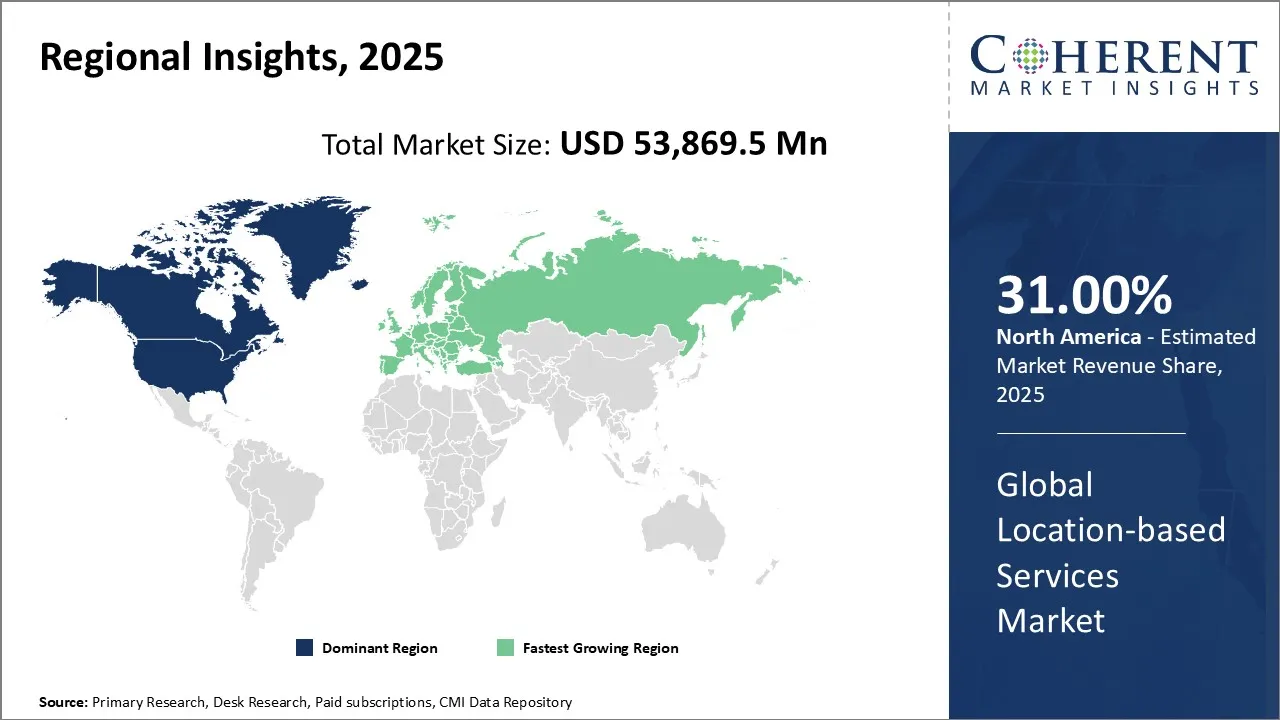
North America Location-based Services Market Trends
North America dominates the overall market with an estimated share of 31% in 2026. The North America Location-based Services market is advancing quickly as businesses actively adopt mapping, geofencing, and real-time tracking tools to drive digital transformation. Widespread use of smartphones, connected devices, and high-speed networks is enabling broader LBS integration across retail, logistics, healthcare, and transportation sectors. Companies leverage these services to deliver personalized customer experiences, manage fleets and assets efficiently, and improve safety applications. Rising investment in smart infrastructure and data-driven operations continues to propel the region toward more sophisticated, location-enabled solutions. For instance, Verizon has launched Hyper Precise Location using Real Time Kinematics (RTK), a GPS technology that delivers location accuracy within one to two centimeters on its network.
Europe Location-based Services Market Trends
The Europe Location-based Services market is growing as companies actively deploy advanced positioning, geofencing, and real-time analytics to boost operational efficiency and engage customers. Increasing use of smartphones, IoT devices, and connected infrastructure drives LBS adoption across retail, transportation, healthcare, and public safety sectors. Businesses apply these solutions to deliver personalized services, streamline logistics, and enhance location-based marketing efforts. At the same time, government initiatives promoting smart cities and digital infrastructure are accelerating the rollout of innovative, location-enabled solutions throughout the region.
United States Location-based Services Market Trends
The United States Location-based Services market is growing as businesses and public-sector organizations actively deploy real-time tracking, geofencing, and analytics to enhance operations and engage customers. Widespread smartphone use, extensive IoT adoption, and advanced network infrastructure enable broader LBS implementation across retail, logistics, healthcare, and transportation sectors. Companies use these solutions to optimize asset management, provide personalized experiences, and strengthen safety measures. At the same time, increasing investment in smart city projects and connected technologies is accelerating the development of innovative, location-based solutions across the country. For instance, in November 2026, the U.S. Space Force (USSF) launched an advanced GPS satellite, it not only added a more capable node to the global navigation network but also showcased remarkable agility by reducing the time from mission kickoff to liftoff to just over three months.
United Kingdom Location-based Services Market Trends
The United Kingdom Location-based Services market is growing as businesses actively use real-time tracking, geofencing, and advanced analytics to improve customer experiences and boost operational efficiency. Expanding smartphone adoption and increasing IoT connectivity drive LBS implementation across retail, transportation, healthcare, and public service sectors. Companies leverage these technologies to streamline logistics, deliver personalized marketing, and enhance asset management. At the same time, government initiatives supporting smart cities and digital infrastructure are accelerating the rollout of innovative, location-enabled solutions across the UK.
End-user Feedback and Unmet Needs in the Location-based Services Market
- Accuracy and Reliability Concerns: End-users often report inconsistencies in location accuracy, especially indoors or in dense urban areas. GPS alone struggles in enclosed spaces, leading to navigation errors or delayed tracking. Users seek more reliable positioning technologies that provide precise, real-time data across both indoor and outdoor environments, minimizing disruptions in service.
- Integration with Existing Systems: Businesses and organizations find challenges in integrating LBS solutions with their current IT infrastructure, CRM systems, and IoT platforms. End-users emphasize the need for seamless interoperability that allows analytics, reporting, and operational tools to work in sync, reducing manual efforts and improving the overall efficiency of location-based applications.
- Privacy and Data Security: Many users express concerns about data privacy, consent management, and potential misuse of location information. End-users expect LBS providers to implement robust security measures, transparent data policies, and compliance with regulations, ensuring that sensitive location data is collected, stored, and used responsibly without compromising trust.
Location-based Services Market Trend
Expansion of Indoor Positioning Technologies
Indoor positioning is becoming a major focus as businesses seek precise navigation and tracking inside malls, airports, hospitals, and warehouses. Technologies such as BLE beacons, Wi-Fi triangulation, Ultra-Wideband (UWB), and sensor fusion are being widely adopted. This trend enables retailers and enterprises to improve asset tracking, optimize space utilization, and provide personalized experiences, bridging the gap between online and physical environments while addressing the limitations of traditional GPS in indoor settings.
Integration with IoT and Smart Infrastructure
LBS solutions increasingly integrate with IoT devices, smart buildings, and connected infrastructure. Sensors, wearable devices, and intelligent systems feed real-time location data into operational and analytics platforms. This convergence allows organizations to enhance logistics, monitor assets, automate processes, and deliver context-aware services. By leveraging smart environments, LBS adoption grows beyond navigation, transforming operations across retail, healthcare, transportation, and industrial sectors, while enabling predictive insights and data-driven decision-making.
Location-based Services Market Opportunity
Smart Cities and Urban Infrastructure
Governments and urban planners can leverage LBS to improve city management, traffic control, public safety, and resource allocation. Real-time location data supports smart transportation systems, emergency response, and citizen services. By integrating LBS with IoT, cities can monitor congestion, optimize utilities, and enhance urban mobility. These opportunities enable sustainable urban development, reduce operational costs, and improve quality of life, making location intelligence a strategic tool in modern smart city initiatives and municipal planning.
Market Report Scope
Location-based Services Market Report Coverage
| Report Coverage | Details | ||
|---|---|---|---|
| Base Year: | 2025 | Market Size in 2026: | USD 53,869.5 Mn |
| Historical Data for: | 2020 To 2024 | Forecast Period: | 2026 To 2033 |
| Forecast Period 2026 to 2033 CAGR: | 18.9% | 2033 Value Projection: | USD 1,78,853.7 Mn |
| Geographies covered: |
| ||
| Segments covered: |
| ||
| Companies covered: | GuardRFID Solutions Inc., ALE International (Nokia Corporation), Favendo Gmbh, Teldio Corporation, CenTrak, Cisco Systems Inc. (Cisco Meraki), AiRISTA Flow Inc., Creativity Software Ltd., IBM Corporation, DigitalGlobe Inc. (Maxar Technologies), Aruba Networks (HPE Development LP), Ericsson Inc., HERE Global BV, IndoorAtlas Ltd., GL Communications Inc., and Esri Inc | ||
| Growth Drivers: |
| ||
| Restraints & Challenges: |
| ||
Location-based Services Market News
- In May 2025, Sri Lankan telco Dialog Axiata has introduced a location-tracking service for school vans to enhance student safety and improve the efficiency of school transportation.
- In September 2025, Airtel Business a strategic partnership with Swift Navigation to launch Airtel-Skylark, a cloud-based AI/ML location service that delivers accuracy up to 100 times higher than standard Global Navigation Satellite Systems (GNSS).
Analyst Opinion (Expert Opinion)
The Location-Based Services (LBS) market is entering a critical inflection point in which precision, hybrid positioning architectures, and advanced analytics capabilities are becoming the principal differentiators among vendors. Recent industry data indicates that approximately 71% of new enterprise deployments now employ hybrid approaches—typically combining BLE, Wi-Fi, UWB, or comparable sensor-fusion configurations—rather than relying solely on GPS. This transition is significant: hybrid systems resolve the longstanding limitations of GPS in indoor or complex environments and enable sub-meter or floor-level accuracy. Such performance is essential for real-time asset tracking, indoor navigation, and context-aware services in operational environments such as warehouses, retail centers, hospitals, and airports, where precise spatial awareness is mission-critical. As a result, LBS is shifting from an optional enhancement to core operational infrastructure.
The effects are already measurable. In retail environments, the integration of indoor positioning with analytics platforms facilitated more than 1.5 billion location-triggered promotions in 2024, demonstrating the scale and commercial impact of geofencing and proximity-based engagement strategies. In logistics and manufacturing, the combination of LBS with real-time location systems (RTLS) and IoT infrastructure has led to significant operational improvements—including faster inventory retrieval, heightened productivity, and more reliable asset visibility.
However, not all LBS implementations are positioned to succeed. Solution quality and execution remain decisive. Academic studies consistently show that legacy BLE-only beacon systems relying on basic RSSI measurements are vulnerable to signal fluctuation, multipath interference, and instability in dense indoor settings. Without advanced sensor-fusion techniques, filtering, or AI-assisted correction layers, such systems often fail to deliver reliable accuracy, eroding user trust and limiting enterprise-scale deployment.
The market is also undergoing a clear bifurcation. On one side are comprehensive “location-aware intelligence platforms” that offer analytics, contextual reasoning, SDKs/APIs, privacy and compliance controls, and seamless integration with enterprise systems. On the other side lie basic beacon-based or legacy LBS offerings that are increasingly commoditized and at risk of obsolescence. With 47–50% of enterprise respondents expressing concerns about integration costs, infrastructure challenges, and data-governance factors, only solutions capable of delivering demonstrable ROI—through efficiency gains, enhanced experience, or improved safety—are likely to achieve sustained adoption.
Speak to the analyst
Want personalized insights?
Take the findings above to one of our principal consultants, or have the report rebuilt around the segments, geographies and competitors you actually track.
Market Segmentation
- Global Location-Based Services Market By Location
- Indoor
- Outdoor
- Global Location-Based Services Market By End User Industry
- FMCG and e-commerce
- Retail
- Healthcare
- IT and Telecom
- Transportation
- Oil and Gas
- Other End user Industries
- Regional Insights (Revenue, USD Mn, 2021 - 2033)
- North America
- U.S.
- Canada
- Latin America
- Brazil
- Argentina
- Mexico
- Rest of Latin America
- Europe
- Germany
- U.K.
- Spain
- France
- Italy
- Russia
- Rest of Europe
- Asia Pacific
- China
- India
- Japan
- Australia
- South Korea
- ASEAN
- Rest of Asia Pacific
- Middle East
- GCC Countries
- Israel
- Rest of Middle East
- Africa
- South Africa
- North Africa
- Central Africa
- North America
- Key Players Insights
- GuardRFID Solutions Inc.
- ALE International (Nokia Corporation)
- Favendo Gmbh
- Teldio Corporation
- CenTrak
- Cisco Systems Inc. (Cisco Meraki)
- AiRISTA Flow Inc.
- Creativity Software Ltd.
- IBM Corporation
- DigitalGlobe Inc. (Maxar Technologies)
- Aruba Networks (HPE Development LP)
- Ericsson Inc.
- HERE Global BV
- IndoorAtlas Ltd.
- GL Communications Inc.
- Esri Inc.
Sources
Primary Research interviews
- Technology officers and CIOs from retail, logistics, healthcare, and smart city projects
- Operations managers and LBS solution implementers
- Fleet management and warehouse supervisors
- Smart infrastructure and IoT system administrators
Databases
- IEEE Xplore
- Scopus
- PubMed
- arXiv
- OpenStreetMap datasets
- Google Scholar
Magazines
- Wired
- MIT Technology Review
- GPS World
- IoT World Today
- Mobile World Magazine
Journals
- Journal of Location Based Services
- Sensors
- IEEE Transactions on Mobile Computing
- International Journal of Geographical Information Science
- ACM Transactions on Sensor Networks
Newspapers
- The Wall Street Journal (Technology Section)
- The New York Times (Technology Section)
- The Guardian (Tech and Business Section)
- Financial Times (Technology & Telecom Section)
- The Times of India (Technology Section)
Associations
- Urban Land Institute (ULI)
- Institute of Electrical and Electronics Engineers (IEEE)
- Location-Based Marketing Association (LBMA)
- Open Geospatial Consortium (OGC)
Public Domain sources
- Government smart city portals
- FAA / Transportation GIS Data
- European Union Open Data Portal
- US Census Bureau (geospatial datasets)
- NASA Earth Observations
- OpenStreetMap
Proprietary Elements
- CMI Data Analytics Tool
- Proprietary CMI Existing Repository of information for last 8 years
Get access to 250+ pages report
Every segment, forecast, competitor profile and data table behind the analysis above — available for instant download.
- ESOMAR Member
- ISO 9001:2015 Certified
- D-U-N-S Registered
- GDPR & CCPA Compliant
Missing comfort of reading report in your local language? Find your preferred language:
Transform your Strategy with Exclusive Trending Reports
Frequently Asked Questions
The Location-Based Services Market is estimated to be valued at USD 53,869.5 Mn in 2026, and is expected to reach USD 1,78,853.7 Mn by 2033.
The CAGR of the Location-Based Services Market is projected to be 18.9% from 2026 to 2033.
Rise in demand for geo-based marketing and technological developments supported by emerging BLE and UWB for indoor services are fuelling the market.
The Indoor segment is the leading component segment in the market.
Trade-offs between security/privacy and regulatory limitations and stringent standards and regulations are the major factors restraining the market.
GuardRFID Solutions Inc., ALE International (Nokia Corporation), Favendo Gmbh, Teldio Corporation, CenTrak, Cisco Systems Inc. (Cisco Meraki), AiRISTA Flow Inc., Creativity Software Ltd., IBM Corporation, DigitalGlobe Inc. (Maxar Technologies), Aruba Networks (HPE Development LP), Ericsson Inc., HERE Global BV, IndoorAtlas Ltd., GL Communications Inc., and Esri Inc.