

Circuit Breaker and Fuses Market Size and Share Analysis- 2026 To 2033
The Circuit Breaker and Fuses Market size is anticipated to grow at a CAGR of 5.2%, with an estimated value of approximately USD 22.8 Bn in 2026 and is expected to reach nearly USD 32.4 Bn in 2033. The growth is mainly due to the increase in electricity demand, rapid expansion of transmission and distribution infrastructure, expanding industrial automation, and rapid integration of renewable energy sources into national grids. According to the International Energy Agency (IEA), demand for electricity around the world continues to grow gradually due to electrification of transport, heating and industrial operations, which will further reinforce long term need for power infrastructure components such as circuit breakers and fuses.
Key Takeaways
- Circuit Breakers segment is projected to dominate the market with 68% share in 2026.The segment is likely to maintain its dominance because to its widespread usage in power generation, transmission and distribution networks, industrial automation systems and renewable energy integration projects. According to the International Energy Agency (IEA, Electricity Report), there has been consistent growth in the demand for electricity around the world, which makes up more than 20% of total energy use and is growing fast due to increased electrification, thus creating a need for circuit breakers and other grid protection devices.
- Low Voltage segment to hold a share of 52% in 2026. This is due to its widespread use in residential and commercial buildings and in industrial distribution systems. According to the U.S. Energy Information Administration (EIA), the growth in power consumption in the residential and commercial sectors continues at a constant rate which drives demand for low-voltage protection systems and distribution equipment.
- Vacuum Circuit Breakers category is anticipated to be the leader with 38% share by 2026. High reliability and low requirements of maintenance, coupled with growing applications in medium-voltage systems, contribute significantly to the trend. The IEA’s World Energy Investment report indicates that there is going to be an extremely large investment in electricity grids worldwide, aimed at integration of renewable energy sources and modernization of outdated facilities.
- Low Voltage Fuses category is expected to dominate in 2026 with 71% share. The driving force behind this dominance is the extensive application in residential wiring systems, consumer electrical protection and commercial infrastructure. The World Bank Energy Data highlights the continuous development of worldwide electrification, particularly in emerging countries, boosting the demand for low-voltage protection systems.
- The Cartridge Fuses segment is projected to dominate the market by capturing a 57% market share by 2026. This is attributed to their ability to handle high fault current ratings, reliability, and high industrial and commercial applications. The international standard for low voltage fuses is IEC 60269 standards of the International Electrotechnical Commission. The systems have a rated current ranging from 0.5 A to 1250 A. They are, therefore, the most versatile fuse types in industrial and commercial applications.
- Construction section is predicted to lead the market with 29% share in 2026. The segment's rise is attributed to increasing investments in residential and commercial structures, urban infrastructure development and expanding electrification requirements that necessitate significant deployment of circuit breakers and fuses for safe power distribution and fault protection. As stated by International Energy Agency (IEA), the buildings account for around 30% of global energy demands. The increase in global electricity consumption in buildings is estimated to be greater than 600 TWh (5%) in 2024, representing almost 60% of the total increase in electricity consumption.
- Asia Pacific is predicted to hold the greatest share of 41% in 2026. The growth in the region is driven by rapid urbanization, large-scale electrification projects, expansion of transmission and distribution infrastructure, strong industrial manufacturing growth, rising EV adoption and increasing renewable energy installations across China, India, Japan, and Southeast Asia. According to the IEA power 2026 projection, Asia Pacific will represent the biggest proportion of the growth in global power demand, driven by increased industrial output and residential consumption.
Market Drivers
Rapid Electrification, Grid Expansion & Rising Power Demand is Accelerating Circuit Protection Adoption
Rapid urbanization, industrialization, and transport electrification are significantly increasing demand for reliable circuit protection equipment such as circuit breakers and fuses. Utilities are adding transmission and distribution (T&D) infrastructure to handle increasing peak demands and to prevent failures in aging networks.
According to the International Energy Agency (IEA), rise in electricity demand is becoming one of the most important drivers of global energy consumption, with electrification in transport, heating, and industrial the main accelerators.
Renewable Energy Integration is Increasing Grid Complexity and Fault Protection Requirements
The rapid expansion of solar and wind energy brings with it the challenges of fluctuating and decentralized power flows that necessitate enhanced switching and protection systems to ensure grid stability and avoid the propagation of faults. In renewable-rich grids circuit breakers are crucial for fault isolation.
The IEA Renewables Outlook shows global additions of renewable electricity capacity at record levels. Solar PV and wind account for the majority of new power capacity additions worldwide, increasing variability in grid supply patterns.
Current Events and Their Impact on the Circuit Breaker and Fuses Market
Current Event | Description and its Impact |
IEA Push for Accelerated Grid Modernization & Electrification (2024–2026) |
|
Rapid Expansion of Renewable Energy Capacity (Global Solar & Wind Growth Surge) |
|
- Current Industry Events of 2026
- Market Size Estimation
- Regional Breakdown
- Competitive Landscape
- Customer Intelligence
- Segmental Analysis
- Pricing Analysis
- Key Market Drivers, Challenges & Future Trends
- Customized Insights Section
Segmental Insights
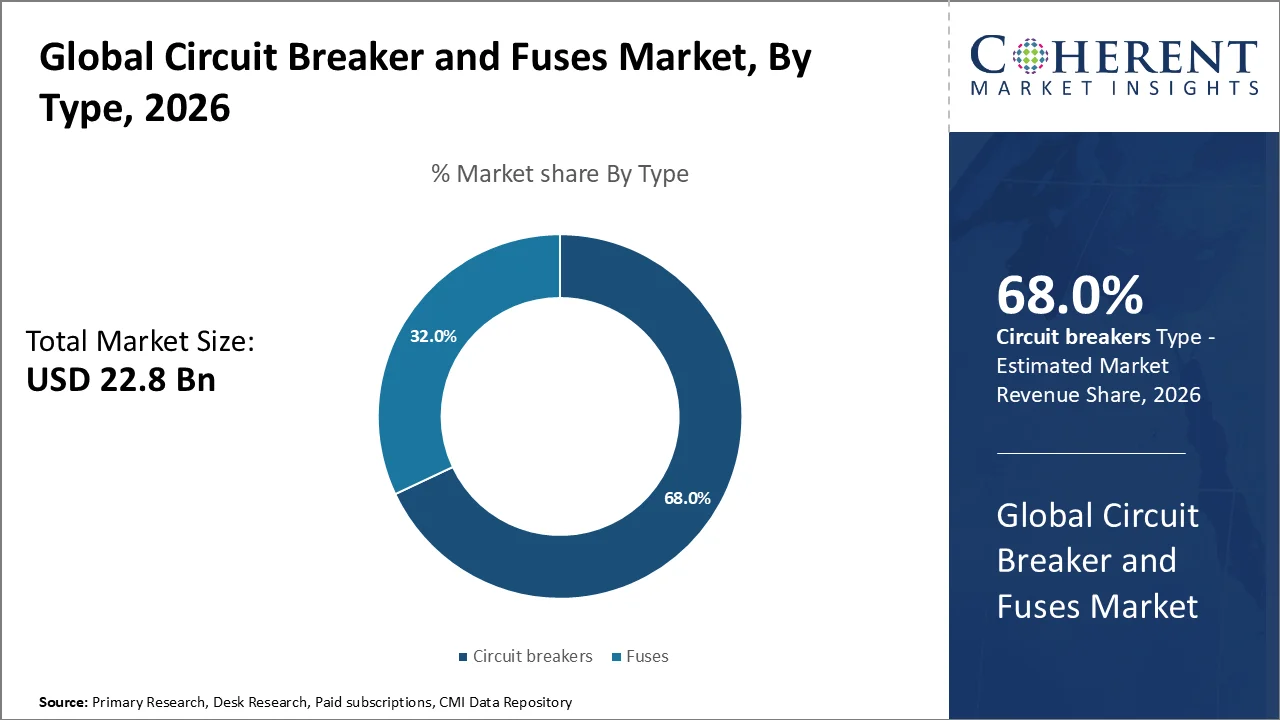
Why is Circuit Breakers Segment Dominating the Market?
Based on type, the Circuit Breakers segment is expected to hold the Circuit Breaker and Fuses Market share by 68% in 2026. The category is witnessing expansion owing to its broad adoption across power generation, transmission and distribution networks, industrial automation systems and renewable energy integration projects, where rapid fault isolation and system protection are crucial.
According to the IEA power 2026 report, worldwide power demand is expected to increase at an average of 3.6% per year (2026–2030) with growth driven by the electrification of industry, transport and data centres, leading to a massive increase in demand for grid protection equipment such as circuit breakers.
In March 2026, ABB launched the DS301C M ICN 10kA ultra-compact residual current circuit breaker (RCBO) at Light + Building 2026, marking a new generation of space-saving, high-performance protection devices for modern residential and commercial electrical distribution systems.
Why is Low Voltage Segment Leading the Market?
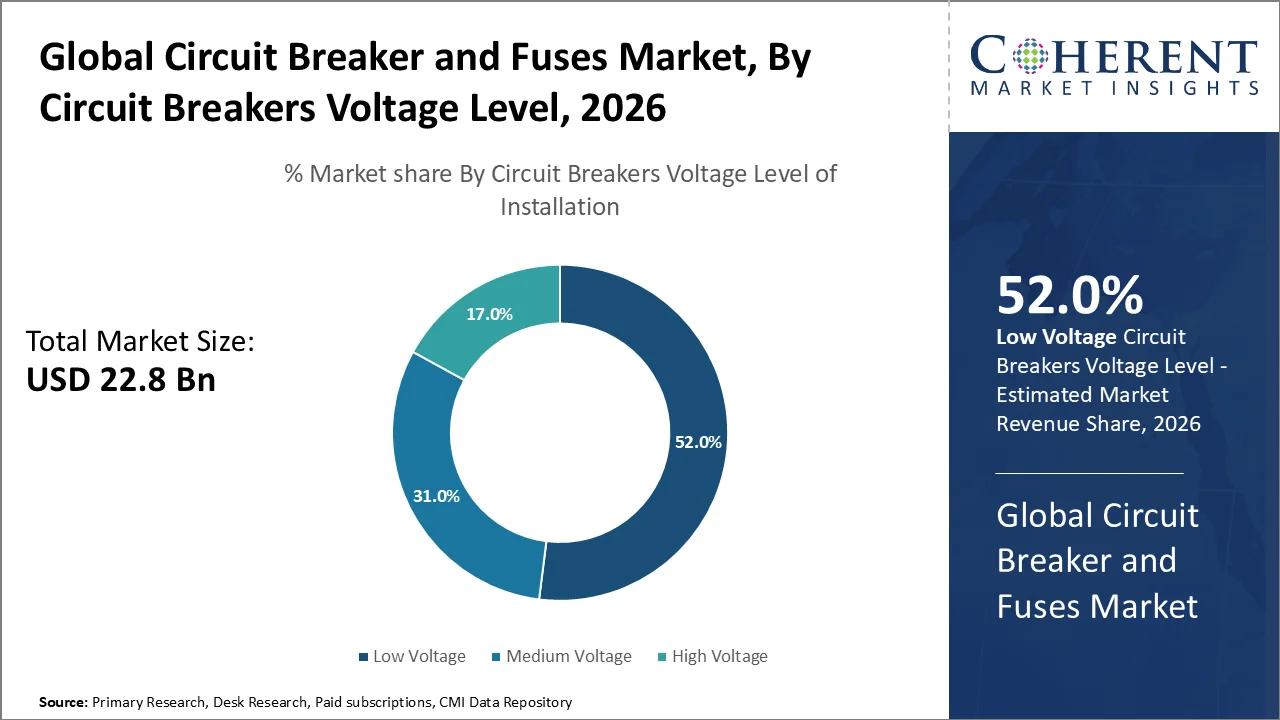
Based on circuit breakers voltage level, the Low Voltage sector is estimated to account for 52% market in 2026, owing to its wide application in residential buildings, commercial infrastructure and industrial distribution systems where most of end-user energy consumption occurs.
According to the IEA Buildings sector research, buildings account for roughly 30% of worldwide energy demand. The industry accounts for a significant share of electrical power consumption in both residential and commercial sectors. This highlights the high level of reliance on low voltage electrical power systems.
In December 2025, Schneider Electric released the Easy9 Pro Catalogue 2025. This adds to Schneider’s family of circuit breakers for low voltage residential and small commercial applications such as miniature circuit breakers, residual current circuit breakers, and residual current breaker overcurrent devices.
Why are Vacuum Circuit Breakers Gaining Strong Adoption?
On the basis of arch quenching type, the Vacuum Circuit Breakers segment is projected to dominate the vacuum circuit breaker market in 2026 with a share of 38%, attributed to its high reliability, long service life, low maintenance needs, and high applicability for medium-voltage applications.
Utilities are rapidly replacing older oil and air-based systems with vacuum interruption technology, due to the greater efficiency, safety, and operational stability of current grid conditions.
According to the IEA electricity system transformation forecast, the distribution networks cause around 80% of all grid outages. Thus, the medium voltage switching equipment is a primary emphasis area for reliability upgrades and fault isolation enhancement.
Why is Low Voltage Fuses Segment Dominating Demand?
Based on fuse voltage level, the Low Voltage Fuses sector is expected to lead with 71% share in 2026, owing to extensive application in residential wire systems, commercial buildings, and small industrial electrical protection systems.
According to the World Bank Energy Access data, global electricity access has expanded to over 90% of the world population, with the majority of new connections occurring at the residential low-voltage distribution level, directly increasing low-voltage fuse deployment.
Why are Cartridge Fuses the Leading Fuse Type?
On the basis of fuse type, the Cartridge Fuses segment is estimated to lead the market with 57% share in 2026, due to strong fault interruption capability, standardized design and wide industrial and commercial usage in electrical protection systems.
According to Eaton’s electrical engineering guidance, cartridge fuses are commonly employed in motor protection, distribution panels and industrial control systems as they have a large breaking capacity and are reliable under fault conditions.
In September 2025, Littelfuse launched the 828 and 827 Series High Voltage Cartridge Fuses, designed for next-generation electric vehicle (EV) onboard chargers and power distribution systems.
Construction Segment Holds the Largest Market Share
Based on application, the Construction segment is projected to lead with a significant 29% share in 2026. The expansion of the market is attributed to the increasing investments in residential and commercial structures, urban infrastructure development, and increasing electrification requirements, which demand the significant deployment of circuit breakers and fuses for safe power distribution and fault protection.
In May 2024, Hager Group invested €120 million and creates 500 new jobs in France by 2026 on the occasion of the Choose France Summit. Some €75 million was committed to boost production capacity and meet the growing demand for electrical distribution and energy management solutions in residential and commercial buildings.
Circuit Breaker and Fuses Market Trends
- Modernization and digitalization of the grid are driving the introduction of sophisticated circuit breakers and smart switchgear. Utilities are modernizing outdated transmission and distribution systems to improve reliability and reduce outages, as well as to enable automated problem detection. According to the IEA World Energy Investment Report 2024, global investment in grids is estimated at about USD 400-450 billion per year, with a heavy focus on growth and modernization.
- Rapid renewable energy integration is increasing grid complexity and demanding quick fault protection systems. The high penetration of solar and wind energy is creating intermittent and bidirectional power flows necessitating improved protection equipment. IEA data indicates that renewables sources account for the majority of new power capacity additions globally, which increases the demand for reliable switching and isolation devices.
- Electrification of mobility (EVs) and charging infrastructure is increasing low and medium-voltage protection requirements. EV charging stations demand highly reliable circuit breakers and fuses to cope with load changes and safety. The IEA Global EV Outlook 2024 reports that the global EV stock exceeded 40 million vehicles, and rapid growth is likely to continue.
- The market is evolving towards smart, digital, and predictive maintenance-enabled technologies. Traditional mechanical breakers are being replaced with vacuum, SF6 alternatives, and IoT-enabled devices that provide real-time monitoring and predictive fault detection, boosting operating efficiency and reducing maintenance costs.
Regional Insights
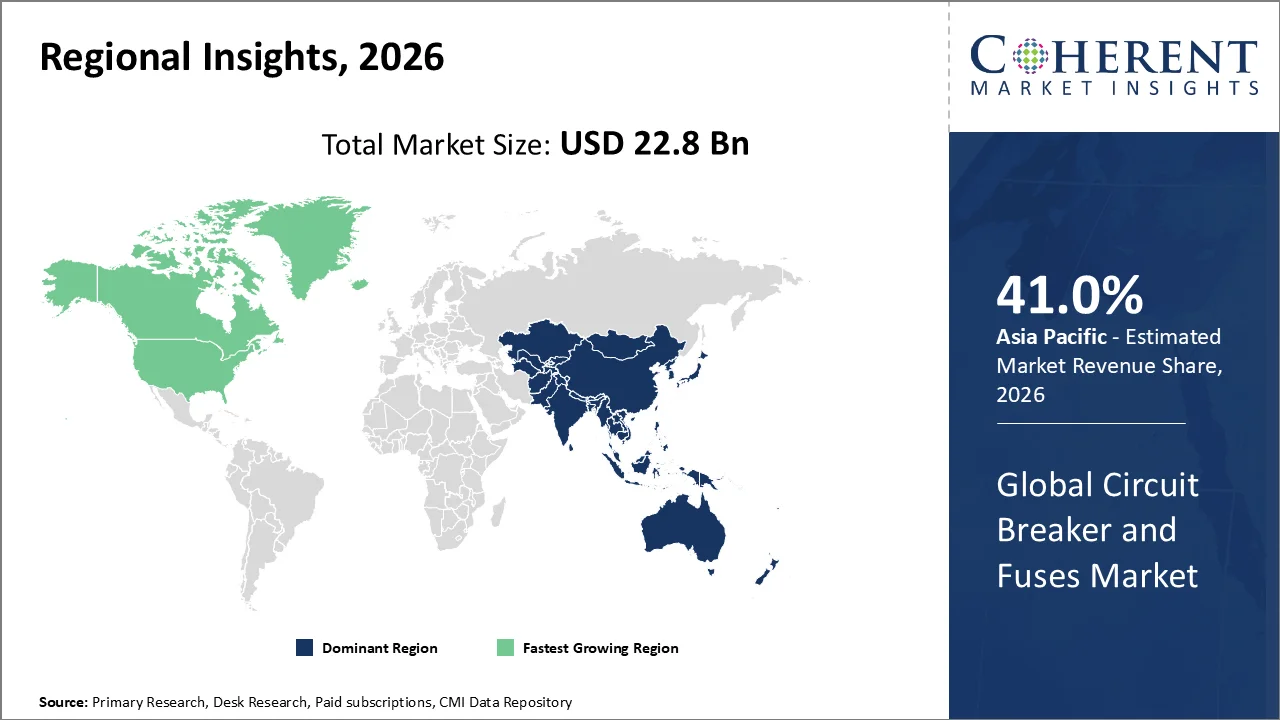
Asia Pacific Dominates Owing to Rapid Electrification and Large-Scale Industrial Expansion
Asia Pacific to hold the highest share of 41% in 2026. The region is dominated by swift urbanization, large-scale electrification projects, development of transmission and distribution networks and robust growth in industrial manufacturing, EV infrastructure and renewable energy installations spanning China, India, Japan and Southeast Asia.
According to the IEA Renewables 2024 report, global renewable capacity additions are projected to increase from 666 GW in 2024 to nearly 935 GW by 2030, with Asia accounting for the largest share of new installations.
North America Emerges as the Fastest-Growing Region Owing to Grid Modernization and Digital Energy Expansion
North America is predicted to be the fastest growing region in the Circuit Breaker and Fuses Market during the forecast period. The region’s growth is driven by large-scale grid modernization projects, increasing investments in renewable energy integration, rapid development of EV charging infrastructure and increased electricity consumption from data centers, industrial automation and electrified transit systems. Utilities in the United States and Canada are also modernizing outdated transmission and distribution networks to improve reliability and minimize the risk of outages, a trend that is considerably driving demand for sophisticated circuit protection devices.
According to the U.S. Department of Energy (DOE) has announced that the country expects to enhance long-distance transmission capacity by 16% by 2030, including 7,500 miles of additional transmission lines, to meet increasing power demand and system resilience. This expansion is intended to enhance deployment of switchgear, circuit breakers, and fuse systems across transmission and distribution networks.
Electrification, Grid Modernization, and Data Center Expansion are Accelerating the Market in United States
The U.S. Circuit Breaker and Fuses Market is witnessing significant growth owing to grid modernization initiatives, increased electricity consumption from data centers, expansion of EV charging infrastructure, and growing expenditures in renewable energy integration.
According to the U.S. Department of Energy (DOE), the Grid Resilience and Innovation Partnerships (GRIP) Program provides USD 10.5 billion to boost grid resilience and flexibility. DOE announced more than USD 7.6 billion in the first and second rounds of financing for 105 projects in all 50 states and the District of Columbia. These initiatives are fostering grid expansion and reliability, and are generating significant demand for switchgear, circuit breakers and protective equipment.
In March 2024, Schneider Electric announced it will invest over USD 140 million to expand manufacturing operations in the United States to include manufacturing facilities for switchboards, switchgear, and circuit breakers to meet rising demand from data centers, utilities, and infrastructure projects.
Massive Renewable Energy Deployment and Ultra-High Voltage Grid Expansion are Strengthening the Market in China
China’s Circuit Breaker and Fuses Market is rising due to large scale deployment of renewable energy, ultra-high-voltage (UHV) transmission projects and continued expenditures in industrial electrification.
In January 2025, State Grid Corporation of China announced further investments worth over CNY 650 billion (roughly USD 90 billion) for power grid infrastructure to enhance transmission capacity and support renewable energy integration, creating significant opportunities for circuit protection equipment manufacturers.
Who are the Major Companies in Circuit Breaker and Fuses Industry
Some of the major key players in Circuit Breaker and Fuses Market are ABB Ltd, Toshiba Corporation, Alstom SA, Siemens AG, Eaton Corporation, Schneider Electric SA, G&W Electric Company, Pennsylvania Breaker, LLC; General Electric, Mitsubishi Electric, and Maxwell Technologies Ltd.
Key News
- In October 2025, ABB Ltd launched the SACE Emax 3 air circuit breaker integrated into its MNS low-voltage switchgear platform for AI-ready data centers, providing enhanced sensing, intelligence, and reliability.
- In June 2024, Siemens AG announced an additional €100 million investment to expand its Frankfurt switchgear plant, increasing gas-insulated switchgear production capacity and creating up to 400 jobs by 2027.
Market Report Scope
Circuit Breaker and Fuses Market Report Coverage
| Report Coverage | Details | ||
|---|---|---|---|
| Base Year: | 2025 | Market Size in 2026: | USD 22.8 Bn |
| Historical Data for: | 2020 To 2024 | Forecast Period: | 2026 To 2033 |
| Forecast Period 2026 to 2033 CAGR: | 5.2% | 2033 Value Projection: | USD 32.4 Bn |
| Geographies covered: |
| ||
| Segments covered: |
| ||
| Companies covered: | ABB Ltd, Toshiba Corporation, Alstom SA, Siemens AG, Eaton Corporation, Schneider Electric SA, G&W Electric Company, Pennsylvania Breaker, LLC; General Electric, Mitsubishi Electric, and Maxwell Technologies Ltd. | ||
| Growth Drivers: |
| ||
| Restraints & Challenges: |
| ||
Analyst Opinion
- Reliability and asset life management are becoming more important issues for utilities and industrial users. CIGRE’s fourth international reliability survey revealed that modern circuit breakers have low major failure frequencies, whereas older assets that have been in operation for over 35 years’ experience significantly higher failure rates, fueling the demand for the replacement of aging assets with advanced circuit breakers and protection devices.
- Equipment design advances are leading to more reliable systems and lower maintenance costs. CIGRE studies show that changing to better performing breaker mechanisms resulted in a dramatic reduction in failures for some utilities. One utility replaced more than 450 transmission circuit breakers and had only one mechanism failure thereafter, highlighting the value of modern protection technologies.
- Growing demands for enhanced protection systems driven by digital substations, EV infrastructure and data center growth. IEA expects the growth in demand for electricity to continue to accelerate, requiring more resilient and intelligent switching and fault isolation equipment, offering long-term prospects for smart circuit breakers and high-performance fuse technologies.
Speak to the analyst
Want personalized insights?
Take the findings above to one of our principal consultants, or have the report rebuilt around the segments, geographies and competitors you actually track.
Market Segmentation
- By Type (Revenue, USD Bn, 2021-2033)
- Circuit breakers
- Fuses
- By Circuit Breakers Voltage level (Revenue, USD Bn, 2021-2033)
- Low voltage
- Medium voltage
- High voltage
- By Arch Quenching Type (Revenue, USD Bn, 2021-2033)
- Air circuit breakers
- Vacuum circuit breakers
- Oil circuit breakers
- SF6 circuit breakers
- Others (CO2, hybrid, DCB)
- By Fuse Voltage level (Revenue, USD Bn, 2021-2033)
- Low voltage fuses
- High voltage fuses
- By Fuse Type (Revenue, USD Bn, 2021-2033)
- Plug-in fuses
- Cartridge fuses
- By Applications (Revenue, USD Bn, 2021-2033)
- Construction
- Transport
- Industrial
- Consumer Electronics
- Power generation
- Others (healthcare, military)
- By Region (Revenue, USD Bn, 2021-2033)
- North America
- U.S.
- Canada
- Latin America
- Brazil
- Mexico
- Argentina
- Rest of Latin America
- Europe
- Germany
- U.K.
- France
- Italy
- Spain
- Russia
- Rest of Europe
- Asia Pacific
- China
- India
- Japan
- Australia
- South Korea
- ASEAN
- Rest of Asia Pacific
- Middle East
- GCC
- Israel
- Rest of Middle East
- Africa
- South Africa
- Central Africa
- North Africa
- North America
Sources
Primary Research Interviews
- Circuit Breaker and Fuse Manufacturers
- Switchgear and Protection Equipment Suppliers
- Power Utilities and Grid Operators
- Transmission & Distribution (T&D) Companies
- Electrical Equipment Distributors and OEMs
- Industrial Automation Solution Providers
- Renewable Energy Project Developers
- Electrical Contractors and EPC Companies
- Smart Grid Technology Providers
- Others
Databases
- Bloomberg Terminal
- Thomson Reuters Eikon
- FactSet
- Others
Magazines
- Power Engineering International
- Electrical Review
- T&D World
- Power Technology Magazine
- Electrical India
- Energy Global
- Others
Journals
- IEEE Transactions on Power Delivery
- IEEE Transactions on Power Systems
- Electric Power Systems Research
- International Journal of Electrical Power & Energy Systems
- Journal of Modern Power Systems and Clean Energy
- Energies Journal
- Others
Newspapers
- Reuters
- Bloomberg News
- Financial Times
- The Wall Street Journal
- The Economic Times
- Business Standard
- Nikkei Asia
- Others
Associations
- International Energy Agency (IEA)
- International Electrotechnical Commission (IEC)
- Institute of Electrical and Electronics Engineers (IEEE)
- CIGRE (International Council on Large Electric Systems)
- Edison Electric Institute (EEI)
- National Electrical Manufacturers Association (NEMA)
- Electrical Safety Foundation International (ESFI)
- Others
Public Domain Sources
- International Energy Agency (IEA)
- U.S. Department of Energy (DOE)
- U.S. Energy Information Administration (EIA)
- World Bank Open Data
- International Renewable Energy Agency (IRENA)
- International Electrotechnical Commission (IEC)
- National Renewable Energy Laboratory (NREL)
- State Grid Corporation of China
- Eurostat
- U.S. Census Bureau
- Others
Proprietary Elements
- CMI Data Analytics Tool
- Proprietary CMI Existing Repository of Information for the Last 10 Years
Get access to 250+ pages report
Every segment, forecast, competitor profile and data table behind the analysis above — available for instant download.
- ESOMAR Member
- ISO 9001:2015 Certified
- D-U-N-S Registered
- GDPR & CCPA Compliant
Missing comfort of reading report in your local language? Find your preferred language:
Transform your Strategy with Exclusive Trending Reports
Frequently Asked Questions
The Circuit Breaker and Fuses Market is expected to reach USD 32.4 Bn by 2033.
Major players operating in the global Circuit Breaker and Fuses Market include ABB Ltd, Toshiba Corporation, Alstom SA, Siemens AG, Eaton Corporation, Schneider Electric SA, G&W Electric Company, Pennsylvania Breaker, LLC, General Electric, Mitsubishi Electric, and Maxwell Technologies Ltd.
The complex integration with aging power infrastructure and legacy grids, risk of counterfeit and low-quality electrical protection components, high maintenance costs, and increasing grid complexity associated with renewable energy integration are the key factors hampering growth of the market.
The rapid electrification and rising electricity demand, expansion of transmission and distribution (T&D) infrastructure, growing renewable energy integration, increasing industrial automation, and rising investments in EV charging infrastructure and smart grids are boosting demand for circuit breakers and fuses.
The Circuit Breaker and Fuses Market is anticipated to grow at a CAGR of 5.2% between 2026 and 2033.
Among regions, Asia Pacific is expected to account for the largest market share in the global Circuit Breaker and Fuses Market over the forecast period, owing to rapid urbanization, industrialization, electrification projects, and expansion of transmission and distribution infrastructure.
Utilities and industries are adopting advanced circuit breakers and fuses to improve grid reliability, prevent electrical faults, support renewable energy integration, reduce downtime, and enhance safety across residential, commercial, and industrial power systems.