

Low Voltage Motor Control Center Market Analysis & Forecast: 2026-2033
Low Voltage Motor Control Center Market is estimated to be valued at USD 5,032.6 Mn in 2026 and is expected to reach USD 8,279.0 Mn in 2033, exhibiting a compound annual growth rate (CAGR) of 7.4% from 2026 to 2033.
Key Takeaways
- By Type, the Traditional Motor Control Center (MCC) segment is projected to dominate the global Low Voltage Motor Control Center Market in 2026, accounting for the largest share due to its widespread adoption in established industrial sectors.
- By Region, Asia Pacific is expected to lead the Low Voltage Motor Control Center Market in 2026, capturing a commanding 33.3% share, driven by rapid industrialization, expanding manufacturing base, and growing infrastructure investments.
Market Overview
The increasing need for commercial facilities such as hotels, restaurants, office complexes, and retail shops is anticipated to fuel the growth of the Global Low Voltage Motor Control Center Market. In addition, the growing focus on industrialization tends to expand the market, for instance, the motor control market is positively impacted by the construction boom in commercial facilities in Asia and other emerging economies.
Current Events and Its Impact on the Global Low Voltage Motor Control Center Market
Event | Description and Impact |
Global Supply Chain Disruptions and Semiconductor Shortages |
|
Energy Transition and Renewable Energy Expansion |
|
Inflation and Interest Rate Changes in Major Economies |
|
Role of Advanced Technologies
The manufacturing of low voltage motor control centers is undergoing a significant transformation driven by the adoption of intelligent low voltage motor control centers. These advanced systems integrate IoT-enabled sensors, edge computing, and smart connectivity protocols such as EtherNet/IP and Modbus TCP/IP, enabling real-time monitoring and predictive maintenance. Low voltage motor control centers manufacturers are increasingly focusing on embedding microprocessor-based protection relays and arc flash reduction technologies to enhance motor safety and worker protection.
Advanced energy management features in these intelligent low voltage motor control centers optimize power consumption and maintain power quality through harmonic mitigation and power factor correction. Modular and flexible designs allow for scalable and rapid equipment upgrades, improving maintenance efficiency without interrupting operations.
Moreover, cybersecurity has become a vital aspect, with low voltage motor control centers manufacturers incorporating encrypted communication and secure authentication to protect connected MCC systems from cyber threats. The integration of AI and machine learning further enables autonomous motor control optimization, enhancing operational efficiency and reducing downtime.
These technological advancements position low voltage motor control centers as critical components in modern industrial automation, supporting smarter, safer, and more energy-efficient manufacturing processes globally.
- Current Industry Events of 2026
- Market Size Estimation
- Regional Breakdown
- Competitive Landscape
- Customer Intelligence
- Segmental Analysis
- Pricing Analysis
- Key Market Drivers, Challenges & Future Trends
- Customized Insights Section
Segmental Insights
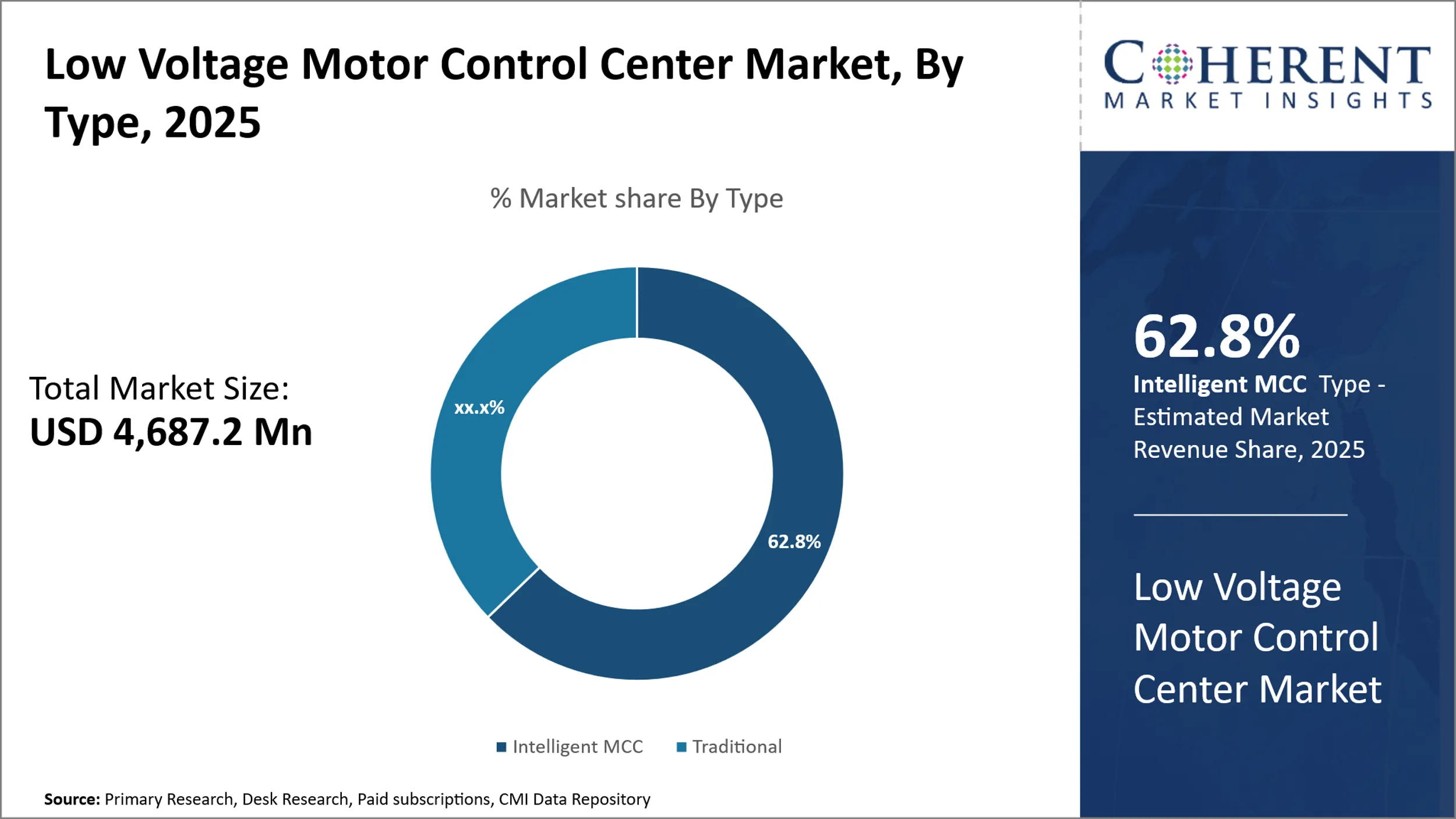
Global Motor Control Center (MCC) Market Insights, By Type
In terms of type, the Traditional MCC segment is expected to dominate the global market by 2026, capturing a significant 63.8% share in terms of value. This dominance stems from the consistent demand for traditional motor control centers across diverse industrial environments.
Traditional MCCs are specifically designed to withstand harsh conditions such as dust, moisture, corrosive atmospheres, and wide temperature fluctuations, making them highly suitable for industrial settings. The proven reliability and robustness of low voltage traditional MCCs continue to drive their adoption across sectors like manufacturing, utilities, and heavy industries, supporting sustained market growth for this segment.
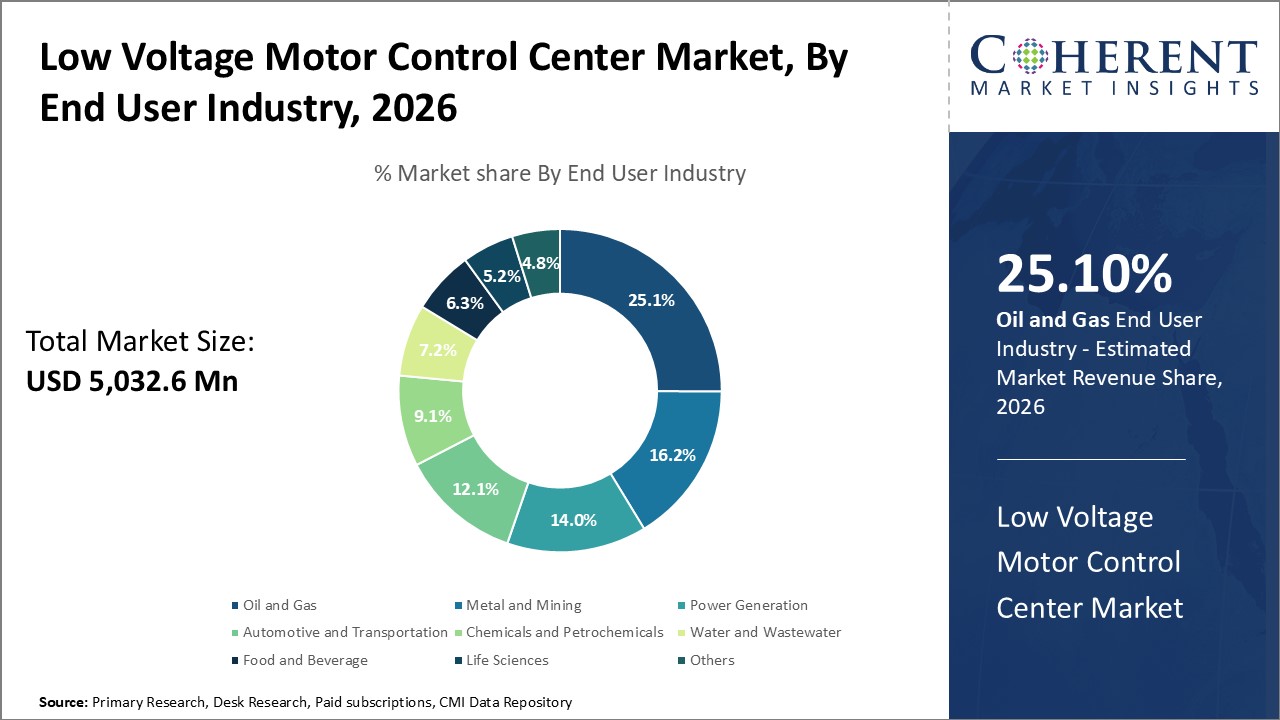
Global Motor Control Center (MCC) Market Insights, By End User Industry
Among end user industries, the Oil and Gas segment is projected to lead the market over the forecast period. This is largely due to significant investments in power management solutions by companies within the sector.
Power management in oil and gas typically involves a combination of low, medium, and high voltage switchgear, motor control centers, and emergency power generation systems. The high demand for reliable low voltage MCCs to ensure continuous and safe operations in challenging environments is a key factor driving growth in this industry segment.
Regional Insights
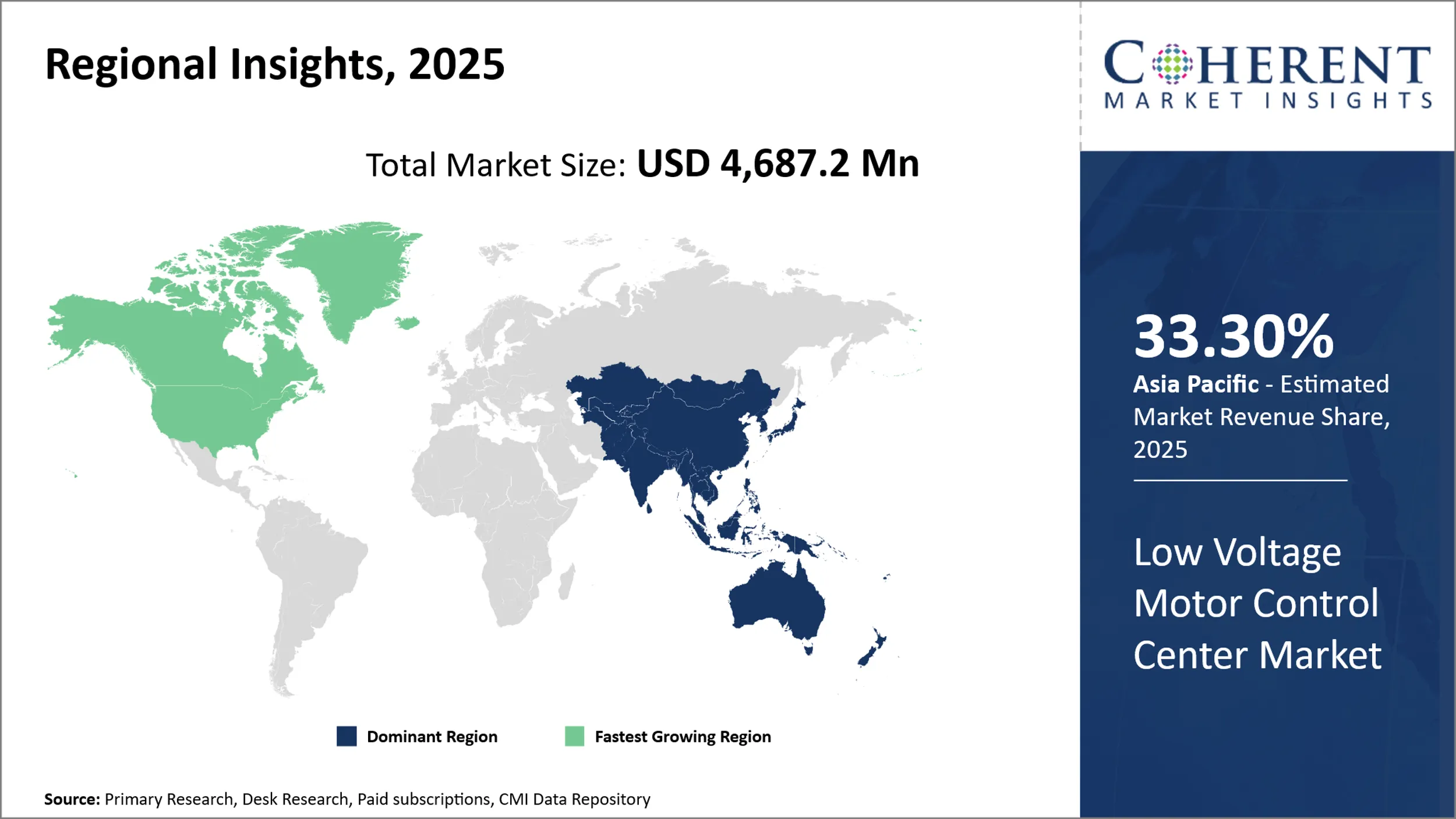
Asia Pacific Low Voltage Motor Control Center Market Analysis and Trends
Asia Pacific is anticipated to lead the global low voltage motor control center market with a commanding 33.30% share by 2026. The region’s dominance is largely attributed to widespread adoption of automation technologies across multiple industries such as manufacturing, chemicals, and infrastructure development.
Increasing energy efficiency concerns have accelerated the demand for compact, energy-saving low voltage electrical equipment, prompting manufacturers to innovate and launch highly efficient MCC solutions. Furthermore, the rapid growth of the manufacturing sector and industrialization in countries like China, India, Japan, and South Korea is fueling demand for reliable motor control systems that support large-scale production.
Government initiatives to modernize industrial facilities and focus on sustainable energy use also strengthen market prospects. This robust growth trajectory positions Asia Pacific as a key player in the global low voltage MCC landscape.
North America Low Voltage Motor Control Center Market Analysis and Trends
North America is projected to witness significant growth in the global low voltage motor control center (MCC) market during the forecast period. This expansion is driven primarily by the increasing adoption of new MCC and intelligent motor control centers (IMCC) across key industries such as life sciences, pharmaceuticals, and food processing.
Companies are investing in the expansion and modernization of existing plants as part of broader digital transformation initiatives. For example, Eli Lilly and Company announced a US$400 million investment in upgrading its facilities in November 2019, highlighting the trend toward modernized automation infrastructure.
Additionally, rising demand for efficient low voltage MCC systems in the food processing sector further supports market growth. The region’s strong industrial base, combined with technological advancements and regulatory emphasis on energy efficiency, continues to propel adoption of advanced motor control solutions.
Europe and Other Regions Low Voltage Motor Control Center Market Analysis and Trends
Europe holds a significant share of the global low voltage motor control center market, driven by stringent energy regulations and the adoption of Industry 4.0 technologies. The presence of well-established manufacturing industries, including automotive, chemicals, and pharmaceuticals, encourages demand for sophisticated motor control systems designed to optimize performance and reduce energy consumption. Countries such as Germany, France, and the UK are leading efforts to upgrade legacy electrical infrastructure to meet sustainability targets.
Dominating Countries in the Low Voltage Motor Control Center Market
United States Low Voltage Motor Control Center Market Analysis and Trends
The United States is a dominant market in North America, fueled by investments in life sciences, pharmaceuticals, and food processing industries. The country’s focus on digital transformation and facility expansion continues to drive demand for advanced MCC and IMCC solutions. Regulatory emphasis on energy efficiency and safety standards further supports growth, making the U.S. a hotspot for technological innovation in motor control centers.
China Low Voltage Motor Control Center Market Analysis and Trends
China leads the Asia Pacific market, driven by rapid industrialization and significant investments in manufacturing and infrastructure. The country’s energy conservation policies and push for automation adoption in industries such as chemicals, electronics, and automotive manufacturing create strong demand for low voltage MCCs. China’s growing domestic production and R&D capabilities also enhance its market position.
India Low Voltage Motor Control Center Market Analysis and Trends
India is experiencing rapid growth in the low voltage MCC market due to expanding manufacturing capabilities and rising industrial automation. Government initiatives focused on ‘Make in India’ and energy efficiency are encouraging adoption of compact and smart motor control solutions. Increasing infrastructure projects and modernization of factories also contribute to the growing market.
Market Report Scope
Low Voltage Motor Control Center Market Report Coverage
| Report Coverage | Details | ||
|---|---|---|---|
| Base Year: | 2025 | Market Size in 2026: | USD 5,032.6 Mn |
| Historical Data for: | 2020 To 2024 | Forecast Period: | 2026 To 2033 |
| Forecast Period 2026 to 2033 CAGR: | 7.4% | 2033 Value Projection: | USD 8,279.0 Mn |
| Geographies covered: |
| ||
| Segments covered: |
| ||
| Companies covered: | Tesco Controls Inc., ABB Ltd., Mitsubishi Electric Corporation, Schneider Electric SE, Allis Electric Co. Ltd., Siemens AG, Weg SA, Rockwell Automation Inc., and Eaton Corporation PLC | ||
| Growth Drivers: |
| ||
| Restraints & Challenges: |
| ||
Global Low Voltage Motor Control Center Market Drivers
- Rise in industrial automation across the globe to fuel the market pace
The growing adoption of Industry 4.0 concept across industries is bringing several advancements in productivity and efficiency along with changes in the way industrial processes operate. The conventional business operations are likely to change due to growing connectivity of the network to the manufacturing process as well as advancements in production efficiency.
This is further expected to create lucrative opportunities for the market. The demand for automated systems in the processes is increasing due to high cost of labor and competitive rivalry. Due to this, demand for intelligent MCC is likely to increase, which in turn is expected to fuel growth of the global low voltage motor control center market during the forecast period.
- Rise infrastructural developments to boost the market pace
The end user industries of this market rely on heavy capital investments for adoption of novel low voltage motor control centers or for shifting to IMCC. There is a rise in investment in power management solutions across heavy industries such as metal and mining, oil and gas, and petrochemical among others.
Moreover, the food and beverage along with water and wastewater industries are also likely to witness infrastructural developments in the near future. Thus, this factor is expected to propel growth of the global low voltage motor control center market during the forecast period.
Global Low Voltage Motor Control Center Market Opportunities
Increase in consumer propensity towards adopting connected solutions is likely to bring lucrative opportunities in the global low voltage motor control center market during the forecast period. Consumers of the market are looking for upgrading their systems and are increasing adopting connected solutions.
Thus, vendors in the market are focusing to offer integrated solutions that includes various standalone MCCs components. Market vendors are thus likely to increase their product offerings towards integration and connectivity software and hardware solutions in the coming years. This in turn will bring growth opportunities in the global low voltage motor control center market.
Rise in demand from end user industries in developing nations is anticipated to create multiple opportunities in the global low voltage motor control center market during the forecast period. The demand for MCCs is likely to decrease due to rise in adoption of IMCCs in developed regions such as North America and Europe, as consumers demand upgrade of their existing systems. However, demand for low voltage MCC is increasing in end user industries such as water and wastewater, food and beverage, and oil and gas industries in developing countries, due to lack of such infrastructure. This is further expected to create growth opportunities in the market over the forecast future.
Global Low Voltage Motor Control Center Market Trends
- Increasing adoption in organic food processing sector is a growing trend
The demand for organic food is growing in European region, especially in Germany. This is further driving the adoption of IMCC among organic food processing firms. This in turn is expected to drive the market growth in this region. Moreover, the number of wastewater treatment plants replacing the existing MCCs and IMCCs in Europe is growing, due to the groundwater directives and water framework directives in the region.
- Rise in government investment in increasing power generation capacity is a recent trend
Governments of several countries, especially in Asia Pacific region are increasingly making investments to increase their power generation capacities.
From this budget for 850 power plants, more than 75% is nuclear and coal-based. Thus, such investments by government of countries are a growing trend in the global low voltage motor control center market, which in turn is likely to drive growth of the market.
Analyst Viewpoint
- The low voltage motor control center (LV MCC) market is gaining strong momentum, propelled by the rise of industrial automation and a global focus on energy efficiency. Manufacturing industries are increasingly implementing smart motor control systems to enhance operational efficiency, cut energy use, and improve process reliability. The incorporation of IoT technologies and predictive maintenance offers substantial benefits for industrial operators aiming to reduce downtime and lower maintenance expenses.
- Despite this growth, the market faces challenges such as significant upfront costs and complex installation processes, which may discourage small and medium enterprises from adopting these solutions. Additionally, supply chain disruptions and semiconductor shortages have caused procurement delays, impacting project schedules across industrial sectors.
- Key growth opportunities exist within the renewable energy segment, where LV MCCs are essential components in wind and solar power plants. Heightened emphasis on sustainable manufacturing and stricter energy efficiency regulations further drive demand. Moreover, digital transformation across industries is increasing interest in advanced motor control systems equipped with improved monitoring and diagnostic features.
- Regionally, Asia-Pacific leads the market, driven by rapid industrialization in countries like China and India and major infrastructure investments. North America, however, is experiencing the fastest growth due to the modernization of aging industrial assets and rigorous energy efficiency standards. The pharmaceutical and food processing sectors also represent important growth areas, requiring sophisticated motor control technologies to comply with stringent operational and regulatory demands.
Global Low Voltage Motor Control Center Market: Key Developments
- In October 2024, Siemens AG, a global leader in industrial automation, announced the launch of its next-generation low voltage motor control center (MCC) series featuring integrated IoT connectivity and advanced energy management capabilities, aimed at enhancing operational efficiency in manufacturing plants.
- In December 2024, Schneider Electric unveiled its EcoStruxure Motor Control Center, designed with modular architecture and enhanced safety features to meet stringent international energy efficiency standards, targeting the oil & gas and utilities sectors.
- In September 2024, ABB announced a strategic partnership with a leading IoT platform provider to develop smart MCC solutions capable of predictive maintenance and remote monitoring, aimed at reducing downtime and operational costs for industrial clients worldwide.
Market Segmentation
- Global Low Voltage Motor Control Center Market, By Type (Revenue, USD Mn, 2021 - 2033)
- Traditional MCC
- Intelligent MCC
- Global Low Voltage Motor Control Center Market, By End User Vertical (Revenue, USD Mn, 2021 - 2033)
- Oil and Gas
- Metal and Mining
- Power Generation
- Automotive and Transportation
- Chemicals and Petrochemicals
- Water and Wastewater
- Food and Beverage
- Life Sciences
- Other End user Industries
- Global Low Voltage Motor Control Center Market, By Geography (Revenue, USD Mn, 2021 - 2033)
- North America
- U.S.
- Canada
- Latin America
- Brazil
- Argentina
- Mexico
- Rest of Latin America
- Europe
- Germany
- U.K.
- Spain
- France
- Italy
- Russia
- Rest of Europe
- Asia Pacific
- China
- India
- Japan
- Australia
- South Korea
- ASEAN
- Rest of Asia Pacific
- Middle East
- GCC Countries
- Israel
- Rest of Middle East
- Africa
- South Africa
- North Africa
- Central Africa
- North America
- Company Profiles
- ABB Ltd.
- Schneider Electric SE
- Siemens AG
- Rockwell Automation Inc.
- Eaton Corporation PLC
- Weg SA
- Allis Electric Co. Ltd.
- Mitsubishi Electric Corporation
- Tesco Controls Inc.
Sources
Primary Research Interviews
- Motor Control Center Manufacturers
- Electrical Equipment Distributors
- Industrial Automation Engineers
- Power System Integrators
- Others
Databases
- Bloomberg Terminal
- Thomson Reuters Eikon
- IHS Markit
- Euromonitor International
- Others
Magazines
- Electrical Construction & Maintenance (EC&M)
- Control Engineering Magazine
- Plant Engineering
- IndustryWeek
- Others
Journals
- IEEE Transactions on Industrial Electronics
- Electric Power Systems Research
- International Journal of Electrical Power & Energy Systems
- Others
Newspapers
- Financial Times
- The Wall Street Journal
- Reuters
- Bloomberg News
- Others
Associations
- National Electrical Manufacturers Association (NEMA)
- International Electrotechnical Commission (IEC)
- Institute of Electrical and Electronics Engineers (IEEE)
- Electrical Apparatus Service Association (EASA)
- Others
Public Domain Sources
- U.S. Department of Energy (DOE)
- International Energy Agency (IEA)
- World Bank Open Data
- Government Statistical Offices
- Others
Proprietary Elements
- CMI Data Analytics Tool
- Proprietary CMI Existing Repository of information for last 8 years
Definition: Low Voltage Motor Control Center is a type of electrical control equipment that is used for controlling the speed of electric motors. These units are a key part of electrical controls systems and are often found in manufacturing plants that need power for their processes.
Get access to 250+ pages report
Every segment, forecast, competitor profile and data table behind the analysis above — available for instant download.
- ESOMAR Member
- ISO 9001:2015 Certified
- D-U-N-S Registered
- GDPR & CCPA Compliant
Missing comfort of reading report in your local language? Find your preferred language:
Transform your Strategy with Exclusive Trending Reports
Frequently Asked Questions
The Low Voltage Motor Control Center Market size is estimated to be valued at USD 5,032.6 Mn in 2026, and is expected to reach USD 8,279.0 Mn by 2033.
The CAGR of the global Market is projected to be 7.4% from 2026 to 2033.
Rise in industrial automation across the globe and rise infrastructural developments are fuelling the growth of market.
The Traditional segment is the leading component segment in the market.
Fewer amount of replacement sales and sluggish investment from oil and gas industry are the major factors restraining market.
Tesco Controls Inc., ABB Ltd., Mitsubishi Electric Corporation, Schneider Electric SE, Allis Electric Co. Ltd., Siemens AG, Weg SA, Rockwell Automation Inc., and Eaton Corporation PLC.
Motor control problems refer to issues like overheating, voltage fluctuations, short circuits, mechanical failures, and improper start/stop sequences that affect the performance and lifespan of electric motors.