

Magnetic Sensors Market Analysis & Forecast: 2026-2033
The global magnetic sensors market is estimated to be valued at USD 4.32 Bn in 2026 and is expected to reach USD 6.50 Bn by 2033, exhibiting a compound annual growth rate (CAGR) of 6.0% from 2026 to 2033.
Key Takeaways
- By Type, the Hall Effect Sensors segment is projected to dominate the global Magnetic Sensors Market in 2026, accounting for 41.9% of the total market share.
- By Technology, Analog Magnetic Sensors are expected to lead the market in 2026, holding a substantial 63.8% share due to their cost-effectiveness and reliability in traditional applications.
- By End-Use Industry, The Automotive Segment is anticipated to remain the largest consumer of magnetic sensors in 2026, contributing 38.3% of the global market share.
- By Region, North America is forecast to dominate the Magnetic Sensors Market in 2026, capturing an estimated 38.1% share, driven by advancements in automotive electronics and industrial automation.
Market Overview
The Consumer Electronics and Automotive industries are two example verticals where the applications of magnetic sensors are being widely adopted, and the market is growing. To take another example, in 2024 Infineon Technologies expanded its portfolio of magnetic sensors, further facilitating the use of ADAS in EVs (electric vehicles). These sensors are very accurate, consume low power, and are widely used in safety critical applications for positioning and speed information. In general, growth is being driven by technological improvements and increasing safety requirements, offset, of course, by the presence of competing technologies.
Current Events and Its Impact on the Magnetic Sensors Market
Event | Description and Impact |
China’s Economic Slowdown and Manufacturing Sector Contraction |
|
U.S.-China Technology Trade Restrictions and Semiconductor Supply Chain Disruptions |
|
European Union’s Green Deal and Electric Vehicle Transition Acceleration |
|
Role of Emerging Technologies
The role of emerging technologies in the magnetic sensors market is both transformative and expansive. Magnetic sensors are numerous and increasingly sophisticated, driven by continuous advancements in materials, design, and integration. In particular, magnetic sensors for automotive applications have seen significant innovation, with automotive-grade magnetic sensors evolving to meet stringent demands for precision, reliability, and interference resistance in electric and autonomous vehicles.
Technologies such as Tunnel Magnetoresistance (TMR) and MEMS-based sensors enable ultra-sensitive, miniaturized devices that support multi-axis detection and sensor fusion. These advancements enhance the penetration of magnetic sensors in automotive systems, including motor control, position sensing, and safety-critical functions compliant with ISO 26262 standards.
Furthermore, integration with wireless communication and edge computing supports real-time monitoring and predictive maintenance, enhancing sensor utility in Industry 4.0 and IoT ecosystems. Flexible and quantum sensors are opening new possibilities for wearables and medical imaging, broadening magnetic sensor applications beyond traditional sectors.
- Current Industry Events of 2026
- Market Size Estimation
- Regional Breakdown
- Competitive Landscape
- Customer Intelligence
- Segmental Analysis
- Pricing Analysis
- Key Market Drivers, Challenges & Future Trends
- Customized Insights Section
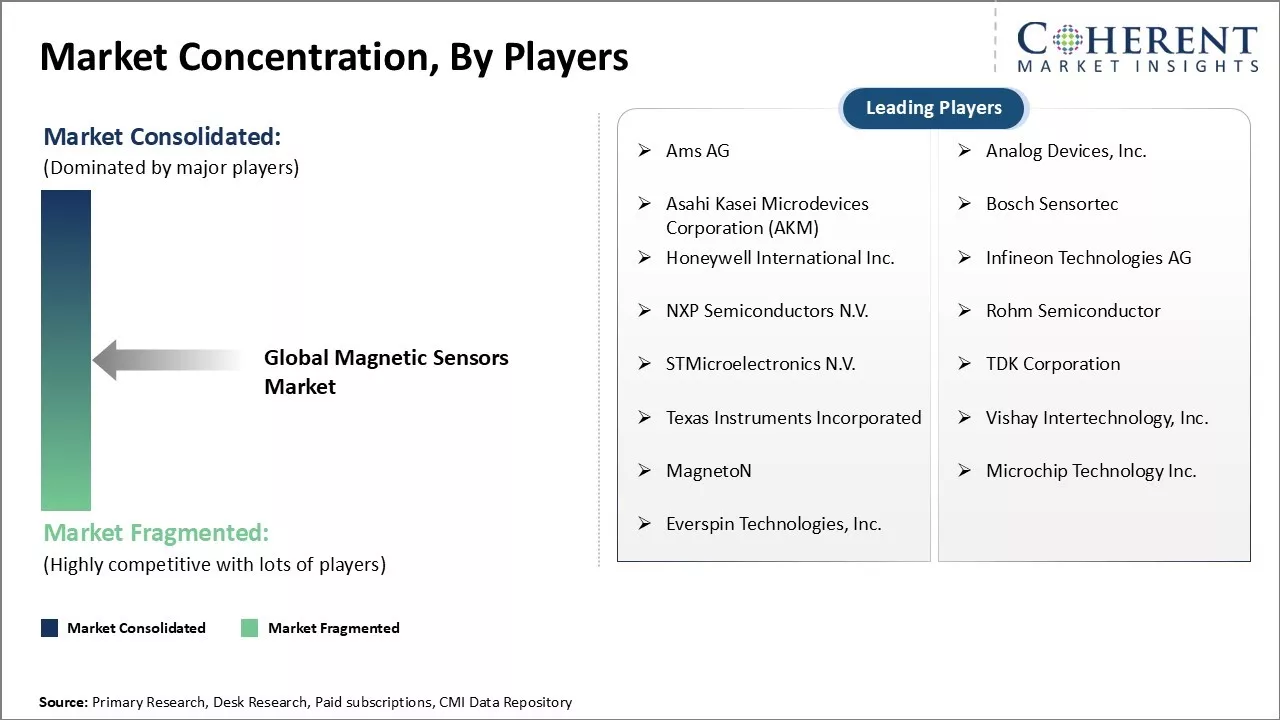
Market Concentration and Competitive Landscape
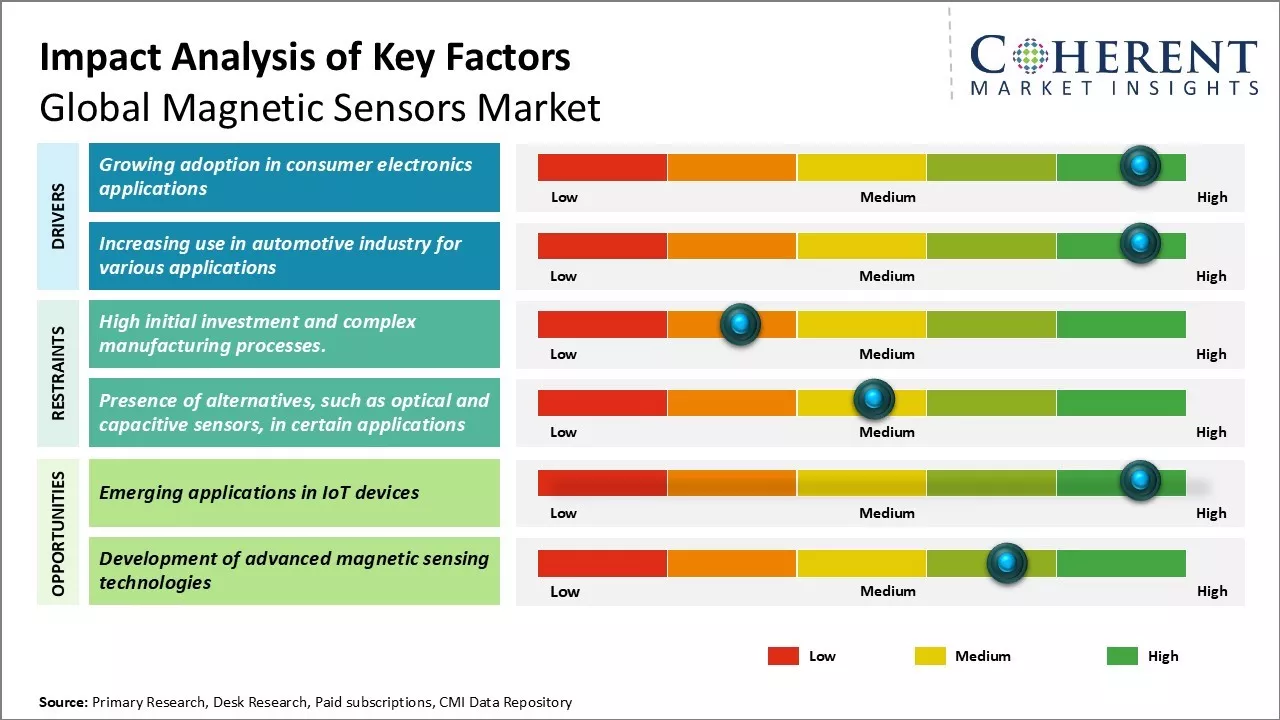
Increasing use in automotive industry for various applications
The automotive industry has emerged as a major end-use segment for magnetic sensors in modern times. A contemporary vehicle now houses dozens of sensors, controllers, and electronic control units for handling various functions related to engine optimization, emissions control, safety, comfort, and infotainment. Magnetic sensors form an indispensable part of such networked automotive electronic systems, and their adoption is rising steadily owing to several factors.
Vehicle safety systems like anti-lock braking and electronic stability control heavily rely on magnetic speed and position sensors to instantaneously detect wheel slippage or loss of traction. This helps prevent accidents by enabling precise traction control. Sensors also play a key role in advanced driver-assistance features through applications like blind-spot detection, automatic braking and lane-keep assist. As autonomous driving becomes a greater reality, vehicles equipped with highly accurate magnetic angular and linear position sensors can map their surrounds in real-time for self-navigation.
Rising electrification of automobiles has further bolstered the need for magnetic sensors. Electric motors require position tracking of rotors and timing belt for optimized torque generation. Hybrid and electric powertrains too are sensor-intensive with their reliance on sensors to switch smoothly between engine and electric modes. Even non-electric automobiles now commonly employ start-stop technology where magnetic sensors are needed to restart the engine automatically. Infotainment and telematics functions like rear-view cameras also leverage magnetic field sensing for their operation.
Battery management further draws upon magnetic current and temperature measurement to balance charging loads and prevent overheating. As automakers aggressively push for connected vehicles capabilities via features like automatic software updates and remote diagnostics, the use of magnetic sensors as node components linking various ECUs is growing.
Market Opportunities: Emerging applications in IoT devices for market
One of the key opportunities for the global magnetic sensors market lies in its increasing usage in various Internet of Things (IoT) devices. With growing penetration of smartphones, wearable devices, wireless healthcare gadgets, and smart home/industrial appliances, the need for miniature low-power magnetic sensors has been on the rise.
IoT has opened up several new application areas for magnetic sensors such as in contactless payment, navigation, remote controls, and position/movement sensing for user interface. Magnetic sensors now allow developers to add innovative location-based and gesture recognition functions in various IoT gadgets.
Furthermore, their ability to detect magnetic fields for networking between connected devices presents an emerging opportunity. It is estimated that the integration of magnetic sensing capabilities will become more commonplace across a wide range of IoT applications going forward leading to strong demand prospects for magnetic sensor vendors over the long term.
Market Driver - Growing adoption in consumer electronics applications
The consumer electronics sector has seen tremendous growth over the past decade owing to ongoing innovations as well as rising disposable income of consumers globally. This has translated into increased demand for devices such as smartphones, tablets, gaming consoles, smart wearables, and other portable consumer devices. Magnetic sensors have emerged as a critical component for various applications in consumer electronics.
Nearly all smartphones are now equipped with magnetic sensors to support features like pedometer, compass, and other location-based services. Advancements in magnetic sensor technology have enabled them to become smaller in size while delivering higher accuracy and sensitivity. This allows smartphone manufacturers to integrate them without significantly increasing the device thickness or cost.
With more focus on fitness tracking and health monitoring via mobile apps, magnetic sensors that can precisely count steps and measure body movement are seeing higher adoption in contemporary smartphones. Tablets and other portable consumer devices are also incorporating them to add interactive features.
Gaming consoles rely on magnetic sensors for motion-sensing game controllers that detect things like hand gestures and body movement. This has enhanced the gaming experience for users. Next-generation virtual reality and augmented reality headsets utilize accurate magnetic sensors for motion tracking capabilities. The demand for these immersive technologies is surging rapidly with their use cases spanning gaming, entertainment and workplace training.
Smart wearables like smartwatches and fitness trackers heavily depend on miniature magnetic sensors to measure vital health metrics like heart rate, sleep patterns and more. This has fueled strong growth in the shipments of health-focused wearable devices.
Overall, consumer expectations on interactivity from electronic devices are increasing continuously. Magnetic sensors play an important role in fulfilling those expectations by enabling gesture controls, mapping body motion and powering AR/VR applications.
Segmental Insights
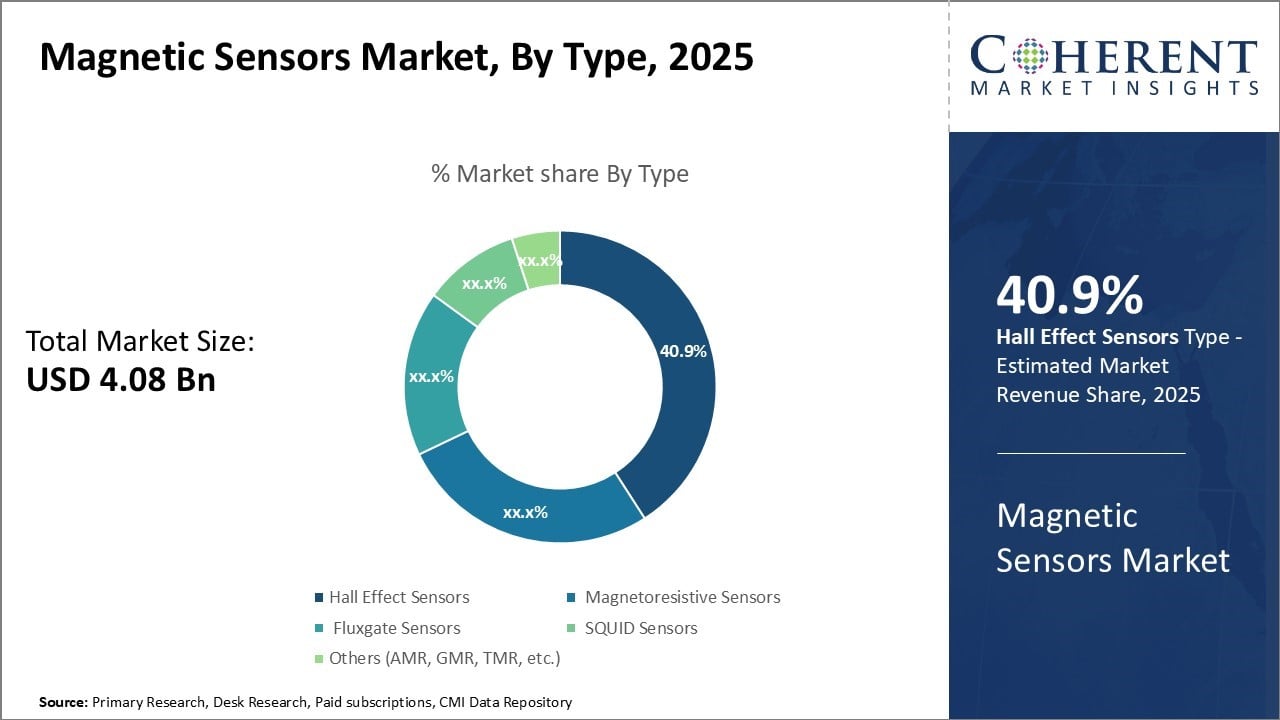
Global Magnetic Sensors Market Insights, By Type
In terms of type, Hall Effect sensors contribute 41.9% share of the market in 2026 owing to their widespread use in industrial automation applications. Hall Effect sensors are widely used for position sensing and proximity switching in automated machinery found in various industries such as automotive manufacturing, food processing, and semiconductor fabrication. Their non-contact operation makes them well-suited for harsh industrial environments where moving parts and heavy loads are involved.
Hall Effect sensors offer reliability and longevity even with continuous operation in conditions with vibrations, dirt, and temperature fluctuations. Most industrial robots, packaging lines, and assembly machines rely on Hall sensors for accurate speed or position feedback from motor shafts, conveyor belts, and moving parts. They enable consistent production outputs through precise motion control and detection of items on a conveyor. Additionally, their low cost makes them suitable for high-volume repetitive sensing applications found across various automated assembly processes.
As global industries rapidly automate manual and repetitive tasks, the demand for sophisticated automated systems with complex motion controls is rising significantly. This widespread industrial automation trend drives substantial growth in the use of Hall Effect sensors for proximity detection, positioning, speed measurement, and other feedback applications.
Manufacturers continue to develop more precise and durable Hall sensors optimized for the rugged factory environments while lowering costs, further fueling their popularity among industrial machinery designers. Overall, the growing prominence of automated manufacturing processes across industries makes Hall Effect sensors an integral part of industrial machinery, cementing their leading market share position.
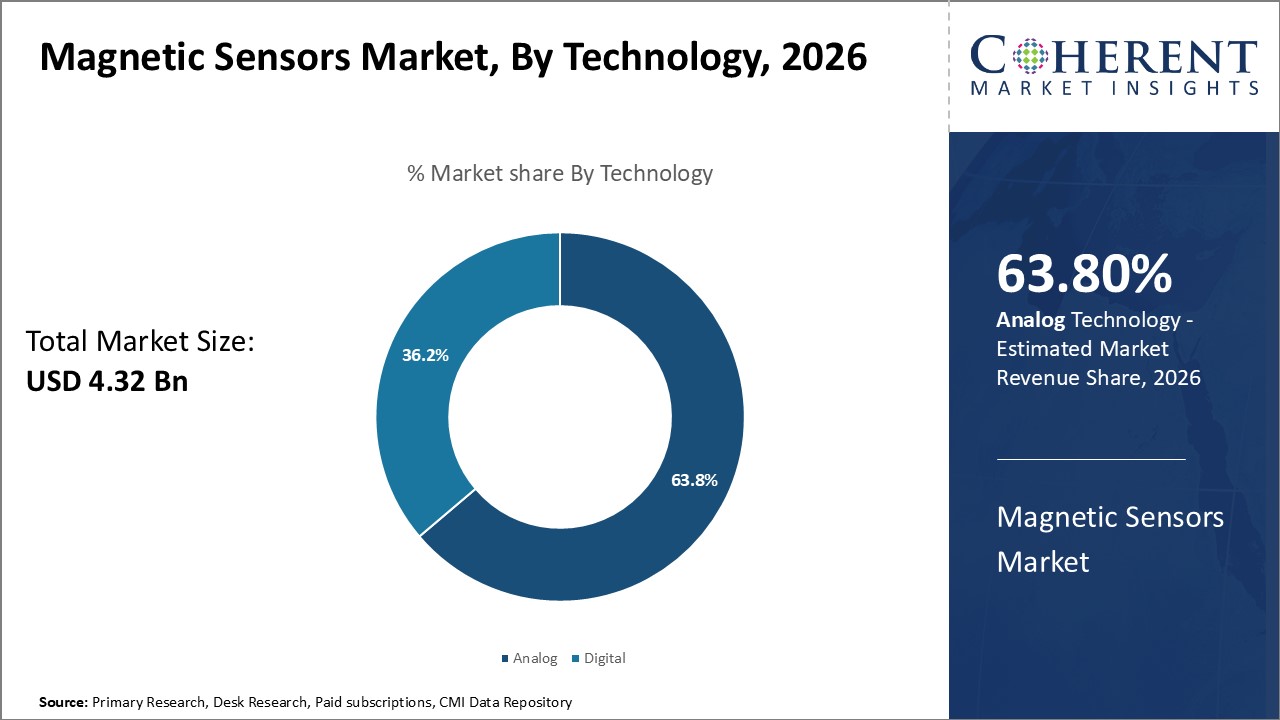
Global Magnetic Sensors Market Insights, By Technology
In terms of technology, analog dominates with current market share of 63.8% in 2026 due to their widespread legacy use. However, digital magnetic sensors are poised to see rising adoption rates going forward, driven predominantly by growth in the consumer electronics industry. Digital magnetic sensors offer compelling advantages for miniaturized device applications requiring low power consumption and multi-axis sensing capabilities.
New generations of consumer tech devices such as smartphones, tablets, wearables and IoT appliances are pushing the boundaries of miniaturization, forcing component suppliers to develop ever smaller and more efficient sensing solutions. While analog magnetic sensors have been sufficient for earlier consumer gadgets, their physical size and power demands are becoming prohibitive as devices strive for thinner and longer-lasting designs. In contrast, digital magnetic sensors integrate sensing and processing in very small footprint integrated circuits optimized for minimal power usage.
Device manufacturers are actively exploring digital magnetic solutions to enable new form factors, multi-sensor fusion capabilities and extended battery life. Smartphone makers are among the early adopters, utilizing digital magnetic sensors for miniature e-compasses, magnetic payment identification, and improved navigation in augmented reality applications.
Wearables like smartwatches are another promising near-term growth area owing to rigid constraints on component sizing. As consumer technology roadmaps emphasize mobility, responsiveness and seamless connectivity between an ecosystem of devices, digital magnetic sensors are well-positioned to accelerate replacement of legacy analog solutions across consumer end markets. This growing shift towards digital is set to make it the dominant magnetic sensing technology in the long run.
Global Magnetic Sensors Market Insights, By End-Use Industry
In terms of end-use industry, the automotive segment contributes 38.3% market share in 2026 for magnetic sensors. This stems from the widespread and increasing adoption of magnetic sensors across modern automotive electronic systems for applications such as engine control, navigation, vehicle security, and advanced driver-assistance.
Current magnetic sensor applications in automotive include proximity sensing for keyless entry systems, current sensing in alternators, position sensing of motors for electric power steering, and window lift motors. However, the landscape is witnessing major growth driven by the rising demand for smarter, connected, and autonomous vehicles. Magnetic sensors play an integral role in next-generation automotive electronic features such as electric parking brakes, e-mirrors, advanced driver-assistance systems (ADAS), 360-degree camera systems, and virtual reality rear-view mirror replacements.
Their non-contact operation, resistance to vibration and automotive-grade ruggedness make magnetic sensors robust components for reliability-critical automotive applications. Furthermore, automakers are actively developing applications centered around digital cluster displays, 360-degree sensing for self-driving vehicles, advanced driver monitoring and sensor fusion with cameras/radar—all driving magnetic sensor adoption. Stringent fuel efficiency and emissions regulations are also prompting innovations centered on start-stop ignition systems, electric/hybrid powertrains, and battery/fuel cell management – areas leveraging magnetic field sensing.
Regional Insights
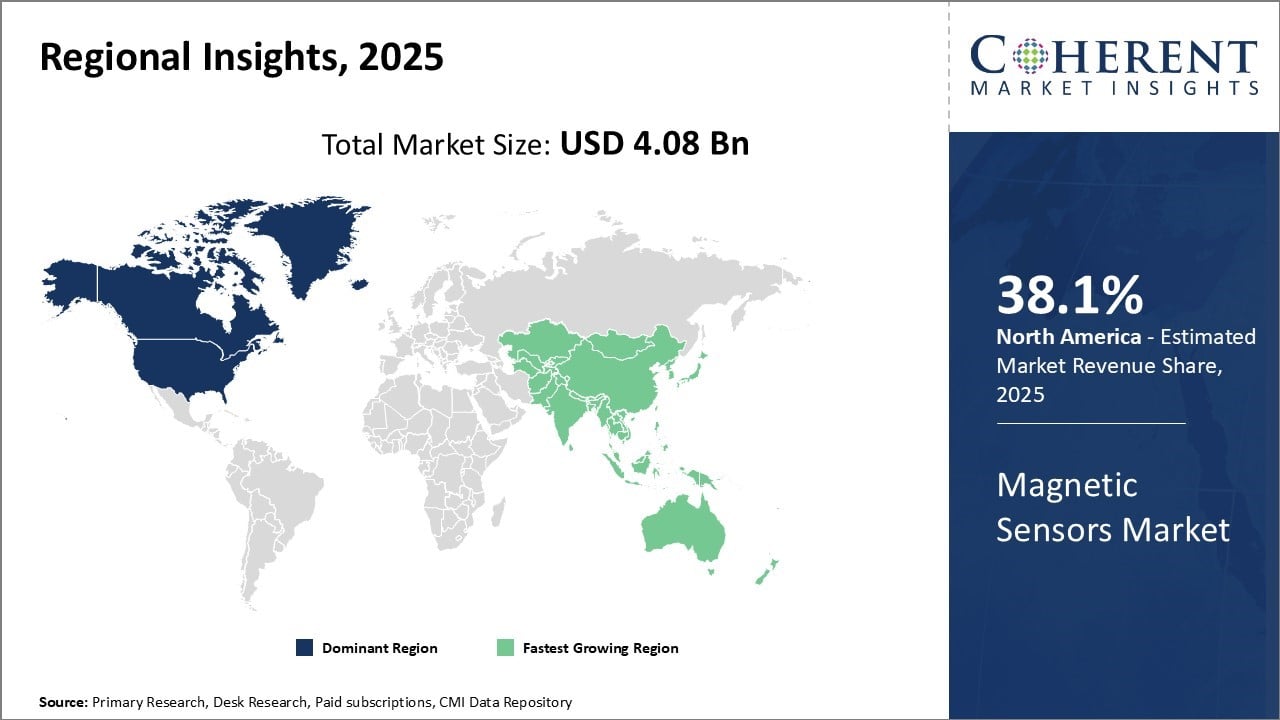
North America Magnetic Sensors Market Analysis and Trends
North America is projected to maintain its leadership in the global magnetic sensors market in 2026, accounting for an estimated 38.1% share of the total market. This dominance is underpinned by the strong presence of major automotive OEMs, consumer electronics companies, and industrial automation manufacturers that are early adopters of magnetic sensing technologies.
The region’s well-established automotive industry plays a crucial role in driving demand for magnetic sensors used in current sensing, wheel speed detection, ignition systems, and advanced driver assistance systems (ADAS). Additionally, widespread implementation of magnetic sensors in industrial automation—for applications such as motion tracking, position control, and robotics—further reinforces North America’s competitive advantage.
Leading players continue to invest in R&D and localization strategies, enhancing sensor performance and addressing growing demand across smart vehicles and intelligent factory environments. These trends collectively position North America as a hub for innovation and deployment of advanced magnetic sensing solutions.
Asia Pacific Magnetic Sensors Market Analysis and Trends
Asia Pacific has emerged as the fastest-growing region in the global magnetic sensors market, fueled by rapid industrialization, growing automotive production, and robust expansion of the consumer electronics and semiconductor sectors. Key economies such as China, South Korea, Taiwan, and India are central to this growth trajectory.
The automotive sector—led by China’s massive vehicle production and rising EV adoption—is a major driver for magnetic sensors used in drivetrain monitoring, battery management, and motor control systems. The proliferation of consumer electronics such as smartphones, wearables, and laptops further stimulates demand for miniature, high-performance sensors.
Additionally, Asia Pacific's thriving semiconductor ecosystem and strong government support for industrial automation are creating sustained opportunities for magnetic sensor deployment across robotics, factory automation, and smart appliances. International sensor manufacturers are increasingly forming strategic alliances with local electronics and OEM firms to expand regional market presence.
Europe Magnetic Sensors Market Analysis and Trends
Europe remains a prominent player in the global magnetic sensors market, supported by its advanced automotive sector, precision machinery OEMs, and extensive process industries. Demand is driven by the integration of magnetic sensors in safety, mobility, and automation applications within vehicles and industrial systems.
Countries such as Germany, France, and Italy are investing in next-generation automotive technologies, including electric and hybrid powertrains, where magnetic sensors play critical roles. Europe’s focus on Industry 4.0 and smart manufacturing continues to foster innovation and adoption of high-precision magnetic sensing solutions in industrial environments.
Dominating Countries in the Asia Pacific Magnetic Sensors Market
China Magnetic Sensors Market Analysis and Trends
China leads the Asia Pacific magnetic sensors market, supported by its dominant position in vehicle production, electronics assembly, and industrial automation. The country's aggressive push toward electric mobility and smart factories has significantly accelerated magnetic sensor adoption. Domestic sensor producers and international firms are scaling operations to meet rising demand across automotive and manufacturing verticals.
South Korea Magnetic Sensors Market Analysis and Trends
South Korea plays a critical role in the regional magnetic sensors market, driven by its advanced semiconductor and electronics industries. Magnetic sensors are widely used in smartphones, display panels, and next-gen consumer gadgets. South Korean companies are investing in sensor miniaturization and integrating them into AI-driven smart devices and robotics.
Taiwan Magnetic Sensors Market Analysis and Trends
Taiwan’s strength in semiconductor fabrication and electronics OEM manufacturing supports consistent demand for magnetic sensors. The country is a vital export hub for PCBs and mobile devices, where sensors are used for motion control, orientation, and safety functions. Local manufacturers are also investing in sensor innovation to serve global electronics brands.
India Magnetic Sensors Market Analysis and Trends
India is emerging as a promising market for magnetic sensors, with growing vehicle production, industrial automation initiatives, and digitalization across sectors. Government-led programs like “Make in India” are encouraging investments in electronics manufacturing, driving the need for locally sourced sensor technologies. Demand is also rising in renewable energy systems and electric two-wheeler segments.
Market Report Scope
Magnetic Sensors Market Report Coverage
| Report Coverage | Details | ||
|---|---|---|---|
| Base Year: | 2025 | Market Size in 2026: | USD 4.32 Bn |
| Historical Data for: | 2020 To 2024 | Forecast Period: | 2026 To 2033 |
| Forecast Period 2026 to 2033 CAGR: | 6.0% | 2033 Value Projection: | USD 6.50 Bn |
| Geographies covered: |
| ||
| Segments covered: |
| ||
| Companies covered: | Ams AG, Analog Devices, Inc., Asahi Kasei Microdevices Corporation (AKM), Bosch Sensortec, Honeywell International Inc., Infineon Technologies AG, NXP Semiconductors N.V., Rohm Semiconductor, STMicroelectronics N.V., TDK Corporation, Texas Instruments Incorporated, Vishay Intertechnology, Inc., MagnetoN, Microchip Technology Inc., and Everspin Technologies, Inc. | ||
| Growth Drivers: |
| ||
| Restraints & Challenges: |
| ||
Analyst Viewpoint
- The global magnetic sensors market is poised to grow significantly over the next decade driven by increasing demand across various end-use industries such as automotive, consumer electronics, and industrial. Growth in electric and hybrid vehicles will boost the demand for magnetic sensors as they are integral components for position sensing, current sensing, and other applications in advanced driver-assistance systems. Increased adoption of magnetic sensors in motors, generators, and other industrial machinery is another key growth driver.
- North America currently dominate the magnetic sensors market owing to widespread use in medical devices, industrial automation and factory equipment in these regions. However, Asia Pacific is expected to be the fastest growing regional market fueled by booming automotive and electronics manufacturing industries, especially in China, India, and Southeast Asia.
- High initial costs could limit the adoption of magnetic sensors in price-sensitive applications. Security concerns over data theft may also restrain usage of magnet-based sensors in sensitive industries like defense and aerospace. However, ongoing technological advancements focused on miniaturization, low power consumption, and higher reliability are expanding use cases and paving way for new opportunities.
Magnetic Sensors Industry News
- In October 2023, Renesas Electronics Corp., a leading global supplier of semiconductor solutions, announced the development of its new inductive position sensor (IPS) technology. This advanced technology is designed for highly accurate motor position sensor ICs, catering to robotics, industrial, and medical applications.
- In October 2023, Melexis, a global leader in semiconductor solutions for the automotive industry, announced the expansion of its popular MLX9042x series of 3D magnetic position sensing solutions with the introduction of the MLX90423.
- In January 2023, Infineon Technologies AG, a prominent semiconductor manufacturer, announced the launch of the XENSIV TLI5590-A6W magnetic position sensor.
- In April 2020, TDK Corporation, a leading global electronics company, announced a collaboration with Genetesis, a U.S.-based firm specializing in magnetocardiography (MCG) technology.
Market Segmentation
- Type Insights (Revenue, USD Bn, 2021 - 2033)
- Hall Effect Sensors
- Magnetoresistive Sensors
- Fluxgate Sensors
- SQUID Sensors
- Others (AMR, GMR, TMR, etc.)
- Technology Insights (Revenue, USD Bn, 2021 - 2033)
- Analog
- Digital
- End-use Industry Insights (Revenue, USD Bn, 2021 - 2033)
- Automotive
- Consumer Electronics
- Industrial
- Healthcare
- Aerospace & Defense
- Others (Energy, Transportation, etc.)
- Regional Insights (Revenue, USD Bn, 2021 – 2033)
- North America
- U.S.
- Canada
- Latin America
- Brazil
- Argentina
- Mexico
- Rest of Latin America
- Europe
- Germany
- U.K.
- Spain
- France
- Italy
- Russia
- Rest of Europe
- Asia Pacific
- China
- India
- Japan
- Australia
- South Korea
- ASEAN
- Rest of Asia Pacific
- Middle East
- GCC Countries
- Israel
- Rest of Middle East
- Africa
- South Africa
- North Africa
- Central Africa
- Key Players Insights
- Ams AG
- Analog Devices, Inc.
- Asahi Kasei Microdevices Corporation (AKM)
- Bosch Sensortec
- Honeywell International Inc.
- Infineon Technologies AG
- NXP Semiconductors N.V.
- Rohm Semiconductor
- STMicroelectronics N.V.
- TDK Corporation
- Texas Instruments Incorporated
- Vishay Intertechnology, Inc.
- MagnetoN
- Microchip Technology Inc.
- Everspin Technologies, Inc.
Sources
Primary Research Interviews
- Magnetic sensor manufacturers and suppliers
- Electronics component distributors
- Automotive industry experts
- Industrial automation specialists
- Others
Databases
- Global Trade Atlas
- MarketResearch.com
- Statista Industrial Technology Database
- IBISWorld Industry Reports
- Others
Magazines
- Electronic Design Magazine
- Sensors Magazine
- IEEE Spectrum
- Electronic Products Magazine
- Others
Journals
- IEEE Transactions on Magnetics
- Sensors and Actuators A Physical
- Journal of Magnetism and Magnetic Materials
- Others
Newspapers
- Financial Times
- Wall Street Journal
- Electronic Engineering Times
- Reuters Technology News
- Others
Associations
- Semiconductor Industry Association (SIA)
- International Electronics Manufacturing Initiative (iNEMI)
- Magnetic Materials Producers Association (MMPA)
- Electronic Components Industry Association (ECIA)
- Others
Public Domain Sources
- U.S. Patent and Trademark Office (USPTO)
- European Patent Office (EPO)
- SEC filings and annual reports
- Government statistical offices
- Others
Proprietary Elements
- CMI Data Analytics Tool
- Proprietary CMI Existing Repository of information for last 8 years
*Definition: The global magnetic sensors market consists of various types of sensors such as hall effect sensors, anisotropic magnetoresistance (AMR) sensors, giant magnetoresistance (GMR) sensors, and tunnel magnetoresistance (TMR) sensors that are used to detect and measure the magnetic field, magnetic flux, magnetic poles, current and angle of rotation. These magnetic sensors have applications in industries such as consumer electronics, automotive, industrial, aerospace & defense and healthcare. The increasing demand for magnetic sensors from automotive and consumer electronics industries is expected to drive the growth of the global magnetic sensors market during the forecast period.
Get access to 250+ pages report
Every segment, forecast, competitor profile and data table behind the analysis above — available for instant download.
- ESOMAR Member
- ISO 9001:2015 Certified
- D-U-N-S Registered
- GDPR & CCPA Compliant
Missing comfort of reading report in your local language? Find your preferred language:
Transform your Strategy with Exclusive Trending Reports
Frequently Asked Questions
The Magnetic Sensors Market size is estimated to be valued at USD 4.32 Bn in 2026, and is expected to reach USD 6.50 Bn by 2033.
The CAGR of the global Market is projected to be 6.0% from 2026 to 2033.
Growing adoption in consumer electronics applications and increasing use in automotive industry for various applications are the major factor driving the growth of the global market.
High initial investment and complex manufacturing processes and presence of alternatives, such as optical and capacitive sensors, in certain applications are the major factors hampering the growth of the global market.
In terms of type, Hall Effect sensors is estimated to dominate the market revenue share in 2026.
Ams AG, Analog Devices, Inc., Asahi Kasei Microdevices Corporation (AKM), Bosch Sensortec, Honeywell International Inc., Infineon Technologies AG, NXP Semiconductors N.V., Rohm Semiconductor, STMicroelectronics N.V., TDK Corporation, Texas Instruments Incorporated, Vishay Intertechnology, Inc., MagnetoN, Microchip Technology Inc., and Everspin Technologies, Inc. are the major players.
North America is expected to lead the global magnetic sensors industry in 2026.