

Laser Displacement Sensor Market Size and Share Analysis: (2026-2033)
The laser displacement sensor market size is anticipated to grow at a CAGR of 8.2% with USD 4.4 Bn in 2026 and is expected to reach USD 7.64 Bn in 2033. The primary drivers are largely defined by the growing demand for automation in manufacturing and automotive industries. Some of the other factors are advancements in automotive safety and robotics, along with the need for high-accuracy sensors in quality control processes. In addition, the rising demand for miniaturized sensors and the integration of these sensors in consumer electronics is also propelling the market growth.
Key Takeaways
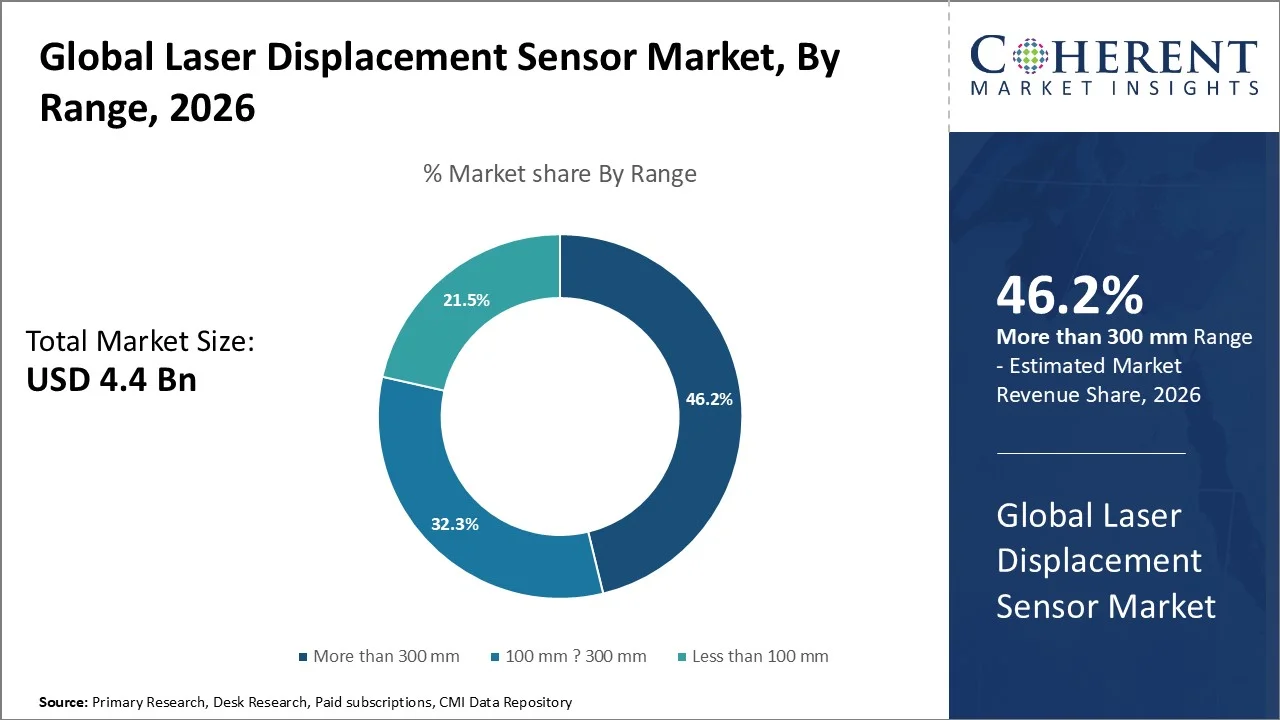
- More than 300 mm is set to lead with 46.2% in 2026. The segment’s growth is owing to the rising demand for high-precision measurement in automotive, aerospace, and industrial applications, where longer ranges are required for accurate displacement as well as position sensing. The laser displacement sensors are crucial in these industries for ensuring operational efficiency, safety, and component quality in high-volume production lines.
- The automotive segment is likely to dominate the market with 32.5% in 2026. The segment’s growth is due to increasing adoption of laser displacement sensors in vehicle assembly lines for quality control, crash safety testing, and manufacturing of autonomous vehicle components. These sensors allow for precise measurements of critical parts, thereby enhancing production accuracy as well as performance standards.
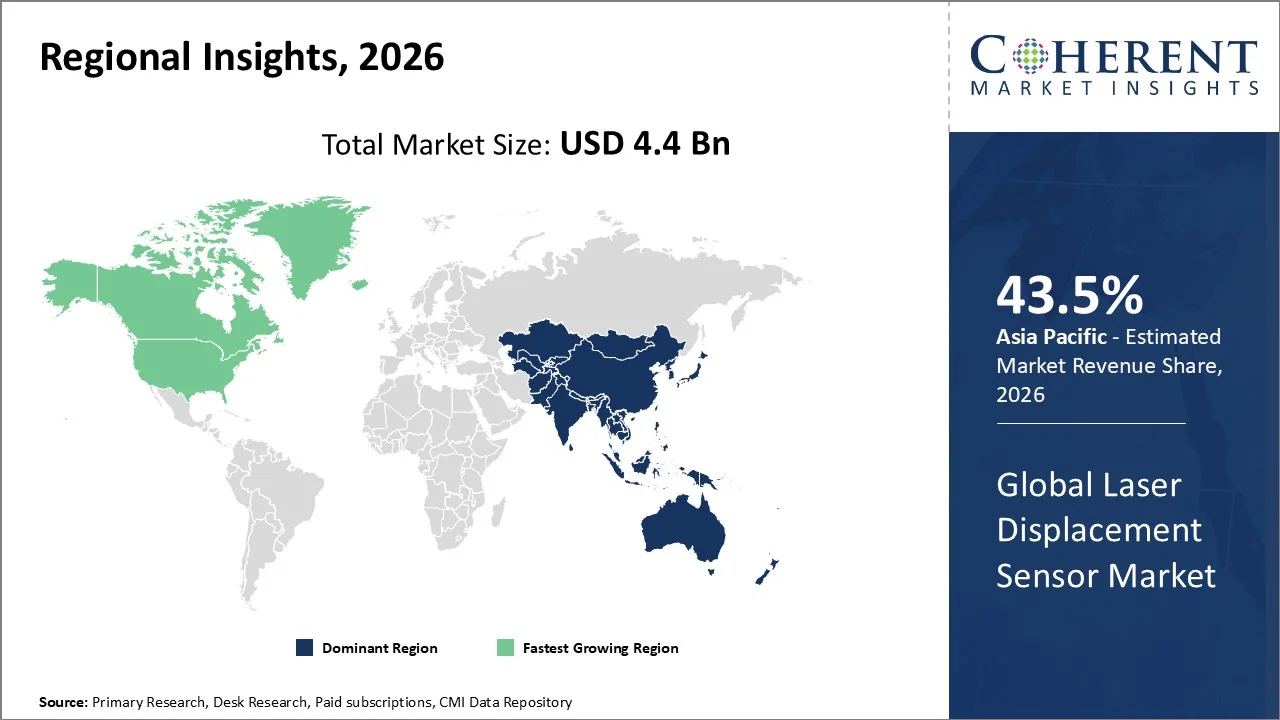
- Asia Pacific is expected to acquire the prominent share of 43.5% in 2026. This is due to region’s strong presence in manufacturing hubs, particularly in China and Japan, which are major players in electronics, automotive, and robotics industries. The region’s growth is also facilitated by the increasing production of electric vehicles and automation in manufacturing processes. This creates a substantial demand for laser displacement sensors to ensure product quality and performance.
Segmental Insights
Why is More than 300 mm segment Acquiring the Largest Share?
On the basis of range, more than 300 mm is projected to account for the largest laser displacement sensor market share of 46.2% in 2026. The segment’s growth is owing to its strong use in industries that require accurate measurement of large components, including automotive manufacturing, aerospace, and robotics. These sensors support precise, non-contact measurement, thereby making them suitable for moving objects, uneven surfaces, and components with different textures.
The rising adoption of manufacturing automation is also responsible for the segment’s growth. In automated production lines, the laser displacement sensors are widely used for quality control, surface profiling, dimensional inspection, and component alignment. The ability of these sensors to measure over longer distances assists in improving reliability in large-scale industrial operations where short-range sensors may not be suitable.
In addition, the calibration standards covering measurement ranges from 300 mm to 2,000 mm are also supporting their industrial adoption. With more than 70 standard laser displacement sensor models covering measuring ranges from 2 mm to 1,000 mm, the manufacturers can select suitable models for both compact as well as large-scale measurement applications.
- Current Industry Events of 2026
- Market Size Estimation
- Regional Breakdown
- Competitive Landscape
- Customer Intelligence
- Segmental Analysis
- Pricing Analysis
- Key Market Drivers, Challenges & Future Trends
- Customized Insights Section
Automotive hold the Largest Market Share
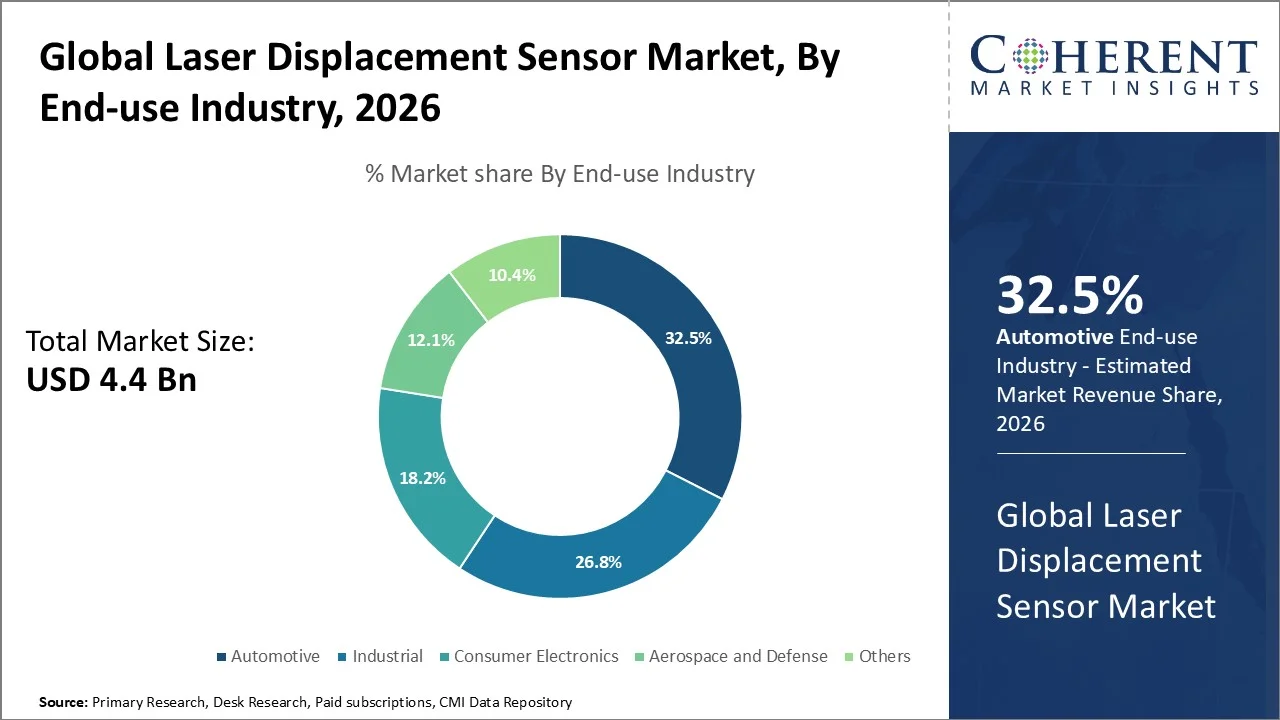
On the basis of end-use industry, automotive segment is set to lead with a major 32.5% share in 2026. The laser displacement sensors are crucial in automotive manufacturing for tasks like gap & flush measurements, surface profiling, and component alignment. The ability of these sensors to provide non-contact, high-precision measurements is essential in improving production efficiency as well as part quality in automated assembly lines. The government-backed initiatives like Industry 4.0 promote automation as well as digital manufacturing, thereby propelling the use of these sensors in the automotive production.
The laser displacement sensors fit well with smart manufacturing systems, as they provide precise measurements within automated systems, improving the overall production process. The governments emphasize technologies like these to improve productivity and ensure better product quality across sectors. In automotive manufacturing, they are used for both in-line inspection as well as quality control of parts, thereby making the sector a major adopter of these sensors.
One of the recent developments in the market is Omron’s launch of the ZP-L laser displacement sensor in 2025. It was designed specifically for automotive manufacturing and offered enhanced detection stability and easy integration in industrial automation systems.
Growth in Industrial Automation & Robotics is Transforming the Laser Displacement Sensor Market in the US
The expansion of industrial automation and robotics in the United States is driving the demand for laser displacement sensors, which are critical for high‑precision, non‑contact measurement in automated manufacturing and quality control systems. According to the National Institute of Standards and Technology Robotic Systems for Smart Manufacturing program, only about 10. This highlights substantial growth potential for sensing technologies which enhance robotic performance as well as safety.
The government‑supported initiatives aimed at strengthening US manufacturing competitiveness cite robotics as essential tools, which further underline the strategic role of advanced sensors within automated production. The official installation data from the World Robotics 2025 reported that the US accounted for 34,200 industrial robot installations in 2024. This represents 68 % of installations in the Americas, thereby underscoring robust automation uptake.
Major Breakthrough in Laser Displacement Sensor Market: Multi ‑Axis and Multi ‑Point Laser Sensors
The laser displacement sensor market is undergoing a major breakthrough with the introduction of multi‑axis and multi‑point sensors. This is because they offer enhanced precision and automation capabilities. These sensors are integrated in various applications like 3D scanning and high‑precision measurement systems.
The recent developments in laser metrology as those explored by the U.S. National Institute of Standards and Technology (NIST) have advanced the use of laser displacement sensors. This is especially evident in fields like construction and manufacturing, especially for 3D point-cloud capture in construction surveying.
In April 2026, Micro‑Epsilon launched its next‑generation LLT8x00 series 4K laser scanners. The scanners feature integrated 3D processing as well as Green Laser technology. This innovation allows for real-time, high-resolution surface and geometry measurement, thereby greatly improving multi
According to the reports from the NIST, these laser-based systems are crucial for smart manufacturing and Industry 4.0 adoption, thereby emphasizing their increasing role in the industrial sector. This breakthrough marks a notable step in precision measurement technology.
Current Events and Their Impact on the Laser Displacement Sensor Market
Current Event | Description and its Impact |
Euro 7 Emission Standards Implementation (EU, 2026) |
|
U.S. CHIPS and Science Act |
|
National Robotics and Automation Strategies |
|
Laser Displacement Sensor Market Trends
- The growing demand for automation in manufacturing industries is propelling the adoption of laser displacement sensors. As of 2023, Europe’s manufacturing sector, employing over 30 million people, continues to see increased investments in automation technologies. These systems, which integrate sensors like laser displacement sensors for precision measurements, are crucial for quality control, alignment, as well as real-time monitoring in automated production lines.
- Industrial automation, driven by robotics and AI, is rapidly growing in major regions. In 2024, Western Europe reported a robot density of 267 units per 10,000 employees, a key indicator of the integration of advanced measurement technologies like laser displacement sensors. As automation intensifies, the demand for high-precision measurement tools in production environments continues to rise.
- As manufacturing becomes more automated, federal agencies like NIST are emphasizing the role of precision technologies to improve manufacturing competitiveness. This ongoing shift towards automation is boosting the need for technologies like laser displacement sensors which provide the precision required for robotic systems as well as machine vision applications.
- According to the World Robotics 2025 report, North America is also increasing its robot density, with an anticipated 204 units per 10,000 employees by 2024. The increasing use of robots and automation technologies highlights the growing importance of laser displacement sensors in industries like automotive, electronics, and aerospace, where precision is critical for production quality.
Regional Insights
Asia Pacific Dominates Owing to the Rapid Industrial Automation and Advanced Manufacturing Capabilities
The Asia Pacific region accounts for 43.5% of the market share in 2026. The region’s growth is owing to the rapid industrial automation as well as advanced manufacturing capabilities, particularly in the automotive, electronics, and semiconductor sectors.
The region leads global factory automation, with adoption rates exceeding 45%, and major manufacturing hubs like China, Japan, and South Korea prioritizing precision measurement and automated inspection technologies. These technologies, which rely heavily on laser displacement sensors, are of high importance for accurate distance and position monitoring in high-precision manufacturing processes.
In addition, the region is also gaining traction from the stringent regulatory compliance with internationally recognized safety standards like IEC 60825-1. Such rules ensures that laser sensors meet safety and equipment classification requirements for industrial use. This regulatory alignment facilitates the safe deployment of laser sensors in demanding environments like electronics manufacturing, where accuracy and reliability are crucial for operational efficiency as well as quality control.
North America Laser Displacement Sensor Market Trends
North America is expected to witness strong growth in laser displacement sensor market over the forecast period. The region’s growth is owing to advancements in industrial automation, manufacturing precision, and the growing demand for accurate, non-contact measurement technologies.
According to the U.S. National Institute of Standards and Technology (NIST), laser measurement systems are crucial for enhancing manufacturing quality control and improving efficiency across various sectors. The increasing implementation of Industry 4.0 technologies like robotics and smart factories is also accelerating the demand for high-precision sensors in applications like automotive manufacturing and electronics.
In addition, the U.S. Department of Energy has identified laser displacement sensors as key components in advanced manufacturing systems which reduce production costs and improve product quality. This technological advancement solidifies the region’s position as a frontrunner in cutting-edge sensor technology for industrial automation.
Rapid Industrial Automation is Accelerating the Laser Displacement Sensor Demand in China
In the China laser displacement sensor market, the rapid industrial automation is substantially propelling the growth. According to official reports, China leads globally in industrial robot installations, with over 54% of the world's industrial robots deployed in the country by 2024. This reflects the increasing need for precision measurement technologies like laser displacement sensors. These sensors are crucial for ensuring accurate distance and position monitoring in automated manufacturing processes. In addition, the market benefits from compliance with safety standards like IEC 60825-1 which governs laser safety, thus ensuring reliable sensor performance in industrial applications.
United States Laser Displacement Sensor Market Trends
The demand for laser displacement sensors is growing in the United States. The growth in the country is owing to the role in industrial automation, precision manufacturing, and quality control applications in various sectors like automotive, aerospace, and electronics. These sensors provide highly accurate and non-contact distance measurements, which are vital for maintaining high manufacturing standards.
The U.S. manufacturing output reached a record USD 2.913 trillion in 2024, thereby highlighting the country’s expanding industrial sector, which relies on such precision tools for efficient production. According to the National Institute of Standards and Technology (NIST), the research into advanced laser metrology techniques is also enhancing sensor technology to meet the needs of modern manufacturing environments.
Who are the Major Companies in Laser Displacement Sensor Industry
Some of the major key players in Laser Displacement Sensor Market are Panasonic Corporation, Micro-epsilon, Sick AG, Hans Turck GmbH Co. KG, Omron Corporation, Banner Engineering Corp., Keyence Corporation, Cognex Corporation, ZSY Group Ltd, and Mechanical Technology, Inc.
Key News
- In December 2025, SinceVision showcased its advanced industrial imaging technologies at Japan’s ITE Expo 2025. The company also introduced six displacement sensor series like SCI04025, SGI080, SG5080, SD33, SD22, and SD-C030. These sensors deliver high-speed distance measurement as well as repeatability in automotive assembly, wafer production, and precision machining applications.
- In May 2025, the firm, SinceVision, introduced the SD-C Series, one of the latest innovations in the high-accuracy laser displacement sensor offerings. The series is available in working ranges from 25mm to 600mm, The SD-C Series is ideal for applications requiring measurements of displacement, distance, thickness, height, roundness, step height, warping, vibration, and flatness.
- In May 2025, Aeva, a leader in next-generation sensing and perception systems, has announced the initial orders for its Aeva Eve 1 series of high-precision sensors, designed for high-volume and inline industrial automation applications.
Market Report Scope
Laser Displacement Sensor Market Report Coverage
| Report Coverage | Details | ||
|---|---|---|---|
| Base Year: | 2025 | Market Size in 2026: | USD 4.4 Bn |
| Historical Data for: | 2020 To 2024 | Forecast Period: | 2026 To 2033 |
| Forecast Period 2026 to 2033 CAGR: | 8.2 % | 2033 Value Projection: | USD 7.64 Bn |
| Geographies covered: |
| ||
| Segments covered: |
| ||
| Companies covered: | Panasonic Corporation, Micro-epsilon, Sick AG, Hans Turck GmbH Co. KG, Omron Corporation, Banner Engineering Corp., Keyence Corporation, Cognex Corporation, ZSY Group Ltd, and Mechanical Technology, Inc. | ||
| Growth Drivers: |
| ||
| Restraints & Challenges: |
| ||
Analyst Opinion
- The laser displacement sensor market is linked to the expansion of advanced manufacturing and automation systems, where precise measurement and positioning are essential for quality control and process optimization. According to the International Federation of Robotics (IFR), the total number of industrial robots in operational use worldwide reached approximately 4,664,000 units in 2024, thus marking a 9% year‑on‑year increase. The increase in robotic automation is driving the need for high-precision sensors like laser displacement sensors which are mainly used for inspection, alignment, and feedback in automated production lines.
- The use of industrial robots has greatly increased, leading to a higher demand for non-contact measurement and feedback systems to maintain accuracy and consistency in operations. The IFR highlights that 542,000 industrial robots were installed in factories worldwide in 2024. This demonstrates a continual shift towards sensor-integrated automation platforms. The laser displacement sensors are integral to this trend. They are playing a critical role in applications like electronics assembly, automotive body alignment, and precision cutting, where high-precision measurements are crucial.
- The public sector initiatives like the U.S. National Institute of Standards and Technology’s Smart Manufacturing initiative are focusing on the importance of advanced measurement as well as sensing technologies. These initiatives aim to promote the development of reliable and interoperable manufacturing systems, where laser displacement sensors are a key component. The increasing demand for these sensors aligns with national strategies in order to improve manufacturing efficiency, reduce defects, and enhance the quality of industrial products.
Speak to the analyst
Want personalized insights?
Take the findings above to one of our principal consultants, or have the report rebuilt around the segments, geographies and competitors you actually track.
Market Segmentation
- By Range (Revenue, USD Bn, 2021-2033)
- Less than 100 mm
- 100 mm – 300 mm
- More than 300 mm
- By End-Use Industry (Revenue, USD Bn, 2021-2033)
- Automotive
- Aerospace and Defense
- Industrial
- Consumer Electronics
- Others
- By Region (Revenue, USD Bn, 2021-2033)
- North America
- U.S.
- Canada
- Latin America
- Brazil
- Mexico
- Argentina
- Rest of Latin America
- Europe
- Germany
- U.K.
- France
- Italy
- Spain
- Russia
- Rest of Europe
- Asia Pacific
- China
- India
- Japan
- Australia
- South Korea
- ASEAN
- Rest of Asia Pacific
- Middle East
- GCC
- Israel
- Rest of Middle East
- Africa
- South Africa
- Central Africa
- North Africa
- North America
- Key Players
- Panasonic Corporation
- Micro-epsilon
- Sick AG
- Hans Turck GmbH Co. KG
- Omron Corporation
- Banner Engineering Corp.
- Keyence Corporation
- Cognex Corporation
- ZSY Group Ltd
- Mechanical Technology, Inc.
Sources
Primary Research Interviews
- Laser Displacement Sensor Manufacturers
- Industrial Automation Providers
- Motion Control Engineers
- Optical Sensing Technology Experts
- Precision Measurement Consultants
- Others
Databases
- Bloomberg Terminal
- Thomson Reuters Eikon
- IHS Markit
- Euromonitor International
- Others
Magazines
- Control Engineering Magazine
- Sensors Online
- Measurement and Control Magazine
- Industrial Automation Magazine
- Others
Journals
- Journal of Sensors and Actuators A: Physical
- Precision Engineering
- Measurement Science and Technology
- Journal of Optical Society of America A
- Others
Newspapers
- Financial Times
- The Wall Street Journal
- Reuters
- Bloomberg News
- Others
Associations
- International Society of Automation (ISA)
- National Institute of Standards and Technology (NIST)
- International Measurement Confederation (IMEKO)
- Optical Society of America (OSA)
- European Sensors Summit (ESS)
- Others
Public Domain Sources
- U.S. National Institute of Standards and Technology (NIST)
- International Electrotechnical Commission (IEC)
- European Commission – Industrial Technologies Directorate
- National Renewable Energy Laboratory (NREL)
- U.S. Department of Energy (DOE) – Office of Energy Efficiency & Renewable Energy
- Others
Proprietary Elements
- CMI Data Analytics Tool
- Proprietary CMI Existing Repository of Information for the Last 10 Years
Get access to 250+ pages report
Every segment, forecast, competitor profile and data table behind the analysis above — available for instant download.
- ESOMAR Member
- ISO 9001:2015 Certified
- D-U-N-S Registered
- GDPR & CCPA Compliant
Missing comfort of reading report in your local language? Find your preferred language:
Transform your Strategy with Exclusive Trending Reports
Frequently Asked Questions
The Laser Displacement Sensor Market is expected to reach USD 7.64 Bn in 2033.
Major players operating in the global Laser Displacement Sensor Market include Panasonic Corporation, Micro-epsilon, Sick AG, Hans Turck GmbH Co. KG, Omron Corporation, Banner Engineering Corp., Keyence Corporation, Cognex Corporation, ZSY Group Ltd, and Mechanical Technology, Inc.
The high implementation costs, technical limitations in challenging environments, and a shortage of skilled personnel for integration are the key factors hampering growth of the market.
The rapid adoption of Industry 4.0 automation, the demand for high-precision quality control, and advancements in non-contact, high-speed measurement technologies is boosting the demand for Laser Displacement Sensor.
The Laser Displacement Sensor Market is anticipated to grow at a CAGR of 8.2% between 2026 and 2033.
Among regions, Asia Pacific is expected to account for a largest market share in the global Laser Displacement Sensor Market over the forecast period.