

Global Automotive Manufacturing Equipment Market Size and Forecast – (2026-2033)
Coherent Market Insights estimates that the global automotive manufacturing equipment market is expected to reach USD 33 Bn in 2026 and will expand to USD 44 Bn by 2033, registering a CAGR of 6% between 2026 and 2033.
Key Takeaways of the Automotive Manufacturing Equipment Market
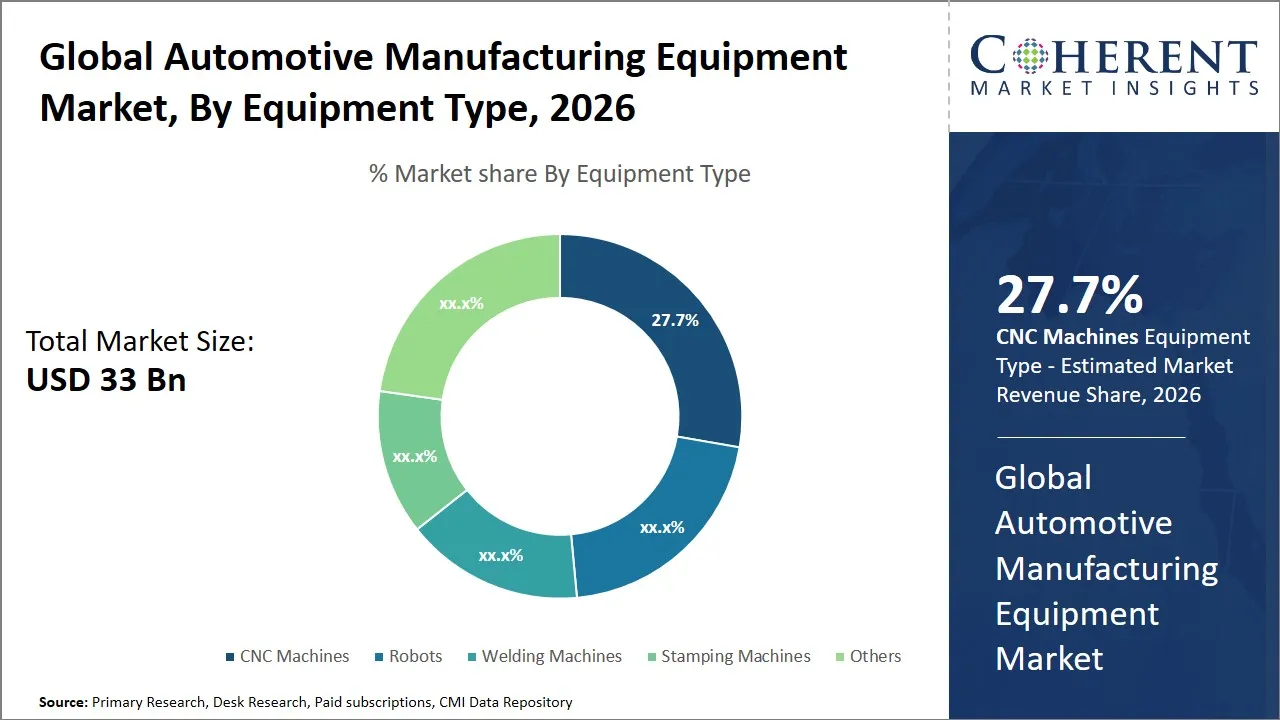
- The CNC machines segment is expected to account for 27.7% of the automotive manufacturing equipment market share in 2026.
- The automatic systems segment is estimated to capture 57% of the market share in 2026.
- The passenger vehicles segment is projected to hold 51% of the global automotive manufacturing equipment market share in 2026.
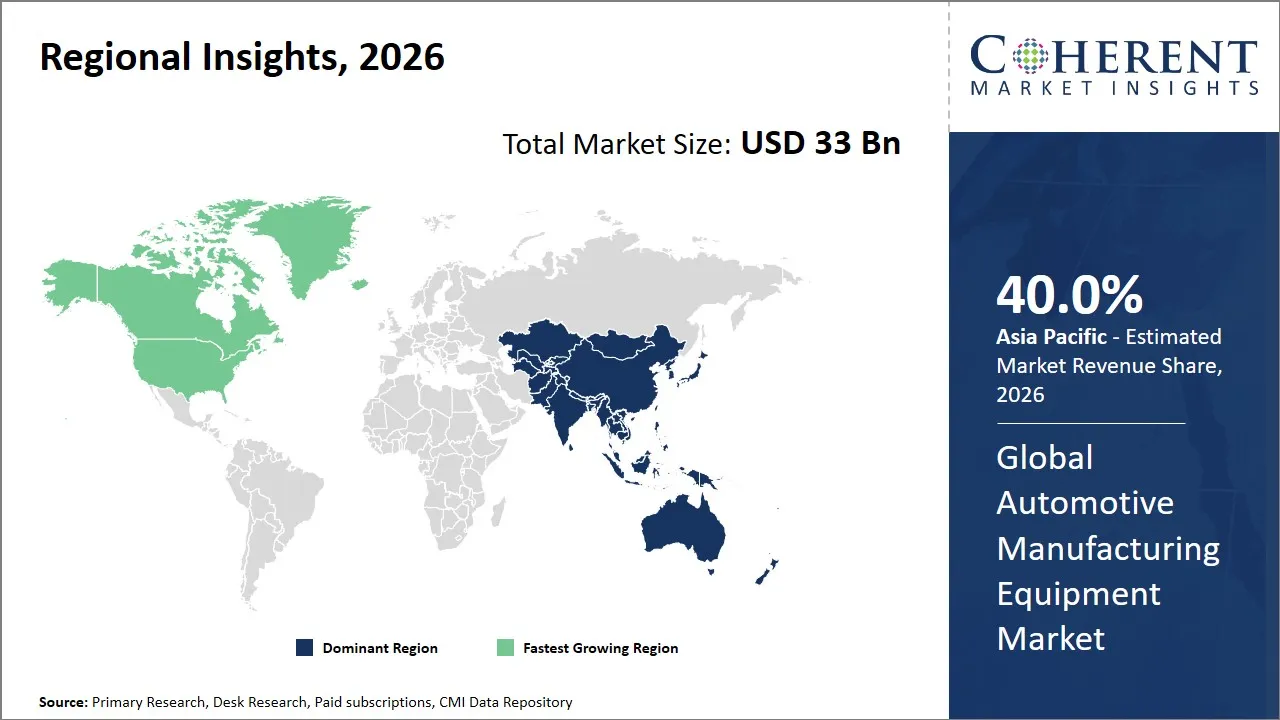
- Asia Pacific will dominate the automotive manufacturing equipment market in 2026 with a 40%
- North America will hold 22% share in 2026 and is expected to record the fastest growth over the forecast period.
Currents Events and Its Impact
Current Events | Description and its Impact |
ABB Robotic Division Announcement |
|
Segmental Insights
- Current Industry Events of 2026
- Market Size Estimation
- Regional Breakdown
- Competitive Landscape
- Customer Intelligence
- Segmental Analysis
- Pricing Analysis
- Key Market Drivers, Challenges & Future Trends
- Customized Insights Section
Why Does the CNC Machines Segment Dominate the Global Automotive Manufacturing Equipment Market in 2026?
The CNC machines segment is expected to account for 27.7% of the market share in 2026. Most progress comes from precision that holds firm under pressure. Consistency defines results in car manufacturing and CNC technology provides exactly that. When tolerances are narrow, any shift is unacceptable; such machines prevent drift over repeated runs. Less waste appears once mistakes disappear, while downtime shrinks where breakdowns stop. Better output emerges not by rushing forward, yet through trust woven into every step.
For instance, on September 10, 2024, Okuma America Corporation announced a product addition to the company’s line of CNC horizontal machining centers, the MA-4000H. The MA-4000H features one of the largest machining areas of its class and has the spindle power and speed for maximum efficiency and productivity.
Automatic Systems Segment Dominates the Global Automotive Manufacturing Equipment Market
The automatic systems segment is expected to hold 57% of the global automotive manufacturing equipment market share in 2026. Productivity improves when operations run without interruption, quality remains steady over time. Complexity defines automobile production, repetition marks every stage from joining parts to coating surfaces, precision matters above all. Machines handle these duties reliably because they reduce mistakes people might make during long shifts. Technology like feedback devices, mechanical arms, work under constant digital supervision ensures output stays within strict boundaries set by vehicle builders.
For instance, on June 16, 2025, KraussMaffei announced the plans to showcase a new fully automated assembly cell designed for real‑time automatic assembly of parts without manual intervention at K 2025 on October 8 – October 26.
Why is Passenger Vehicles the Most Widespread Vehicle Type in the Automotive Manufacturing Equipment Market?
The passenger vehicles segment is projected to capture 51% of the automotive manufacturing equipment market share in 2026. Growth emerges from steady increases in how people want ways to move themselves around. Attention keeps shifting toward safer cars that offer better comfort while using less fuel. In developing regions, more individuals join the middle class. Cities expand at a fast pace. A stronger wish for owning vehicles spreads across populations. These conditions lift global output of passenger automobiles. Equipment used to make these vehicles must evolve. Production needs grow larger yet remain affordable. Machines involved become smarter and more efficient over time.
For instance, on December 3, 2025, Aeva, a leader in next-generation sensing and perception systems, announced that a Top European passenger OEM has selected Aeva as its exclusive LiDAR supplier for its global series-production vehicle platform to enable Level 3 automated driving.
Pricing Analysis of the Automotive Manufacturing Equipment Market
Industrial Welding Robots | Stamping and Forming Equipment | CNC Machining Centers |
KUKA (Germany): KR QUANTEC series
ABB (Switzerland): IRB series
Fanuc (Japan): ARC Mate series
| Schuler Group (Germany)
AIDA Engineering (Japan):
Komatsu Industries (Japan):
| DMG Mori (Germany/Japan)
Mazak (Japan)
|
Regional Insights
Asia Pacific Automotive Manufacturing Equipment Market Analysis and Trends
Asia Pacific region is projected to lead the market with a 40% share in 2026. Growth stems from solid auto production setups alongside broad industrial networks. Thanks to wide-reaching supplier connections, heavy spending on automated systems, also a firm base of vehicle makers and parts builders, advantages emerge clearly. In places like Japan, China, and South Korea, progress shows through high-end factories, shaped by state-backed drives toward updated industry practices. Trade pacts across nations allow seamless movement of goods, simpler access to vital car-making pieces.
Among key players, FANUC and DENSO from Japan, Hyundai Welding & Automation in South Korea, along with Shanghai Electric based in China, deliver robotic arms, joining tools, plus line-control tech that lift output quality and accuracy.
For instance, on November 17, 2025, Nexteer Automotive broke ground on its APAC Smart Manufacturing Project in Suzhou Industrial Park, China, an initiative designed to advance the company's smart manufacturing capabilities and long-term operational agility.
North America Automotive Manufacturing Equipment Market Analysis and Trends
North America region is expected to exhibit the fastest growth in the market contributing 22% share in 2026. Growth takes shape where modern methods meet rising needs, electric transport and smart vehicles pull focus here. Across North America, automation gains ground in manufacturing, notably in industrial regions of the U.S. and Canada. Government actions provide backing - tax benefits for domestic output, financial support linked to sustainable power targets, nudging progress forward without fanfare. Longstanding clusters such as Detroit and certain areas in Ontario continue serving as meeting points, where new players arrive, thinking spreads.
Firms including ABB Robotics, Rockwell Automation, and Lincoln Electric supply tools that reshape workflows, one weld, one automated line, one precision check at a time, keeping output steady with fewer pauses along the way.
Global Automotive Manufacturing Equipment Market Outlook for Key Countries
Why is Japan Emerging as a Major Hub in the Automotive Manufacturing Equipment Market?
Across Japan, precision defines how machines are made for car production. Automation tools from companies including FANUC and Kawasaki Robotics meet strict demands set by major automakers such as Toyota, Honda, and Nissan. Instead of broad claims, real progress shows in consistent upgrades on factory floors. Because research networks work closely with policy goals focused on digital manufacturing, new methods emerge without fanfare. High expectations drive steady improvements in how things are built, maintained, refined. This nation remains influential abroad simply by doing what works - quietly, repeatedly.
Germany Automotive Manufacturing Equipment Market Analysis and Trends
Despite global shifts, Germany remains central to advanced machinery for car production. Home to giants like BMW, Volkswagen, and Daimler, its industrial ecosystem fosters precision engineering. Firms such as KUKA and TRUMPF deliver cutting-edge robotic systems, laser tools, and metal shaping devices. Supported by national policies promoting Industry 4.0, automation gains steady momentum. Digital workflows merge seamlessly into assembly lines due to strategic public investment. Adaptability and output stay high within factories adopting these intelligent methods. Market responsiveness emerges naturally from integrated technological frameworks.
Is U.S. the Next Growth Engine for the Automotive Manufacturing Equipment Market?
Despite steady growth, the U.S. market for auto production machinery evolves through rising electric vehicle output rather than sudden breakthroughs. Firms like Rockwell Automation along with Lincoln Electric deliver automated systems and joining technologies tailored to traditional automakers as well as new battery-powered car ventures. Support from federal and regional programs aimed at modern industrial methods plus eco-conscious tech helps sustain interest in updated machinery. A quiet shift toward bringing operations back home has also led factories across states to renew infrastructure using stronger local networks.
South Korea Automotive Manufacturing Equipment Market Analysis and Trends
Driven by major manufacturers including Hyundai and Kia, South Korea's auto equipment sector emphasizes precision automation. Advanced systems come from firms such as Hyundai Welding & Automation, built around local operational demands. Support arrives via state-backed initiatives promoting robotics alongside intelligent factory upgrades. Innovation thrives where artificial intelligence meets real-time defect detection in assembly workflows. Growth persists within international markets due to consistent technological integration across production lines.
Market Players, Key Development, and Competitive Intelligence
Key Developments
- On October 8, 2025, ABB announced it has signed an agreement to divest its Robotics division to SoftBank Group Corp. for an enterprise value of USD 5.375 billion, marking a strategic shift and enabling the robotics business to combine with SoftBank’s robotics and AI capabilities.
- On May 12, 2025, FANUC America, a global industrial automation leader, showcased its latest industrial and collaborative robotic innovations at Automate 2025. The event featured several all- new applications designed to enhance efficiency and unlock increased productivity.
Top Strategies Followed by Global Automotive Manufacturing Equipment Market Players
Player Type | Strategic Focus | Example |
Established Market Leaders | Product Line Expansion | On July 2, 2025, ABB launched three new families of factory robots designed especially for China, as it aims to benefit from rising demand for automation. |
Mid-Level Players | Business Collaboration | On February 25, 2025, KUKA announced a collaboration with Dassault Systèmes to integrate Dassault’s 3DEXPERIENCE platform into KUKA’s digital ecosystem mosaixx), enabling virtual twin simulation, collaborative engineering, and advanced pre‑deployment planning for robotics and automated production systems. |
Small-Scale Players | Business Collaboration | On May 1, 2025, Red Hat and ABB announced an extended collaboration to develop automation systems for the future of industrial IT, enabling more secure and modular deployment of control applications for process industries. |
Market Report Scope
Global Automotive Manufacturing Equipment Market Report Coverage
| Report Coverage | Details | ||
|---|---|---|---|
| Base Year: | 2025 | Market Size in 2026: | USD 33 Bn |
| Historical Data for: | 2020 To 2024 | Forecast Period: | 2025 To 2032 |
| Forecast Period 2026 to 2033 CAGR: | 6 % | 2033 Value Projection: | USD 44 Bn |
| Geographies covered: |
| ||
| Segments covered: |
| ||
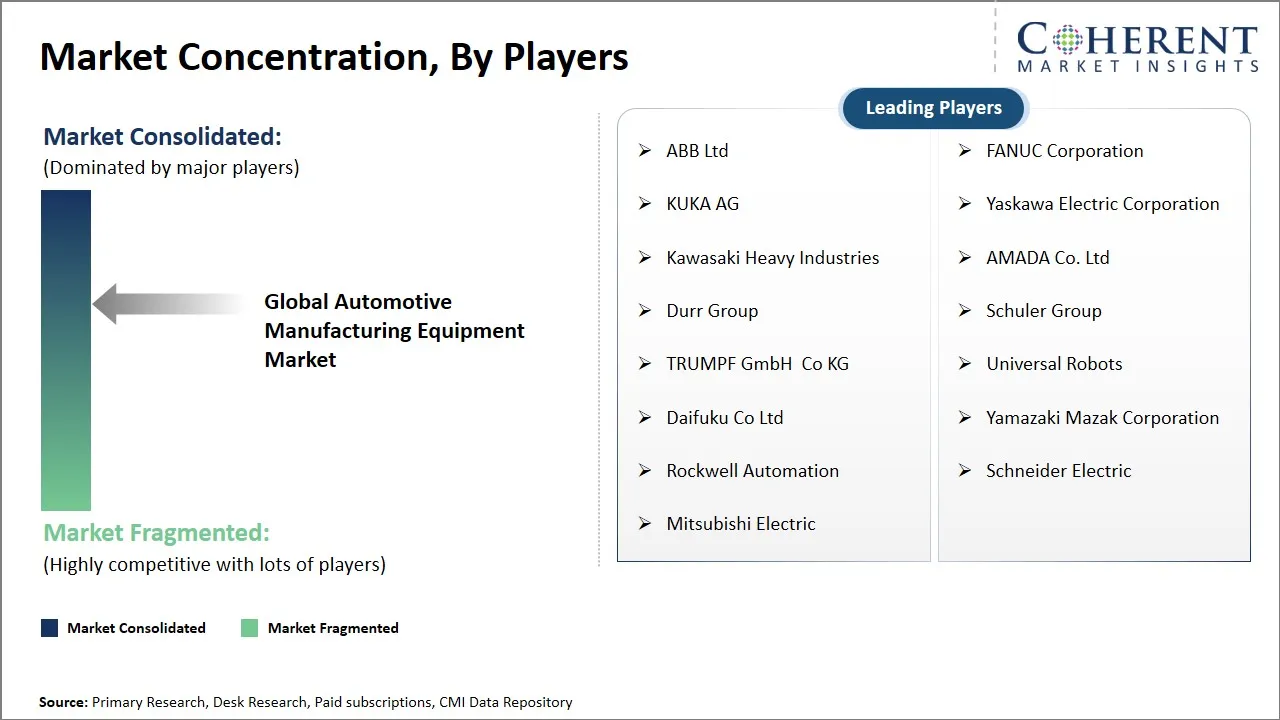
| Companies covered: | ABB Ltd, FANUC Corporation, KUKA AG, Yaskawa Electric Corporation, Kawasaki Heavy Industries, AMADA Co. Ltd, Durr Group, Schuler Group, TRUMPF GmbH Co KG, Universal Robots, Daifuku Co Ltd, Yamazaki Mazak Corporation, Rockwell Automation, Schneider Electric, and Mitsubishi Electric | ||
| Growth Drivers: |
| ||
| Restraints & Challenges: |
| ||
Global Automotive Manufacturing Equipment Market Dynamics
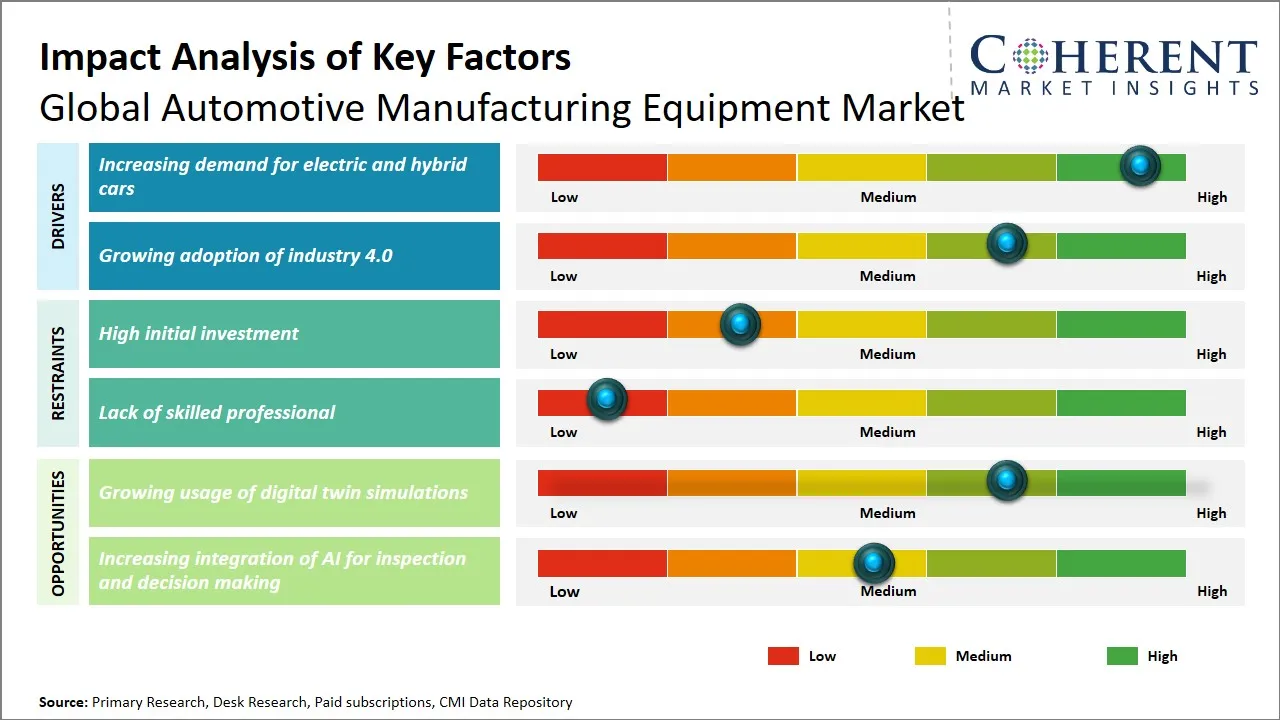
Global Automotive Manufacturing Equipment Market Driver - Increasing Demand for Electric and Hybrid Cars
Change in what buyers choose pushes updates in how cars are built. As older engine types fade slowly, factories adjust with tools meant for electric vehicles. Machines now must work exactly right on parts like power packs, electric engines, cables, and strong but light substances - unlike past car materials. Where rules about fumes grow tighter, companies move faster toward electric options. Production systems evolve to handle many kinds of these newer vehicles without slowing down.
For instance, on March 5, 2025, KGM introduced its newest midsize electric pickup, the Musso EV. This vehicle marks South Korea’s debut in the electric truck segment, blending car-like ride quality with cargo versatility. Powered by an 80.6 kWh LFP blade battery, it runs on a 152.2 kW motor; delivering around 249 miles per full charge in rear-wheel-drive form.
Global Automotive Manufacturing Equipment Market Opportunity - Growing Usage of Digital Twin Simulations
Growing use of digital twin simulations software opens new pathways in the worldwide market for automotive production machinery, supported by demands for smoother workflows and lower expenses. Though initially complex, virtual models of machines and assembly sequences allow live tracking and adjustments while factories keep running. These setups support early fault detection, tighter accuracy in output, and faster design iterations - offering advantages where change happens quickly. When combined with modern factory automation strategies, such replicas help handle intricate tasks, particularly as electric and self-driving vehicles require more exact manufacturing methods. Despite skepticism at first, many producers now rely on these systems to manage escalating complexity in vehicle construction.
For instance, on December 18, 2025, Siemens launched its PAVE360 Automotive technology, a new category of digital twin software that is pre-integrated and designed as an off-the-shelf offering to address the escalating complexity of automotive hardware and software integration.
Analyst Opinion (Expert Opinion)
- A transformation now shapes the world market for auto production machinery. Electrified powertrains contribute, while vehicle software integration adds further influence. So does rising complexity in factory output. Equipment buyers include major carmakers plus their top-tier partners. These groups increase spending on smart machines. Automation systems play a larger role. Robotics matter more. Digital capabilities support new performance goals, flexibility improves.
- Future manufacturing depends heavily on digital integration. Tools like simulated replicas of systems, artificial intelligence for checking output quality, or testing operations virtually shape upcoming assembly setups. Such methods help lower interruptions, refine spatial design ahead of construction, also handle increasing expense challenges. Across areas, the Asia Pacific continues leading in scale enlargement as companies shift toward local production networks.
Speak to the analyst
Want personalized insights?
Take the findings above to one of our principal consultants, or have the report rebuilt around the segments, geographies and competitors you actually track.
Market Segmentation
- Equipment Type Insights (Revenue, USD Bn, 2021 - 2033)
- CNC Machines
- Robots
- Welding Machines
- Stamping Machines
- Others
- Mode of Operation Insights (Revenue, USD Bn, 2021 - 2033)
- Automatic Systems
- Semi-Automatic Systems
- Vehicle Type Insights (Revenue, USD Bn, 2021 - 2033)
- Passenger Vehicles
- Commercial Vehicles
- Regional Insights (Revenue, USD Bn, 2021 - 2033)
- North America
- U.S.
- Canada
- Latin America
- Brazil
- Argentina
- Mexico
- Rest of Latin America
- Europe
- Germany
- U.K.
- Spain
- France
- Italy
- Russia
- Rest of Europe
- Asia Pacific
- China
- India
- Japan
- Australia
- South Korea
- ASEAN
- Rest of Asia Pacific
- Middle East
- GCC Countries
- Israel
- Rest of Middle East
- Africa
- South Africa
- North Africa
- Central Africa
- North America
- Key Players Insights
- ABB Ltd
- FANUC Corporation
- KUKA AG
- Yaskawa Electric Corporation
- Kawasaki Heavy Industries
- AMADA Co. Ltd
- Durr Group
- Schuler Group
- TRUMPF GmbH Co KG
- Universal Robots
- Daifuku Co Ltd
- Yamazaki Mazak Corporation
- Rockwell Automation
- Schneider Electric
- Mitsubishi Electric
Sources
Primary Research interviews
- Automotive Manufacturing Equipment Suppliers and Manufacturers
- OEM Automotive Companies and Tier-1 Suppliers
- Industry Consultants and Technology Experts
- End-user Industries (Automotive Assembly Plants)
Databases
- Global Data Automotive Manufacturing Database
Magazines
- Automotive Manufacturing Solutions
- Assembly Magazine
- Manufacturing Engineering Magazine
- Automotive Industries Magazine
Journals
- International Journal of Automotive Manufacturing
- Journal of Manufacturing Science and Engineering
- Automotive Engineering International Journal
Newspapers
- Financial Times (Manufacturing & Industrial Section)
- The Wall Street Journal (Automotive Industry Coverage)
- Automotive Manufacturing Report
- Manufacturing News Daily
Associations
- Association for Manufacturing Excellence (AME)
- Automotive Industry Action Group (AIAG)
- International Association of Automotive Engineering (IAAE)
- Society of Manufacturing Engineers (SME)
Public Domain Sources
- U.S. Bureau of Economic Analysis (Manufacturing Statistics)
- International Trade Administration Reports
- European Automobile Manufacturers Association (ACEA) Publications
- Ministry of Economy, Trade and Industry (Japan) Reports
Proprietary Elements
- CMI Data Analytics Tool
- Proprietary CMI Existing Repository of information for last 8 years
Get access to 250+ pages report
Every segment, forecast, competitor profile and data table behind the analysis above — available for instant download.
- ESOMAR Member
- ISO 9001:2015 Certified
- D-U-N-S Registered
- GDPR & CCPA Compliant
Missing comfort of reading report in your local language? Find your preferred language:
Transform your Strategy with Exclusive Trending Reports
Frequently Asked Questions
The global automotive manufacturing equipment market is projected to stand at USD 33 Bn in 2026 and is expected to reach USD 44 Bn by 2033.
The CAGR of global automotive manufacturing equipment market is projected to be 6 % from 2026 to 2033.
Increasing demand for electric and hybrid cars and growing adoption of industry 4.0 are the major factors driving the growth of the global automotive manufacturing equipment market.
High initial investment and lack of skilled professional are the major factors hampering the growth of the global automotive manufacturing equipment market.
In terms of equipment type, CNC machines are estimated to dominate the market revenue share in 2026.
ABB Ltd, FANUC Corporation, KUKA AG, Yaskawa Electric Corporation, Kawasaki Heavy Industries, AMADA Co. Ltd, Durr Group, Schuler Group, TRUMPF GmbH Co KG, Universal Robots, Daifuku Co Ltd, Yamazaki Mazak Corporation, Rockwell Automation, Schneider Electric, and Mitsubishi Electric are the major players
Asia Pacific is expected to lead the global automotive manufacturing equipment market in 2026.