

Automotive Sheet Metal Components Market Size and Forecast – 2026 to 2033
The Automotive Sheet Metal Components Market is anticipated to grow at a CAGR of 6.3% with USD 142.9 Bn in 2026 and is expected to reach USD 271.5 Bn in 2033. Automakers expand the automotive sheet metal components market by increasing vehicle production and seeking lightweight, durable, and cost-efficient parts. According to OICA, global motor vehicle sales reached 99.8 million units in 2025, up 4.7% from 95.3 million units in 2024. Global vehicle production also increased by 3.9%, rising from 92.7 million units in 2024 to 96.4 million units in 2025.
Key Takeaways
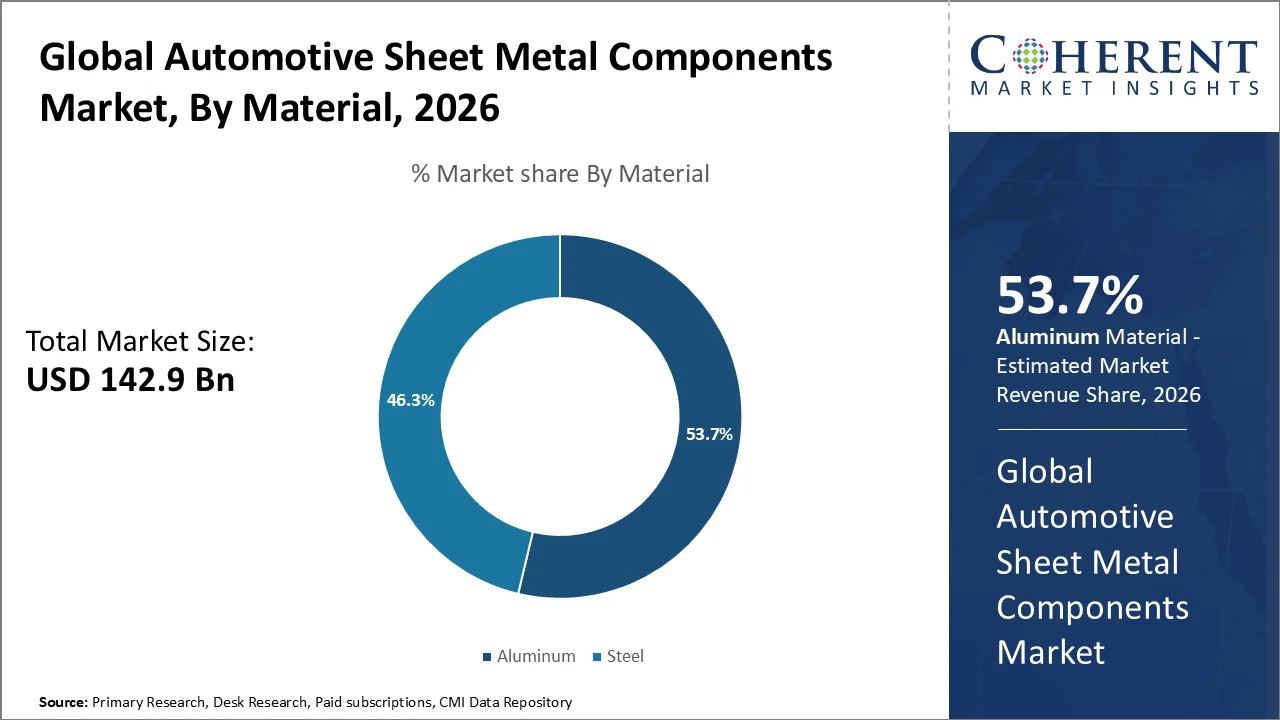
- Aluminum holds the largest market share of 53.7% in 2026 owing to the vehicle lightweighting. A 10% reduction in vehicle weight can improve fuel efficiency by approximately 6%–8%.
- Engine expected to hold largest market of 42.6% in 2026 owing to its demand for fuel-efficient engines.
- Wholesaler acquired the prominent market share of 42.7% in 2026 owing to the expansion of the automotive aftermarket. According to our research, the ASEAN Automotive Aftermarket is estimated to surpass USD 74.19 Bn by 2033.
- Asia Pacific is expected to acquire the dominant share of 38.6% in 2026 owing to the Increasing Demand for Lightweight Vehicles. India’s light-vehicle demand is projected to reach approximately 5.6–6.9 million units.
Current Events and Their Impact on the Automotive Sheet Metal Components Market
Current Event | Description and its Impact |
End-of-Life Vehicles Rules, 2025 introduce mandatory producer responsibility for vehicle scrapping |
|
India: PM E-DRIVE accelerates electric-vehicle adoption and manufacturing |
|
Segmental Insights
- Current Industry Events of 2026
- Market Size Estimation
- Regional Breakdown
- Competitive Landscape
- Customer Intelligence
- Segmental Analysis
- Pricing Analysis
- Key Market Drivers, Challenges & Future Trends
- Customized Insights Section
Why is Aluminum Acquiring the Largest Market Share?
Aluminum holds the largest market share of 53.7% in 2026. India’s aluminium production increased from 3.6 million tonnes in FY2021 to 4.2 million tonnes in FY2024, reflecting moderate growth over the period. Automakers are driving growth in the aluminum segment of the Automotive Sheet Metal Components Market by increasing their use of lightweight materials to improve fuel efficiency and reduce emissions. They use aluminum for body panels, hoods, doors, roofs, and structural components because it offers a strong strength-to-weight ratio and excellent corrosion resistance. The rapid growth of electric vehicles is further increasing aluminum demand, as manufacturers use it to reduce vehicle weight and extend driving range. Global passenger EV sales are projected to reach 23.3 million units in 2026, indicating continued growth in electric-vehicle adoption. Advances in aluminum alloys, stamping, forming, joining, and recycling technologies are also expanding its use in automotive manufacturing.
Engine expected to hold largest market
Engine expected to hold largest market of 42.6% in 2026 owing to its adoption of high-strength and lightweight materials. Rising vehicle production, demand for fuel-efficient engines, and adoption of advanced engine technologies drive the engine segment in the Automotive Sheet Metal Components Market. Automakers incorporate sheet metal components such as engine covers, heat shields, brackets, and oil pans to enhance durability and manage heat effectively. Growing commercial vehicle production and hybrid vehicle adoption further increase demand for engine-related components. Approximately 16.7 million trucks, vans, and buses are manufactured globally each year, with Europe accounting for 18% (approximately 3.08 million units) of total production. In addition, stricter emission regulations push manufacturers to improve engine efficiency, while advances in stamping, forming, and lightweight materials enhance component performance.
Which Distribution Channel segment dominates the market?
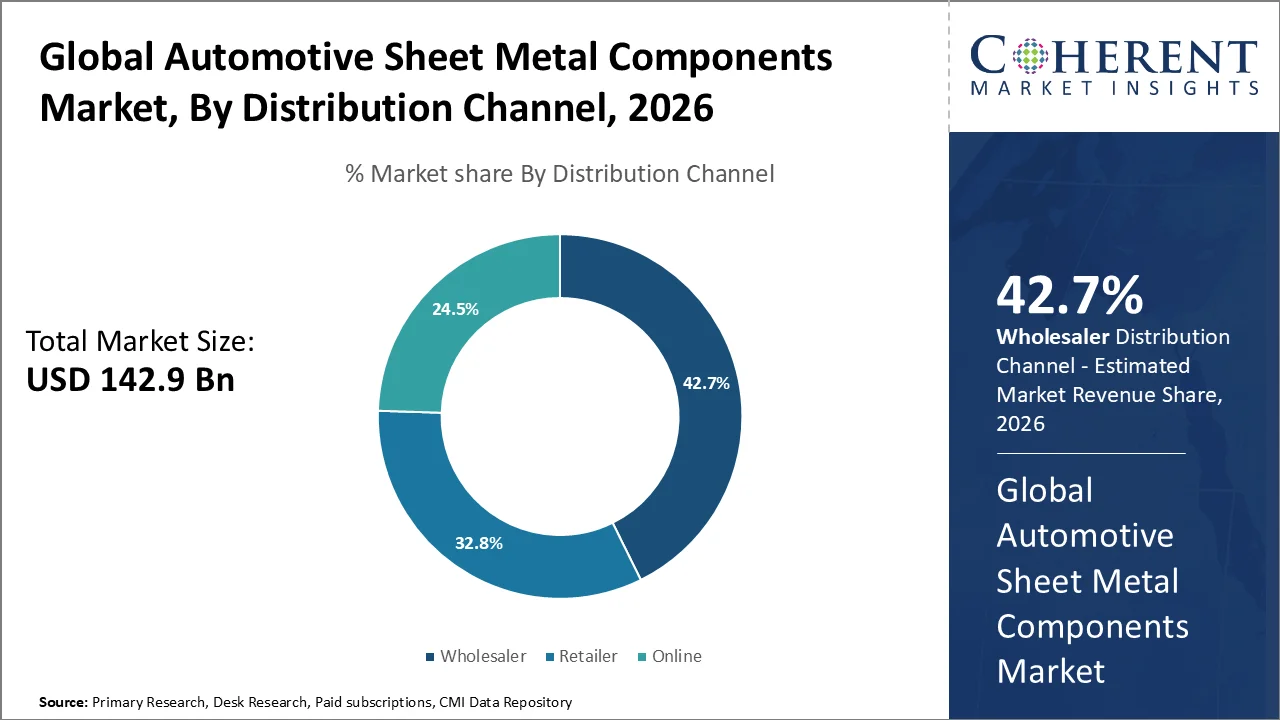
Wholesaler acquired the prominent market share of 42.7% in 2026. The growing automotive aftermarket, increasing vehicle ownership, and rising demand for replacement body parts fuel the wholesaler segment in the Automotive Sheet Metal Components Market. Wholesalers supply repair shops, retailers, and distributors with a wide range of components while maintaining efficient inventory and distribution networks. Rising vehicle repair and collision rates further increase demand for sheet metal parts. India recorded more than 450,000 road accidents and over 150,000 fatalities in 2022, highlighting the significant public health impact of road traffic incidents. Independent repair centers and digital B2B platforms also drive wholesaler growth by expanding product availability, simplifying procurement, accelerating order fulfillment, and improving supply chain efficiency.
Automotive Sheet Metal Components Market Trends
- Rising adoption of lightweight materials such as aluminum and advanced high-strength steel is enabling automakers to reduce vehicle weight and improve efficiency. The U.S. Department of Energy states that a 10% reduction in vehicle weight can improve fuel economy by approximately 6%–8%. Lightweighting is particularly relevant to EVs because reducing vehicle mass can improve efficiency and help offset the weight of batteries and electric motors.
- Increasing vehicle electrification is creating new demand for lightweight and structurally engineered sheet-metal components. Global electric-car sales exceeded 20 million units in 2025, representing approximately one-quarter of all new cars sold worldwide, according to the IEA. The continued expansion of EV production is increasing the need for optimized vehicle structures and components that balance weight, safety, durability, and packaging requirements.
- EV battery growth is expanding the requirement for specialized vehicle structures and metal components. Global EV battery demand exceeded 950 GWh in 2024, increasing by 25% from 2023, with electric cars accounting for more than 85% of total EV battery demand. This growth supports opportunities for suppliers of metal battery enclosures, structural components, brackets, shields, and other stamped or fabricated parts used in electrified vehicles.
Regional Insights
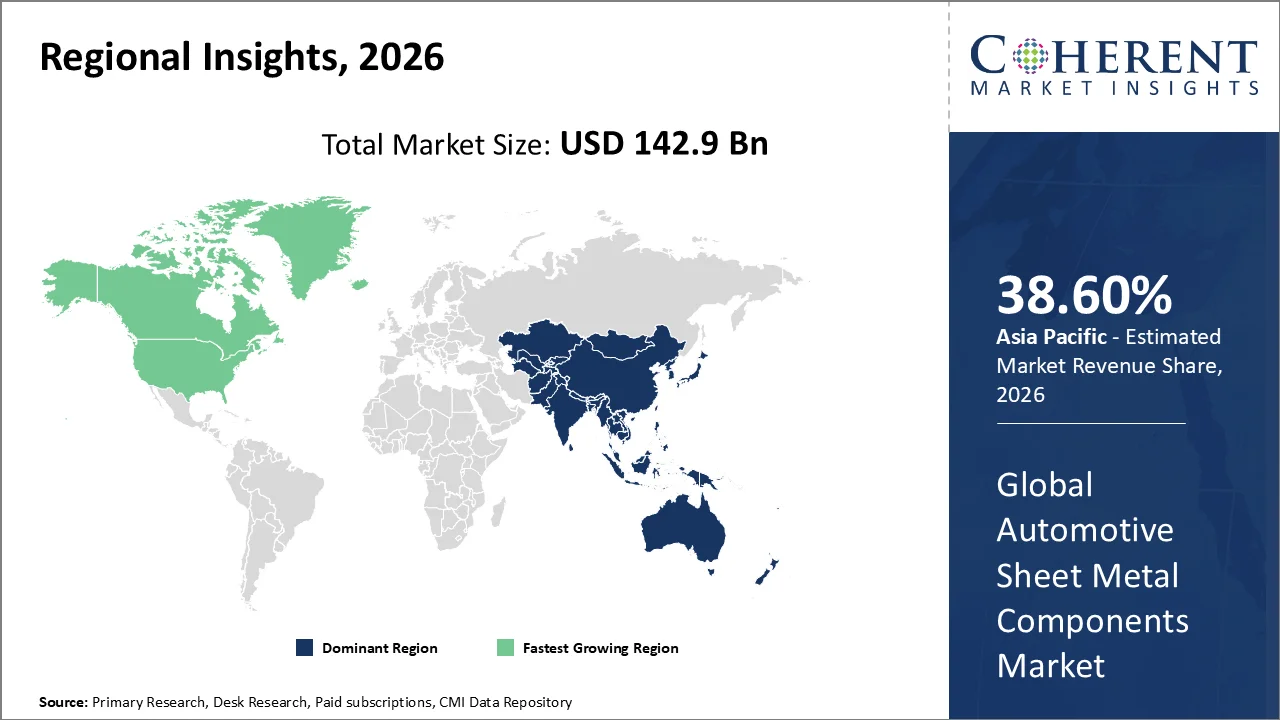
Asia Pacific dominates owing to strong presence of automotive OEMs and Tier-1 suppliers
Asia Pacific is expected to acquire the dominant share of 38.60% in 2026. Expanding vehicle production, rising automotive sales, and increased investment in manufacturing infrastructure drive the Asia Pacific Automotive Sheet Metal Components Market. China’s automobile industry recorded 31.43 million vehicle sales in 2024, including approximately 27.56 million passenger vehicles. Growing demand for passenger and commercial vehicles across China, India, Japan, South Korea, and Southeast Asia increases the need for sheet metal components. Strong regional automotive supply chains, cost-competitive manufacturing capabilities, and growing electric vehicle production further support market expansion. Government initiatives that promote vehicle manufacturing and localization attract new investments, while advances in stamping, forming, welding, and automation enhance production efficiency and component quality. For instance, GAMECO has established a Composite Repair Center (CRC) to provide structural repair, engineering, overhaul, and AOG support for composite and sheet metal components.
North America Automotive Sheet Metal Components Market Trends
Rising vehicle production, increasing demand for lightweight and fuel-efficient vehicles, and rapid adoption of advanced manufacturing technologies drive the North American automotive sheet metal components market. Automakers use high-strength steel and aluminum components to enhance vehicle safety, durability, and performance. Growing electric vehicle production also increases demand for specialized sheet metal components, including battery enclosures and structural parts. Strong aftermarket demand, innovations in stamping and forming technologies, and continued investments in regional automotive manufacturing further support market expansion. For instance, in July 2026, Belinker has expanded Belinker Manufacturing, a global service connecting U.S. businesses with South Korea’s advanced manufacturing capabilities.
China Automotive Sheet Metal Components Market Trends
China’s automotive sheet metal components market benefits from strong vehicle production, expanding electric vehicle manufacturing, and rising demand for lightweight, durable body structures. Government initiatives supporting new energy vehicles and advanced manufacturing encourage automakers and suppliers to invest in stamping, forming, and precision metal technologies. In June 2026, China launched a nationwide initiative to accelerate new energy vehicle (NEV) adoption in rural areas, focusing on vehicle trade-ins, charging infrastructure, after-sales services, and models tailored to rural consumers. Growing consumer demand for passenger and commercial vehicles further increases component requirements. China’s well-established automotive supply chain, skilled workforce, and adoption of automation improve manufacturing efficiency. Additionally, automakers and suppliers increasingly localize component sourcing and expand investments, creating new growth opportunities across the market.
United States Automotive Sheet Metal Components Market Trends
Strong vehicle production, growing demand for lightweight and fuel-efficient vehicles, and rising electric vehicle adoption drive the United States automotive sheet metal components market. According to an article published by the Center for Sustainable Energy in July 2026, more than 8.2 million plug-in electric vehicles have been sold in the United States since 2010. Automakers are investing in advanced manufacturing facilities, which increases demand for sheet metal components. Regulatory requirements for vehicle safety and emissions also encourage manufacturers to adopt high-strength and precision-engineered parts. Meanwhile, consumers’ growing preference for SUVs, pickup trucks, and commercial vehicles supports market expansion, while advances in stamping, forming, welding, and automation further strengthen industry development.
Who are the Major Companies in Automotive Sheet Metal Components Industry
Some of the major key players in Automotive Sheet Metal Components are Larsen Manufacturing, General Stamping & Metalworking Inc., Aleris Corporation, Mayville Engineering Company Inc., The Cramer Group, O’Neal Manufacturing Services, Omax Auto Limited, Novelis, Inc., Frank Dudley Ltd., Jobro Sheet Metal Technology AB, Amada Co. Ltd. And Paul Craemer GmbH.
Key News
- In April 2026, Prime Minister Sifi Ghrieb launched a factory project in Batna to produce molded metal parts and components during his visit to the wilaya on behalf of Algerian President Abdelmadjid Tebboune.
Market Report Scope
Automotive Sheet Metal Components Report Coverage
| Report Coverage | Details | ||
|---|---|---|---|
| Base Year: | 2025 | Market Size in 2026: | USD 142.9 Bn |
| Historical Data for: | 2020 To 2024 | Forecast Period: | 2026 To 2033 |
| Forecast Period 2026 to 2033 CAGR: | 6.3% | 2033 Value Projection: | USD 271.5 Bn |
| Geographies covered: |
| ||
| Segments covered: |
| ||
| Companies covered: | Larsen Manufacturing, General Stamping & Metalworking Inc., Aleris Corporation, Mayville Engineering Company Inc., The Cramer Group, O’Neal Manufacturing Services, Omax Auto Limited, Novelis, Inc., Frank Dudley Ltd., Jobro Sheet Metal Technology AB, Amada Co. Ltd. And Paul Craemer GmbH. | ||
Analyst Opinion
- U.S. vehicle production remains the fundamental demand engine for automotive sheet metal components. The U.S. new-vehicle market reached approximately 16.3 million units in 2025, making it the strongest sales year since 2019. In my view, this production base provides a more durable demand driver for sheet metal components than short-term technology trends, because every vehicle requires stamped, formed, welded, and structural metal components.
- Lightweighting and crash performance are pushing automakers toward more sophisticated sheet metal rather than simply more metal. Advanced high-strength steel has become strategically important because manufacturers can reduce material thickness while maintaining structural stiffness and crash protection. Modern vehicle structures can contain as much as 60% AHSS, while the available AHSS portfolio has expanded from 38 grades in 2017 to nearly 70 grades.
- EV adoption is reshaping component requirements, but I do not view electrification as a simple replacement cycle for conventional automotive sheet metal. U.S. EV sales reached nearly 1.3 million units in 2025, representing the second-best year on record, despite a sharp fourth-quarter slowdown. The real opportunity lies in redesigned battery enclosures, reinforced underbody structures, crash-management systems, and lightweight body architectures. WorldAutoSteel’s Steel E-Motive research, for example, uses 1,500–2,000 MPa AHSS grades to improve structural integrity and reduce vehicle weight while protecting batteries during crashes.
- Manufacturing technology is the decisive competitive factor for U.S. sheet metal suppliers. The industry is moving toward digitally validated forming, advanced welding, automated inspection, and process simulation to reduce tooling errors and production losses. WorldAutoSteel’s latest engineering guidance specifically emphasizes “first-time-right” body-in-white development, where manufacturers validate forming processes virtually before committing to physical tooling. Suppliers that combine material expertise with automation and simulation capabilities should therefore capture more valuable programs than companies competing primarily on fabrication cost.
Speak to the analyst
Want personalized insights?
Take the findings above to one of our principal consultants, or have the report rebuilt around the segments, geographies and competitors you actually track.
Market Segmentation
- By Material Type (Revenue, USD Bn, 2021-2033)
- Aluminum
- Steel
- By Application (Revenue, USD Bn, 2021-2033)
- Interior
- Drivetrain
- Engine
- Exterior
- Chassis
- By Distribution Channels (Revenue, USD Bn, 2021-2033)
- Wholesaler
- Retailer
- Online
- By Region (Revenue, USD Bn, 2021-2033)
- North America
- U.S.
- Canada
- Latin America
- Brazil
- Mexico
- Argentina
- Rest of Latin America
- Europe
- Germany
- U.K.
- France
- Italy
- Spain
- Russia
- Rest of Europe
- Asia Pacific
- China
- India
- Japan
- Australia
- South Korea
- ASEAN
- Rest of Asia Pacific
- Middle East
- GCC
- Israel
- Rest of Middle East
- Africa
- South Africa
- Central Africa
- North Africa
- North America
Sources
Primary Research interviews
- Automotive OEM procurement and sourcing professionals
- Tier-1 and Tier-2 automotive component manufacturers
- Sheet metal stamping and fabrication companies
- Automotive body-in-white (BIW) component suppliers
- Automotive parts distributors and channel partners
- Raw material suppliers, including steel and aluminum producers
- Industry experts specializing in automotive manufacturing, stamping, forming, and fabrication
- Production, operations, engineering, and supply-chain professionals from automotive component manufacturing facilities
Databases
- United Nations Comtrade Database
- World Integrated Trade Solution (WITS)
- International Trade Centre (ITC) Trade Map
- World Bank DataBank
- OECD Data
- International Monetary Fund (IMF) Data
- U.S. International Trade Commission (USITC) DataWeb
- Eurostat
- National statistical databases and government trade databases
- Automotive production, registration, and trade databases maintained by relevant national authorities
Magazines
- Automotive News
- Automotive Manufacturing Solutions
- MetalForming Magazine
- Modern Machine Shop
- The Fabricator
- Automotive World
- SAE Media publications
- Industry-specific manufacturing and metalworking magazines
Journals
- SAE International technical journals and publications
- International Journal of Automotive Technology
- Journal of Materials Processing Technology
- Journal of Manufacturing Processes
- International Journal of Advanced Manufacturing Technology
- Materials & Design
- International Journal of Machine Tools and Manufacture
- Production Engineering and related peer-reviewed manufacturing journals
Newspapers
- The Economic Times
- Business Standard
- Financial Times
- The Wall Street Journal
- Reuters
- The Hindu BusinessLine
- The Times of India
- Regional and national business newspapers covering automotive manufacturing, trade, and industrial production
Associations
- Society of Automotive Engineers (SAE International)
- Automotive Component Manufacturers Association (ACMA)
- International Organization of Motor Vehicle Manufacturers (OICA)
- American Iron and Steel Institute (AISI)
- Steel Manufacturers Association (SMA)
- European Automobile Manufacturers’ Association (ACEA)
- Automotive Industry Action Group (AIAG)
- International Federation for the Processing of Sheet Metal (IFPS)
- Federation of Indian Chambers of Commerce & Industry (FICCI)
- Confederation of Indian Industry (CII)
Public Domain sources
- Government automotive production and registration statistics
- National ministries and departments responsible for automotive, industry, trade, and transportation
- Central banks and national statistical offices
- Customs and international trade statistics
- United Nations industrial and trade statistics
- World Bank and OECD economic indicators
- Government publications, regulatory filings, and industrial policy documents
- Publicly available annual reports and investor presentations of automotive OEMs and component manufacturers
- Vehicle production, sales, export, and import statistics
- Publicly available technical standards, regulations, and environmental policies relevant to automotive manufacturing
Proprietary Elements
- CMI Data Analytics Tool
- Proprietary CMI Existing Repository of information for last 10 years
Get access to 250+ pages report
Every segment, forecast, competitor profile and data table behind the analysis above — available for instant download.
- ESOMAR Member
- ISO 9001:2015 Certified
- D-U-N-S Registered
- GDPR & CCPA Compliant
Missing comfort of reading report in your local language? Find your preferred language:
Transform your Strategy with Exclusive Trending Reports
Frequently Asked Questions
The Automotive Sheet Metal Components Market is anticipated to grow at a CAGR of 6.3% with USD 142.9 Bn in 2026 and is expected to reach USD 271.5 Bn in 2033.
Automotive sheet metal components are metal parts manufactured through processes such as stamping, forming, bending, cutting, welding, and joining.
Steel remains the dominant material, particularly advanced high-strength steel (AHSS), due to its strength, durability, formability, and cost efficiency.
Key drivers include vehicle production, demand for lightweight vehicles, electric vehicle adoption, stringent safety requirements, and increasing use of high-strength materials.
Electric vehicles are creating demand for specialized structural components, battery enclosures, underbody protection, crash-management structures, and lightweight body parts.
Lightweighting helps manufacturers improve vehicle efficiency while maintaining safety and performance.