

Automotive Airbag Market Size and Share Analysis- 2026 To 2033
The Automotive Airbag Market size is anticipated to grow at a CAGR of 6.3% with USD 17.1 Bn in 2026 and is expected to reach USD 26.2 Bn in 2033. The primary drivers are defined by rising vehicle production, stricter occupant-safety regulations, increasing installation of side and curtain airbags, growing consumer preference for advanced safety features, and adoption of smart sensor-enabled restraint systems. Global vehicle production reached 96.4 million units in 2025, while road crashes cause approximately 1.16 million deaths annually worldwide. This supports higher demand for advanced automotive airbag systems.
Key Takeaways
- The front airbag segment is likely to dominate the market with 53.8% in 2026. The segment’s growth is owing to standardized installation in driver and front-passenger positions and their critical role in reducing head and chest injuries during frontal collisions. According to the U.S. National Highway Traffic Safety Administration, frontal airbags have saved more than 50,000 lives in the U.S. over approximately three decades.
- The nylon segment is set to lead with 65.5% in 2026. The segment’s growth is owing to its high tensile strength, abrasion resistance, dimensional stability, heat resistance, and ability to withstand rapid inflation. Toray Industries identifies nylon 66 as a major airbag-yarn material supplied across multiple automotive manufacturing regions.
- The silicone coating segment is set to lead with 57.3% in 2026. The segment’s growth is owing to the superior thermal stability, abrasion resistance, controlled air permeability, and ability to protect airbag fabrics from heat generated during inflation.
- The air bag module segment is set to lead with 51.7% in 2026. The segment’s growth is owing to the increasing integration of inflators, cushions, sensors, and electronic control units into compact and ready-to-install vehicle safety systems.
- The passenger cars segment is set to lead with 71.5% in 2026. The segment’s growth is owing to the substantially higher global production volume and increasing airbag content per vehicle. China accounts for 34% of the world's annual car production of 69 million vehicles, followed by Europe at 19% and North America at 15%.
- Asia Pacific is expected to acquire the prominent share of 42.5% in 2026. The region’s growth is owing to the large vehicle-production clusters in China, Japan, India, and South Korea. According to the International Organization of Motor Vehicle Manufacturers, China manufactured approximately 34.53 million vehicles in 2025, while Japan and India produced approximately 8.41 million and 6.49 million vehicles, respectively. The region’s manufacturing scale is supporting localized airbag-module, inflator, fabric, sensor, and steering-wheel supply chains.
Segmental Insights
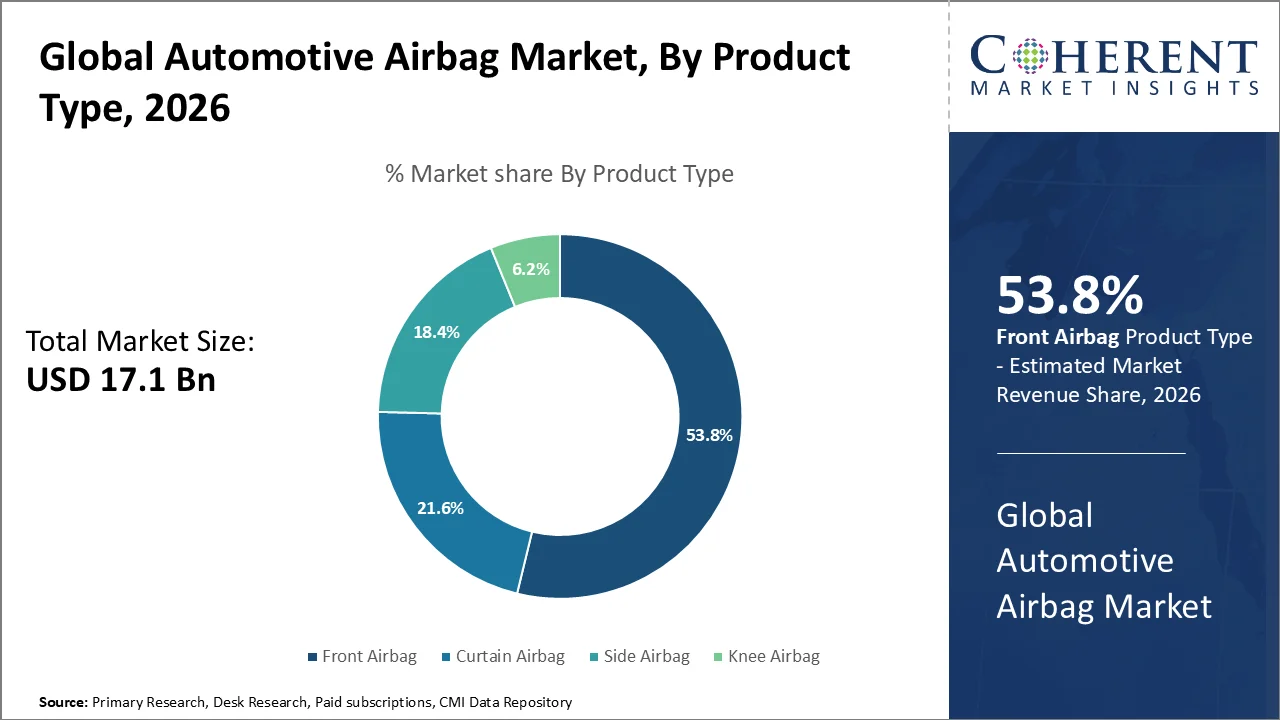
Why is Front Airbag Segment Acquiring the Largest Share?
On the basis of product type, the front airbag segment is projected to account for the largest Automotive Airbag Market share of 53.8% in 2026. The segment’s growth is owing to standard driver and passenger installation, regulatory crash-performance requirements, and integration with seat belts, occupant sensors, and adaptive restraint controllers.
The European Commission reports that driver and front-seat passenger airbags, when combined with seat belts, reduce fatal-injury risk by 68%. NHTSA separately estimates that airbags are approximately 30% effective in reducing fatalities in pure frontal crashes, demonstrating their direct value during head-on impacts.
In June 2026, Toyoda Gosei announced the adoption of its newly structured driver-side frontal airbag in the new Lexus ES. The airbag’s shape was changed from spherical to cylindrical, increasing its depth by more than 25%.
- Current Industry Events of 2026
- Market Size Estimation
- Regional Breakdown
- Competitive Landscape
- Customer Intelligence
- Segmental Analysis
- Pricing Analysis
- Key Market Drivers, Challenges & Future Trends
- Customized Insights Section
Nylon hold the Largest Market Share
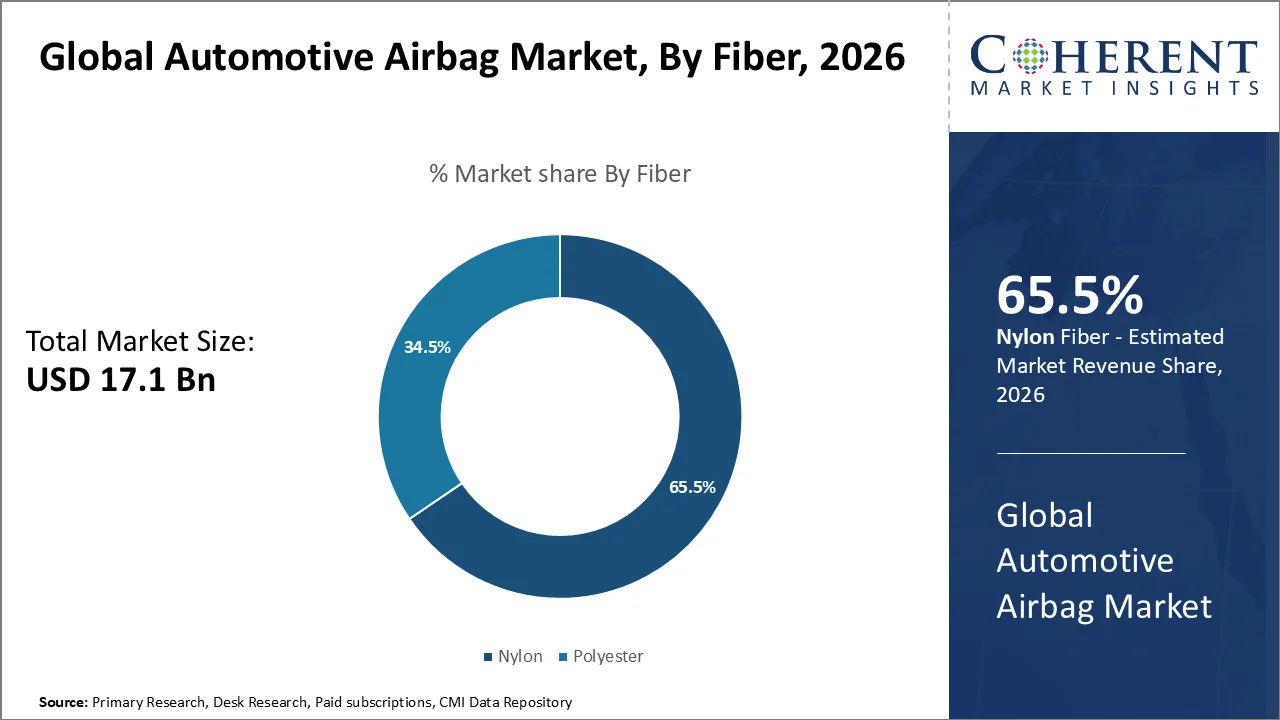
On the basis of fiber, the nylon segment lead with a major 65.5% share in 2026. The growth is owing to the tensile strength, abrasion resistance, dimensional stability, controlled elongation, thermal performance, and ability to remain folded within an airbag module over a vehicle’s operating life.
Nylon 6,6 is particularly important for airbag fabrics. Ascend Performance Materials supplies airbag fibers in the 420–840 denier range with reported tenacities of 9.0–9.5 grams per denier. High-tenacity fibers allow manufacturers to balance fabric strength, cushion weight, foldability, permeability, and package size.
Toray Industries has developed recycled nylon 66 resin produced by removing silicone from airbag-fabric scrap, washing the material, and applying proprietary additive-compounding technology. Toray states that the recycled compound’s flowability and mechanical properties are comparable to injection-molding grades derived from virgin raw materials.
Market Drivers
Rising Occupant-Protection Innovations are Transforming the Automotive Airbag Market in China
China is becoming one of the most influential countries for automotive airbag innovation due to its vehicle-manufacturing scale, rapid new-energy vehicle adoption, growing domestic brands, and increasingly sophisticated vehicle interiors. According to OICA, China produced approximately 34.53 million vehicles in 2025, adding around 3.25 million units compared with 2024. New-energy vehicle production reached approximately 16.63 million units, thus increasing 29% year over year. Electrified platforms incorporate flat floors, larger displays, redesigned dashboards, flexible consoles, and alternative seating arrangements, thereby creating new requirements for airbag packaging and deployment.
In January 2026, Toyoda Gosei announced that its compact curtain airbag had been adopted for the IM Motors LS9. The product is approximately 15% smaller than the company’s previous model while maintaining protection performance aligned with China New Car Assessment Program criteria. Toyoda Gosei also used computer-aided engineering during product design to respond to the accelerated development requirements of Chinese automakers.
Adaptive Occupant-Aware Airbags: A Major Breakthrough in the Automotive Airbag Market
Adaptive occupant-aware airbags represent an important shift from standardized deployment toward restraint systems that respond to the size, position, posture, and movement of individual occupants. Traditional systems generally use crash severity, seat occupancy, seat-belt status, and limited occupant-weight classifications to determine whether an airbag should deploy. Advanced systems integrate cabin cameras, pressure sensors, seat-position data, occupant classification, and real-time control software.
These systems can potentially adjust airbag deployment force, inflation timing, cushion pressure, and the coordination between airbags and seat-belt pretensioners. This is particularly important as electric and automated vehicles introduce reclining seats, movable consoles, rotating seating concepts, and larger interior spaces.
In October 2025, ZF LIFETEC introduced an adaptive restraint concept combining camera and sensor data to classify occupants in real time. The technology enables airbags and seat-belt systems to respond to different seating positions and occupant postures. ZF stated that the system is being developed in alignment with Euro NCAP’s 2026 and 2030 roadmaps, including requirements related to occupant monitoring and adaptive frontal protection.
Current Events and Their Impact on the Automotive Airbag Market
Current Event | Description and its Impact |
2026 U.S. Ban on Defective Imported Airbag Inflators
|
|
2026 Expansion of Takata “Do Not Drive” Recall Action |
|
Automotive Airbag Market Trends
- Rising installation of side-curtain, knee, and center airbags strengthens occupant protection and expands airbag content per vehicle globally.
- Adaptive airbags using occupant-detection sensors adjust deployment force and timing, improving protection across different body sizes and seating positions.
- Electric and autonomous vehicle designs encourage new airbag placements for reclined seats, flexible cabins, and retractable steering systems.
- Tightening crash-testing standards accelerates adoption of advanced restraint systems, supporting demand for multi-airbag configurations. From 2026, Euro NCAP evaluates broader occupant body types, including older passengers and children, while expanding near-side, pole, and far-side impact assessments. In July 2026, the ZEEKR 7 GT achieved maximum side-impact points, partly supported by its center-airbag configuration.
- Persistent road fatalities and stronger vehicle-safety awareness reinforce demand for reliable frontal and side airbags. In January 2026, Autoliv and Tensor introduced a foldable steering wheel for autonomous vehicles, using a steering-wheel airbag during manual driving and an instrument-panel airbag when the wheel retracts, demonstrating how passive-safety systems are adapting to next-generation mobility worldwide.
Regional Insights
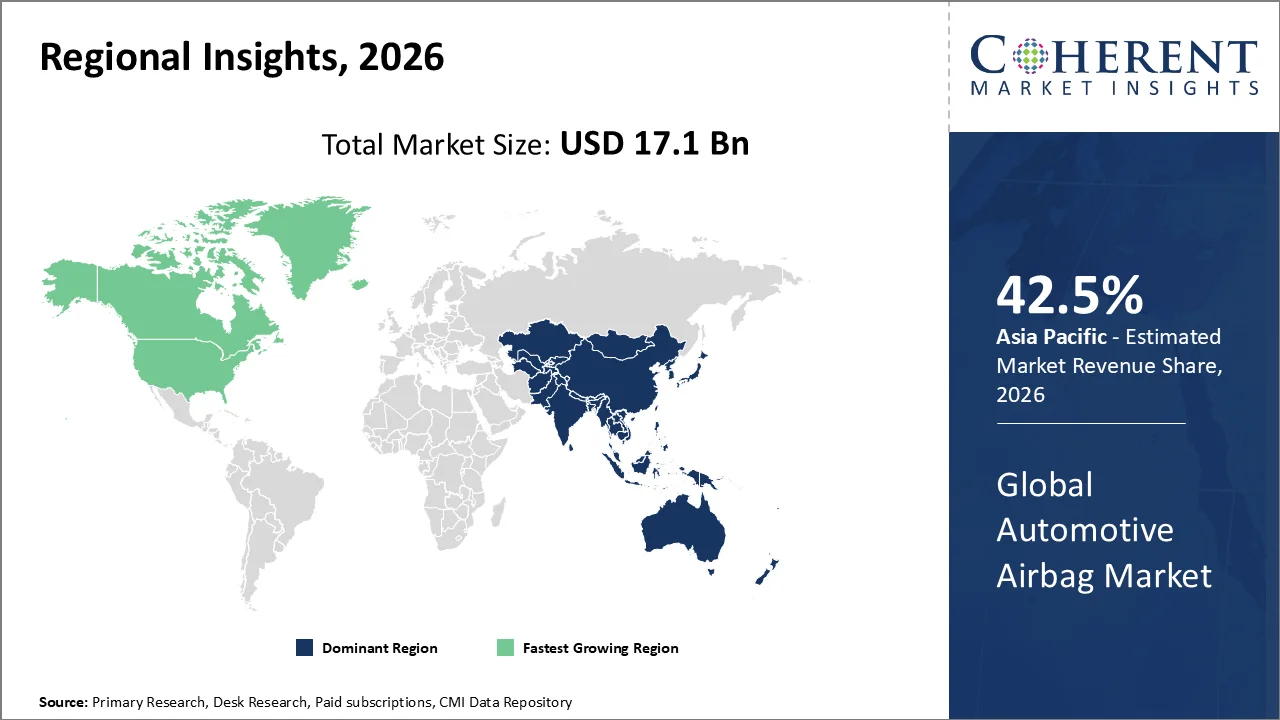
Asia Pacific Dominates Owing to the Mandatory Airbag Regulations, High Road-Safety Needs, and Expanding Manufacturing Capacity
The Asia Pacific region accounts for 42.5% of the market share in 2026. The region’s growth is owing to mandatory airbag fitment, persistent road-safety pressures, and deeper collaboration between regional automakers and safety-system suppliers.
India illustrates the underlying need: the Ministry of Road Transport and Highways recorded 480,583 road accidents and 172,890 fatalities in 2023. Government rules require driver airbags in M1 vehicles and front-passenger airbags in all such vehicles, thereby strengthening the baseline installation across mass-market cars.
In October 2024, Toyoda Gosei Co., Ltd. began operations at its expanded Neemrana airbag plant in Rajasthan, India. The expansion increases production capacity for frontal, side, and curtain airbags to meet growing automaker demand and stricter vehicle safety regulations nationwide.
North America Automotive Airbag Market Trends
North America is expected to witness strong growth in Automotive Airbag Market over the forecast period. The region’s growth is owing to the tighter crash-safety testing, redesign of occupant-restraint systems, and increasing adoption of center, knee, side, and curtain airbags.
In January 2026, NHTSA reported that women face a 46% higher risk of injury than men in frontal crashes, highlighting the need for airbags calibrated across different occupant sizes and seating positions. The same study found a 62% higher risk of lower-extremity injuries for women in frontal crashes, strengthening demand for improved knee airbags, deployment algorithms, sensors, and crash-test validation.
In March 2026, Kia launched the redesigned 2027 Telluride in the U.S. with 10 standard airbags, including a new front-row center airbag. Located between the driver and front passenger, the airbag helps reduce occupant-to-occupant contact during side-impact collisions. The vehicle went on sale in the U.S. in 2026.
Road-Safety Priorities and Integrated Airbag Innovations are Accelerating the Automotive Airbag Market in Japan
The Japan Automotive Airbag Market is driven by the sustained road-safety priorities, tighter occupant-protection expectations, and continued innovation by domestic suppliers. Japan’s National Police Agency reported 2,547 traffic fatalities in 2025, the lowest level recorded under the current statistical system since 1948, thereby reinforcing ongoing attention to vehicle safety technologies.
In March 2026, Autoliv and Yamaha Motor introduced an integrated airbag module for the Yamaha Tricity 300 commuter scooter. The airbag is installed inside the vehicle panel and was scheduled for market availability during the first half of 2026.
United States Automotive Airbag Market Trends
United States is expected to show strong growth in the Automotive Airbag Market. The trend is driven by federal occupant-protection requirements, continued road-safety concerns, and automakers’ adoption of multi-airbag systems. In April 2026, NHTSA estimated that 36,640 people died in U.S. traffic crashes during 2025, while the fatality rate declined to 1.10 deaths per 100 million vehicle miles traveled.
Who are the Major Companies in Automotive Airbag Industry
Some of the major key players in Automotive Airbag Market are Autoliv, Inc., Robert Bosch GMBH, Continental AG, Delphi Automotive PLC, Denso Corporation, Takata Corporation, Toyoda Gosei Co., Ltd., Nihon Plast Co. Ltd., Hyundai Mobis Co., Ltd., and Key Safety Systems Inc.
Key News
- In June 2026, ZF LIFETEC unveiled an integrated airbag system designed for highly reclined and comfort-oriented seating positions. The concept combines a seat-ramp airbag, active-heel airbag, dual-contour knee airbag, and adaptive driver/passenger airbag.
- In May 2026, Toyoda Gosei announced the adoption of its knee airbag in the new 2026 Mazda CX-5. The system supports the occupant’s legs during frontal crashes, limits forward body movement and helps maintain a safer restraint posture.
Market Report Scope
Automotive Airbag Market Report Coverage
| Report Coverage | Details | ||
|---|---|---|---|
| Base Year: | 2025 | Market Size in 2026: | USD 17.1 Bn |
| Historical Data for: | 2020 To 2024 | Forecast Period: | 2026 To 2033 |
| Forecast Period 2026 to 2033 CAGR: | 6.3% | 2033 Value Projection: | USD 26.2 Bn |
| Geographies covered: |
| ||
| Segments covered: |
| ||
| Companies covered: | Autoliv, Inc., Robert Bosch GMBH, Continental AG, Delphi Automotive PLC, Denso Corporation, Takata Corporation, Toyoda Gosei Co., Ltd., Nihon Plast Co. Ltd., Hyundai Mobis Co., Ltd., and Key Safety Systems Inc. | ||
| Growth Drivers: |
| ||
| Restraints & Challenges: |
| ||
Analyst Opinion
- Automotive airbag demand is driven by the continuing need for vehicle safety. In 2024, approximately 39,254 people died in motor vehicle crashes in the U.S. This means the market is not expanding only because of technological trends but it is growing because effective occupant-protection systems remain essential for reducing crash-related fatalities and injuries.
- Frontal airbags are among the most effective automotive safety systems. The research shows that frontal airbags reduce driver fatalities in frontal crashes by nearly 29% and fatalities among front-seat passengers aged 13 years and older by approximately 32%.
- Side and curtain airbags are gaining significant importance with head-protecting side airbags reducing driver death risk by 37% in passenger cars and 52% in SUVs during driver-side crashes. This strong safety performance will encourage manufacturers to integrate advanced side-curtain, centre, knee, and multi-stage airbag systems, increasing airbag content per vehicle and supporting market growth across passenger and commercial vehicle segments.
Speak to the analyst
Want personalized insights?
Take the findings above to one of our principal consultants, or have the report rebuilt around the segments, geographies and competitors you actually track.
Market Segmentation
- By Product Type (Revenue, USD Bn, 2021-2033)
- Front Airbag
- Side Airbag
- Curtain Airbag
- Knee Airbag
- By Fiber (Revenue, USD Bn, 2021-2033)
- Nylon
- Polyester
- By Coating (Revenue, USD Bn, 2021-2033)
- Neoprene Coating
- Silicone Coating
- Non-Coated
- By Component (Revenue, USD Bn, 2021-2033)
- Air Bag Module
- Crash Sensors
- Monitoring Unit
- Others
- By Vehicle Type (Revenue, USD Bn, 2021-2033)
- Passenger Cars
- Commercial Vehicles
- By Region (Revenue, USD Bn, 2021-2033)
- North America
- U.S.
- Canada
- Latin America
- Brazil
- Mexico
- Argentina
- Rest of Latin America
- Europe
- Germany
- U.K.
- France
- Italy
- Spain
- Russia
- Rest of Europe
- Asia Pacific
- China
- India
- Japan
- Australia
- South Korea
- ASEAN
- Rest of Asia Pacific
- Middle East
- GCC
- Israel
- Rest of Middle East
- Africa
- South Africa
- Central Africa
- North Africa
- North America
Sources
Primary Research Interviews
- Automotive safety engineers
- Airbag system and inflator manufacturers
- Automobile original equipment manufacturers (OEMs)
- Tier 1 automotive component suppliers
- Vehicle crash-testing and homologation experts
- Automotive procurement and sourcing managers
- Automotive component distributors
- Key opinion leaders (KOLs) in vehicle safety
Databases
- National Highway Traffic Safety Administration (NHTSA)
- Insurance Institute for Highway Safety (IIHS)
- European New Car Assessment Programme (Euro NCAP)
- United Nations Economic Commission for Europe (UNECE)
- International Organization of Motor Vehicle Manufacturers (OICA)
- Organisation for Economic Co-operation and Development (OECD)
Magazines
- Automotive News
- SAE Automotive Engineering
- Automotive World
- Just Auto
Journals
- Traffic Injury Prevention
- Accident Analysis & Prevention
- SAE International Journal of Transportation Safety
- International Journal of Automotive Technology
- Journal of Safety Research
Newspapers
- The New York Times
- The Guardian
- The Wall Street Journal
- Financial Times
Associations
- Automotive Safety Council
- SAE International
- International Organization of Motor Vehicle Manufacturers (OICA)
- European Association of Automotive Suppliers (CLEPA)
- Motor & Equipment Manufacturers Association (MEMA)
- Alliance for Automotive Innovation
Public Domain Sources
- Company Annual Reports and Investor Presentations
- Government Vehicle Safety and Transportation Publications
- Vehicle Crash-Test and Safety-Rating Databases
- Automotive Production and Vehicle Registration Statistics
- Regulatory Standards and Homologation Documents
- Patent Databases and Company Product Literature
Proprietary Elements
- CMI Data Analytics Tool
- Proprietary CMI Existing Repository of Information for the Last 10 Years
Get access to 250+ pages report
Every segment, forecast, competitor profile and data table behind the analysis above — available for instant download.
- ESOMAR Member
- ISO 9001:2015 Certified
- D-U-N-S Registered
- GDPR & CCPA Compliant
Missing comfort of reading report in your local language? Find your preferred language:
Transform your Strategy with Exclusive Trending Reports
Frequently Asked Questions
The Automotive Airbag Market is expected to reach USD 26.2 Bn in 2033.
Major players operating in the global Automotive Airbag Market include Autoliv, Inc., Robert Bosch GMBH, Continental AG, Delphi Automotive PLC, Denso Corporation, Takata Corporation, Toyoda Gosei Co., Ltd., Nihon Plast Co. Ltd., Hyundai Mobis Co., Ltd., and Key Safety Systems Inc.
The high production costs, complex technology integration, and expensive replacement after deployment are the key factors hampering growth of the market.
The government-mandated safety regulations, increasing consumer safety awareness, and rising global vehicle production is boosting the demand for Automotive Airbag.
The Automotive Airbag Market is anticipated to grow at a CAGR of 6.3% between 2026 and 2033.
Among regions, Asia Pacific is expected to account for a largest market share in the global Automotive Airbag Market over the forecast period.
An automotive airbag is a vehicle safety restraint system that uses a flexible fabric bag designed to inflate instantly within milliseconds during a collision.