

Commercial Vehicles Market Size and Forecast – 2026 to 2033
Commercial Vehicles Market is estimated to be valued at USD 1,763.78 Bn in 2026 and is expected to reach USD 5,685.48 Bn in 2033, exhibiting a compound annual growth rate (CAGR) of 18.2% from 2026 to 2033.
Key Takeaways
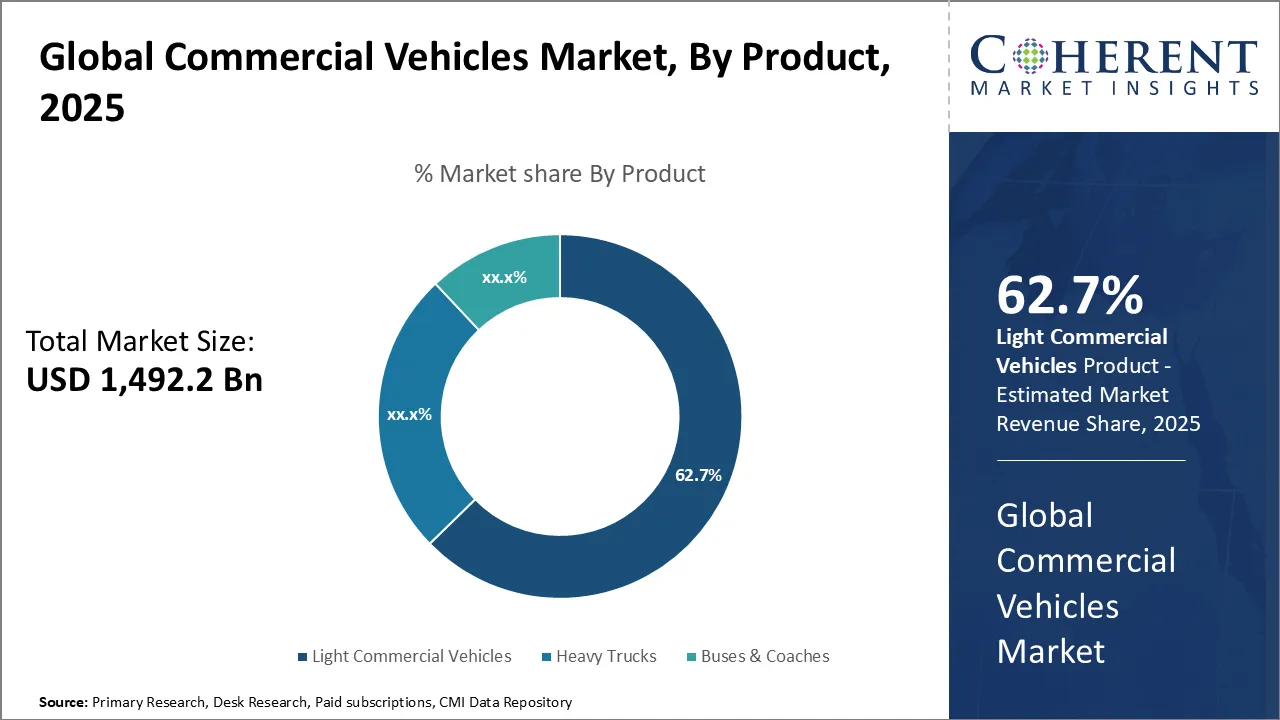
- By Product, Light commercial vehicles hold the largest market share of 63.7% in 2026 owing to the growth of e‑commerce, logistics & last‑mile delivery demand.
- By End Use, Logistics expected to hold largest market share in 2026 owing to the e-commerce and online retail growth.
- By Region, North America dominates the overall market with an estimated share of 51.5% in 2026 owing to the boom in e‑commerce, logistics & last‑mile delivery demand.
Market Overview
The Commercial Vehicles (CV) market includes light, medium, and heavy vehicles that transport goods and passengers across urban, regional, and long-haul routes. Rapid growth in e-commerce, logistics, and infrastructure development drives demand, while fleet modernization and regulatory compliance encourage the adoption of advanced, fuel-efficient, and environmentally friendly vehicles. Expanding supply chains, increasing industrialization, and urbanization further strengthen the market, as sectors like retail, construction, and manufacturing actively rely on commercial vehicles to move goods and provide services efficiently.
Current Events and Its Impact
Current Events | Description and its impact |
Geopolitical Dynamics Affecting Supply Chains |
|
Economic and Market Demand Fluctuations |
|
Technological Advancements and Electrification Trends |
|
Segmental Insights
- Current Industry Events of 2026
- Market Size Estimation
- Regional Breakdown
- Competitive Landscape
- Customer Intelligence
- Segmental Analysis
- Pricing Analysis
- Key Market Drivers, Challenges & Future Trends
- Customized Insights Section
Commercial Vehicles Market Insights, By Product - Light commercial vehicles contribute the highest share of the market owing to its versatility and cost‑efficiency for short‑haul & intracity transport
Light commercial vehicles hold the largest market share of 63.7% in 2026. Businesses increasingly drive demand for light commercial vehicles as they focus on faster delivery, flexible transport, and efficient distribution across expanding urban and suburban regions. Growing e-commerce operations, wider retail networks, and rising mobility needs of small enterprises prompt companies to choose compact, economical vehicles ideal for frequent, short-distance movements. Enhanced road connectivity and streamlined logistics further strengthen their adoption, while modern, fuel-efficient designs with versatile payloads and easy maneuverability make LCVs a go-to option for everyday commercial transport. For instance, in June 2025, Mahindra’s Truck and Bus division (MTB), part of the Mahindra Group, introduced the Mahindra Furio 8, a new line of Light Commercial Vehicles (LCVs), confidently promising customers: “Achieve the highest mileage, or return the truck.”
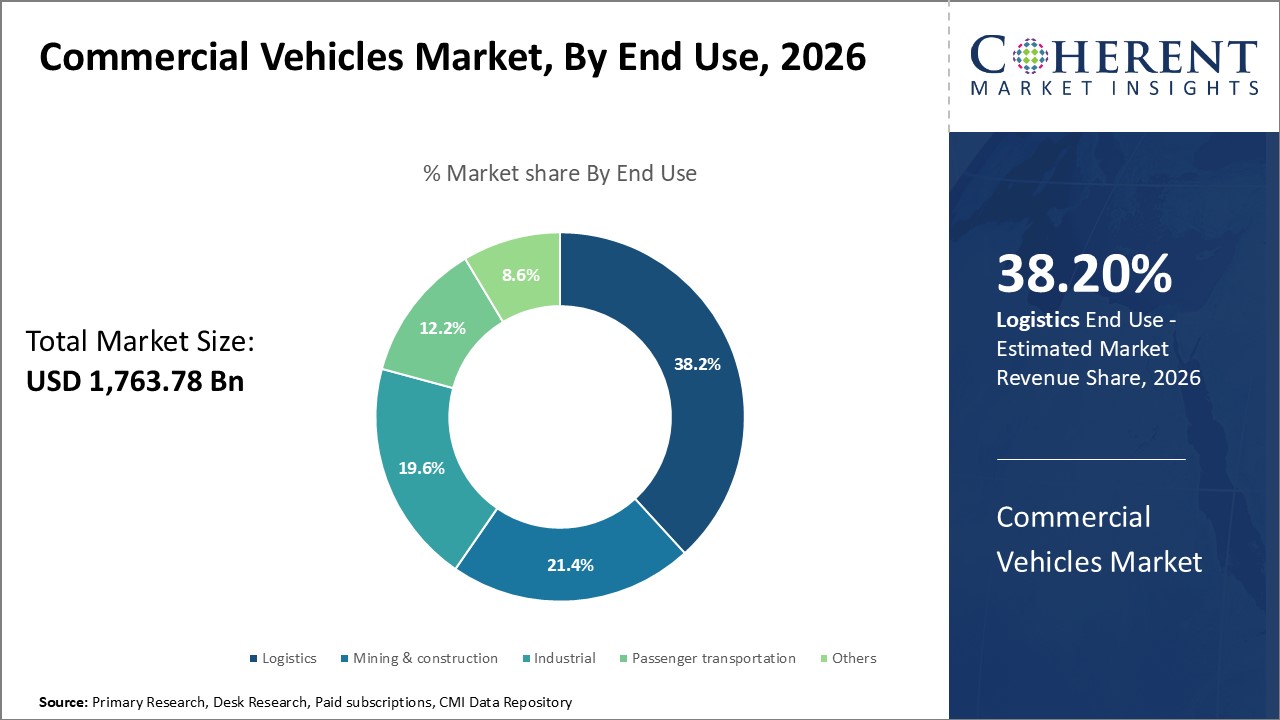
Commercial Vehicles Market Insights, By End Use - Logistics contribute the highest share of the market owing to its increase in organized retail and FMCG distribution
Logistics drives the demand for commercial vehicles as businesses work to achieve faster and more dependable movement of goods across expanding supply networks. Growing e-commerce and organized retail push companies to use various commercial vehicles to support frequent replenishment and smooth last-mile delivery. Rising industrial activity, better transport infrastructure, and the need for efficient distribution systems further promote adoption. At the same time, advanced fleet technologies improve routing, tracking, and overall operational performance within logistics operations. For instance, in November 2025, Eicher has launched the Pro X Diesel small truck to revolutionize India’s last-mile logistics. Following the successful Pro X EV debut at the Bharat Mobility Global Expo, the diesel variant leverages Eicher’s expertise in fuel efficiency and application excellence for customers needing reliable diesel-powered solutions.
Regional Insights
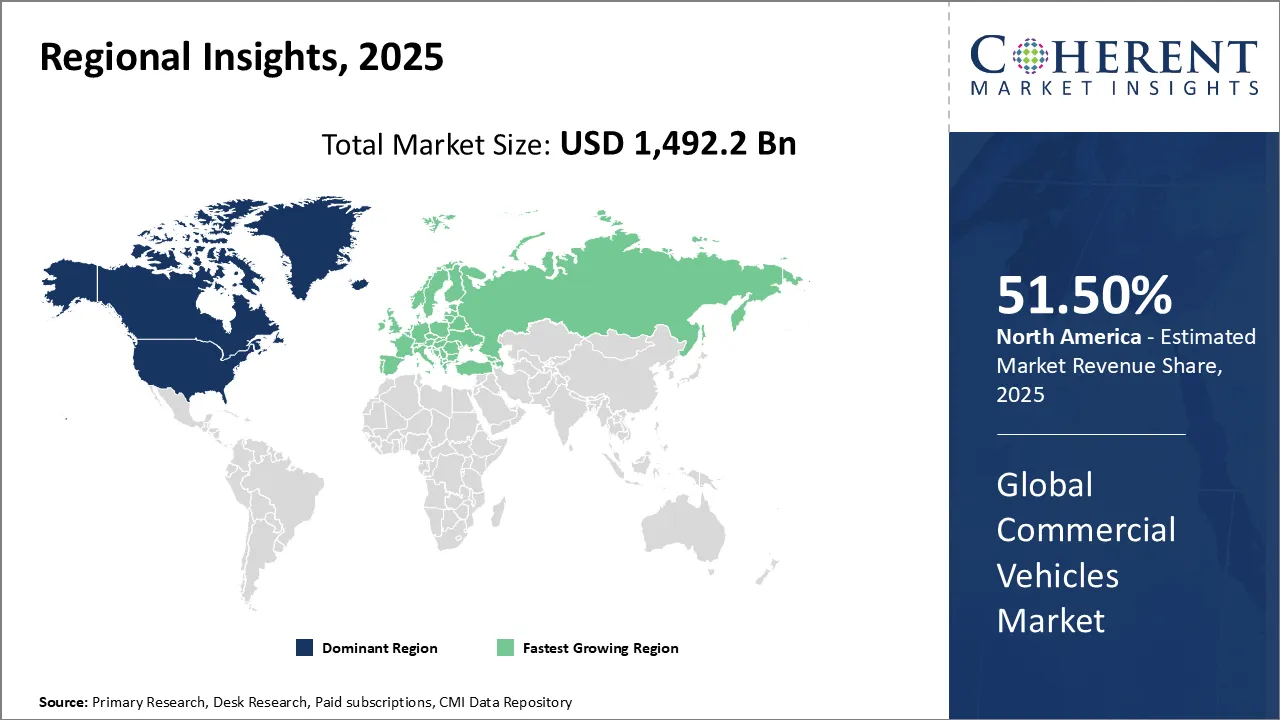
North America Commercial Vehicles Market Trends
North America dominates the overall market with an estimated share of 51.5% in 2026. The North America Commercial Vehicles market continues to evolve as logistics demands change, fleets modernize, and interest in cleaner transport solutions grows. Companies embrace advanced connectivity, telematics, and autonomous-ready features to improve efficiency and reduce downtime. Expanding last-mile delivery networks drive the use of versatile light and medium vehicles, while heavy trucks support essential long-haul freight movement. A stronger emphasis on sustainability, ongoing fleet replacement, and major infrastructure developments further influence purchasing choices and guide the market’s overall direction. For instance, in March 2026, Volvo Trucks introduced the new Volvo VNR, a redesigned truck for North America’s regional haul market. Built on Volvo’s new platform to support future propulsion technologies, the truck offers enhanced fuel efficiency, advanced safety features, and greater versatility.
Europe Commercial Vehicles Market Trends
The Europe Commercial Vehicles market continues to transform as sustainability targets, urban mobility demands, and tightening environmental regulations drive changes in fleet strategies. Manufacturers and operators actively adopt electric, hybrid, and alternative-fuel vehicles to align with evolving emission standards. Growing pressure for efficient urban delivery boosts the use of compact, technology-rich light commercial vehicles, while strong cross-border trade and industrial operations maintain demand for heavy trucks. Advancements in digital fleet tools, automation, and improved logistics networks further guide the market’s direction. For instance, in April 2026, Isuzu unveiled its new D-Max EV at the Commercial Vehicle Show in Birmingham, introducing what it calls Europe’s first fully electric commercial pick-up truck with full operational capabilities.
United States Commercial Vehicles Market Trends
The United States Commercial Vehicles market continues to evolve as fleet operators prioritize efficiency, advanced technologies, and cleaner transportation choices. Expanding e-commerce activity and broader delivery routes push demand for agile light and medium vehicles, while heavy-duty trucks support critical long-haul freight movement. Companies actively integrate telematics, enhanced safety features, and connected systems to boost performance and minimize downtime. Growing adoption of electric and alternative-fuel models, along with major infrastructure improvements, further shapes fleet strategies and the overall market trajectory. For instance, Daimler Truck Group has launched a line of electric trucks in the U.S. under the new RIZON brand. The company will unveil RIZON and its vehicles to the public for the first time at the Advanced Clean Transportation (ACT) Expo in Anaheim, California.
United Kingdom Commercial Vehicles Market Trends
The United Kingdom Commercial Vehicles market continues to evolve as businesses actively prioritize sustainability, operational efficiency, and advanced fleet management. Rising e-commerce activity and growing urban delivery needs push companies to adopt compact, technology-equipped light commercial vehicles, while heavy trucks handle essential regional and long-haul transport. Fleet operators implement telematics, safety systems, and low-emission technologies to enhance operations and minimize environmental impact. Government programs promoting clean energy and infrastructure upgrades further drive fleet modernization, guiding market trends and encouraging investment in innovative commercial vehicle solutions.
End-user Feedback and Unmet Needs in the Commercial Vehicles Market
- Operational Efficiency Challenges: End-users report a need for vehicles that reduce downtime and maintenance costs. Many fleets face inefficiencies due to older vehicles, inconsistent fuel consumption, and limited real-time monitoring. Users seek advanced telematics, predictive maintenance tools, and fuel-efficient designs to optimize daily operations and improve overall fleet productivity.
- Environmental and Sustainability Concerns: Operators increasingly demand low-emission or electric vehicles to comply with regulations and meet corporate sustainability goals. Many users face gaps in charging infrastructure, limited model availability, and high upfront costs for clean-energy vehicles. End-users desire affordable, reliable, and eco-friendly options to reduce environmental impact without compromising performance.
- Driver Comfort and Safety Needs: Feedback highlights the importance of ergonomic cabins, safety systems, and modern driver-assist technologies. Many drivers report fatigue and safety concerns during long shifts or urban traffic navigation. Users want vehicles equipped with advanced braking, lane-assist, and telematics to improve comfort, reduce accidents, and ensure long-term driver retention.
Market Dynamics
Commercial Vehicles Market Trend
Electrification and Alternative-Fuel Adoption
The market is witnessing a significant shift toward electric, hybrid, and alternative-fuel commercial vehicles. Manufacturers are introducing low-emission models to meet stricter environmental regulations and corporate sustainability goals. Fleet operators increasingly prioritize cleaner technologies to reduce operational costs and environmental impact. While infrastructure for charging and fuel alternatives continues to expand, companies seek reliable, long-range solutions to maintain performance, ensuring that electrification remains a central trend in modern commercial vehicle deployment.
Digitalization and Connected Vehicle Technologies
Fleet operators are adopting telematics, GPS tracking, and advanced fleet management systems to improve efficiency, reduce downtime, and optimize route planning. Connected vehicles provide real-time diagnostics, predictive maintenance alerts, and enhanced driver safety features. Integration with logistics software enables better asset utilization and operational transparency. The trend toward digitalization also supports data-driven decision-making, allowing businesses to enhance fleet performance, monitor driver behavior, and streamline delivery and cargo management across multiple segments.
Commercial Vehicles Market Opportunity
Expansion of E-Commerce and Last-Mile Delivery
The booming e-commerce sector presents a major opportunity for commercial vehicle manufacturers and fleet operators. Increasing online orders drive demand for efficient, agile vehicles capable of frequent deliveries in urban and suburban areas. Companies can develop specialized light and medium commercial vehicles designed for last-mile operations, focusing on fuel efficiency, compact design, and cargo versatility. Partnerships with logistics and retail firms can further enhance market penetration and create tailored vehicle solutions.
Market Report Scope
Commercial Vehicles Market Report Coverage
| Report Coverage | Details | ||
|---|---|---|---|
| Base Year: | 2025 | Market Size in 2026: | USD 1,763.78 Bn |
| Historical Data for: | 2020 To 2024 | Forecast Period: | 2026 To 2033 |
| Forecast Period 2026 to 2033 CAGR: | 18.2% | 2033 Value Projection: | USD 5,685.48 Bn |
| Geographies covered: |
| ||
| Segments covered: |
| ||
| Companies covered: | Ashok Leyland, General Motors Company, Bosch Rexroth AG, Xiamen Golden Dragon Bus Co., Ltd., Daimler AG, Volvo Group, Volkswagen AG, Mahindra and Mahindra Ltd., Toyota Motor Corporation, and Tata Motors Ltd. | ||
| Growth Drivers: |
| ||
| Restraints & Challenges: |
| ||
Commercial Vehicles Market News
- In November 2025, io, India’s leading logistics SaaS platform, unveiled AI-Powered Truck Routes, a pioneering routing intelligence engine designed specifically for the country’s commercial vehicle ecosystem.
- In September 2025, Fleet safety technology company Netradyne introduced its Driver•i D-450 video safety platform and DMS Sensor drowsiness detection system in India to help meet upcoming commercial vehicle safety regulations.
- In December 2025, Daimler India Commercial Vehicles (DICV) has launched the BB1924, a heavy-duty bus chassis with a 19,500 kg Gross Vehicle Weight, designed for India’s intercity passenger transport. The model targets operators seeking higher payload capacity and lower operating costs.
Analyst Opinion (Expert Opinion)
- The commercial‑vehicles market is poised at a pivotal moment: with shifting regulatory pressure, rising environmental consciousness, and evolving logistics demands, fleet operators are increasingly investing in modern, fuel‑efficient, and connected vehicles rather than sticking with legacy trucks. In North America, for example, ongoing demand for heavy‑duty freight keeps heavy trucks relevant even as the push for “last‑mile” vans and urban delivery vehicles grows.
- Yet this transition carries risk: recent data show that even though new electric and zero‑emission models are entering fleets, their adoption remains limited — only a small fraction of medium and heavy‑duty registrations in the United States in 2025 were zero‑emission vehicles.
- Meanwhile, logistics companies and OEMs are betting on a future in which telematics, real‑time diagnostics, modular vehicle design, and compliance with emissions norms aren’t optional but core to competitiveness. The result is growing segmentation: agile light commercial vehicles for urban supply chains, traditional heavy trucks for long‑haul freight, and a slowly emerging cohort of electric vans and trucks for environmentally conscious customers.
- In this evolving landscape, the true opportunity lies not in just volume growth, but in offering versatility, regulatory‑compliance, and technology — those operators and manufacturers that align with these needs are most likely to lead the market.
Speak to the analyst
Want personalized insights?
Take the findings above to one of our principal consultants, or have the report rebuilt around the segments, geographies and competitors you actually track.
Market Segmentation
- Global Commercial Vehicles Market, By Product
- Light commercial vehicles
- Heavy trucks
- Buses & coaches
- Global Commercial Vehicles Market, By End-Use
- Industrial
- Mining & construction
- Logistics
- Passenger transportation
- Others
- Regional Insights (Revenue, USD Bn, 2021 - 2033)
- North America
- U.S.
- Canada
- Latin America
- Brazil
- Argentina
- Mexico
- Rest of Latin America
- Europe
- Germany
- U.K.
- Spain
- France
- Italy
- Russia
- Rest of Europe
- Asia Pacific
- China
- India
- Japan
- Australia
- South Korea
- ASEAN
- Rest of Asia Pacific
- Middle East
- GCC Countries
- Israel
- Rest of Middle East
- Africa
- South Africa
- North Africa
- Central Africa
- North America
- Key Players Insights
- Ashok Leyland
- General Motors Company
- Bosch Rexroth AG
- Xiamen Golden Dragon Bus Co., Ltd.
- Daimler AG
- Volvo Group
- Volkswagen AG
- Mahindra and Mahindra Ltd.
- Toyota Motor Corporation
- Tata Motors Ltd.
Sources
Primary Research interviews
- Fleet operators and logistics managers in North America, Europe, and Asia-Pacific
- OEM executives from leading commercial vehicle manufacturers
- Dealership and distribution network representatives
- Government transportation and regulatory officials
- Urban logistics service providers and e-commerce delivery companies
Databases
- IHS Markit transportation and vehicle production statistics
- World Bank Global Transport Data
- U.S. Department of Transportation (Bureau of Transportation Statistics)
- Eurostat Transport and Vehicle Databases
- National Highway Traffic Safety Administration (NHTSA) Vehicle Registrations Data
Magazines
- Automotive Fleet Magazine
- Fleet Owner
- Transport Topics
- Commercial Carrier Journal
- Heavy Duty Trucking Magazine
Journals
- Journal of Transportation Engineering
- International Journal of Vehicle Design
- Transportation Research Part A: Policy and Practice
- SAE International Journal of Commercial Vehicles
- Journal of Intelligent Transportation Systems
Newspapers
- The Wall Street Journal – Transportation Section
- Financial Times – Automotive & Logistics
- The New York Times – Business & Transportation
- The Guardian – Transport & Mobility
- Automotive News
Associations
- Society of Motor Manufacturers and Traders (SMMT)
- American Trucking Associations (ATA)
- European Automobile Manufacturers’ Association (ACEA)
- International Road Transport Union (IRU)
- National Association of Fleet Administrators (NAFA)
Public Domain sources
- U.S. Federal Highway Administration reports
- European Commission Transport Policy Publications
- United Nations Economic Commission for Europe (UNECE) Transport Statistics
- Government transport ministry websites of key markets
- Open-access logistics and transportation white papers
Proprietary Elements
- CMI Data Analytics Tool, and Proprietary CMI Existing Repository of information for last 8 years
Get access to 250+ pages report
Every segment, forecast, competitor profile and data table behind the analysis above — available for instant download.
- ESOMAR Member
- ISO 9001:2015 Certified
- D-U-N-S Registered
- GDPR & CCPA Compliant
Missing comfort of reading report in your local language? Find your preferred language:
Transform your Strategy with Exclusive Trending Reports
Frequently Asked Questions
The Commercial Vehicles Market is estimated to be valued at USD 1,763.78 Bn in 2026, and is expected to reach USD 5,685.48 Bn by 2033.
The CAGR of the Commercial Vehicles Market is projected to be 18.2% from 2026 to 2033.
Rise in integration of safety features and increasing growth of retail e-commerce industry are fuelling the market.
The Light Commercial Vehicle segment is the leading Product segment in the market.
Environmental impact of emissions and stringent government regulations around emissions are the major factors restraining growth of the market.
Ashok Leyland, General Motors Company, Bosch Rexroth AG, Xiamen Golden Dragon Bus Co., Ltd., Daimler AG, Volvo Group, Volkswagen AG, Mahindra and Mahindra Ltd., Toyota Motor Corporation, and Tata Motors Ltd.