

Vehicle To Grid Technology Market Analysis & Forecast: 2026-2033
Vehicle To Grid Technology Market is estimated to be valued at USD 511.0 Mn in 2026 and is expected to reach USD 6,592.5 Mn in 2033, exhibiting a compound annual growth rate (CAGR) of 44.1% from 2026 to 2033.
Key Takeaways
- Based on Application, the Grid Load Balancing segment is expected to lead the market with 41.1% share in 2026, ensuring stable supply-demand balance and preventing blackouts.
- Based on Power Source, the Battery Electric Vehicles (BEVs) segment is expected to capture 73.3% share in 2026, due to their larger battery capacity and rapid global adoption.
- Based on Region, Europe is set to lead the vehicle to grid technology market in 2026 with 36% share. While, Asia Pacific is anticipated to be the fastest growing region.
Market Overview
The increasing adoption of electric vehicles (EVs) and renewable energy sources, coupled with the growing demand for energy storage solutions, are the major drivers of this market growth. The report also identifies North America and Europe as the leading regions in terms of V2G technology adoption, with Asia Pacific expected to exhibit significant growth during the forecast period.
Current Events and Its Impacts on the Vehicle to Grid Technology Market
Current Event | Description and Its Impact |
Global Energy Transition and Renewable Integration Acceleration |
|
Regulatory Framework Evolution and Policy Support |
|
Vehicle-to-Grid (V2G) Technology Market Trends
Energy Market Participation
- V2G-enabled EVs are increasingly being integrated into energy trading platforms, allowing owners to sell stored electricity back to utilities.
- This creates new revenue streams for consumers and fleet operators, boosting adoption.
Integration with Smart Homes
- V2G systems are being linked with home energy management solutions, enabling EVs to power households during outages or peak demand.
- This strengthens energy independence and reduces reliance on traditional grids.
Utility Partnerships
- Utilities are forming strategic alliances with automakers to deploy large-scale V2G pilots.
- These partnerships accelerate infrastructure rollout and ensure grid compatibility across regions.
Data & AI Optimization
- Advanced AI-driven energy management systems are being deployed to predict demand and optimize EV charging/discharging cycles.
- This maximizes efficiency and enhances grid stability.
- Current Industry Events of 2026
- Market Size Estimation
- Regional Breakdown
- Competitive Landscape
- Customer Intelligence
- Segmental Analysis
- Pricing Analysis
- Key Market Drivers, Challenges & Future Trends
- Customized Insights Section
Segmental Insights
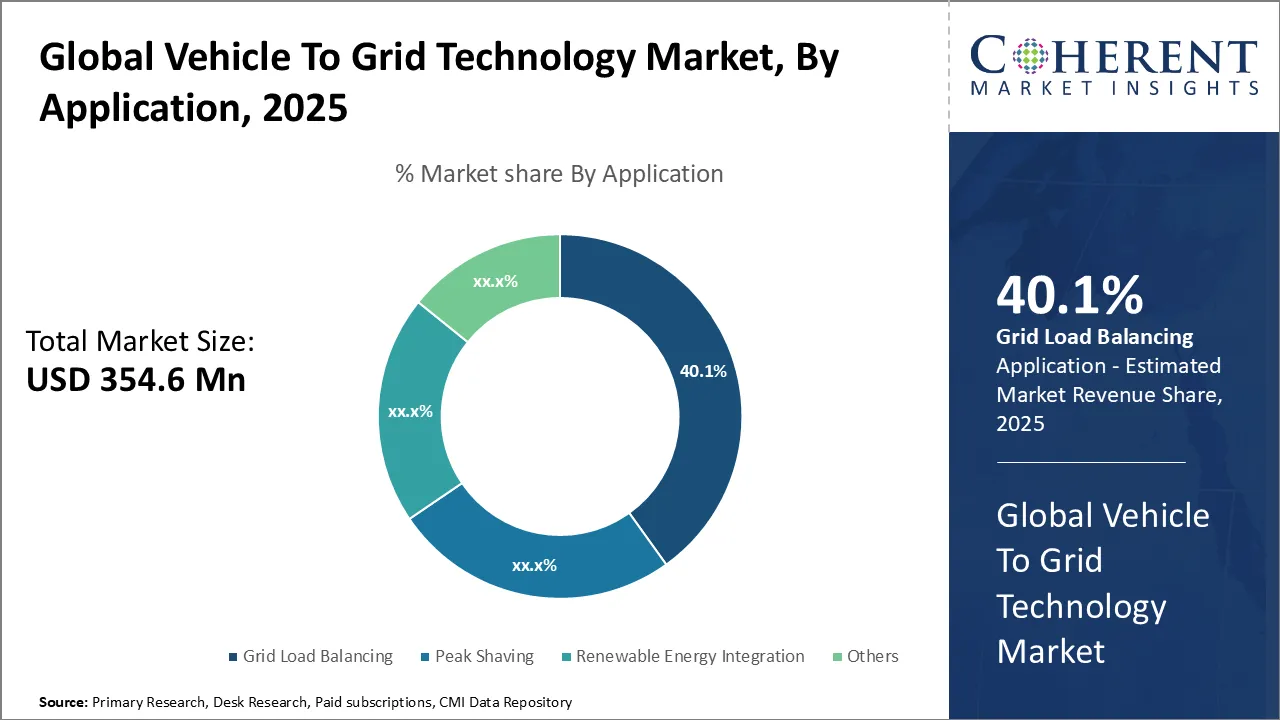
Vehicle To Grid Technology Market Insights, By Application: Grid Load Balancing dominates ensuring stable supply-demand balance and preventing blackouts.
In terms of application, the grid load balancing segment is expected to lead by 41.1% share of the market in 2026. Power grids all over the world are under increasing stress due to rising electricity demand and the addition of renewable sources that don't always work. Electric vehicles that can connect to V2G networks act like distributed energy storage units, charging when demand is low and discharging when demand is high. This dynamic interaction helps utilities keep the supply-demand balance stable, stops the grid from getting too full, and lowers the chance of blackouts.
For instance, in October 2025, RedEarth brought Vehicle-to-Grid (V2G) technology to Australia, but it has been more difficult than expected because of rules and technical issues.
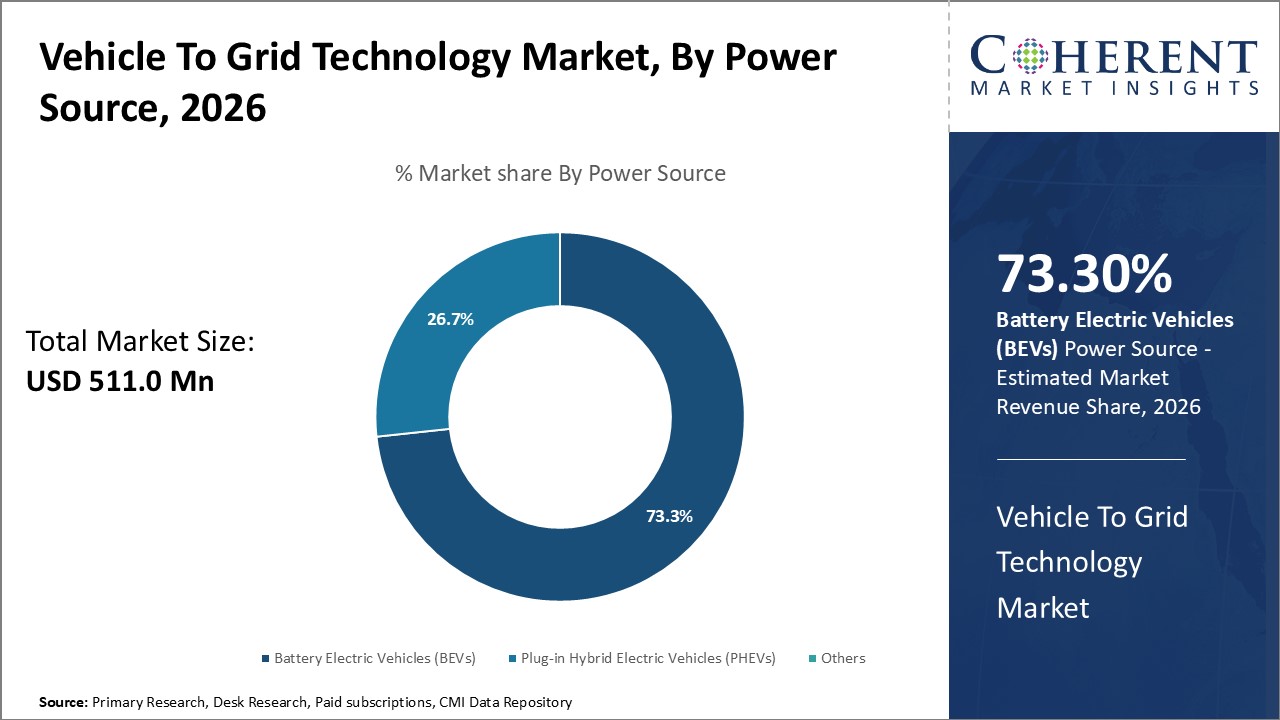
Vehicle To Grid Technology Market Insights, By Power Source: Battery Electric Vehicles (BEVs) Dominate Due To Their Larger Battery Capacity and Rapid Global Adoption
In terms of power source, the Battery Electric Vehicles (BEVs) segment is projected to capture 73.3% share of the market in 2026. Because their large batteries capacity than those of Plug-in Hybrid Electric Vehicles (PHEVs), they are much better for grid services because they can release a lot of energy when demand is high. The rapid global adoption of BEVs, driven by government incentives, stricter emission regulations, and falling battery prices, makes them even more important as the backbone of V2G systems.
For instance, in October 2024, Nissan announced it intends to begin selling cheap Vehicle-to-Grid (V2G) technology in the UK in 2026 and then roll it out across Europe. The initiative will let its battery electric vehicles send power back to homes and the grid. This will help integrate renewable energy and cut down on the need for fossil fuels. Nissan has already run more than 40 pilot projects around the world to test the system.
Regional Insights

Europe Vehicle to Grid Technology Market Analysis & Trends
Europe, holding a share of 36%, is expected to dominate the vehicle to grid technology market in 2026. Strong government policies that support decarbonization, a lot of people using electric vehicles (EVs), and advanced charging infrastructure all help this dominance. The UK, the Netherlands, and Denmark are leaders in V2G pilot projects, which connect electric vehicles to national grids to stabilize demand and increase the use of renewable energy. Europe is clearly the leader in V2G deployment because of its tough climate goals and helpful rules.
For instance, in September 2026, BMW Group and E.ON launched Germany's first customer solution that allows electric cars to actively take part in the energy market. The project uses Vehicle-to-Grid (V2G) technology, which lets electric vehicles send stored energy back to the grid. This is a big step toward combining mobility with renewable energy, which will make the grid more stable and help Germany's transition to clean energy.
Asia Pacific Vehicle to Grid Technology Market Analysis & Trends
Asia Pacific is projected to be the fastest growing region. An increasing number of people are getting electric vehicles given cities are growing quickly, electricity demand is going up, and governments in places like China, Japan, and South Korea are supporting EV programs. Japan has been a leader in V2G technology, with Nissan and other car companies doing large-scale tests. The region's focus on integrating renewable energy and building smart grids
For instance, in July 2026, the Agency for New and Renewable Energy Research and Technology (ANERT) in Kerala set up a demo project on Vehicle-to-Grid (V2G) technology to show how electric cars can help the power grid. The initiative lets EVs act as distributed energy storage, charging when demand is low and sending electricity back to the grid when demand is high. This helps integrate renewable energy and keep the grid stable.
Vehicle to Grid Technology Market Outlook Country-Wise
Germany Vehicle to Grid Technology Market Trends
Germany demands Vehicle-to-Grid (V2G) technology a lot in 2026 because of the growing use of renewable energy, strict climate goals, and the need for grid stability. As more people buy electric cars, V2G lets them act as mobile energy storage. This helps balance supply and demand, cuts down on the use of fossil fuels, and helps Germany's transition to clean energy.
For instance, in September 2026, Mercedes-Benz launched a new line of Vehicle-to-Grid (V2G) ready electric vehicles, enabling owners to feed stored energy back into the grid. The initiative supports renewable integration and grid stability while offering customers added value from their EVs. This marks a significant step in combining sustainable mobility with smart energy solutions in global markets.
China Vehicle to Grid Technology Market Trends
China demands Vehicle-to-Grid (V2G) technology substantially in 2026 as more consumers are buying electric cars, electricity use is going up, and there is a push to use more renewable energy. V2G lets electric vehicles act as mobile storage, which helps keep the grid stable by balancing supply and demand. This helps China move toward clean energy and makes power more reliable as cities grow.
For instance, in April 2026, China started new electric vehicle projects that use Vehicle-to-Grid (V2G) technology to help stabilize the power supply. The program lets electric vehicles act as distributed energy storage, charging when demand is low and sending electricity back to the grid when demand is high. This is a big step toward making the grid more resilient and helping China switch to renewable energy.
Market Report Scope
Vehicle To Grid Technology Market Report Coverage
| Report Coverage | Details | ||
|---|---|---|---|
| Base Year: | 2025 | Market Size in 2026: | USD 511.0 Mn |
| Historical Data for: | 2020 To 2024 | Forecast Period: | 2026 To 2033 |
| Forecast Period 2026 to 2033 CAGR: | 44.1% | 2033 Value Projection: | USD 6,592.5 Mn |
| Geographies covered: |
| ||
| Segments covered: |
| ||
| Companies covered: | Nissan Motor Corporation, Mitsubishi Motors Corporation, Honda Motor Co., Ltd., BMW Group, Tesla, Inc., General Motors Company, Ford Motor Company, Toyota Motor Corporation, Daimler AG, Volvo Group | ||
| Growth Drivers: |
| ||
| Restraints & Challenges: |
| ||
Vehicle to Grid Technology Market Driver
Increasing adoption of electric vehicles (EVs)
The increasing adoption of electric vehicles (EVs) is a key driver boosting the Vehicle to Grid Technology Market size. As more EVs connect to smart grids, they provide distributed energy storage, enhance load balancing, and support renewable integration. This growing EV penetration significantly expands opportunities for V2G deployment worldwide.
Increasing adoption of renewable energy sources
The increasing adoption of renewable energy sources is driving growth in the Vehicle to Grid Technology Market share. As solar and wind power expand, V2G systems enable electric vehicles to store excess energy and feed it back during peak demand. This integration enhances grid stability and maximizes renewable utilization.
Supportive government policies and regulations
Supportive government policies and regulations are significantly driving Vehicle to Grid Technology Market demand. Incentives for electric vehicle adoption, renewable energy integration, and smart grid development encourage utilities and automakers to invest in V2G solutions. These frameworks enhance grid stability, reduce fossil fuel reliance, and accelerate sustainable energy transitions worldwide.
Vehicle to Grid Technology Market Opportunities
The Vehicle-to-Grid (V2G) technology market presents several opportunities for growth and innovation. The integration of V2G technology with smart grid systems and renewable energy sources presents opportunities for the development of new business models and revenue streams. For example, V2G systems can enable EV owners to sell excess energy back to the grid, providing a potential source of income. V2G technology can also be used to support grid stability, particularly during periods of high demand or fluctuating renewable energy supply.
Furthermore, the growing demand for V2G technology presents opportunities for innovation and technological advancement, particularly in the areas of battery technology, energy management, and software development. Overall, the V2G technology market presents a significant opportunity for stakeholders across the transportation, energy, and technology sectors to collaborate and drive towards a more sustainable energy future.
Analyst Opinion (Expert Opinion)
The Vehicle-to-Grid technology market value is moving from small-scale tests to larger-scale commercial use. This is possible because there are more and more electric vehicles that can charge both ways and the smart-charging infrastructure is growing. According to industry reports, the global market is steadily growing. The sales of dedicated V2G chargers show that more advanced grid-service applications are being built out with the right hardware. Fleet deployments are on the rise, with mobility operators adding large groups of V2G-ready vehicles to their daily operations. This shows that it is possible to do so in practice and makes it easier for utilities and energy service providers to see how much money they are making.
Changes in electricity prices, tariff structures, and market-access rules in different parts of the country have a big effect on how well the market does. These things affect how much money you can make from energy arbitrage, peak-load management, and taking part in ancillary service markets. Battery wear is still a major problem, and research shows that it gets worse over long-term cycles. This makes it even more important to have accurate cost models and clear compensation systems.
Interoperability problems and different regulatory paths are still making scaling slower, but improvements in charging standards, software integration, and support from automakers are making technical barriers lower. The V2G landscape is changing in a way that makes the technology a useful part of grid flexibility and distributed energy management. This is because infrastructure is growing, fleet economics are getting better, and commercial validation is growing.
Speak to the analyst
Want personalized insights?
Take the findings above to one of our principal consultants, or have the report rebuilt around the segments, geographies and competitors you actually track.
Vehicle to Grid Technology Market Recent Developments
- In November 2025, Mitsubishi and Kaluza started Japan's first residential Vehicle-to-Grid (V2G) project, which lets electric cars send power back to homes and the grid. The project shows how electric vehicles (EVs) can store energy in different places, which helps with renewable energy integration and grid stability. This is a big step toward Japan's future with clean energy.
- In September 2025, AGL announced Australia's first large-scale Vehicle-to-Grid (V2G) trial for homes, working with Hyundai, Kia, BYD, and Zeekr. The program lets electric vehicles work as batteries for homes, which lowers energy costs and helps keep the grid stable. There are already more than 300,000 electric vehicles (EVs) on Australian roads. The trial is a big step toward combining smart mobility and renewable energy.
- In June 2025, The UK's first Vehicle-to-Grid (V2G) bundle launched by Octopus Energy and BYD. It includes electric cars, smart charging, and energy tariffs. The program lets electric vehicles send power back into the grid, which helps with the integration of renewable energy and lowers costs for drivers. This is a big step forward for the UK in terms of making transportation and energy more sustainable.
Market Segmentation
- Global Vehicle to Grid Technology Market, By Application (Revenue, USD Mn, 2021 - 2033)
- Grid Load Balancing
- Peak Shaving
- Renewable Energy Integration
- Others
- Global Vehicle To Grid Technology Market, By Power Source (Revenue, USD Mn, 2021 - 2033)
- Battery electric vehicles (BEVs)
- Plug-in hybrid electric vehicles (PHEVs)
- Others
- Global Vehicle To Grid Technology Market, By Region (Revenue, USD Mn, 2021 - 2033)
- North America
- U.S.
- Canada
- Latin America
- Brazil
- Argentina
- Mexico
- Rest of Latin America
- Europe
- Germany
- U.K.
- Spain
- France
- Italy
- Russia
- Rest of Europe
- Asia Pacific
- China
- India
- Japan
- Australia
- South Korea
- ASEAN
- Rest of Asia Pacific
- Middle East
- GCC Countries
- Israel
- Rest of Middle East
- Africa
- South Africa
- North Africa
- Central Africa
- North America
- Leading Players in Vehicle to Grid Technology Market
- Nissan Motor Corporation
- Mitsubishi Motors Corporation
- Honda Motor Co., Ltd.
- BMW Group
- Tesla, Inc.
- General Motors Company
- Ford Motor Company
- Toyota Motor Corporation
- Daimler AG
- Volvo Group
Sources
Primary Research Interviews
- Electric Vehicle (EV) Manufacturers
- Charging Station Operators
- V2G Technology Providers
- Smart Grid Solution Integrators
- Utility & Grid Management Experts
- Energy Storage System Engineers
- Others
Databases
- Bloomberg Terminal
- Thomson Reuters Eikon
- Others
Magazines
- Utility Dive
- Energy Storage News
- Smart Energy International
- Power Engineering Magazine
- Recharge News
- Others
Journals
- IEEE Transactions on Smart Grid
- Applied Energy Journal
- Renewable & Sustainable Energy Reviews
- Energy Policy Journal
- International Journal of Electrical Power & Energy Systems
- Others
Newspapers
- Financial Times
- The Wall Street Journal
- Reuters
- Bloomberg News
- The Guardian – Energy Section
- Others
Associations
- Electric Power Research Institute (EPRI)
- International Energy Agency (IEA) – Smart Grids
- European Network of Transmission System Operators for Electricity (ENTSO-E)
- Smart Electric Power Alliance (SEPA)
- Vehicle-to-Grid Technology Forum
- Others
Public Domain Sources
- U.S. Department of Energy (DOE) – Office of Electricity
- International Energy Agency (IEA)
- European Commission – Smart Grid Task Force
- National Renewable Energy Laboratory (NREL)
- World Bank Open Data
- Others
Proprietary Elements
- CMI Data Analytics Tool
- Proprietary CMI Existing Repository of Information for the Last 8 Years
Get access to 250+ pages report
Every segment, forecast, competitor profile and data table behind the analysis above — available for instant download.
- ESOMAR Member
- ISO 9001:2015 Certified
- D-U-N-S Registered
- GDPR & CCPA Compliant
Missing comfort of reading report in your local language? Find your preferred language:
Transform your Strategy with Exclusive Trending Reports
Frequently Asked Questions
The Vehicle To Grid Technology Market is estimated to be valued at USD 511.0 Mn in 2026, and is expected to reach USD 6,592.5 Mn by 2033.
The CAGR of the Vehicle To Grid Technology Market is projected to be 44.1% from 2026 to 2033.
Increasing adoption of electric vehicles (EVs) and renewable energy sources is expected to drive the market
Compatibility issues & Technical challenges is the major factor that is hampering the growth of the market
Major players operating in the market include Nissan Motor Corporation, Mitsubishi Motors Corporation, Honda Motor Co., Ltd., BMW Group, Tesla, Inc., General Motors Company, Ford Motor Company, Toyota Motor Corporation, Daimler AG, Volvo Group