

Third Party Logistics Market Size and Share Analysis- Growth Trends and Forecasts (2026-2033)
The Third Party Logistics Market size is anticipated to grow at a CAGR of 9.1%, from USD 1,356.7 Bn in 2026 to approximately USD 2,502.2 Bn by 2033. The primary drivers are largely driven by the rapid growth of e-commerce, growing outsourcing of warehousing and transportation functions, increasing demand for integrated supply chain solutions, and wider acceptance of automation, real-time tracking, and digital logistics platforms. The market is further driven by growing cross-border trade, increasing demand for faster last mile delivery and increased focus among manufacturers and retailers on improving supply chain efficiency, flexibility and cost optimization. According to the U.S. Census Bureau, U.S. retail e-commerce sales totaled USD 340.2 Bn in Q2 2026, an increase of 12.2% year-on-year, compared to a 6.7% rise in total retail sales.
Key Takeaways
- The international transportation management segment is likely to dominate the market with 32.5% in 2026. The segment’s growth is owing to rising cross-border merchandise flows, increasing outsourcing of freight forwarding and customs management, and growing demand for integrated multimodal transportation services. According to UN Trade and Development (UNCTAD), world trade in goods in the first half of 2026 was estimated at USD 13.7 trillion, up 12.5% compared to the same period in 2025, creating demand for international transportation and freight-management services.
- The roadways segment is set to lead with 57.5% in 2026. The segment’s growth is owing to extensive door-to-door connectivity, suitability for short- and medium-distance freight, strong last-mile delivery requirements, and integration with warehouses and distribution centers. According to Eurostat, EU road freight transport reached 1,886 Bn tonne-kilometers in 2025, increasing 0.9% year-on-year, while the total weight of goods transported increased 1.8% to 13.3 Bn tonnes.
- The manufacturing segment is expected to acquire the leading share of 25.0% in 2026. The segment’s growth is owing to increasing outsourcing of inbound and outbound logistics, complex international production networks, just-in-time inventory requirements, and demand for specialized warehousing and distribution services. According to the United Nations Industrial Development Organization (UNIDO), global manufacturing production increased 1.2% quarter-on-quarter in Q1 2026, while global manufacturing exports increased 3.5%, supporting higher movement of industrial inputs and finished goods through logistics networks.
- Asia Pacific is expected to acquire the prominent share of 44.0% in 2026. The region’s growth is owing to its large manufacturing base, expanding cross-border trade, rapid e-commerce development, extensive logistics infrastructure investment, and strong presence of China, India, Japan, South Korea, and Southeast Asian production hubs. According to the World Trade Organization (WTO), merchandise export volumes from Asia increased 12.9% year-on-year in Q1 2026, while import volumes increased 14.6%; in value terms, Asia’s exports and imports increased 20% and 22%, respectively.
Market Drivers
Rapid Expansion of E-Commerce is Increasing Demand for Third Party Logistics Services
The rapid expansion of e-commerce is a major driver of the Third Party Logistics Market, as retailers and manufacturers increasingly require outsourced warehousing, order fulfillment, inventory management, parcel transportation, and last-mile delivery capabilities. Increasing online order volumes are also creating demand for geographically distributed fulfillment centers and technology-enabled logistics networks capable of supporting shorter delivery windows.
According to UN Trade and Development (UNCTAD) estimates that business-to-business e-commerce sales in 45 developed and developing economies reached some USD 28 trillion in 2024. In economies with comparable historical data, e-commerce sales grew 4.4% in 2024 compared to 2023.
Expansion of Global Trade and Cross-Border Supply Chains is Driving 3PL Demand
The demand for freight forwarding, customs brokerage, international transportation management, warehousing and multimodal logistics services is growing as the world-wide flow of merchandise increases. Manufacturers are diversifying their sourcing and distribution to multiple countries and are increasingly using third party logistics providers to coordinate complex cross border supply chains and consolidate transportation activities.
According to the World Trade Organization (WTO), the volume of world merchandise trade increased 3.2% year-on-year in the first quarter of 2026, while its U.S. dollar value increased 11% year-on-year. Asia recorded particularly strong activity, with merchandise exports increasing 20% and imports increasing 22% in value terms during the quarter.
Current Events and Their Impact on the Third Party Logistics Market
Current Event | Description and its Impact |
U.S. Continues Suspension of Duty-Free De Minimis Treatment for Imports from All Countries (2026) |
|
EU Carbon Border Adjustment Mechanism Enters its Definitive Regime (2026) |
|
- Current Industry Events of 2026
- Market Size Estimation
- Regional Breakdown
- Competitive Landscape
- Customer Intelligence
- Segmental Analysis
- Pricing Analysis
- Key Market Drivers, Challenges & Future Trends
- Customized Insights Section
Segmental Insights
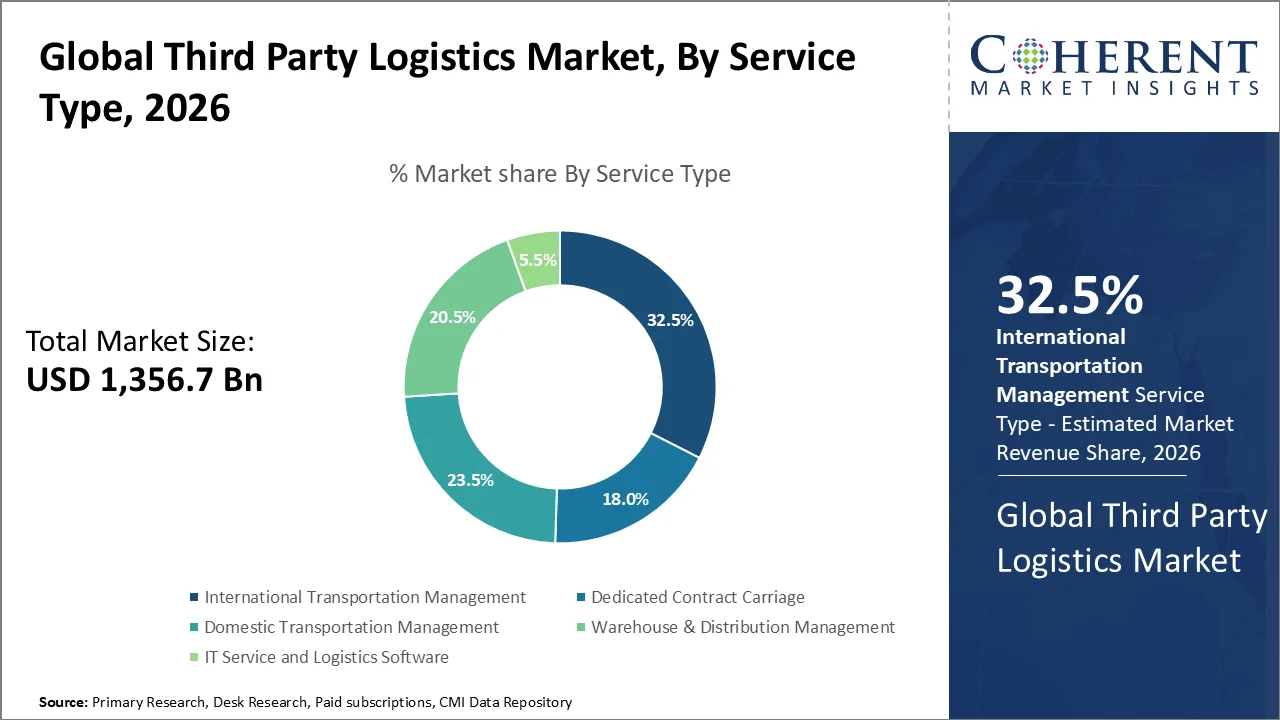
Why is International Transportation Management Acquiring the Largest Share?
On the basis of service type, the international transportation management segment is projected to account for the largest Third Party Logistics Market share of 32.5% in 2026. The segment’s growth is owing to increasing cross-border merchandise movement, globalization of sourcing networks, growing customs and regulatory requirements, and rising dependence on 3PL providers for coordinated air, ocean, and multimodal freight transportation.
According to the International Air Transport Association (IATA), international air cargo demand increased 9.6% year-on-year in June 2026, while international cargo capacity increased 4.9%. The Asia–North America trade lane grew 14.7%, while Europe–Asia increased 7.1%, indicating strong demand across major international freight corridors.
In February 2026, DSV announced the operational integration of Schenker’s Air & Sea, Fairs & Events and customs businesses in Germany under the DSV brand. The two also combined to strengthen DSV’s air and ocean freight network of locations and added capacity to its transportation services, so customers can get more services from origin to final delivery through one integrated network.
Why are Roadways Holding the Largest Market Share?
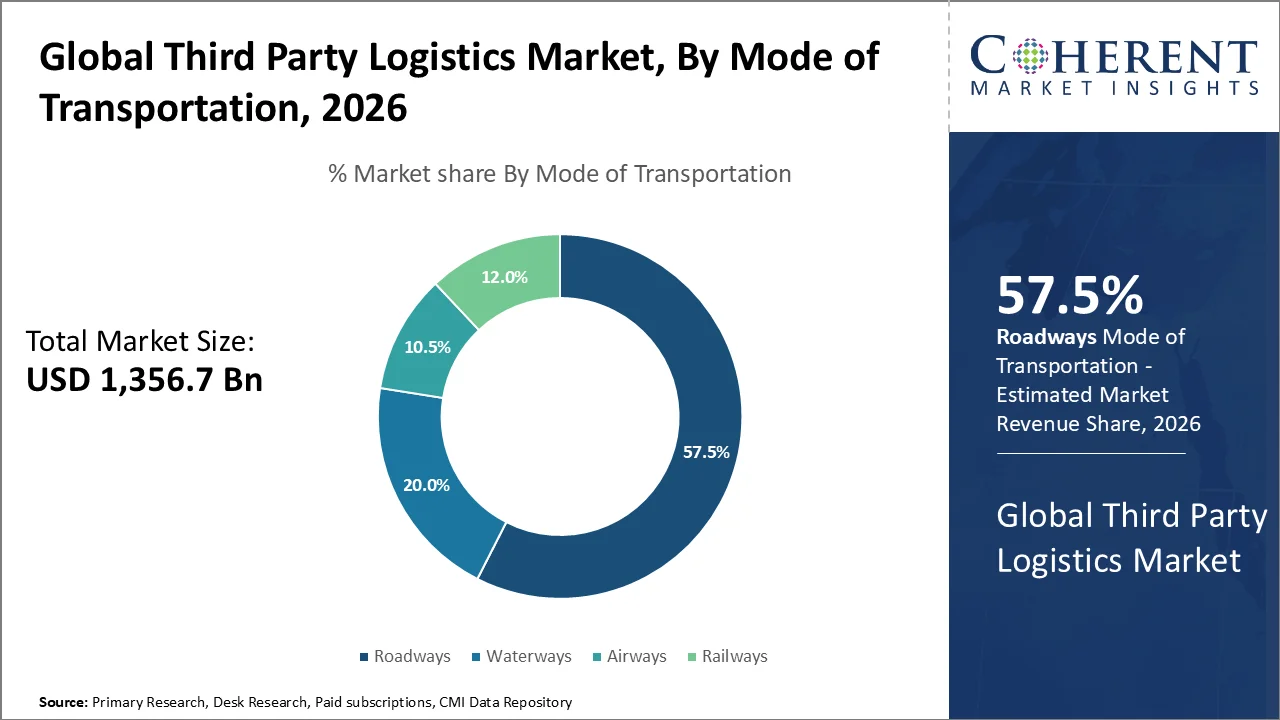
On the basis of mode of transportation, the roadways segment is set to lead the Third Party Logistics Market with a 57.5% share in 2026. The segment’s growth is owing to its extensive door-to-door connectivity, flexibility in delivery scheduling, strong integration with warehouses and distribution centers, and critical role in first-mile and last-mile transportation.
According to the U.S. Bureau of Transportation Statistics (BTS), trucks transported approximately USD 1.04 trillion of freight between the U.S., Canada, and Mexico in 2025, increasing 0.7% from 2024.
In June 2026, GXO Logistics announced a new five-year expansion of its transportation partnership with Co-op in the U.K. The agreement covers GXO transportation operations across Avonmouth, Andover, and Lea Green and supports deliveries to more than 1,000 Co-op stores.
Why is Manufacturing Acquiring the Largest Share?
On the basis of end user, the manufacturing segment is expected to acquire the largest Third Party Logistics Market share of 25.0% in 2026. The segment’s growth is owing to complex global production networks, just-in-time inventory requirements, increasing outsourcing of inbound and outbound logistics, and the need for specialized warehousing and distribution of raw materials, components, and finished goods.
According to the United Nations SDG Report 2026, Global manufacturing grew by 2.7% in 2026 and seaborne trade, which handles over 80% of global merchandise trade, reached a record 24.1 billion metric tons in 2024.
In February 2026, GXO Logistics announced that it had been selected by BMW Group to manage logistics operations at BMW’s Swindon manufacturing plant in the U.K. GXO will manage warehousing and movement of car parts supporting production of pressed components used in MINI vehicles assembled at Oxford and BMW models produced at other international facilities.
Third Party Logistics Market Trends
- AI, robotics and autonomous warehouse systems are becoming more prevalent, revolutionizing 3PL operations with faster picking, faster inventory movement, better labor optimization and real-time decision-making. In March 2026, GXO Logistics deployed its first AI-powered autonomous industrial truck at its Epinoy facility in France, integrating autonomous material handling into a live, high-volume warehouse environment.
- Rising cross-border e-commerce is driving demand for international fulfillment, customs management, parcel logistics and distributed warehousing services. DHL’s 2026 E-Commerce Trends Report, which surveyed 29,000 shoppers and 5,800 businesses in 29 countries, found that 70% of shoppers are buying internationally, up from 60% in 2025 and over 30% of e-commerce orders are being shipped internationally.
- An increasing focus on supply-chain regionalization and nearshoring is changing 3PL network design. Logistics providers are increasingly supporting regional distribution centers, alternative sourcing routes and multi-country transportation networks. The DHL Global Connectedness Report 2026 shows that in 2025, almost two-thirds of the companies surveyed had regionalization strategies in place and over half were actively involved in nearshoring.
Regional Insights
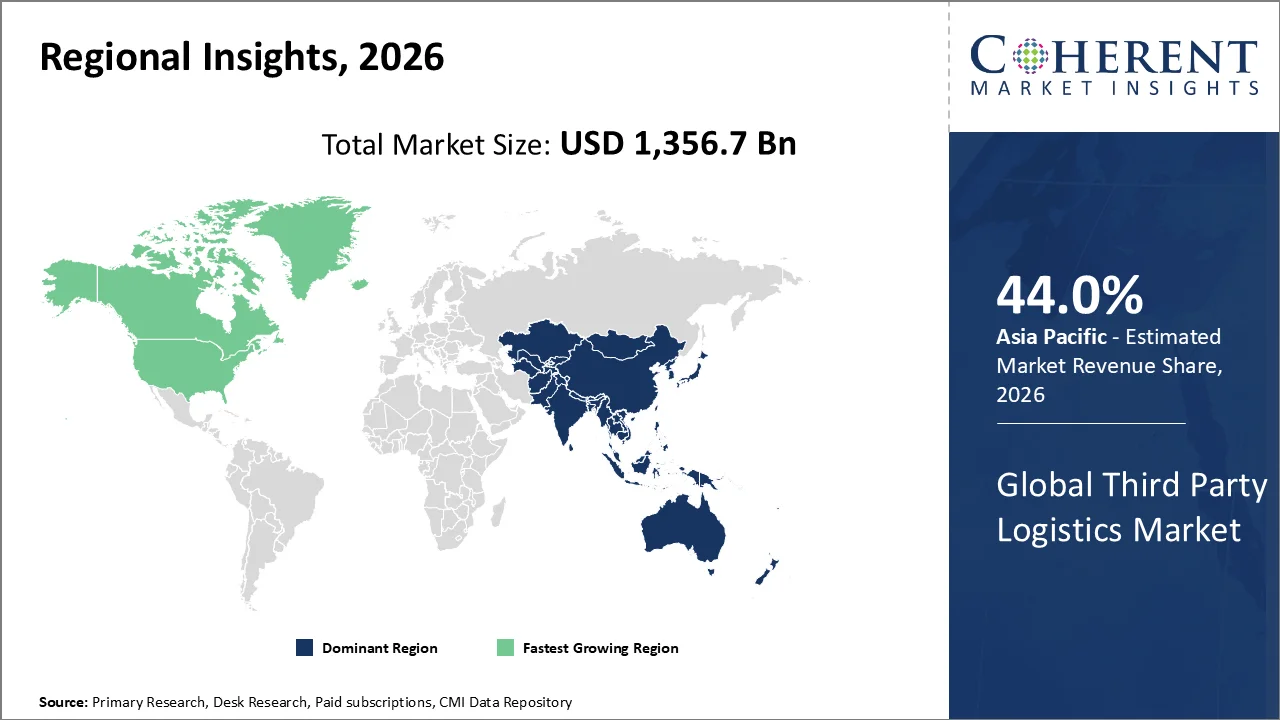
Asia Pacific Dominates Owing to Strong Trade Connectivity and Extensive Logistics Infrastructure
The Asia Pacific region accounts for 44.0% of the Third Party Logistics Market share in 2026. The region’s dominance is owing to its large manufacturing and export base, extensive port and transportation infrastructure, rapidly expanding e-commerce ecosystem, and strong concentration of global production and distribution networks. The linked CMI market scope also identifies Asia Pacific as the dominant regional market.
In addition, the Asian Development Bank projected developing Asia and the Pacific to expand 4.9% in 2026, with South Asia forecast to grow 6.0%. Continued economic activity, infrastructure investment, manufacturing output, and regional consumption strengthen demand for contract transportation, warehousing, freight forwarding, and distribution services.
In August 2026, DHL Express expanded its international logistics infrastructure in China, including a EUR 177 million investment in its Shenzhen “Super Gateway,” the company’s largest investment in mainland China to date.
North America Third Party Logistics Market Trends
North America is expected to witness the fastest growth in the Third Party Logistics Market over the forecast period. The region’s growth is owing to expanding U.S.–Mexico and U.S.–Canada supply chains, high logistics outsourcing penetration, large-scale retail and manufacturing distribution networks, advanced warehouse automation, and increasing demand for integrated cross-border freight management.
The latest U.S. Department of Transportation Bureau of Transportation Statistics (BTS) data show that North American transborder freight reached USD 157.1 billion in June 2026, increasing 19.9% year-on-year. U.S.–Mexico freight increased 22.2% to USD 89.2 billion, while U.S.–Canada freight increased 17.0% to USD 67.9 billion.
In March 2026, Arvato expanded its North American fulfillment network across the U.S. and Canada with the acquisition of THINK Logistics, a Canadian third party logistics provider.
Large Inventory Base and Advanced Fulfillment Infrastructure are Supporting the Third Party Logistics Market in the United States
The U.S. Third Party Logistics Market is being supported by a large retail and wholesale distribution base, extensive outsourcing of warehousing and transportation, sophisticated fulfillment networks and growing adoption of automated inventory and supply-chain management systems.
The scale of international merchandise movement further supports the logistics industry. The U.S. Bureau of Transportation Statistics reported that total U.S. international freight trade reached approximately USD 5.33 trillion in 2025, illustrating the large addressable base for freight forwarding, customs brokerage, contract transportation, and integrated 3PL services.
China Third Party Logistics Market Trends
China is expected to witness strong growth in the Third Party Logistics Market over the forecast period. The growth is driven by the country’s vast e-commerce and express-delivery ecosystem, large manufacturing base, expanding logistics infrastructure, and government initiatives to improve logistics efficiency and reduce supply-chain costs.
According to China's State Post Bureau, the country's express-delivery volume surpassed 100 billion parcels by June 30, 2026, reaching the milestone nine days earlier than in 2025. China had already handled nearly 200 billion express parcels in 2025, an increase of 13.6% year-on-year, maintaining its position as the world's largest express-delivery network by volume.
Who are the Major Companies in Third Party Logistics Industry
Some of the major key players in Third Party Logistics Market are AmeriCold Logistics LLC, BDP International, Burris Logistics, C.H. Robinson Worldwide, CEVA Logistics, DB Schenker Logistics, DHL Supply Chain, FedEx, GEODIS, J. B. Hunt, Kintetsu World Express, Inc., Landstar System, Inc., Nippon Express Co., Ltd, Panalpina World Transport Ltd., Ryder Supply Chain Solutions, Schneider National, Inc., SinoTrans (HK) Logistics Limited, Total Quality Logistics, Inc., Transplace Texas LP, Unyson Logistics, Inc., UPS Supply Chain Solutions, XPO Logistics, Inc.
Key News
- In August 2026, Americold launched integrated direct-to-consumer cold-chain fulfillment capabilities across its network. The solution combines temperature-controlled infrastructure, order-level fulfillment, packaging, technology, and last-mile delivery to support food manufacturers and brands expanding into e-commerce and omnichannel distribution.
- In June 2026, C.H. Robinson launched its Lean AI Engineer for 4PL Managed Solutions, an AI technology designed to operate, continuously assess, and improve customers’ global supply chains. The company stated that the system can assess an entire supply chain and identify improvements in approximately 25–30 minutes, compared with traditional assessments that can take up to four weeks.
Market Report Scope
Third Party Logistics Market Report Coverage
| Report Coverage | Details | ||
|---|---|---|---|
| Base Year: | 2025 | Market Size in 2026: | USD 1,356.7 Bn |
| Historical Data for: | 2020 To 2024 | Forecast Period: | 2026 To 2033 |
| Forecast Period 2026 to 2033 CAGR: | 9.1% | 2033 Value Projection: | USD 2,502.2 Bn |
| Geographies covered: |
| ||
| Segments covered: |
| ||
| Companies covered: | AmeriCold Logistics LLC, BDP International, Burris Logistics, C.H. Robinson Worldwide, CEVA Logistics, DB Schenker Logistics, DHL Supply Chain, FedEx, GEODIS, J. B. Hunt, Kintetsu World Express, Inc., Landstar System, Inc., Nippon Express Co., Ltd, Panalpina World Transport Ltd., Ryder Supply Chain Solutions, Schneider National, Inc., SinoTrans (HK) Logistics Limited, Total Quality Logistics, Inc., Transplace Texas LP, Unyson Logistics, Inc., UPS Supply Chain Solutions, XPO Logistics, Inc. | ||
| Growth Drivers: |
| ||
| Restraints & Challenges: |
| ||
Analyst Opinion
- The Third Party Logistics Market is increasingly shifting from transactional outsourcing toward long-term strategic supply chain partnerships. The 2026 Annual Third-Party Logistics Study found that 85% of shippers and 94% of 3PL providers reported that their longest-standing 3PL partnership had lasted more than five years, indicating strong customer retention and deeper integration of logistics providers into transportation, warehousing, inventory, and supply-chain planning activities.
- Technology capability is fast becoming a competitive differentiator for 3PL providers, particularly as customers are demanding increased levels of visibility, analytics, automation and predictive supply-chain management. “Technology capabilities are very important when choosing a 3PL provider, 90% of shippers say, according to the 2026 Annual Third-Party Logistics Study, but only 57% are satisfied with their providers’ current technology capabilities.”
- Logistics expertise will continue to be in demand as companies seek to outsource due to cost pressure and the complexity of supply chains. Increasingly, companies will focus on better asset utilization, transportation optimization and resilient distribution networks. U.S. business logistics costs were about USD 2.4 trillion, or 7.8% of U.S. GDP, according to the Council of Supply Chain Management Professionals’ 2026 State of Logistics Report. The report also identifies trade-flow realignment, labor and productivity constraints, energy-price volatility, and growing automation investment as structural forces shaping logistics strategies.
Speak to the analyst
Want personalized insights?
Take the findings above to one of our principal consultants, or have the report rebuilt around the segments, geographies and competitors you actually track.
Market Segmentation
- By Service Type (Revenue, USD Bn, 2021-2033)
- Dedicated Contract Carriage
- Domestic Transportation Management
- International Transportation Management
- Warehouse & Distribution Management
- IT Service and Logistics Software
- By Mode of Transportation (Revenue, USD Bn, 2021-2033)
- Waterways
- Airways
- Railways
- Roadways
- By End User (Revenue, USD Bn, 2021-2033)
- Manufacturing
- Retail
- Healthcare
- Automotive
- Others
- By Region (Revenue, USD Bn, 2021-2033)
- North America
- U.S.
- Canada
- Latin America
- Brazil
- Mexico
- Argentina
- Rest of Latin America
- Europe
- Germany
- U.K.
- France
- Italy
- Spain
- Russia
- Rest of Europe
- Asia Pacific
- China
- India
- Japan
- Australia
- South Korea
- ASEAN
- Rest of Asia Pacific
- Middle East
- GCC
- Israel
- Rest of Middle East
- Africa
- South Africa
- Central Africa
- North Africa
- North America
Sources
Primary Research Interviews
- Third party logistics service providers
- Freight forwarding and transportation companies
- Warehousing and distribution center operators
- Supply chain and logistics managers from manufacturing companies
- Retail and e-commerce fulfillment managers
- Automotive and healthcare logistics procurement professionals
- Customs brokerage and international trade specialists
- Key opinion leaders (KOLs) in logistics and supply chain management
Databases
- World Bank
- World Trade Organization (WTO)
- UN Trade and Development (UNCTAD)
- Organisation for Economic Co-operation and Development (OECD)
- U.S. Bureau of Transportation Statistics (BTS)
- U.S. Census Bureau
- Eurostat
- United Nations Industrial Development Organization (UNIDO)
Magazines
- Logistics Management
- Supply Chain Management Review
- Inbound Logistics
- Transport Topics
- FreightWaves
- Modern Materials Handling
Journals
- International Journal of Logistics Management
- Transportation Research Part E: Logistics and Transportation Review
- International Journal of Physical Distribution & Logistics Management
- Journal of Business Logistics
- Supply Chain Management: An International Journal
- Transportation Research Part A: Policy and Practice
Newspapers
- The Wall Street Journal
- Financial Times
- Reuters
- Bloomberg
- The Economic Times
- South China Morning Post
Associations
- Council of Supply Chain Management Professionals (CSCMP)
- International Federation of Freight Forwarders Associations (FIATA)
- International Air Transport Association (IATA)
- International Road Transport Union (IRU)
- American Trucking Associations (ATA)
- Global Cold Chain Alliance (GCCA)
- Warehousing Education and Research Council (WERC)
Public Domain Sources
- Company Annual Reports and Investor Presentations
- Government Transportation and Freight Statistics
- Customs and International Trade Publications
- Port Authority and Airport Cargo Statistics
- Logistics Infrastructure and Freight Corridor Reports
- Regulatory Publications Related to Transportation, Customs, and Cross-Border Trade
- Company Press Releases on Warehouse Openings, Network Expansions, Acquisitions, and Technology Launches
Proprietary Elements
- CMI Data Analytics Tool
- Proprietary CMI Existing Repository of Information for the Last 10 Years
Get access to 250+ pages report
Every segment, forecast, competitor profile and data table behind the analysis above — available for instant download.
- ESOMAR Member
- ISO 9001:2015 Certified
- D-U-N-S Registered
- GDPR & CCPA Compliant
Missing comfort of reading report in your local language? Find your preferred language:
Transform your Strategy with Exclusive Trending Reports
Frequently Asked Questions
The Third Party Logistics Market is expected to reach USD 2,502.2 Bn by 2033, compared with USD 1,356.7 Bn in 2026.
Major players operating in the global Third Party Logistics Market include AmeriCold Logistics LLC, BDP International, Burris Logistics, C.H. Robinson Worldwide, CEVA Logistics, DB Schenker Logistics, DHL Supply Chain, FedEx, GEODIS, J. B. Hunt, Kintetsu World Express, Inc., Landstar System, Inc., Nippon Express Co., Ltd, Panalpina World Transport Ltd., Ryder Supply Chain Solutions, Schneider National, Inc., SinoTrans (HK) Logistics Limited, Total Quality Logistics, Inc., Transplace Texas LP, Unyson Logistics, Inc., UPS Supply Chain Solutions, and XPO Logistics, Inc.
High transportation and fuel costs and rising labor and warehouse operating costs are the key challenges hampering growth of the Third Party Logistics Market.
The increasing outsourcing of transportation and warehousing operations, rapid expansion of e-commerce and omnichannel retail, growing cross-border trade, and rising demand for integrated supply chain solutions are driving growth of the Third Party Logistics Market.
The Third Party Logistics Market is anticipated to grow at a CAGR of 9.1% between 2026 and 2033.
Among regions, Asia Pacific is expected to account for the largest market share of 44.0% in 2026. The region benefits from its large manufacturing and export base, extensive logistics infrastructure, expanding e-commerce ecosystem, and concentration of global production networks.
North America is expected to witness the fastest growth over the forecast period, supported by expanding U.S.–Mexico and U.S.–Canada supply chains, advanced warehouse automation, and increasing demand for integrated cross-border freight management.