

Travel Mobility Scooter Market Size and Forecast – 2026 to 2033
The Travel Mobility Scooter Market is anticipated to grow at a CAGR of 6.5% with USD 2.3 Bn share in 2026 and is expected to reach USD 4.1 Bn in 2033. The Travel Mobility Scooter Market is driven by an aging population, lightweight scooter innovations, better batteries, improved accessibility, and growing travel among seniors. By 2030, one in six people worldwide is expected to be aged 60 or older, increasing from 1 Bn in 2020 to 1.4 Bn. By 2050, this population is projected to reach 2.1 Bn, while the number of people aged 80 and above is expected to triple to 426 million.
Key Takeaways
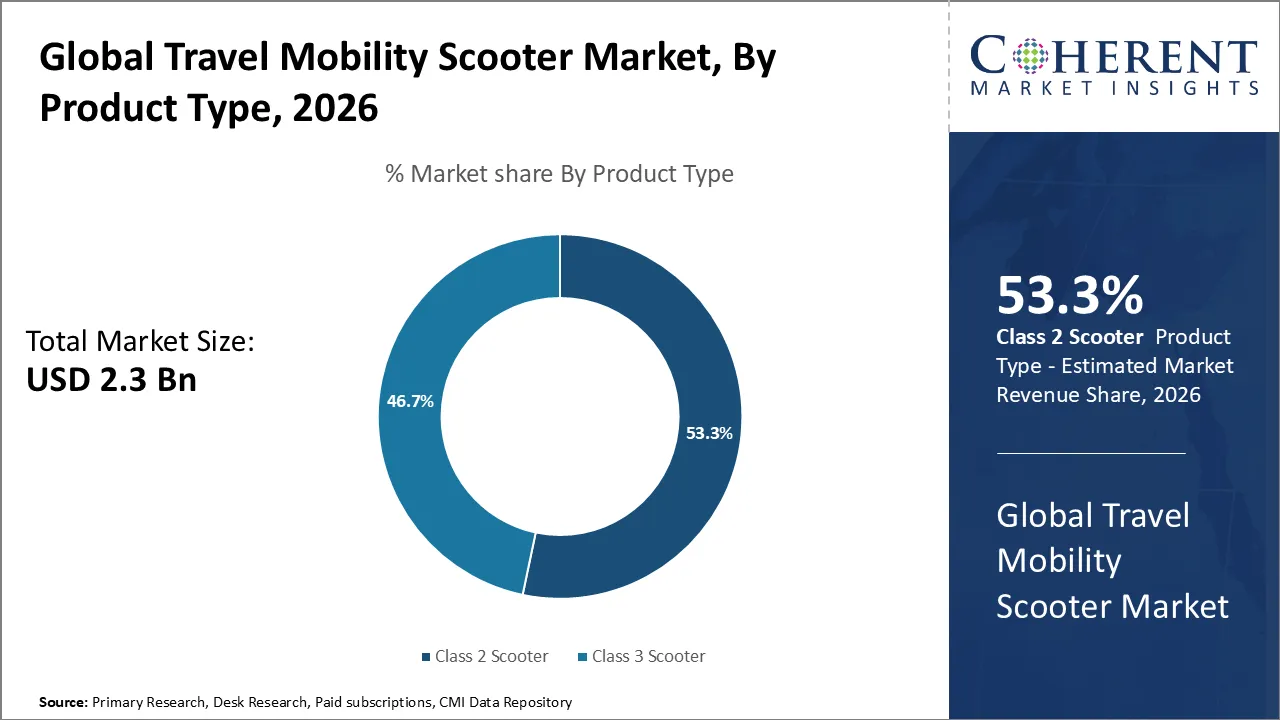
- Class 2 Scooter hold the largest market share of 53.3% in 2026 owing to its growing elderly population. In China’s aging cities, millions of elderly residents use mobility scooters to overcome gaps in public transportation.
- Residential expected to hold largest market share of 52.9% in 2026 owing to the preference for independent living. More than 55% of the world’s population lives in urban areas, a share expected to reach 68%–70% by 2050.
- North America is expected to acquire the dominant share of 42.8% in 2026 owing to the high prevalence of mobility impairments. More than one in four U.S. adults has a disability.
Current Events and Their Impact on the Travel Mobility Scooter Market
Current Event | Description and its Impact |
UK Review of Powered Mobility Device Regulations |
|
U.S. Airline Accessibility Regulations |
|
Segmental Insights
- Current Industry Events of 2026
- Market Size Estimation
- Regional Breakdown
- Competitive Landscape
- Customer Intelligence
- Segmental Analysis
- Pricing Analysis
- Key Market Drivers, Challenges & Future Trends
- Customized Insights Section
Why is Class 2 Scooter Acquiring the Largest Market Share?
Class 2 Scooter hold the largest market share of 53.3% in 2026. Class 2 scooters are driving demand in the Travel Mobility Scooter Market because their lightweight, compact, and user-friendly designs support convenient short-distance travel. Older adults and people with limited mobility increasingly choose these scooters for shopping, leisure, and everyday activities. Their easy maneuverability, portability, and convenient storage further encourage adoption. Manufacturers are also improving battery performance, comfort, safety features, and foldable designs, making these scooters more practical. Growing consumer awareness of independent mobility solutions continues to strengthen demand. Dashmoto has launched the dash 3 Williams Edition, a performance electric scooter inspired by the Atlassian Williams F1 Team. The launch expands dashmoto’s collaboration with the renowned Formula 1 team, combining motorsport-inspired engineering with personal electric mobility.
Which Application segment dominates the market?
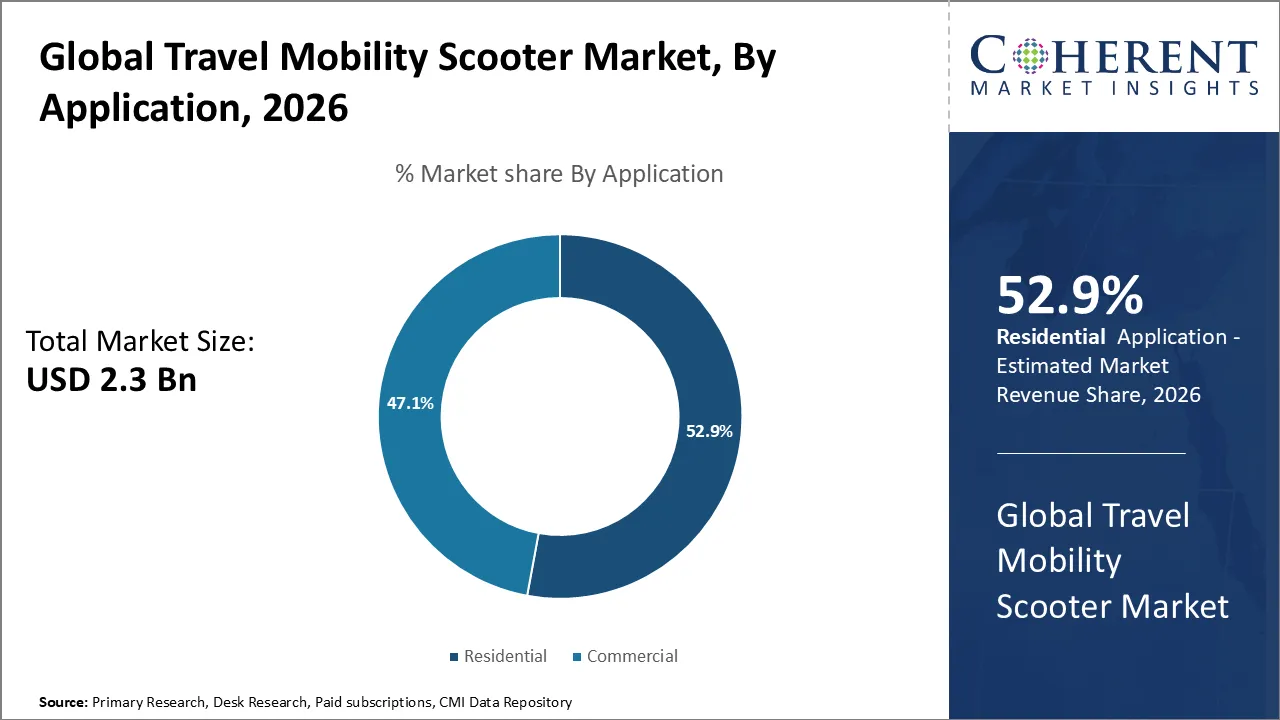
Residential expected to hold largest market share of 52.9% in 2026. The residential segment of the Travel Mobility Scooter Market benefits from rising demand for independent mobility among older adults and individuals with limited movement. Consumers use compact scooters to manage household tasks, travel within their neighborhoods, shop, and participate in social activities. Aging-in-place preferences encourage more households to purchase personal mobility solutions. Manufacturers meet this demand by introducing lightweight, foldable, and easily stored models with enhanced battery performance, comfort, and safety features. Increasing awareness of mobility aids also drives residential adoption.
Travel Mobility Scooter Market Trends
- Rapid Growth in the Global Older Population: The global population aged 60 and older is projected to increase from 1.1 billion in 2023 to 1.4 billion by 2030 and 2.1 billion by 2050, according to the WHO. This demographic shift is expected to expand the potential user base for mobility solutions that support independent movement and travel.
- Growing Demand from People with Disabilities: More than 1 in 4 U.S. adults (28.7%) has a disability, with 12.2% reporting a mobility disability, according to CDC data. The large population experiencing mobility limitations supports demand for mobility devices, including scooters designed for everyday movement and travel.
- Increasing Focus on Air Travel Accessibility: The U.S. Department of Transportation issued a 2024 final rule strengthening protections for passengers who travel with wheelchairs and mobility scooters. The rule addresses handling, damage, delays, and airline assistance for mobility devices. This regulatory focus increases the importance of durable, transportable, and travel-compatible scooter designs.
Regional Insights
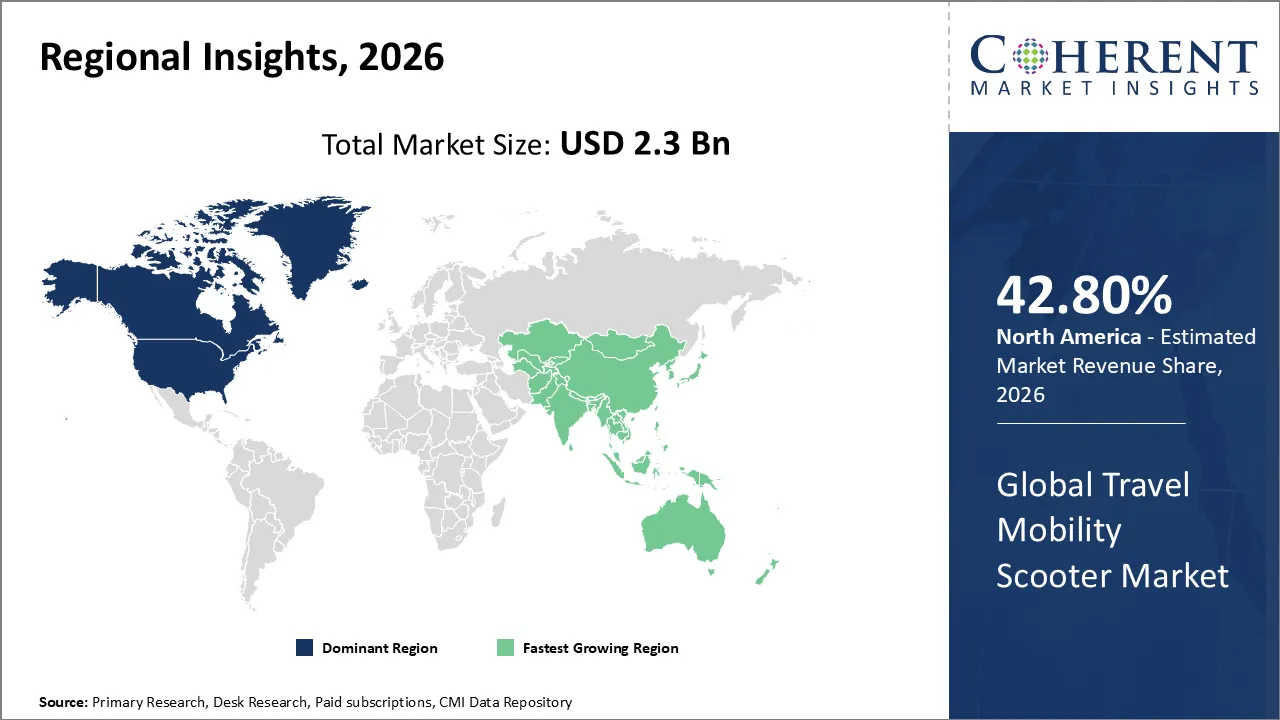
North America dominates owing to established DME and retail distribution channels
North America is expected to acquire the dominant share of 42.8% in 2026. North America’s Travel Mobility Scooter Market continues to expand as its aging population increases demand for independent mobility. Older adults and individuals with mobility limitations increasingly choose scooters to support daily activities and travel. Strong healthcare systems and established durable medical equipment networks provide consumers with easier access to mobility solutions. Consumers also favor lightweight, portable, and technologically advanced models. Aging-in-place preferences, accessible transportation, and tourism infrastructure further encourage adoption, while strong purchasing power enables consumers to invest in premium mobility scooters. iScooter launched its 2026 Back-to-School Sale in North America, running from August 10 to September 23, 2026. The campaign offers limited-time prices, bundle savings, and student discounts for convenient short-distance mobility.
Asia Pacific Travel Mobility Scooter Market Trends
Rapid population aging, greater awareness of mobility challenges, and the growing desire for independent travel are driving the Asia Pacific travel mobility scooter market. Governments and healthcare providers are expanding accessibility programs and assistive mobility support, encouraging more consumers to adopt these scooters. Rising tourism and the development of accessible travel facilities across Japan, China, India, Thailand, and Australia further strengthen demand. Thailand recorded 22.18 million international arrivals through September 19, 2026, down 3.67% year-on-year, while generating ฿1.083 trillion in tourism revenue. Manufacturers are also introducing lightweight, foldable models with longer-lasting batteries and enhanced portability, making travel mobility scooters easier and more convenient to use. Zelio E-Mobility launched the 2026 X-Men+ low-speed scooter for urban commuters in India, featuring a refreshed design and four new color options: Dark Knight Black, White, Midnight Blue, and Nardo Grey.
United States Travel Mobility Scooter Market Trends
The aging U.S. population, rising mobility-related disabilities, and growing demand for independent travel actively drive the travel mobility scooter market. By 2040, approximately 20% of Americans will be 65 or older, compared with 12.5% in 2000. Consumers increasingly choose portable mobility solutions for tourism, shopping, recreation, and outdoor activities. Healthcare coverage and reimbursement programs improve access, while ADA-compliant airports, hotels, and public facilities encourage scooter use. Manufacturers also attract consumers by introducing lightweight folding models, longer-lasting batteries, improved maneuverability, and smart connectivity features, making travel mobility scooters more convenient, practical, and appealing for users across the United States. Isinwheel launched its U.S. spring promotion and new-product presales from February 27 to March 26, 2026, offering improved electric mobility solutions focused on performance, safety, range, and versatility for outdoor travel.
Japan Travel Mobility Scooter Market Trends
Japan’s travel mobility scooter market benefits from its aging population, which increases seniors’ need for independent and convenient transportation. Growing accessible tourism and demand for barrier-free facilities encourage more travelers to use mobility scooters. Government programs that promote universal tourism and accessibility further support market growth. In September 2026, Japan will launch the Kyushu Recovery Support Discount on October 1 to boost tourism following the Kumamoto Earthquake. The subsidy will cover 60% in Kumamoto and Kagoshima and 50% in the other five prefectures, where cancellations were lower. Manufacturers also improve scooter designs by reducing weight, enhancing battery performance, and adding smart features. Meanwhile, rising inbound tourism and expanding rental services at major destinations make mobility scooters more accessible and convenient for travelers.
Who are the Major Companies in Travel Mobility Scooter Industry
Some of the major key players in Travel Mobility Scooter are Merits Health Products, Pride Mobility Products, Afikim Electric Vehicles, Invacare, Golden Technologies, Hoveround Corp, Quingo, TGA Mobility, Electric Mobility, Amigo Mobility, and Vermeiren.
Key News
- In August 2026, Nepali brand Yatri launched the locally designed P-2 electric scooter with Sipradi Trading, offering 5.2 kWh, 3.7 kWh, and 3 kWh battery options. The models deliver claimed ranges of up to 157 km, 112 km, and 90 km, respectively.
Market Report Scope
Travel Mobility Scooter Market Report Coverage
Report Coverage | Details | ||
Base Year: | 2025 | Market Size in 2026: | USD 2.3 Bn |
Historical Data for: | 2020 to 2024 | Forecast Period: | 2026 to 2033 |
Forecast Period 2026 to 2033 CAGR: | 6.5% | 2033 Value Projection: | USD 4.1 Bn |
Geographies covered: |
| ||
Segments covered: |
| ||
Companies covered: | Merits Health Products, Pride Mobility Products, Afikim Electric Vehicles, Invacare, Golden Technologies, Hoveround Corp, Quingo, TGA Mobility, Electric Mobility, Amigo Mobility, and Vermeiren. | ||
Analyst Opinion
- Travel mobility scooters are shifting from being a medical aid to becoming a practical travel-enablement product. Japan is the clearest example: people aged 65 and above reached 36.24 million in 2026, representing 29.6% of the population, the highest proportion among major economies. In my view, this demographic reality creates sustained demand for compact, maneuverable scooters that allow older travelers to remain active rather than restrict mobility to assisted transportation.
- Accessible tourism is becoming a commercial demand driver, not simply an inclusion initiative. Australia recorded 70.5 million trips by travelers with accessibility needs in 2024, generating A$29.2 billion in spending. This demonstrates that travelers with mobility requirements represent a substantial tourism customer base, and destinations, hotels, airports, and attractions have a direct incentive to provide mobility solutions such as rental scooters.
- The strongest opportunity lies in lightweight and travel-oriented scooter designs rather than traditional bulky mobility products. Japan already supports extensive accessibility infrastructure, including 59,918 welfare taxis and more than 32,000 railway vehicles compliant with barrier-free standards. As transportation infrastructure becomes easier to navigate, consumers increasingly need the final-mile mobility solution, positioning portable scooters as a critical link between accessible transport and tourist destinations.
- Rental availability will increasingly determine adoption because travelers rarely want to transport heavy mobility equipment internationally. Almost half of travelers with accessibility needs take at least one international leisure trip annually, yet significant barriers remain within the travel sector. Destination-based scooter rental, hotel partnerships, airport availability, and attraction-level mobility services to become more important competitive differentiators than simply selling higher-capacity scooters.
Speak to the analyst
Want personalized insights?
Take the findings above to one of our principal consultants, or have the report rebuilt around the segments, geographies and competitors you actually track.
Market Segmentation
- By Product Type (Revenue, USD Bn, 2021-2033)
- Class 2 Scooter
- Class 3 Scooter
- By Application (Revenue, USD Bn, 2021-2033)
- Residential
- Commercial
- By Region (Revenue, USD Bn, 2021-2033)
- North America
- U.S.
- Canada
- Latin America
- Brazil
- Mexico
- Argentina
- Rest of Latin America
- Europe
- Germany
- U.K.
- France
- Italy
- Spain
- Russia
- Rest of Europe
- Asia Pacific
- China
- India
- Japan
- Australia
- South Korea
- ASEAN
- Rest of Asia Pacific
- Middle East
- GCC
- Israel
- Rest of Middle East
- Africa
- South Africa
- Central Africa
- North Africa
- North America
Sources
Primary Research interviews
- Mobility scooter manufacturers and distributors
- Durable medical equipment (DME) suppliers
- Mobility equipment retailers and dealers
- Travel mobility equipment rental providers
- Accessible tourism operators and travel agencies
- Rehabilitation and mobility specialists
- Healthcare professionals and occupational therapists
- Users of mobility scooters and caregivers
- Airport, hotel, and tourist-attraction accessibility managers
Databases
- Japan Statistics Bureau
- U.S. Census Bureau
- Eurostat
- OECD Data
- World Health Organization (WHO) Global Health Observatory
- World Bank DataBank
- United Nations Population Division
- Japan National Tourism Organization (JNTO) Tourism Statistics
- U.S. Bureau of Transportation Statistics
- European Commission transport and accessibility databases
Magazines
- Mobility Management
- Disability Horizons
- Travel Weekly
- Travel + Leisure
- Senior Travel News
- Accessible Travel Magazine
- Rehabilitation Management
Journals
- Disability and Rehabilitation
- Journal of Transport & Health
- Journal of Aging and Health
- Ageing & Society
- Transportation Research Part A: Policy and Practice
- International Journal of Environmental Research and Public Health
- Journal of Rehabilitation Medicine
- Tourism Management
Newspapers
- The Japan Times
- Nikkei Asia
- The Guardian
- The New York Times
- The Washington Post
- Financial Times
- The Asahi Shimbun
- The Mainichi
Associations
- International Transport Forum (ITF)
- World Travel & Tourism Council (WTTC)
- International Association of Accessibility Professionals (IAAP)
- European Network for Accessible Tourism (ENAT)
- National Mobility Equipment Dealers Association (NMEDA)
- RESNA (Rehabilitation Engineering and Assistive Technology Society of North America)
- American Occupational Therapy Association (AOTA)
- British Healthcare Trades Association (BHTA)
Public Domain sources
- Japan Ministry of Land, Infrastructure, Transport and Tourism (MLIT)
- Japan Tourism Agency
- Japan National Tourism Organization (JNTO)
- Japan Statistics Bureau
- U.S. Department of Transportation
- U.S. Bureau of Transportation Statistics
- U.S. Census Bureau
- European Commission
- Eurostat
- OECD
- World Health Organization (WHO)
- United Nations
- World Bank
- National Center for Biotechnology Information (NCBI)
- Government accessibility and barrier-free transportation publications
- National disability and aging statistics
- Public transportation accessibility reports
- Government tourism and universal-design policy documents
Proprietary Elements
- CMI Data Analytics Tool
- Proprietary CMI Existing Repository of information for last 10 years
Get access to 250+ pages report
Every segment, forecast, competitor profile and data table behind the analysis above — available for instant download.
- ESOMAR Member
- ISO 9001:2015 Certified
- D-U-N-S Registered
- GDPR & CCPA Compliant
Missing comfort of reading report in your local language? Find your preferred language:
Transform your Strategy with Exclusive Trending Reports
Frequently Asked Questions
The Travel Mobility Scooter Market is projected to grow from USD 2.3 Bn in 2026 to USD 4.1 Bn by 2033.
Key growth drivers include the rising elderly population, increasing preference for independent living, and growing participation of older adults and people with mobility limitations in travel and recreational activities.
Class 2 scooters dominate the market, accounting for 53.3% in 2026.
Class 2 scooters typically offer a practical combination of portability, maneuverability, comfort, and ease of storage.
The residential segment is expected to lead with a 52.9% share in 2026.