

Contract Logistics Market Analysis & Forecast: 2026-2033
Contract Logistics Market is estimated to be valued at USD 325.40 Bn in 2026 and is expected to reach USD 546.88 Bn in 2033, exhibiting a compound annual growth rate (CAGR) of 7.7% from 2026 to 2033.
Key Takeaways
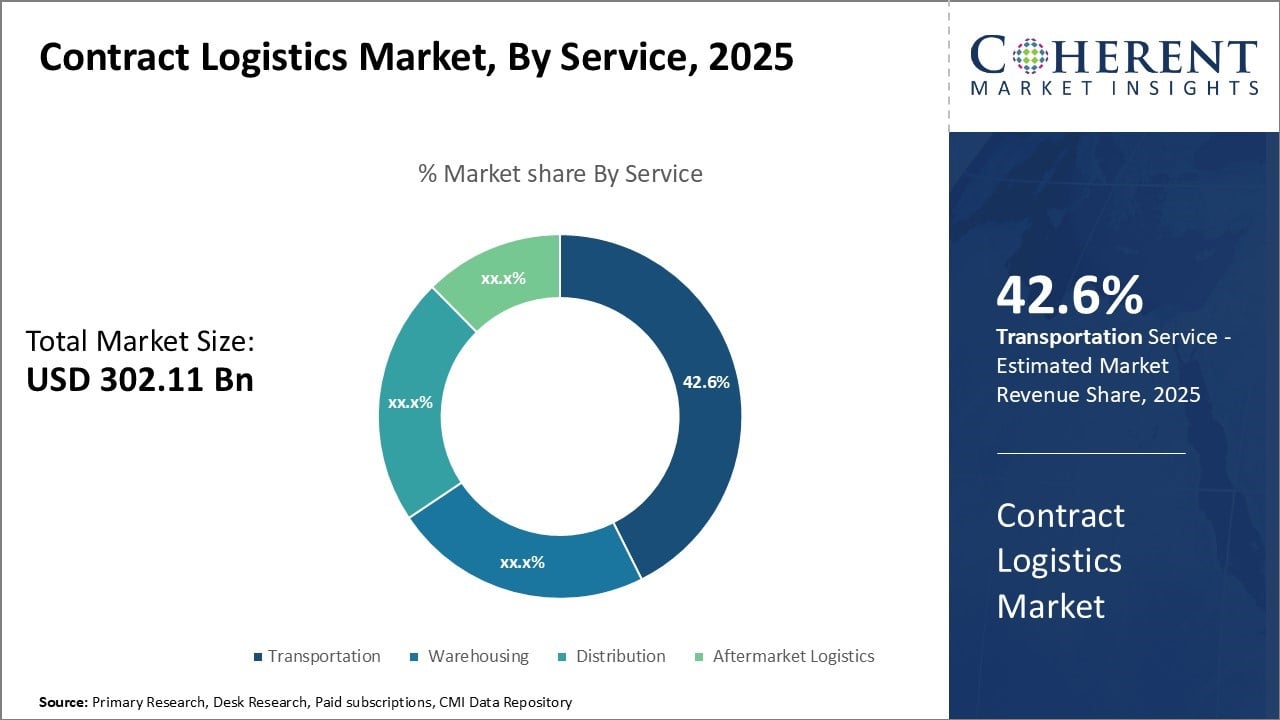
- According to Service, The Transportation Category is anticipated to account for the largest share of 43.6% for the Contract Logistics market in 2026. Effective inventory management, prompt delivery, and the efficient movement of goods across supply chains all depend on transportation services, which include air, sea, rail, and road freight.
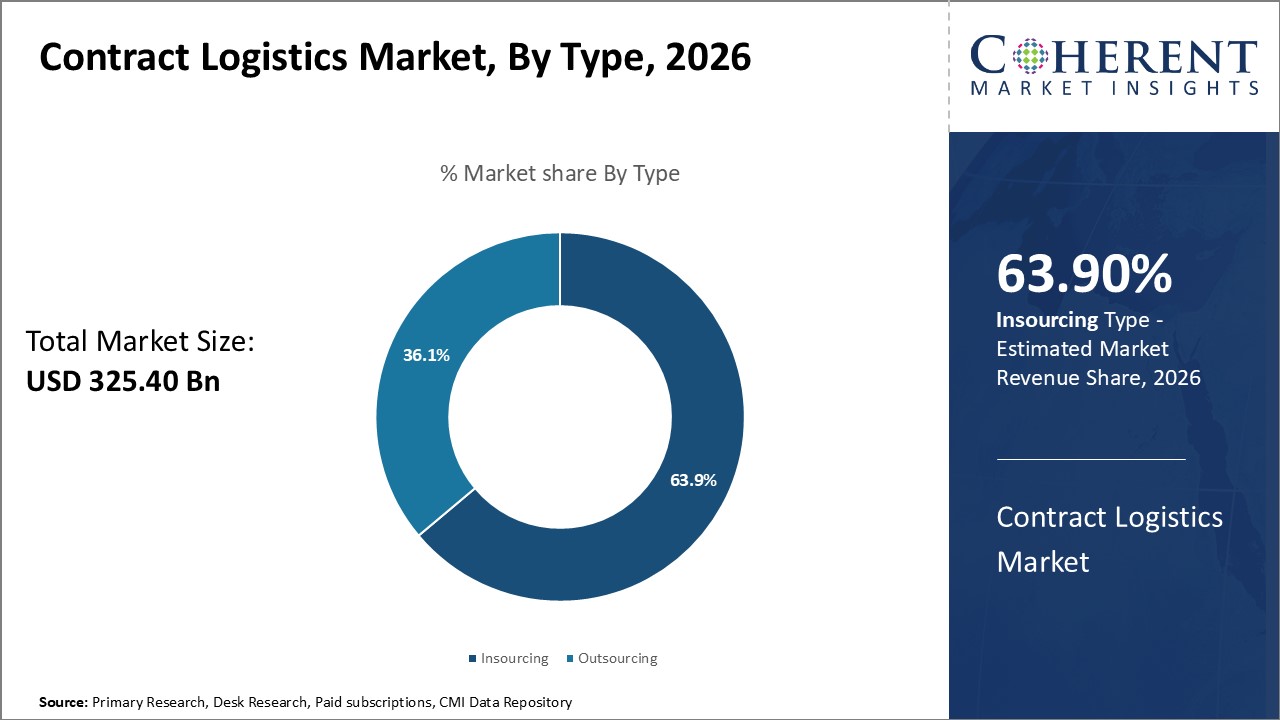
- According to Type, The Insourcing Model Segment is anticipated to hold 63.9% share of the Contract Logistics market in 2026. This strategy enables businesses to keep close supervision and command over vital supply chain functions, such as inventory control, shipping, warehousing, and post-production customisation.
- According to Mode Of Transportation, Roadways Transportation Category dominates contract logistics market with 42.8% shares in 2026. Its supremacy is ascribed to its unmatched accessibility and versatility, which make it the go-to option for product delivery particularly in last mile and final logistics.
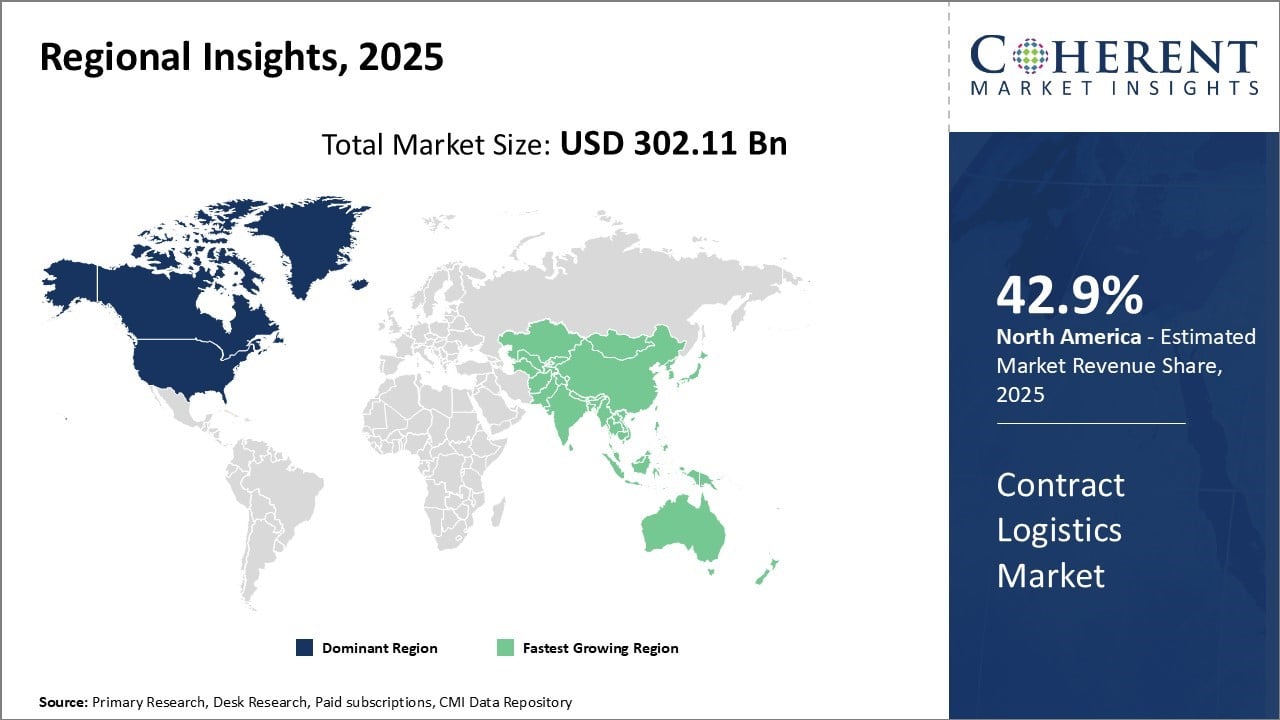
- According to region, North America holds the largest market share of 42.9% for Contract Logistics market growth by 2026. The need for effective, scalable logistics and same-day or next day delivery services has increased due to shifting customer purchasing habits such as the move toward online shopping.
Market Overview
The Contract Logistics Market Size is mostly driven by the growing need for technologically integrated, cost-effective supply chains, the quick growing demand for outsourced logistics services. The contract logistics market is expected to witness significant growth during the forecast period. This can be attributed to factors such as increased outsourcing of operations by manufacturing companies, growth of the e-commerce industry, and rising contract logistics market demand for value-added services. Emerging technologies such as automation, robotics and artificial intelligence are enabling logistics companies to enhance efficiency and gain a competitive advantage. Adoption of these technologies is expected to accelerate in the coming years, thereby supporting market growth.
Current Events and Its Impact on the Contract Logistics Market
Event | Description and Impact |
Rise of E-commerce and On-Demand Delivery |
|
Adoption of AI and Machine Learning in Automation |
|
Pipeline Analysis
The pipeline for the contract logistics market in Europe is robust, reflecting ongoing expansion and diversification across key sectors such as manufacturing, automotive, food & beverage, and e-commerce. Companies are increasingly investing in new logistics hubs, automation technologies, and digital platforms to streamline operations and enhance service offerings.
Notably, the transportation segment remains the largest, while aftermarket logistics is the fastest-growing area, indicating a shift toward value-added services and end-to-end supply chain solutions. The pipeline also includes strategic partnerships and mergers aimed at expanding geographic reach and improving operational efficiency, with Germany and the UK leading in new project developments and capacity upgrades.
- Current Industry Events of 2026
- Market Size Estimation
- Regional Breakdown
- Competitive Landscape
- Customer Intelligence
- Segmental Analysis
- Pricing Analysis
- Key Market Drivers, Challenges & Future Trends
- Customized Insights Section
Patent Landscape
While the contract logistics market is not typically driven by traditional patents as seen in pharmaceuticals or high-tech sectors, innovation remains a key differentiator. The industry’s patent landscape centers on proprietary software systems, automation technologies, and process optimization tools designed to improve supply chain visibility, inventory management, and last-mile delivery.
Leading logistics providers are investing in intellectual property related to warehouse automation, real-time tracking, and digital integration platforms, which are increasingly critical for maintaining competitiveness and meeting evolving customer demands.
Reimbursement Scenario
- Reimbursement, in the context of contract logistics, refers to the financial arrangements and compensation structures between logistics providers and their clients. In Europe, these scenarios are evolving as more companies outsource logistics functions to achieve cost efficiency and operational flexibility.
- Payment models are increasingly performance-based, with contracts often structured around key performance indicators (KPIs) such as delivery speed, accuracy, and cost savings. This shift incentivizes logistics providers to optimize processes and invest in technology, as their compensation is directly linked to measurable outcomes and service quality.
Prescribers’ Preference
- Decision-makers (“prescribers”) in the European contract logistics market, such as supply chain managers and procurement officers, are showing a clear preference for partners offering advanced technological capabilities, risk management, and scalability.
- There is a strong inclination toward outsourcing to providers with expertise in automation, digitalization, and integrated supply chain solutions.
- Prescribers also favor logistics companies that can offer flexibility, transparency, and tailored services—especially those capable of supporting complex, multi-channel distribution and responding to the rapid growth of e-commerce and on-demand delivery.
Segmental Insights
Contract Logistics Market Insights, By Service
Transportation accounts for the largest share of the contract logistics market with 43.6% in 2026 owing to its dependability and cost-effectiveness in delivering goods. As contract logistics providers take on greater responsibility for managing supply chains end-to-end, reliable and affordable transportation options are key.
Outsourcing transportation to specialized operators allows companies to focus on their core competencies while ensuring products and parts reach customers on time. This is particularly important as supply chains grow more complex with expanding international trade.
Transportation providers offer custom solutions tailored to clients' unique supply chain needs. For perishable goods or time-sensitive deliveries, temperature-controlled trucks, optimized routes, and real-time tracking maximize freshness and minimize delays. Multi-modal options integrating truck, rail, air and ocean transport seamlessly link production facilities globally. Flexible scheduling accommodates variable demand while chartering entire vessel shipments for bulk volumes achieves significant cost savings over less-than-truckload mixes.
Advanced telematics integrate with transportation management software to enhance visibility and efficiency. Real-time load tracking, estimated times of arrival and automated dispatching based on traffic conditions optimize routes on the fly. Automated tendering streamlines processes from order entry to proof of delivery. Machine learning algorithms refine algorithms over time based on historical data to continually improve on-time performance, fuel usage and asset utilization.
The ability of transportation providers, including last mile contract logistics providers, to deliver a comprehensive solution tailored to clients' supply chain requirements at competitive rates drives its dominance of the contract logistics market segment. Outsourcing this complex yet critical function frees up capital and management attention for core business priorities.
Contract Logistics Market Insights, By Type
The insourcing model accounts for a higher share of the contract logistics market with 63.9% in 2026 due to companies' desire to mitigate risks by maintaining direct oversight of certain supply chain activities. For strategically important or profit-driving operations, ownership provides greater control over quality, service levels and intellectual property. Insourcing also ensures adequate capacity and resources are dedicated during business fluctuations with the flexibility to ramp up or down as needed.
Certain activities such as post-production customization, configuration or programming of technology and medical products require specialized facilities, certifications and proprietary production processes. Partnering with expert contract manufacturers that have made the necessary investments in these capabilities onsite maintains oversight of sensitive intellectual property and quality without the upfront capital expenditure.
For seasonal, volatile or immature product lines, insourcing distribution or transportation protects against capacity bottlenecks or service failures during peaks. It also allows companies to devote more attention to new products in early stages before transitioning operations out once mature. Building internal expertise in complex customs clearances or cross-border documentation for globally distributed supply chains likewise reduces compliance risks.
Maintaining ownership and management of certain activities gives companies tighter control over brand reputation and the customer experience in high-value market segments. It ensures the highest standards for food safety, traceability, worker conditions or environmental practices are upheld that outsource partners may not have the same commitment to. The ability to mitigate supply chain risks drives insourcing's prevalence in contract logistics.
Contract Logistics Market Insights, By Mode of Transportation
Road transportation commands the largest share of the contract logistics market with 42.8% in 2026 mode of transportation segment due to its unparalleled versatility and accessibility for delivering goods the final mile.
Whether transporting full truckloads between warehouses or coordinating multiple stop routes for less-than-truckload and parcel carriers, optimized road networks maximize service efficiency. Real-time mapping and telematics allow continuously updated ETAs as well as dynamic routing to consolidate deliveries.
Door-to-door connectivity is road transportation’s core advantage over rail, air or ocean transport that require transloading between modes. The accessibility of company vehicles to virtually any address eliminates delays from additional handling. This is particularly important for delivering bulky, oversized or time-sensitive items that would incur sizeable fees on alternate modes. Trucks also accommodate constantly evolving packing and delivery methods from pallets to bins to totes and parcels.
Tailored temperature-controlled vehicles maintain product freshness for grocery, food service and pharmaceutical deliveries with precision monitoring. Refrigerated and dry containers can store entire inventories on wheels. Fleet telematics integrated with warehouse management optimize load building, routing and stop sequencing to minimize mileage and consolidate routes. Machine learning algorithms refine route plans daily based on dynamic factors like traffic.
The last mile's strategic importance for fulfilling customer orders and cultivating ongoing relationships with retailers and consumers underpins road transport's prominence in contract logistics. Its flexible, customized solutions for final-leg connectivity outmatch competitors' efficiency for mission-critical deliveries.
Contract Logistics Market – Regional Insights
North America Contract Logistics Market
North America has established itself as the dominant region with 42.9% market share in 2026 in the global contract logistics market. With a well-developed transportation and warehousing infrastructure, major companies from various industries have their regional headquarters located here. This provides local contract logistics players with scale and recurring business from multinational corporations.
The region also has a highly skilled workforce with expertise in complex supply chain requirements of industries such as aerospace, automotive and healthcare. Strong presence of 3PL leaders has ensured standardized services and technological capabilities are consistently delivered across the area.
Asia Pacific Contract Logistics Market
Meanwhile, Asia Pacific has emerged as the fastest growing market for contract logistics services. Numerous factors are aiding the surge in demand. There is a massive manufacturing shift happening here as OEMs set up factories to cater to domestic and global demand. This has led to development of industrial clusters and special economic zones which new-age 3PL providers are quickly setting up networks in.
The region is witnessed growing international trade volumes both for imports and exports. As companies look to consolidate and manage supply chains efficiently, they are increasingly partnering with local providers that understand cultural sensibilities.
Contract Logistics Market In Europe
The transition from conventional in-house logistics models to more sophisticated, outsourced contract logistics solutions has been greatly accelerated by the growth of e-commerce and on-demand delivery. This allows companies to concentrate on their core skills while utilizing specialized knowledge for supply chain management.
Contract Logistics Market Dominating Countries
U.S Contract Logistics Market
The demand for sophisticated warehousing, distribution, and last-mile delivery systems has been fueled by the growth of e-commerce. In response, U.S. logistics companies have increased their infrastructure and included state-of-the-art technologies like real-time tracking and route optimization, which has improved delivery metrics and operational efficiency.
India Contract Logistics Market
India's contract logistics market is growing quickly due to the nation's thriving e-commerce industry, supply chain modernization, and rising manufacturer outsourcing. As businesses look for flexibility and cost savings, demand for value-added services like inventory management and integrated transportation solutions is growing.
Contract Logistics Market In China
The development of smart logistics infrastructure and the growth of international e-commerce further solidify China's position as the industry leader. Companies such as Alibaba and JD.com have made significant investments in automated logistics hubs, demonstrating the nation's dedication to market expansion and technological innovation and securing China's leadership in international contract logistics.
Market Report Scope
Contract Logistics Market Report Coverage
| Report Coverage | Details | ||
|---|---|---|---|
| Base Year: | 2025 | Market Size in 2026: | USD 325.40 Bn |
| Historical Data for: | 2020 To 2024 | Forecast Period: | 2026 To 2033 |
| Forecast Period 2026 to 2033 CAGR: | 7.7% | 2033 Value Projection: | USD 546.88 Bn |
| Geographies covered: |
| ||
| Segments covered: |
| ||
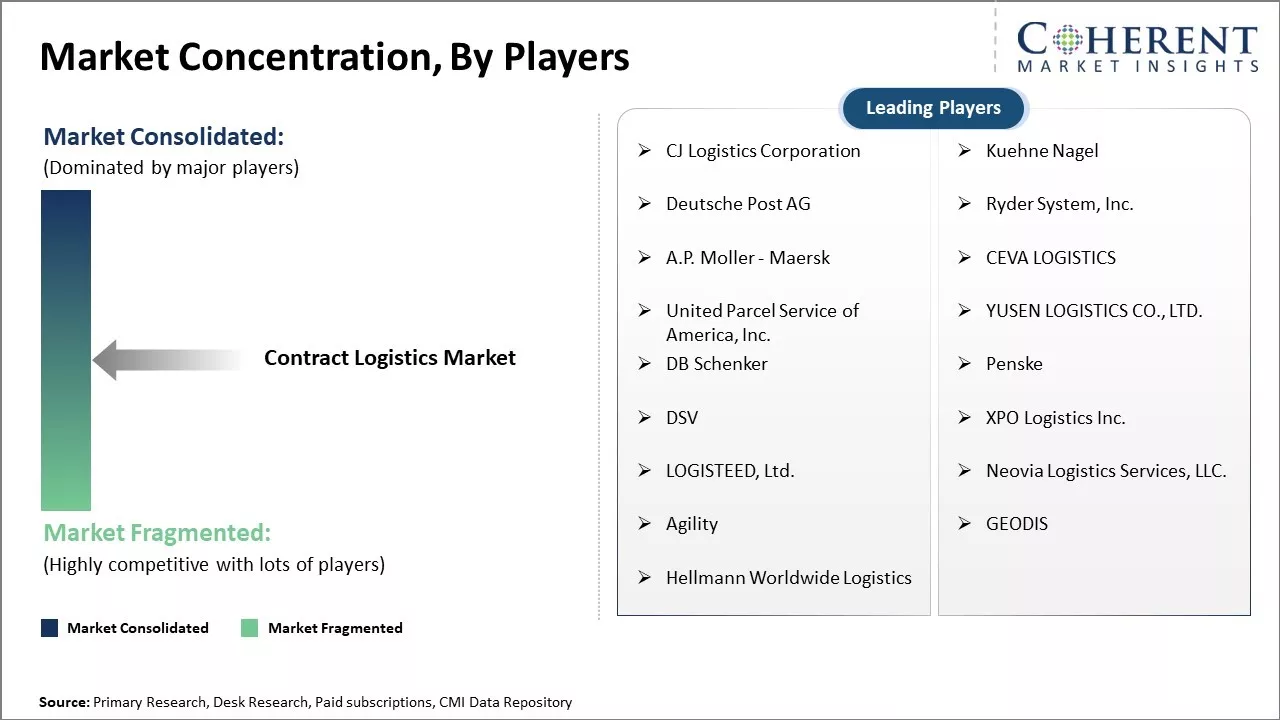
| Companies covered: | CJ Logistics Corporation, Kuehne Nagel, Deutsche Post AG, Ryder System, Inc., A.P. Moller - Maersk, CEVA LOGISTICS, United Parcel Service of America, Inc., YUSEN LOGISTICS CO., LTD., DB Schenker, Penske, DSV, XPO Logistics Inc., LOGISTEED, Ltd., Neovia Logistics Services, LLC., Agility, GEODIS, Hellmann Worldwide Logistics | ||
| Growth Drivers: |
| ||
| Restraints & Challenges: |
| ||
Market Concentration and Competitive Landscape
Contract Logistics Market: Growth Drivers
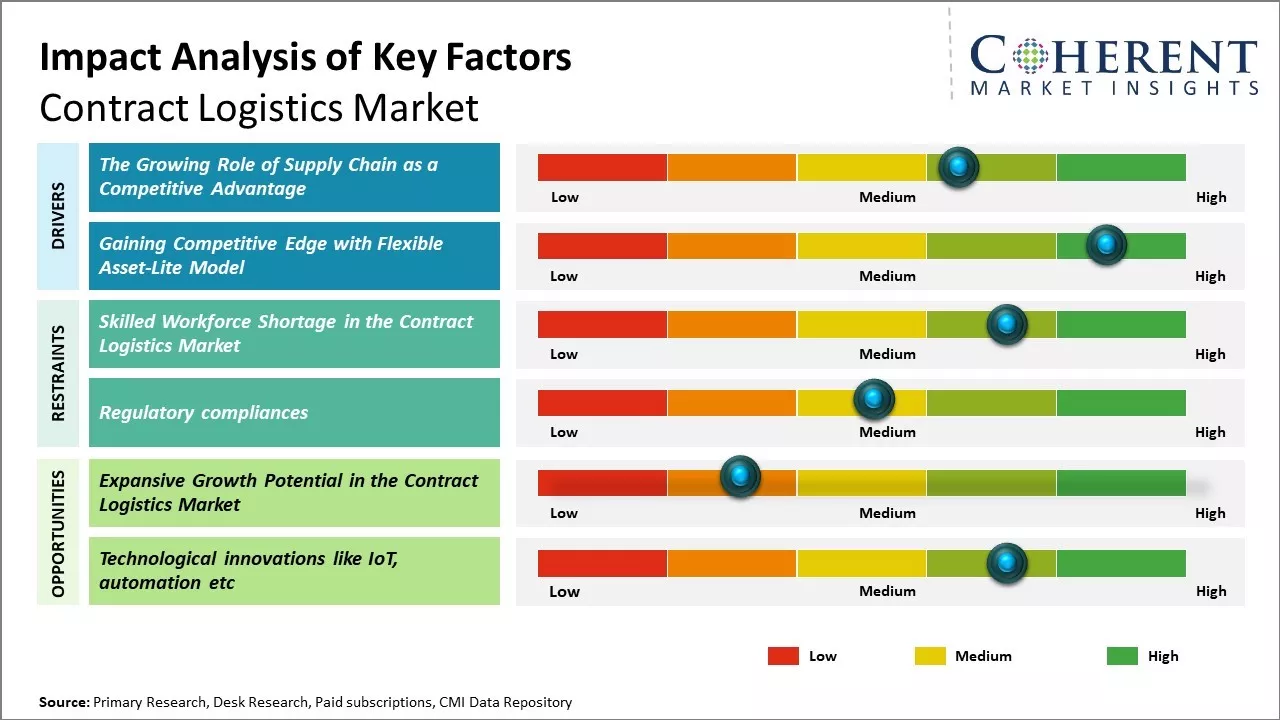
- The Growing Role of Supply Chain as a Competitive Advantage
Surging Demand for Customized Supply Chain Solutions: In today's complex global business environment, companies are under immense pressure to provide highly customized products and services to their customers across diverse geographic locations. This has significantly increased the complexity of supply chain operations. Managing disparate distribution centers, fleet requirements, handling returns and compliance with various country-level regulations has become a major headache.
Furthermore, customers demand rapid delivery with complete visibility of order status. To address these evolving customer needs while remaining focused on their core operations, many companies are now outsourcing parts of their supply chain management to third-party logistics providers.
Contract logistics providers have deep expertise in streamlining operations through technological solutions and process optimization. They offer end-to-end customized solutions tailored to the specific industry and business requirements. Over the past decade, there has been a sharp rise in demand for such integrated contract logistics services.
- Gaining Competitive Edge with Flexible Asset-Lite Model
Businesses today operate in a highly volatile environment marked by technological disruptions, changing consumer preferences, and trade conflicts. Supply chain resilience has become critical to deal with uncertainties and ensure operational continuity. However, maintaining large fixed assets like warehouses, trucks, handling equipment requires massive capital investments and operating expenses.
It also makes the supply chain rigid and less responsive to changes. By partnering with contract logistics providers, companies can maintain a more flexible asset-light model and focus capital on their core offerings. Service providers have access to large modern infrastructure and resources across a wide geographic network.
They can dynamically scale up or down operations based on real-time demand through their flexi-staffing models. This way, companies gain the reliability of a robust integrated supply chain without fixing huge assets. Outsourcing non-core logistics activities allows internal resources to be optimized for innovation, resulting in competitive advantages.
Contract Logistics Market: Restraints
- Skilled Workforce Shortage in the Contract Logistics Market
The contract logistics market faces challenges in terms of lack of skilled workforce. With the rising demand for complex logistic needs from manufacturing and retail industries, there is dearth of talent pool with capabilities of handling advanced technologies like robotics, artificial intelligence etc. Logistics companies find it difficult to hire and retain talent leading to increased operational costs.
Contract Logistics Market: Trends
- Increasing growth of food packaging industry in Asia Pacific is trending in the market
Asia Pacific has presence of large population pool, and the region is witnessing expansion of disposable income among customers, due to which food packaging industry is one of the major markets in the region. Moreover, technological developments across countries in the region are enabling premium food manufacturers to deliver unique food choices in long-lastingly and sustainable manner.
- Increasing digital transformation of enterprises around the world is a growing trend
Due to digital transformation of enterprises, the emergence of automation powered by digital technologies such as AI and robotics is increasing around the world. This is likely to help companies reduce cost of manufacturing. The use of robotic filling equipment allows packagers to create more than they can with manual product filling.
This technology can enable dependable, repeatable, and consistent fill with every cycle, whether the fill is based on a volume, level, weight, or another measurement. Thus, growing digital transformation of enterprises to fuel growth of the global Contract Logistics market during the forecast period.
Contract Logistics Market: Opportunities
- Expansive Growth Potential in the Contract Logistics Market
The contract logistics market possesses tremendous opportunities for growth and expansion. With continuing globalization and outsourcing trends, third party logistics providers can leverage their expertise and invest in advanced capabilities to gain more business. Growing e-commerce and omni-channel retailing has opened new avenues for logistics players. Integration of new technologies allows them to offer value added services and ensure seamless fulfilment. This will help win new customers and ensure higher revenue streams.
Contract Logistics Market: Key Developments
- January 2025, DHL Supply Chain, the Americas leader in contract logistics, today announced the acquisition of Inmar Supply Chain Solutions, a division of Inmar Intelligence and a leading returns solutions provider for the retail e-commerce industry. The strategic acquisition will make DHL Supply Chain the largest provider of reverse logistics solutions in North America. The acquisition will result in 14 return centers and around 800 associates joining the DHL Supply Chain business, expanding the company’s North American footprint, which currently stands at over 520 warehouses supported by 52,000 associates.
- April 2025, The world’s largest pure-play contract logistics operator (PPCLO), GXO, has argued that its intended acquisition of UK competitor Wincanton won’t lead to a substantial lessening of competition for domestic grocery and non-grocery retailers.
- September 2024, Universal Logistics Holdings, Inc. announced today its acquisition of Parsec, LLC, Parsec Intermodal of Canada ULC, and OB Leasing, LLC. Parsec is a market-leading provider of terminal management services to the Class I, regional, and short-line railroads across North America. With a highly-skilled workforce of nearly 2,100 employees, Parsec offers a comprehensive suite of terminal services at over 20 rail yards throughout the United States and in Canada.
Analyst Opinion
- The rapid rise of the e-commerce industry, the growing need for value-added services like inventory management and last-mile delivery, and the growing outsourcing of logistical operations by manufacturing and retail companies are all major contributors to this expansion.
- New technologies like automation, robots, and artificial intelligence are revolutionizing the sector by increasing operational effectiveness and empowering logistics companies to offer customers more specialized and integrated solutions.
- Businesses are depending more and more on third-party suppliers with extensive experience and cutting-edge technology skills due to the complexity of global supply chains and the demand for highly customized logistics solutions.
- Europe and North America are anticipated to grow more slowly, reflecting local economic conditions and market maturity, while Asia Pacific is anticipated to lead global expansion due to its dynamic e-commerce growth.
Speak to the analyst
Want personalized insights?
Take the findings above to one of our principal consultants, or have the report rebuilt around the segments, geographies and competitors you actually track.
Market Segmentation
- By Service (Revenue, USD Bn, 2021 - 2033)
- Transportation
- Warehousing
- Distribution
- Aftermarket Logistics
- By Type (Revenue, USD Bn, 2021 - 2033)
- Insourcing
- Outsourcing
- By Mode Of Transportation (Revenue, USD Bn, 2021 - 2033)
- Railways
- Airways
- Roadways
- Waterways
- By Industry Vertical (Revenue, USD Bn, 2021 - 2033)
- Aerospace
- Automotive
- Industrial
- High-tech
- Pharma and healthcare
- Others
- Retail
- E-Commerce
- By Regional (Revenue, USD Bn, 2021 - 2033)
- North America
- U.S.
- Canada
- Latin America
- Brazil
- Argentina
- Mexico
- Rest of Latin America
- Europe
- Germany
- U.K.
- Spain
- France
- Italy
- Russia
- Rest of Europe
- Asia Pacific
- China
- India
- Japan
- Australia
- South Korea
- ASEAN
- Rest of Asia Pacific
- Middle East
- GCC Countries
- Israel
- Rest of Middle East
- Africa
- South Africa
- North Africa
- Central Africa
- Key Players Insights
- CJ Logistics Corporation
- Kuehne Nagel
- Deutsche Post AG
- Ryder System, Inc.
- A.P. Moller - Maersk
- CEVA LOGISTICS
- United Parcel Service of America, Inc.
- YUSEN LOGISTICS CO., LTD.
- DB Schenker
- Penske
- DSV
- XPO Logistics Inc.
- LOGISTEED, Ltd.
- Neovia Logistics Services, LLC.
- Agility
- GEODIS
- Hellmann Worldwide Logistics
Sources
Primary Research Interviews
- Supply Chain Managers at 3PL companies
- Logistics Heads of major FMCG/CPG firms
- Procurement Officers in automotive and electronics companies
Databases
- Orbis
- Trade Map (International Trade Centre)
- UN Comtrade
Magazines
- DC Velocity
- Logistics Management
- Inbound Logistics
- Modern Materials Handling
Journals
- Journal of Business Logistics
- International Journal of Physical Distribution & Logistics Management
- Transportation Journal
Newspapers
- The Wall Street Journal – Logistics section
- Financial Times – Supply Chain section
- The Economic Times (India) – Logistics
- The Hindu Business Line – Logistics
Associations
- Council of Supply Chain Management Professionals (CSCMP)
- International Warehouse Logistics Association (IWLA)
- Global Cold Chain Alliance (GCCA)
- Chartered Institute of Logistics and Transport (CILT)
Proprietary Elements
- CMI Data Analytics Tool, Proprietary CMI Existing Repository of information for last 8 years
*Definition: The contract logistics market involves third-party logistics companies that provide logistics and supply chain management services to companies on a contractual basis. These third-party logistics providers store, manage, and transport goods for client companies. They handle inbound and outbound logistics activities like transportation management, warehousing, fulfillment, and distribution. Contract logistics providers help companies improve efficiencies in their supply chain and focus on their core competencies rather than logistics operations.
Get access to 250+ pages report
Every segment, forecast, competitor profile and data table behind the analysis above — available for instant download.
- ESOMAR Member
- ISO 9001:2015 Certified
- D-U-N-S Registered
- GDPR & CCPA Compliant
Missing comfort of reading report in your local language? Find your preferred language:
Transform your Strategy with Exclusive Trending Reports
Frequently Asked Questions
The Contract Logistics Market size is estimated to be valued at USD 325.40 Bn in 2026, and is expected to reach USD 546.88 Bn by 2033.
The CAGR of the global Market is projected to be 7.7% from 2026 to 2033.
The Growing Role of Supply Chain as a Competitive Advantage and Gaining Competitive Edge with Flexible Asset-Lite Model are the major factor driving the growth of Contract Logistics industry.
Skilled Workforce Shortage in the Contract Logistics Market and Regulatory compliances are the major factor hampering the growth of global Market.
In terms of Service, Transportation , estimated to dominate the market revenue share in 2026.
CJ Logistics Corporation, Kuehne Nagel, Deutsche Post AG, Ryder System, Inc., A.P. Moller - Maersk, CEVA LOGISTICS, United Parcel Service of America, Inc., YUSEN LOGISTICS CO., LTD., DB Schenker, Penske, DSV, XPO Logistics Inc., LOGISTEED, Ltd., Neovia Logistics Services, LLC., Agility, GEODIS, Hellmann Worldwide Logistics are the major players.
North America is expected to lead the Contract Logistics industry in 2026.