

Supply Chain Analytics Market Size and Forecast — 2026-2033
The Supply Chain Analytics Market size is estimated to be valued at USD 9.08 billion in 2026 and is expected to reach USD 18.49 billion by 2033, exhibiting a compound annual growth rate (CAGR) of 10.7% from 2026 to 2033.
Overview
Supply chain analytics is an algorithm that consists of mathematics, statistics, predictive modelling and machine-learning techniques. It helps convert business data including order, shipment, and transactional data of several industries such as, manufacturing, retail & consumer, healthcare, and transportation into meaningful insights.
Supply chain analytics analyses data to provide accurate forecasting that is in tune with current and future market trends. Moreover, supply chain analytics solution is involved in providing real time analysis for huge data set. Rampant growth of unstructured data set through the data or record management of forecasting, transportation logistics, retail and manufacturing, data or transaction of banks and finance, and business tax are expected to boost the growth of overall supply chain analytics market globally, owing to the requirement of analysis and management of huge unstructured data set in shorter time span, which is labor intensive. For instance, machine learning algorithms are used in warehouses to demonstrate an intelligent stock management system for the prediction of resupply requirement in future. In Finance sector, supply chain analytics are used to predict capital costs or the probability of working capital, which helps to target the best suppliers and also provides prompt warning of budget overruns. In transportation, supply chain analytics software can forecast the impact of weather on shipments.
Key Takeaways
The Predictive Analytics segment dominates the supply chain analytics market with a significant 43% market share, driven by its ability to anticipate future demand and supply risks accurately.
Regionally, North America commands the highest market revenue share due to the presence of mature supply chain ecosystems and early technology adopters in industries such as manufacturing and retail.
Asia Pacific is emerging rapidly with the fastest CAGR, stimulated by digitization initiatives, increasing eCommerce penetration, and favorable government policies supporting technology expansion.
Supply Chain Analytics Market – Segmentation Analysis
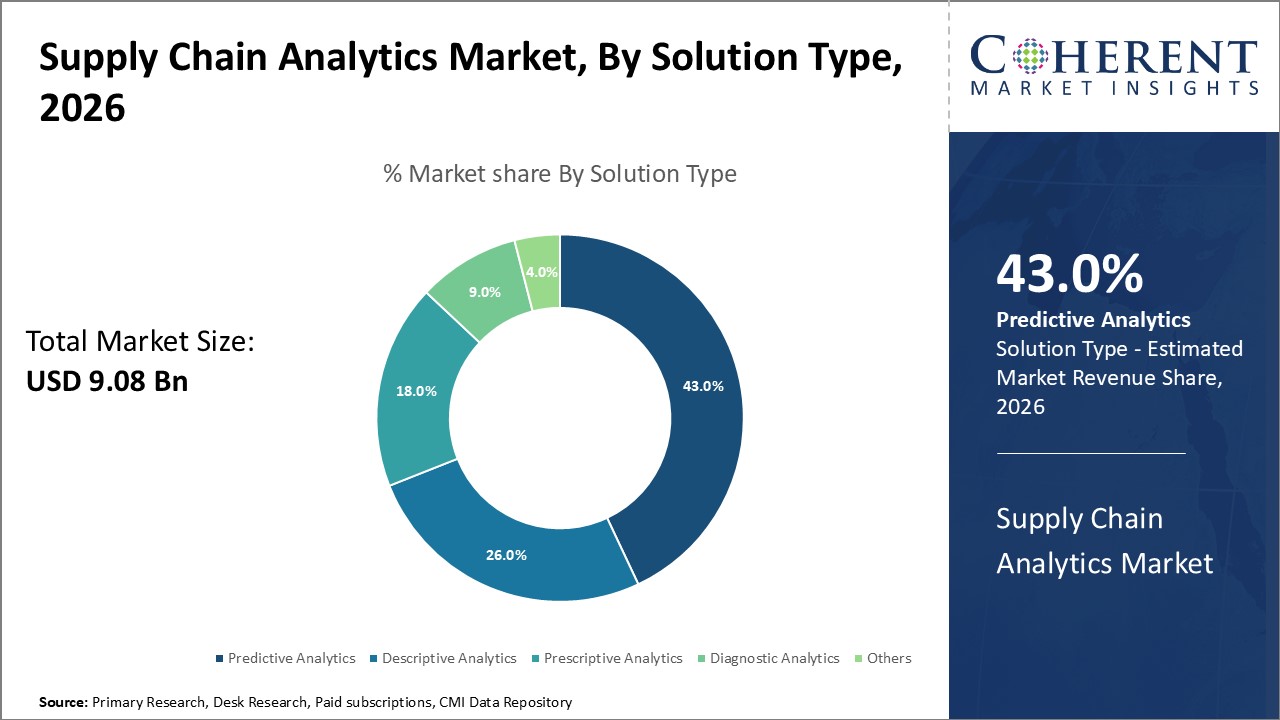
Supply Chain Analytics Market Insights, By Solution Type
In terms of solution type, predictive analytics dominates the market share with 43%. Predictive Analytics excels by enabling companies to forecast customer demand, anticipate supply chain risks, and optimize inventory, making it indispensable for strategic planning in manufacturing and retail. This segment leverages artificial intelligence and machine learning algorithms to analyze historical and real-time data, facilitating proactive decision-making and enhanced supply chain efficiency and also it supports supply chain automation and risk mitigation, leading to reduced operational costs and improved productivity.
Supply Chain Analytics Market Insights, By Deployment Mode
According to the deployment mode segment, cloud-based emerging as the dominating subsegment driven by its flexibility, scalability, and lower initial investment costs enabling mid-sized enterprises to access advanced analytics. This subsegment benefits from continuous software updates and seamless integration with other cloud services. Cloud solutions offer flexibility, scalability, and ease of use, making them popular as organizations seek real-time decision-making support in logistics, warehouse, and procurement operations. The adoption of cloud-based analytics is fueled by the need for remote access, timely tracking, and improved supply chain reliability.
Supply Chain Analytics Market Insights, By Application
In application segment, inventory management dominates the market owing to its central role in reducing holding costs and ensuring stock availability. Technologies that provide real-time analytics on inventory flows significantly improve operational efficiency. Better inventory control and risk management are made possible for this market by sophisticated analytics, real-time visibility, and intelligent demand sensing. The effectiveness of inventory management is further improved by the growing use of cloud-based solutions, artificial intelligence, and Internet of Things technologies, which supports increased demand for transportation logistics and lowers operating costs.
Supply Chain Analytics Market Trends
The increasing integration of AI-powered predictive models with Internet of Things (IoT) data streams marks a decisive trend reshaping supply chain analytics.
Organizations deploying real-time sensor data achieved a 23% improvement in delivery accuracy metrics in logistics by 2026, highlighting progressive automation adoption.
There is also a notable shift towards decentralized supply chain analytics platforms, leveraging blockchain technology to enhance data transparency and trustworthiness.
Furthermore, sustainability analytics focusing on carbon footprint monitoring have gained momentum as environmental regulations tighten globally, compelling companies to embed these analytics into broader supply chain decision-making frameworks.
Supply Chain Analytics Market Insights, By Geography
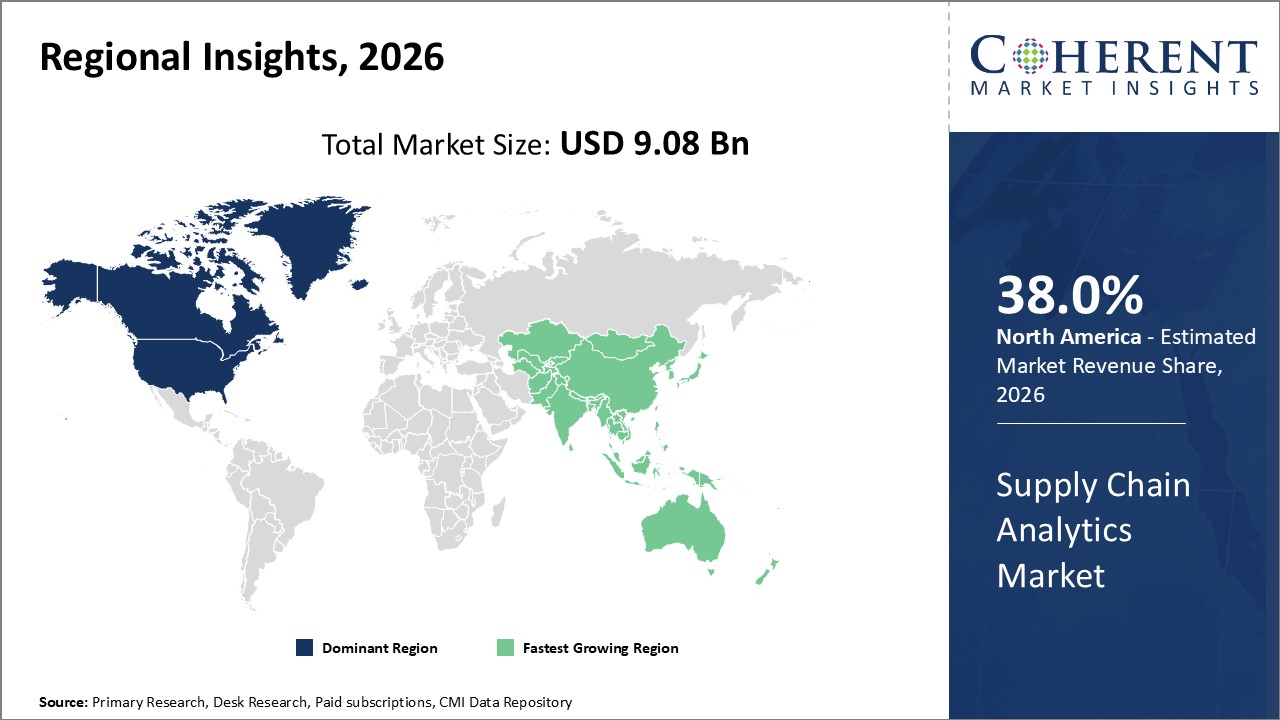
North America Supply Chain Analytics Market Analysis and Trends
The supply chain analytics market in North America is dominated by a developed digital ecosystem, significant R&D expenditure, and sophisticated technology infrastructure. The presence of several leading market companies and early adoption of AI-driven analytics contribute considerably to the region accounting for approximately 38% of the overall market revenue. Robust regulatory frameworks and initiatives to standardize supply chain transparency further support the market’s stronghold.
Asia Pacific Supply Chain Analytics Market Analysis and Trends
Asia Pacific, on the other hand, is growing at the quickest rate, with a compound annual growth rate (CAGR) of over 12%. This is due to the region's fast industrialization, growing e-commerce penetration, and government policies that encourage digital transformation in nations like China. The increasing investments by multinational companies in manufacturing hubs across the region are driving the deployment of advanced supply chain analytics solutions.
Supply Chain Analytics Market Outlook for Key Countries
United States Supply Chain Analytics Market Analysis and Trends
The USA’s market holds a pivotal role in driving innovation within supply chain analytics, characterized by high adoption rates of digital supply chain solutions in logistics and manufacturing.
In 2025, major players implemented AI-powered demand forecasting solutions enabling a 25% logistics efficiency improvement in the retail sector. Government initiatives promoting Industry 4.0 and integration of big data analytics have accelerated supply chain visibility tools adoption, supporting sustained business growth and market revenue expansion.
China Supply Chain Analytics Market Analysis and Trends
Owing to increased e-commerce volumes and national digitization initiatives, China's supply chain analytics market is growing quickly.
The market benefits from strong government backing through initiatives like “Made in China 2026,” offering subsidies to logistics firms adopting data analytics. Key domestic companies are investing heavily in predictive and prescriptive analytics platforms, enhancing supply chain agility and elevating the nation’s industry share in Asia Pacific’s market growth dynamics.
Analyst Opinion
Demand for real-time data integration is a key driver in expanding the market size and supply chain analytics adoption. In 2025, over 71% of leading manufacturing firms reported deploying real-time monitoring systems to reduce production downtime by up to 36%. This quantitative shift signals a growing preference towards dynamic data models enabling agile supply chain responses.
Pricing strategies in service offerings have shown an increased tilt towards subscription-based models. Analytics platforms witnessed a 26% year-over-year increase in revenue from SaaS solutions in 2026, reflecting customers’ demand for scalable and flexible solutions that can evolve with changing business requirements.
The diversification of use cases, especially in logistics and retail sectors, strongly impacts market growth. Import volumes influenced by seasonal demand fluctuations were optimized using predictive analytics, reducing overstocking costs by up to 21% in the last reported fiscal year in the U.S. retail sector.
Microeconomic indicators, such as small and medium enterprises (SMEs) embracing analytics tools, influence market expansion significantly. In 2025, SME adoption rates grew by 16%, accounting for an estimated 19% of total market revenue, underscoring the broadening market scope beyond large enterprises.
- Current Industry Events of 2026
- Market Size Estimation
- Regional Breakdown
- Competitive Landscape
- Customer Intelligence
- Segmental Analysis
- Pricing Analysis
- Key Market Drivers, Challenges & Future Trends
- Customized Insights Section
Market Scope
| Report Coverage | Details | ||
|---|---|---|---|
| Base Year: | 2025 | Market Size in 2026: | USD 9.08 billion |
| Historical Data for: | 2020 To 2024 | Forecast Period: | 2026 To 2033 |
| Forecast Period 2026 to 2033 CAGR: | 10.7% | 2033 Value Projection: | USD 18.49 billion |
| Geographies covered: |
| ||
| Segments covered: |
| ||
| Companies covered: | IBM Corporation, SAP SE, Oracle Corporation, Microsoft Corporation, SAS Institute Inc., Infor Inc., Blue Yonder Group, Inc., Kinaxis Inc., Tableau Software, Manhattan Associates, Inc. | ||
| Growth Drivers: |
| ||
Supply Chain Analytics Market Growth factors
The market growth is primarily driven by accelerating digital transformation initiatives adopted by enterprises, which demand robust data analytics to streamline processes and reduce risk exposure. Enhanced focus on predictive analytics allows companies to optimize inventory and anticipate disruptions, which has led to a reported 18% operational cost reduction among early adopters in 2026. Increasing complexity in global supply chains fueled by geopolitical tensions and trade volatility is propelling demand for advanced supply chain visibility solutions.
Furthermore, growing government mandates on supply chain transparency and sustainability are pushing enterprises to invest in analytics tools that can monitor compliance and environmental impact. Lastly, advancements in cloud computing infrastructure have expanded accessibility of supply chain analytics to mid-sized companies, significantly broadening the market scope and fostering widespread business growth.
Supply Chain Analytics Market Development
In July 2026, Schneider Electric, an advisory, services, and software solutions provider for energy and electrification, announced the launch of Zeigo Hub, a new digital platform designed to assist businesses in decarbonizing their supply chains. It has the ability to interact with suppliers, create customized decarbonization programs, set goals, and monitor supplier-by-supplier progress.
In October 2025, AWS Supply Chain Analytics powered by Amazon QuickSight is now generally available, according to a statement from Amazon Web Services. Using your data in AWS Supply Chain, this new functionality enables you to create personalized report dashboards. Your supply chain managers or business analysts can use this functionality to visualize data, conduct bespoke analysis, and obtain useful insights for your supply chain management operations.
Key Players
IBM Corporation
SAP SE
Oracle Corporation
Microsoft Corporation
SAS Institute Inc.
Infor Inc.
Blue Yonder Group, Inc.
Kinaxis Inc.
Tableau Software
Manhattan Associates, Inc.
Several leading companies have leveraged strategic acquisitions and partnerships to enhance their technology stack and increase market share.
For instance, in 2025, one of the top analytics providers expanded its footprint in North America through the acquisition of a logistics data start-up, resulting in a 13% increase in client base. Another key player introduced AI-integrated analytics modules, leading to a 21% rise in recurring revenue due to new cross-industry segment penetration.
Supply Chain Analytics Market Future Outlook
A robust development trajectory is anticipated for the supply chain analytics market in the future, propelled by the growing use of cloud-based, AI, and machine learning technologies that will facilitate predictive decision-making and real-time supply chain visibility.
With the continued global expansion of e-commerce and Industry 4.0, organizations will concentrate on using sophisticated analytics to optimize inventory control, demand forecasting, and risk management.
Emerging technologies such as generative AI, digital twins, and autonomous processes will further transform supply chains into more adaptive, responsive, and resilient networks.
Sustainability and circular supply chain approaches will gain importance, with companies integrating eco-friendly practices across the supply chain lifecycle.
Regional markets like North America will continue to lead due to technological advancements and investments, while Asia-Pacific will witness the fastest growth fueled by digitalization and smart city initiatives.
Challenges such as cybersecurity and integration complexities will persist but will be addressed by innovative cloud deployments and partnerships, positioning the market for robust expansion in the coming decade.
This growth will be supported by increasing government initiatives, globalization, and the rising need for supply chain efficiency and agility in a volatile business environment.
Historical Analysis
The supply chain analytics market's historical study showed how it changed in tandem with technology breakthroughs and the growing complexity of supply chain management. Supply chain operations were initially handled manually with little data use.
However, the coining of the term "Supply Chain Management" in the 1980s marked the beginning of systematic efforts to optimize supply chains with early software aids like flexible spreadsheets and Enterprise Resource Planning (ERP) systems. Over time, the integration of technologies such as RFID and later IoT enhanced the monitoring of goods and inventory.
The past decade witnessed rapid adoption of advanced analytics powered by artificial intelligence, machine learning, and big data. These technologies transformed supply chain analytics into a critical tool for real-time monitoring, predictive forecasting, and operational efficiency.
Sources
Primary Research interviews:
Operations Managers
Data Scientists (specialized in supply chain)
Warehouse Managers
Databases:
EBSCOhost
ScienceDirect
SpringerLink
Magazines:
Inbound Logistics
Supply Chain Management Review
DC Velocity
Journals:
Supply Chain Management: An International Journal
Journal of Business Logistics
International Journal of Logistics Management
Newspapers:
The Economic Times
The Hindu Business Line
Business Standard
Associations:
Association for Supply Chain Management (ASCM/APICS)
Chartered Institute of Procurement & Supply (CIPS)
International Warehouse Logistics Association (IWLA)
Material Handling Industry (MHI)
Get access to 250+ pages report
Every segment, forecast, competitor profile and data table behind the analysis above — available for instant download.
- ESOMAR Member
- ISO 9001:2015 Certified
- D-U-N-S Registered
- GDPR & CCPA Compliant
Missing comfort of reading report in your local language? Find your preferred language:
Transform your Strategy with Exclusive Trending Reports
Frequently Asked Questions
Dominant players include IBM Corporation, SAP SE, Oracle Corporation, and Microsoft Corporation, who lead with diverse analytics portfolios and extensive global reach.
The market size is projected to grow from USD 9.08 billion in 2026 to USD 18.49 billion by 2033, reflecting a CAGR of 10.7%.
Inventory management segment offer the largest growth opportunities due to their high dependency on efficient demand forecasting and inventory management.
Trends point towards increased AI and IoT integration, decentralized blockchain-enabled analytics, and heightened emphasis on sustainability monitoring within supply chains.
The competitive landscape is characterized by innovation-driven strategies and partnerships. Challenges include data integration complexities and regulatory compliance.
Strategies such as subscription-based pricing models, strategic acquisitions, and collaborative ecosystem development are prevalent to expand customer base and capabilities.