

Global Risk Management Market Size and Forecast: 2026-2033
The Global Risk Management Market is estimated to be valued at USD 17.23 Bn in 2026 and is expected to reach USD 46.96 Bn by 2033, exhibiting a compound annual growth rate (CAGR) of 15.4% from 2026 to 2033.
Key Takeaways of the Risk Management Market
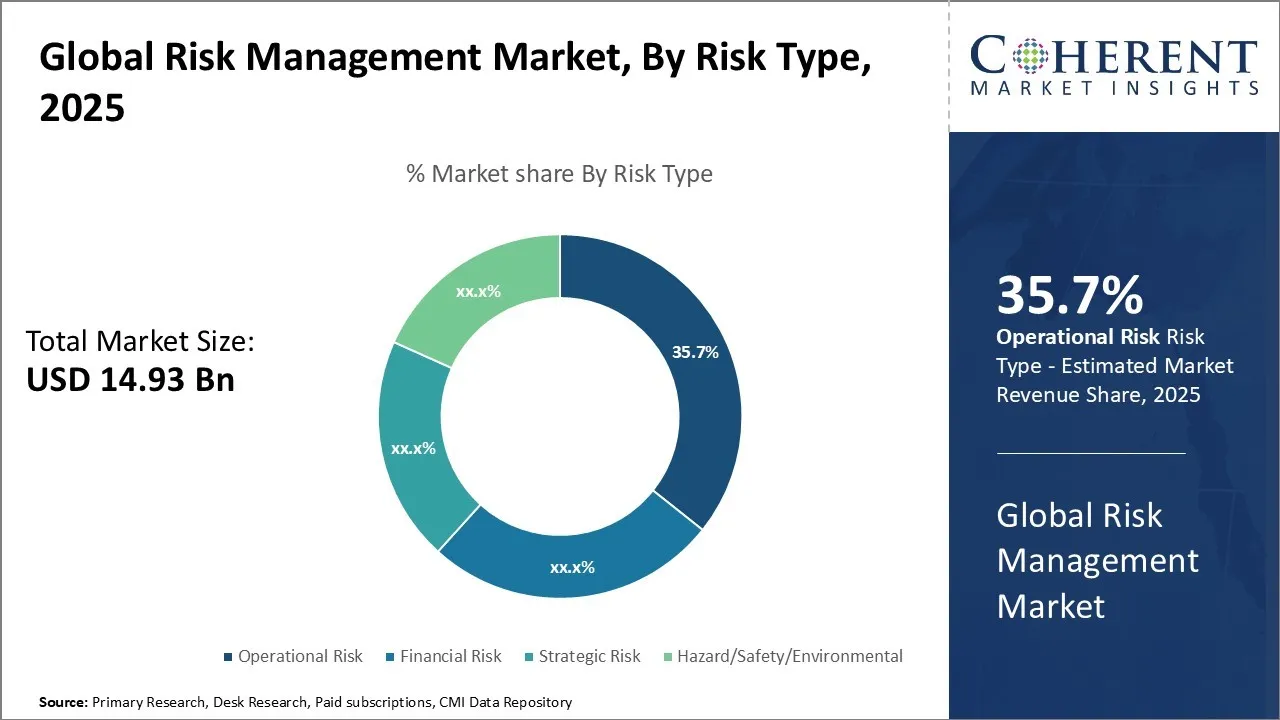
- The operational risk segment leads the market holding an estimated share of 36.7% in 2026.
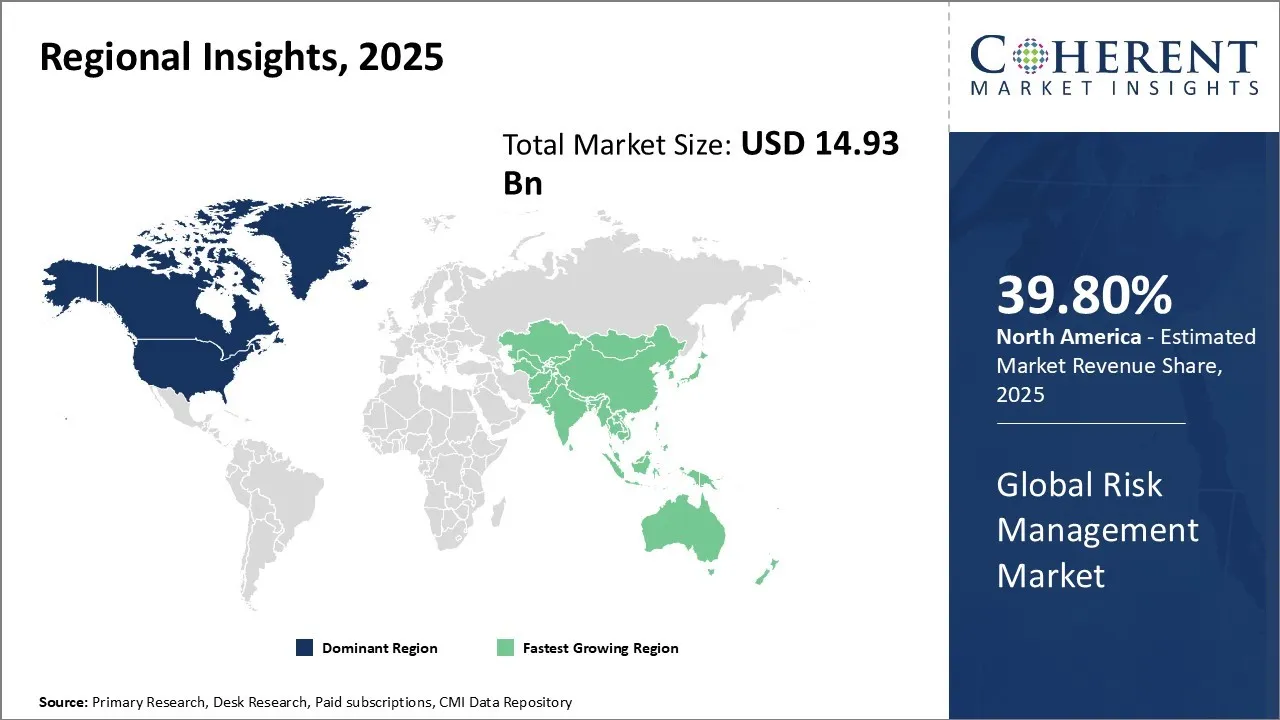
- North America is estimated to lead the market with a share of 39. 8% in 2026.
- Asia Pacific, holding a share of 20. 2% in 2026, is projected to be the fastest growing region.
Market Overview
The market is seeing a rising adoption of advanced technologies such as artificial intelligence, machine learning, and big data analytics within risk management frameworks. These innovations improve predictive capabilities and real-time decision-making, driving efficiency and accuracy. Also, growing regulatory compliance requirements and the increasing frequency of cyber threats are pushing enterprises in different industries to invest in comprehensive risk management systems, adding to market expansion.
Current Events and their Impact
Current Events | Description and its impact |
Geopolitical and Trade Developments |
|
Economic and Infrastructure Trends |
|
Segmental Insights
- Current Industry Events of 2026
- Market Size Estimation
- Regional Breakdown
- Competitive Landscape
- Customer Intelligence
- Segmental Analysis
- Pricing Analysis
- Key Market Drivers, Challenges & Future Trends
- Customized Insights Section
Global Risk Management Market Insights, By Risk Type – Robust Organizational Complexity and Regulatory Compliance Fuel Operational Risk Management Growth
Operational Risk segment is expected to account for the highest share of 36.7% in the market in 2026. Operational risk includes risks arising from internal processes, people, systems, or external events, and its management has become very important as organizations face increasingly complex operational environments. As companies expand their geographical footprint and integrate advanced technologies, the potential for operational failures, system outages, fraud, and human errors rises significantly. Managing these risks effectively requires sophisticated risk management solutions designed to identify, assess, and mitigate operational vulnerabilities before they translate into financial losses or reputational damage.
Another significant factor propelling operational risk management is the heightened regulatory landscape across various sectors such as banking, insurance, and manufacturing. Regulatory authorities worldwide have implemented stringent compliance standards that mandate organizations to establish robust operational risk frameworks. In 2024, Standard Chartered Bank implemented MetricStream’s Operational Risk Management platform across its global operations to unify risk data, enhance incident reporting, and comply with multiple regulatory regimes including the EU’s DORA and the UK’s PRA requirements.
Technological advancements also play a dual role by both increasing operational risk exposure and offering innovative solutions for its management. The growing dependence on digital platforms introduces risks related to cybersecurity breaches, data integrity, and system failures. This catalyzes demand for risk management systems equipped with real-time monitoring, predictive analytics, and automated controls tailored to operational risk.
Impact of Artificial intelligence (AI) on the Risk Management Market
Artificial intelligence (AI) is transforming the risk management landscape by enabling organizations to identify, assess, and mitigate risks with greater speed and accuracy. AI-powered tools can process massive volumes of structured and unstructured data — from financial transactions to social media sentiment — to detect anomalies, predict potential threats, and suggest proactive interventions. This shift from reactive to predictive risk management allows businesses to address issues before they escalate, reducing financial losses and reputational damage. AI also enhances regulatory compliance by automating documentation, monitoring evolving rules, and ensuring that risk reporting meets jurisdiction-specific requirements, which is particularly vital in highly regulated sectors like BFSI and healthcare.
IBM OpenPages with Watson integrates AI-driven natural language processing to help risk managers quickly analyze unstructured text from policies, audit reports, and news sources.
Regional Insights
North America Risk Management Market Analysis and Trends
North America, holding an estimated share 39.80% in 2026, dominates the global risk management market, driven by a mature and highly developed market ecosystem with a strong presence of leading technology firms and financial institutions. The region benefits from robust government regulations mandating comprehensive risk assessment and compliance frameworks, especially in the U.S. and Canada. These regulations, coupled with heightened cybersecurity concerns and the increasing adoption of advanced analytics, foster a favorable environment for risk management solutions.
Key industry players such as IBM, Oracle, and SAP have significant operational bases here, contributing to innovation and extensive deployment of risk management platforms across sectors like banking, insurance, and manufacturing. In 2024, LogicManager, a U.S.-based integrated risk management provider, introduced a generative AI-powered incident reporting assistant designed to help employees quickly log and categorize risk events in natural language. Furthermore, the presence of many multinational corporations headquartered in this region facilitates the widespread integration of risk management solutions, maintaining North America’s leading position.
Asia Pacific Risk Management Market Analysis and Trends
The Asia Pacific region, holding a share of 20.2% in 2026, exhibits the fastest growth in the global risk management market, largely fueled by expanding industrialization, digital transformation initiatives, and growing regulatory attention toward risk and compliance management. Countries like China, India, Japan, and Australia are witnessing the rapid adoption of risk management software, especially for financial risk, operational risk, and compliance management. Government efforts to bolster financial sector stability and encourage technology modernization in banking, energy, and manufacturing sectors have accelerated market traction.
The expanding middle-class consumer base and increased foreign direct investment create a dynamic trade environment, necessitating more sophisticated risk mitigation strategies. Prominent companies such as TCS, Infosys, and Hitachi provide region-specific solutions that help enterprises manage cross-border risks and regulatory compliance effectively. In 2024, MetricStream expanded its operations in Singapore by launching an AI-enabled ESG and operational risk management module tailored for Asia Pacific regulatory frameworks, including MAS operational resilience guidelines and Australia’s CPS 230.
Global Risk Management Market Outlook for Key Countries
U.S. Risk Management Market Analysis and Trends
The U.S. remains the largest and most technologically advanced, driven by stringent government regulations like the Sarbanes-Oxley Act and Dodd-Frank Act, which emphasize transparency and risk control in financial reporting. Key players such as IBM and Oracle have pioneered AI-powered risk management tools widely adopted across financial services, healthcare, and manufacturing sectors. The U.S. market is also characterized by a high degree of digital maturity and investment in cybersecurity risk management, positioning it at the forefront of innovation and application of emerging technologies.
China Risk Management Market Analysis and Trends
China is propelled by its ambitious “Digital China” initiative, focusing on incorporating risk management frameworks into its rapidly expanding banking, fintech, and industrial sectors. Chinese firms like Huawei and Infosys have been instrumental in customizing risk management platforms that align with local regulatory requirements and the unique challenges of managing supply chain and operational risks within the region’s complex business landscape.
Germany Risk Management Market Analysis and Trends
Germany continues to lead Europe’s risk management market with its highly regulated industrial and financial sectors. Strong governmental emphasis on compliance with EU directives such as GDPR and Basel III fosters the widespread adoption of risk solutions. Major companies including SAP and Siemens drive innovation by integrating risk analytics into enterprise resource planning and industrial automation systems.
India Risk Management Market Analysis and Trends
India is rapidly evolving due to digitization efforts by the government under programs like Digital India and initiatives for enhanced financial inclusion. Regulatory frameworks from the Reserve Bank of India have intensified requirements for risk monitoring in banking and non-banking financial institutions. Domestic IT giants like TCS and Wipro play a crucial role in developing scalable and cost-effective solutions, particularly focused on mitigating credit and operational risks. The growing e-commerce and telecom sectors also contribute significantly to rising demand for comprehensive risk management platforms.
U.K. Risk Management Market Analysis and Trends
The U.K. risk management market is strongly influenced by financial services regulation and compliance requirements under both domestic frameworks and EU standards, despite Brexit-related adjustments. London’s status as a global financial hub drives demand for sophisticated risk analytics and governance tools from firms like Experian and FIS. Additionally, enhanced focus on data privacy and anti-money laundering (AML) regulations pushes continuous innovation in risk management solutions. The U.K. market also benefits from a vibrant fintech ecosystem, which encourages agile and technology-driven approaches to risk management across various industries.
Competitive Landscape
Key Developments
- In June 2025, EY announced the launch of new solutions to tackle the complexities of modern risk management in collaboration with NVIDIA. The solutions, EY.ai for Risk, aim to consolidate risk technology and knowledge into a single, cohesive system built on the EY.ai agentic platform.
- In January 2025, Achilles Information Ltd., a global leader in supply chain risk and performance management, acquired the assets of Global Risk Management Solutions (GRMS), a premier provider of supplier risk management programs. The acquisition strengthens Achilles’ position as a global leader in supply chain risk management.
- In October 2024, Prevalent was acquired by Mitratech, a 35-year global leader in legal, risk management, and HR solutions! The move combined Mitratech’s global resources and expertise in legal and risk management with Prevalent’s established TPRM leadership in information security and supplier risk management.
- In July 2023, SAFE, the AI-Driven Cyber Risk Management company, acquired RiskLens, the pioneer of the Cyber Risk Quantification standard – FAIR. By combining RiskLens and SAFE, the two companies are bringing together the world’s most advanced cyber risk quantification based on Factor Analysis of Information Risk (FAIR™), with the world’s most advanced AI-powered automated Cyber Risk Management platform, SAFE.
Top Strategies Followed by Risk Management Market Players
- Established companies dominate the landscape by heavily investing in research and development (R&D) to innovate and deliver high-performance, comprehensive risk management solutions.
- IBM has been investing significantly in enhancing its OpenPages with Watson platform, adding advanced AI and machine learning capabilities to improve predictive risk analytics.
- Mid-level players in the global risk management market adopt a distinct approach focused on balancing quality and affordability to attract price-sensitive customers.
- Resolver, a mid-tier Canadian risk management software provider, introduced a modular subscription pricing model in 2024, allowing smaller enterprises to adopt only the specific risk or incident management modules they need.
- Small-scale players navigate the competitive global risk management market by focusing on niche segments and innovative product features that differentiate them from broader-based competitors.
- Cynopsis Solutions, a Singapore-based regtech startup, focuses exclusively on anti-money laundering (AML) and know-your-customer (KYC) risk management solutions.
Market Report Scope
Risk Management Market Report Coverage
| Report Coverage | Details | ||
|---|---|---|---|
| Base Year: | 2025 | Market Size in 2026: | USD 17.23 Bn |
| Historical Data for: | 2020 To 2024 | Forecast Period: | 2026 To 2033 |
| Forecast Period 2026 to 2033 CAGR: | 15.4% | 2033 Value Projection: | USD 46.96 Bn |
| Geographies covered: |
| ||
| Segments covered: |
| ||
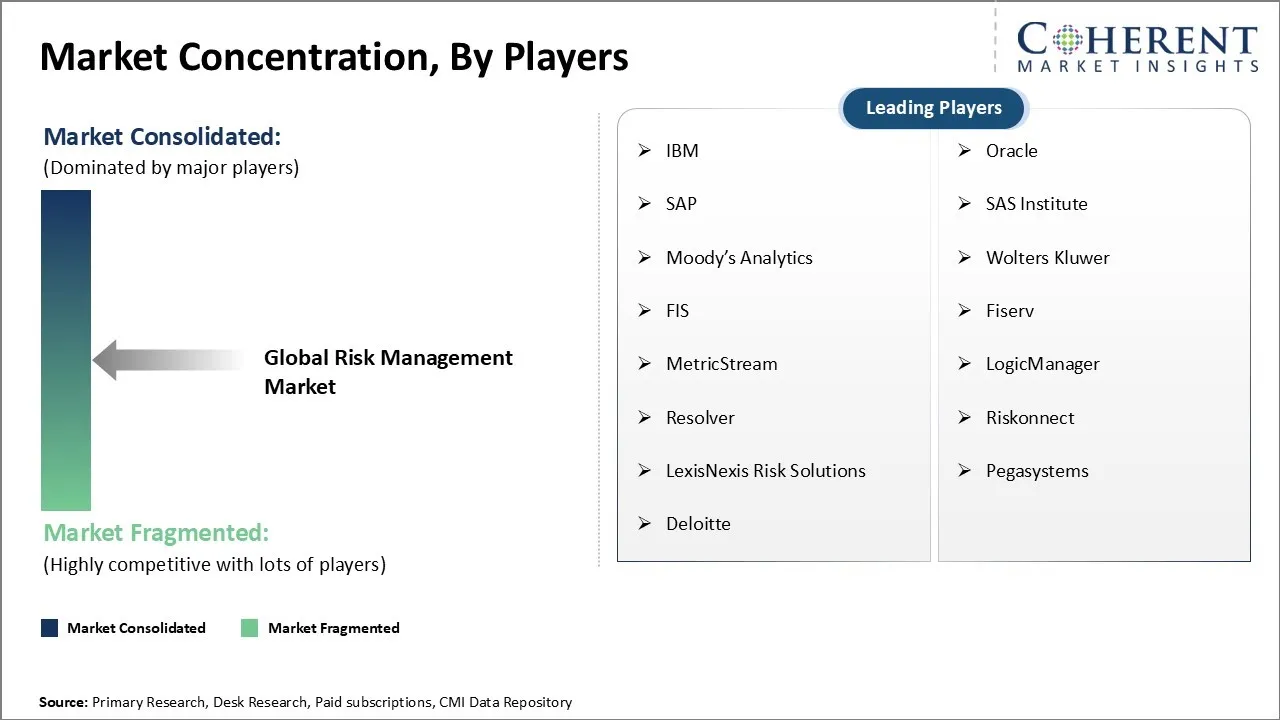
| Companies covered: | IBM, Oracle, SAP, SAS Institute, Moody’s Analytics, Wolters Kluwer, FIS, Fiserv, MetricStream, LogicManager, Resolver, Riskonnect, LexisNexis Risk Solutions, Pegasystems, and Deloitte | ||
| Growth Drivers: |
| ||
| Restraints & Challenges: |
| ||
Market Dynamics
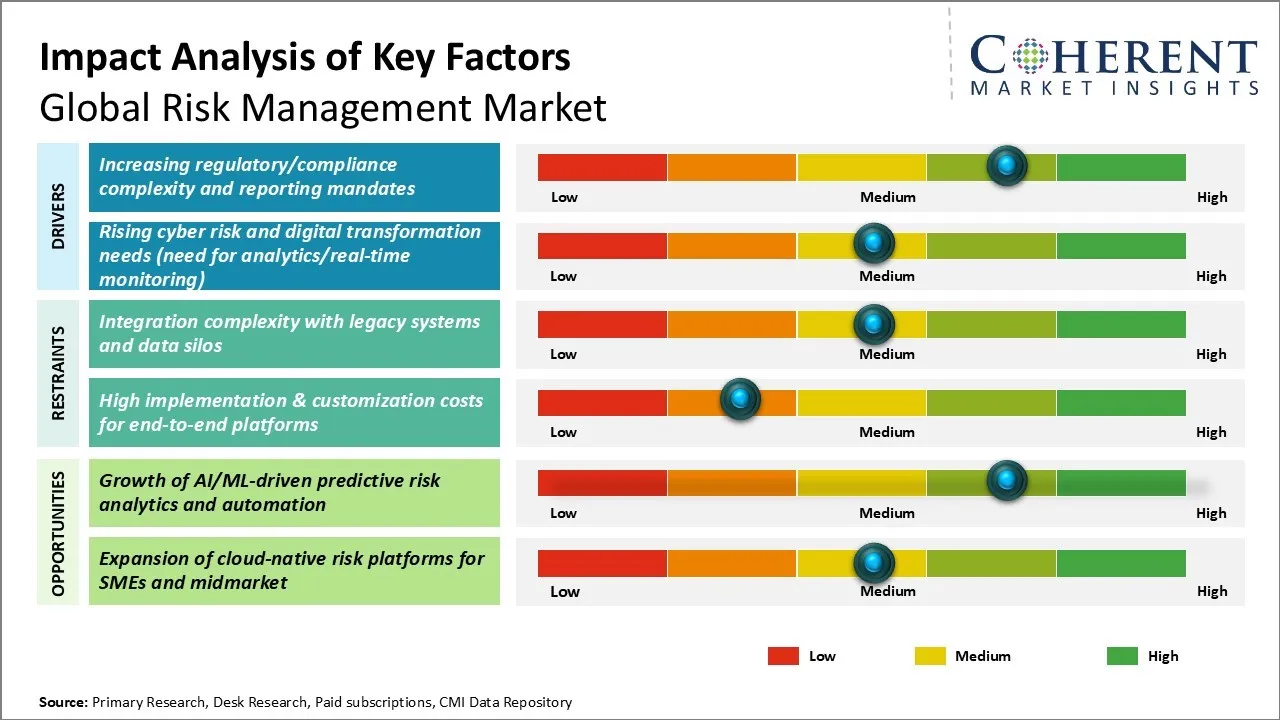
Global Risk Management Market Driver – Increasing Regulatory/Compliance Complexity and Reporting Mandates
Organizations today face an expanding array of compliance requirements related to data privacy, financial reporting, environmental standards, and cybersecurity, which often vary widely by region and sector. For instance, European Union’s Digital Operational Resilience Act (DORA), which came into force in January 2025, requires financial institutions to implement stringent ICT risk management, incident reporting, and operational resilience measures. This escalating complexity compels businesses to adopt advanced risk management solutions to effectively monitor, assess, and respond to multiple overlapping regulations.
Furthermore, regulatory bodies are increasingly mandating detailed and frequent reporting, pushing companies to enhance their risk data collection and analytics capabilities to ensure transparency and timely submissions. Failure to comply can lead to severe financial penalties, reputational damage, and operational disruptions, making regulatory adherence a critical priority.
Global Risk Management Market Opportunity – Growth of AI/ML-Driven Predictive Risk Analytics and Automation
Organizations across industries are increasingly leveraging AI/ML algorithms to enhance their ability to identify, assess, and mitigate risks with greater accuracy and speed. These technologies enable the analysis of vast and complex datasets in real-time, uncovering hidden patterns and emerging threats that traditional risk management approaches might overlook. By automating routine risk assessment tasks, AI/ML solutions reduce human error and free up risk professionals to focus on strategic decision-making. In 2024, Moody’s Analytics launched an AI-based early warning system within its credit risk platform, designed to predict borrower defaults by analyzing large datasets including financial statements, market signals, and macroeconomic trends.
Furthermore, predictive analytics powered by machine learning models facilitate proactive risk management by forecasting potential vulnerabilities and enabling timely interventions. The integration of AI-driven automation also supports regulatory compliance by continuously monitoring changes in regulatory frameworks and adjusting risk parameters accordingly.
Analyst Opinion (Expert Opinion)
- Regulatory bodies worldwide are aligning rules to address risks from emerging technologies such as cloud computing, AI, and blockchain. Frameworks like the EU’s Digital Operational Resilience Act (DORA) and the Monetary Authority of Singapore’s Technology Risk Management Guidelines are pushing enterprises to integrate technology-specific compliance features directly into their risk platforms.
- With the EU AI Act and proposed U.S. AI governance policies, organizations must incorporate AI risk assessments, bias detection, and explainability mechanisms into their operational processes. This trend is driving adoption of AI governance modules within integrated risk management systems to ensure that AI/ML-driven use-cases meet transparency and accountability standards.
- Industries adopting advanced technologies — such as IoT-enabled manufacturing, digital banking, and telemedicine — face sector-focused regulations (e.g., HIPAA for healthcare IoT data, PSD2 for open banking). This has created a growing need for domain-specialized risk solutions that map technology-driven use-cases to relevant compliance controls.
Speak to the analyst
Want personalized insights?
Take the findings above to one of our principal consultants, or have the report rebuilt around the segments, geographies and competitors you actually track.
Market Segmentation
- Risk Type Insights (Revenue, USD Bn, 2021 - 2033)
- Operational Risk
- Financial Risk
- Strategic Risk
- Hazard/Safety/Environmental
- Regional Insights (Revenue, USD Bn, 2021 - 2033)
- North America
- U.S.
- Canada
- Latin America
- Brazil
- Argentina
- Mexico
- Rest of Latin America
- Europe
- Germany
- U.K.
- Spain
- France
- Italy
- Russia
- Rest of Europe
- Asia Pacific
- China
- India
- Japan
- Australia
- South Korea
- ASEAN
- Rest of Asia Pacific
- Middle East
- GCC Countries
- Israel
- Rest of Middle East
- Africa
- South Africa
- North Africa
- Central Africa
- North America
- Key Players Insights
- IBM
- Oracle
- SAP
- SAS Institute
- Moody’s Analytics
- Wolters Kluwer
- FIS
- Fiserv
- MetricStream
- LogicManager
- Resolver
- Riskonnect
- LexisNexis Risk Solutions
- Pegasystems
- Deloitte
Sources
Primary Research Interviews
Stakeholders
- C-level Executives and Risk Officers from Financial Institutions (e.g., Chief Risk Officers, Compliance Heads)
- IT Security and Cyber Risk Managers from large enterprises
- Risk Solution Vendors and GRC Software Providers
- Consultants from Big Four and mid-tier advisory firms specializing in risk management implementation
- Regulatory Experts and Compliance Officers from industry regulators
- Insurance and Reinsurance Risk Assessors (focusing on operational and cyber risk coverage)
- ESG and Sustainability Risk Analysts (if focusing on environmental and social risk factors)
Databases
- World Bank DataBank
- U.S. Securities and Exchange Commission (SEC) Filings Database
- Asia-Pacific Financial Regulatory Authority Reports
- OECD Statistics Portal
- UNCTAD Investment & Risk Reports
Magazines
- Risk Management Magazine
- CFO Magazine
- Enterprise Risk Management Insights
- Chief Executive Magazine (Risk Section)
Journals
- Journal of Risk and Financial Management
- International Journal of Risk Assessment and Management
- Computers & Security Journal
- Business Horizons (Risk and Strategy Section)
Newspapers
- The Wall Street Journal (Risk & Compliance Section)
- Financial Times (FT)
- The Economic Times (India) – Risk & Governance Section
- The Straits Times (Singapore) – Business Risk Coverage
Associations
- Risk Management Society (RIMS)
- Global Association of Risk Professionals (GARP)
- Institute of Risk Management (IRM)
- International Compliance Association (ICA)
- Information Systems Audit and Control Association (ISACA)
Public Domain Sources
- U.S. Census Bureau
- EUROSTAT
- United Nations Economic Commission for Europe (UNECE)
- World Bank
- ResearchGate
Proprietary Elements
- CMI Data Analytics Tool, Proprietary CMI Existing Repository of information for last 8 years
Get access to 250+ pages report
Every segment, forecast, competitor profile and data table behind the analysis above — available for instant download.
- ESOMAR Member
- ISO 9001:2015 Certified
- D-U-N-S Registered
- GDPR & CCPA Compliant
Missing comfort of reading report in your local language? Find your preferred language:
Transform your Strategy with Exclusive Trending Reports
Frequently Asked Questions
The global risk management market is estimated to be valued at USD 17.23 Bn in 2026 and is expected to reach USD 46.96 Bn by 2033.
The CAGR of global risk management market is projected to be 15.4% from 2026 to 2033.
Increasing regulatory/compliance complexity and reporting mandates and rising cyber risk and digital transformation needs (need for analytics/real-time monitoring) are the major factors driving the growth of the global risk management market.
Integration complexity with legacy systems and data silos and high implementation & customization costs for end-to-end platforms are the major factors hampering the growth of the global risk management market.
In terms of Risk Type, Operational Risk segment is estimated to dominate the market revenue share in 2026.
IBM, Oracle, SAP, SAS Institute, Moody’s Analytics, Wolters Kluwer, FIS, Fiserv, MetricStream, LogicManager, Resolver, Riskonnect, LexisNexis Risk Solutions, Pegasystems, and Deloitte are the major players.
North America is expected to lead the global risk management market in 2026.