

Global Nylon 6 Market Size and Forecast – 2026 to 2033
The Global Nylon 6 Market is estimated to be valued at USD 18.50 Bn in 2026 and is expected to reach USD 29.13 Bn by 2033, reflecting a compound annual growth rate (CAGR) of 6.7% from 2026 to 2033.
Key Takeaways of the Nylon 6 Market
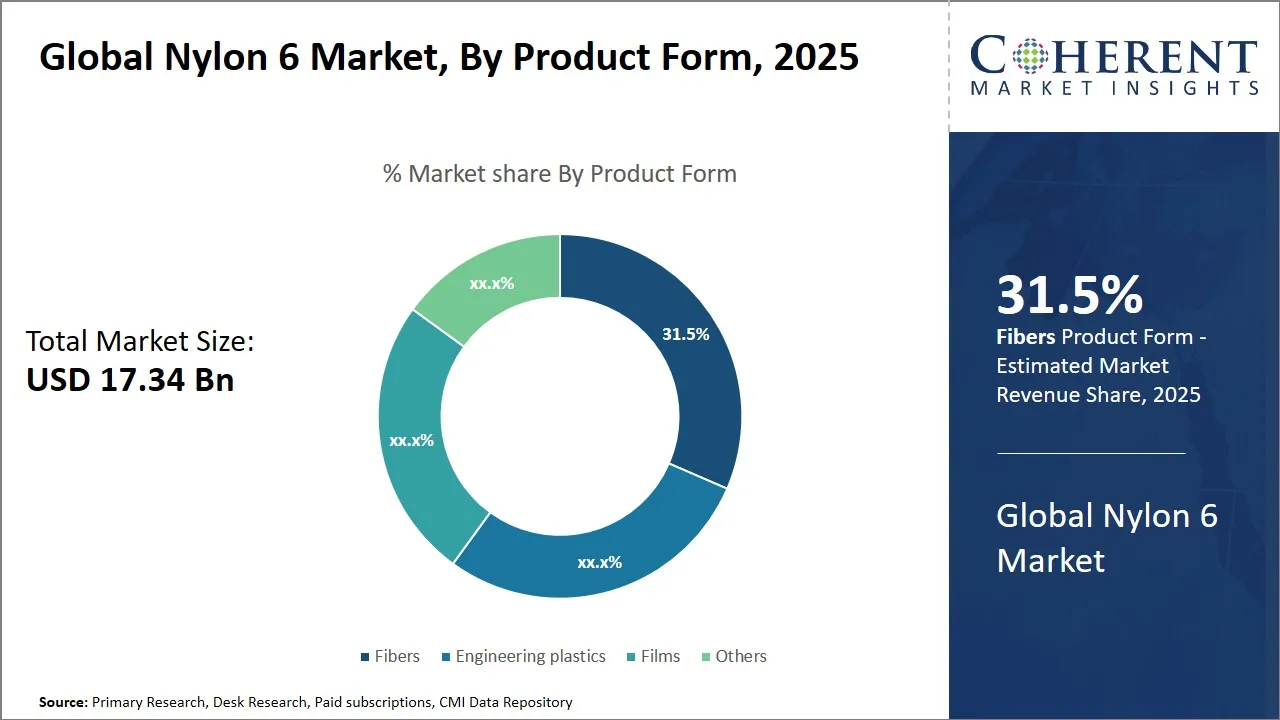
- Fibers segment is estimated to account for 32.5% of the global nylon 6 market share in 2026.
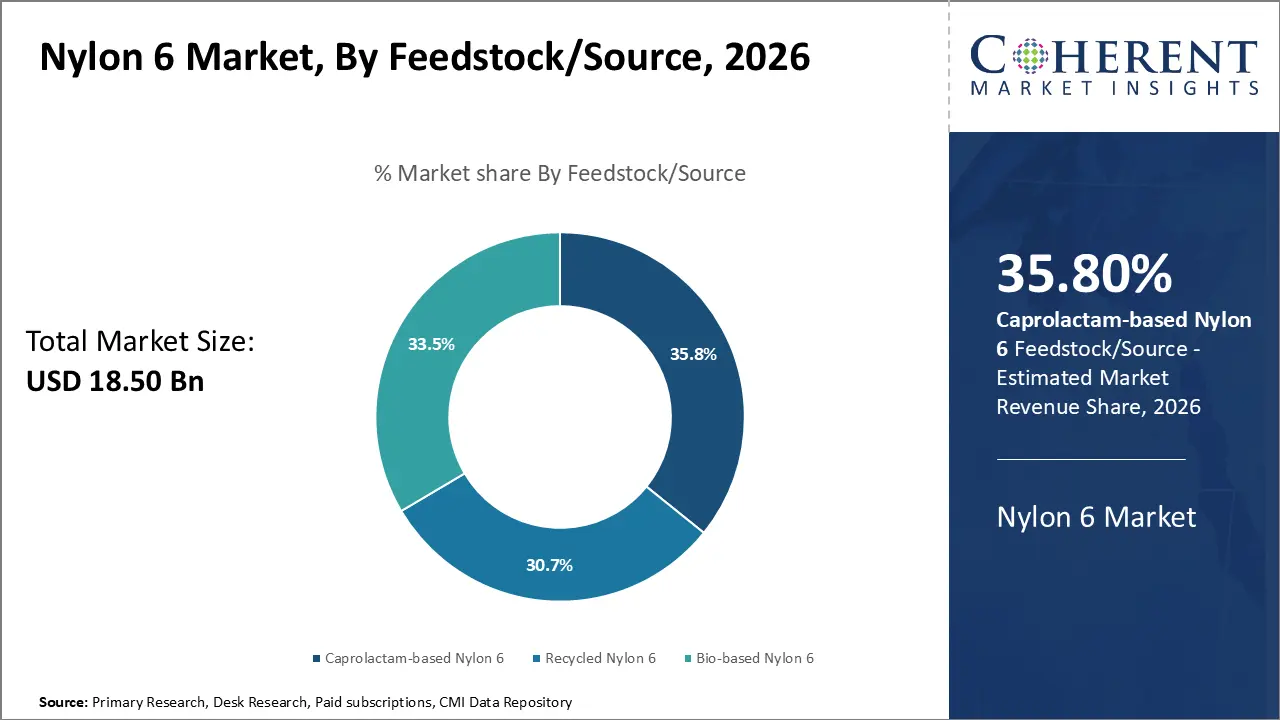
- The Caprolactam-based Nylon 6 segment is expected to account for 35.8% of the market share in 2026.
- The automotive segment is projected to hold 28.7% of the nylon 6 market share in 2026.
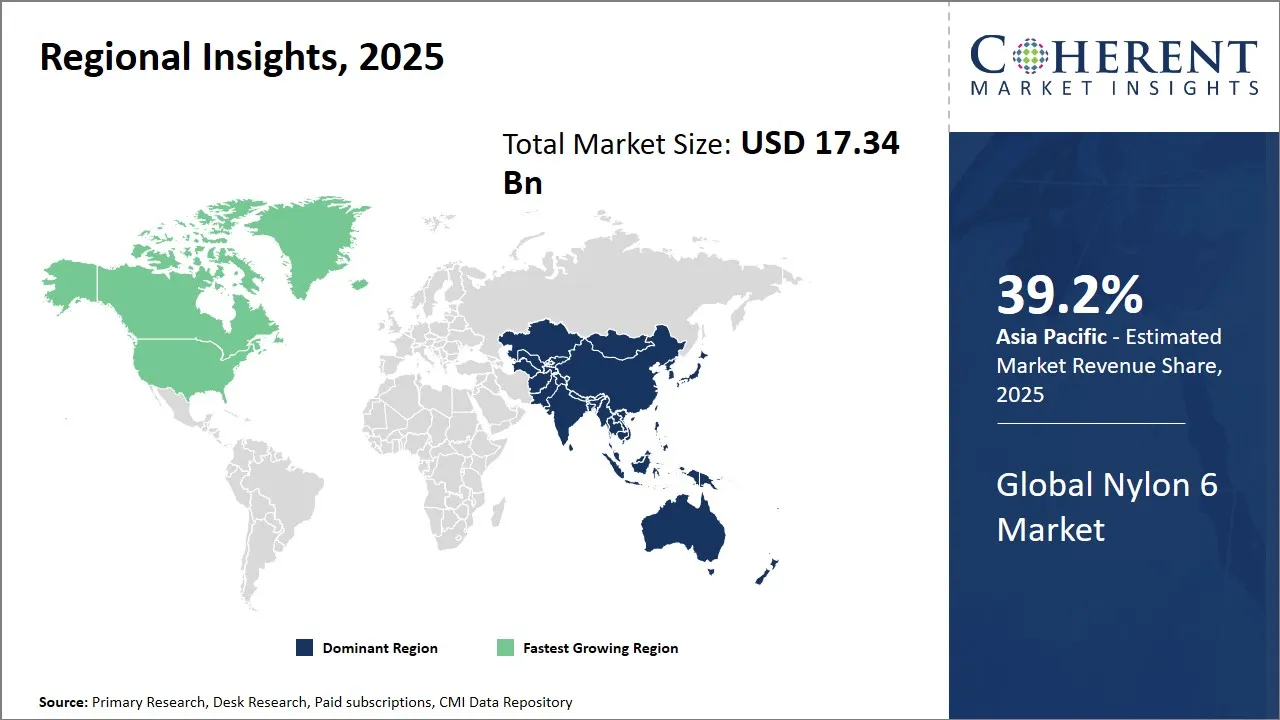
- Asia Pacific will lead the nylon 6 market in 2026 with an estimated 39.2% share.
- North America will account for 17.3% share in 2026 and record the fastest growth.
Market Overview
- The market trend for nylon 6 highlights a shift towards sustainable and eco-friendly production processes, with manufacturers investing in bio-based raw materials and recycling technologies.
- Additionally, advancements in polymerization catalysts techniques are enhancing product performance, opening new application avenues. The rising emphasis on lightweight and high-strength materials in automotive and industrial sectors further accelerates nylon 6 adoption.
- This trend reflects growing environmental awareness and the need for materials combining strength with sustainability.
Currents Events and Its Impacts
Current Events | Description and its Impact |
Updated EU PFAS restriction process (textiles, processing aids, additives) |
|
China caprolactam capacity additions (new projects coming online) |
|
Segmental Insights
- Current Industry Events of 2026
- Market Size Estimation
- Regional Breakdown
- Competitive Landscape
- Customer Intelligence
- Segmental Analysis
- Pricing Analysis
- Key Market Drivers, Challenges & Future Trends
- Customized Insights Section
Why Does Fibers Dominate the Nylon 6 Market in 2026?
Fibers segment is expected to hold 32.5% of the global nylon 6 market share in 2026, due to their extensive usage across multiple industries such as textiles, automotive, and industrial sectors. Among the major reasons that have contributed to the increased growth of nylon 6 fibers is the fact that it possesses great mechanical strength besides the high level of elasticity and resistance to abrasion. These qualities make nylon 6 fibers the best choice when it comes to production of strong textiles, high-performance industrial products, as well as technical fabrics. Nylon 6 fibers possess the property of structural integrity when they are placed under stress and hence manufacturers can incorporate them in products that need flexibility as well as toughness.
Nylon 6 fiber is also used in automotive airbags and seatbelt webbing because it has high energy absorption and tear strength when subjected to sudden loads. This app on its own secures long-term OEM demand because it is impossible to reduce material performance through safety components unless there are regulatory and liability risks.
Why Does Caprolactam-Based Nylon 6 Dominate the Nylon 6 Market?
The Caprolactam-based Nylon 6 segment is projected to hold 35.8% of the nylon 6 market share in 2026, due to the advancement and well-developed production process that guarantees uniform quality and performance of the material. The most important chemical intermediate, which is called caprolactam, is produced based on petrochemical feeds and the large-scale industrial synthesis paths have been developed throughout decades, offering manufacturers with a stable supply chain and inexpensive manufacturing.
Nylon 6, which is made of caprolactam, is a good blend of various properties such as good mechanical strength, high thermal stability and chemical stability. These features have seen it being the favorite in application in many disciplines, automotive parts to consumer products. The elegized polymerizing process provides the Nylon 6 with homogenous molecular weight distribution that translates to predictability and stability of the end-products qualities a very important factor in the applications that demand accuracy and stability.
Automotive Dominates the Global Nylon 6 Market
The automotive segment is expected to represent 28.7% of the nylon 6 market share in 2026, propelled by the increasing emphasis on vehicle weight reduction, fuel efficiency, and enhanced performance standards. Nylon 6 has high mechanical strength, thermal stability, wear and chemical resistance that it cannot be substituted by traditional metals and other heavier polymers to be used in the automotive industry.
The automotive components like gears, bearings, fuel lines and interior parts are also being produced with Nylon 6 as well as in its compounded forms because it has the capability of withstanding the rough operating conditions. The lightweight feature also comes with a direct impact of reducing the total weight of the vehicle to enhance fuel efficiency and minimize emissions which are major factors considering the strict international regulatory systems that are also aimed at ensuring fuel sustainability and environmental sustainability.
Regional Insights
Asia Pacific Nylon 6 Market Analysis and Trends
The Asia Pacific region is projected to lead the market with a 39.2% share in 2026, due to its robust manufacturing base, extensive raw material availability, and strong demand from end-use industries such as automotive, textiles, electronics, and packaging. The location also has the advantage of having established chemical centers in China, India, Japan, and South Korea which are assisted by the government in the effort to strengthen the chemical and polymers industry.
The supply chain ecosystem is strengthened by favorable trade policies and free trade agreements which support easy trade of raw materials and finished goods in the region. Such key players as China National Chemical Corporation (ChemChina), Toray Industries (Japan), and BASF India (member of the world-renowned BASF group) are constantly engaged in capacity building and research and development investment. Their quest to come up with high-performance and environmentally-friendly Nylon 6 versions enhance the regions leadership.
North America Nylon 6 Market Analysis and Trends
The North America region is expected to exhibit the fastest growth in the market contributing 17.3% share in 2026, driven by technological advancements and rising demand in automotive lightweighting, aerospace applications, and high-performance textiles. Advanced polymer research and application development is supported by the high industrial environment in the region supported by the innovation centers such as the U.S and Canada.
Sustainable manufacturing policies, strict environmental regulations in the government stimulate the use of the environmentally friendly nylon 6 products and recycling technology. The key industry rivalry players like DuPont, Ascend Performance Materials, and Solvay have adopted the best production technologies and alliances to satisfy the changing market demands, especially in industries that focus on long lifestyles and sustainability.
Global Nylon 6 Market Outlook for Key Countries
China Nylon 6 Market Trends
The China nylon 6 market is a strong force considering that it has enormous production plants and the continuous investments it is making in infrastructure. Domestic manufacturers such as ChemChina and Shanghai Petrochemical have increased their capacities to satisfy the domestic and export markets. The government of China has a positive policy towards the chemical industry by giving subsidies and innovation grants to the chemical industry to produce advanced polymer, and to be environmentally sustainable. The flourishing textile and automobile industries drive a need in the Nylon 6 fibers and engineering plastics and the rising export to the emerging market thwarts the Chinas strategic location in the global supply chain.
Is the U.S. Emerging as a Global Innovation Hub for the Nylon 6 Market?
The U.S. nylon 6 market takes advantage of the trend in innovation and sustainability, as the industry leaders, including DuPont and Ascend Performance Materials, move forward with the product development. Much concentration is paid to the creation of the bio-based and recycled nylon 6 materials that react to the demands of consumers and regulators. The auto markets that are moving towards lightweight and hardy materials drive the application of nylon 6 in under-hood parts and interiors. Green chemistry and other incentives offered by the government strengthens investment in the new methods of polymerization of nylon 6 that will be used in the forthcoming generation, which places the U.S. as a technological force in the world market.
Germany Nylon 6 Market Trends
The nylon 6 market in Germany has the advantage of having a well-developed industrial base especially in the manufacture of automobiles and machinery, where nylon 6 is an important material used in high performance. Such companies as Covestro and BASF have large-scale production and research facilities, and their goal is on the efficiency of materials and sustainability. The strict environmental requirements put forth by the governments promote a greater use of recyclable and bio-based products of nylon 6. The end-use innovation and importation compliance of nylon 6 remove its consistent demand in Germany’s well-integrated chains of supply and its export orientation.
Is India Positioning Itself as a High-Growth Manufacturing Hub for the Nylon 6 Market?
The market of nylon 6 in India is developing at a high pace on the basis of the growing textile, automotive and packaging industries. The push towards Make in India and the development of better chemical manufacturing infrastructure by the countries also helps to attract the interest of such global giants as Reliance Industries and BASF India. The government policies promote capacity building and technological adoption to lower the level of dependence on imports. Market growth is driven by the increasing domestic consumption, which is accompanied by the increasing exports to Asia Pacific, Africa, and the Middle East. Sustainability and principles of a circular economy are taking more ground, and manufacturers are looking at recycled nylon 6 and environmentally friendly manufacturing techniques.
Japan Nylon 6 Market Trends
Japan is a prime competitor in nylon 6 because it leads in high-tech materials and synthetic fibers. Firms like Toray industries and Mitsubishi chemical keep advancing on high-performance and specialty nylon 6 products employed in electronics and automotive as well as in industrial applications. Focus on the value of being precise in manufacturing and also sustainable to the environment works towards the creation of lightweight, strong, and recyclable nylon 6 products. The efforts of the government in regard to green technologies and industrial cooperation plans also contribute to an increase in the competitiveness of Japan in the international market.
Disruption Risk Mapping
Risk Dimension
| Indicators Used | Nylon 6 Impact Logic |
Geopolitical Risk | Export controls, sanctions exposure, regional instability | Disrupts caprolactam exports, delays Nylon 6 polymer production |
Energy & Feedstock Risk | Benzene price volatility, energy intensity | Directly inflates Nylon 6 resin and fiber costs |
Operational Risk | Plant age, shutdown frequency, unplanned outages | Sudden shortages propagate downstream within weeks |
Market Players, Key Development, and Competitive Intelligence
Key Developments
- In September 2025, Samsara Eco, an Australia-based biotech company, launched its inaugural plant in Jerrabomberra, New South Wales, to produce low-carbon, virgin-quality recycled materials such as nylon 6, and polyester. The facility utilizes the company's enzymatic recycling technology, EosEco, which leverages AI-designed enzymes to break down mixed plastics into reusable raw materials. This innovation enables brands to incorporate sustainable materials into their products. The plant also features expanded enzyme production and AI-powered enzyme discovery capabilities, positioning Samsara Eco to develop recycling solutions for a wider range of plastics.
- In October 2025, Industrial biomanufacturing technology leader Genomatica ("Geno") today announced that it has entered into a new partnership with Sojitz Corporation ("Sojitz") to significantly accelerate the commercialization of plant-based nylon-6 based on Geno's underlying proprietary technology. Sojitz has made a strategic financial investment to accelerate time-to-market, while also contributing its commercial and business expertise. Nylon-6 is one of the most widely used materials in the world. Traditionally produced from fossil-derived carbon sources or recycled materials, it can be found in a broad range of everyday products including outdoor gear, apparel, military materials, and automotive components. Geno's proprietary technology enables 100% renewable carbon-based nylon-6.
- In March 2025, BASF starts production of recycled nylon 6 in China. The production facility in China has started up the commercial-scale manufacture of GRS-certified recycled nylon 6 polymers from industrial textile waste. BASF has started up commercial production of its GRS-certified recycled nylon 6 polymer at a 500 metric tons per year facility in Shanghai, China.
Top Strategies Followed by Global Nylon 6 Market Players
Player Type | Strategic Focus | Example |
Established Market Leaders | Heavy investment in R&D and innovation | BASF, Lanxess, UBE Corporation and Toray industries are constantly upgrading polymer chemistry to provide high performance grades on automotive, E&E and industrial usage. They apply to BASFs emphasis on lightweight, heat-ductile Nylon 6 mobility use and Lanxesss superior engineering plastics that are specifically engineered in automobile under-the-hood parts. |
Mid-Level Players | Cost-effective solutions with balanced quality | DOMO Chemicals stands in a strong position to compete in the segment of textiles and industrial yarns by providing consistent grades of Nylon 6 on a large scale, whereas AdvanSix can take advantage of backward integration in caprolactam to manage the bottom line. |
Small-Scale Players | Niche specialization & innovative variants | Regional producers and specialty compounders are gaining the invention of bio-based Nylon 6, custom polymer blends and application-oriented grades to electronics enclosures, specialty fibers or sustainability-oriented brands. These may include niche compounders in Europe and Asia Pacific that provide tailored Nylon 6 compositions with particular flame retardancy, flexibility or recyclability characteristics to particular OEM. |
Market Report Scope
Nylon 6 Market Report Coverage
| Report Coverage | Details | ||
|---|---|---|---|
| Base Year: | 2025 | Market Size in 2026: | USD 18.50 Bn |
| Historical Data for: | 2020 To 2024 | Forecast Period: | 2026 To 2033 |
| Forecast Period 2026 to 2033 CAGR: | 6.7% | 2033 Value Projection: | USD 29.13 Bn |
| Geographies covered: |
| ||
| Segments covered: |
| ||
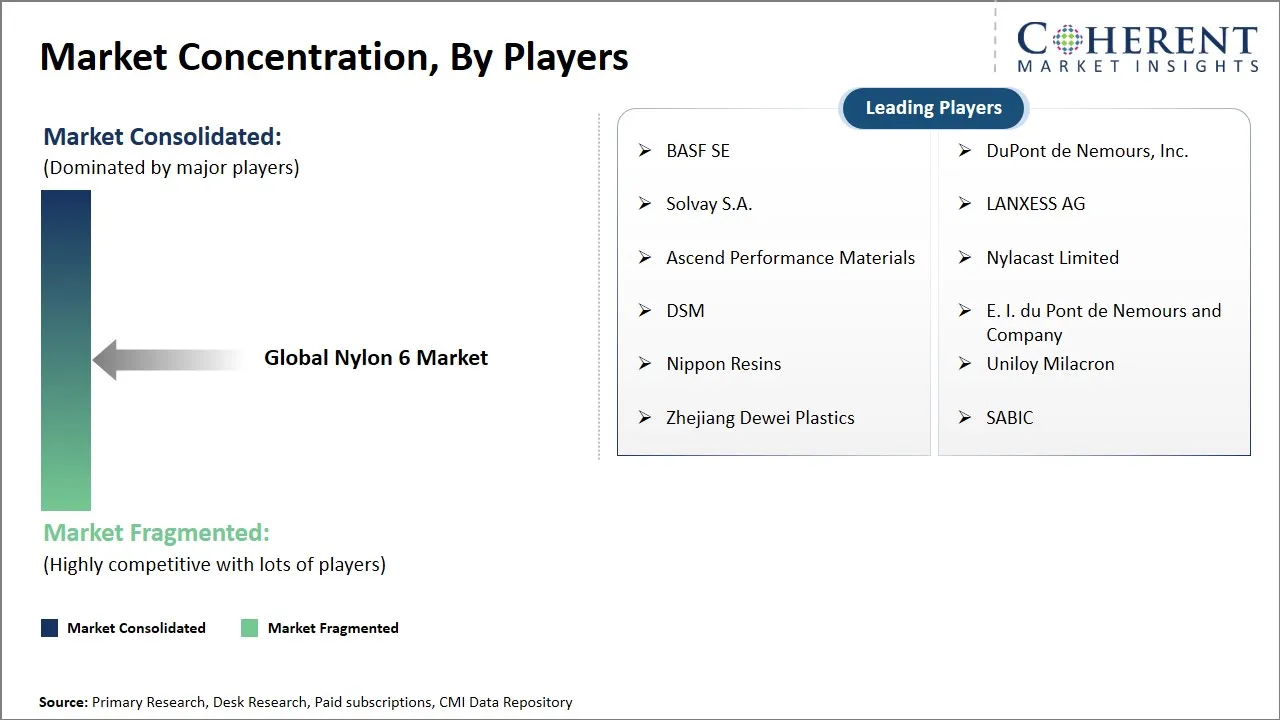
| Companies covered: | BASF SE, DuPont de Nemours, Inc., Solvay S.A., LANXESS AG, Ascend Performance Materials, Nylacast Limited, DSM, E. I. du Pont de Nemours and Company, Nippon Resins, Uniloy Milacron, Zhejiang Dewei Plastics, and SABIC | ||
| Growth Drivers: |
| ||
| Restraints & Challenges: |
| ||
Nylon 6 Market Dynamics
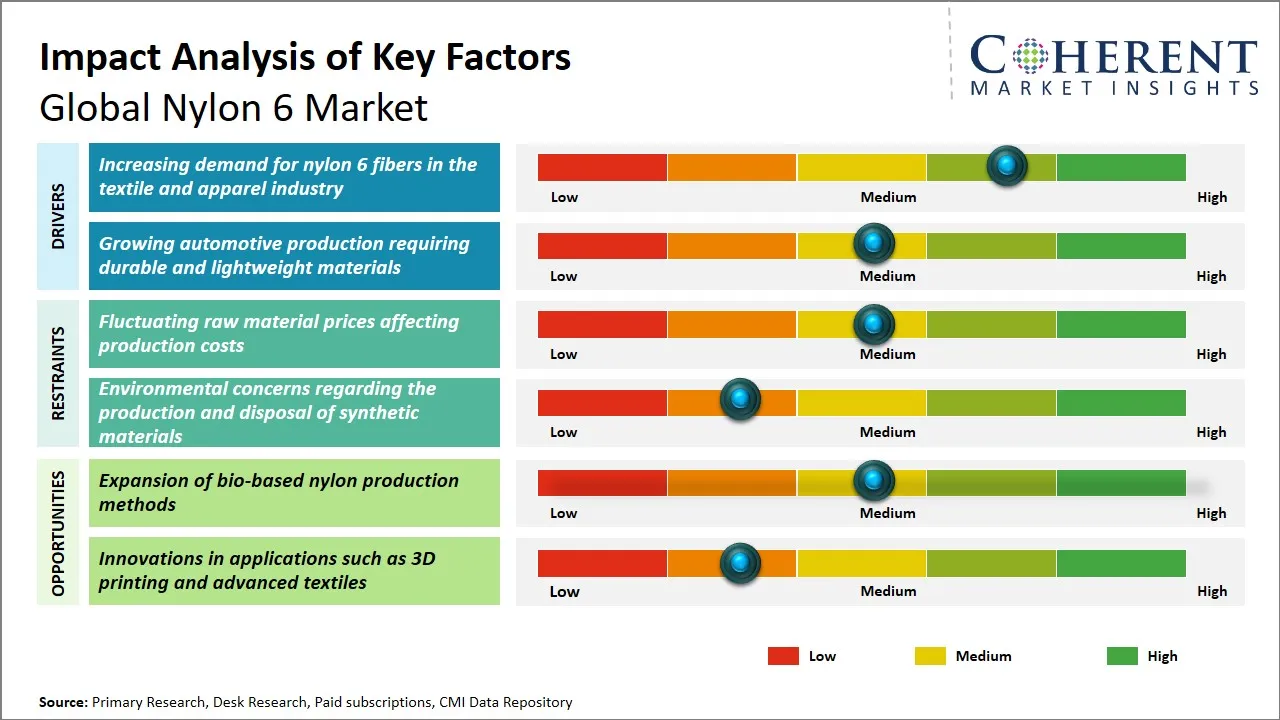
Nylon 6 Market Driver - Increasing Demand for Nylon 6 Fibers in the Textile and Apparel Industry
The escalating demand for nylon 6 fibers within the textile and apparel sector is a significant driver propelling the growth of the global nylon 6 market. Nylon 6, known for its exceptional strength, elasticity, and abrasion resistance, has become a preferred material in manufacturing high-performance fabrics used in sportswear, activewear, and outerwear. Its moisture-wicking properties and durability cater to consumers’ increasing preference for functional and long-lasting garments.
Additionally, advances in fiber technology have enhanced nylon 6’s versatility, enabling its use in blends with other fibers to improve fabric quality and comfort. The fashion industry’s shift towards producing lightweight yet robust materials further accentuate the demand for nylon 6 fibers.
For example, Hyosung Advanced Materials and Toray Industries have expanded nylon 6 textile-grade fiber capacities to meet rising demand from sportswear and fast-fashion brands, particularly in Asia Pacific and Europe. Carpet and hosiery segments also remain volume anchors, with nylon 6 dominating premium carpets and sheer stockings due to resilience and dye affinity.
Nylon 6 Market Opportunity - Expansion of Bio-Based Nylon Production Methods
The global nylon 6 market presents a significant opportunity through the expansion of bio-based nylon production methods, driven by increasing environmental concerns and stringent regulatory frameworks aimed at reducing carbon emissions. The conventional method of producing nylon 6 is very much dependent on petroleum based feedstocks which cause environmental decline and unstable prices of raw materials. Manufacturers are in turn responding by investing on innovative bio-based technologies that use renewable resources like castor oil, plant-based sugars and other biomass derivatives to create nylon intermediates like bio-caprolactam. This will not only conform to the global sustainability, but will also appeal to consumer needs of eco-friendly and biodegradable plastics materials.
For example, BASF is investing in bio-mass balance and renewable feedstock integration for polyamides, including Nylon 6, enabling customers to claim reduced Scope 3 emissions without changing material performance.
Analyst Opinion (Expert Opinion)
- Nylon 6 market is showing a commendable growth owing to the growing demands of durable and multi-purpose materials in the numerous application sectors especially the automotive and textile sectors. The Nylon and Polyamide Conference (2023) and the Global Plastics Summit (2022) have shed light on the area of major innovations, with the companies such as BASF and Invista on the forefront of advancing the technology of nylon fibers. Recent introduction of a new brand of Nylon 6 by Invistas which uses recycled materials is an excellent representation of how the industry is interested in ensuring sustainability and addressing consumer needs of environmentally friendly products.
- The meetings held in these conferences highlighted the increasing trend of lightweight materials in the design of automobiles in a bid to enhance their fuel efficiency, which additional fueled the nylon 6 demand. Nevertheless, difficulties like the change in prices of raw materials and the presence of bio-based alternatives were also often cited as the factors that could hinder the growth.
- Businesses that aim at the improvement of thermal properties, mechanical properties, and Nylon 6 as well as investing in the future sustainable production processes will probably gain a competitive advantage. In the end, the market of the nylon 6 will depend on the capacity to create constantly, and it will be associated with the changing demands of the industries that are oriented on the performance and sustainability in terms of the material choice.
Speak to the analyst
Want personalized insights?
Take the findings above to one of our principal consultants, or have the report rebuilt around the segments, geographies and competitors you actually track.
Market Segmentation
- Product Form Insights (Revenue, USD Bn, 2021 - 2033)
- Fibers
- Staple fibers
- Filament yarns
- Industrial yarns
- Engineering plastics
- Compounded Nylon 6
- Unfilled Nylon 6
- Films
- Biaxially Oriented Nylon (BOPA) films
- Cast Nylon films
- Others
- Feedstock / Source Insights (Revenue, USD Bn, 2021 - 2033)
- Caprolactam-based Nylon 6
- Recycled Nylon 6
- Bio-based Nylon 6
- Application Insights (Revenue, USD Bn, 2021 - 2033)
- Automotive
- Engineering Plastics
- Electronics & Electrical
- Textiles
- Consumer Goods
- Others
- Regional Insights (Revenue, USD Bn, 2021 - 2033)
- North America
- U.S.
- Canada
- Latin America
- Brazil
- Argentina
- Mexico
- Rest of Latin America
- Europe
- Germany
- U.K.
- Spain
- France
- Italy
- Russia
- Rest of Europe
- Asia Pacific
- China
- India
- Japan
- Australia
- South Korea
- ASEAN
- Rest of Asia Pacific
- Middle East
- GCC Countries
- Israel
- Rest of Middle East
- Africa
- South Africa
- North Africa
- Central Africa
- North America
- Key Players Insights
- BASF SE
- DuPont de Nemours, Inc.
- Solvay S.A.
- LANXESS AG
- Ascend Performance Materials
- Nylacast Limited
- DSM
- E. I. du Pont de Nemours and Company
- Nippon Resins
- Uniloy Milacron
- Zhejiang Dewei Plastics
- SABIC
Sources
Primary Research Interviews
- Primary Research Interviews
- CEO – Leading Nylon 6 Producer (e.g., BASF SE or AdvanSix equivalent)
- Supply Chain Director – Major Nylon 6 Distributor
- Production Lead – Specialty Nylon 6 Compounds Manufacturer
- Sustainability Officer – Nylon Polymer Certification Authority
Stakeholders
- Manufacturers
- End-use Sectors
- Automotive Industry (Engine Components, Gears)
- Textiles & Fibers Producers
- Electrical & Electronics (Connectors, Housings)
- Packaging & Films
- Regulatory & Certification Bodies (e.g., EPA for polyamides, REACH compliance in EU)
- E-commerce Platforms and Retailers (Alibaba, Industrial Suppliers, Sigma-Aldrich)
- Technology Integration Players: Advanced engineering plastics and filament yarn producers using nylon 6
Databases
- UN Comtrade Database (HS Code for Polyamides including Nylon 6)
- India Import Export (EXIM) Database
- USGS Mineral Commodity Summaries (related polymers where applicable)
- Eurostat Trade Statistics for Chemicals (Nylon 6 granulate)
Magazines
- Chemical Processing Magazine – Trends in nylon polymers supply
- Plastics Today – Nylon 6 in engineering plastics innovations
- Textile World – Applications in nylon 6 filament yarns
- Industrial Minerals – Market dynamics for nylon 6
- Automotive News – Nylon 6 use in vehicle lightweighting
Journals
- Journal of Materials Science – Nylon 6 in durability and composites
- Resources Policy – Global nylon supply chain analysis
- Journal of Hazardous Materials – Environmental impact of nylon processing
- Polymer Engineering & Science – Synthesis and purification of nylon 6
- Minerals Engineering – Feedstock extraction for caprolactam
Newspapers
- The Wall Street Journal – Global demand for nylon compounds
- The Guardian – Sustainability in nylon production
- Business Standard (India) – Nylon 6 imports and Asia market growth
- Chemical Week – Supply disruptions in nylon production
- Reuters – Price volatility in polyamides like nylon 6
Associations
- International Polyamide Association (or equivalent)
- Nylon Producers Group
- Society of Plastics Engineers
- Automotive Plastics Division
- European Chemical Industry Council (Cefic)
- Green Chemistry Institute
Public Domain Sources
- EPA – Guidelines for polyamide compounds handling
- European Commission – REACH regulations on nylon 6
- World Health Organization – Safety standards for polymer exposure
- USGS – Polymer trade assessments
- OECD – Chemical trade and sustainability reports for nylon
Proprietary Elements
- CMI Data Analytics Tool
- Proprietary CMI Existing Repository of information for last 8 years.
Get access to 250+ pages report
Every segment, forecast, competitor profile and data table behind the analysis above — available for instant download.
- ESOMAR Member
- ISO 9001:2015 Certified
- D-U-N-S Registered
- GDPR & CCPA Compliant
Missing comfort of reading report in your local language? Find your preferred language:
Transform your Strategy with Exclusive Trending Reports
Frequently Asked Questions
The global nylon 6 market is estimated to be valued at USD 18.50 Bn in 2026 and is expected to reach USD 29.13 Bn by 2033.
The CAGR of global nylon 6 market is projected to be 6.7% from 2026 to 2033.
Increasing demand for nylon 6 fibers in the textile and apparel industry and growing automotive production requiring durable and lightweight materials are the major factors driving the growth of the global nylon 6 market.
Fluctuating raw material prices affecting production costs and environmental concerns regarding the production and disposal of synthetic materials are the major factors hampering the growth of the global nylon 6 market.
Caprolactam is the primary feedstock, typically petrochemical-derived.
In terms of product form, fibers are estimated to dominate the market revenue share in 2026.
BASF SE, DuPont de Nemours, Inc., Solvay S.A., LANXESS AG, Ascend Performance Materials, Nylacast Limited, DSM, E. I. du Pont de Nemours and Company, Nippon Resins, Uniloy Milacron, Zhejiang Dewei Plastics, and SABIC are the major players.