

Global Polyethylene Terephthalate Market Size and Share Analysis – Growth Trends and Forecasts (2026-2033)
Polyethylene Terephthalate (PET) Market is estimated to be valued at USD 56.54 Bn in 2026 and is expected to reach USD 90.20 Bn in 2033, exhibiting a compound annual growth rate (CAGR) of 6.9% from 2026 to 2033.
Key Takeaways
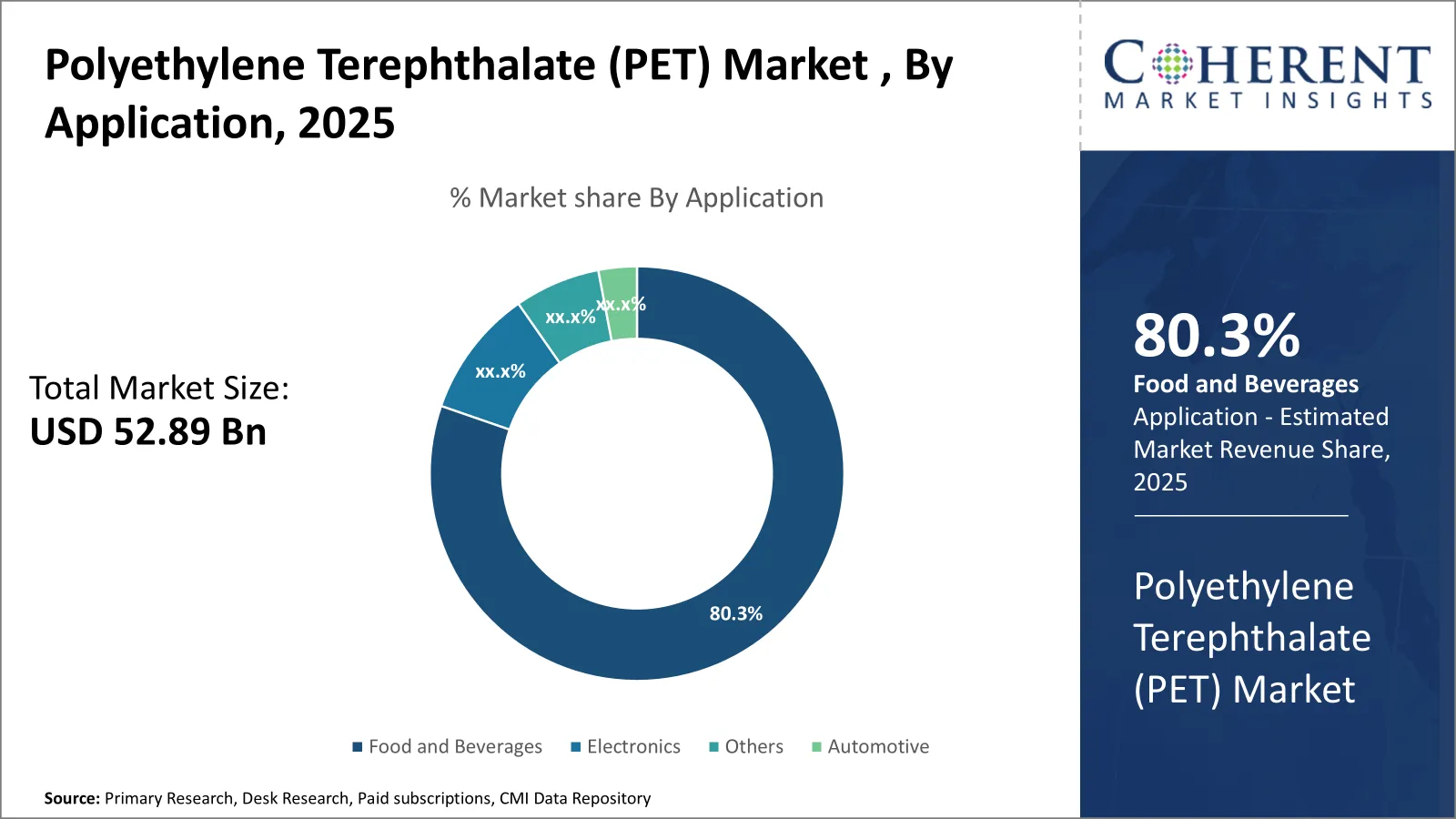
- Based on Application, Food & Beverages Segment accounted for the largest market share of 81.3% in during the forecast period.
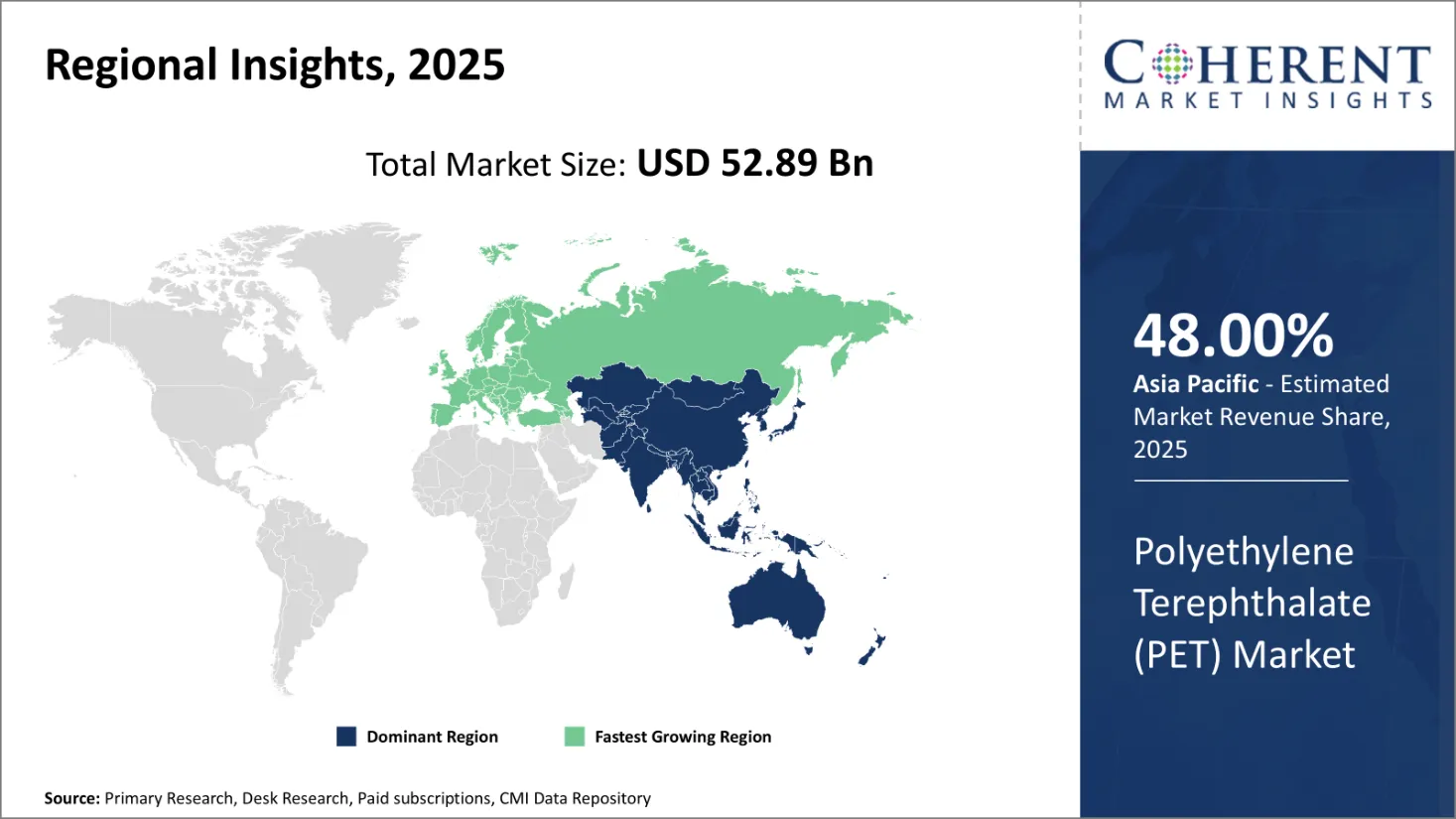
- Asia Pacific dominated the global Polyethylene Terephthalate (PET) market accounting for a 48% share in 2026. This is due to its large-scale manufacturing capacity and abundant raw material availability.
Market Overview
The Polyethylene Terephthalate (PET) market is driven by the rising need for light, strong, and recyclable material across packaging, textiles, automotive, and electronic industries. PET's strength, clarity, and versatility render it the standard packaging material in food and beverage packaging, especially bottles and containers. The sector is also affected by increasing environmental awareness and regulatory pressures, which are driving the move to recycled PET (rPET) and bio-based PET. With increasing global sustainability aspirations, brand owners and manufacturers are seeking to incorporate sustainable PET into their supply bases increasingly in order to drive carbon footprints lower and enable circularity.
Current Events and Its Impact on Polyethylene Terephthalate (PET) Market
Current Events | Description and its impact |
Carbios Unveils First Enzymatic Recycling Plant for PET in France |
|
Indorama Ventures Inaugurates PET Circularity Hub in Europe
|
|
Pricing Analysis
The cost analysis of the market for Polyethylene Terephthalate (PET) in 2025 portrays a sophisticated interaction of raw material prices, local demand-supply forces, energy prices, and sustainability forces. PET, which mostly comes from purified terephthalic acid (PTA) and monoethylene glycol (MEG), is sensitive to changes in crude oil prices since both feedstocks are petrochemical in nature. Escalating oil prices and supply chain limitations have created relatively moderate price rises worldwide, especially following geopolitical tensions and logistics bottlenecks in early 2025.
Asia-Pacific, particularly China and India, is still the most cost-effective region as a result of high-volume PET resin manufacture and low-cost feedstock and labor availability. Prices here tend to be lower, and thus they are prime exporters.
Nevertheless, North America and Europe have experienced elevated PET prices fueled by strict environmental regulations, energy price volatility, and demand for recycled PET (rPET) material, which tends to be more expensive to manufacture given the lower feedstock availability and sophisticated processing demands.
In 2025, there is a clear price difference between virgin PET and rPET, with rPET fetching a premium of 15–25% because of growing demand from sustainable packaging programs, particularly from beverage and FMCG companies. Pressure towards circular economy compliance, particularly in Europe under the EU Green Deal and Plastic Tax, is accelerating rPET take-up and affecting average market pricing.
Overall, PET prices are expected to maintain a moderate upward trajectory, with an estimated CAGR of 4–6% through 2028, driven by sustainability trends, demand growth in packaging and textiles, and the rising share of recycled content in global supply chains.
- Current Industry Events of 2026
- Market Size Estimation
- Regional Breakdown
- Competitive Landscape
- Customer Intelligence
- Segmental Analysis
- Pricing Analysis
- Key Market Drivers, Challenges & Future Trends
- Customized Insights Section
Adoption of new technology
The Polyethylene Terephthalate (PET) industry is witnessing a technology shift driven by sustainability objectives, regulatory forces, and circular economy efforts. The most noteworthy among these is the use of chemical recycling technologies—like depolymerization, glycolysis, and enzymatic recycling—that depolymerize PET to its monomers (PTA and MEG) to re-polymerize into virgin-grade resin. Players like Carbios and Eastman are at the forefront of this, making it possible to produce higher-quality recycled PET (rPET) and diminishing the dependence on fossil feedstocks.
New sorting and purification technologies are also picking up speed. These are NIR sorting machines, AI-enabled waste sorting, and decontamination technologies that provide food-grade rPET from post-consumer waste. These technologies are necessary to keep up with emerging demand for food and beverage packaging where food safety standards are particularly high.
Within the packaging industry, lightweighting technologies are on the verge of adoption to minimize resin use per bottle without jeopardizing strength. This not only saves cost but also minimizes environmental damage. Another technology in the pipeline is digital watermarking as a means of enhancing PET identification in recycling, enhancing sortation efficiency, and purity levels.
The fashion industry, PET's largest user, is looking towards bio-based PET from renewable sources such as corn or sugarcane. This complies with sustainability requirements and appeals to eco-friendly consumers and brands.
Overall, the convergence of smart recycling technologies, bio-based substitutes, and AI-driven production processes is revolutionizing the PET industry. These technologies are enabling firms to comply with environmental standards, carbon footprints reduction, and build supply chain resilience—setting the market for sustainable long-term growth.
Use Of Sustainable and Eco-Friendly Material
The Polyethylene Terephthalate (PET) market is increasingly turning towards sustainable and environmentally friendly materials amidst global environmental issues, strict regulations, and growing consumer demand for greener packaging. One of the largest trends in this shift is increased adoption of recycled PET (rPET), especially in packaging.
rPET is created from post-consumer PET bottles and containers, and its uptake lowers plastic waste and carbon emissions. Large consumer packaged goods and beverage companies are making commitments to increasing rPET content in their packaging’s due to policies like the EU Plastic Tax and Extended Producer Responsibility (EPR) programs.
In addition to mechanical recycling, chemical recycling technologies are becoming increasingly important as they provide a closed-loop process by which virgin-quality PET can be produced from difficult-to-recycle waste. This method provides the possibility of PET being reused several times without quality loss, suitable for food-grade use, and helping to create a more circular plastics economy.
The industry is also seeing the emergence of bio-based PET, which is based on renewable raw materials such as sugarcane, corn, or agricultural residues rather than fossil fuel. Bio-PET has a lower carbon footprint and can be blended in with current PET recycling streams. Firms such as Coca-Cola and Toyota have already incorporated bio-based PET into their products and packaging.
Also supporting sustainability are innovations in green additives and light PET resins that minimize material consumption and energy expenditure in manufacturing. Collectively, these innovations are reshaping the PET value chain, enabling producers to achieve regulatory goals and enhance the environmental profile of PET in packaging and textile applications.
Market Drivers
- Increase in the use of polyethylene terephthalate in food and beverages packaging
Rising demand for polyethylene terephthalate in food and beverage packaging such as carbonated soft drinks packaging contributed to the growth of the global polyethylene terephthalate market. The increasing demand for bottled beverage packaging, the glass and metal container replacements find no better alternatives than the polyethylene terephthalate, due to its versatility in shape and size.
In June 2024, Coca‑Cola India introduced PET bottles made entirely from recycled PET (rPET) in 250 ml and 750 ml formats for its carbonated beverages. The bottles are lightweight, leading to a 66% reduction in carbon footprint compared to virgin PET equivalents.
- Advancements in the technology for the development of lightweight PET bottles
Technological advancement for developing lightweight, high-strength, and energy-efficient PET bottles is expected to boost market growth. For instance, in April 2022, Sidel, one of a leading provider of equipment, services and complete solutions for packaging liquids, foods, home and personal care products in PET, can, glass and other materials launches Pressure SAFE, which is an innovative PET aerosol container design that will give home and personal care brands the opportunity to offer more environmentally sustainable dispensing spray packaging. This new PET product-packaging solution is approved for the traditional PET recycling stream.
Market Restraints
- Increase in the stringent regulatory standards and guidelines governing the use of PET material
Rise in the strict government norms and regulations associated with the usage of PET material, increase in the availability of substitute products in the market and less PET recycling rates due to high contamination are the major factor among others acting as a restraint, and will further challenge the growth of polyethylene terephthalate (PET) market in the forecast period mentioned above. For instance, in 2019, according to an article published by 'The Economic Times', nine out of ten bottles of polyethylene terephthalate are recycled in India, affecting the manufacturing of polyethylene terephthalate.
In October 2019, India announced a plan, "Clean India Mission" which is an attempt to "sensitize" the public against single-use plastics and it planned to eliminate single-use plastics within three years. Imposing strict regulations on manufacturing and recycling plastic products have a negative impact on the polyethylene terephthalate market.
Market Trends
As polyethylene terephthalate (PET) is an excellent water and moisture barrier material, plastic bottles made from PET are widely used for mineral water and soft drinks (low and high carbonated). PET bottles are also recycled for various purposes. For example, they are used in solar water disinfection in developing nations, in which empty PET bottles are filled with water and left in the sun to allow disinfection by ultraviolet radiation.
PET is useful for this purpose because many other materials (including window glass) that are transparent to visible light are opaque to ultraviolet radiation. Additionally, the Polyethylene Terephthalate (PET) heat resistance enables these bottles to withstand the temperatures involved in sterilization and reuse processes, making PET a versatile and durable material for such applications.
According to the Indian Journal of Science and Technology, PET bottles filled with sand, soil, fly ash, or any other material like household plastic waste when well compacted can be used as a building material replacing traditional bricks.
Segmental Insights
Polyethylene Terephthalate Market Insights, By Application
Based on application, the market is segmented into Food & Beverages, Automotive, Electronics, and Others. The food & beverages segment accounted for the largest market share in the Global Polyethylene Terephthalate market which was 81.3% of the total revenue share in 2021 and is expected to continue its dominance over the forecast period.
Global Polyethylene Terephthalate (PET) Market – Regional Insights
Asia Pacific Polyethylene Terephthalate (PET) Market Analysis and Trends
Asia Pacific dominated the global Polyethylene Terephthalate (PET) market in 2022, accounting for a 48.00% share in terms of revenue, followed by Europe and North America, respectively. Asia Pacific dominated the global PET market in 2022 due to its large-scale manufacturing capacity and abundant raw material availability. Rapid urbanization and population growth in countries like China and India fueled demand for packaged goods and textiles.
The region’s cost-effective labor and production infrastructure attracted global PET manufacturers. Strong export activity and government support for industrial growth further boosted market dominance. Additionally, increasing investments in recycling and sustainability initiatives strengthened Asia Pacific’s position.
Polyethylene Terephthalate (PET) Market Dominating Countries
China Polyethylene Terephthalate (PET) Market Analysis and Trend
China is the globe's largest consumer and producer of PET, fueled by its huge packaging, textile, and manufacturing sectors. The nation has cheap production costs, vast petrochemical plants, and growing domestic demand for virgin and recycled PET. China's aggressive investments in recycling plants and chemical recycling technologies are also reinforcing market dominance.
United States Polyethylene Terephthalate (PET) Market Analysis and Trend
The U.S. has a strong presence in the PET market on account of its robust beverage, food packaging, and pharma industries. As demand for rPET increases, the nation is quickly developing recycling capacities. American giants are also investing heavily in bio-based PET and chemical recycling processes to serve sustainability objectives as well as regulatory norms.
Germany Polyethylene Terephthalate (PET) Market Analysis and Trend
Germany dominates Europe's PET market, with environmental regulations strict and recycling rates high. It is the champion of green PET usage, benefiting from widespread government support for circular economy solutions. German industry is the leader in the deployment of state-of-the-art recycling and light-weighting technology, and it is a center of eco-friendly PET innovation.
India Polyethylene Terephthalate (PET) Market Analysis and Trend
India is becoming a key PET market through urbanization, rising packaged food and beverage consumption, and a growing textile industry. The trend towards plastic waste management by the government and rising utilization of rPET in non-food sectors is bolstering local production and consumption of eco-friendly PET solutions.
Market Report Scope
Polyethylene Terephthalate (PET) Market Report Coverage
| Report Coverage | Details | ||
|---|---|---|---|
| Base Year: | 2025 | Market Size in 2026: | USD 56.54 Bn |
| Historical Data for: | 2020 To 2024 | Forecast Period: | 2026 To 2033 |
| Forecast Period 2026 to 2033 CAGR: | 6.9% | 2033 Value Projection: | USD 83.28 Bn |
| Geographies covered: |
| ||
| Segments covered: |
| ||
| Companies covered: | Alpek S.A.B de C.V., RTP Company, BASF SE, The Dow Chemicals Company, Jiangsu Sanfangxiang Group, Indorama Ventures, M&G Chemicals, Nan Ya Plastics Corporation, Far Eastern New Century, and Quadrant AG | ||
| Growth Drivers: |
| ||
| Restraints & Challenges: |
| ||
Recent Developments
- In July 2025, Veolia revealed a £70 million (US $95 million) investment in constructing the UK's first closed-loop PET recycling plant, which will have the capability to recycle trays into food-grade products by early 2026. The project greatly improves UK PET recycling facilities and assists the sustainability ambitions of the British grocery industry.
- In October 2024, Indorama Ventures announced the launch of the globe's first commercial-scale bio-PET bottles produced from ISCC+-certified bio-paraxylene from used cooking oil. Around 45 million bottles started shipping in Japan, which is a key milestone in cutting down CO₂ emissions in beverage packaging.
Analyst View
- The global PET market reflects strong fundamentals fueled by surging demand from packaging and textile segments, especially food and beverages where PET's high barrier properties and light weight offer competitive benefits. Growing consumer demand for convenient, portable packaging solutions continues to drive market growth, and the automotive industry's rising use of PET for lightweight parts bolsters diversification away from conventional applications. Additionally, the polyethylene terephthalate (pet) market for 3d printing filaments is emerging as a niche but promising segment, expanding PET's reach into advanced manufacturing technologies.
- But the market is confronted with huge headwinds in the form of increasing environmental concerns and strict regulatory environments aimed at single-use plastics. Increasing consumer knowledge about plastic pollution and sustainability issues, along with growing scrutiny of the polyethylene terephthalate (PET) environmental footprint, pose big threats to long-term demand, forcing manufacturers to make heavy investments in recycling technology and circular economy programs.
- The Asia-Pacific is the leading market force, fueled by industrialization, growing middle-class consumer bases, and strong manufacturing capacity in countries such as China and India. It is blessed by low-cost production facilities and access to major end-use markets, making it both a manufacturing center and consumption hub.
- Strategic potential is in the production of bio-based PET replacements and next-generation recycling technologies that meet environmental standards without sacrificing performance requirements. Organizations making investments in chemical recycling technology and sustainable feedstock creation are well-placed to benefit from future market trends.
Market Segmentation
- Global Polyethylene Terephthalate Market, By Product Type (Revenue, USD Bn, 2021 - 2033)
- Carbonated Soft Drink
- Bottled Water
- Other Drinks
- Sheets & Films
- Food
- Non-Food
- Global Polyethylene Terephthalate Market, By Application (Revenue, USD Bn, 2021 - 2033)
- Food & Beverages
- Automotive
- Electronics
- Others
- Global Polyethylene Terephthalate Market, By Region (Revenue, USD Bn, 2021 - 2033)
- North America
- U.S.
- Canada
- Latin America
- Mexico
- Brazil
- Argentina
- Rest of Latin America
- Europe
- EU
- Benelux
- Nordic
- Russia
- Ukraine
- Poland
- Rest of Europe
- Asia Pacific
- China
- India
- Japan
- ASEAN
- OCEANIA
- Rest of Asia Pacific
- Middle East & Africa
- Turkey
- GCC
- South Africa
- Rest of Middle East & Africa
- North America
- Company Profiles
- Alpek S.A.B de C.V.
- RTP Company
- BASF SE
- The Dow Chemicals Company
- Jiangsu Sanfangxiang Group
- Indorama Ventures
- M&G Chemicals
- Nan Ya Plastics Corporation
- Far Eastern New Century
- Quadrant AG.
Sources
Primary Research Interviews
- PET Manufacturing Companies Executives
- Packaging Industry Key Decision Makers
- Bottle & Container Manufacturers
- Textile & Fiber Industry Professionals
- Others
Databases
- IHS Markit Chemical Economics Handbook
- Platts Petrochemical Analytics
- Wood Mackenzie Chemicals Database
- ICIS Pricing Database
- Others
Magazines
- Plastics Technology Magazine
- Packaging World Magazine
- Plastic News Magazine
- Flexible Packaging Magazine
- Others
Journals
- Journal of Applied Polymer Science
- Polymer Engineering & Science
- Packaging Technology and Science
- Others
Newspapers
- Financial Times
- The Wall Street Journal
- Chemical & Engineering News
- Reuters Business News
- Others
Associations
- National Association for PET Container Resources (NAPCOR)
- Society of Plastics Engineers (SPE)
- Plastics Industry Association
- European PET Bottle Platform (EPBP)
- Others
Public Domain Sources
- U.S. Environmental Protection Agency (EPA)
- European Chemicals Agency (ECHA)
- Bureau of International Recycling (BIR)
- United Nations Industrial Development Organization (UNIDO)
- Others
Proprietary Elements
- CMI Data Analytics Tool
- Proprietary CMI Existing Repository of information for last 8 years
Get access to 250+ pages report
Every segment, forecast, competitor profile and data table behind the analysis above — available for instant download.
- ESOMAR Member
- ISO 9001:2015 Certified
- D-U-N-S Registered
- GDPR & CCPA Compliant
Missing comfort of reading report in your local language? Find your preferred language:
Transform your Strategy with Exclusive Trending Reports
Frequently Asked Questions
The Polyethylene Terephthalate (PET) Market size is estimated to be valued at USD 56.54 Bn in 2026, and is expected to reach USD 90.20 Bn by 2033.
Increase in the use of polyethylene terephthalate in food and beverages packaging to uplift market growth and advancements in the technology for the development of lightweight PET bottles to uplift market growth.
The primary chemical components used to produce PET are terephthalic acid (or its dimethyl ester) and ethylene glycol.
PET is a thermoplastic, meaning it can be melted and reshaped multiple times without altering its chemical properties.
Use as a water and moisture barrier material, plastic bottles, etc.
Rise in the strict norms and regulations associated with the usage of PET materials from the government hinders the market growth.
Major players operating in the market include Alpek S.A.B de C.V., RTP Company, BASF SE, The Dow Chemicals Company, Jiangsu Sanfangxiang Group, Indorama Ventures, M&G Chemicals, Nan Ya Plastics Corporation, Far Eastern New Century, and Quadrant AG.