

Metallocene Polyethylene Market Size and Forecast
Metallocene Polyethylene Market is estimated to be valued at USD 7,580.4 Mn in 2026 and is expected to reach USD 11,912.1 Mn in 2033, exhibiting a compound annual growth rate (CAGR) of 6.7% from 2026 to 2033.
Key Takeaways
- Based on Product Type, the mLLDPE segment is projected to hold the largest share of the market in 2026, driven by its exceptional balance of strength, flexibility, and processability.
- Based on Application, the Films segment is expected to account for 56% of the global metallocene polyethylene market in 2026, owing to their superior mechanical and optical properties.
- Based on Region, Asia Pacific is expected to lead the global metallocene polyethylene market in 2026 with a 39.40% share. While, North America, with a 22.30% share in 2026, will be the fastest growing region during forecast period.
Market Overview
The global metallocene polyethylene (mpe) market is poised for significant growth, driven by the rising demand for advanced, high-performance packaging materials. The unique molecular structure of metallocene catalysts enables the production of polyethylene resins with exceptional optical clarity, tensile strength, and stiffness, making them ideal for a wide range of packaging applications. New-generation mPE films are gaining popularity in the food, industrial, and hygiene packaging sectors, where enhanced mechanical strength and processability are critical. The growing preference for lightweight, durable, and visually appealing packaging solutions is fueling metallocene polyethylene market demand, particularly in regions focusing on flexible and sustainable packaging innovations.
Current Events and Their Impact on the Metallocene Polyethylene Market
Current Event | Description And Its Impact |
Regulatory Shifts in Sustainability |
|
Technological and Industrial Advancements |
|
End-User Feedback and Unmet Needs in the Metallocene Polyethylene Market
End-User Feedback
- Preference for enhanced material properties such as improved clarity, flexibility, and toughness.
- High value placed on consistent product quality and reliable supply chain management.
- Demand for customized resin grades tailored to specific application requirements.
- Positive recognition of metallocene polyethylene’s superior performance compared to conventional polyethylene.
Unmet Needs
- Need for more cost-effective resin options that do not compromise on material performance.
- Increasing demand for sustainable and environmentally friendly products, including
- Resins with improved recyclability.
- Bio-based or renewable content in resin formulations.
- Requirement for stronger technical support and application expertise from suppliers to optimize resin use and processing.
- Desire for closer collaboration between resin manufacturers and end-users to foster innovation and address evolving market challenges.
- Current Industry Events of 2026
- Market Size Estimation
- Regional Breakdown
- Competitive Landscape
- Customer Intelligence
- Segmental Analysis
- Pricing Analysis
- Key Market Drivers, Challenges & Future Trends
- Customized Insights Section
Segmental Insights
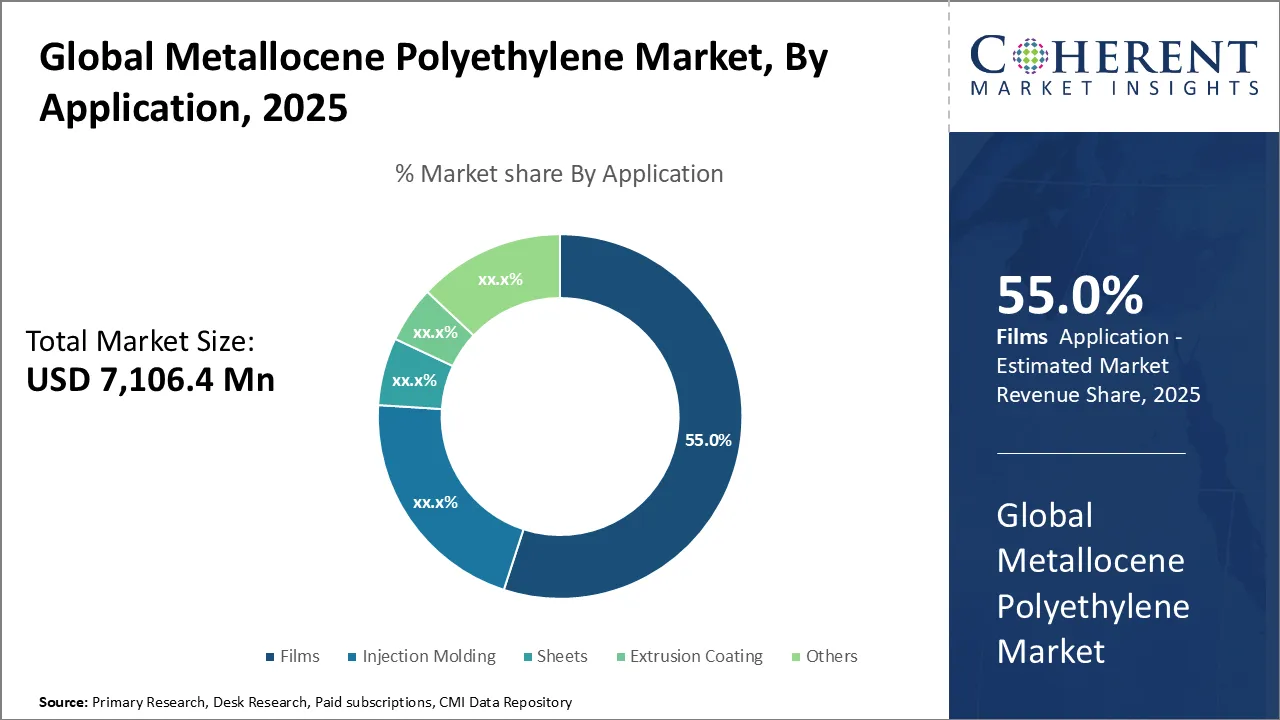
Metallocene Polyethylene Market Insights, By Application
Films Acquires the Dominant Share owing to its Superior Mechanical and Optical Properties
In terms of application, the films segment is expected to contribute 56.0% share of the global metallocene polyethylene market in 2026, owing to their superior mechanical and optical properties compared to conventional polyethylene films, making them ideal for a wide range of applications in packaging, agriculture, hygiene, and industrial sectors.
The key driver is the growing need for flexible, durable, and lightweight packaging, especially in the food, pharmaceutical, and personal care industries. mPE films, particularly those made from metallocene linear low-density polyethylene (mLLDPE), offer enhanced toughness, better puncture resistance, improved sealability, and clarity, which are critical for extending product shelf life and ensuring safety in packaging. Their ability to maintain performance with thinner gauges also supports sustainability efforts by reducing material use and waste.
In October 2024, TotalEnergies expanded its metallocene polyethylene (mPE) portfolio with Advanced Supertough 12AST05, a novel Very Low Linear Density Polyethylene (VLLDPE) grade ranging from 0.912 to 0.960 g/cm³. This new film-grade resin offers excellent mechanical strength, 5% haze, 70° gloss, and superior sealing, initiating 2°C below current market materials, enabling reduced plastomer usage and production cost savings. This is further propelling the metallocene polyethylene market revenue.
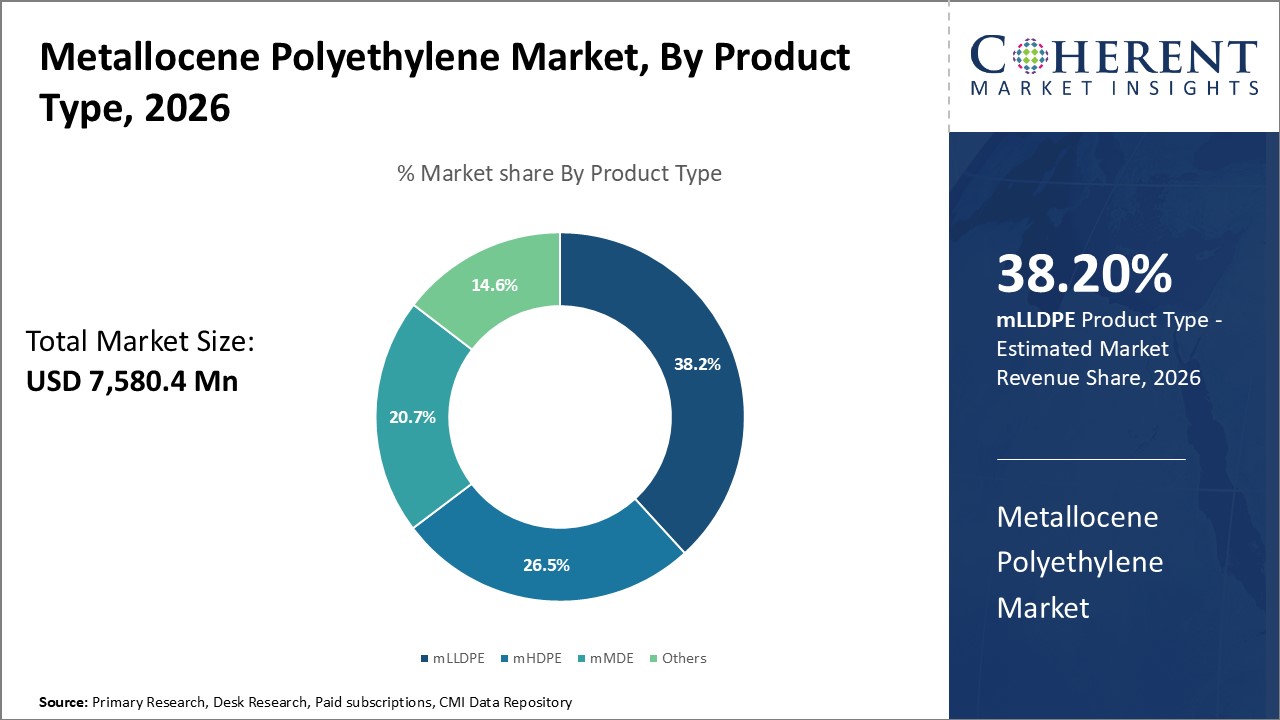
Metallocene Polyethylene Market Insights, By Product Type
mLLDPE Holds the Dominant Share owing to its Exceptional Balance of Strength and Flexibility
In terms of product type, the mLLDPE segment is expected to contribute the largest share of the market in 2026, driven by its exceptional balance of strength, flexibility, and processability. mLLDPE is particularly valuable in flexible packaging applications, especially in the food, industrial, agricultural, and hygiene sectors, where high-performance films are essential. For instance, in the food industry, mLLDPE’s ability to form thin, yet durable films help reduce material usage without compromising product protection. Additionally, it supports the development of multi-layer packaging with better sealing and shelf-life capabilities.
Additionally, growing environmental concerns are also fueling the shift toward down-gauging and recyclable packaging materials, where mLLDPE's mechanical strength at lower thicknesses becomes crucial. Furthermore, the material’s compatibility with advanced extrusion and blown film processing techniques enables manufacturers to optimize production efficiency and reduce energy consumption. The increasing preference for lightweight, cost-effective, and sustainable materials in emerging economies makes mLLDPE a key driver in the global metallocene polyethylene market.
In June 2025, in a strategic move, a Saudi Arabian petrochemical firm introduced metallocene linear low-density polyethylene (mLLDPE) to China, marking a significant expansion into Asia.
Regional Insights
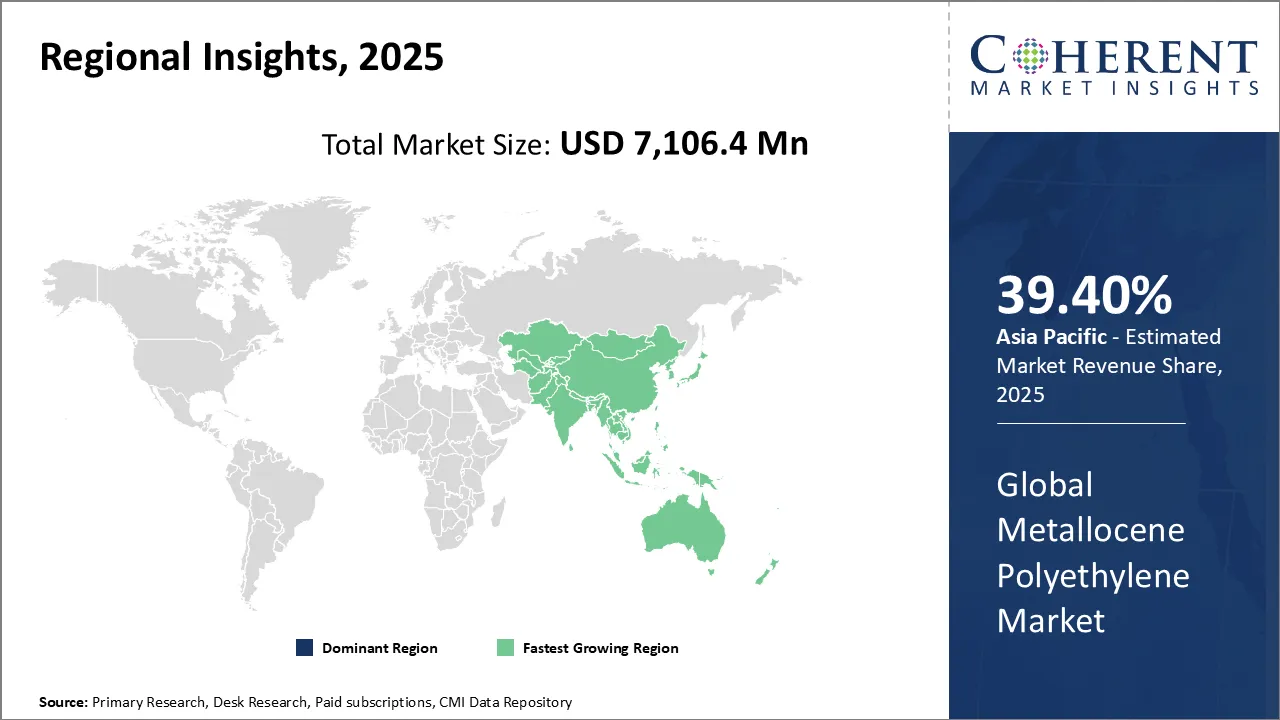
Asia Pacific Metallocene Polyethylene Market Analysis & Trends
The Asia Pacific region is projected to lead the market with a 39.40% share in 2026 owing to the evolving consumer behavior. The region’s rapid economic development, particularly in countries like China, India, Indonesia, Vietnam, and Thailand, is driving large-scale demand for high-performance, cost-efficient, and sustainable plastic materials across multiple sectors. With growing urbanization and income levels, Asia Pacific is seeing surging demand for packaged foods, personal care products, and e-commerce shipments. Metallocene polyethylene is favored in these applications due to its high clarity, superior sealing properties, and downgauging ability, making it ideal for flexible packaging, pouches, and stretch films. For example, Indian companies like Cosmo Films and UFLEX are incorporating mPE to meet both cost-efficiency and sustainability requirements in multilayer packaging.
Countries such as India and China are introducing strict rules on plastic usage, aiming to phase out non-recyclable single-use plastics. mPE supports recyclable and lightweight film structures, aligning with these policies. As a result, packaging converters and film manufacturers are shifting toward mPE to meet compliance while maintaining performance.
Asia Pacific’s solar energy boom, led by China and India, is also influencing mPE demand. mPE’s UV resistance and clarity make it useful in solar panel encapsulation films and backsheet layers. Meanwhile, the healthcare investments across the region boosts the use of mPE in medical-grade films, diagnostic packaging, and pharmaceutical containers. As these sectors expand, mPE is becoming increasingly essential due to its versatility, durability, and processability.
For instance, in May 2026, a Singapore-based chemical supplier has launched offers for metallocene linear low‑density polyethylene (mLLDPE), targeting Southeast Asian markets.
North America Metallocene Polyethylene Market Analysis & Trends
North America region is expected to exhibit the fastest growth in the market contributing an estimated 22.30% share in 2026 on account of the evolving needs of end-use industries such as packaging, healthcare, agriculture, and renewable energy. The U.S. and Canada have a highly developed food and beverage packaging industry. The mPE films are valued for their excellent seal strength, optical clarity, and toughness, making them ideal for stand-up pouches, snack packaging, and frozen food wraps. Brands increasingly use mPE to create recyclable, mono-material packaging formats aligned with sustainability goals.
Moreover, North American brands and retailers are under pressure to meet plastics reduction and recycling targets. mPE allows for material downgauging, producing thinner films without sacrificing strength, helping manufacturers reduce plastic usage and improve recyclability, particularly in polyethylene-based flexible packaging.
For instance, in May 2026, Univation Technologies (Houston) launched a groundbreaking 800,000 tonnes per year design for its flagship UNIPOL™ PE Process, setting a new global benchmark in polyethylene manufacturing. This next-generation, single-train platform delivers unparalleled economies of scale, significantly increasing output over its previous 650,000 tpy design while preserving the flexibility to produce unimodal HDPE, bimodal HDPE, LLDPE, and metallocene PE. Engineers benefit from cost-effective capital expenditure, enhanced operational efficiency via PREMIER™ APC+ 3.0 control, and compatibility with Univation’s advanced catalyst suite.
Metallocene Polyethylene Market Outlook Country-Wise
The U.S. Metallocene Polyethylene Market Trends
In the United States, metallocene polyethylene market demand is growing rapidly, driven by its use in flexible packaging, healthcare, and sustainability-focused applications. Brands increasingly prefer mPE for high-clarity, recyclable packaging films and FDA-compliant medical materials like IV bags and diagnostic wraps. The solar energy sector is also adopting mPE for durable panel backsheets and wire coatings. Additionally, sustainability is another powerful force shaping mPE demand. As part of circular economy efforts, major brands are shifting toward mono-material polyethylene packaging that is easier to recycle. mPE allows film manufacturers to maintain performance while reducing material layers, contributing to recyclable, lightweight packaging formats, the U.S. remains a key growth market for metallocene polyethylene.
For instance, LyondellBasell introduced a new range of metallocene linear low density polyethylene (mLLDPE) resins in the North American market.
China Metallocene Polyethylene Market Trends
China is a key growth driver in the metallocene polyethylene (mPE) market, fueled by rapid expansion in e-commerce, agriculture, and consumer goods. As online retail surges, packaging manufacturers are adopting mPE for its stronger seal strength, clarity, and downgauging potential, reducing material use while maintaining quality. In agriculture, mPE is used in greenhouse and mulch films due to its durability and UV resistance. Meanwhile, the electronics and consumer goods sectors rely on mPE for protective, puncture-resistant packaging. With growing demand for sustainable, high-performance materials, China’s industrial shift toward mPE continues to accelerate.
For instance, Grace’s ActivCat® catalyst technology formed strategic alliance with Zhejiang Petrochemical Co (ZPC), becoming the first major licensee of the UNIVATION® polyethylene (PE) process technology in China. This partnership aims to produce high-quality metallocene PE films and Polyethylene of Raised Temperature (PE-RT) resins tailored for packaging and piping uses. This is further proliferating the metallocene polyethylene market revenue.
Market Report Scope
Metallocene Polyethylene Market Report Coverage
| Report Coverage | Details | ||
|---|---|---|---|
| Base Year: | 2025 | Market Size in 2026: | USD 7,580.4 Mn |
| Historical Data for: | 2020 To 2024 | Forecast Period: | 2026 To 2033 |
| Forecast Period 2026 to 2033 CAGR: | 6.7% | 2033 Value Projection: | USD 11,912.1 Mn |
| Geographies covered: |
| ||
| Segments covered: |
| ||
| Companies covered: | Borealis AG, Formosa Plastics Corporation, Chevron Phillips Chemical Company, SABIC, INEOS Group Limited, Dow Inc., LyondellBasell Industries N.V., ExxonMobil, Total Petrochemicals USA, and Brentwood Plastics. | ||
| Growth Drivers: |
| ||
| Restraints & Challenges: |
| ||
Global Metallocene Polyethylene Market Drivers
Demand for metallocene polyethylene from packaging industry
The global metallocene polyethylene market is experiencing robust growth as industries increasingly adopt metallocene-based high-density polyethylene (mHDPE) for its superior strength, toughness, and clarity. These advanced resins are being widely used in flexible and rigid packaging, owing to their excellent sealing properties and durability. The rising popularity of mHDPE in consumer goods, food packaging, and industrial films is expanding its footprint, particularly in emerging economies like India, Vietnam, and Brazil, where plastic production is rapidly scaling up.
Several flexible packaging manufacturers in Southeast Asia announced the switch to metallocene grades to meet export quality standards in food-grade packaging. For instance, in October 2024, Lamb Weston partnered with SABIC and Oerlemans Plastics to introduce sustainable packaging for frozen potato products. This packaging is made from at least 60% bio-renewable polymers sourced from used cooking oil (UCO), cutting its carbon footprint by about 30%. The UCO is converted into bio-feedstock to produce SABIC’s certified bio-based HDPE and mLLDPE polymers.
Benefits and diverse applications in various end use Industry
The global metallocene polyethylene market demand is witnessing robust growth, fueled by its expanding application base and the rapid development of end-use industries. One of the primary drivers is the growing food and beverage sector, where metallocene polyethylene (mPE) is preferred for its excellent clarity, seal strength, and flexibility in packaging films. Beyond packaging, the market is also seeing rising demand in injection molded products, including agricultural containers, plumbing fixtures, toys, and medical components due to mPE's superior toughness and chemical resistance.
Analyst Opinion (Expert Opinion)
- The metallocene polyethylene market value is at a pivotal juncture, increasingly characterized by high-performance differentiation. One of the core driver of this transformation is the escalating demand for advanced flexible packaging, particularly in fast-moving consumer goods (FMCG) and hygiene segments, where performance consistency, downgauging, and sustainability is now non-negotiable.
- Metallocene resins have earned their position not merely due to superior tensile strength or sealing properties, but because they enable film converters to achieve down-gauging by up to 20–25%, reducing overall material usage without compromising mechanical integrity. This has a direct impact on cost efficiency and sustainability targets, a major win for consumer brands under mounting regulatory and ESG pressures. For instance, Procter & Gamble and Unilever have already begun favoring metallocene-based films in their secondary packaging applications, given the critical balance they strike between puncture resistance and clarity.
- Moreover, in multilayer film structures, mPE offers enhanced layer adhesion and optical clarity, making it the preferred choice for high-barrier packaging in sectors such as frozen foods and pharmaceuticals. Converters in Germany and South Korea have moved nearly 40% of their LLDPE-based lines to mLLDPE to capture better dart impact performance, which translates to fewer failures during transportation and retail handling.
- Players such as ExxonMobil and TotalEnergies are rapidly advancing reactor and catalyst technology to push metallocene capabilities further into niche segments such as breathable films and stretch hoods. Additionally, mPE’s compatibility with post-consumer recycled (PCR) resins gives it an edge in closed-loop supply chains. A recent pilot project in the Netherlands demonstrated that incorporating up to 30% PCR in mPE films had negligible impact on seal initiation temperatures — a critical parameter for automated packaging lines.
Speak to the analyst
Want personalized insights?
Take the findings above to one of our principal consultants, or have the report rebuilt around the segments, geographies and competitors you actually track.
Recent Developments
- In February 2025, ExxonMobil initiated operations at its first 730,000 t/yr linear low-density polyethylene (LLDPE) unit in Huizhou, Guangdong Province.
- In December 2024, Dowpol Chemical introduced its latest metallocene-engineered polyalphaolefin (mPAO) product, DowSyn V2000, aimed at industrial lubrication applications. The new high-viscosity base oil is formulated to enhance performance in extreme-pressure and high-temperature environments.
- In August 2024, Russian petrochemical giant Sibur is advancing plans to build a new facility in Tobolsk for producing metallocene polyethylene from domestically developed catalysts. Phase one, a pilot complex, will manufacture chromium-based catalysts by 2027 with a RUB 11 billion investment.
- In June 2024, Univation Technologies, LLC unveiled its new UNIGILITY™ Tubular High‑Pressure PE Process Technology, a licensed platform designed to produce both low‑density polyethylene (LDPE) and ethylene‑vinyl acetate (EVA) resins. Leveraging Dow’s proven tubular high‑pressure process, the platform offers a first‑quartile operational performance, automated startups, and low energy consumption.
Market Segmentation
- Global Metallocene Polyethylene Market, By Product Type (Revenue, USD Mn, 2021 - 2033)
- mHDPE
- mMDPE
- mLLDPE
- Others
- Global Metallocene Polyethylene Market, By Application (Revenue, USD Mn, 2021 - 2033)
- Films
- Sheets
- Injection Molding
- Extrusion Coating
- Others
- Global Metallocene Polyethylene Market, By Region (Revenue, USD Mn, 2021 - 2033)
- North America
- U.S.
- Canada
- Latin America
- Brazil
- Argentina
- Mexico
- Rest of Latin America
- Europe
- Germany
- U.K.
- Spain
- France
- Italy
- Russia
- Rest of Europe
- Asia Pacific
- China
- India
- Japan
- Australia
- South Korea
- ASEAN
- Rest of Asia Pacific
- Middle East
- GCC Countries
- Israel
- Rest of Middle East
- Africa
- South Africa
- North Africa
- Central Africa
- North America
- Key Companies
- Borealis AG
- Formosa Plastics Corporation
- Chevron Phillips Chemical Company
- SABIC
- INEOS Group Limited
- Dow Inc.
- LyondellBasell Industries N.V.
- ExxonMobil
- Total Petrochemicals USA
- Brentwood Plastics
Sources
Primary Research Interviews from the following stakeholders
Stakeholders
- Interviews with resin producers, packaging film converters, flexible packaging manufacturers, extrusion blow molders, agricultural film suppliers, and procurement leads across global manufacturing hubs.
Specific stakeholders
- Polymer product managers at petrochemical firms (e.g., SABIC, ExxonMobil, Indian Oil Corporation)
- Procurement heads at FMCG firms and flexible packaging companies (e.g., Nestlé, Amcor, ITC Packaging)
- Film and extrusion line operators at packaging plants (e.g., Uflex, Jindal Poly Films, Taghleef Industries)
- Operations managers at agriculture film supply companies and greenhouse film distributors
- Material innovation and R&D heads at stretch film and wrap film manufacturers
- Facility and production managers at industrial and protective packaging companies
- Sustainability officers overseeing polyolefin usage in food-grade and recyclable packaging
Databases
- UN Comtrade Database
- World Trade Organization (WTO) Trade Statistics
- Ministry of Chemicals and Fertilizers (India) – Department of Chemicals and Petrochemicals
- United States International Trade Commission (USITC)
- China Customs Statistics
- Korea Trade Statistics Promotion Institute (KTSPI)
- Eurostat
- Japan External Trade Organization (JETRO)
- Directorate General of Commercial Intelligence and Statistics (DGCIS), India
Magazines
- Plastic News
- FlexPack Magazine
- Modern Plastics India
- European Plastic Product Manufacturer (EPPM)
- Converters Quarterly
- Film and Sheet Extrusion Magazine
- Recycling Today (Plastics section)
- Processing & Control News
Journals
- Polymer Testing (Elsevier)
- Journal of Applied Polymer Science
- Journal of Plastic Film & Sheeting
- Polymer-Plastics Technology and Engineering
- Journal of Vinyl and Additive Technology
Newspapers
- The Economic Times – Chemicals & Packaging
- Business Standard – Materials Science & Manufacturing
- Financial Express – Petrochemicals and Trade
- The Wall Street Journal – Commodities & Manufacturing
- South China Morning Post – Trade & Materials
- Nikkei Asia – Petrochemical Industry Reports
Associations
- The Plastics Export Promotion Council (PLEXCONCIL), India
- All India Plastics Manufacturers’ Association (AIPMA)
- American Chemistry Council – Plastics Division
- Plastic Industry Association (PLASTICS), USA
- European Plastics Converters (EuPC)
- Indian Centre for Plastics in the Environment (ICPE)
- Gulf Petrochemicals and Chemicals Association (GPCA)
Public Domain Sources
- Ministry of Environment, Forest and Climate Change (MoEFCC), India
- Ministry of Economy, Trade and Industry (METI), Japan
- Central Institute of Plastics Engineering & Technology (CIPET), India
- National Institute of Standards and Technology (NIST), U.S.
- NITI Aayog – Plastic Waste Management & Circular Economy Reports
- Reserve Bank of India (RBI) – Industrial Raw Material Trends
- India Investment Grid – Chemicals & Petrochemicals Sector
- European Chemicals Agency (ECHA) – Polymer Safety Reports
Proprietary Elements
- CMI Data Analytics Tool, and Proprietary CMI Existing Repository of information for last 8 years
*Definition: Metallocene polyethylene is a high-performance polymer that is used in food & beverages packaging, agriculture, and several industrial applications. Products such as sheets and films made from metallocene polyethylene (mPE) resins that have high tensile strength, and are used in various industrial products such as custom marine parts, water tanks, chemical storage containers, and in consumer products such as food packaging materials, heavy-duty sacks, and stretch films.
Get access to 250+ pages report
Every segment, forecast, competitor profile and data table behind the analysis above — available for instant download.
- ESOMAR Member
- ISO 9001:2015 Certified
- D-U-N-S Registered
- GDPR & CCPA Compliant
Missing comfort of reading report in your local language? Find your preferred language:
Transform your Strategy with Exclusive Trending Reports
Frequently Asked Questions
The Metallocene Polyethylene Market is estimated to be valued at USD 7,580.4 Mn in 2026, and is expected to reach USD 11,912.1 Mn by 2033.
Major players operating in the market include Borealis AG, Formosa Plastics Corporation, Chevron Phillips Chemical Company, SABIC, INEOS Group Limited, Dow Inc., LyondellBasell Industries N.V., ExxonMobil, Total Petrochemicals USA, and Brentwood Plastics.
Rising concern about the disposal of plastic films and products is one of the major factors that is expected to hamper growth of the market over the forecast period.
Demand for metallocene polyethylene from packaging industry, and benefits and diverse applications in various end use industry are the major factors that is expected to propel growth of the market over the forecast period.
The CAGR of the Metallocene Polyethylene Market is projected to be 6.7% from 2026 to 2033.
Among region, Asia Pacific is expected to hold dominant position in the market over forecast period.
Metallocene Polyethylene enhances durability through superior tensile strength, puncture resistance, and improved performance under mechanical and environmental stress.