

Automotive Labels Market Size and Forecast — 2026-2033
Overview
Automotive labels serve the purpose of displaying company name, cost, technical information, components information, other specifications, and barcode in automobiles. These labels are durable even in high temperature. They are required to cope with engine conditions including high temperature and exposure to liquids such as brake fluid, screen wash, and engine oil.
The growing demand from automobile industry for RFID labels and mandatory compliance with automotive labelling laws are the main drivers for automotive labels market. Emerging countries and new product launches open up new opportunities for the market growth. The initial cost of manufacturing is more if manufactured in small quantities, hence the cost to profit ratio is a concern to small manufacturers.
Automotive Labels Market Size and Forecast – 2026 – 2033
The Automotive Labels Market size is estimated to be valued at USD 4.83 billion in 2026 and is expected to reach USD 7.91 billion by 2033, exhibiting a compound annual growth rate (CAGR) of 7.3% from 2026 to 2033.
Key Takeaways
The Pressure-Sensitive Labels segment dominates the product type category with a 46% market share, driven by its versatility and ease of application across vehicle components.
Passenger Cars remain the largest Vehicle Type with continued technological upgrades necessitating diverse labeling solutions.
North America leads regional revenue, accounting for roughly 30% of the market share, supported by strong OEM presences and regulatory enforcement on automotive labeling.
Asia Pacific, with a CAGR of approximately 8% from 2026-2033, represents the fastest-growing region due to increasing vehicle production volumes and government incentives favoring sustainable automotive innovations.
Automotive Labels Market – Segmentation Analysis
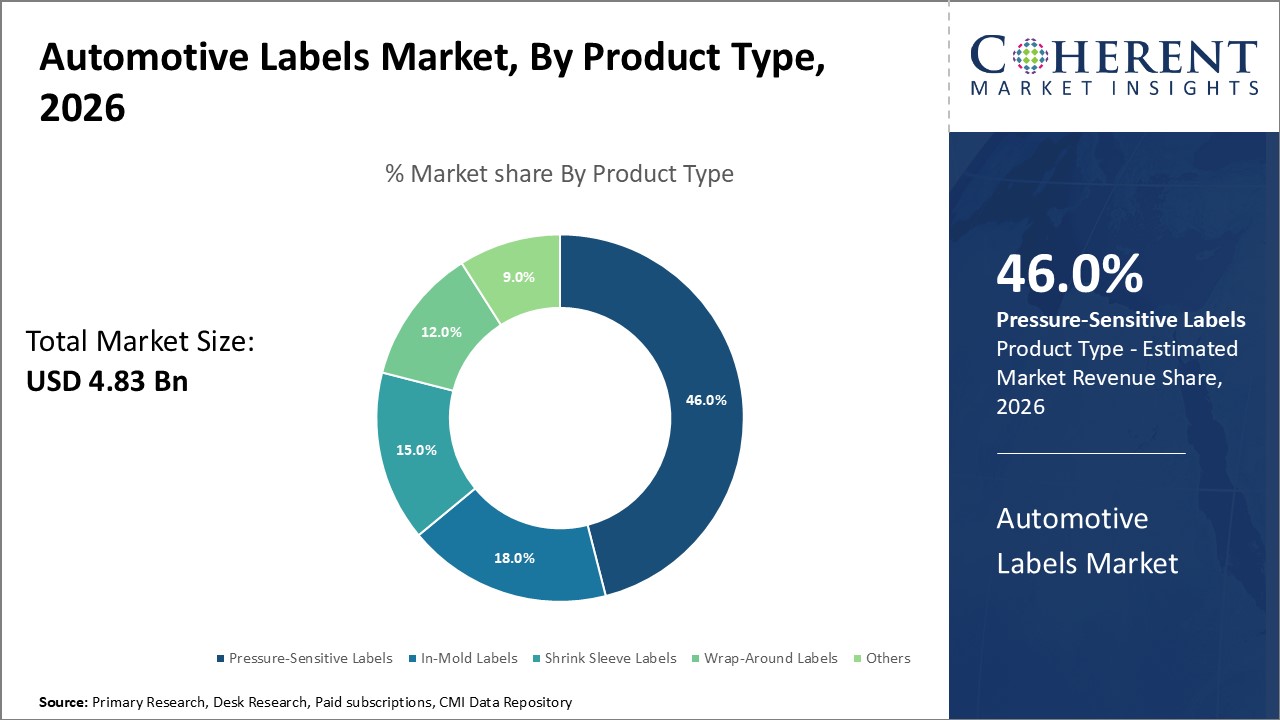
Automotive Labels Market Insights, By Product Type
In terms of product type, the automotive labels market is segmented into Pressure-Sensitive Labels, In-Mold Labels, Shrink Sleeve Labels, Wrap-Around Labels, and Others, among which Pressure-Sensitive Labels dominate the market share at 45%. Pressure-Sensitive Labels maintain their leading position due to their ease of application, cost efficiency, and adaptability to various surfaces and environmental conditions. These labels are widely preferred for both interior and exterior vehicle applications, offering excellent durability against heat, moisture, and abrasion.
Automotive Labels Market Insights, By Application
The application segment includes Exterior Labeling, Interior Labeling, Engine/Under-the-Hood Labeling, Electronic Components Labeling, and Others, where Exterior Labeling holds the dominant market share due to increasing consumer demand for customized vehicle aesthetics and branding. Exterior labels demand high resistance to UV exposure, weathering, and chemicals, making innovation in material composition and adhesion critical.
Automotive Labels Market Insights, By Vehicle Type
The vehicle type segment consists of Passenger Cars, Commercial Vehicles, Electric Vehicles, Two-Wheelers, and Others, with Passenger Cars dominating market share due to their sheer volume and wide variety of label applications ranging from branding to compliance. Passenger Cars continue to incorporate advanced labeling for infotainment, safety, and emission standards, making this segment the backbone of overall market revenue.
Automotive Labels Market Insights, By Geography
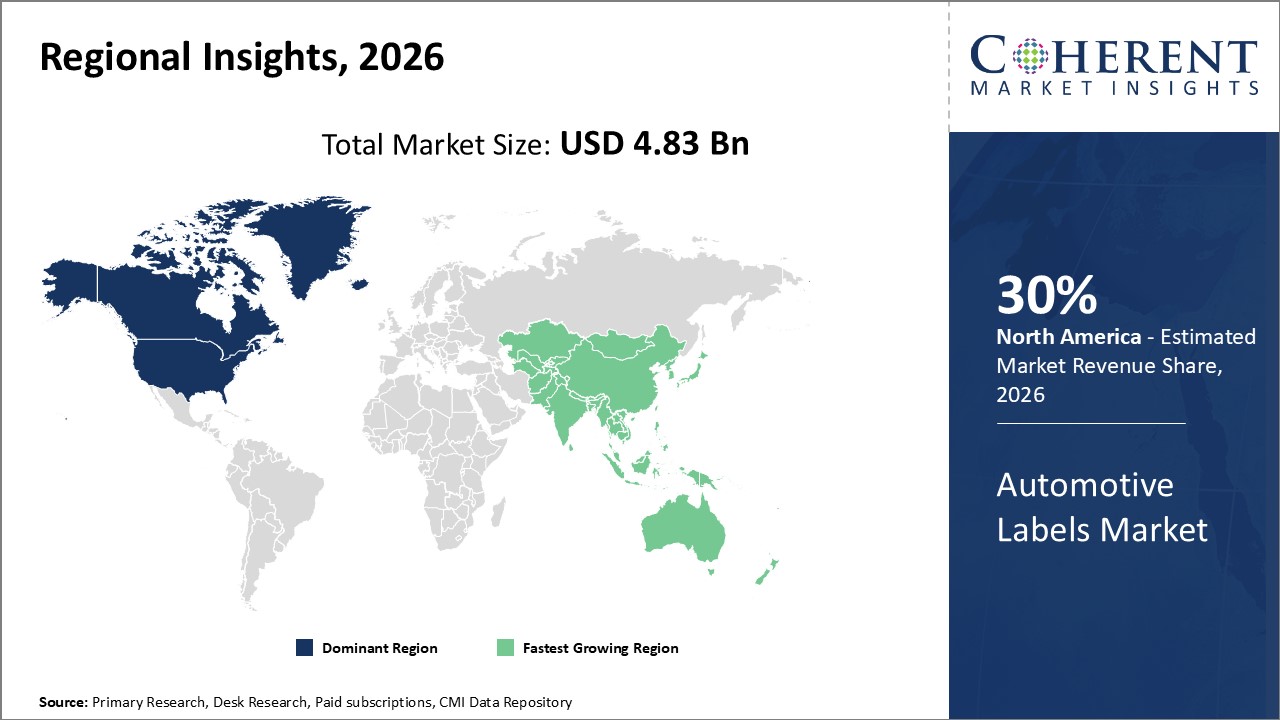
North America Automotive Labels Market Analysis and Trends
In North America, the dominance in the Automotive Labels market is propelled by stringent vehicle safety and environmental regulations, sophisticated OEM ecosystems, and strong aftermarket demand. This region holds approximately 30% of the industry share due to the presence of major automotive hubs and early adoption of smart labelling techniques. Leading companies such as Avery Dennison and 3M significantly contribute to revenue growth through innovation and tailored solutions for electric and autonomous vehicles. Government initiatives supporting electric vehicle adoption further expand labelling requirements, consolidating North America's position as the frontrunner.
Asia Pacific Automotive Labels Market Analysis and Trends
Meanwhile, the Asia Pacific exhibits the fastest growth with a CAGR of around 8%, driven by rapid industrialization, sizable automotive manufacturing clusters in China, India, and Japan, and proactive government policies incentivizing electric mobility growth. The expanding consumer base and increasing local content requirements have magnified demand for advanced automotive labels. Notably, regional players collaborate with international companies to scale production capabilities and optimize supply chains, accelerating market growth.
Automotive Labels Market Outlook for Key Countries
United States Automotive Labels Market Analysis and Trends
The USA's automotive labels market benefits from a mature automotive manufacturing base and strong regulatory oversight. With new federal safety mandates rolled out in 2025, demand for specialized safety and compliance labels surged by over 10%, contributing significantly to market revenue. Leading companies invest heavily in R&D centers located within the U.S. to pioneer label solutions adapted to increasing EV production and autonomous vehicle technologies. Furthermore, partnerships between OEMs and label suppliers have streamlined supply chains, enhancing overall market growth strategies.
China Automotive Labels Market Analysis and Trends
China's automotive labels market stands as a crucial growth engine due to the country's position as the world's largest vehicle manufacturer. Government incentives for new energy vehicles had a direct impact on label demand, witnessing a 15% year-on-year increase in 2026. Domestic manufacturers are rapidly scaling up production while driving innovation in eco-friendly and smart labels. Collaborations with global market companies have also fostered technology transfer, supporting the market scope's expansion and enabling business growth in both passenger and commercial vehicle segments.
Analyst Opinion
Supply Chain Efficiency Remains a Core Growth Driver: The ramp-up in vehicle production, especially in electric and hybrid vehicles, has led to a significant increase in demand for automotive labels with higher durability and versatility. In 2025 alone, manufacturers expanded label production capacity by over 16% in leading automotive hubs, supporting increased market revenue. Price optimizations in raw materials such as eco-friendly adhesives have pushed competitive pricing, enhancing market share for suppliers who adapted quickly.
Demand-Side Expansion Across Diverse Vehicle Segments: Passenger vehicles continue to absorb the bulk of automotive label applications with a market share exceeding 61%. However, commercial vehicles and two-wheelers are witnessing rapid adoption of specialized labels to satisfy safety regulation updates, leading to a 13% rise in import volumes of high-performance label materials in 2026. This demand diversification drives market growth through 2033.
Customization and IoT Integration: Emerging micro-indicators reflect breakthrough integrations of RFID and QR codes within automotive labels for smart traceability and anti-counterfeit measures. Pilot programs by major automobile manufacturers in 2025 reported a 21% reduction in supply chain discrepancies due to such integrations, carving out a new segment of market players focused on advanced labeling.
Nano-Scale Innovations in Label Adhesives: Recent developments in nano-adhesive technologies have improved label adhesion on complex surfaces like curved interiors and EV batteries. Such technological advancements were prominently commercialized in 2023, enhancing product portfolios and thus positively impacting overall market dynamics and growth strategies.
- Current Industry Events of 2026
- Market Size Estimation
- Regional Breakdown
- Competitive Landscape
- Customer Intelligence
- Segmental Analysis
- Pricing Analysis
- Key Market Drivers, Challenges & Future Trends
- Customized Insights Section
Market Scope
| Report Coverage | Details | ||
|---|---|---|---|
| Base Year: | 2025 | Market Size in 2026: | USD 4.83 billion |
| Historical Data for: | 2020 To 2024 | Forecast Period: | 2026 To 2033 |
| Forecast Period 2026 to 2033 CAGR: | 7.3% | 2033 Value Projection: | USD 7.91 billion |
| Geographies covered: |
| ||
| Segments covered: |
| ||
| Companies covered: | Avery Dennison Corporation, CCL Industries Inc., Brady Corporation, Multi-Color Corporation, UPM Raflatac, Ritrama S.p.A., Lintec Corporation, Constantia Flexibles, MacTac, 3M Company, and SATO Holdings Corporation | ||
| Growth Drivers: |
| ||
Growth factors
Several key market drivers are shaping the automotive labels market growth. First, stringent regulatory frameworks requiring enhanced vehicle safety labels and compliance markings are driving manufacturers to adopt advanced labelling solutions. For instance, new emission regulation mandates in the EU and China triggered a 9% annual growth in demand for specialized under-the-hood labels in 2025. Second, the rise of electric vehicles (EVs) is propelling the need for high-performance labels resistant to heat and chemicals, with EV sales accounting for almost 15% of overall vehicle production growth in 2026. Third, increased adoption of smart labelling technology integrating IoT for supply chain traceability led to renewed market strategies focusing on innovation and customization. Finally, growing vehicle production in Asia Pacific, especially in India and China, backed by government incentives, continuously expands the automotive labels market size and scope in these regions.
Automotive Labels Market Development
In August 2026, Appvion unveiled a breakthrough in Direct Thermal labeling with PolyTherm Extend – a coating technology that significantly extends label life and enhances environmental resistance. This invention, which was created for harsh environments, offers up to two years of indoor scannability and one year of outdoor scannability. PolyTherm Extend increases the potential for direct thermal applications including timber tagging, asset tracking, long-term automotive marking, and warehousing and horticulture labeling.
In July 2026, Avery Dennison launched its RFID-enabled in-mold label (IML) portfolio, designed for integration into plastic items during injection molding. These durable, high-performance labels support circularity and reuse across various industries. The AD Anchor U9 IML (UHF) is ideal for tracking assets like plastic pallets, plant trays, bins, waste containers, and components in logistics, manufacturing, and automotive sectors.
Market Trends
The automotive labels market is undergoing a significant shift towards sustainability and digital integration. The emergence of bio-based and recyclable label materials aligns with evolving consumer and regulatory expectations aimed at lowering carbon footprints. In 2025, over 30% of major automotive label production was shifted to eco-friendly substrates, reflecting a bold move by industry players. Additionally, the integration of NFC (Near Field Communication) and RFID tags within labels enables enhanced vehicle parts tracking, warranty validation, and counterfeit prevention, marking a trendsetters’ paradigm shift towards intelligent labels. The market also witnesses a geographic pivot with rapid growth acceleration in Asia Pacific supported by expanding automotive manufacturing clusters and government subsidies promoting electric mobility infrastructure.
Key Players
Avery Dennison Corporation
CCL Industries Inc.
Brady Corporation
Multi-Color Corporation
UPM Raflatac
Ritrama S.p.A.
Lintec Corporation
Constantia Flexibles
MacTac
3M Company
SATO Holdings Corporation
Among market players, Avery Dennison expanded its footprint by launching eco-friendly adhesive label technologies that reportedly enhanced business growth by 19% in 2025. Meanwhile, CCL Industries strategically acquired smaller innovative label manufacturers in 2026, accelerating product portfolio diversification and increasing its market share notably in Europe and Asia Pacific.
Automotive Labels Market Future Outlook
The Automotive Labels Market is projected to experience steady growth from 2026 to 2030, this growth is driven by increasing regulatory requirements, rising adoption of electric vehicles, and technological advancements such as smart labeling with QR codes and RFID tags. The market outlook highlights continued innovation in label materials tailored for durability and compliance with safety standards in harsh automotive environments.
Asia Pacific region is projected to witness the fastest growth, fueled by expanding vehicle production and industrialization, while North America maintains a significant share driven by strong automotive manufacturing investments. The market is also characterized by competitive strategies including mergers, acquisitions, and R&D investments aimed at expanding regional presence and product innovation. Overall, the automotive labels market is expected to benefit from the industry’s shift toward electrification, connectivity, and sustainability through 2030 and beyond, providing specialized, high-performance labeling solutions to meet evolving automotive needs.
Historical Analysis
In September 2018, Avery Dennison Corporation launched a new range of reflective vinyl films for the automobile sector. The new product line included V2000 Beaded Reflective Film, printable V4000 Beaded Reflective Film, and Visiflex V8000 Series Prismatic Reflective Vinyl. The new products provided increased visibility in various applications such as outdoor signage, indoor signage, fleet wraps, striping, etc.
According to the China Association of Automobile Manufacturers (CAAM) and the Society of Indian Automobile Manufacturers (SIAM), sales of cars in China stood at 28.03 million in 2016 and 3.00 million in India.
Sources
Primary Research interviews:
Label manufacturers
Adhesive suppliers
Printing technology providers
Databases:
Refinitiv Eikon
IMF Data
World Bank Data
Magazines:
Motor Trend
Automotive News
Auto Express
Journals:
International Journal of Automotive Technology
Journal of Adhesion Science and Technology
Journal of Manufacturing Processes
Newspapers:
The Times of India (Automobile section)
The Guardian (Automotive)
The Wall Street Journal (Autos & Industry)
Associations:
International Organization for Standardization (ISO) – Automotive Standards
European Automobile Manufacturers Association (ACEA)
Japan Automobile Manufacturers Association (JAMA)
Get access to 250+ pages report
Every segment, forecast, competitor profile and data table behind the analysis above — available for instant download.
- ESOMAR Member
- ISO 9001:2015 Certified
- D-U-N-S Registered
- GDPR & CCPA Compliant
Missing comfort of reading report in your local language? Find your preferred language:
Transform your Strategy with Exclusive Trending Reports
Frequently Asked Questions
The key market companies include Avery Dennison Corporation, CCL Industries Inc., Brady Corporation, Multi-Color Corporation, UPM Raflatac, Ritrama S.p.A., Lintec Corporation, Constantia Flexibles, MacTac, 3M Company, and SATO Holdings Corporation, which collectively hold a significant portion of market share due to their innovation and global reach.
The market size is projected to grow from USD 4.83 billion in 2026 to USD 7.91 billion by 2033, with a CAGR of 7.3%.
Passenger cars dominate the market revenue, but electric vehicles and commercial vehicles are rapidly emerging as substantial growth sectors.
Integration of smart label technologies, along with sustainability-driven material innovations, will substantially reshape the market dynamics.
Market players face challenges such as rising raw material costs and increasing demand for eco-friendly products; competition remains intense with a focus on innovation and regional expansions.
Companies focus on strategic acquisitions, product portfolio diversification, and R&D investments to maintain competitive advantage and capture emerging market opportunities.