

Polycarbonate Market Size and Trends Forecast: 2026 - 2033
The polycarbonate market is estimated to be valued at USD 29.46 Bn in 2026 and is expected to reach USD 47.30 Bn by 2033, exhibiting a compound annual growth rate (CAGR) of 7.0% from 2026 to 2033.
Key Takeaways of the Polycarbonate Market
- By application, the electronics segment is expected to contribute the highest share of the polycarbonate market with 30% in 2026.
- Asia Pacific has established itself as the dominant region with an estimated market share of 58. 0% in 2026 in the global polycarbonate market.
Market Overview
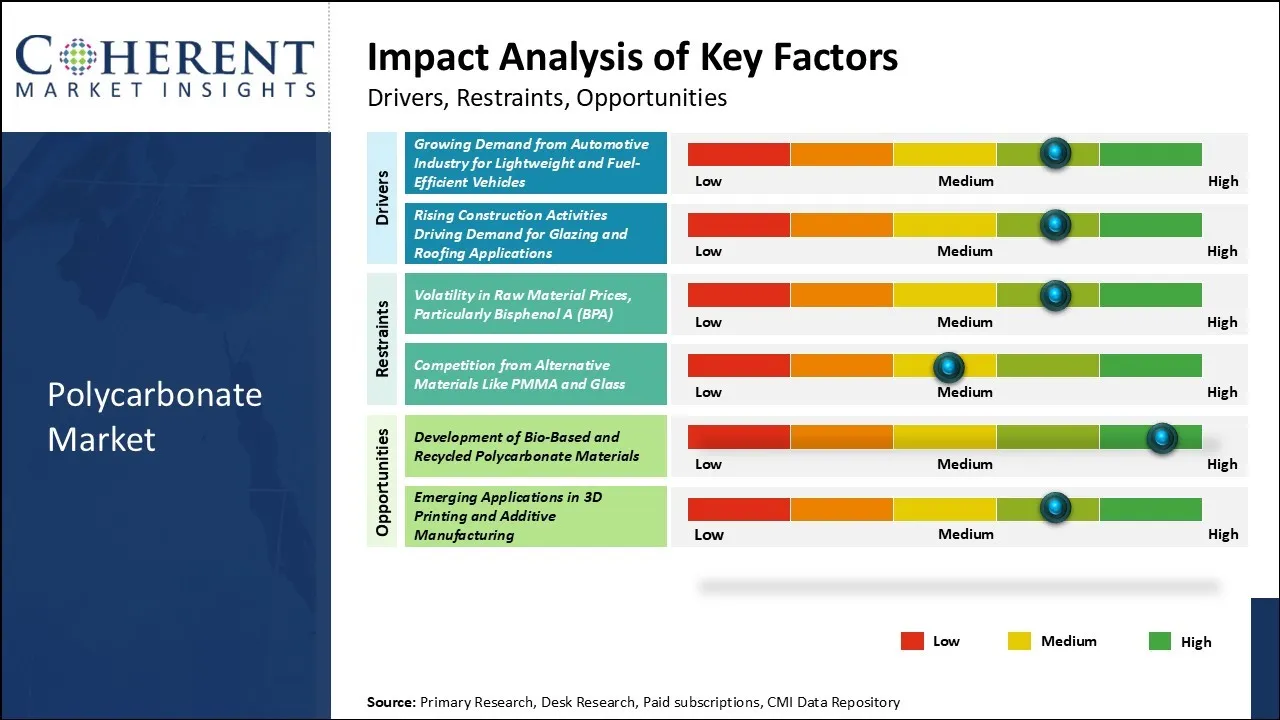
Polycarbonate is a high-performance thermoplastic polymer that is tough, transparent, and amorphous. It exhibits excellent properties such as moisture resistance, chemical resistance, electrical resistance, and thermal stability. It is produced through a step-growth polymerization process. Moreover, polycarbonate resins can be processed into components using injection molding and extrusion techniques.
However, growing environmental concerns as these polymers are difficult to recycle which can harm both terrestrials, as well as aquatic life in the environment, is expected to hinder the market growth.
Market Concentration and Competitive Landscape
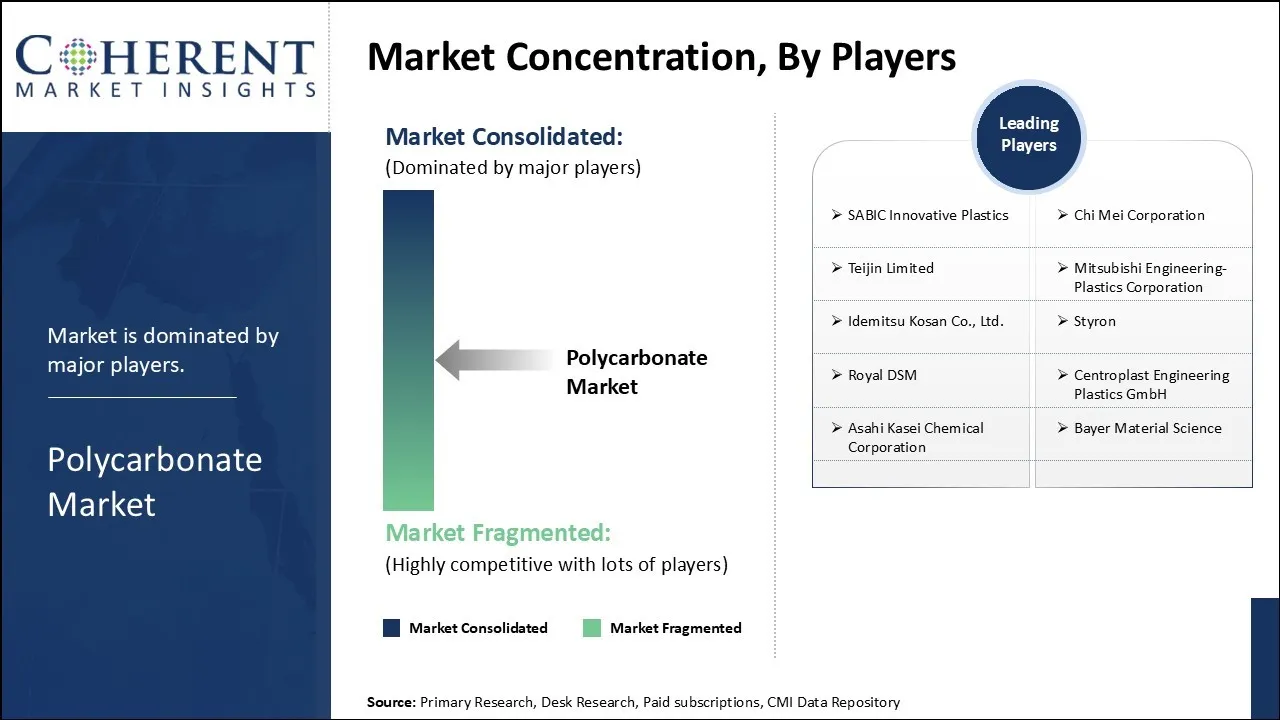
Current Events and their Impact on the Polycarbonate Market
Current Events | Description and its impact |
Geopolitical and Trade Dynamics |
|
Economic and Market Conditions |
|
- Current Industry Events of 2026
- Market Size Estimation
- Regional Breakdown
- Competitive Landscape
- Customer Intelligence
- Segmental Analysis
- Pricing Analysis
- Key Market Drivers, Challenges & Future Trends
- Customized Insights Section
Market Trends
Rising Construction Activities
The surge in construction activities globally is playing a pivotal role in propelling the growth of the polycarbonate market. Polycarbonate, known for its high impact resistance, optical clarity, thermal stability, and lightweight nature, is increasingly favored in various construction applications such as roofing sheets, window panels, skylights, and facades. This trend is particularly evident in urbanizing regions where governments and private sectors are investing heavily in infrastructure development to meet housing demands and commercial space expansions.
For instance, according to the United Nations Department of Economic and Social Affairs (UN DESA), the global urban population is projected to increase by nearly 2.5 billion by 2050, with rapid development occurring in Asia and Africa since 2020.
Segmental Insights
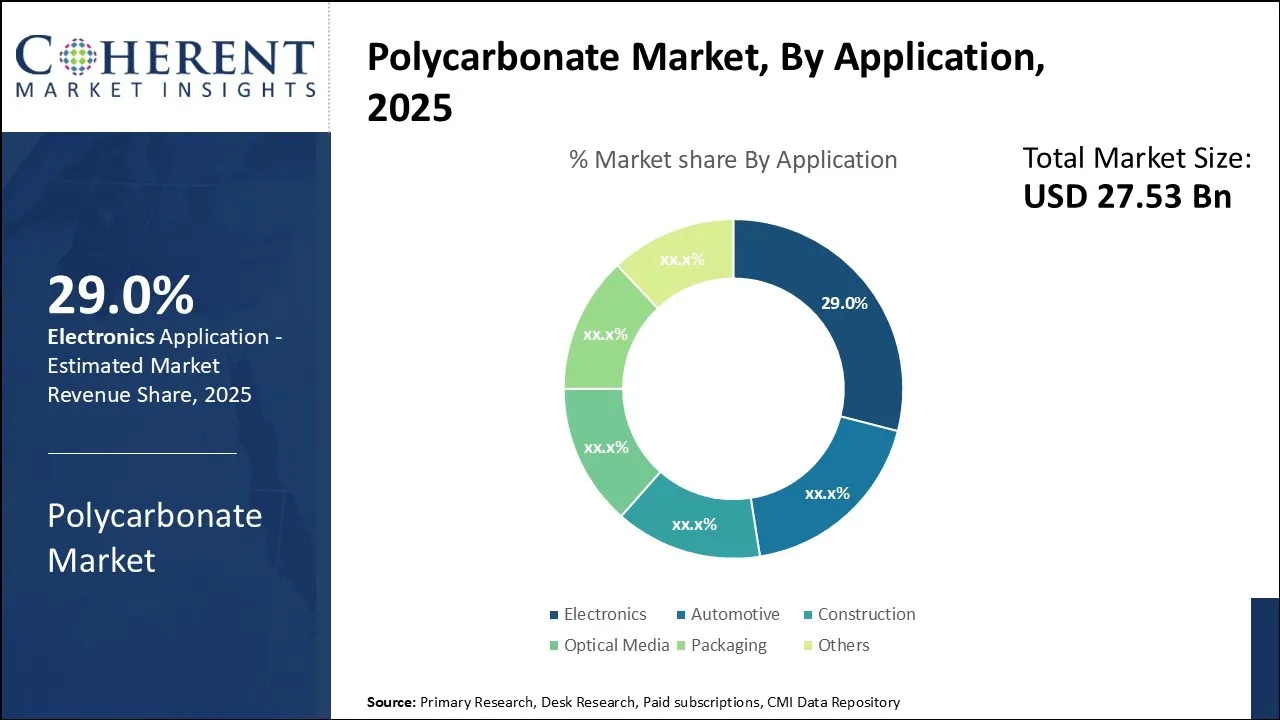
Polycarbonate Market Insights, By Application: Electronics Segment Dominates Owing to Dramatic and Sustained Growth in Consumer Electronics
The electronics segment is expected to contribute the highest share of 30.0% in 2026. This dominance stems from the material’s vital role in electronics manufacturing, where its properties—such as durability, impact resistance, thermal stability, and electrical insulation—are critical for enhancing device performance and safety. Polycarbonate is widely used in enclosures, screen panels, connectors, and other components across consumer electronics, appliances, and industrial electrical equipment.
Polycarbonate’s unique properties such as high impact resistance, excellent dimensional stability, and superb thermal resistance make it an ideal material for manufacturing electronic devices. For instance, polycarbonate is extensively used in the production of smartphones, tablets, laptops, and other portable devices where its lightweight property aids in increasing portability while its durability ensures protection against accidental drops and damage.
Emerging Innovations in the Polycarbonate Market
- The Enhancement of Material Properties Through Molecular and Formulation Engineering
- Advances in polymerization techniques have enabled the production of polycarbonate grades with superior mechanical strength, higher thermal resistance, and better UV stability. These improvements extend the application scope of PC, particularly in outdoor and high-performance environments such as automotive lighting and architectural glazing.
- Growing Emphasis on Sustainability and Recyclability
- With increased environmental regulations and consumer awareness, manufacturers are focusing on developing bio-based polycarbonates and improving recycling processes. Chemical recycling, where polycarbonate waste is depolymerized and re-monomerized to produce virgin-quality polymers, is gaining traction as a method to reduce environmental impact without compromising material performance.
Analysis of Manufacturing Facilities and Production Capacities of Manufacturers in the Polycarbonate Market
Manufacturers | Their Manufacturing Facilities |
Covestro AG |
|
LG Chem |
|
Regional Insights
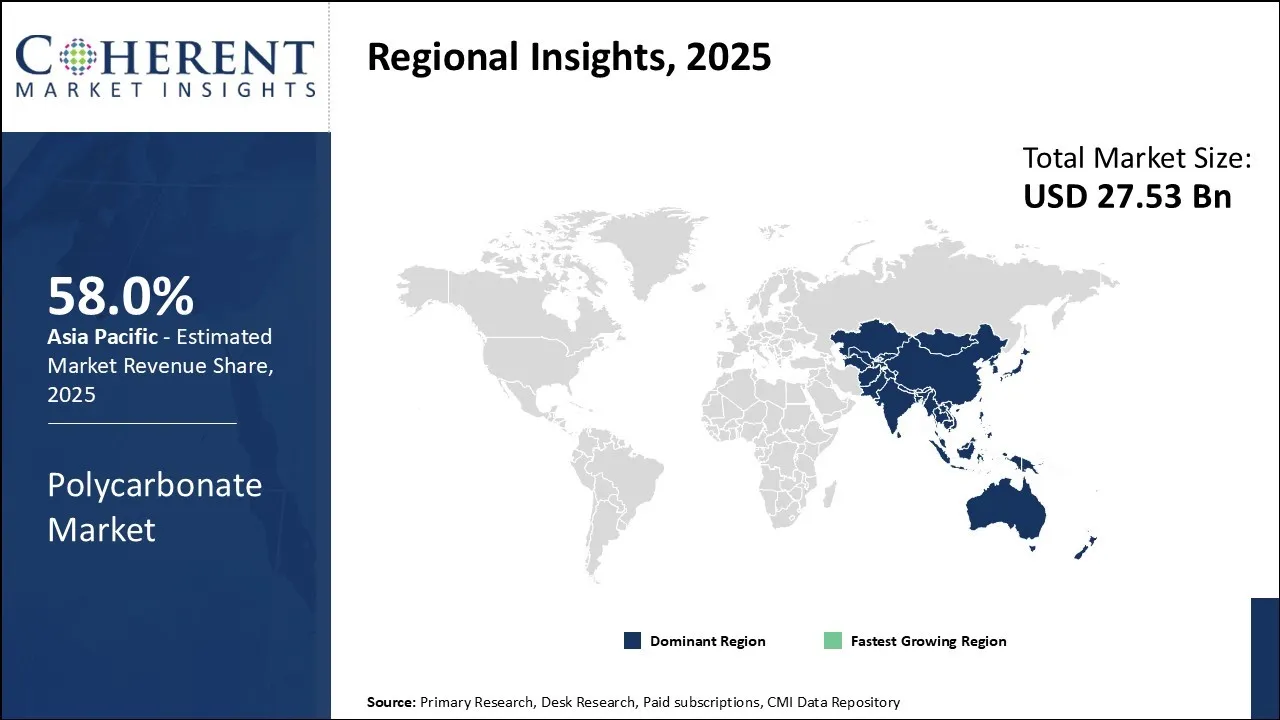
Asia Pacific Polycarbonate Market Analysis and Trends
Asia Pacific has established itself as the dominant region with an estimated market share of 58.0% in 2026 in the global polycarbonate market. Countries such as China, Japan, South Korea, and India serve as major hubs for polycarbonate production and consumption, driven by rapid industrialization and urbanization coupled with supportive government initiatives aimed at enhancing local manufacturing capacities.
For instance, Covestro announced an investment of over USD 29.7 million in a new production line in Asia Pacific, scheduled to be commissioned in 2023. The line will be capable of producing more than 25,000 tons of high-quality polycarbonates and blends containing mechanically recycled content annually. Overall, the company aims to deliver over 60,000 tons per year of polycarbonates with recycled content in the region by 2026, underscoring Asia Pacific’s growing role in sustainable polycarbonate manufacturing.
Polycarbonate Market Outlook for Key Countries
China Polycarbonate Market Analysis and Trends
China stands as the largest producer and consumer in the global polycarbonate market. Its dominance is driven by the country’s massive industrial base, particularly in electronics, automotive, and construction sectors — all major consumers of polycarbonate. Government-backed initiatives such as "Made in China 2026" support domestic manufacturing and technological upgrades, which further stimulate polycarbonate demand. Additionally, China continues to expand its production capacity through both state-owned and private enterprises, making it a central player in global supply chains.
U.S. Polycarbonate Market Analysis and Trends
The U.S. remains a key contributor to the polycarbonate market due to its advanced manufacturing infrastructure, strong presence of leading chemical companies, and high demand from automotive, medical, and aerospace industries. The country is home to several major producers of polycarbonate resins and has a robust innovation ecosystem that supports the development of high-performance and sustainable materials. Regulatory support for lightweight and environmentally friendly materials in transportation and construction further boosts domestic polycarbonate usage.
Germany Polycarbonate Market Analysis and Trends
Germany plays a critical role in the European polycarbonate market, primarily due to its strong automotive and engineering sectors. As the largest economy in Europe, Germany emphasizes precision manufacturing and high-performance materials, both of which require polycarbonate for applications like headlamp covers, electronic housings, and lightweight interior components. The country is also at the forefront of recycling and sustainable materials development, encouraging the use of bio-based and recycled-content polycarbonate products.
South Korea Polycarbonate Market Analysis and Trends
South Korea has emerged as a significant player in the polycarbonate market, supported by its global leadership in consumer electronics and semiconductor manufacturing. Polycarbonate is a critical material for high-end electronic components, displays, and protective casings — areas where South Korea excels. Major chemical producers based in the country, combined with strong export demand for electronic goods, contribute to its growing influence. Continued investments in R&D and material innovation further strengthen South Korea’s position in the global polycarbonate landscape.
Pricing Analysis of the Polycarbonate Market
Region | Pricing Range (USD/Kg) |
North America | 2.8 - 5.2 |
Europe | 2.9 - 5.0 |
Asia Pacific | 2.3 - 4.5 |
Middle East | 2.7 - 4.8 |
Latin America | 2.6 - 4.0 |
Market Report Scope
Polycarbonate Market Report Coverage
| Report Coverage | Details | ||
|---|---|---|---|
| Base Year: | 2025 | Market Size in 2026: | USD 29.46 Bn |
| Historical Data for: | 2020 To 2024 | Forecast Period: | 2026 To 2033 |
| Forecast Period 2026 to 2033 CAGR: | 7.0% | 2033 Value Projection: | USD 47.30 Bn |
| Geographies covered: |
| ||
| Segments covered: |
| ||
| Companies covered: | SABIC Innovative Plastics, Chi Mei Corporation, Teijin Limited, Mitsubishi Engineering-Plastics Corporation, Idemitsu Kosan Co., Ltd., Styron, Royal DSM, Centroplast Engineering Plastics GmbH, Asahi Kasei Chemical Corporation, and Bayer Material Science | ||
| Growth Drivers: |
| ||
| Restraints & Challenges: |
| ||
Polycarbonate Industry News
- In July 2025, Teijin Limited announced that pipes molded from its biomass-derived polycarbonate (PC) resin were adopted for use in the world’s first pipe organ made from bioplastic. The transparent pipes were manufactured by Teiyo Co., Ltd., a Teijin Group company specializing in plastic molding.
- In May 2025, Covestro presented its series of high-performance, sustainable material solutions at its customer salon in Taiwan - "AI Forward: Circular Future Together". These innovative materials help consumer electronic products achieve performance upgrades, collaborative innovation, and sustainable development in the era of artificial intelligence (AI).
- In March 2025, SABIC showcased specialty materials that empower robust data infrastructures at the 2025 Optical Fiber Communications (OFC) conference and exhibition. At the event, the company highlighted high-performance materials, including ULTEM and SILTEM resins and LNP ELCRES polycarbonate copolymers, which helps customers to build robust and reliable data infrastructures.
- In March 2025, Haldia Petrochemicals Ltd (HPL), planned to establish a polycarbonate production plant in West Bengal with a capital expenditure of USD 1 billion (approximately ₹8,700 crore). The company intended to utilize spare land at its existing site in Haldia, signaling further diversification into the chemical downstream business.
Analyst View
- The polycarbonate market is witnessing robust momentum driven primarily by its versatile applications across multiple industries such as automotive, electronics, construction, and consumer goods. The growing demand for lightweight and durable materials in automotive manufacturing is a significant driver, as polycarbonate offers high impact resistance and thermal stability, contributing to enhanced fuel efficiency and safety.
- Additionally, the surge in electronics innovation, particularly in smartphones, laptops, and wearable devices, fuels demand due to polycarbonate’s excellent optical clarity and electrical insulation properties.
- However, the market faces some restraints, notably the high production cost of polycarbonate compared to alternative plastics like polypropylene or polyethylene. Environmental concerns related to plastic waste and increasing regulatory pressures to adopt sustainable materials also pose challenges for widespread adoption. Moreover, volatility in raw material prices may impact market stability.
- On the opportunity front, advancements in bio-based polycarbonate and recycling technologies present promising avenues to address environmental issues while meeting the rising demand for sustainable products. The integration of polycarbonate in 3D printing for customized applications further broadens its potential.
Market Segmentation
- Application Insights (Revenue, USD Bn, 2021 - 2033)
- Automotive
- Electronics
- Construction
- Optical Media
- Packaging
- Others
- Regional Insights (Revenue, USD Bn, 2021 - 2033)
- North America
- U.S.
- Canada
- Latin America
- Brazil
- Argentina
- Mexico
- Rest of Latin America
- Europe
- Germany
- U.K.
- Spain
- France
- Italy
- Russia
- Rest of Europe
- Asia Pacific
- China
- India
- Japan
- Australia
- South Korea
- ASEAN
- Rest of Asia Pacific
- Middle East
- South Africa
- GCC Countries
- Israel
- Rest of Middle East
- Africa
- South Africa
- North Africa
- Central Africa
- Key Players Insights
- SABIC Innovative Plastics
- Teijin Limited
- Chi Mei Corporation
- Idemitsu Kosan Co., Ltd.
- Mitsubishi Engineering-Plastics Corporation
- Styron
- Centroplast Engineering Plastics GmbH
- Bayer MaterialScience
- Royal DSM
- Asahi Kasei Chemical Corporation
Sources
Primary Research Interviews
- Polycarbonate manufacturers and producers
- Raw material suppliers (bisphenol A, phosgene)
- Automotive industry procurement managers
- Electronics and electrical equipment manufacturers
- Others
Magazines
- Plastics Today
- Modern Plastics Worldwide
- Plastics Engineering Magazine
- Automotive Plastics & Composites
- Others
Journals
- Polymer Engineering & Science
- Journal of Applied Polymer Science
- Plastics, Rubber and Composites
- Others
Newspapers
- Chemical Week
- Plastics News
- ICIS Chemical Business News
- Chemical & Engineering News
- Others
Associations
- Society of Plastics Engineers (SPE)
- American Chemistry Council (ACC)
- Plastics Industry Association
- European Plastics Converters (EuPC)
- Others
Public Domain Sources
- U.S. Environmental Protection Agency (EPA)
- European Chemicals Agency (ECHA)
- Ministry of Commerce & Industry statistics
- Trade statistics from various government portals
- Others
Proprietary Elements
- CMI Data Analytics Tool – Polycarbonate Market
- CMI Existing Repository of Information for the Last 8 Years
*Definition: The polycarbonate market refers to the global industry involved in the production, distribution, and application of polycarbonate, a high-performance thermoplastic known for its strength, transparency, thermal stability, and impact resistance, widely used across sectors such as automotive, electronics, construction, medical, and packaging.
Get access to 250+ pages report
Every segment, forecast, competitor profile and data table behind the analysis above — available for instant download.
- ESOMAR Member
- ISO 9001:2015 Certified
- D-U-N-S Registered
- GDPR & CCPA Compliant
Missing comfort of reading report in your local language? Find your preferred language:
Transform your Strategy with Exclusive Trending Reports
Frequently Asked Questions
The polycarbonate market is estimated to be valued at USD 29.46 Bn in 2026 and is expected to reach USD 47.30 Bn by 2033.
The CAGR of the polycarbonate market is projected to be 7.0% from 2026 to 2033.
Rising adoption of polycarbonate in the manufacturing of packaging solutions is expected to drive the market growth during the forecast period.
Environmental concerns associated with the usage of polycarbonate is hampering the market growth.
In terms of application, electronics is estimated to dominate the market revenue share in 2026.
Major players operating in the polycarbonate market include SABIC Innovative Plastics, Chi Mei Corporation, Teijin Limited, Mitsubishi Engineering-Plastics Corporation, Idemitsu Kosan Co., Ltd., Styron, Royal DSM, Centroplast Engineering Plastics GmbH, Asahi Kasei Chemical Corporation, and Bayer Material Science.
Asia Pacific is expected to lead the polycarbonate market in 2026.