

Vinyl Acetate Monomer Market Analysis & Forecast: 2026-2033
Vinyl Acetate Monomer Market is estimated to be valued at USD 11.19 Bn in 2026 and is expected to reach USD 17.17 Bn in 2033, exhibiting a compound annual growth rate (CAGR) of 6.3% from 2026 to 2033.
Key Takeaways
- Based on Application, the Polyvinyl Acetate (PVAc) segment is projected to dominate the market with 47.2% share in 2026, due to its widespread industrial applications.
- Based on Region, Asia Pacific is set to lead the market with 46.2% share in 2026. While, North America is holing 25% share and is projected to be the fastest growing region.
Market Overview
The vinyl acetate monomer market demand is rising steadily due to its widespread use in adhesives, paints, coatings, textiles, and packaging. This versatile chemical is a key ingredient in manufacturing polyvinyl acetate and polyvinyl alcohol, which are essential in construction, automotive, and consumer goods. Growth is driven by expanding industrial applications and increased infrastructure development, especially in emerging economies. Environmental regulations and innovations in bio-based alternatives are also influencing market dynamics, prompting manufacturers to adapt and invest in sustainable production methods.
Current Events and Their Impact on the Vinyl Acetate Monomer Market
Current Event | Description and its Impact |
Global Energy Crisis and Feedstock Price Volatility |
|
European Union's Green Deal and Sustainability Regulations |
|
Feedstock Cost Impact on VAM Production
According to cost analysis, acetic acid and ethylene together account for over 60% of total VAM production costs. This makes Vinyl Acetate Monomer (VAM) pricing highly reactive to upstream volatility.
- Acetic Acid: Prices vary based on methanol availability, energy costs, and regional supply. For example, in Q2 2025, acetic acid prices in China hovered around USD 520–580/MT, while in the U.S. they ranged from USD 600–650/MT, reflecting regional production dynamics.
- Ethylene: As a petrochemical, ethylene prices are tied to crude oil and natural gas markets. In 2025, global ethylene prices fluctuated between USD 900–1,100/MT, with spikes during energy supply disruptions.
These fluctuations directly influence VAM pricing. For instance, VAM prices in Q2 2025 were:
- USA: USD 1,298/MT
- China: USD 738/MT
- France: USD 1,121/MT
- Brazil: USD 1,345/MT
- Current Industry Events of 2026
- Market Size Estimation
- Regional Breakdown
- Competitive Landscape
- Customer Intelligence
- Segmental Analysis
- Pricing Analysis
- Key Market Drivers, Challenges & Future Trends
- Customized Insights Section
Segmental Insights
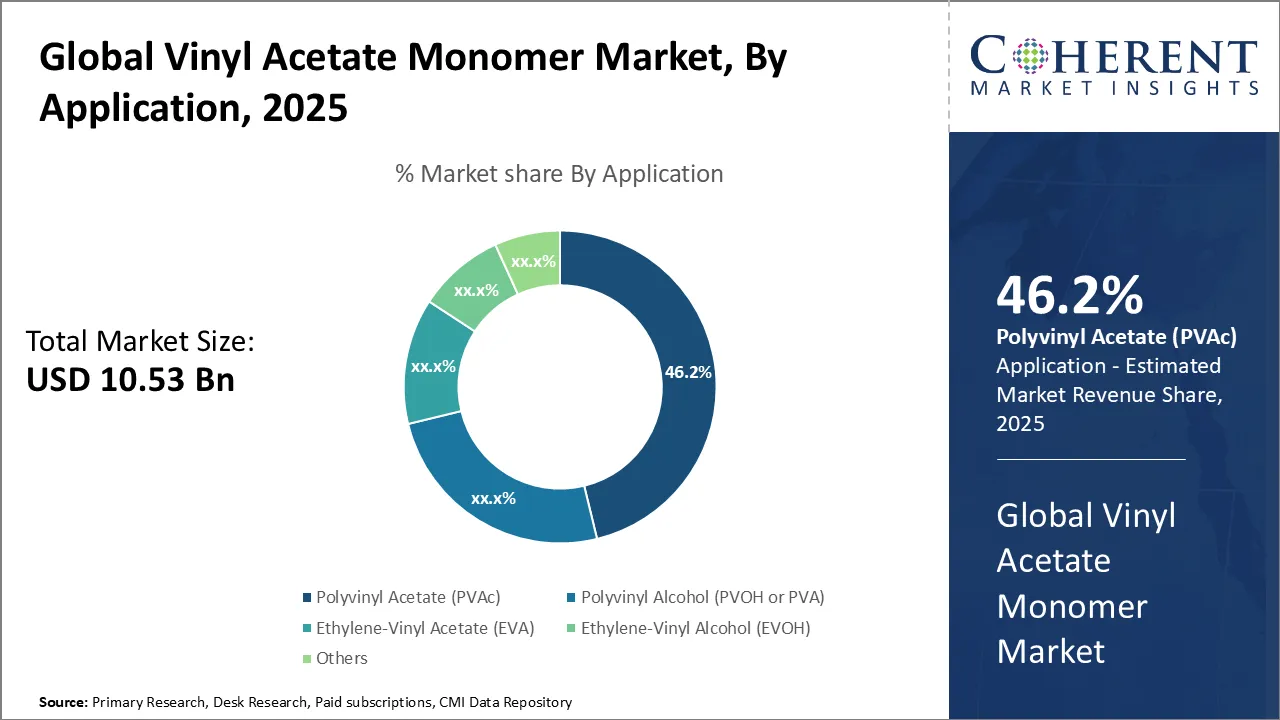
Vinyl Acetate Monomer Market Insights, By Application: Polyvinyl Acetate (PVAc) Segment Dominates Due To Its Widespread Industrial Applications
In terms of application, the Polyvinyl Acetate (PVAc) segment is expected to lead the market with 47.2% share in 2026, due to its extensive use in adhesives, paints, coatings, and construction materials. Its strong bonding properties and versatility make it a preferred choice across industries such as packaging, woodworking, and textiles. The demand for PVAc-based emulsions is particularly high in the Asia-Pacific region, where infrastructure development and industrial manufacturing are accelerating.
For instance, in May 2026, Borealis unveiled a renewables-based polymer grade designed for footwear midsoles, leveraging Ethylene-Vinyl Acetate (EVA) technology. EVA is a copolymer of ethylene and vinyl acetate monomer, widely used for its cushioning and flexibility. This innovation highlights the growing role of Vinyl Acetate Monomer in sustainable materials for consumer applications.
Regional Insights
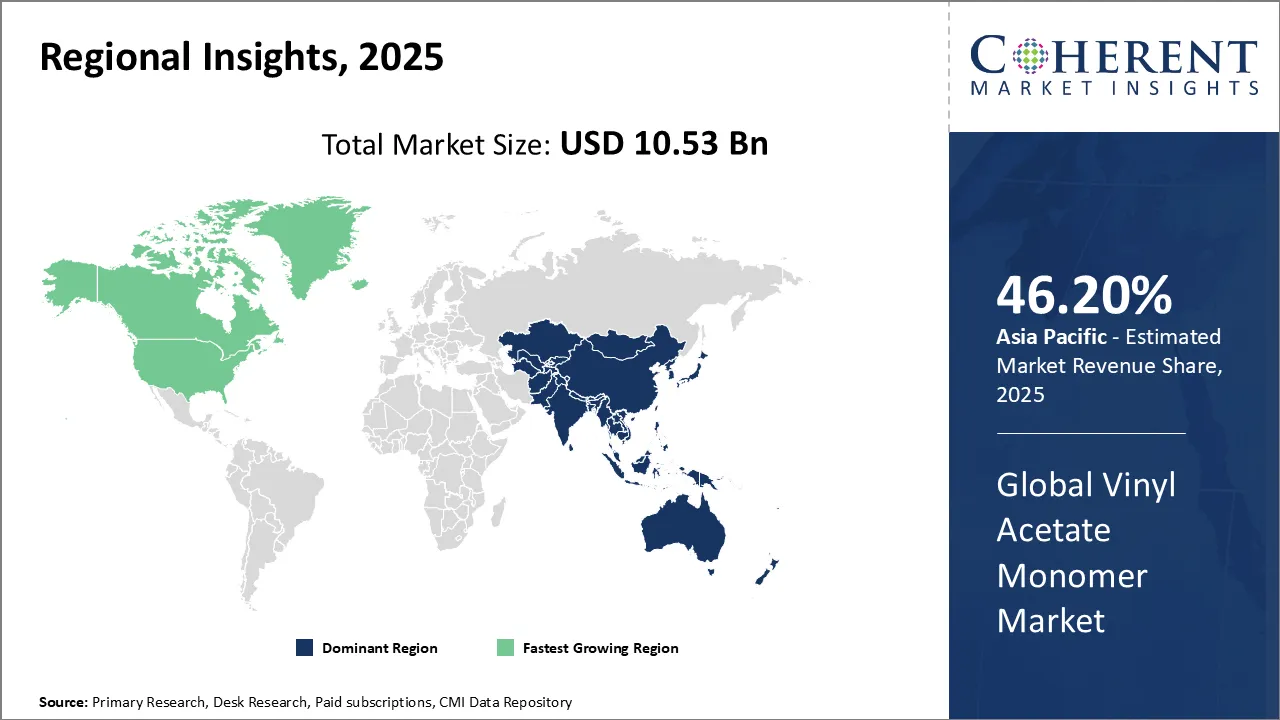
Asia Pacific Vinyl Acetate Monomer Market Analysis & Trends
Asia Pacific, holding a share of 46.20% in 2026, is expected to dominate the global vinyl acetate monomer market in 2026, due to rapid industrialization, infrastructure development, and booming manufacturing sectors. High consumption of adhesives, paints, textiles, and packaging materials, especially in China and India is fueling growth. Expanding construction and automotive industries further amplify the region’s dominance in VAM applications.
For instance, in September 2026, Kuraray earned ISCC PLUS certification for three production sites in Japan, enabling a certified supply chain for five vinyl acetate-related products. This includes Vinyl Acetate Monomer (VAM), PVOH resin and film, and EVOH resin and film. The move reinforces Kuraray’s commitment to sustainability and strengthens Japan’s role in the global VAM market.
North America Vinyl Acetate Monomer Market Analysis & Trends
North America is expected to exhibit the fastest growth of the market, driven by robust growth in the construction, automotive, and packaging sectors. Increased use of adhesives, coatings, and films, especially in infrastructure upgrades and consumer goods, fuels consumption. Technological advancements and sustainability initiatives also support the region’s expanding VAM applications.
For instance, in September 2026, Celanese implemented private 5G networks at two Texas manufacturing sites with NTT Data and Celona, enhancing automation and safety. As the world’s leading producer of Vinyl Acetate Monomer (VAM), Celanese’s digital upgrade supports more efficient chemical operations, reinforcing its role in the global VAM supply chain.
Vinyl Acetate Monomer Market Outlook Country-Wise
China Vinyl Acetate Monomer Market Trends
In 2026, China's Vinyl Acetate Monomer Market demand is driven by its expansive manufacturing base, rapid urbanization, and strong growth in construction, packaging, and textile industries. High consumption of high performance adhesives, paints, and coatings, coupled with government infrastructure initiatives, positions China as a key global consumer of VAM-based products.
For instance, in January 2026, Haitung Group Limited has announced major updates to its Vinyl Acetate Monomer (VAM) factory in China, boosting production and distribution capacity to meet rising global demand. As one of Asia’s top VAM producers, Haitung’s expansion strengthens China’s position in the international chemical supply chain and supports growing industrial applications worldwide.
India Vinyl Acetate Monomer Market Trends
India’s Vinyl Acetate Monomer Market sees strong demand in 2026 due to rising consumption in paints, adhesives, and textiles. Government initiatives supporting manufacturing and exports, along with seasonal growth in construction and automotive sectors, boost VAM usage. Domestic production recovery also reduces import dependency, strengthening market momentum.
For instance, in March 2026, Asian Paints announced an additional capital expenditure of ₹690 crore to expand its manufacturing capacity across India. This strategic investment is expected to enhance production of paints and coatings, potentially increasing demand for raw materials like Vinyl Acetate Monomer (VAM), crucial in the formulation of adhesives and emulsions.
Market Report Scope
Vinyl Acetate Monomer Market Report Coverage
| Report Coverage | Details | ||
|---|---|---|---|
| Base Year: | 2025 | Market Size in 2026: | USD 11.19 Bn |
| Historical Data for: | 2020 To 2024 | Forecast Period: | 2026 To 2033 |
| Forecast Period 2026 to 2033 CAGR: | 6.3% | 2033 Value Projection: | USD 17.17 Bn |
| Geographies covered: |
| ||
| Segments covered: |
| ||
| Companies covered: | Celanese Corporation Dairen Chemical Corporation, Japan VINYL ACETATE MONOMER & POVAL Co. Ltd., Kuraray Co. Ltd., LyondellBasell Industries, Ningxia Yinglite Chemical Co., Ltd., China Petroleum & Chemical Corporation (Sinopec Corp.), The Dow Chemical Company, Wacker Chemie AG | ||
| Growth Drivers: |
| ||
| Restraints & Challenges: |
| ||
Global Vinyl Acetate Monomer Market Driver
Rising Infrastructural Investment
Global infrastructure investment is accelerating demand in the vinyl acetate monomer market size in 2025. As countries prioritize urban development, transportation upgrades, and industrial expansion, the need for high-performance materials intensifies. VAM is a key ingredient in adhesives, paints, and coatings used across construction, automotive, and packaging sectors. Its role in producing polymers like PVAc and PVOH makes it essential for durable, weather-resistant applications. From smart cities in Asia to transit systems in North America, infrastructure growth is fueling VAM consumption worldwide. This surge is prompting manufacturers to scale production and innovate in sustainable chemical processes to meet rising global demand.
Increasing Demand Across a Range of End Industries
The vinyl acetate monomer market is experiencing rising demand across diverse end-use industries in 2025. VAM is a key raw material in producing adhesives, paints, coatings, textiles, and packaging films, making it indispensable in construction, automotive, consumer goods, and electronics. Growth in e-commerce boosts packaging needs, while infrastructure and housing projects drive paint and adhesive consumption. Textile and paper industries also rely on VAM-based polymers like PVOH for enhanced performance. This broad industrial reliance is expanding the vinyl acetate monomer market share globally, prompting manufacturers to scale production and innovate sustainable solutions to meet evolving sectoral requirements.
Vinyl Acetate Monomer Market Opportunity
Automotive and Electronics Applications
The automotive and electronics sectors are emerging as dynamic growth drivers in the vinyl acetate monomer market forecast for 2025 and beyond. VAM-derived polymers such as polyvinyl acetate and ethylene-vinyl acetate are widely used in wire coatings, sealants, and interior components due to their durability, flexibility, and adhesive properties. As electric vehicles (EVs) gain momentum and consumer electronics become more compact and sophisticated, manufacturers increasingly rely on lightweight, high-performance materials to meet design and efficiency standards. This surge in technological innovation and production volume is expected to significantly influence VAM consumption, reinforcing its role in advanced material applications across global markets.
Analyst Opinion (Expert Opinion)
The Vinyl Acetate Monomer market value currently exhibits structural tightness driven by upstream supply constraints and regional cost asymmetries. Limited integration among producers and recurring disruptions in acetic acid and ethylene supply continue to create significant price volatility. For instance, in mid-2025, VAM prices averaged around USD 738/ton in China, compared to nearly USD 1,345/ton in Brazil, underscoring strong regional divergence driven by logistics costs, regulatory pressures, and feedstock availability.
Operational outages by major integrated producers have tightened global supply by an estimated 15–20% in affected quarters, reinforcing the influence of a few key players. Downstream, demand from polyvinyl acetate (PVAc) emulsions and adhesives remains resilient, particularly in packaging, construction, and coatings, which cushions baseline consumption and amplifies price responses during shortages.
Integrated producers with access to low-cost feedstocks maintain pricing power, while non-integrated formulators face a risk premium in spot procurement. Producers are also enforcing pricing discipline through contract-based supply prioritization, compelling downstream manufacturers to diversify sourcing or secure long-term offtake agreements.
Overall, the VAM market is structurally imbalanced, favoring integrated players and disciplined producers. Sustained investment in feedstock security, operational reliability, and contract flexibility will remain essential to navigate persistent supply-demand volatility.
Speak to the analyst
Want personalized insights?
Take the findings above to one of our principal consultants, or have the report rebuilt around the segments, geographies and competitors you actually track.
Recent Development
- In September 2025, Prochema introduced Vinyl Neodecanoate V10, a high-performance monomer designed for advanced coatings and adhesives. The launch strengthens Prochema’s specialty chemical portfolio, offering enhanced weather resistance and flexibility. This innovation supports growing demand in construction, automotive, and industrial applications, aligning with market trends for durable and sustainable materials.
- In April 2025, the Bureau of Indian Standards (BIS) extended the Quality Control Order (QCO) for Vinyl Acetate Monomer, Methyl Acrylate, and Ethyl Acrylate. This regulatory move aims to enhance product quality and safety in chemical imports and manufacturing. Compliance with BIS standards is now mandatory for producers and importers operating in India.
- In March 2025, Celanese Corporation announced price increases for Vinyl Acetate Monomer (VAM) and its derivatives across the Western Hemisphere. The adjustment reflects rising raw material costs and market demand. The company aims to maintain supply reliability while addressing cost pressures in its acetyl chain product portfolio.
- In January 2025, Crasus Chemical signed a licensing agreement with Yulin Chemical to provide its Vinyl Acetate Monomer (VAM) production technology. The deal includes catalyst supply and operational expertise, enabling Yulin to establish a 200,000-ton annual VAM plant in Shaanxi Province. This partnership supports China’s growing demand for high-quality VAM and advanced chemical manufacturing.
Market Segmentation
- Global Vinyl Acetate Monomer Market, By Application (Revenue, USD Bn, 2021 - 2033)
- Polyvinyl Acetate (PVAc)
- Polyvinyl Alcohol (PVOH or PVA)
- Ethylene-Vinyl Acetate (EVA)
- Ethylene-Vinyl Alcohol (EVOH)
- Others
- Global Vinyl Acetate Monomer Market, By Region (Revenue, USD Bn, 2021 - 2033)
- North America
- U.S.
- Canada
- Europe
- U.K.
- Germany
- France
- Italy
- Spain
- Russia
- Rest of Europe
- Asia Pacific
- China
- India
- Japan
- ASEAN
- Australia
- South Korea
- Rest of Asia Pacific
- Latin America
- Brazil
- Mexico
- Rest of Latin America
- Middle East & Africa
- Middle East
- Africa
- North America
- Market Companies
- Celanese Corporation
- Dairen Chemical Corporation
- Japan VINYL ACETATE MONOMER & POVAL Co. Ltd.
- Kuraray Co. Ltd.
- LyondellBasell Industries
- Ningxia Yinglite Chemical Co., Ltd.
- China Petroleum & Chemical Corporation (Sinopec Corp.)
- The Dow Chemical Company
- Wacker Chemie AG
Sources
Primary Research Interviews from the following stakeholders
Stakeholders
- Plant process & production managers at VAM / acetylene-derivative chemical plants.
- R&D and product development chemists (polyvinyl acetate (PVAc), polyvinyl alcohol (PVA) producers).
- Procurement and sourcing heads at adhesives, coatings, paints, and emulsion manufacturers.
- Technical managers and formulators at adhesives & sealants manufacturers.
- Manufacturers of downstream polymers (PVA, PVAc), vinyl acetate copolymers and ethylene-vinyl acetate (EVA) producers.
- Industrial end-users: packaging film manufacturers, textile finishers, paper & board converters, and nonwovens producers.
- Process engineering and maintenance teams (plant reliability, catalyst & reactor specialists).
- Logistics, trade compliance and export managers (chemical traders, bulk shipping & warehousing).
- Regulatory, EHS and product stewardship leads (compliance with REACH, EPA, etc.).
- Procurement heads at major OEMs that specify adhesives or coating systems (automotive, construction, consumer goods).
- Traders and distributors of VAM and downstream emulsions.
Specific stakeholders
- Heads of procurement / raw materials at major chemical producers and downstream users (e.g., Celanese, Dow, Wacker, Chang Chun, LyondellBasell — interview roles: procurement, process R&D).
- Formulation & technical leads at large adhesives & coatings companies (e.g., H.B. Fuller, Henkel, 3M).
- Product managers / R&D leads at PVAc/PVA producers and polymer compounders.
- Supply chain / logistics managers at bulk chemical traders and port terminals handling VAM (e.g., port terminals at Rotterdam, Shanghai, Houston).
- Regulatory & EHS officers’ at large polymer/adhesive manufacturing clusters.
- Procurement/technical leads at large end-user groups (textile groups, paperboard converters, packaging groups).
- Research heads at industrial research labs and university polymer chemistry departments that publish on vinyl acetate chemistry.
- Plant managers and process engineers at major VAM production sites in Asia, Europe, and the Americas.
Secondary / Desk-research sources
International & Trade Databases
- World Trade Organization (WTO) Trade Statistics
- UN Comtrade Database
- U.S. Bureau of Economic Analysis (BEA) / U.S. Census Foreign Trade (USA trade in chemicals)
- Eurostat (chemical production & trade datasets)
- China Customs Statistics
- Korea Customs Service Data Portal
- Japan External Trade Organization (JETRO) trade statistics
- Directorate General of Commercial Intelligence & Statistics (DGCIS), India / Ministry of Commerce & Industry (India) trade databases
- U.S. International Trade Commission (USITC) data portals
- OECD Chemical Statistics / OECD Trade in Value Added (TiVA) datasets
Industry Magazines & Trade Press
- Chemical & Engineering News (C&EN)
- Chemical Week
- ICIS News & Analysis (chemical markets & pricing)
- Platts / S&P Global commodity coverage (chemical briefs)
- Coatings World
- Adhesives & Sealants Industry (ASI) magazine
- Plastics News
- Polymer Technology Europe / European Coatings Journal
Peer-Reviewed Journals
- Journal of Applied Polymer Science
- Polymer (Elsevier)
- Macromolecules (ACS)
- Polymer Degradation and Stability
- Journal of Vinyl & Additive Technology (or equivalent specialty polymer journals)
- Journal of Coatings Technology and Research
- Industrial & Engineering Chemistry Research
Newspapers & Business Press
- The Wall Street Journal – Industry & Markets (Chemicals)
- Financial Times – Corporate & Commodities coverage
- Nikkei Asia – Chemicals & Supply Chain reporting
- The Economic Times – Industry & Commodities (India)
- South China Morning Post – Manufacturing & Trade news
Associations, Standards Bodies & Trade Organizations
- American Chemistry Council (ACC) — monomer & polymer data, policy updates
- European Chemical Industry Council (Cefic) — market & policy reports
- International Council of Chemical Associations (ICCA)
- PlasticsEurope (polymer statistics and market insights)
- Adhesive and Sealant Council (ASC) / Adhesive & Sealant Industry associations by region
- Society of Chemical Industry (SCI) — conferences and technical papers
- International Organization for Standardization (ISO) — relevant polymer and test standards
- Regional Chambers of Commerce / export promotion bodies (for local trade intelligence)
Regulatory & public-domain technical sources
- European Chemicals Agency (ECHA) — substance dossiers, regulatory restrictions (REACH).
- U.S. Environmental Protection Agency (EPA) — chemical regulatory & safety data.
- Ministry of Chemicals & Fertilizers / Department of Chemicals & Petrochemicals (India) — policy, production statistics, schemes.
- Japan METI (Ministry of Economy, Trade and Industry) — chemical industry reports.
- China Ministry of Ecology & Environment / National Bureau of Statistics — production and environmental compliance data.
- National Institute of Standards and Technology (NIST) — material data and standard references.
- United Nations Industrial Development Organization (UNIDO) — industrial statistics & technical assistance reports.
- FAO / World Bank – when linking VAM use to packaging, agrochemical or industrial trends.
Proprietary Elements
- CMI Data Analytics Tool
- Proprietary CMI Existing Repository of information for last 8 years
Definition: Vinyl Acetate Monomer is an organic compound that is produced by the reaction of ethylene and acetic acid with oxygen by using a palladium catalyst. It is one of the key chemical compounds used to produce various industrial and consumer goods such as polymers and which are further used in coatings, wire, and construction materials.
Get access to 250+ pages report
Every segment, forecast, competitor profile and data table behind the analysis above — available for instant download.
- ESOMAR Member
- ISO 9001:2015 Certified
- D-U-N-S Registered
- GDPR & CCPA Compliant
Missing comfort of reading report in your local language? Find your preferred language:
Transform your Strategy with Exclusive Trending Reports
Frequently Asked Questions
The Vinyl Acetate Monomer Market is estimated to be valued at USD 11.19 Bn in 2026, and is expected to reach USD 17.17 Bn by 2033.
The CAGR of the Vinyl Acetate Monomer Market is projected to be 6.3% from 2026 to 2033.
Increasing focus of the manufacturer on production capacity by establishing new plants is one of the current trends in the market.
Regulation-related issues are preventing growth of the Vinyl Acetate Monomers Market.
Major players operating in the Global Vinyl Acetate Monomer Market include, Celanese Corporation Dairen Chemical Corporation, Japan VINYL ACETATE MONOMER & POVAL Co. Ltd., Kuraray Co. Ltd., LyondellBasell Industries, Ningxia Yinglite Chemical Co., Ltd., China Petroleum & Chemical Corporation (Sinopec Corp.), The Dow Chemical Company, Wacker Chemie AG