

Waste Management Market Size and Forecast – 2026 to 2033
Waste Management Market is estimated to be valued at USD 2,493.15 Bn in 2026 and is expected to reach USD 3,675.13 Bn in 2033, exhibiting a compound annual growth rate (CAGR) of 5.7% from 2026 to 2033.
Key Takeaways
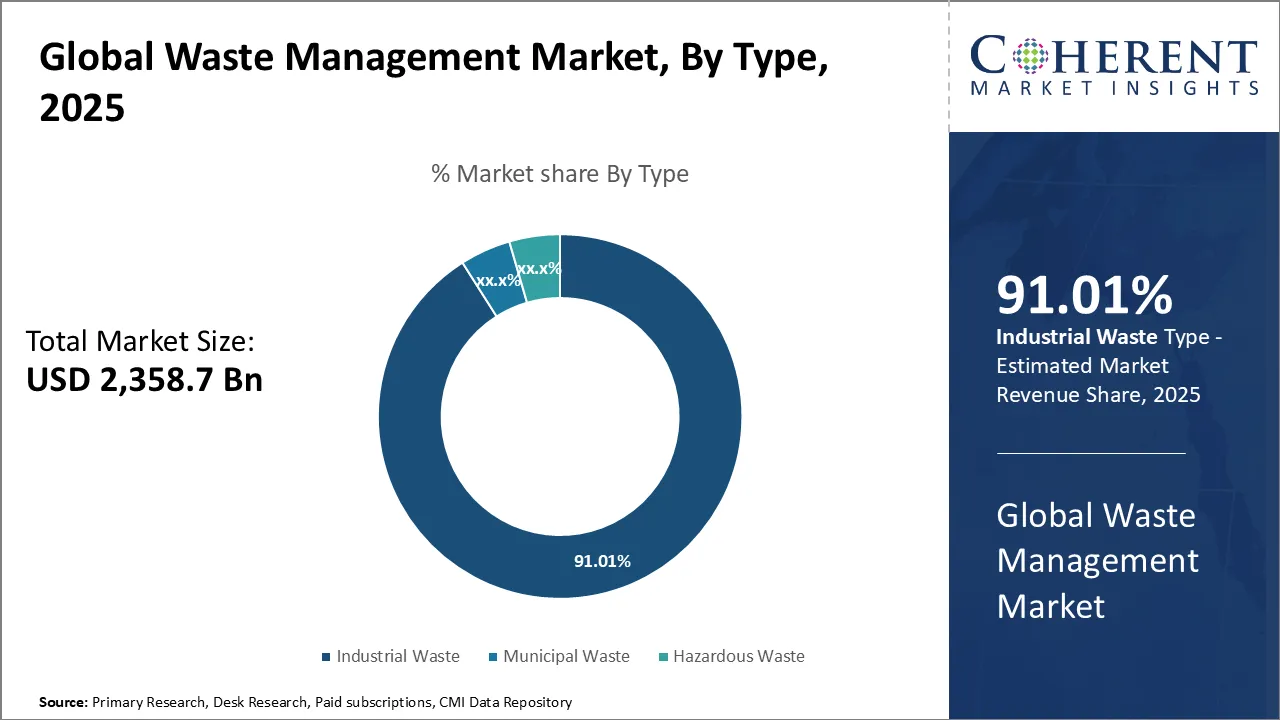
- By Type, Industrial Waste hold the largest market share of 92% in 2026 owing to its rapid industrialization & growth of manufacturing.
- By Service, Collection Service acquired the prominent market share in 2026 owing to the increased waste generation.
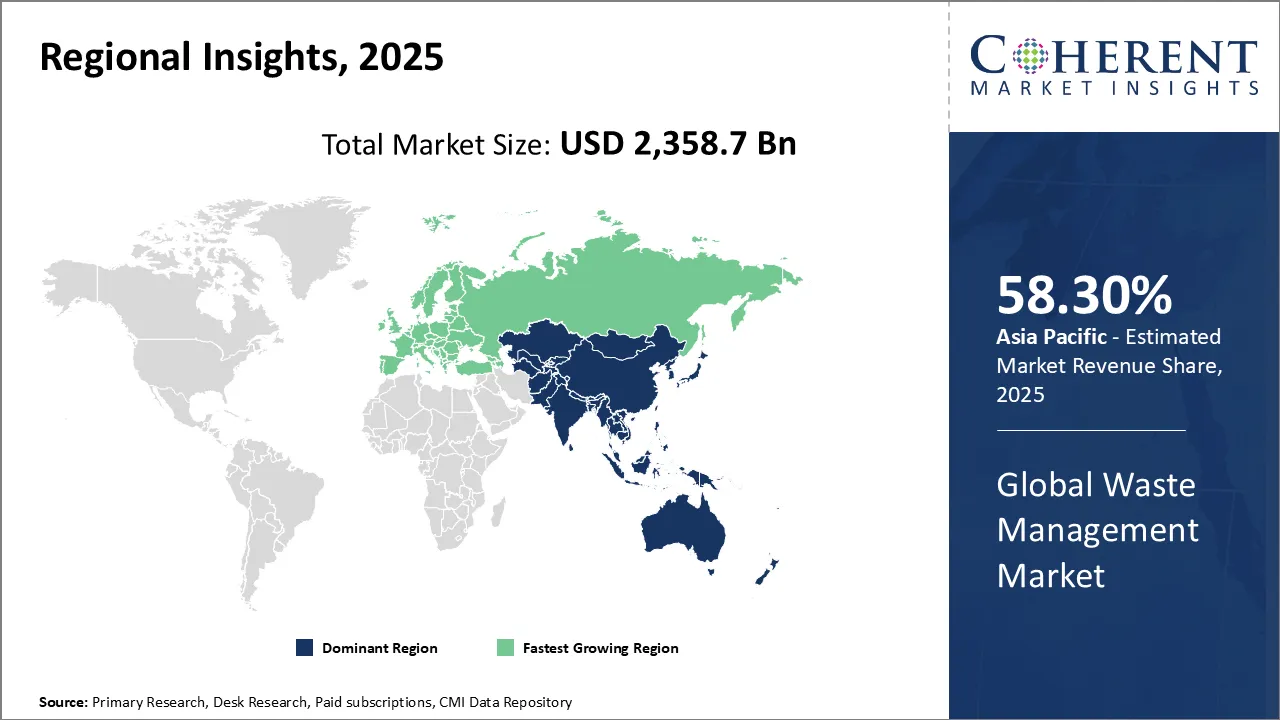
- By Region, Asia Pacific dominates the overall market with an estimated share of 58.30% in 2026 owing to the rapid urbanization & population growth.
Market Overview
The Waste Management Market is rapidly expanding as urbanization, industrialization, and environmental awareness increase. Rising volumes of municipal, industrial, and hazardous waste drive the demand for efficient collection, recycling, treatment, and disposal services. Governments enforce stricter regulations and promote sustainable practices while encouraging private-sector participation. Technological advancements, such as smart collection systems and waste-to-energy solutions, enhance efficiency and resource recovery. The market continues to evolve toward integrated, eco-friendly solutions that prioritize sustainability, circular economy practices, and advanced waste-processing infrastructure across regions.
Current Events and Its Impacts on the Waste Management Market
Current Events | Description and its Impact |
Geopolitical and Regulatory Developments |
|
Technological Innovations and Industry Advances |
|
Economic and Market Dynamics |
|
Segmental Insights
- Current Industry Events of 2026
- Market Size Estimation
- Regional Breakdown
- Competitive Landscape
- Customer Intelligence
- Segmental Analysis
- Pricing Analysis
- Key Market Drivers, Challenges & Future Trends
- Customized Insights Section
Waste Management Market Insights, By Type: Industrial Waste contribute the highest share of the market owing to its rising environmental & sustainability awareness.
Industrial Waste hold the largest market share of 92% in 2026. The rapid growth of manufacturing, construction, and chemical industries drives the generation of large volumes of by-products and hazardous materials, fueling industrial waste in the Waste Management Market. Companies follow strict environmental regulations to ensure proper disposal and treatment. Rising sustainability awareness and corporate responsibility motivate firms to implement recycling, resource recovery, and cleaner production practices. Advances in waste-treatment technologies, automation, and monitoring allow safer and more efficient handling of industrial waste. These factors collectively boost demand for organized and compliant waste-management solutions. For instance, in September 2025, Tiruchi Corporation, reclaimed nearly 40 acres, planned to launch waste management projects at the Ariyamangalam dump yard, with work expected to start soon as negotiations continue.
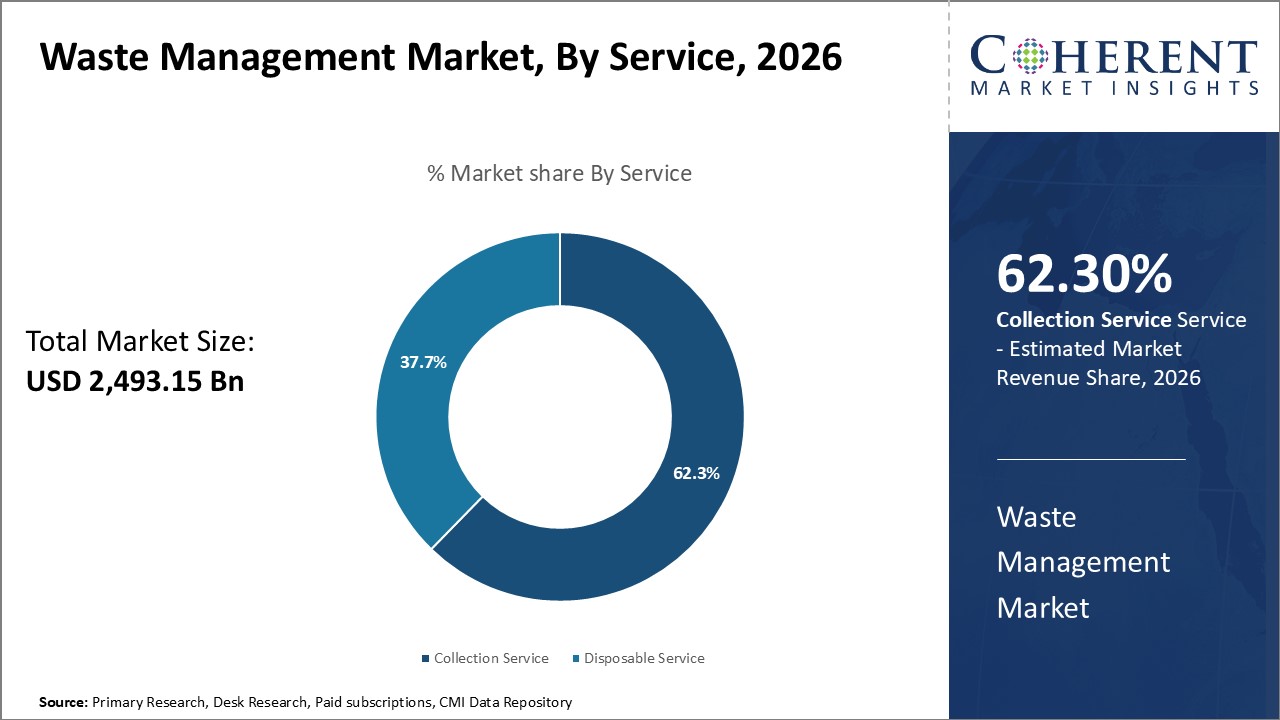
Waste Management Market Insights, By Service: Collection Service contribute the highest share of the market owing to its environmental compliance.
Growing urban populations and expanding commercial activities drive the demand for waste collection services in the Waste Management Market by producing larger volumes of municipal and industrial waste. Governments enforce stricter disposal regulations, leading households and businesses to use organized collection systems. Increased public awareness of hygiene and environmental sustainability motivates proper waste disposal. Moreover, technological innovations, including route optimization, smart bins, and automated monitoring, enhance collection efficiency and reliability. Together, these factors encourage the widespread adoption of professional, structured waste-collection services. For instance, in August 2025, the Tumakuru City ICCC launched “Pick My Garbage,” a digital service letting residents schedule garbage pickups via QR code, a first for the city’s municipal services.
Role of AI (Artificial Intelligence) in the Waste Management Market
Artificial Intelligence is revolutionizing the Waste Management Market by improving efficiency, accuracy, and sustainability in daily operations. AI-powered systems optimize collection routes, track bin fill levels, and forecast waste generation, helping reduce costs and resource consumption. Machine learning algorithms sort recyclables, detect hazardous waste, and streamline processing workflows. AI also supports data-driven decisions for municipalities and companies, enables automated monitoring, and enhances waste-to-energy solutions. Collectively, AI empowers faster, smarter, and more environmentally responsible waste-management practices. For instance, in November 2025, Bengaluru startup AISmart Bin has launched BinPro, an AI-powered waste-segregation bin with 95% accuracy, featuring six compartments and set for deployment in major public spaces.
Regional Insights
Asia Pacific Waste Management Market Trends
Asia Pacific dominates the overall market with an estimated share of 58.30% in 2026. Rising urbanization, increasing waste volumes, and expanding industrial activity are rapidly transforming the Asia Pacific waste‑management market. Cities adopt smart systems, employing IoT-enabled bins, sensor-based monitoring, and AI-driven analytics to optimize collection and sorting, enhancing efficiency and preventing overflow. Governments promote sustainability and circular-economy policies, encouraging waste-to-energy initiatives and recycling programs. Public-private partnerships, stricter regulations, and growing environmental awareness drive investments in modern waste-treatment infrastructure, advancing the region toward more integrated, technology-driven waste-management solutions. For instance, in February 2026, Union Minister Dr. Jitendra Singh launched Sṛjanam, India’s first indigenous automated biomedical waste treatment rig, at AIIMS New Delhi. Developed by CSIR-NIIST in Thiruvananthapuram, it is the country’s first rig of its kind.
Europe Waste Management Market Trends
European countries are driving the waste‑management market toward sustainable, circular‑economy practices by expanding recycling programs and investing in energy recovery from waste. Cities deploy advanced recycling technologies, automated sorting systems, and waste‑to-energy facilities that convert residual waste into electricity or heat. The European Union enforces strict regulations that promote recycling, reduce landfill use, and ensure efficient waste treatment. Municipal solid waste management remains a priority, while rising industrial and consumer waste boosts service demand. Innovation, infrastructure upgrades, and policy-driven sustainability continue to modernize waste handling and reduce environmental impact. For instance, in February 2026, UK-based TeknTrash Robotics, a pioneer in AI-powered robotics for waste management, partnered with environmental services provider Sharp Group to start real-world testing of ALPHA, an advanced humanoid robot designed to revolutionize waste sorting.
India Waste Management Market Trends
Rapid urbanization and a growing population are transforming the India waste‑management market by increasing waste generation across residential, commercial, and industrial sectors. Cities implement modern solutions, such as waste‑to‑energy (WTE) plants and material recovery systems, to ease landfill pressure and manage rising waste volumes. They adopt smart technologies, including IoT-based monitoring, automated sorting, and efficient collection systems, to improve operations. Government programs promoting cleanliness, enforcing stricter waste‑segregation rules, and raising environmental awareness actively support this transition toward sustainable waste management.
In November 2026, India, home to over 100 unicorns, is driving technology and innovation from metros to smaller cities. Building on this momentum, MoHUA and IIT Kanpur’s SIIC launched the second cohort of sanitation and waste-management startups at the Swachhata Startup Conclave in New Delhi.
United Kingdom Waste Management Market Trends
The United Kingdom is transforming its waste‑management market by adopting sustainability, circular‑economy practices, and advanced waste-treatment methods. Regulators enforce tougher recycling laws, higher landfill taxes, and mandatory business waste separation, directing waste streams toward recycling, energy recovery, and material reuse instead of landfills. Cities and companies implement AI-powered sorting, IoT monitoring, and digital tracking systems to improve recycling accuracy and cut processing costs. Rising public and corporate environmental awareness drives demand for eco-friendly solutions, encouraging investment in modern recycling facilities, waste-to-energy plants, and circular supply-chain initiatives.
End-user Feedback and Unmet Needs in the Waste Management Market
- Infrastructure & Collection Gaps: Many users point out inadequate waste‑management infrastructure: insufficient bins, outdated or insufficient collection vehicles, and irregular or missed pick‑ups. In dense or low‑income neighborhoods especially, waste often accumulates due to inconsistent or no collection.
- Poor Waste Segregation and Recycling Options: Even when rules mandate segregation, lack of awareness, education or proper systems means waste often remains mixed — reducing recycling efficiency. Users note that mixed waste streams make recycling or composting impractical, and many recyclable or organic materials end up in landfills.
- Lack of Transparency and Reliability: People often complain about unclear scheduling, unpredictable collection times, and inconsistent service standards. This unreliability creates distrust — especially when households pay for collection but receive irregular or low‑quality service, or when mixed waste is collected despite segregation efforts.
Waste Management Market Trend
Smart & Technology‑Driven Waste Management
Waste management is becoming increasingly technology‑enabled: municipalities and firms are adopting IoT sensors, AI‑powered sorting, data analytics, and automation to monitor bin fill‑levels, optimize collection routes, and sort recyclables more effectively. This shift improves efficiency, reduces operating costs, lowers manual labor, and enhances recycling and waste‑processing accuracy — making waste services more reliable and sustainable overall.
Rise of Circular Economy & Recycling Initiatives
A growing emphasis on circular economy principles is reshaping waste management: policies, corporate commitments and consumer awareness push for reduction, reuse, and recycling instead of linear disposal. Advanced recycling technologies — including chemical recycling, improved sorting, and material recovery — enable waste streams, including plastic and e‑waste, to be repurposed rather than disposed. As a result, waste is increasingly viewed as a resource rather than a burden.
Waste Management Market Opportunity
Growth of Waste‑to‑Energy (WtE) and Energy‑Recovery Projects
Converting waste into energy — via incineration, anaerobic digestion, gasification or other WtE technologies — presents a strong opportunity to address both waste and energy needs. As landfills fill up and energy demands rise, WtE plants offer cities and industries a dual benefit: reducing landfill use and generating heat or electricity. Waste‑management companies can thus diversify into energy production, tapping renewable‑energy demand and government incentives for cleaner power.
Market Report Scope
Waste Management Report Coverage
| Report Coverage | Details | ||
|---|---|---|---|
| Base Year: | 2025 | Market Size in 2026: | USD 2,493.15 Bn |
| Historical Data for: | 2020 To 2024 | Forecast Period: | 2026 To 2033 |
| Forecast Period 2026 to 2033 CAGR: | 5.7% | 2033 Value Projection: | USD 3,675.13 Bn |
| Geographies covered: |
| ||
| Segments covered: |
| ||
| Companies covered: | Biffa Plc, Clean Harbors, Inc., Covanta Holding Corporation, Daiseki Co., Ltd, Hitachi Zosen Corporation, Remondis Se & Co. Kg, Republic Services, Inc., Suez, Veolia Environment, and Waste Management Inc. | ||
| Growth Drivers: |
| ||
| Restraints & Challenges: |
| ||
Waste Management Market News
- In November 2025, the Chandigarh municipal corporation unveiled educational visits for school and college students to raise awareness about solid waste management, source segregation, and Swachh Bharat Mission (Urban) 2.0 principles.
- In November 2025, Karnataka’s Minister M. B. Patil inaugurated ActiLearn, an interactive educational book under ITC YiPPee!’s Better World CSR programme. The Plastic Smart Workbook teaches students about plastic waste and recycling through activities, promoting awareness of plastic waste management.
Analyst Opinion (Expert Opinion)
- The global waste management sector is entering a decisive inflection point, driven not only by increasing waste volumes but by intensifying technological, regulatory, and circular-economy forces that are redefining the sector’s purpose. The industry, traditionally focused on collection and disposal, is transitioning toward resource recovery, digital traceability, and climate-resilient circularity.
- The magnitude of the challenge remains considerable. Global assessments show municipal solid waste generation at approximately 2.1 billion tonnes in 2023, with projections rising to as much as 3.8 billion tonnes by 2050 without fundamental systemic change. Despite sustained efforts to reduce landfilling, the practice remains deeply embedded even in advanced economies: roughly 40% of municipal waste in OECD countries was still landfilled in 2023, down from about 53% in 2010. This persistence reflects structural inertia, capacity limitations, inadequate infrastructure, and legacy views of waste as a burden rather than a resource.
- Evidence of a shifting paradigm is already emerging in developing markets. Recykal, a domestic digital waste-management provider, reports channeling more than one million tonnes of waste through its platform, diverting billions of plastic bottles and substantial volumes of metal, paper, and e-waste from landfills. Such developments indicate a potential shift in the economic model of waste: from a cost-center focused on disposal to a value-generating system based on recycled materials, resource recovery, extended producer responsibility (EPR) compliance, and traceability-driven services.
Speak to the analyst
Want personalized insights?
Take the findings above to one of our principal consultants, or have the report rebuilt around the segments, geographies and competitors you actually track.
Market Segmentation
- Global Waste Management Market, By Type
- Municipal Waste
- Industrial Waste
- Hazardous Waste
- Global Waste Management Market, By Service
- Collection Service
- Disposable Service
- Regional Insights (Revenue, USD Bn, 2021 - 2033)
- North America
- U.S.
- Canada
- Latin America
- Brazil
- Argentina
- Mexico
- Rest of Latin America
- Europe
- Germany
- U.K.
- Spain
- France
- Italy
- Russia
- Rest of Europe
- Asia Pacific
- China
- India
- Japan
- Australia
- South Korea
- ASEAN
- Rest of Asia Pacific
- Middle East
- GCC Countries
- Israel
- Rest of Middle East
- Africa
- South Africa
- North Africa
- Central Africa
- North America
- Key Players Insights
- Biffa Plc
- Clean Harbors, Inc.
- Covanta Holding Corporation
- Daiseki Co., Ltd
- Hitachi Zosen Corporation
- Remondis Se & Co. Kg
- Republic Services, Inc.
- Suez
- Veolia Environment
- Waste Management Inc.
Sources
Primary Research interviews
- Interviews with waste management company executives
- Discussions with municipal waste authorities
- Interviews with recycling facility managers
- Conversations with environmental consultants
- Interactions with technology providers in waste processing
Databases
- United Nations Environment Programme (UNEP) statistics
- World Bank Open Data on waste management
- European Environment Agency (EEA) data sets
- U.S. Environmental Protection Agency (EPA) databases
- FAO (Food and Agriculture Organization) waste statistics
Magazines
- Waste Today Magazine
- Resource Recycling Magazine
- Environmental Leader
- Waste Management World
- BioCycle
Journals
- Journal of Waste Management
- Waste Management & Research
- Journal of Environmental Management
- Journal of Cleaner Production
- Sustainability Journal
Newspapers
- The Guardian – Environment section
- The New York Times – Climate & Environment
- The Hindu – Environment section
- Financial Times – Sustainability news
- Reuters – Environment
Associations
- Solid Waste Association of North America (SWANA)
- International Solid Waste Association (ISWA)
- Environmental Services Association (ESA)
- Zero Waste International Alliance (ZWIA)
- European Waste Management Association
Public Domain sources
- Government environmental reports
- National statistics offices
- Policy documents on waste management
- Environmental impact assessments
- UN Sustainable Development Goals reports
Proprietary Elements
- CMI Data Analytics Tool
- Proprietary CMI Existing Repository of information for last 8 years
Get access to 250+ pages report
Every segment, forecast, competitor profile and data table behind the analysis above — available for instant download.
- ESOMAR Member
- ISO 9001:2015 Certified
- D-U-N-S Registered
- GDPR & CCPA Compliant
Missing comfort of reading report in your local language? Find your preferred language:
Transform your Strategy with Exclusive Trending Reports
Frequently Asked Questions
The Waste Management Market is estimated to be valued at USD 2,493.15 Bn in 2026, and is expected to reach USD 3,675.13 Bn by 2033.
The CAGR of the Waste Management Market is projected to be 5.7% from 2026 to 2033.
Rapid urbanization and government regulations for illegal dumping are fuelling growth of the market.
The Industrial Waste segment is the leading component segment in the market.
Labor intensive and high costs of transportation is the major factors restraining growth of the market.
Biffa Plc, Clean Harbors, Inc., Covanta Holding Corporation, Daiseki Co., Ltd, Hitachi Zosen Corporation, Remondis Se & Co. Kg, Republic Services, Inc., Suez, Veolia Environment, and Waste Management Inc.