

Waste To Energy Market Analysis & Forecast: 2026-2033
The Global Waste To Energy Market is estimated to be valued at USD 31.6 Mn in 2026 and is expected to reach USD 49.7 Mn by 2033, exhibiting a compound annual growth rate (CAGR) of 6.7% from 2026 to 2033.
Key Takeaways
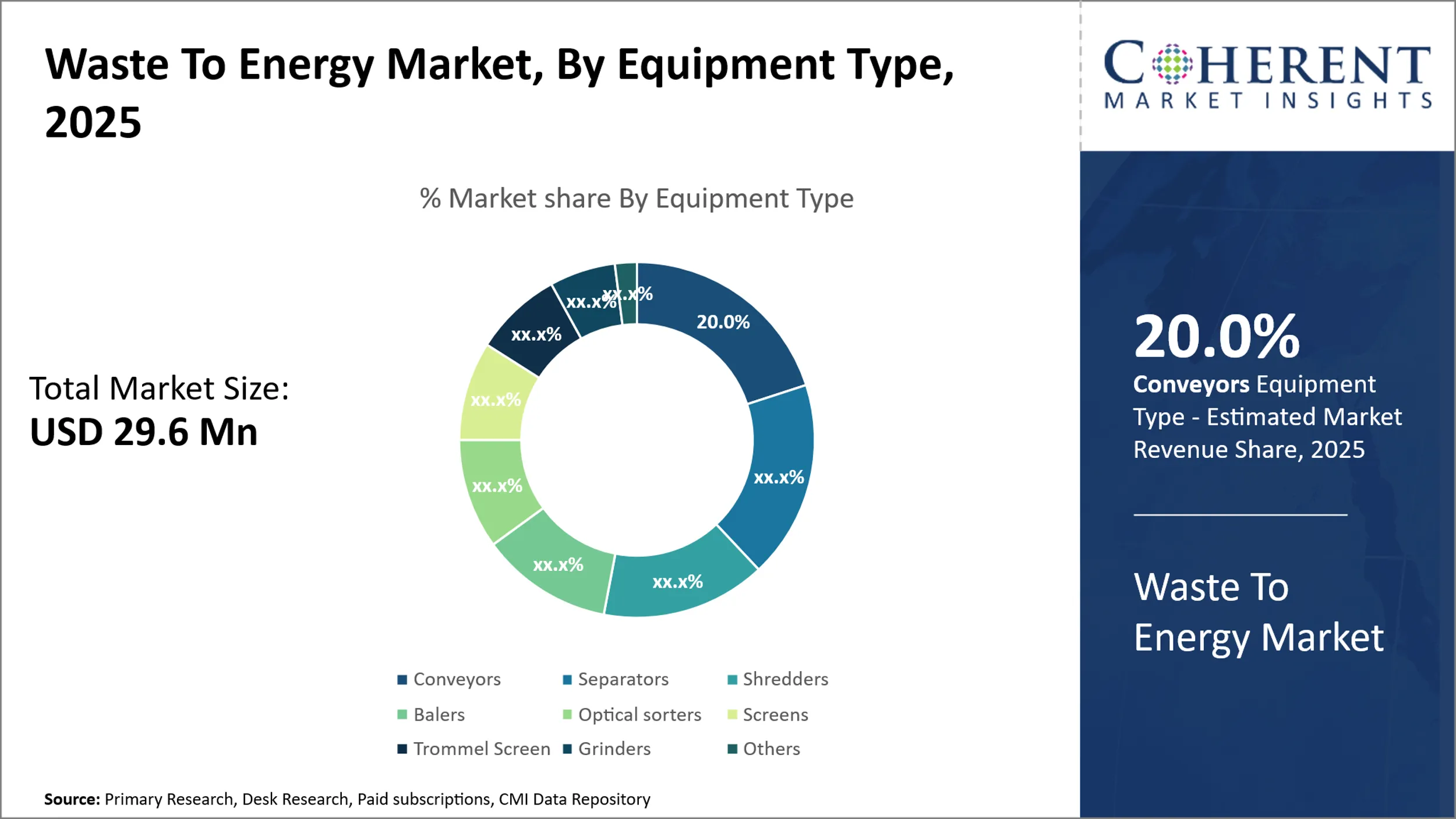
- Based on Equipment Type, Conveyors segment is projected to command 21% share of the market in 2026.
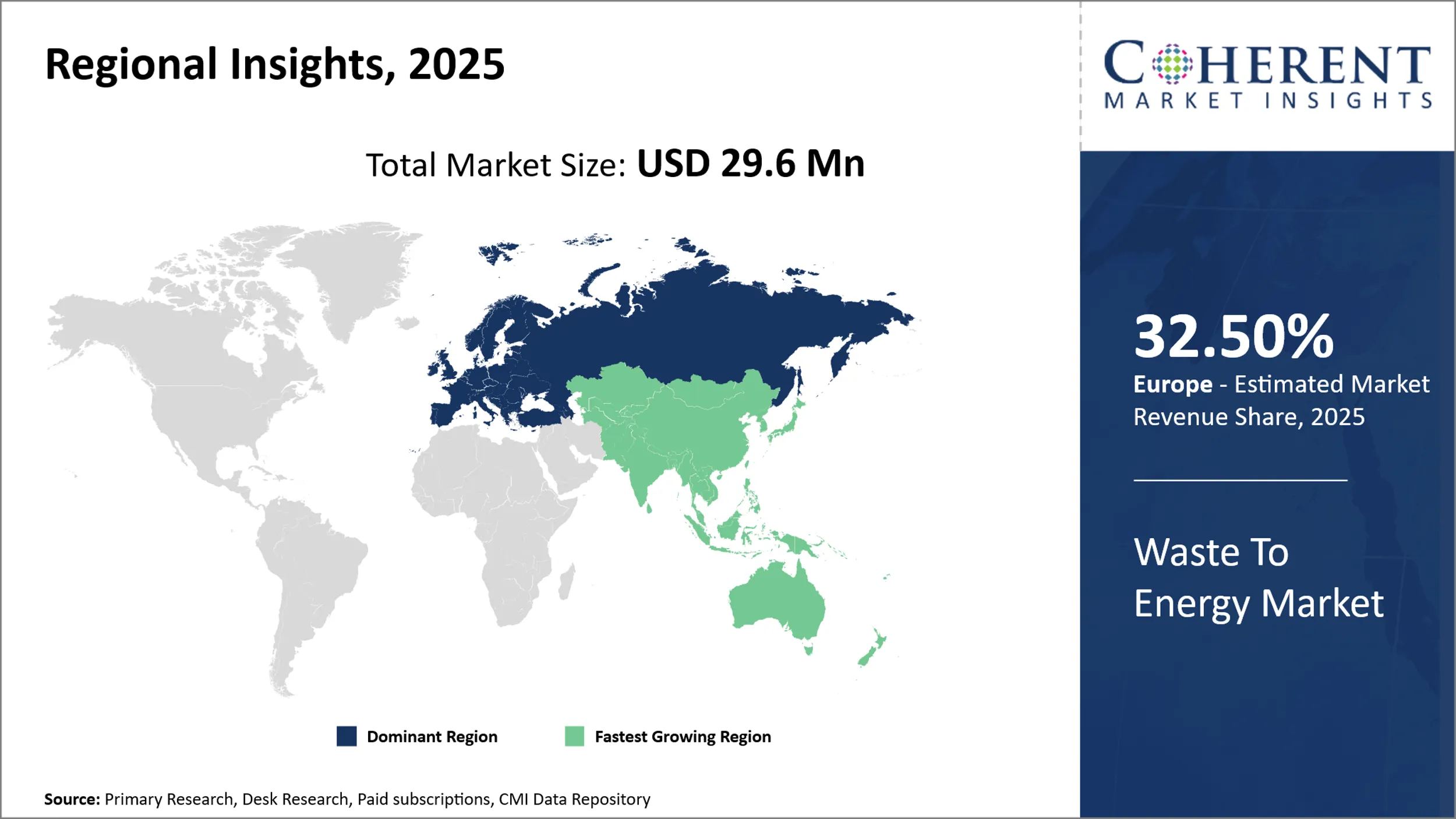
- Europe is set to dominate the global waste to energy market with a 32. 5% share in 2026.
Market Overview
The major drivers for the growth of waste to energy market include the increasing popularity of renewable energy resources, high waste generation, stringent regulations regarding waste disposal, and world policy regarding climate change such as the Kyoto Protocol and Paris Climate Agreement. The restraining factors for the growth of the market include low fossil fuel prices, which can be attributed to an oversupply of crude oil and gas due to increased production from shale reserves in the U.S. The availability of low-cost feedstock has significantly reduced the costs of production of conventional plastic.
Current Events and Its Impact
Current Event | Description and its Impact |
Advanced Gasification and Plasma Technologies Development |
|
Global Inflation and Energy Price Crisis |
|
Segmental Insights
- Current Industry Events of 2026
- Market Size Estimation
- Regional Breakdown
- Competitive Landscape
- Customer Intelligence
- Segmental Analysis
- Pricing Analysis
- Key Market Drivers, Challenges & Future Trends
- Customized Insights Section
Waste to Energy Market Insights, By Equipment Type
Based on equipment type, Conveyors segment is projected to dominate the global waste to energy market in 2026, due to their critical role in efficiently transporting waste materials through various stages of the energy conversion process. Conveyors enhance automation, reduce manual handling, and improve operational efficiency and safety within WTE facilities. Their adaptability to different types of waste and integration with sorting, shredding, and combustion systems make them essential for large-scale, continuous waste processing.
For instance, in April 2024, Metso launched productized FIT™ in-plant and Foresight™ overland conveyors for reliable material transportation in the mining industry. The standardized conveyor modules and premium components offer high capacity and layout flexibility as well as substantial savings in time and resources, from feasibility and design to implementation, thereby enabling higher lifetime productivity.
Regional Insights
Europe Waste to Energy Market Analysis & Trends
Europe is projected to hold around 32.5% shares in the global waste to energy market during the forecast period. This is owing to the region's stringent environmental regulations, high landfill taxes, and strong policy frameworks that promote sustainable waste management practices. Additionally, the European Union’s push towards achieving climate neutrality and reducing reliance on fossil fuels has accelerated investment in WTE technologies.
For instance, in May 2024, Northern European energy company Gren announced its plan to invest more than EUR 200 million in Latvia to build a waste-to-energy plant in Acone. The new plant will use the most modern and safest technologies and is expected to be operational in 2029.
Asia Pacific Waste to Energy Market Analysis & Trends
Asia Pacific is projected to hold around 31.6% shares in the global waste to energy market during the forecast period. This is owing to rapid urbanization, population growth, and the resulting surge in municipal solid waste across major economies such as China, India, and Japan. Governments in the region are increasingly investing in WTE infrastructure to address waste management challenges and reduce environmental pollution.
For instance, Mitsubishi Heavy Industries, Ltd. (MHI) and Mitsubishi Heavy Industries Environmental & Chemical Engineering Co., Ltd. (MHIEC), part of MHI Group, have made a wholly-owned subsidiary of TuasOne Pte. Ltd., a special purpose company (SPC) for the business of the construction and operations of a waste-to-energy (WTE) facility in Singapore.
Waste to Energy Market – Dominating Countries
The U.S. Waste to Energy Market Analysis & Trends
The U.S. is projected to hold around 24.6% shares in the global waste to energy market during the forecast period. This is owing to increasing emphasis on sustainable waste management solutions, rising energy demand, and growing concerns over landfill capacity. Federal and state-level initiatives promoting renewable energy and reducing greenhouse gas emissions are encouraging the adoption of WTE technologies.
For instance, in September 2026, IKEA U.S. has launched a food waste pilot program that takes a direct aim at one of retail’s most stubborn environmental challenges: organic waste. Partnering with Vanguard Renewables, a Massachusetts-based organics recycling company, the initiative will test how restaurant scraps from five IKEA stores can be transformed into renewable natural gas and fertilizer.
China Waste to Energy Market Analysis & Trends
China is projected to hold around 10.5% shares in the global waste to energy market during the forecast period. This is due to the country's rapid urbanization, massive population, and the resulting increase in municipal solid waste generation. The Chinese government has made waste-to-energy a key part of its waste management and renewable energy strategies, with strong policy support, financial incentives, and large-scale infrastructure investments.
For instance, in July 2026, China’s Hunan Junxin Environmental Protection Co. Ltd. planned to invest $600 million in constructing three waste-to-energy plants in Kazakhstan.
Analyst Opinion – Waste to Energy Market
- The waste-to-energy (WTE) market is gaining momentum as governments and industries prioritize sustainability, circular economy models, and alternative energy sources. A key trend is the adoption of advanced thermal technologies, such as incineration with energy recovery and gasification, which improve efficiency and reduce emissions.
- Europe continues to dominate the market due to stringent environmental regulations, strong policy support, and high landfill taxes that encourage WTE adoption. Countries like Germany, Sweden, and the Netherlands lead in integrating WTE into their waste management and energy systems, setting a benchmark for other regions.
Speak to the analyst
Want personalized insights?
Take the findings above to one of our principal consultants, or have the report rebuilt around the segments, geographies and competitors you actually track.
Waste to Energy Market Key Developments
- In October 2025, The Government of India’s Ministry of New and Renewable Energy (MNRE) announced a significant simplification of its Waste to Energy Programme documentation and application procedures, effective October 3, 2025. This move, which comes with the approval of the Minister for NRE, is designed to make the process more user-friendly, accelerate project development, and promote the generation of Biogas, Bio-CNG, Power, and syngas from various wastes, including urban, industrial, and agricultural residues.
- For instance, in September 2025, Sovereign wealth fund Danantara Indonesia unveiled nearly eight waste-to-power projects by to manage waste and increase renewable energy production, executives said on Tuesday.
Market Report Scope
Waste To Energy Market Report Coverage
| Report Coverage | Details | ||
|---|---|---|---|
| Base Year: | 2025 | Market Size in 2026: | USD 31.6 Mn |
| Historical Data for: | 2020 To 2024 | Forecast Period: | 2026 To 2033 |
| Forecast Period 2026 to 2033 CAGR: | 6.7% | 2033 Value Projection: | USD 49.7 Mn |
| Geographies covered: |
| ||
| Segments covered: | By Equipment: Trommel Screens, Conveyors, Separators, Optical Sorter, Grinders, Balers, Screens (Disc Screens, Star Screens, and Free Flow Screens), Shredders, and Others | ||
| Companies covered: | Babcock & Wilcox Enterprises, BCE – Burners and Combustion Equipment, China Everbright International Limited, CP Manufacturing Inc., Harpscreen International Ltd., Hustler Conveyor Company, Multotec, Screen Machine Industries, SUEZ NEWS, Sutco RecyclingTechnik GmbH, Terex Ecotec (Terex Corporation), Vermeer Corporation S.A., Tetronics (International), Limited., Advanced Plasma Power Limited (APP), Ylem Energy Limited, Wheelabrator Technologies Inc., Waste Management, Inc., Sierra Energy Corporation, MDS International, FLSmidth & Co., A.S., Machinery (Group) Ltd., McLanahan Corporation | ||
| Growth Drivers: |
| ||
| Restraints & Challenges: |
| ||
Market Opportunities: Waste to Energy Market
The waste-to-energy (WTE) market presents significant opportunities as nations seek sustainable solutions to growing waste and energy demands. With increasing urbanization and stricter environmental regulations, converting municipal solid waste into electricity or heat offers a dual benefit: reducing landfill use and generating renewable energy. Emerging economies, in particular, show strong potential due to rising waste volumes and inadequate waste management infrastructure.
Market Segmentation
- Equipment Insights (Revenue, USD, 2021 - 2033)
- Trommel Screens
- Conveyors
- Separators
- Optical Sorter
- Grinders
- Balers
- Screens (Disc Screens, Star Screens, and Free Flow Screens)
- Shredders
- Others
- Regional Insights (Revenue, USD Mn, 2021 - 2033)
- North America
- U.S.
- Canada
- Latin America
- Brazil
- Mexico
- Argentina
- Rest of Latin America
- Europe
- Germany
- U.K.
- Spain
- France
- Italy
- Russia
- Rest of Europe
- Asia Pacific
- China
- India
- Japan
- Australia
- South Korea
- ASEAN
- Rest of Asia Pacific
- Middle East
- GCC
- Israel
- Rest of Middle East
- Africa
- North Africa
- Central Africa
- South Africa
- North America
- Key Players Insights
- Babcock & Wilcox Enterprise
- BCE – Burners and Combustion Equipment
- China Everbright International Limited
- CP Manufacturing Inc.
- Harpscreen International Ltd
- Hustler Conveyor Company
- Multotec
- Screen Machine Industries
- SUEZ NWS
- Sutco RecyclingTechnik GmbH
- Terez Ecotec (Terex Corporation)
- Vermeer Corporation
- Veolia Environment S.A.
- Tetronics (International) Limited.
- Advanced Plasma Power Limited (APP)
- Ylem Energy Limited
- Wheelabrator Technologies Inc.
- Waste Management, Inc.
- Sierra Energy Corporation
- Covanta Holding Corporation
- MDS International
- FLSmidth & Co. AS
- Machinery (Group) Ltd.
- McLanahan Corporation
Sources
Primary Research Interviews
- Waste-to-Energy Plant Operators and Management
- Municipal Waste Management Officials
- Technology Vendors and Equipment Manufacturers
- Environmental Consultants and Policy Makers
- Others
Databases
- International Energy Agency (IEA) Database
- World Bank Open Data
- EPA Landfill Methane Outreach Program Database
- OECD Environmental Statistics
- Others
Magazines
- Waste Management World
- Renewable Energy World Magazine
- BioCycle Magazine
- Waste360 Magazine
- Others
Journals
- Waste Management Journal
- Energy Conversion and Management
- Renewable and Sustainable Energy Reviews
- Others
Newspapers
- Environmental Finance
- Waste Business Journal
- Energy Daily
- Environmental Leader
- Others
Associations
- Waste-to-Energy Research and Technology Council (WTERT)
- International Solid Waste Association (ISWA)
- Energy Recovery Council (ERC)
- Confederation of European Waste-to-Energy Plants (CEWEP)
- Others
Public Domain Sources
- U.S. Environmental Protection Agency (EPA)
- European Environment Agency (EEA)
- International Renewable Energy Agency (IRENA)
- United Nations Environment Programme (UNEP)
- Others
Proprietary Elements
- CMI Data Analytics Tool, Proprietary CMI Existing Repository of information for last 8 years
Get access to 250+ pages report
Every segment, forecast, competitor profile and data table behind the analysis above — available for instant download.
- ESOMAR Member
- ISO 9001:2015 Certified
- D-U-N-S Registered
- GDPR & CCPA Compliant
Missing comfort of reading report in your local language? Find your preferred language:
Transform your Strategy with Exclusive Trending Reports
Frequently Asked Questions
The waste to energy market is estimated to be valued at USD 31.6 Mn in 2026, and is expected to reach USD 49.7 Mn by 2033.
The CAGR of the waste to energy market is projected to be 6.7% from 2026 to 2033.
Growing demand for personalized treatment options and evolving diagnostic and therapeutic technologies are the major factors driving the growth of the waste to energy market.
Obtaining patient specific molecular data is tedious and expensive and lack of reimbursement policies are the major factors hampering the growth of the waste to energy market.
In terms of application, diagnostics is estimated to dominate the market revenue share in 2026.
Babcock & Wilcox Enterprises, BCE – Burners and Combustion Equipment, China Everbright International Limited, CP Manufacturing Inc., Harpscreen International Ltd., Hustler Conveyor Company, Multotec, Screen Machine Industries, SUEZ NEWS, Sutco RecyclingTechnik GmbH, Terex Ecotec (Terex Corporation), Vermeer Corporation S.A., Tetronics (International), Limited., Advanced Plasma Power Limited (APP), Ylem Energy Limited, Wheelabrator Technologies Inc., Waste Management, Inc., Sierra Energy Corporation, MDS International, FLSmidth & Co., A.S., Machinery (Group) Ltd., McLanahan Corporation are the major players operating in the market.
Europe is expected to lead the waste to energy market.