

Fuel Additive Market Size and Trends
Global fuel additive market is estimated to be valued at USD 10.30 Bn in 2026 and is expected to reach USD 13.70 Bn by 2033, exhibiting a compound annual growth rate (CAGR) of 4.2% from 2026 to 2033.
Key Takeaways
- Based on Type, Deposit Control Additives segment is projected to account for 40.8% of the global market in 2026, owing to its critical role in keeping fuel systems clean and sludge-free.
- Based on Fuel Type, Gasoline segment is expected to capture 35.1% share of the market in 2026, due to its immense popularity of gasoline engines in consumer automotive and small equipment applications.
- Based on Region, North America is set to dominate the global fuel additive market with a 32.8% share in 2026.
Market Overview
Global fuel additive market growth is driven by stringent regulations regarding fuel emissions. Deposit control additives prevent the deposit formation in the engine for smooth functioning. Cetane improvers are added to diesel fuels to provide better combustion of fuels. Cold flow improvers are used to facilitate the flow of fuel through filters at low temperatures. Fuel additives help in improving the functionality of vehicles and reducing emissions. Growing automotive industry and increasing environmental regulations worldwide boosts demand for high-performance fuel additives during the forecast period.
Current Events and their Impact on the Fuel Additives Market
Current Event | Description and its Impact |
Global Energy Transition and Decarbonization Policies |
|
Automotive Industry Technological Advancements |
|
End-user Feedback and Unmet Needs in the Fuel Additives Market
End-User Feedback
- Product Effectiveness and Compatibility: Consumers frequently express skepticism about the tangible benefits of fuel additives. Many reports minimal improvements in fuel efficiency or engine performance, particularly in newer vehicles equipped with advanced fuel systems. This skepticism is compounded by a lack of standardized testing and inconsistent product claims.
- Quality Inconsistency and Lack of Standardization: The absence of universal standards for fuel additives leads to variations in product quality and performance. Additives that perform well in one region or under specific conditions may not yield the same results elsewhere, causing confusion and mistrust among consumers.
- High Costs and Economic Accessibility: Premium fuel additives often come with a high price tag, making them less accessible to budget-conscious consumers. This is particularly challenging in emerging markets, where cost sensitivity is a significant factor in purchasing decisions.
- Limited Awareness and Misconceptions: Many consumers are unaware of the potential benefits of fuel additives or hold misconceptions about their necessity. This lack of awareness can lead to underutilization of additives that could enhance vehicle performance and longevity.
Unmet Needs in the Fuel Additives Market
- Standardized Testing and Transparency: There is a pressing need for standardized testing protocols and transparent reporting on the efficacy of fuel additives. Such measures would help consumers make informed decisions and foster trust in the products.
- Affordable and Accessible Options: Developing cost-effective fuel additives that do not compromise on quality would make these products more accessible to a broader range of consumers, particularly in price-sensitive markets.
- Educational Initiatives: Implementing educational campaigns to raise awareness about the benefits and proper usage of fuel additives could help dispel misconceptions and encourage informed adoption.
- Product Customization: Offering fuel additives tailored to specific vehicle types, fuel qualities, and regional conditions would enhance their effectiveness and appeal to a wider audience.
- Current Industry Events of 2026
- Market Size Estimation
- Regional Breakdown
- Competitive Landscape
- Customer Intelligence
- Segmental Analysis
- Pricing Analysis
- Key Market Drivers, Challenges & Future Trends
- Customized Insights Section
Fuel Additives Market Driver
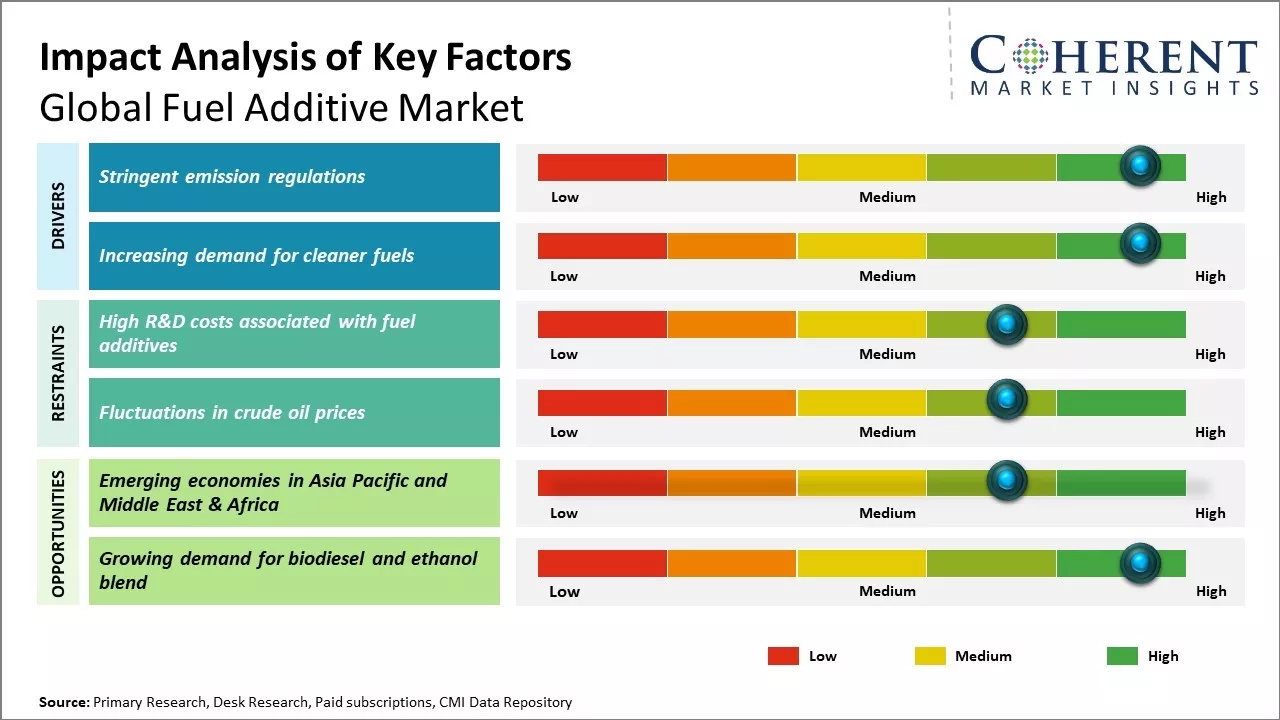
Stringent emission regulations
Many countries such as India and China are now implementing stringent vehicle emission regulations, in order to control pollution levels and reduce harmful emissions from vehicles.
Fuel additives play a crucial role as these optimize combustion processes, improve fuel efficiency and reduce emissions when used along with engine oils and other lubricants. Additives such as gasoline detergents prevent deposits in combustion chambers and keep engines clean for optimal performance. Cetane improvers and diesel additives improve ignition quality of fuels and control hazardous pollutants from diesel engines. The need to meet strict emission control targets has boosted demand for high-quality fuel additives across the globe.
Increasing demand for cleaner fuels
Along with stringent emission norms, there has been rising consumer demand for eco-friendly fuel and energy options due to heightening environmental concerns. People are more aware now about the impacts of air pollution and want to contribute to sustainability through their daily energy consumption choices. This changing customer behavior has prompted oil marketing companies and fuel retailers to provide cleaner and greener fuel options.
Advanced biofuels produced from sustainable feedstocks has been gaining popularity. Integrating bio components into traditional fossil fuels presents technical difficulties concerning storage, distribution, and maintaining consistent performance. Effective fuel additives help overcome these problems and facilitate higher blending rates of biofuels.
Additives also play a major role in capturing and utilizing alternative forms of energy like natural gas. As reliance on cleaner transportation fuels increases, the significance of supplementary additives for maintaining fuel stability and ensuring compliance with emission standards will also rise.
Segmental Insights
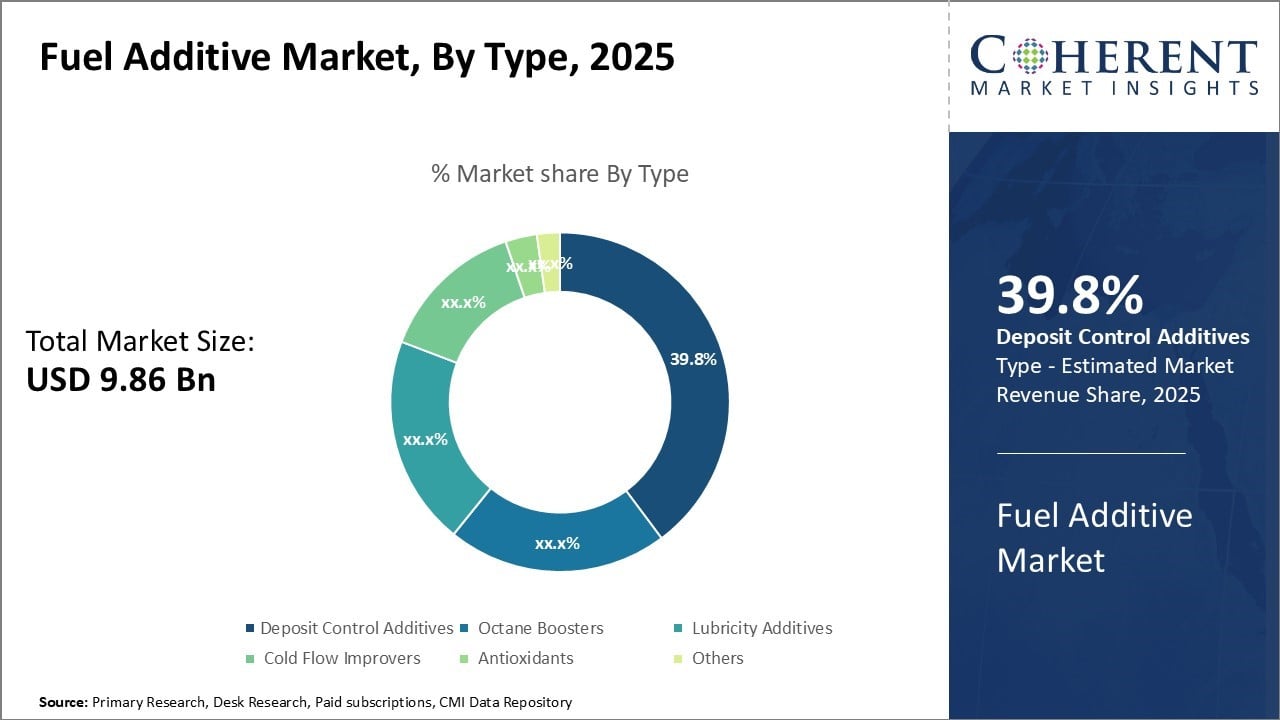
Fuel Additive Market Insights, By Type: Importance in preventing sludge buildup
In terms of type, deposit control additives segment is estimated to contribute the highest market share of 40.8% in 2026. Deposit control additives play a critical role in keeping fuel systems clean and sludge-free. As engines and vehicles become more sophisticated, sludge buildup can occur more quickly and cause significant operational issues if left unaddressed.
Deposit control additives work to prevent the accumulation of deposits on internal engine surfaces like intake valves, injectors, and combustion chambers. By keeping these critical components clean and lubricated, deposit control additives help ensure optimal engine performance over time.
Modern engines typically have very small tolerances and precise fuel delivery systems. Even minor deposits can disrupt fuel spray patterns and combustion chamber airflow. This leads to reduced power, poor drive ability, and reduced fuel economy. Deposit control additives address this issue head-on by safely dissolving and suspending deposits to keep engines running smoothly.
In September 2025, BASF announced its upcoming Keropur Gasoline Performance Additive Series, designed to exceed the new U.S. TOP TIER+™ detergent gasoline standard and meet EPA’s Lowest Additive Concentration (LAC) requirements. Developed for modern engines, especially GDI engines, the additives undergo strict testing for injector deposit control and protection against stochastic pre-ignition (SPI), ensuring better performance and lower emissions.
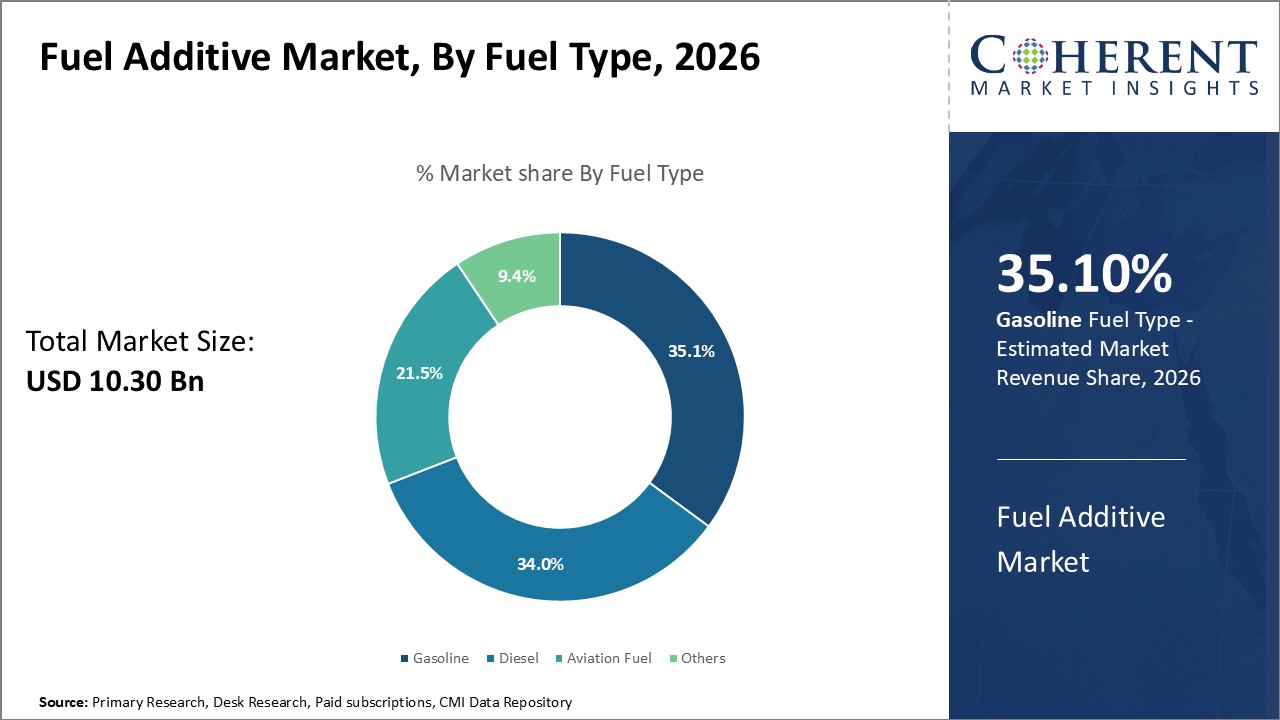
Fuel Additives Market Insights, By Fuel Type: Extensive consumer adoption
In terms of fuel type, gasoline segment is estimated to contribute the highest market share of 35.1% in 2026. Out of all fuel types that utilize additive packages, gasoline-powered vehicles represent by far the largest segment of the global market due to the immense popularity of gasoline engines in consumer automotive and small equipment applications. Cars, trucks, motorcycles, lawn mowers, chainsaws, and many other everyday gas-powered products depend on fuel additives to support optimal performance.
Gasoline vehicles on the road globally can also drive the segment growth. Unlike commercial fleets that run on diesel, this diverse consumer base exposes a far greater number of engines to the benefits of additives on an ongoing basis. Gasoline engines also require specific additive solutions to address octane requirements, lubricity needs, and fuel stability variables. This need is further compounded by consumer tendency to keep vehicles longer between oil changes or services.
As fuel economy standards have become more stringent, additive manufacturers have developed solutions to help drivers maximize the distance they can travel on each gallon of gasoline. Additives play a crucial role in optimizing performance and squeezing out additional fuel efficiency gains, whether by supporting more complete combustion, maintaining engine cleanliness, or enhancing cold weather operation.
For instance, in May 2024, Braskem announced the expansion of its fuels business portfolio with the launch of Octane Plus focused on serving the premium segment of automotive fuels market worldwide. Octane Plus is an additive blended in the gasoline production process to increase the fuel's octane rating.
Regional Insights
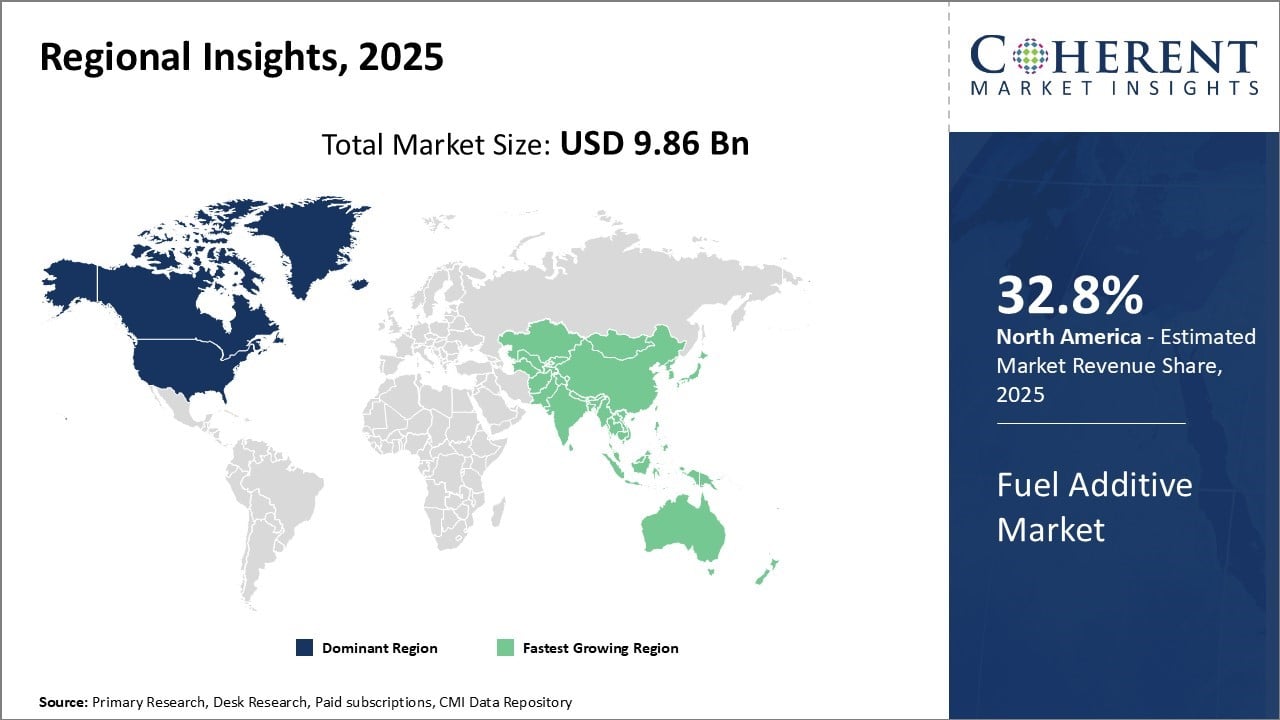
North America Fuel Additive Market Analysis & Trends
North America dominates the global fuel additive market led by the U.S., with an estimated market share of 32.8% in 2026. Strong presence of automotive and petrochemical industries in the U.S. and Canada along with stringent emission regulations have boosted demand for fuel additives in the region.
Most of the leading fuel additive manufacturers such as Chevron, ExxonMobil and Royal Dutch Shell have their regional headquarters located in North America, allowing them to efficiently cater to the demand. North America has a well-developed distribution network for fuel additives considering the size of the automotive industry and fuel consumption across transportation and industrial sectors.
For instance, in April 2022, Afton Chemical announced the launch of its new Greenclean TM 3 diesel detergent additives in North America.
Asia Pacific Fuel Additive Market Analysis & Trends
Asia Pacific has emerged as the fastest growing regional market for fuel additive globally. Countries such as China, India, Indonesia and Vietnam witness growth due to rising vehicle ownership, expanding petroleum sector and growing industrialization. Rapidly expanding middle-class population coupled with increasing disposable incomes have boosted gasoline and diesel demand in the region.
This has prompted petroleum companies to augment their fuel additive production and downstream supply chain to match the demand from transportation and other end-use sectors. However, lack of stringent emission guidelines comparable to developed markets can limit demand from certain countries.
Developing nations such as Africa and other, are now taking initiatives to reduce vehicular emissions by introducing BS VI standards at par with global emission norms. This offers immense opportunities for fuel additive companies to penetrate into new markets in Asia Pacific.
For instance, BASF has started producing fuel performance additives at its Pudong site in Shanghai, China. The new plant addresses the increasing regional demand for fuel performance additives and brings greater supply security and flexibility to customers in Asia.
Fuel Additive Market Outlook Country-Wise
The U.S. Fuel Additive Market Trends
The U.S. fuel additive market is experiencing steady growth, driven by tightening environmental regulations, the push for cleaner emissions, and the rising adoption of biofuels. Consumers and industries alike are increasingly seeking additives that improve fuel efficiency, engine performance, and emissions control. There's a growing demand for multifunctional additives that address multiple performance parameters, particularly for diesel engines.
India Fuel Additive Market Trends
India’s fuel‑additive market is growing steadily, driven by stricter emissions norms (e.g. BS‑VI), rising vehicle ownership, and government policies such as mandatory ethanol blending (E20) in petrol. Additives that improve combustion, reduce deposits, enhance octane/cetane, prevent corrosion and stabilize bio‑fuel mixtures are in increasing demand. On the supply side, cost pressures (raw materials, formulation) and technical issues such as compatibility in older engines with ethanol blends are emerging challenges
For instance, in July 2024, Indian Oil launched STORM-X, a high-octane racing fuel, becoming the first Indian firm to produce F1 fuel for motorsports events.
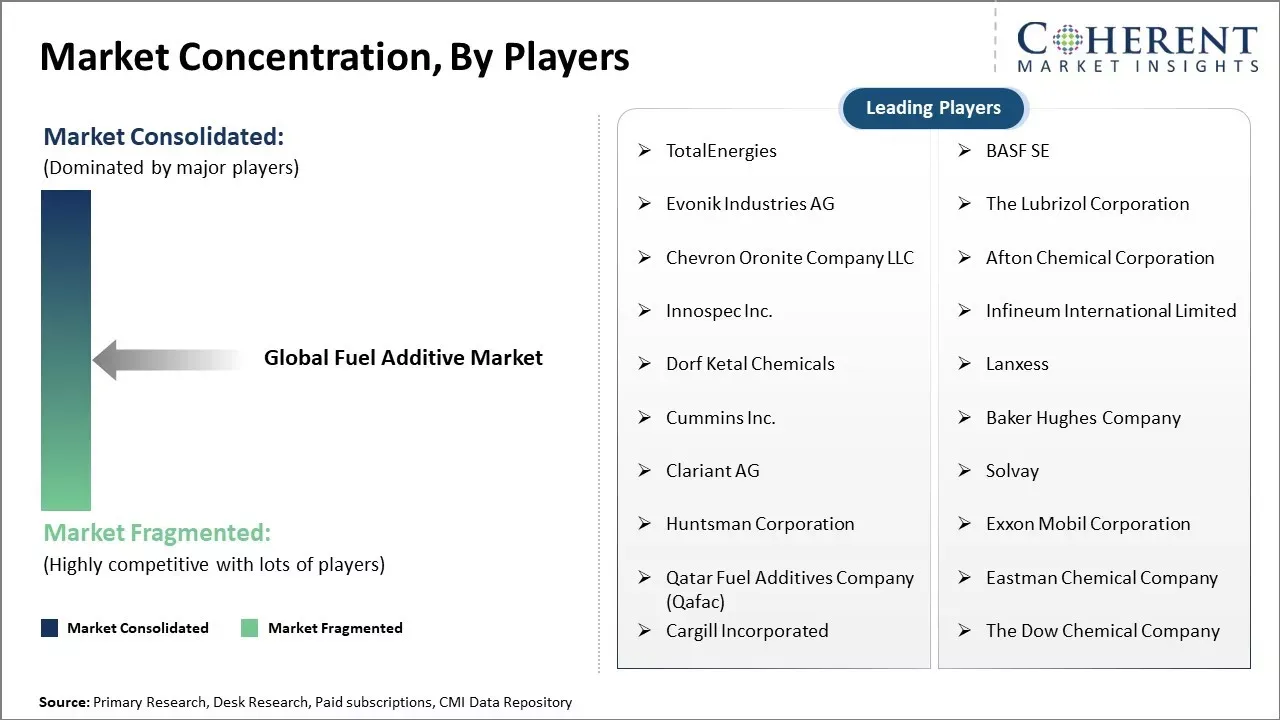
Market Concentration and Competitive Landscape
Analyst Opinion (Expert Opinion)
Global fuel additive market growth is driven by stringent emission regulations across major economies as governments aim to curb vehicular pollution. Additives help improve the efficiency of engines and reduce emissions, making them indispensable to automakers seeking to comply with developing emission standards. Expanding fleet of older vehicles worldwide can also drive the market growth. As engines age, these require more detergents and friction modifiers to ensure smoother operations. This growing aftermarket demand can boost additive sales.
Rising popularity of electric vehicles can hamper the market growth. Though still a small segment, EV sales are increasing steadily which could cut demand for fuel and correspondingly fuel additives in the long run. High raw material prices of additives can also hamper the market growth. Expanding into developing markets and introducing novel high-performance products catering to specific engine technologies can offer growth opportunities. North America currently dominates fuel additive usage large automotive production base and lax emission norms historically. Strict regulations can boost additive consumption growth.
Speak to the analyst
Want personalized insights?
Take the findings above to one of our principal consultants, or have the report rebuilt around the segments, geographies and competitors you actually track.
Fuel Additive Industry News
- In September 2025, Afton Chemical Corporation, announced the launch of the world’s first commercially available dedicated additive for hydrogen heavy-duty engines – HiTEC® 12582.
- In April 2025, Puma Energy announced the launch of its new fuel additive technology with its brand name CLEANTEC in Latin America. This new additive is especially designed to improve engine performance and keep engine clean.
Market Report Scope
Fuel Additive Market Report Coverage
| Report Coverage | Details | ||
|---|---|---|---|
| Base Year: | 2025 | Market Size in 2026: | USD 10.30 Bn |
| Historical Data for: | 2020 To 2024 | Forecast Period: | 2026 To 2033 |
| Forecast Period 2026 to 2033 CAGR: | 4.2% | 2033 Value Projection: | USD 13.70 Bn |
| Geographies covered: |
| ||
| Segments covered: |
| ||
| Companies covered: | TotalEnergies, BASF SE, Evonik Industries AG, The Lubrizol Corporation, Chevron Oronite Company LLC, Afton Chemical Corporation, Innospec Inc., Infineum International Limited, Dorf Ketal Chemicals, Lanxess, Cummins Inc., Baker Hughes Company, Clariant AG, Solvay, Huntsman Corporation, Exxon Mobil Corporation, Qatar Fuel Additives Company (Qafac), Eastman Chemical Company, Cargill Incorporated, and The Dow Chemical Company | ||
| Growth Drivers: |
| ||
| Restraints & Challenges: |
| ||
Market Opportunity - Emerging economies in Asia Pacific and Middle East & Africa
Fuel additive market in emerging economies of Asia Pacific and Middle East & Africa regions provides tremendous opportunities for players to expand their business. Increasing vehicle fleet sizes, growing industrialization, and improving economic conditions in countries such as China, India, Indonesia, and various nations in the Middle East boosts demand for transportation fuels.
As these developing nations aim to meet international emission standards and focus on using better quality fuels, there has been need for high-performance fuel additives. Established additive manufacturers looking to expand into new markets can capitalize on the available opportunities.
In Asia Pacific and Middle East & Africa through joint ventures, partnerships with local players, and by setting up local manufacturing units. This will help companies strengthen their presence while catering to the needs of fast-growing automotive and industrial sectors in these regions.
Market Segmentation
- Type Insights (Revenue, USD Bn, 2021 - 2033)
- Deposit Control Additives
- Octane Boosters
- Lubricity Additives
- Cold Flow Improvers
- Antioxidants
- Others
- Fuel Type Insights (Revenue, USD Bn, 2021 - 2033)
- Gasoline
- Diesel
- Aviation Fuel
- Others
- Regional Insights (Revenue, USD Bn, 2021 - 2033)
- North America
- U.S.
- Canada
- Latin America
- Brazil
- Argentina
- Mexico
- Rest of Latin America
- Europe
- Germany
- U.K.
- Spain
- France
- Italy
- Russia
- Rest of Europe
- Asia Pacific
- China
- India
- Japan
- Australia
- South Korea
- ASEAN
- Rest of Asia Pacific
- Middle East
- GCC Countries
- Israel
- Rest of Middle East
- Africa
- South Africa
- North Africa
- Central Africa
- Key Players Insights
- TotalEnergies
- BASF SE
- Evonik Industries AG
- The Lubrizol Corporation
- Chevron Oronite Company LLC
- Afton Chemical Corporation
- Innospec Inc.
- Infineum International Limited
- Dorf Ketal Chemicals
- Lanxess
- Cummins Inc.
- Baker Hughes Company
- Clariant AG
- Solvay
- Huntsman Corporation
- Exxon Mobil Corporation
- Qatar Fuel Additives Company (Qafac)
- Eastman Chemical Company
- Cargill Incorporated
- The Dow Chemical Company
Sources
Primary Research Interviews
- Fuel additive manufacturers and suppliers
- Petroleum refining companies executives
- Automotive industry professionals
- Fuel distribution and retail chain managers
- Others
Databases
- IEA (International Energy Agency) Database
- Global Trade Atlas
- Chemical Market Analytics Platform
- Others
Magazines
- Fuel Technology & Management Magazine
- Petroleum Review Magazine
- Chemical Processing Magazine
- Automotive Fuel Systems Magazine
- Others
Journals
- Journal of Petroleum Science and Engineering
- Fuel Processing Technology Journal
- International Journal of Chemical Engineering
- Others
Newspapers
- Oil & Gas Journal
- Chemical Week
- Automotive News
- Energy Intelligence Daily
- Others
Associations
- American Fuel & Petrochemical Manufacturers (AFPM)
- International Fuel Quality Center (IFQC)
- Society of Automotive Engineers (SAE)
- European Fuel Oxygenates Association (EFOA)
- Others
Public Domain Sources
- U.S. Environmental Protection Agency (EPA)
- European Chemicals Agency (ECHA)
- Government statistical offices and trade departments
- International Maritime Organization (IMO)
- Others
Proprietary Elements
- CMI Data Analytics Tool
- Proprietary CMI Existing Repository of information for last 8 years
*Definition: Global fuel additive market involves the sales of fuel additives that are added to vehicle and transportation fuels to improve fuel performance. Fuel additives include products like antioxidants, cetane improvers, corrosion inhibitors, dehazers, dyes & markers, metal deactivators, and others that are added in small volumes to improve fuel properties like cetane number, prevention of sludge/deposits, coloration for taxation purposes, and others. The fuel additives market helps enhance fuel efficiency, reduce emissions, and extend the life of engines.
Get access to 250+ pages report
Every segment, forecast, competitor profile and data table behind the analysis above — available for instant download.
- ESOMAR Member
- ISO 9001:2015 Certified
- D-U-N-S Registered
- GDPR & CCPA Compliant
Missing comfort of reading report in your local language? Find your preferred language:
Transform your Strategy with Exclusive Trending Reports
Frequently Asked Questions
The Fuel Additive Market is estimated to be valued at USD 10.30 Bn in 2026, and is expected to reach USD 13.70 Bn by 2033.
The CAGR of the Fuel Additive Market is projected to be 4.2% from 2026 to 2033.
Stringent emission regulations and increasing demand for cleaner fuels are the major factors driving the growth of global fuel additive market.
High R&D costs associated with fuel additives and fluctuations in crude oil prices are the major factors hampering the growth of global fuel additive market.
In terms of type, deposit control additives segment is estimated to dominate the market in 2026.
TotalEnergies, BASF SE, Evonik Industries AG, The Lubrizol Corporation, Chevron Oronite Company LLC, Afton Chemical Corporation, Innospec Inc., Infineum International Limited, Dorf Ketal Chemicals, Lanxess, Cummins Inc., Baker Hughes Company, Clariant AG, Solvay, Huntsman Corporation, Exxon Mobil Corporation, Qatar Fuel Additives Company (Qafac), Eastman Chemical Company, Cargill Incorporated, and The Dow Chemical Company are the major players.
North America is expected to lead the global fuel additive market in 2026.