

Linear Alkylbenzene Sulfonate (LAS) Market Size and Share Analysis: 2026-2033
The Linear Alkylbenzene Sulfonate (LAS) Market size is anticipated to grow at a CAGR of 5% with USD 7.4 Bn in 2026 and is expected to reach USD 10.39 Bn in 2033. The growth is mainly owing to the rising demand for household cleaning products, with the average family in the US using 13 bottles of detergent annually. Moreover, the shift towards sustainable, eco-friendly ingredients and increasing demand in personal care products is also propelling the growth in the market.
Key Takeaways
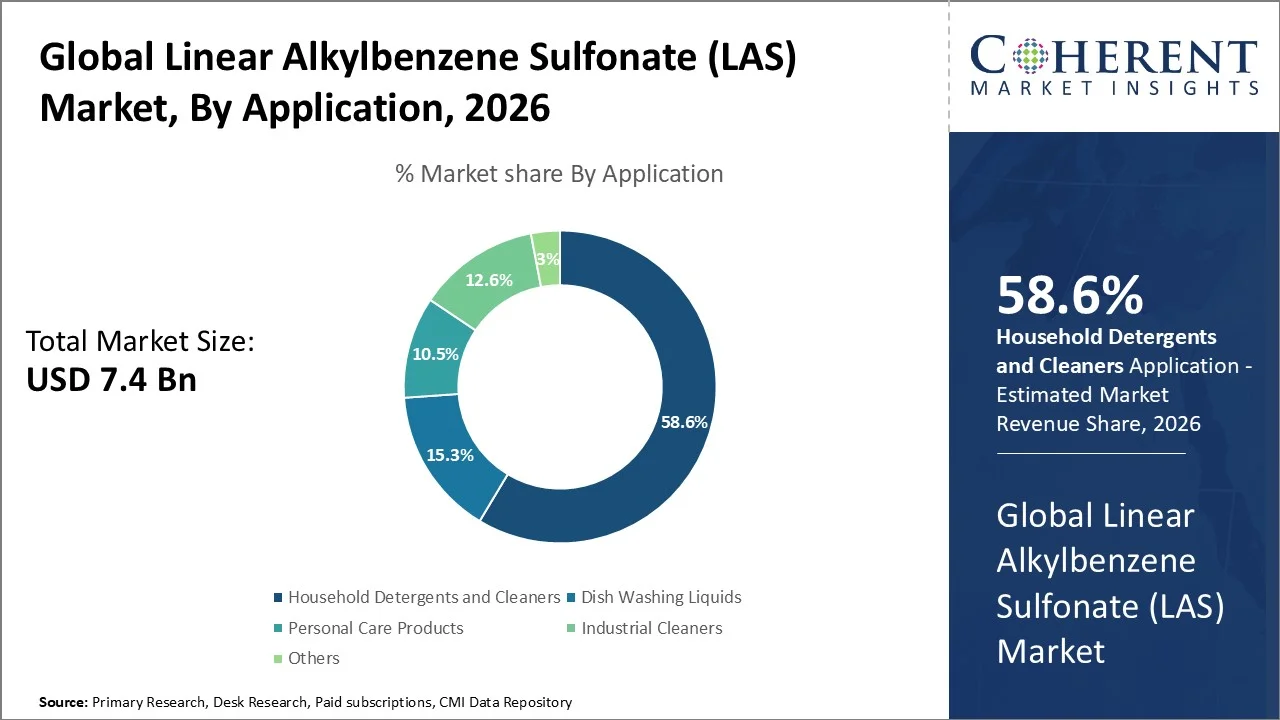
- Household detergents and cleaners is expected to account for the largest share of 58.60% in 2026. This is because linear alkylbenzene sulfonate is the preferred anionic surfactant owing to its strong cleaning performance and cost‑effectiveness in laundry and multipurpose cleaning formulations, thereby sustaining high volumes in everyday consumer usage.
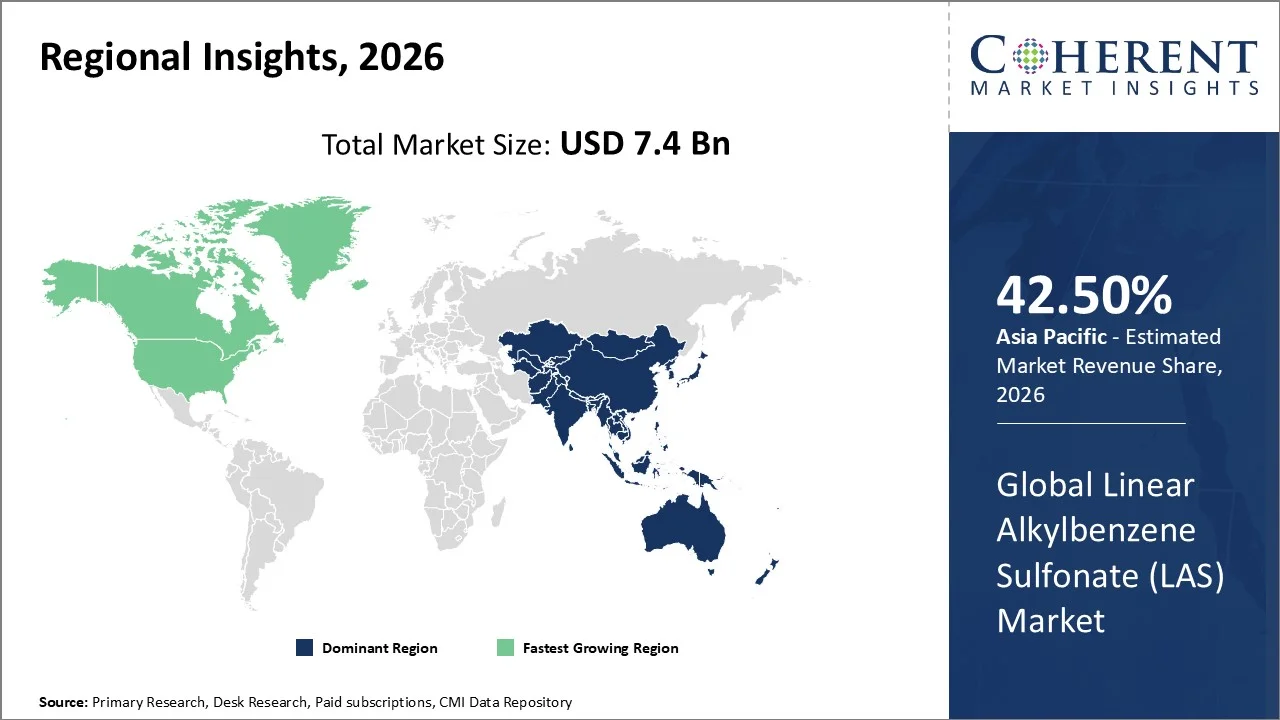
- Asia Pacific is expected to acquire the dominant share of 42.50%in 2026. The region’s growth is attributable to rapid urbanization, rising disposable incomes as well as growing demand for household cleaning products in populous countries like China and India. In addition, the global consumption of household products containing surfactants is projected to grow at nearly 3.5% annually through 2030, driven largely by Asia Pacific markets.
Segmental Insights
Why is Household Detergents and Cleaners Acquiring the Highest Share in the Market?
Household detergents and cleaners is projected to account for the largest Linear Alkylbenzene Sulfonate (LAS) Market share of 58.60% in 2026. The leadership is mainly attributed to LAS’s widespread use in a variety of household cleaning products, including laundry detergents, dishwashing liquids, and surface cleaners. The household demand for surfactant-based cleaning products in the US remained strong in 2023. The U.S. Bureau of Labor Statistics reported that each consumer spent an average of USD 818.49 per year on housekeeping supplies and USD 193.17 on laundry and cleaning products. This shows that cleaning products still plays a crucial role for U.S. households. As a result, the demand for surfactants like LAS continues to grow steadily.
The regulatory programs like the EPA’s Safer Choice program are also contributing to the use of LAS in household products. The EPA’s safer surfactant standards are encouraging manufacturers to develop cleaner and more eco-friendly formulations. This helps LAS remain a preferred ingredient for firms that want to meet consumer needs and regulatory requirements. Owing to strong household consumption and regulatory support, the household detergents and cleaners are expected to remain the leading application area for LAS.
- Current Industry Events of 2026
- Market Size Estimation
- Regional Breakdown
- Competitive Landscape
- Customer Intelligence
- Segmental Analysis
- Pricing Analysis
- Key Market Drivers, Challenges & Future Trends
- Customized Insights Section
Market Drivers
Sustainability and Environmental Innovation is Transforming the Linear Alkylbenzene Sulfonate (LAS) Industry in the United States
Sustainability and environmental innovation are driving growth in the U.S. Linear Alkylbenzene Sulfonate (LAS) industry. The detergent formulators are looking for surfactants that balance cleaning effectiveness with reduced aquatic impact. LAS continues to play a key role, as the EPA recognizes alkylbenzene sulfonates like LAS as essential ingredients in laundry detergents, dishwashing liquids, and other household cleaning products.
This demand is also tied to the household-cleaning basket tracked by the BLS, which includes soaps, detergents, fabric softeners, dishwashing liquids, and general cleaning items. On the regulatory front, the EPA’s Safer Choice criteria now require surfactant ingredients to achieve over 60% mineralization into carbon dioxide and water within 28 days, while avoiding harmful degradation products.
In addition, the EPA restricts non-qualifying impurities in Safer Choice-certified products to no more than 0.01% of the final product. These rules are prompting LAS makers as well as detergent companies to place greater emphasis on improving eco-friendliness, impurity control, wastewater compatibility, and renewable LAB feedstock tests. This ensures that LAS remains affordable and aligned with green-label reformulation goals for sustained market growth throughout the forecast period.
Green innovations in End-use Applications: A Key Advancement in Linear Alkylbenzene Sulfonate (LAS)
The green innovations in end-use applications are driving the evolution of the Linear Alkylbenzene Sulfonate (LAS) market, particularly as detergent and cleaner brands adopt more sustainable practices. The reformulations focusing on biodegradability, eco-friendly chemistry, refillable packaging, and reduced environmental impact are becoming more common. LAS, a core component in household and industrial detergents, is still essential in these developments owing to its surfactant properties and its favorable biodegradation profile.
According to Australia’s industrial chemicals evaluation, LAS biodegrades with a fast pace in wastewater under aerobic conditions, with studies showing 66.7%–94% degradation in line with OECD guidelines, and a half-life of 1.39–13.9 days in river water. In 2025, EPA added 18 chemicals to its Safer Chemical Ingredients List, thereby pushing certified product volumes to 2.4 billion pounds. The European Union’s 2026 detergent regulations are also set to tighten rules on biodegradability and ingredient transparency.
Current Events and Their Impact on the Linear Alkylbenzene Sulfonate (LAS) Market
Current Event | Description and its Impact |
EU Detergents and Surfactants Regulation 2026/405 |
|
U.S. EPA’s Safer Choice Program Expansion for Surfactants |
|
Linear Alkylbenzene Sulfonate (LAS) Market Trends
- The consistent use of LAS in laundry and dish detergents is driving market demand, as the U.S. EPA recognizes LAS surfactants as key ingredients in these products and other everyday cleaning applications.
- The widening household cleaning basket is strengthening LAS consumption, as BLS classifies laundry and cleaning products to include household soaps, detergents, fabric softeners, dishwashing products, bathroom cleaners, window cleaners, and general household cleaners.
- The rising focus on safer surfactants is pushing LAS producers toward stronger biodegradability and aquatic-safety compliance, with EPA Safer Choice criteria generally requiring more than 60% mineralization to CO₂ and water within 28 days.
- The EU’s updated detergents framework is encouraging reformulation and compliance investment, as new rules target improved biodegradability of detergents and cleaning products by summer 2029.
- Pricing discipline is becoming important for LAS-based detergent value chains, as BLS reported a 4.1% year-on-year rise in the U.S. soaps and detergents producer price index in March 2026.
Regional Insights
Asia Pacific Linear Alkylbenzene Sulfonate (LAS) Market Leadership Driven by Demand for Surfactants in Household and Industrial Cleaning Applications
Asia Pacific is set to account for the leading position in the Linear Alkylbenzene Sulfonate (LAS) Market. The region occupies a substantial 42.50% share in 2026. The growth is mainly driven by strong demand for surfactants in household and industrial cleaning applications. One of the key drivers is the scale of chemical production in the region. The official policy analysis from NITI Aayog identifies India as the third, thereby highlighting the region’s expanding manufacturing base and capacity to supply surfactants and intermediates domestically. The prominence of household cleaning and detergent use in APAC supports LAS consumption because these surfactants are essential for effective soil removal as well as formulation stability.
Population growth, urbanization, and increased awareness of hygiene have substantially boosted the use of cleaning products in the Asia Pacific region, thereby propelling higher demand for LAS within the wider surfactants market. The UN Classification of Individual Consumption According to Purpose (COICOP) also underscores that household cleaning expenditures are important components of household consumption categories tracked by national statistics offices, indirectly reflecting demand for surfactant-based products.
In addition, sustainability considerations are shaping regulatory landscapes in countries like Japan and Australia, where environmental guidance is encouraging biodegradable surfactants, thereby aiding the adoption of LAS‑based formulations. This combination of domestic production strength, high cleaning product usage, and evolving regulatory preference for efficient surfactants explains why the Asia Pacific region is poised to maintain leadership in the LAS market.
North America Linear Alkylbenzene Sulfonate (LAS) Market Trends
The North America region is poised to be as the fastest-growing region through 2026-2033. The region’s growth is owing to the robust household detergent consumption, a high demand for institutional cleaning, and increasing regulatory preferences for biodegradable surfactants. According to the Bureau of Labor Statistics (BLS), the U.S. recorded 135.76 million consumer units in 2024, with an average annual consumer expenditure of USD 78,535. This provides a substantial recurring base for products related to laundry, dishwashing, and general household cleaning.
The BLS further classifies laundry and cleaning products, including household soaps and detergents, bathroom and window cleaners, dishwashing products, and general cleaning agents, which represent key end-use categories for Linear Alkylbenzene Sulfonate (LAS). In 2024, the BLS reported that U.S. spending on laundry and cleaning products reached USD 28.27 billion, reflecting strong and sustained demand for anionic surfactants.
In addition, Canada’s federal assessments of linear C10-C13 alkylbenzene sulfonates show biodegradation rates of up to 94% in screening tests, thereby supporting their continued use in cleaning formulations.
Consistent Detergent Consumption is Speeding Up the LAS Adoption in China
The Linear Alkylbenzene Sulfonate (LAS) Market in China is experiencing substantial growth. The growth is mainly due to consistent detergent consumption along with an increasing demand for biodegradable surfactants in cleaning products. As per the Ministry of Ecology and Environment (MEE), LAS and alkyl sulfonates are commonly used in domestic detergents.
The demand for LAS is also backed by the ongoing growth in retail, with online sales of daily necessities increasing by 3.6% in early 2026. In addition, the chemical manufacturing sector is showing positive trends, with a 9.0% rise in value-added chemical products in March 2026. This is helping to boost the production volumes of cleaning formulations. Together, these factors are responsible for the growing demand for LAS in China's cleaning product sector.
United States Linear Alkylbenzene Sulfonate (LAS) Market Trends
The United States Linear Alkylbenzene Sulfonate (LAS) Market is poised for steady growth over the forthcoming years. The growth is owing to regulatory support and high production volumes. LAS is governed by the Environmental Protection Agency’s (EPA) under the Chemical Data Reporting (CDR) program, which tracks the production and use of chemicals manufactured or imported in commerce.
Additionally, LAS is classified as a High Production Volume (HPV) chemical by the EPA, indicating that its annual production and imports in the US exceed 1 million pounds. This high level of production demonstrates the extensive commercial application of LAS, particularly in detergents and cleaning products. This establishes it as an essential component in the US cleaning products industry and is responsible for its continued market growth.
Who are the Major Companies in Linear Alkylbenzene Sulfonate (LAS) Industry
Some of the major key players in Linear Alkylbenzene Sulfonate (LAS) Industry are BASF SE, Clariant Corporation, Croda International Plc, DowDuPont Inc., Evonik Corporation, Henkel AG & Co. KGaA, Huntsman Corporation, Galaxy Surfactants Ltd., Stepan Company, and Solvay S.A.
Key News
- In November 2025, Moeve and Honeywell announced an expanded collaboration aimed at scaling up the production technologies of bio-based Linear Alkylbenzene (LAB), the key raw material for producing LAS (Linear Alkylbenzene Sulfonate), the primary surfactant in household detergents. This initiative integrates cutting-edge process innovation with next-generation surfactant development, thus addressing the increasing demand from both the industry as well as consumers, while promoting environmental sustainability.
- In January 2023, Cepsa Química, a leading producer of surfactants and key raw materials such as fatty alcohols, derivatives, and linear alkylbenzene (LAB), announced that it will showcase NextLab, the world’s first sustainable LAB, at the annual ACI Convention taking place in Orlando. LAB is primarily used to produce linear alkylbenzene sulfonate (LAS), the most widely used primary surfactant in the homecare ingredients industry for manufacturing biodegradable detergents.
Market Report Scope
Linear Alkylbenzene Sulfonate (LAS) Market Report Coverage
| Report Coverage | Details | ||
|---|---|---|---|
| Base Year: | 2025 | Market Size in 2026: | USD 7.4 Bn |
| Historical Data for: | 2020 To 2024 | Forecast Period: | 2026 To 2033 |
| Forecast Period 2026 to 2033 CAGR: | 5% | 2033 Value Projection: | USD 10.39 Bn |
| Geographies covered: |
| ||
| Segments covered: |
| ||
| Companies covered: | BASF SE, Clariant Corporation, Croda International Plc, DowDuPont Inc., Evonik Corporation, Henkel AG & Co. KGaA, Huntsman Corporation, Galaxy Surfactants Ltd., Stepan Company, and Solvay S.A. | ||
| Growth Drivers: |
| ||
| Restraints & Challenges: |
| ||
Analyst Opinion
- The Linear Alkylbenzene Sulfonate (LAS) Market is expanding as household laundry, dishwashing, and cleaning formulations continue to remain the core demand base. The data from EPA notes that the majority of alkylbenzene sulfonate uses are in household laundry and dish detergents. These chemicals fall under High Production Volume thresholds of over 1 million pounds annually.
- The U.S. demand base is quite strong, as BLS recorded 135.76 million consumer units in 2024 and USD 28.27 billion in aggregate spending on laundry and cleaning products. In March 2026, BLS also reported household cleaning products up 2.1% year-on-year, thereby supporting recurring demand for LAS-based surfactants.
- The regulatory visibility is strengthening, as EPA published 2024 Chemical Data Reporting information in April 2026, covering 2020–2023 site-specific LAS production volumes across 8,650 chemicals. This improves tracking of LAS manufacturing, import, and use patterns under TSCA.
- Future growth is expected to be supported by biodegradable surfactant demand. Canada’s federal assessment reported 94% biodegradation for linear C10–C13 alkylbenzene sulfonates in a modified OECD screening test, while EPA Safer Choice surfactant criteria emphasize biodegradation within defined time windows.
Speak to the analyst
Want personalized insights?
Take the findings above to one of our principal consultants, or have the report rebuilt around the segments, geographies and competitors you actually track.
Market Segmentation
- By Application (Revenue, USD Bn, 2021-2033)
- Household Detergents and Cleaners
- Dish Washing Liquids
- Personal Care Products
- Industrial Cleaners
- Others
- By Region (Revenue, USD Bn, 2021-2033)
- North America
- U.S.
- Canada
- Latin America
- Brazil
- Mexico
- Argentina
- Rest of Latin America
- Europe
- Germany
- U.K.
- France
- Italy
- Spain
- Russia
- Rest of Europe
- Asia Pacific
- China
- India
- Japan
- Australia
- South Korea
- ASEAN
- Rest of Asia Pacific
- Middle East
- GCC
- Israel
- Rest of Middle East
- Africa
- South Africa
- Central Africa
- North Africa
- North America
- Key Players
- BASF SE
- Clariant Corporation
- Croda International Plc
- DowDuPont Inc.
- Evonik Corporation
- Henkel AG & Co. KGaA
- Huntsman Corporation
- Galaxy Surfactants Ltd.
- Stepan Company
- Solvay S.A.
Sources
Primary Research Interviews
- Linear Alkylbenzene Sulfonate (LAS) Manufacturers
- Linear Alkylbenzene (LAB) Producers and Suppliers
- Detergent and Household Cleaning Product Manufacturers
- Surfactant Formulators and Specialty Chemical Suppliers
- Raw Material Suppliers and Chemical Distributors
- Industrial and Institutional Cleaning Product Producers
- Personal Care and Home Care Product Formulation Experts
- Environmental and Regulatory Compliance Consultants
- Others
Databases
- Bloomberg Terminal
- UN Comtrade Database
- ITC Trade Map
- Others
Magazines
- Chemical Engineering Magazine
- ICIS Chemical Business
- Chemical Week
- HAPPI Magazine
- Soap, Perfumery & Cosmetics Magazine
- Specialty Chemicals Magazine
- Manufacturing Chemist
- Others
Journals
- Journal of Surfactants and Detergents
- Tenside Surfactants Detergents
- Journal of Oleo Science
- Journal of Cleaner Production
- Environmental Science & Technology
- Industrial & Engineering Chemistry Research
- Colloids and Surfaces A: Physicochemical and Engineering Aspects
- Others
Newspapers
- Financial Times
- The Wall Street Journal
- Reuters
- Bloomberg News
- Business Standard
- The Economic Times
- Nikkei Asia
- Others
Associations
- American Cleaning Institute (ACI)
- International Association for Soaps, Detergents and Maintenance Products (A.I.S.E.)
- European Committee of Organic Surfactants and Their Intermediates (CESIO)
- European Chemical Industry Council (Cefic)
- Indian Chemical Council (ICC)
- The Solvents Industry Association
- American Chemistry Council (ACC)
- Others
Public Domain Sources
- U.S. Environmental Protection Agency (EPA)
- European Chemicals Agency (ECHA)
- Organisation for Economic Co-operation and Development (OECD)
- World Bank Open Data
- UN Comtrade
- International Trade Centre (ITC) Trade Map
- Eurostat
- U.S. International Trade Commission (USITC)
- Ministry of Chemicals and Fertilizers, India
- Others
Proprietary Elements
- CMI Data Analytics Tool
- Proprietary CMI Existing Repository of Information for the Last 10 Years
Get access to 250+ pages report
Every segment, forecast, competitor profile and data table behind the analysis above — available for instant download.
- ESOMAR Member
- ISO 9001:2015 Certified
- D-U-N-S Registered
- GDPR & CCPA Compliant
Missing comfort of reading report in your local language? Find your preferred language:
Transform your Strategy with Exclusive Trending Reports
Frequently Asked Questions
The Linear Alkylbenzene Sulfonate (LAS) Market is expected to reach USD 10.39 Billion in 2033.
Major players operating in the global Linear Alkylbenzene Sulfonate (LAS) Market include BASF SE, Clariant Corporation, Croda International Plc, DowDuPont Inc., Evonik Corporation, Henkel AG & Co. KGaA, Huntsman Corporation, Galaxy Surfactants Ltd., Stepan Company, and Solvay S.A.
The volatile raw material prices, stringent environmental regulations regarding wastewater, and competition from bio-based alternatives are the key factors hampering growth of the market.
The rising demand for biodegradable surfactants in household and industrial detergents, increasing hygiene awareness, and rapid urbanization is boosting demand for Linear Alkylbenzene Sulfonate (LAS).
The Linear Alkylbenzene Sulfonate (LAS) Market is anticipated to grow at a CAGR of 5% between 2026 and 2033.
Among regions, Asia Pacific account for a largest market share in the global Linear Alkylbenzene Sulfonate (LAS) Market over the forecast period.