

Acetic Acid Market Size & Trends
Acetic Acid Market is estimated to be valued at USD 19.35 Bn in 2026 and is expected to reach USD 37.47 Bn in 2033, exhibiting a compound annual growth rate (CAGR) of 9.9% from 2026 to 2033.
Key Takeaways
- Based on Application, the Vinyl Acetate Monomers segment is projected to account for 31% of the market share in 2026, due to its extensive use in manufacturing.
- Based on Region, Asia Pacific is set to lead the global acetic acid market in 2026 with an estimated 62% While, North America is anticipated to be the fastest growing region during the forecast period.
Market Overview
The acetic acid market is witnessing steady expansion, driven by its wide range of end-use industries such as paints and coatings, plastics, textiles, pharmaceuticals, and food processing. Acetic acid serves as a vital intermediate in the production of vinyl acetate monomer (VAM), purified terephthalic acid (PTA), acetic anhydride, and ester solvents. Among these, VAM leads the market in consumption, especially due to its applications in adhesives, sealants, and flexible packaging.
The rising global population and urbanization are fueling the acetic acid market growth, particularly in emerging economies where construction, automotive, and packaging industries are expanding rapidly. Additionally, the increasing use of PTA in polyester manufacturing for textiles and PET bottles continues to drive consumption.
Additionally, the ongoing innovation in bio-based acetic acid production and the growing shift towards sustainable chemistry are expected to create future opportunities, supporting the long-term acetic acid market demand.
Current Events and their Impact on the Acetic Acid Market
Current Event | Description and its Impact |
Capacity Expansions and Overcapacity Concerns in China |
|
Regulatory Shifts and Environmental Pressures |
|
Technological and Sustainable Production Advancements |
|
Import and Export of the Acetic Acid Market
In 2023, global trade data for acetic acid reveals that India was the world’s largest importer, with total imports valued at approximately USD 479.8 million. This substantial demand reflects the country’s large-scale consumption across end-use industries such as textiles, packaging, adhesives, and food preservation. India primarily sources acetic acid from countries like China, Malaysia, and Singapore, which together dominate the regional export landscape. The European Union also accounted for a significant portion of global demand, importing acetic acid worth USD 355.3 million, with individual countries such as Germany (USD 229.3 million) and Belgium (USD 211.5 million) contributing notably to the total. In Southeast Asia, Indonesia imported around USD 30.5 million worth of acetic acid in 2023, with key suppliers including Singapore (USD 16.4 million), Malaysia (USD 11.9 million), and China (USD 1.24 million). These figures highlight how Asia-Pacific acts as both a major production hub and demand center for acetic acid, with strong intra-regional trade flows. Overall, global acetic acid imports are being fueled by robust demand from industrial sectors and food processing applications, especially in fast-growing and manufacturing-intensive economies like India and across the European region.
- Current Industry Events of 2026
- Market Size Estimation
- Regional Breakdown
- Competitive Landscape
- Customer Intelligence
- Segmental Analysis
- Pricing Analysis
- Key Market Drivers, Challenges & Future Trends
- Customized Insights Section
Segmental Insights
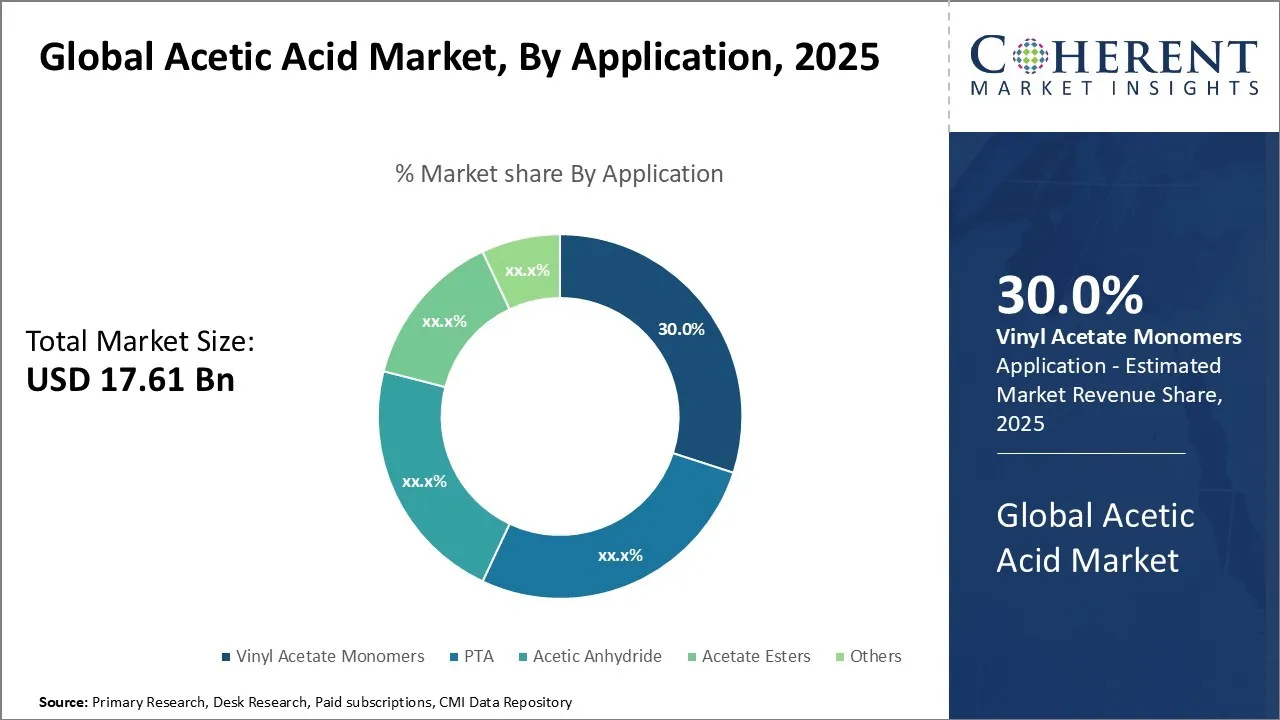
Acetic Acid Market Insights, By Application - Vinyl Acetate Monomers Acquires the Dominant share owing to Wide Range of Industrial and Consumer Products
In terms of application, the vinyl acetate monomers segment is expected to hold 31.0% share of the market in 2026, due to its extensive use in manufacturing a wide range of industrial and consumer products. VAM is produced by reacting acetic acid with ethylene and oxygen, making it one of the largest end-use applications of acetic acid globally. It serves as a crucial raw material in the production of polyvinyl acetate (PVA) and ethylene vinyl acetate (EVA), which are widely used in adhesives, sealants, paints, coatings, textiles, and packaging. In the adhesives and construction industries, VAM-based emulsions offer strong bonding and flexibility. In the paints and coatings sector, they provide durability and water resistance, especially for water-based formulations. The packaging industry also relies heavily on EVA copolymers for flexible films and barrier layers. With growing demand from these sectors, especially in fast-industrializing regions like Asia Pacific, the consumption of VAM is rising steadily, thereby directly accelerating the growth of the acetic acid market.
In November 2024, Kuraray achieved ISCC PLUS certification for six vinyl acetate‑related products across four manufacturing sites in the U.S. and Europe, marking a significant step in establishing a sustainable, certified supply chain. The newly certified products include vinyl acetate monomer (VAM), PVOH resin (ELVANOL™ / KURARAY POVAL™), water‑soluble PVOH film, PVB resin, and EVOH resin (EVAL™), all allocated via the mass‑balance approach, further proliferating the acetic acid market share.
Regional Insights
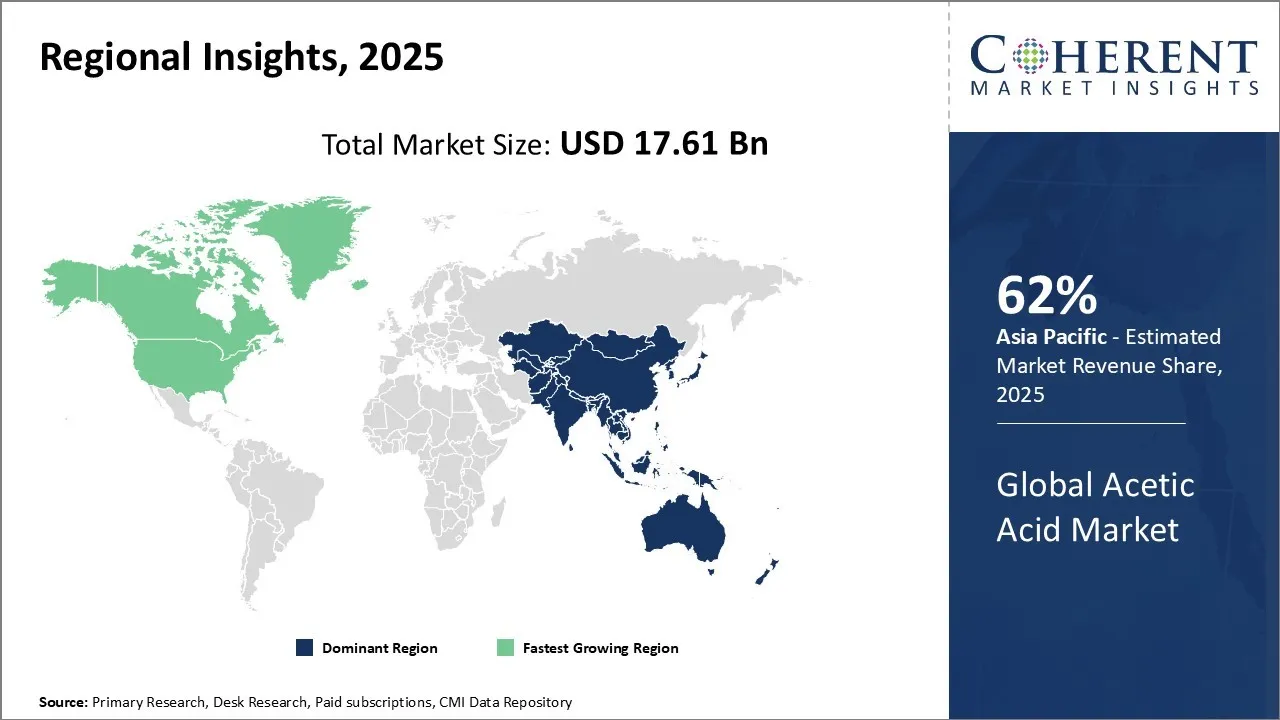
Asia Pacific Acetic Acid Market Analysis & Trends
The Asia Pacific region is projected to lead the market with a 62% share in 2026, fueled by several interlinked industrial and economic factors. Countries like China, India, South Korea, and Japan are witnessing rapid growth in sectors such as textiles, packaging, automotive, and construction, all of which rely heavily on downstream derivatives of acetic acid like vinyl acetate monomer (VAM) and purified terephthalic acid (PTA). These derivatives are crucial for producing paints, adhesives, polyester fibers, and PET bottles.
For instance, in November 2024, INEOS Acetyls and Gujarat Narmada Valley Fertilizers & Chemicals (GNFC) signed a non‑binding Memorandum of Understanding to form a 50:50 joint venture to build a 600,000‑ton‑per‑year acetic acid facility at GNFC’s Bharuch site in Gujarat. Leveraging nearly 30 years of technology partnership, the joint venture aims to support India’s Make in India goals by reducing reliance on imports, which currently account for about 85% of domestic need.
Additionally, Asia Pacific is a global hub for chemical manufacturing, with China alone accounting for a significant share of global acetic acid production and consumption. The region benefits from low-cost labor, abundant raw materials, and expanding domestic demand, making it attractive for both producers and downstream users.
North America Acetic Acid Market Analysis & Trends
North America is expected to exhibit the fastest growth, holding a significant market share in 2026, driven by the strong presence of end-use industries such as paints and coatings, automotive, packaging, and pharmaceuticals. Acetic acid is a key precursor in the production of vinyl acetate monomer (VAM), which is extensively used in adhesives, paints, and sealants, products that are in high demand across construction and automotive sectors in the U.S. and Canada.
For instance, in December 2023, INEOS has confirmed the completion of its acquisition of Eastman Chemical’s Texas City site in Texas which is a home to a 600,000‑ton‑per‑year acetic acid plant and related third‑party operations from Eastman Chemical Company. The transaction, valued at approximately $490–$500 million, includes continued operation of the site’s plasticizer unit by INEOS, although ownership remains with Eastman.
Moreover, growing demand for purified terephthalic acid (PTA) for polyester production, especially for packaging materials like PET bottles, is further boosting acetic acid market revenue.
Acetic Acid Market Outlook Country-Wise
China Acetic Acid Market Trends
China is the largest producer and consumer in the acetic acid market, driven by strong demand for downstream products like vinyl acetate monomer (VAM), acetic anhydride, and purified terephthalic acid (PTA). These are widely used in textiles, packaging, paints, adhesives, and pharmaceuticals. Rapid industrialization, a booming polyester industry, and expanding pharmaceutical manufacturing continue to fuel China's high consumption of acetic acid.
In May 2026, a large acetic acid plant in China, with a capacity of 600,000 tons, officially started operating after its products passed quality tests, marking the beginning of full commercial production.
India Acetic Acid Market Trends
India is a key growth market for the acetic acid market due to its expanding manufacturing and pharmaceutical sectors. Rising demand for vinyl acetate monomer (VAM) in packaging, adhesives, and textiles is a major driver. The country’s large pharmaceutical industry uses acetic acid in the synthesis of APIs and other formulations. Additionally, growing consumption of processed foods is boosting the use of food-grade acetic acid as a preservative. These factors collectively contribute to strong acetic acid market demand in India.
In November 2024, INEOS Acetyls and Gujarat Narmada Valley Fertilizers & Chemicals Ltd (GNFC) signed a Memorandum of Understanding (MoU) to assess the feasibility of constructing a new world-scale acetic acid plant with a capacity of 600,000 tonnes per year at GNFC's site in Bharuch, Gujarat, India.
The U.S. Acetic Acid Market Trends
The United States is a key consumer in the acetic acid market due to its strong chemical manufacturing base and rising demand for sustainable materials. Acetic acid is widely used in producing adhesives, coatings, solvents, and PTA for PET packaging. The growing focus on low-VOC formulations and increasing use in industrial and consumer applications, including construction and packaging, continue to drive demand. Additionally, the country’s shift toward environmentally friendly solvents and expanding use in pharmaceuticals and electronics support acetic acid market growth.
Market Report Scope
Acetic Acid Market Report Coverage
| Report Coverage | Details | ||
|---|---|---|---|
| Base Year: | 2025 | Market Size in 2026: | USD 19.35 Bn |
| Historical Data for: | 2020 To 2024 | Forecast Period: | 2026 To 2033 |
| Forecast Period 2026 to 2033 CAGR: | 9.9%2033 Value Projection: | USD 37.47 Bn | |
| Geographies covered: |
| ||
| Segments covered: |
| ||
| Companies covered: | Celanese Corporation, British Petroleum, Eastman Chemical Company, Jiangsu Sopo (Group) Co., Ltd., China Petroleum & Chemical Corporation (Sinopec), Lyondell Basell Industries, Saudi Basic Industries Corporation (SABIC), Mitsubishi Chemical Company, PetroChina Co. Ltd., PetroChina Co. Ltd., BASF SE. | ||
| Growth Drivers: |
| ||
| Restraints & Challenges: |
| ||
Global Acetic Acid Market Drivers
- The usage of vinegar in the food industry has expanded
Rapid population expansion and the adoption of a healthy, sustainable diet have increased food production globally, which has led to an increase in demand for acetic acid. Acetic acid is mostly used to create vinegar, a prominent ingredient in cuisines and personal care products. Vinegar is a component in marinades, salad dressings, and pickling solutions. It also reduces the risk of Salmonella contamination in meat and poultry products. Food preservation is another use for acetic acid and its sodium salts. For instance, in 2023, U.S. - and Italy-based olive oil, vinegar, and pasta company Colavita acquired the O Olive Oil & Vinegar business from Curation Foods. Such instances are accelerating the acetic acid market demand.
Global Acetic Acid Market Opportunities
Rapid industrialization and urbanization around the globe are projected to offer lucrative market opportunities over the forecast period. Rise in construction industries coupled with the growing demand for high-performance plastic from the end-user industry due to their durability is again expected to foster the acetic acid market share. Moreover, increasing automobile production across the developing region is further projected to raise demand for plastic and rubber products. These trends are anticipated to significantly support acetic acid market forecast, as acetic acid remains a critical feedstock in manufacturing essential intermediates used in construction, automotive, and consumer goods industries.
Global Acetic Acid Market Trends
One of the prominent trends in the acetic acid market is the growing focus of key manufacturers on expanding production capacities to meet rising global demand. This shift is supported by increasing acetic acid consumption in the food & beverage industry, where it is widely used as a preservative, acidity regulator, and flavor enhancer in sauces, pickles, and ready-to-eat meals. The rising consumer expenditure on health-conscious and packaged food products is further driving this demand. As a result, the acetic acid market price has seen upward pressure due to supply-demand imbalances in key regions.
Analyst Opinion (Expert Opinion)
The acetic acid market value stands at a strategically vital intersection of feedstock economics, regional consumption dynamics, and downstream integration. In my opinion, the trajectory of this market is no longer just a derivative of conventional demand cycles in vinyl acetate monomer (VAM) or purified terephthalic acid (PTA) but increasingly influenced by China's consolidation strategy, regional trade realignments, and environmental regulations that are tightening across Asia and Europe.
The most telling structural dynamic today is China's continued dominance, not just in production but in influencing pricing and capacity additions globally. According to ICIS data, over 60% of global acetic acid capacity is based in China, giving Chinese producers significant influence over regional spot markets, particularly in Asia and the Middle East. This concentration, while beneficial for domestic downstream players, has introduced considerable volatility for import-dependent nations such as India and Brazil, where landed cost fluctuations frequently impair pricing power for local acetate and PTA producers.
From a feedstock standpoint, methanol economics are pivotal. Given that over 90% of global acetic acid is produced via the methanol carbonylation route, any sharp movement in natural gas prices (especially in North America or the Middle East) ripples through to acetic acid margins. U.S.-based producers like Eastman and Celanese benefit from relatively stable and low-cost natural gas inputs, offering them margin resilience, especially when Asian FOB prices are under pressure from oversupply.
Another trend often overlooked is the geopolitical alignment influencing trade flows. For example, anti-dumping duties imposed by the European Union on Chinese acetic acid imports have structurally altered intra-regional supply chains, benefiting players in Turkey, Saudi Arabia, and Russia, who now act as intermediaries or alternative suppliers to the EU. The integration of acetic acid capacities into petrochemical parks in countries like Saudi Arabia also presents a long-term advantage in terms of feedstock security and backward integration.
Speak to the analyst
Want personalized insights?
Take the findings above to one of our principal consultants, or have the report rebuilt around the segments, geographies and competitors you actually track.
Recent Developments
- In May 2025, Danish‑German held the groundbreaking ceremony for their first U.S. acetic acid production site in Texas City, marking a major step in sustainable chemical commercialization. The facility will convert industrial CO₂ emissions into acetic acid, fertilizers, and building‑block chemicals through microbial fermentation using hydrogen.
- In April 2025, Lenzing Group and Speyer & Grund GmbH & Co. KG inaugurated a new dedicated storage tank for LENZING™ Acetic Acid Biobased at Speyer & Grund’s site in Meerane, Germany. The tank marks a significant milestone in their long-standing partnership, offering enhanced capacity and greater supply‑chain flexibility. The biobased acid, produced as a by‑product of Lenzing’s wood‑based pulp process, boasts a carbon footprint over 85% lower than conventional fossil‑based acetic acid.
- In March 2025, Assam Bio Ethanol Private Limited (ABEPL), a joint venture led by Numaligarh Refinery Limited with Finnish partners Fortum and Chempolis, unveiled India’s first bamboo‑based second‑generation biorefinery by mid‑2025. With an annual output capacity of approximately 50,000 metric tonnes of bioethanol, the plant will also yield 19,000 MT of furfural and 11,000 MT of acetic acid, plus green energy and CO₂.
Market Segmentation
- Global Acetic Acid Market, By Application (Revenue, USD Bn, 2021 - 2033)
- Vinyl acetate monomer
- PTA
- Acetate esters
- Acetic anhydride
- Others
- Global Acetic Acid Market, By Region (Revenue, USD Bn, 2021 - 2033)
- North America
- U.S.
- Canada
- Latin America
- Brazil
- Argentina
- Mexico
- Rest of Latin America
- Europe
- Germany
- U.K.
- Spain
- France
- Italy
- Russia
- Rest of Europe
- Asia Pacific
- China
- India
- Japan
- Australia
- South Korea
- ASEAN
- Rest of Asia Pacific
- Middle East & Africa
- GCC Countries
- Israel
- Rest of Middle East & Africa
- North America
- Global Acetic Acid Market, Key Companies
- Celanese Corporation
- British Petroleum
- Eastman Chemical Company
- Jiangsu Sopo (Group) Co., Ltd.
- China Petroleum & Chemical Corporation (Sinopec)
- Lyondell Basell Industries
- Saudi Basic Industries Corporation (SABIC)
- Mitsubishi Chemical Company
- PetroChina Co. Ltd.
- BASF SE.
Sources
Primary Research Interviews from the following stakeholders
Stakeholders
- Interviews with acetic acid producers, downstream chemical processors, logistics coordinators, procurement heads, and application engineers across major production and consumption hubs.
Specific Stakeholders
- Plant managers and R&D chemists at petrochemical and specialty chemical plants
- Procurement and supply chain heads at textile and polyester manufacturers
- Product managers and technical heads at paints, coatings, and adhesives companies
- Process engineers in the food-grade acetic acid segment at food processing and packaging firms
- Commercial heads in pharmaceutical and API manufacturing units
- Feedstock procurement managers at methanol and carbon monoxide supply companies
Databases
- UN Comtrade Database
- World Bank – Global Petrochemical Trade Statistics
- International Energy Agency (IEA) Chemical Feedstock Reports
- China Customs Statistics
- European Chemical Industry Council (CEFIC) Data
- Directorate General of Commercial Intelligence and Statistics (DGCIS), India
- Korea International Trade Association (KITA)
- U.S. Energy Information Administration (EIA) – Chemicals and Refining Data
- Ministry of Economy, Trade and Industry (METI), Japan
Magazines
- Chemical & Engineering News (C&EN)
- ICIS Chemical Business
- European Coatings Journal
- Paints & Coatings Industry (PCI)
- Adhesives & Sealants Industry
- Asian Textile Journal
- Modern Plastics India
- Chemicals Technology (B2B Tech Media)
Journals
- Industrial & Engineering Chemistry Research (ACS Publications)
- Journal of Applied Polymer Science
- Journal of Cleaner Production
- Chemical Engineering Journal (Elsevier)
- Journal of Textile and Apparel, Technology and Management
- Progress in Organic Coatings
- Environmental Science & Technology
Newspapers
- Financial Times – Commodities & Chemical Trade Section
- The Economic Times – Chemicals & Petrochemicals Section
- Business Standard – Specialty Chemicals Reports
- The Hindu Business Line – Textiles and Industry News
- Nikkei Asia – Chemical Supply Chain Updates
- South China Morning Post – Industrial Exports & Trade
- The Wall Street Journal – Global Industry Briefings
Associations
- American Chemistry Council (ACC) – Acetic Acid Segment
- Indian Chemical Council (ICC)
- China Petroleum and Chemical Industry Federation (CPCIF)
- Japan Chemical Industry Association (JCIA)
- European Chemical Industry Council (CEFIC)
- Federation of Indian Export Organisations (FIEO) – Chemical Exports Panel
- Textile Association (India)
- Global Acetyls Forum (Industry-specific technical community)
Public Domain Sources
- Ministry of Chemicals and Fertilizers, Government of India
- Ministry of Economy, Trade and Industry (METI), Japan
- National Bureau of Statistics of China (NBS)
- U.S. International Trade Commission (USITC) – Chemical Tariff and Trade Reports
- Eurostat – Chemical Production and Trade Data
- NITI Aayog – Petrochemicals and Downstream Sector Briefs
- Central Pollution Control Board (CPCB) India – Industry Waste and Safety Norms
- Reserve Bank of India (RBI) – Sectoral Credit Deployment Reports
Proprietary Elements
- CMI Data Analytics Tool, and Proprietary CMI Existing Repository of information for last 8 years
*Definition: Acetic acid is a liquid chemical compound that is colorless in nature. Acetic acid is also referred to as ethanoic acid. It is produced by the methanol carbonylation process. Acetic acid is widely used as a key intermediate in the production of chemical products such as Purified Terephthalic Acid (PTA), Vinyl acetate monomer (VAM), and others. Pharmaceutical, rubber, plastics, construction, and paints &coatings are some of the key end-users of acetic acid.
Get access to 250+ pages report
Every segment, forecast, competitor profile and data table behind the analysis above — available for instant download.
- ESOMAR Member
- ISO 9001:2015 Certified
- D-U-N-S Registered
- GDPR & CCPA Compliant
Missing comfort of reading report in your local language? Find your preferred language:
Transform your Strategy with Exclusive Trending Reports
Frequently Asked Questions
The Acetic Acid Market is estimated to be valued at USD 19.35 Bn in 2026, and is expected to reach USD 37.47 Bn by 2033.
The CAGR of the Acetic Acid Market is projected to be 9.9% from 2026 to 2033.
Demand for Vinyl Acetate Monomer and the usage of vinegar in the food industry are driving the acetic acid market growth.
High adoption of acetic acid in the food and beverage industries can be the latest trend for the market growth.
Acetic Acid's Negative Effects Can Slow Market Growth.
Key players operating in the global acetic acid market are Celanese Corporation, British Petroleum, Eastman Chemical Company, Jiangsu Sopo (Group) Co., Ltd., China Petroleum & Chemical Corporation (Sinopec), Lyondell Basell Industries, Saudi Basic Industries Corporation (SABIC), Mitsubishi Chemical Company, PetroChina Co. Ltd., PetroChina Co. Ltd., BASF SE.
Common grades include glacial (≥99%), food grade, industrial grade, and pharmaceutical grade, varying by purity and application.