

Concentrated Nitric Acid Market Size and Forecast – 2026 to 2033
The Concentrated Nitric Acid Market is anticipated to grow at a CAGR of 6.4% with USD 5.9 Bn in 2026 and is expected to reach USD 9.4 Bn in 2033. The concentrated nitric acid market grows as industries increase their use of nitrogen-based fertilizers, expand chemical manufacturing activities, and adopt nitric acid in pharmaceutical and metal processing applications.
Key Takeaways
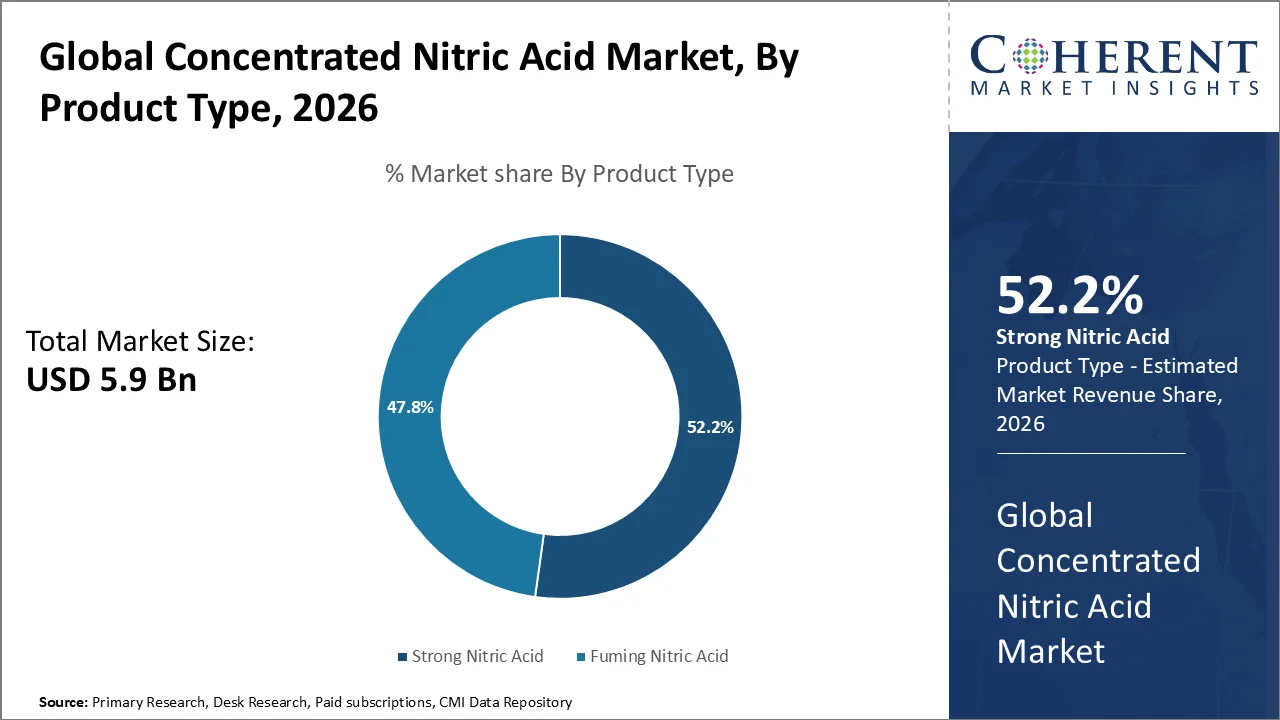
- Strong Nitric Acid hold the largest market share of 52.2% in 2026 owing to the growing demand from fertilizer production. Total fertilizer production increased from 385.39 LMT in 2014–15 to 503.35 LMT in 2023–24.
- Ammonium Nitrate expected to hold largest market share of 39.2% in 2026 owing to its rising global fertilizer usage. Global ammonium nitrate production increased from 45.8 million metric tons in 2023 to 47.8 million metric tons in 2024.
- Automotive acquired the largest market share of 42.2% in 2026 owing to the growing automotive production worldwide. Global automotive production reached approximately 96.4 million vehicles, with China leading global output, followed by Japan and India, which produces around 1.5 million passenger cars per quarter.
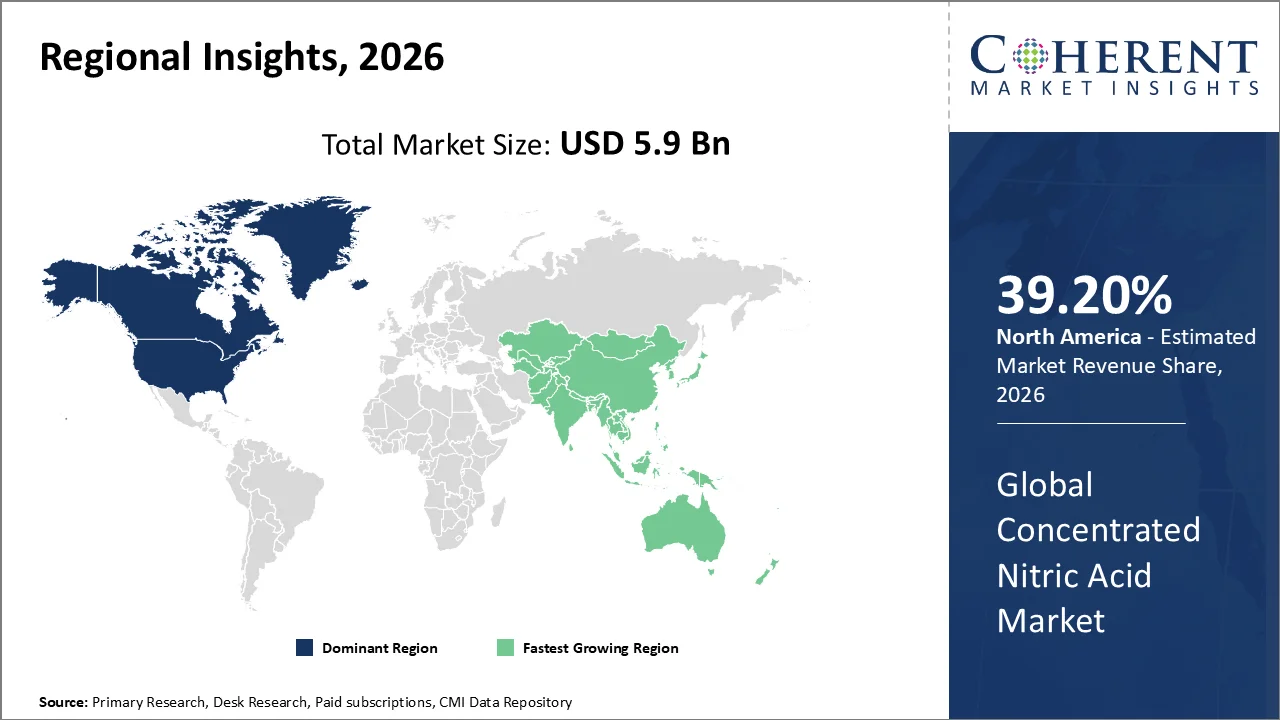
- North America is expected to acquire the dominant share of 39.2% in 2026 owing to its growth of mining and explosives applications.
Current Events and Their Impact on the Concentrated Nitric Acid Market
Current Event | Description and its Impact |
EU Industrial Emissions Directive (IED) Revision Enters into Force (2024) |
|
U.S. EPA Finalizes Stronger Greenhouse Gas Standards for Nitric Acid Plants |
|
Segmental Insights
- Current Industry Events of 2026
- Market Size Estimation
- Regional Breakdown
- Competitive Landscape
- Customer Intelligence
- Segmental Analysis
- Pricing Analysis
- Key Market Drivers, Challenges & Future Trends
- Customized Insights Section
Why is Strong Nitric Acid Acquiring the Largest Market Share?
Strong Nitric Acid hold the largest market share of 52.2% in 2026. Strong nitric acid drives growth in the concentrated nitric acid market through its extensive applications in fertilizer production, explosives manufacturing, and chemical synthesis. Growing agricultural activities, increasing demand for nitrogen-based fertilizers, and expanding mining and infrastructure projects boost its consumption. Manufacturers use strong nitric acid to produce intermediates such as nitro compounds, adipic acid, and specialty chemicals. Rising industrialization, increasing automotive applications, and growing demand from emerging economies further accelerate market expansion and enhance its importance across diverse industries. For instance, KBR commissioned GNFC's second concentrated nitric acid plant in Gujarat, India, using its proprietary MAGNAC technology. The 150-metric-ton-per-day plant improves energy efficiency, reduces emissions, and recycles process water without additional treatment.
Ammonium Nitrate expected to hold largest market share
Ammonium Nitrate expected to hold largest market share of 39.2% in 2026 owing to its expansion of mining and construction activities. Ammonium nitrate fuels growth in the concentrated nitric acid market through its broad use in fertilizer production and industrial explosives. Agricultural industries increase consumption by utilizing nitrogen-based fertilizers to improve crop yields and support food production. Mining, quarrying, and construction sectors drive additional demand by using ammonium nitrate-based explosives for excavation and blasting operations. Manufacturers invest in fertilizer production capacity, while expanding industrial activities in emerging economies and the rising need for effective nutrient solutions further accelerate ammonium nitrate demand in the concentrated nitric acid market.
Which End Use segment dominates the market?
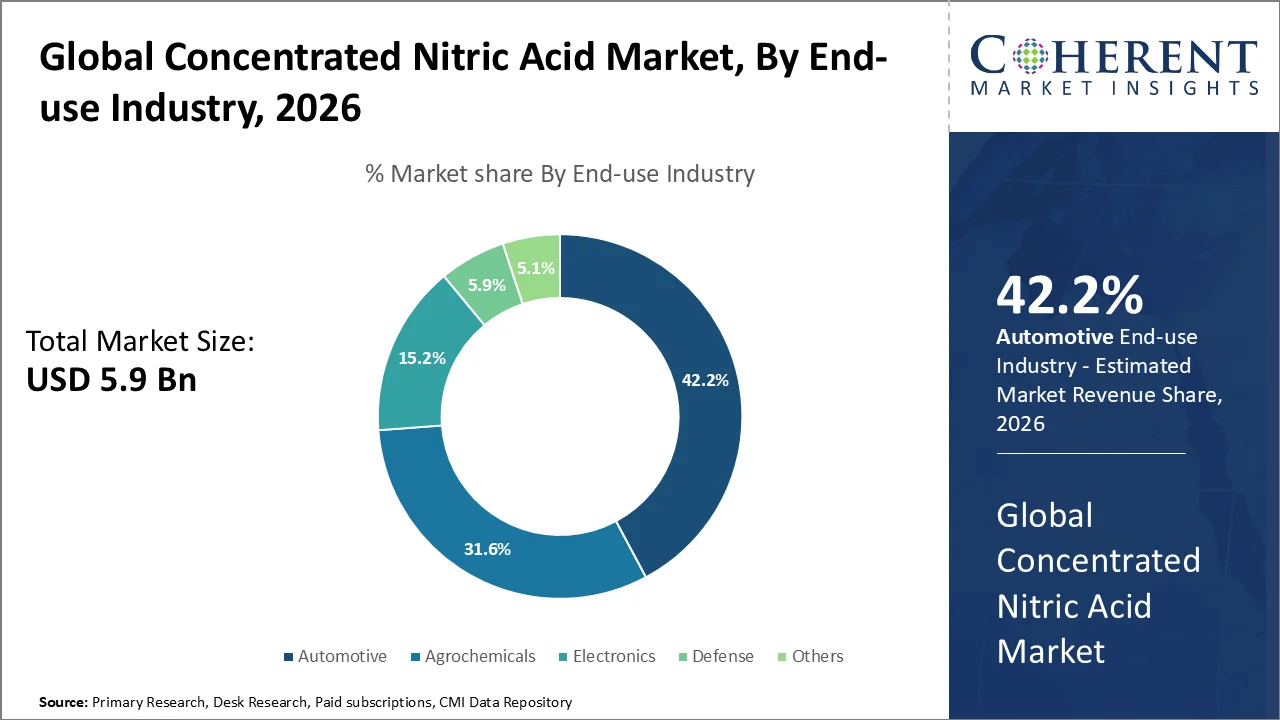
Automotive acquired the largest market share of 42.2% in 2026. The automotive sector supports the concentrated nitric acid market by utilizing nitric acid-derived chemical intermediates, polymers, and specialty materials in vehicle manufacturing. Automakers increase demand through higher vehicle production, the adoption of lightweight components, and the use of advanced materials. Manufacturers rely on nitric acid-based products such as adipic acid and nylon to produce automotive parts, coatings, and engineering plastics. Expanding electric vehicle production, ongoing technological advancements, and growing automotive manufacturing activities further boost concentrated nitric acid demand across the industry. India’s electric vehicle (EV) sales reached 1,752,406 units, recording a 40.3% year-over-year growth.
Concentrated Nitric Acid Market Trends
- Rising demand for nitrogen-based fertilizers continues to support concentrated nitric acid consumption, as it is a key feedstock for ammonium nitrate and other nitrogen fertilizers. According to the Food and Agriculture Organization (FAO), global fertilizer use is projected to reach approximately 199.8 million tonnes in 2024/25, sustaining demand for nitric acid in fertilizer production.
- Increasing industrialization in emerging economies is accelerating nitric acid consumption across fertilizers, chemicals, and manufacturing. According to the United Nations Industrial Development Organization (UNIDO), global manufacturing value added grew by 2.3% in 2024, led by continued industrial expansion in Asia, supporting demand for industrial chemicals including nitric acid.
- Growing investments in fertilizer production capacity continue to strengthen the market. According to the Ministry of Chemicals & Fertilizers, Government of India, India's total fertilizer production increased from 385.39 lakh metric tonnes (LMT) in 2014–15 to 503.35 LMT in 2023–24, driving higher domestic demand for nitric acid and other fertilizer intermediates.
Regional Insights
North America dominates owing to infrastructure development and construction activities
North America is expected to acquire the dominant share of 39.20% in 2026. North America strengthens the concentrated nitric acid market through rising demand from fertilizer production, chemical manufacturing, mining, and industrial sectors. The United States accounts for approximately 10–15% of global fertilizer consumption, making it one of the world's largest fertilizer markets. Agricultural industries increase consumption by using nitrogen-based fertilizers, while mining and infrastructure companies drive ammonium nitrate demand for explosive applications. The region’s well-developed chemical sector manufactures specialty chemicals, polymers, and intermediates using nitric acid-based products. Increased investments in advanced manufacturing, automotive materials, and domestic fertilizer production facilities further accelerate concentrated nitric acid demand throughout North America.
Asia Pacific Concentrated Nitric Acid Market Trends
The Asia Pacific concentrated nitric acid market gains momentum as the fertilizer industry increases its demand for nitrogen-based fertilizers to enhance agricultural productivity. Metal processing, mining, explosives, and chemical manufacturing industries drive market growth through expanding applications. Industrialization, infrastructure development, and investments in advanced chemical production facilities further boost consumption. Moreover, the expansion of end-use industries and the adoption of improved nitric acid production technologies strengthen the market outlook across countries in the region. For instance, Shri Bhagwanth Khuba, Union Minister of State for Chemicals and Fertilizers and New and Renewable Energy, launched Rashtriya Chemicals and Fertilizers Ltd.'s newly manufactured NPK grade during his visit to the RCF Trombay Unit in Mumbai.
United States Concentrated Nitric Acid Market Trends
The United States concentrated nitric acid market gains momentum as chemical manufacturers, fertilizer producers, mining companies, and defense sectors increase their demand for this essential chemical. Industrial expansion, growing semiconductor and electronics manufacturing, and the adoption of nitric acid in advanced materials applications strengthen market opportunities. Agricultural needs for nitrogen-based fertilizers, investments in chemical production infrastructure, and advancements in manufacturing technologies further drive market development. Regulatory requirements and efforts to improve production efficiency continue to shape industry strategies and influence market trends.
Japan Concentrated Nitric Acid Market Trends
Japan’s chemical, electronics, and automotive industries actively drive the concentrated nitric acid market through increasing demand for advanced applications. Japan’s advanced manufacturing sector uses nitric acid for metal processing, semiconductor production, and specialty chemical manufacturing. Fertilizer production, research initiatives, and industrial upgrades further strengthen market growth. Japan aims to reduce chemical fertilizer use by 30% under its national Sustainable Nitrogen Fertilization (SNF) target. The country’s emphasis on high-performance materials, sustainable chemical practices, and technological innovation promotes the continued development and use of concentrated nitric acid across diverse industrial sectors.
Who are the Major Companies in Concentrated Nitric Acid Industry
Some of the major key players in Concentrated Nitric Acid are Nutrien Ltd., BASF S.E., CF Industries Holdings, Inc., Bayer A.G., LSB Industries Inc., Shandong Fengyuan Chemical Stock Co.,Ltd., DowDuPont Inc., Ube Industries, and Yara International.
Key News
- In December 2024, Grupa Azoty Puławy commissioned the fifth line of its nitric acid plant, completing a major phase of its PLN 300 million production modernization project.
Market Report Scope
Concentrated Nitric Acid Market Report Coverage
| Report Coverage | Details | ||
|---|---|---|---|
| Base Year: | 2025 | Market Size in 2026: | USD 5.9 Bn |
| Historical Data for: | 2020 To 2024 | Forecast Period: | 2026 To 2033 |
| Forecast Period 2026 to 2033 CAGR: | 6.4% | 2033 Value Projection: | USD 9.4 Bn |
| Geographies covered: |
| ||
| Segments covered: |
| ||
| Companies covered: | Nutrien Ltd., BASF S.E., CF Industries Holdings, Inc., Bayer A.G., LSB Industries Inc., Shandong Fengyuan Chemical Stock Co.,Ltd., DowDuPont Inc., Ube Industries, and Yara International. | ||
Analyst Opinion
- Concentrated nitric acid demand is fundamentally tied to industrial necessity rather than short-term market trends. The chemical remains a critical feedstock for producing ammonium nitrate, adipic acid, nitrobenzene, and other intermediates used across fertilizers, explosives, polymers, and specialty chemicals. Industry data indicates that nitric acid is one of the most widely consumed inorganic acids globally, with fertilizer applications accounting for the majority of downstream usage.
- Japan’s concentrated nitric acid market is increasingly shaped by high-value manufacturing rather than bulk chemical consumption. Japan’s semiconductor and electronics industries continue to require ultra-high-purity chemicals for precision manufacturing, with the country remaining a major global supplier of semiconductor materials and specialty chemicals. For example, Japan contributes a significant share of global semiconductor materials production, including photoresists, silicon wafers, and process chemicals where chemical purity is critical.
- Japan’s push toward electric vehicles, renewable energy technologies, and advanced materials is increasing the need for specialized chemical processing. Concentrated nitric acid plays a key role in metal treatment, battery material processing, and specialty chemical synthesis. With Japan investing heavily in domestic semiconductor capacity and next-generation manufacturing infrastructure, suppliers with advanced purification capabilities and reliable production systems are better positioned to capture future demand.
- Nitric acid production generates nitrous oxide emissions, a potent greenhouse gas, making emission-control technologies increasingly important. Producers that invest in catalytic reduction systems and cleaner manufacturing processes will gain a competitive advantage as industries prioritize lower-carbon supply chains. Sustainability compliance will become a key differentiator, separating technology-focused producers from conventional suppliers.
Speak to the analyst
Want personalized insights?
Take the findings above to one of our principal consultants, or have the report rebuilt around the segments, geographies and competitors you actually track.
Market Segmentation
- By Product Type (Revenue, USD Bn, 2021-2033)
- Strong Nitric Acid
- Fuming Nitric Acid
- By Application (Revenue, USD Bn, 2021-2033)
- Ammonium Nitrate
- Nitrobenzene
- Adipic Acid
- Toluene Diisocyanate
- Others
- By End-use Industry (Revenue, USD Bn, 2021-2033)
- Automotive
- Agrochemicals
- Electronics
- Defense
- Others
- By Region (Revenue, USD Bn, 2021-2033)
- North America
- U.S.
- Canada
- Latin America
- Brazil
- Mexico
- Argentina
- Rest of Latin America
- Europe
- Germany
- U.K.
- France
- Italy
- Spain
- Russia
- Rest of Europe
- Asia Pacific
- China
- India
- Japan
- Australia
- South Korea
- ASEAN
- Rest of Asia Pacific
- Middle East
- GCC
- Israel
- Rest of Middle East
- Africa
- South Africa
- Central Africa
- North Africa
- North America
Sources
Primary Research Interviews
- Interviews with industry participants across the concentrated nitric acid value chain, including manufacturers, raw material suppliers, distributors, and end users.
- Discussions with technical experts, production managers, procurement professionals, and industry stakeholders to validate market trends, supply dynamics, and application insights.
Databases
- Government trade databases and import-export statistics.
- Chemical industry production and consumption databases.
- Energy, petrochemical, and industrial production statistics databases.
- Publicly available corporate filings and regulatory databases.
Magazines
- Chemical industry magazines.
- Industrial manufacturing and process technology publications.
- Fertilizer, mining, and specialty chemicals trade magazines.
- Engineering and industrial safety publications.
Journals
- Peer-reviewed journals related to nitric acid production, chemical engineering, industrial chemistry, and process optimization.
- Academic publications covering oxidation processes, catalyst technologies, and chemical manufacturing advancements.
- Environmental and sustainability research journals related to nitric acid production and emissions management.
Newspapers
- Business and financial newspapers covering chemical industry developments, capacity expansions, investments, and trade activities.
- Regional and international news publications reporting on industrial manufacturing, energy markets, and regulatory changes.
Associations
- Chemical industry associations.
- Fertilizer and agricultural input associations.
- Mining and explosives industry associations.
- Industrial safety and environmental organizations.
Public Domain Sources
- Government publications and regulatory agency reports.
- Environmental regulations, safety guidelines, and chemical management frameworks.
- Trade statistics and customs data.
- Company annual reports, sustainability reports, and investor disclosures.
- Patent databases and technical documentation.
- Publicly available conference materials and industry presentations.
Proprietary Elements
- CMI Data Analytics Tool
- Proprietary CMI Existing Repository of Information for the last 10 years.
Get access to 250+ pages report
Every segment, forecast, competitor profile and data table behind the analysis above — available for instant download.
- ESOMAR Member
- ISO 9001:2015 Certified
- D-U-N-S Registered
- GDPR & CCPA Compliant
Missing comfort of reading report in your local language? Find your preferred language:
Transform your Strategy with Exclusive Trending Reports
Frequently Asked Questions
The Concentrated Nitric Acid Market is anticipated to grow at a CAGR of 6.4% with USD 5.9 Bn in 2026 and is expected to reach USD 9.4 Bn in 2033
Demand for concentrated nitric acid is primarily driven by its essential role in fertilizer production, chemical synthesis, metal processing, explosives manufacturing, and advanced industrial applications.
The fertilizer industry represents one of the largest application areas, particularly for ammonium nitrate production.
Concentrated nitric acid is used in semiconductor manufacturing for cleaning, etching, and surface treatment processes.
Industrial expansion, fertilizer demand, technological advancements in chemical processing, growth of electronics manufacturing, and investments in specialty chemicals influence market development.
Manufacturers are focusing on reducing nitrous oxide emissions through improved production technologies, emission-control systems, and cleaner manufacturing processes.