

Sulfuric Acid Market Size and Trends- (2026-2033)
The sulfuric acid market is estimated to be valued at USD 29.65 Bn in 2026 and is expected to reach USD 42.00 Bn by 2033, growing at a compound annual growth rate (CAGR) of 5.1% from 2026 to 2033.
Key Takeaways
- Based on Raw Material Type, the Elemental Sulfur segment is expected to lead the market with 53.1% share in 2026, due to low cost, easy availability, and efficient processing advantages.
- Based on Application, the fertilizer segment is expected to hold 42.6% share of the market in 2026, driven by agriculture demand and supportive global policies.
- Based on Manufacturing Process, the Wet Contact Process segment is projected to account for the largest share in 2026, due to cost efficiency, high conversion, and cleaner emissions.
- Based on Region, North America is set to lead the sulfuric acid market with 42.9% share in 2026. While, Asia Pacific is anticipated to be the fastest growing region
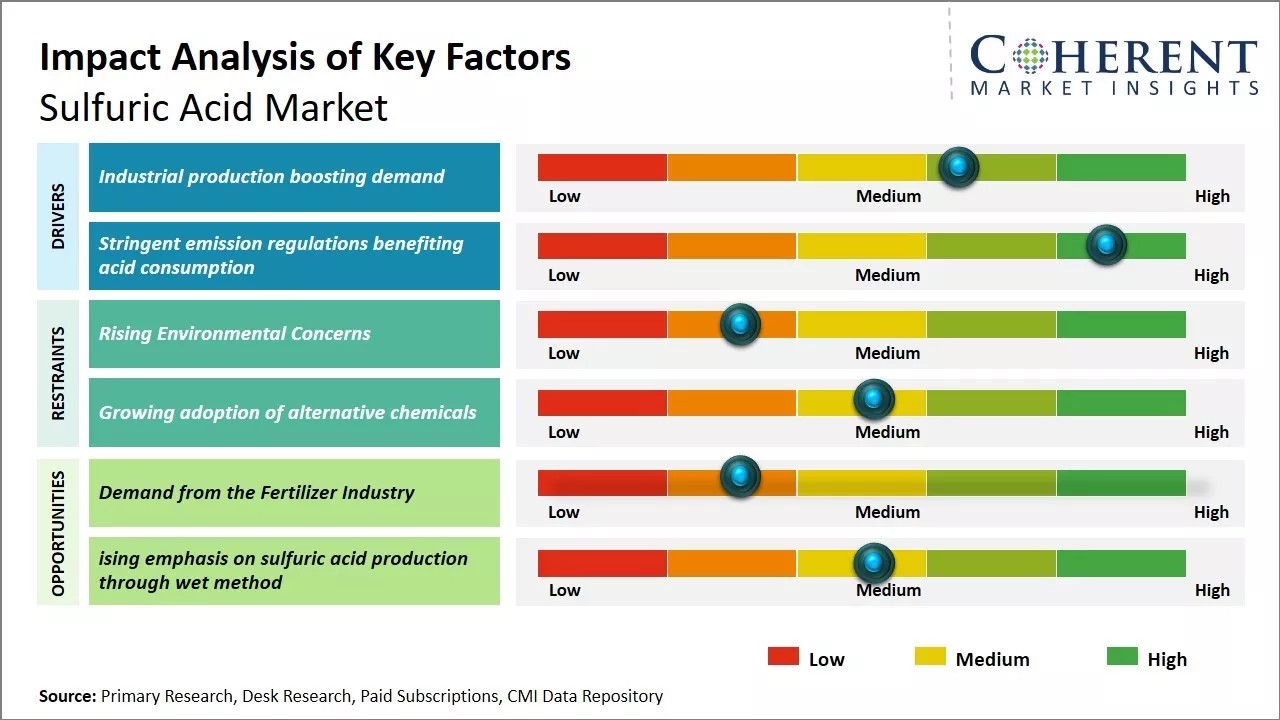
Market Overview
The demand for sulfuric acid is expected to grow steadily due to its increasing applications in chemical manufacturing industries. It is primarily driven by the growing demand from the fertilizer industry as the world's population is rising. Also, recovery in manufacturing and construction sectors will further contribute to the growth of the sulfuric acid market during the forecast period.
Current Events and Its Impacts on the Sulfuric Acid Market
Current Event | Description and its Impact |
Electric Vehicle Battery Manufacturing Boom |
|
Fertilizer Industry Demand Fluctuations |
|
What are End User Feedback in Sulfuric Acid market?
- Fertilizer producers
- Value sulfuric acid’s reliability as a raw material for phosphates.
- Concerned about price volatility linked to elemental sulfur availability from oil & gas refining.
- Seek long-term supply contracts to stabilize costs.
- Chemical manufacturers:
- Require consistent purity levels for downstream products like detergents, dyes, and pharmaceuticals.
- Feedback often stresses the need for better quality assurance and standardized specifications.
- Metals & mining sector
- Depend on sulfuric acid for leaching copper, zinc, and other metals.
- Report challenges with transportation and storage safety, especially in remote mining regions.
- Request more localized production facilities to reduce import reliance.
- Battery & automotive industries
- Increasing demand for battery-grade sulfuric acid with tighter purity standards.
- Feedback highlights supply gaps as EV adoption accelerates.
- Current Industry Events of 2026
- Market Size Estimation
- Regional Breakdown
- Competitive Landscape
- Customer Intelligence
- Segmental Analysis
- Pricing Analysis
- Key Market Drivers, Challenges & Future Trends
- Customized Insights Section
Segmental Insights
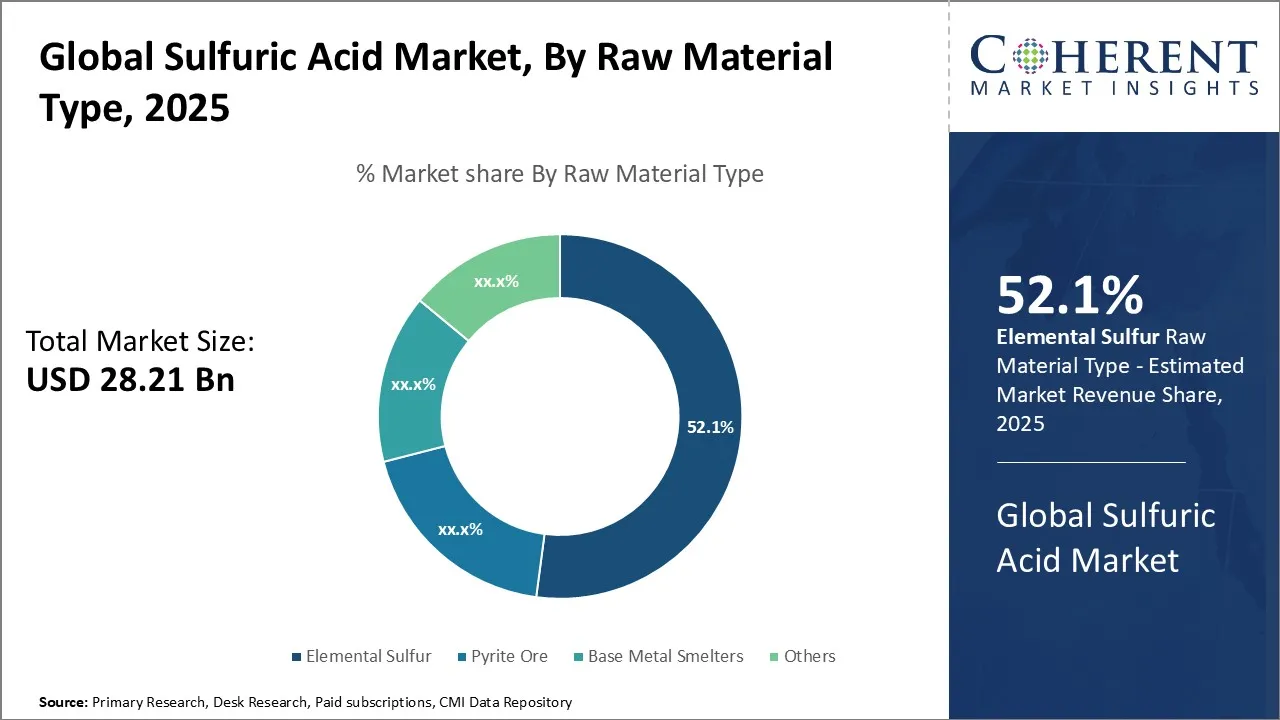
Sulfuric Acid Market Insights, By Raw Material Type - Cost effectiveness drives elemental sulfur domination
In terms of raw material type, elemental sulfur segment contributes 53.1% share of the market owing to its relatively low production cost compared to other raw materials. Elemental sulfur is readily available from various industries as a byproduct, making it inexpensive to obtain. It requires less processing than pyrite ore to produce sulfuric acid, avoiding the need for expensive smelting and roasting steps.
Additionally, the wet contact process used for elemental sulfur conversion has relatively simple equipment and produces fewer waste emissions compared to other production methods. These cost advantages allow sulfuric acid producers to offer competitive prices while still maintaining healthy profit margins when using elemental sulfur as the raw material. The bulk availability and low costs associated with elemental sulfur give it an edge over other materials like pyrite ore in the price-sensitive sulfuric acid market.
For instance, in November 2025, Elessent Clean Technologies' acquisition of Sulphurnet is good news as this will help make sulfuric acid in a more environmentally friendly way. Sulphurnet's knowledge of filtration and process optimization improves efficiency, lowers the impact on the environment, and helps industries like mining and fertilizers. This strategic move helps Elessent grow its global presence and encourages innovation and resilience in sulfur-based chemical value chains.
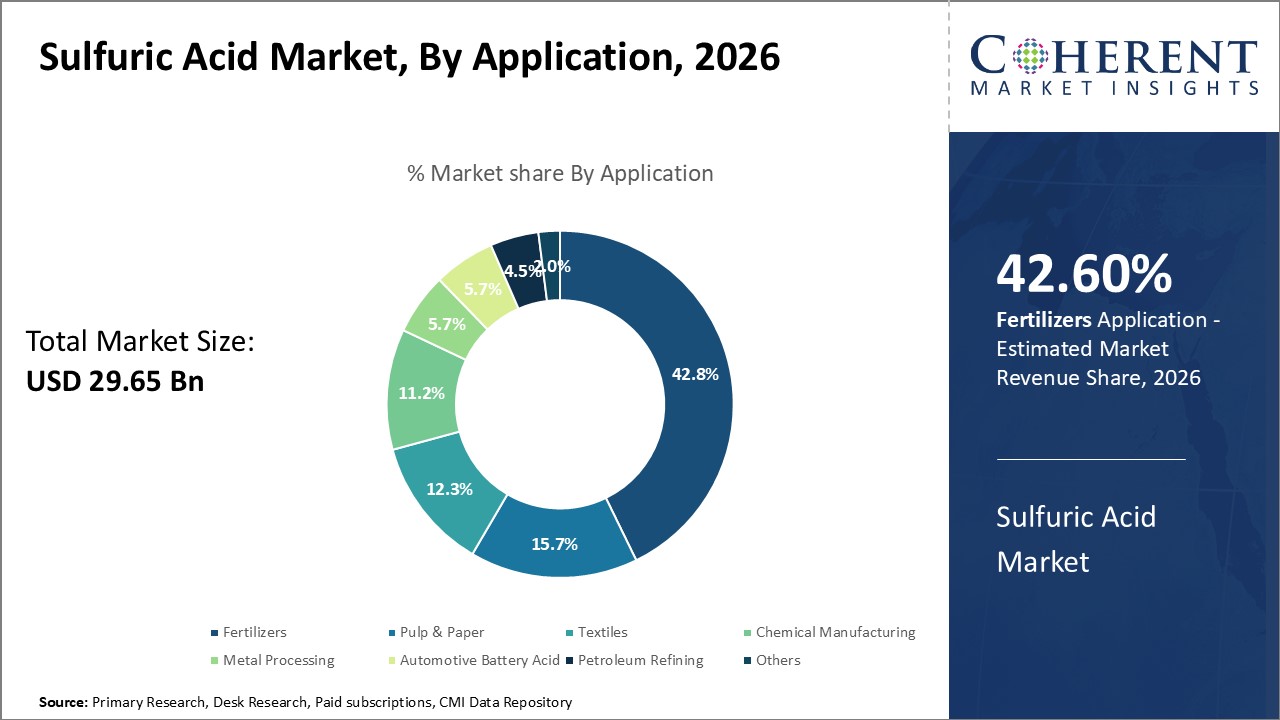
Sulfuric Acid Market Insights, By Application - Ubiquitous usage fuels fertilizers’ dominance
In terms of application, fertilizers segment contributes 42.6% of the market share due to sulfuric acid's widespread use in fertilizer production. Sulfuric acid serves as the raw material for most sulfate fertilizers like ammonium, potassium, and superphosphates. It reacts with phosphate rock to produce phosphoric acid, a key compound in many fertilizer formulations. Given the vast global demand for fertilizers to support agriculture, any disruption in sulfuric acid supply would impact food security. Producers therefore prioritize reliable sulfuric acid allocations to fertilizer customers.
Additionally, favorable regulations in major markets promote fertilizer usage. Subsidies and policies in countries like China, India, and Brazil encourage fertilizer adoption amongst farmers. This growing fertilizer consumption directly correlates to higher sulfuric acid volumes absorbed by the fertilizer application segment. The essential role that sulfuric acid plays in meeting humanity's nutritional needs tilts the scales in favor of the fertilizer segment.
For instance, in December 2025, Hindalco Industries has won India's sulfuric acid tender, becoming the L1 bidder to provide a major fertilizer company. The contract makes sure that CFR Cochin continually has acid available. This helps make fertilizers, keeps demand steady, and makes India's agricultural and chemical industries more resilient.
Sulfuric Acid Market Insights, By Manufacturing Process - Cost and environmental factors elevate the wet contact process
In terms of manufacturing process, the wet contact process segment contributes the highest share of the market owing to its cost competitiveness and relatively cleaner emissions profile. The wet contact process entails burning sulfur vapor in air towers to produce sulfur trioxide gas, which is then absorbed in sulfuric acid. While requiring large contact towers, its equipment costs are lower than the expensive lead chambers of the lead chamber process. It avoids using toxic heavy metals and produces less bottom waste than alternative processes.
Additionally, the wet process yields higher conversion efficiencies at lower operating costs due to improved mass transfer relative to single contact. This enhances profits for sulfuric acid producers. Stringent environmental regulations in major markets also favor its relatively cleaner emissions. Wet contact has thus gained broader acceptance due to the favorable balance it strikes between production costs, conversion efficiency, and sustainable operations.
Regional Insights
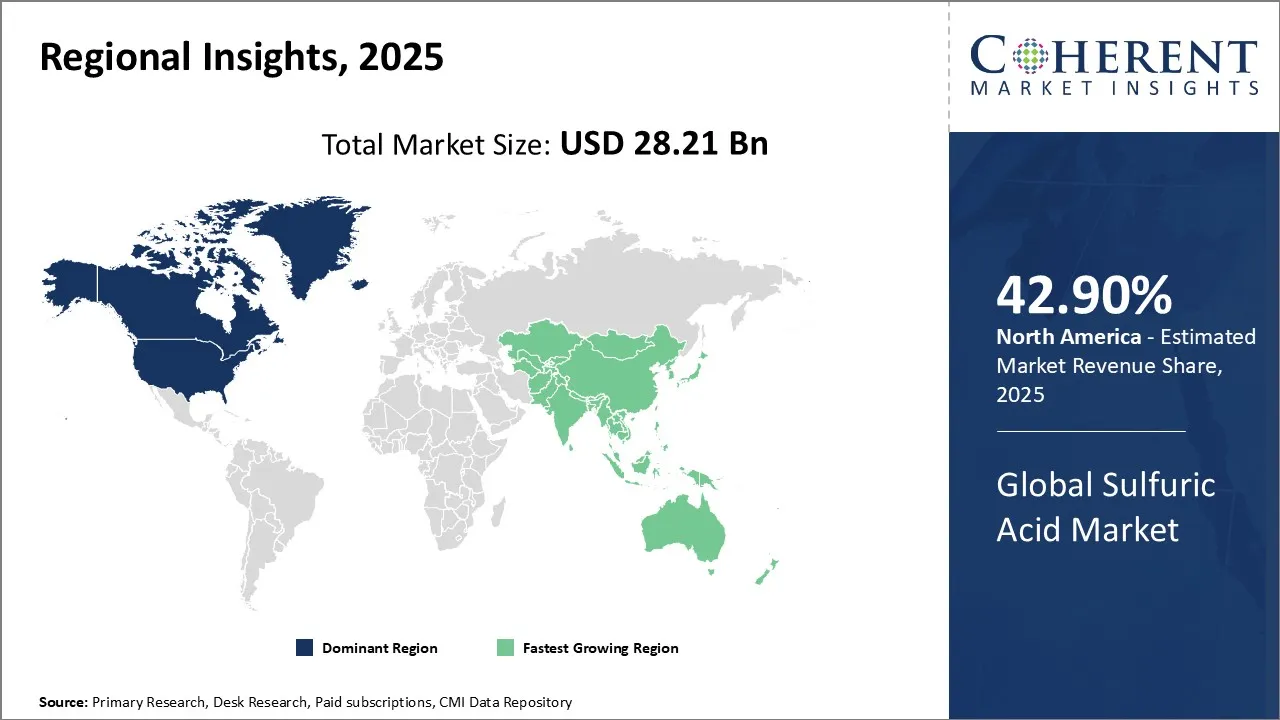
North America Sulfuric Acid Market Analysis & Trends
North America has dominated the global sulfuric acid market for the past few decades with 42.9% of the market share. The region accounts for the largest market share due to a strong presence of chemical and fertilizer industries which are the major end users of sulfuric acid. The U.S. is the single largest country-level market owing to the presence of many acids consuming industries.
Moreover, the country remains one of the top producers of the chemical aided by the easy availability of key raw materials. Many international players have established their production facilities in the region to cater to the local demand. This has further boosted the domestic manufacturing of sulfuric acid.
For instance, in April 2026, Technic Inc., which is based in Cranston, Rhode Island, launched with Technistan ECO Acid, a safer 9M sulfuric acid solution for tin electroplating. It takes the place of dangerous 18M sulfuric acid, making bath management easier, protecting brighteners, and adding built-in antioxidant protection. The new idea makes global manufacturing safer, more efficient, and better at plating.
Asia Pacific Sulfuric Acid Market Analysis & Trends
Asia Pacific has emerged as the fastest growing regional market for sulfuric acid in recent years. China accounts for the major share of both production and consumption in the region. The country has witnessed a rapid growth in the manufacturing sector involving industries like chemicals, fertilizers, and petrochemicals. This has translated into a burgeoning demand for sulfuric acid.
Moreover, the Chinese government has actively promoted self-sufficiency in fertilizer production to boost agricultural yields. As a result, domestic sulfuric acid manufacturing has increased substantially to meet the escalating demand from fertilizer plants. Apart from China, India is another high growth market attributed to robust industrial development. The South Asian nation has also witnessed major capacity additions in sulfuric acid plants over the last decade.
For instance, in June 2026, S&P Global Platts announced it planned to alter the way it rates sulfuric acid in Asia. The update changes how sulfuric acid prices are reported, which affects price benchmarks in all Asian markets. The goal of these changes is to make it easier to see, understand, and keep track of sulfuric acid trade flows in the area.
Sulfuric Acid Market Outlook Country-Wise
Sulfuric Acid Market Trends
The U.S. needs sulfuric acid since it is so important for making fertilizers, chemicals, refining oil, and processing metals. Growing agriculture, industry, and energy needs keep consumption going. Sulfuric acid is very important for America's economy and industry due to it can be used in many different ways in the automotive, pulp and paper, and textiles industries.
For instance, in March 2026, Ecovyst Inc. announced it acquired Cornerstone Chemical Company's sulfuric acid assets, which would allow it grow its business along the U.S. Gulf Coast. The deal helps Ecovyst make and supply more products, which helps the refining and chemical industries. This strategic move improves infrastructure, efficiency, and market presence in sulfuric acid, which is important for industrial growth.
Thailand Sulfuric Acid Market Trends
The need for sulfuric acid in Thailand comes from its use in making chemicals, fertilizers, refining oil, and processing metals. The country's growing agricultural sector, expanding industries, and dependence on refining and the automotive industries all contribute to fuel consumption. Sulfuric acid is very important for Thailand's economic and industrial growth because it can be used in so many different ways.
For instance, in May 2026, Sumitomo Corporation formed a joint venture with Thailand-based tank terminal operator NFC Public Company Limited to operate a sulfuric acid tank terminal. By acquiring a strategically located terminal and applying its expertise in sulfuric acid terminal operations, Sumitomo aims to improve safety and logistics reliability while establishing a regional hub to support business expansion across neighboring Asian markets.
Market Report Scope
Sulfuric Acid Market Report Coverage
| Report Coverage | Details | ||
|---|---|---|---|
| Base Year: | 2025 | Market Size in 2026: | USD 29.65 Bn |
| Historical Data for: | 2020 To 2024 | Forecast Period: | 2026 To 2033 |
| Forecast Period 2026 to 2033 CAGR: | 5.1% | 2033 Value Projection: | USD 42.00 Bn |
| Geographies covered: |
| ||
| Segments covered: |
| ||
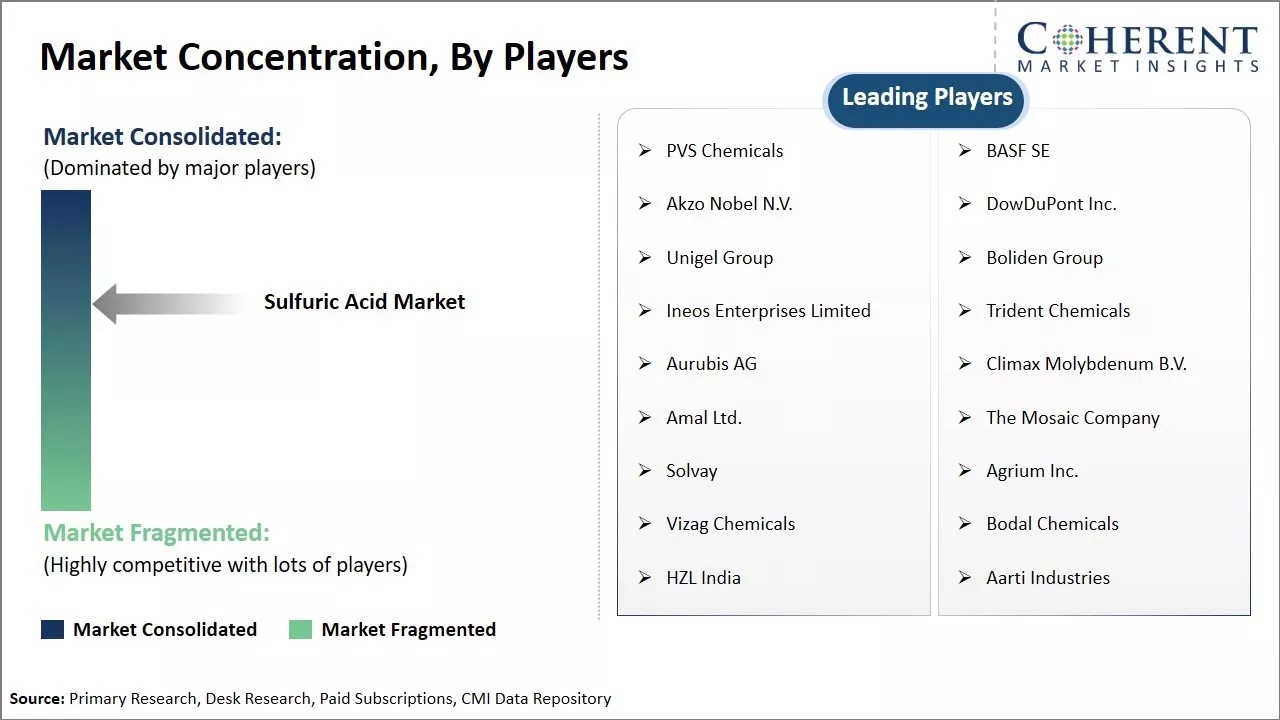
| Companies covered: | PVS Chemicals, BASF SE, Akzo Nobel N.V., DowDuPont Inc., Unigel Group, Boliden Group, Ineos Enterprises Limited, Trident Chemicals, Aurubis AG, Climax Molybdenum B.V., Amal Ltd., The Mosaic Company, Solvay, Agrium Inc., Vizag Chemicals, Bodal Chemicals, HZL India, and Aarti Industries | ||
| Growth Drivers: |
| ||
| Restraints & Challenges: |
| ||
Sulfuric Acid Market Driver
Industrial production boosting demand
The global sulfuric acid market is closely tied to industrial production levels around the world. Being a bulk chemical with widespread applications, sulfuric acid acts as an important intermediate in the production of numerous chemicals, fertilizers, and other materials. When industrial activities are high, the manufacturing of these downstream products increases rapidly, in turn, driving up demand from sectors such as fertilizers, chemical processing, oil refining, wastewater treatment, and metal processing among others. In recent years, the recovery in global industrial production after the recessionary phase has stimulated significant growth in consumption of sulfuric acid. Particularly, robust capital expenditures in developing economies on expanding domestic manufacturing capabilities has translated to greater sulfuric acid intake. The construction sector has also improved gradually, benefitting the fertilizer industry where sulfuric acid is a core ingredient.
Stringent emission regulations benefiting acid consumption
Growing environmental awareness as well as technological progress are compelling industries towards lowering their carbon footprint and turning greener. Sulfuric acid especially finds increased applicability in meeting emission standards getting stricter by the year. Desulfurization of fuel represents one of its primary application areas presently. Sulfur presents in crude oil and needs removal to manufacture ultra-low sulfur gasoline and diesel mandated under legislation. Sulfuric acid aided hydrodesulfurization allows refiners to reduce sulfur content in transport fuels to extremely low permissible limits. With emission norms being tightened further, including recent IMO regulation capping marine fuel sulfur, the demand for desulfurization is anticipated to rise sharply in the coming years.
Market Concentration and Competitive Landscape
Analyst Opinion (Expert Opinion)
- The sulfuric acid market continues to be one of the most important parts of the global chemicals industry because it is needed for making fertilizers, processing metals, refining petroleum, and making chemicals. It is thought that global production volumes are over 300 million metric tons per year, which shows how big and mature the market is. The fertilizer industry uses a lot of this output, especially for making phosphoric acid, which is used in phosphate-based fertilizers and makes up the greatest amount of end-use demand by volume.
- Elemental sulfur remains the main feedstock, and most of it comes from oil and gas refining, which keeps supply chains fairly stable. In areas with strong non-ferrous metal industries, smelter-based sulfuric acid production is also extremely significant. The product mix is slowly changing as there is more demand for high-purity sulfuric acid in batteries, specialty chemicals, and electronics manufacturing.
- In general, the sulfuric acid market is stable in terms of volume, has strong ties to industry, and sees steady growth in demand driven by improvements in agricultural, energy transition metals, and chemical processing efficiency.
Speak to the analyst
Want personalized insights?
Take the findings above to one of our principal consultants, or have the report rebuilt around the segments, geographies and competitors you actually track.
Recent Developments
- In November 2025, Nornickel improved the catalyst in its Sulphur Program to make it easier to turn sulfur dioxide into sulfuric acid. This project helps the environment by making things more efficient, lowering emissions, and meeting environmental goals. The upgrade makes operations more sustainable, which means cleaner production while keeping up with industrial output. This is in line with Nornickel's commitment to being environmentally responsible and coming up with new technologies.
- In September 2025, Röhm built a new sulfuric acid plant in Worms, Germany, to replace one that was damaged in 2023. The plant has cutting-edge technology that makes sure there is always enough methyl methacrylate for production. It also strengthens Röhm's global network and helps industries like automotive, construction, and medical technology work more efficiently and reliably.
Market Segmentation
- Raw Material Type Insights (Revenue, USD Bn & MT, 2026 - 2033)
- Pyrite Ore
- Elemental Sulfur
- Base Metal Smelters
- Others
- Application Insights (Revenue, USD Bn & MT, 2026 - 2033)
- Fertilizers
- Pulp & Paper
- Textiles
- Chemical Manufacturing
- Metal Processing
- Automotive Battery Acid
- Petroleum Refining
- Others
- Manufacturing Process Insights (Revenue, USD Bn & MT, 2026 - 2033)
- Single Contact Process
- Wet Contact Process
- Lead Chamber Process
- Others
- Regional Insights (Revenue, USD Bn & MT, 2026 - 2033)
- North America
- U.S.
- Canada
- Latin America
- Brazil
- Argentina
- Mexico
- Rest of Latin America
- Europe
- Germany
- U.K.
- Spain
- France
- Italy
- Russia
- Rest of Europe
- Asia Pacific
- China
- India
- Japan
- Australia
- South Korea
- ASEAN
- Rest of Asia Pacific
- Middle East & Africa
- GCC Countries
- Israel
- Rest of Middle East & Africa
- North America
- Key Players Insights (Revenue, USD Bn, 2021 - 2033)
- PVS Chemicals
- BASF SE
- Akzo Nobel N.V.
- DowDuPont Inc.
- Unigel Group
- Boliden Group
- Ineos Enterprises Limited
- Trident Chemicals
- Aurubis AG
- Climax Molybdenum B.V.
- Amal Ltd.
- The Mosaic Company
- Solvay
- Agrium Inc.
- Vizag Chemicals
- Bodal Chemicals
- HZL India
- Aarti Industries
Sources
Primary Research Interviews
- Sulfuric Acid Manufacturers & Producers
- Fertilizer Manufacturers (Phosphate & Ammonium Sulfate Producers)
- Petroleum Refinery & Smelting Industry Experts
- Mining & Metallurgical Processing Engineers
- Chemical Process & Plant Design Consultants
- Battery & Chemical Intermediate Manufacturers
- Distributors and Bulk Chemical Traders
- Others
Databases
- Bloomberg Terminal
- Thomson Reuters Eikon
- Euromonitor International
- Others
Magazines
- Chemical Engineering Magazine
- Chemical Week
- ICIS Chemical Business
- Hydrocarbon Processing
- Fertilizer International
- Mining Magazine
- Others
Journals
- Industrial & Engineering Chemistry Research
- Journal of Industrial and Engineering Chemistry
- Chemical Engineering Journal
- Journal of Cleaner Production
- Minerals Engineering
- Applied Catalysis A: General
- Others
Newspapers
- Financial Times
- The Wall Street Journal
- Reuters
- Bloomberg News
- The Economic Times
- Business Standard
- Others
Associations
- International Fertilizer Association (IFA)
- American Chemistry Council (ACC)
- European Chemical Industry Council (Cefic)
- International Council on Mining and Metals (ICMM)
- Society of Chemical Engineers
- Others
Public Domain Sources
- U.S. Geological Survey (USGS)
- U.S. Environmental Protection Agency (EPA)
- World Bank Open Data
- International Energy Agency (IEA)
- United Nations Industrial Development Organization (UNIDO)
- European Commission – Chemicals & Industry Directorate
- Others
Proprietary Elements
- CMI Data Analytics Tool
- Proprietary CMI Existing Repository of Information for the Last 8 Years
Get access to 250+ pages report
Every segment, forecast, competitor profile and data table behind the analysis above — available for instant download.
- ESOMAR Member
- ISO 9001:2015 Certified
- D-U-N-S Registered
- GDPR & CCPA Compliant
Missing comfort of reading report in your local language? Find your preferred language:
Transform your Strategy with Exclusive Trending Reports
Frequently Asked Questions
The Sulfuric Acid Market is estimated to be valued at USD 29.65 Bn in 2026, and is expected to reach USD 42.00 Bn by 2033.
The CAGR of the Sulfuric Acid Market is projected to be 5.1% from 2026 to 2033.
Industrial production boosting demand and stringent emission regulations benefiting acid consumption are the major factors driving the growth of the sulfuric acid market.
Rising environmental concerns and growing adoption of alternative chemicals are the major factors hampering the growth of the sulfuric acid market.
In terms of raw material type, elemental sulfur is estimated to dominate the market revenue share in 2026.
PVS Chemicals, BASF SE, Akzo Nobel N.V., DowDuPont Inc., Unigel Group, Boliden Group, Ineos Enterprises Limited, Trident Chemicals, Aurubis AG, Climax Molybdenum B.V., Amal Ltd., The Mosaic Company, Solvay, Agrium Inc., Vizag Chemicals, Bodal Chemicals, HZL India, and Aarti Industries are the major players operating in the market.
North America is expected to lead the sulfuric acid market.