

Methanol Market Size and Forecast — 2026 - 2033
The Global Methanol Market size is estimated to be valued at USD 45.8 billion in 2026 and is expected to reach USD 72.3 billion by 2033, exhibiting a compound annual growth rate (CAGR) of 7.1% from 2026 to 2033.
Overview
Methanol, also known as methyl alcohol, is a colorless, volatile, and flammable liquid with the chemical formula CH₃OH. It is the simplest type of alcohol and is commonly used as an industrial solvent, antifreeze, fuel, and raw material in the production of chemicals such as formaldehyde and acetic acid. Methanol is produced mainly from natural gas through a process called steam methane reforming. Although it has many industrial applications, methanol is highly toxic to humans if ingested, inhaled, or absorbed through the skin, potentially causing blindness or death. It also plays a growing role as an alternative fuel and in biodiesel production.
Key Takeaways
Chemical manufacturing remains the dominant end-user segment, contributing to over 50% of the global methanol market share due to sustained demand for formaldehyde and acetic acid production.
North America leads regional market revenue with robust infrastructure and technological adaptation, while Asia-Pacific is projected to register the fastest CAGR driven by expanding industrial applications and renewable energy incentives.
Feedstock diversification, particularly the increasing use of coal and biomass, is a key factor fueling methanol market expansion, influencing regional production costs and sustainability profiles.
Emerging markets in Latin America are gaining momentum as import demand rises, creating significant new opportunities for business growth alongside regional industrial development.
Methanol Market Segmentation Analysis
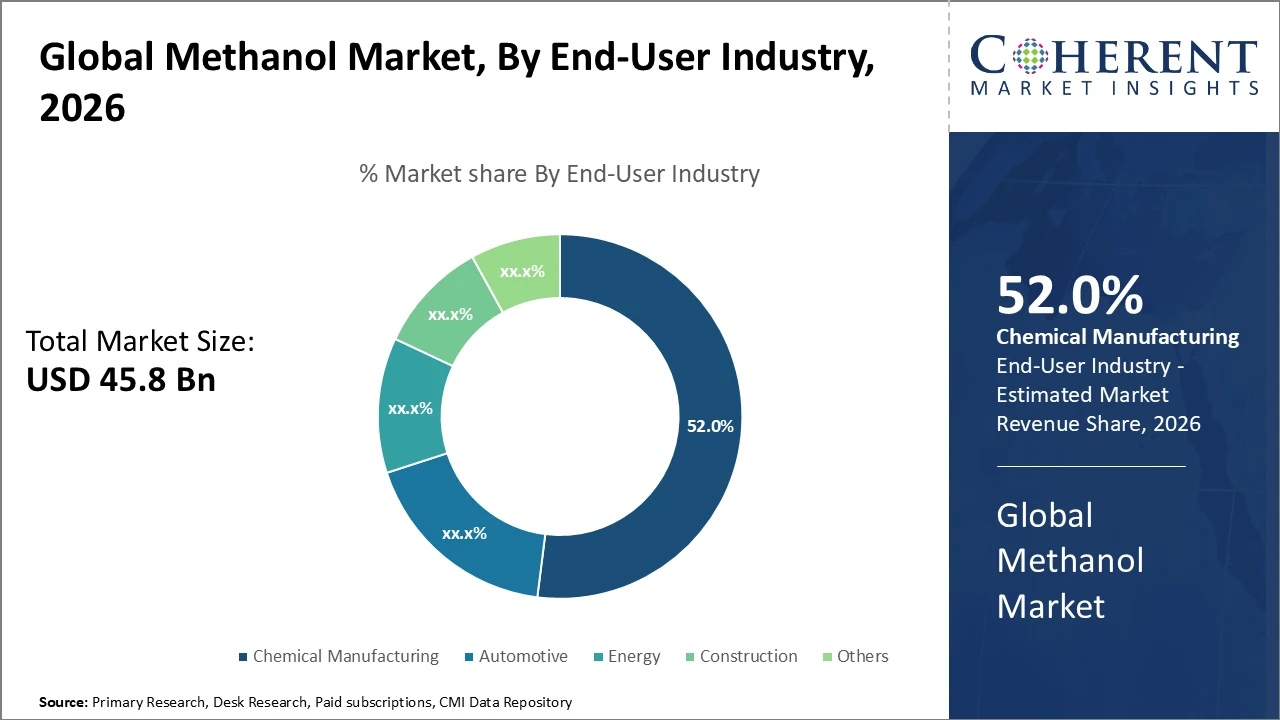
Methanol Market Insights, By End-User Industry
Chemical manufacturing commands a dominant 52% share of the methanol market, reflecting methanol’s essential role in the production of key chemical intermediates. The automotive sector is the fastest-growing segment, driven by increasing acceptance of methanol-based fuel blends amid tightening environmental regulations and alternative fuel mandates, particularly across Asia Pacific and North America. The energy sector is also expanding steadily, with methanol gaining traction in marine fuels and power generation as part of broader global decarbonization initiatives. Meanwhile, construction and other end-use segments contribute stable demand but grow at comparatively slower rates due to their more specialized applications, highlighting focused opportunities for innovation and strategic expansion.
Methanol Market Insights, By Feedstock Type
Natural gas dominates the methanol market with a 58% share, primarily due to its clean-burning properties, widespread availability, and cost-effectiveness, which support stable supply chains and continued investments in production capacity. Biomass represents the fastest-growing subsegment, driven by rising environmental concerns and regulatory pressure to adopt renewable feedstocks. Biomass-based methanol production is expanding notably across Europe and Asia Pacific, supported by government subsidies and carbon credit incentives. Coal remains a significant feedstock, particularly in China, owing to its abundance and established infrastructure, although it faces increasing sustainability scrutiny. The “others” segment includes unconventional feedstocks such as municipal waste, which are gaining traction in niche applications.
Methanol Market Insights, By Application
Formaldehyde production leads the methanol market with a 43% share, driven mainly by its extensive use in resins and adhesives for the construction and automotive industries, particularly amid ongoing industrialization in Asia-Pacific and Latin America. Fuel additives represent the fastest-growing application segment, supported by the global transition toward alternative fuels and stricter emission standards encouraging the adoption of methanol-blended fuels. Acetic acid follows with steady demand, largely sustained by its importance in chemical manufacturing processes. Solvents and other applications remain comparatively niche but are experiencing moderate growth as emerging industrial processes increasingly incorporate methanol derivatives, reflecting diverse regional demand patterns.
Methanol Market Trends
The methanol market is increasingly integrating sustainable production technologies, with green methanol gaining significant momentum as global decarbonization efforts accelerate.
By 2026, nearly 18% of new methanol production capacity worldwide is expected to incorporate carbon capture and utilization (CCU) technologies, reducing reliance on conventional feedstocks.
The expanding use of methanol in fuel cells and as an environmentally friendly marine fuel highlights the industry’s response to stricter environmental regulations and emission standards.
Digital supply chain implementation is emerging as a key operational trend, reducing inefficiencies by approximately 20% across major manufacturing hubs in the Asia-Pacific region.
Methanol Market Insights, By Geography
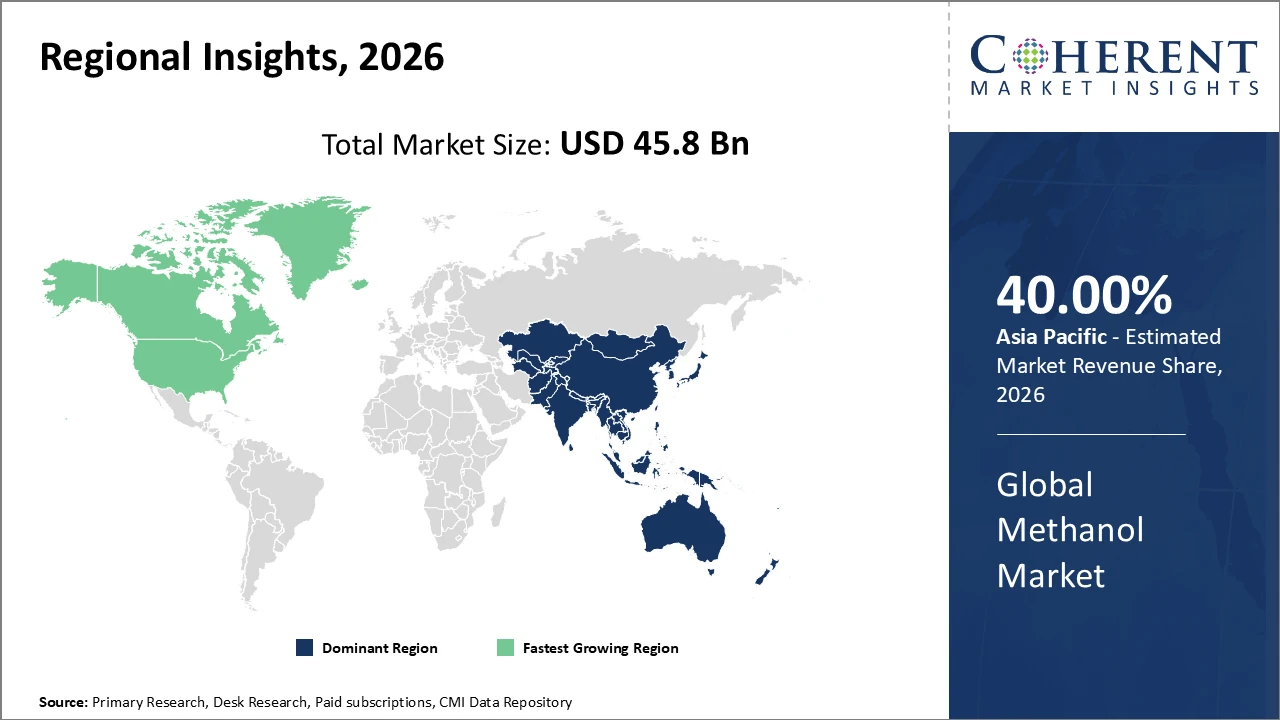
North America Methanol Market Analysis and Trends
The North America methanol market is experiencing steady growth, supported by abundant natural gas availability and advanced production infrastructure. The United States leads regional capacity, benefiting from shale gas development that ensures cost-competitive feedstock supply. Demand is driven by chemical manufacturing, particularly formaldehyde and acetic acid production, along with rising adoption of methanol-blended fuels. Increasing investments in low-carbon and green methanol projects reflect the region’s focus on sustainability and decarbonization goals. Additionally, expanding marine fuel applications and regulatory support for cleaner energy alternatives are shaping market trends. Strategic capacity expansions and technology integration continue to strengthen North America’s competitive positioning globally.
Asia Pacific Methanol Market Analysis and Trends
In Asia Pacific, dominance in the methanol market is driven by expansive industrial bases across China, India, and South Korea. The region accounts for over 40% of global market share, supported by abundant coal and natural gas resources that enable cost-competitive production. Strong demand from chemical manufacturing, construction, and automotive sectors further reinforces regional leadership. Government subsidies and supportive policies promoting alternative fuel adoption—particularly in China—have accelerated revenue growth. Major regional producers continue investing in advanced and large-scale production facilities, strengthening domestic supply while expanding export capabilities to meet rising global demand for methanol and its derivatives.
Methanol Market Outlook for Key Countries
USA Methanol Market Analysis and Trends
The United States methanol market ranks among the most technologically advanced globally, driven by innovation and strong feedstock availability. Leading companies such as Celanese Corporation and Eastman Chemical Company are advancing green methanol development and fuel additive applications. Policy support under the Inflation Reduction Act has accelerated investment in sustainable chemical manufacturing and renewable fuels, contributing to market revenue growth of over 7% in 2025. Abundant natural gas supply, combined with rising demand from automotive and energy sectors, continues to strengthen the country’s methanol production capacity and long-term growth outlook.
Germany Methanol Market Analysis and Trends
Germany’s methanol market is witnessing steady growth, driven by strong chemical manufacturing and industrial demand for formaldehyde, acetic acid, and methanol-derived resins. The country emphasizes sustainable production, with significant investments in green methanol, carbon capture technologies, and renewable feedstocks aligned with EU decarbonization targets. Growing adoption of methanol as a marine fuel and in fuel cell applications supports diversification beyond traditional chemical uses. Germany also benefits from advanced infrastructure, robust R&D capabilities, and government incentives promoting low-emission technologies. Increasing focus on export-oriented production and integration of digital supply chain solutions further strengthens market efficiency and positions Germany as a key European methanol hub.
Analyst Opinion
Major industrial hubs, especially in the Middle East and Asia-Pacific, have significantly increased methanol production capacity with new plants commissioned in 2024 and 2025. For example, Saudi Arabia expanded capacity by over 2.5 million metric tons in 2025, reducing production costs, boosting exports, and strengthening market dominance.
Methanol adoption as a marine and automotive fuel additive has grown due to stricter global emission norms from 2024. Compliance with the IMO 2024 sulfur cap increased methanol-based fuel usage to 12% of new vessels in 2026, up from 7% in 2024.
Methanol prices are closely tied to feedstock costs. In 2025, a 32% rise in natural gas prices compared to 2024 temporarily increased methanol pricing by 18%, encouraging diversification strategies.
Latin America’s import volumes grew 9.7% between 2024 and 2026, driven by Mexico and Brazil’s expanding chemical manufacturing sectors, enhancing market penetration and global methanol market growth.
- Current Industry Events of 2026
- Market Size Estimation
- Regional Breakdown
- Competitive Landscape
- Customer Intelligence
- Segmental Analysis
- Pricing Analysis
- Key Market Drivers, Challenges & Future Trends
- Customized Insights Section
Market Scope
| Report Coverage | Details | ||
|---|---|---|---|
| Base Year: | 2025 | Market Size in 2026: | USD 45.8 billion |
| Historical Data for: | 2020 To 2024 | Forecast Period: | 2026 To 2033 |
| Forecast Period 2026 to 2033 CAGR: | 7.1% | 2033 Value Projection: | USD 72.3 billion |
| Geographies covered: |
| ||
| Segments covered: |
| ||
| Companies covered: | SABIC, OCI N.V., Celanese Corporation, Eastman Chemical Company, BASF SE, Shell Chemicals, Pertamina, Mitsui Chemicals, Trineso S.A., Wanhua Chemical Group | ||
| Growth Drivers: |
| ||
Methanol Market Growth Factors
The methanol market has been driven by several key growth factors supporting industry expansion. Rising global focus on decarbonization is shifting demand toward green methanol, with investments exceeding USD 500 million globally in 2026 alone. Industrial demand for formaldehyde and acetic acid, critical methanol derivatives, continues to rise, with formaldehyde applications growing 5.6% annually due to widespread use in resins and adhesives. Government incentives promoting alternative fuels have accelerated methanol adoption in transportation, particularly in Asia-Pacific, where methanol-blended fuels account for nearly 10% of fuel consumption by 2026. Technological advancements in coal-to-methanol conversion, especially in China, have improved efficiency by 12% and reduced environmental impact, expanding feedstock flexibility.
Methanol Market Development
In July 2025, Clariant formed a strategic partnership with Shanghai Boiler Works, a subsidiary of Shanghai Electric specializing in energy conversion and new energy development. The partnership aims to drive innovation in sustainable energy solutions and advance green energy projects across China. The agreement builds on their successful collaboration at Shanghai Electric’s biomass-to-green methanol plant in Taonan, Jilin Province.
Key Players
Leading Companies of the Market
SABIC
OCI N.V.
Celanese Corporation
Eastman Chemical Company
BASF SE
Shell Chemicals
Pertamina
Mitsui Chemicals
Trineso S.A.
Wanhua Chemical Group
Many leading market companies have pursued competitive strategies focused on capacity expansion and green methanol innovation. For instance, Methanex Corporation boosted its renewable methanol production in Chile through strategic joint ventures, achieving a 15% increase in output in 2025 and advancing its carbon neutrality objectives. Likewise, SABIC invested in bio-methanol technologies in Saudi Arabia, resulting in a 10% improvement in feedstock efficiency by the end of 2024. These proactive initiatives have significantly strengthened the market presence and revenue growth of both companies.
Methanol Market Future Outlook
The methanol market is poised for robust growth, driven by rising demand for cleaner fuels and sustainable chemicals. Green methanol, produced from renewable sources, is gaining traction as industries and governments prioritize carbon reduction and circular economy initiatives. Capacity expansions, technological innovations, and strategic partnerships are enhancing production efficiency and lowering costs. Key markets in Asia, Europe, and the Middle East are leading adoption, while regulatory support and carbon credit incentives further accelerate growth. Over the next decade, increasing use in transportation, energy, and chemical feedstocks is expected to solidify methanol’s role as a vital, low-carbon industrial commodity.
Methanol Market Historical Analysis
The methanol market has experienced steady growth over the past decade, driven primarily by rising industrial demand and expanding applications in chemicals, fuels, and formaldehyde production. Traditionally dominated by fossil-based production, major players like Methanex Corporation and SABIC focused on capacity expansion to meet global demand, particularly in Asia and North America. Technological advancements improved production efficiency, while fluctuating crude oil and natural gas prices influenced market dynamics. Environmental regulations gradually prompted interest in renewable methanol, setting the stage for a transition toward greener, sustainable production methods in subsequent years.
Sources
Primary Research Interviews:
Methanol producers and refiners
Chemical and petrochemical companies
Energy and fuel solution providers
Chemical engineers and process consultants
Magazines:
Chemical Engineering
Methanol Magazine
Industrial & Engineering Chemistry Research
Hydrocarbon Processing
Journals:
Journal of Cleaner Production
Fuel
Energy & Fuels
Industrial & Engineering Chemistry Research
Chemical Engineering & Processing
Newspapers:
Financial Times – Energy & Chemicals
Bloomberg – Chemicals & Sustainable Energy
The Wall Street Journal – Petrochemical Industry
Reuters – Methanol & Renewable Fuels
Nikkei Asia – Industrial Chemicals & Energy
Associations:
Methanol Institute (MI)
International Energy Agency (IEA) – Methanol Reports
European Chemical Industry Council (Cefic)
Renewable Methanol Alliance
Renewable Methanol Alliance
Get access to 250+ pages report
Every segment, forecast, competitor profile and data table behind the analysis above — available for instant download.
- ESOMAR Member
- ISO 9001:2015 Certified
- D-U-N-S Registered
- GDPR & CCPA Compliant
Missing comfort of reading report in your local language? Find your preferred language:
Transform your Strategy with Exclusive Trending Reports
Frequently Asked Questions
The Methanol market is led by industry giants such as Celanese Corporation, SABIC, BASF SE, and OCI Inc., all of whom have expanded production capacity and invested significantly in bio-methanol technologies through 2024 and 2025.
By 2033, the Methanol market size is forecasted to reach USD 72.3 billion, growing at a CAGR of 7.1% from 2026, reflecting rising demand across various industrial applications and enhanced sustainable production methods.
The chemical manufacturing industry remains the largest end-user, accounting for 55% of the market share due to its extensive use in formaldehyde and acetic acid production, which consistently drives market revenue.
Emerging trends such as the shift toward green methanol, expanded use in fuel blending in compliance with global environmental regulations, and integration into energy storage solutions are expected to shape the market landscape through 2033.
While the competitive landscape is marked by capacity expansions and sustainability investments, challenges include feedstock price volatility and regulatory hurdles impacting bio-methanol scale-up, necessitating strategic market growth strategies.
Market players prioritize strategic alliances, capacity expansion, and green methanol technology development, evidenced by recent joint ventures and acquisitions in key regions for enhanced global market presence.