

Succinic Acid Market Size and Forecast — 2026 - 2033
The Global Succinic Acid Market size is estimated to be valued at USD 450 million in 2026 and is expected to reach USD 890 million by 2033, exhibiting a compound annual growth rate (CAGR) of 10.4% from 2026 to 2033.
Overview
The succinic acid market comprises a range of products primarily classified into bio-based and petroleum-derived succinic acid. Bio-based succinic acid is produced through microbial fermentation of renewable feedstocks such as glucose, sucrose, or glycerol, offering a sustainable alternative to traditional petrochemical routes. Petroleum-derived succinic acid is synthesized from maleic anhydride and butane, widely used in conventional industrial applications. Key product forms include powder, crystalline, and liquid grades, tailored for diverse applications. Succinic acid serves as a precursor for polymers, solvents, food additives, pharmaceuticals, and surfactants. Growing demand for eco-friendly and biodegradable materials is driving innovation and adoption across industries globally.
Key Takeaways
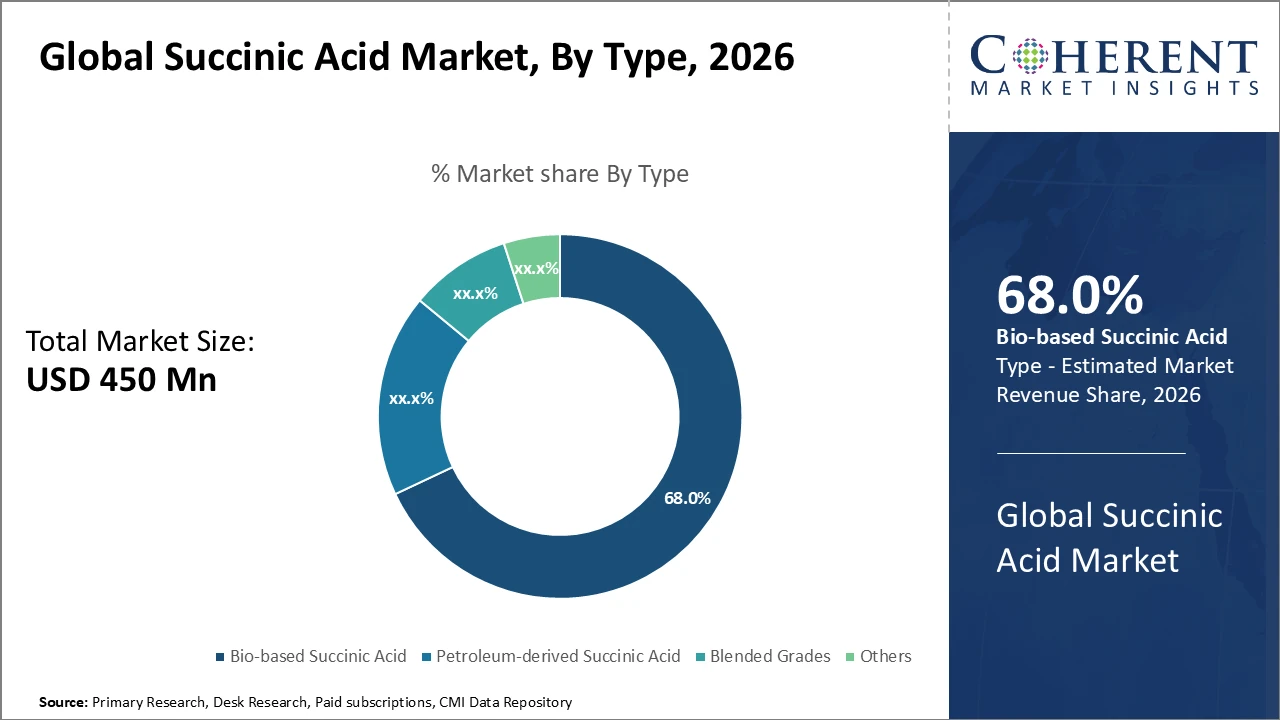
The bio-based type segment holds a dominant market share, driven by growing consumer and regulatory focus on sustainability in chemical manufacturing.
Pharmaceuticals represent the fastest-growing application segment, fueled by innovations in drug formulations requiring high-purity succinic acid derivatives.
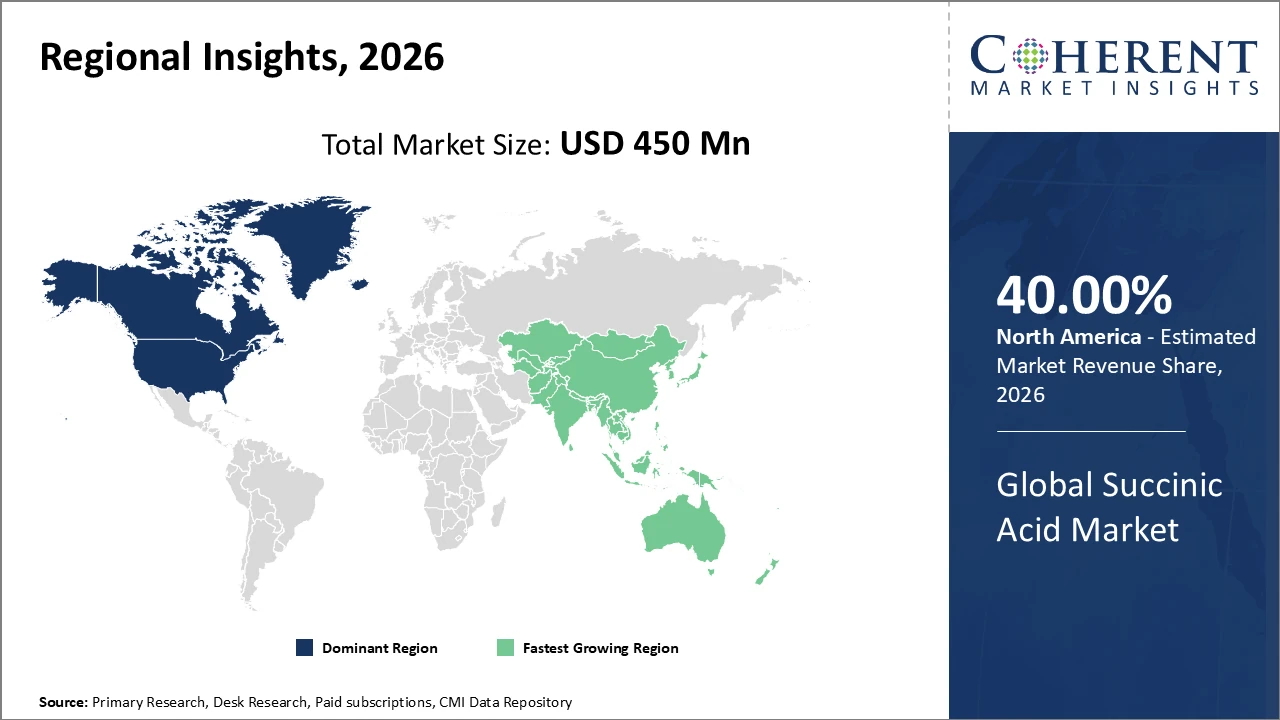
North America leads the regional market due to its mature pharmaceutical and biodegradable polymer industries, supported by strict environmental regulations that encourage green chemical adoption.
Asia Pacific exhibits the highest CAGR, driven by rapid industrialization, increasing demand for agricultural chemicals, and expansion of bio-based chemical manufacturing facilities.
Succinic Acid Market Segmentation Analysis
Succinic Acid Market Insights, By Type
Bio-based succinic acid dominates the market with a 68% share, driven by increasing environmental awareness and regulatory mandates promoting sustainable chemical alternatives. Production primarily relies on fermentation technologies using renewable feedstocks, which have seen significant technological advancements, improving both yield and cost efficiency. The fastest-growing subsegment is Blended Grades, combining bio-based and petroleum-derived succinic acid to balance cost and environmental benefits, appealing to emerging end-users with moderate sustainability goals. Petroleum-derived succinic acid, although constrained by high fossil feedstock costs and regulatory pressures, remains in use for legacy industrial applications. Other minor chemical variants serve niche, specialized purposes.
Succinic Acid Market Insights, By Application
The Pharmaceuticals segment dominates the succinic acid market, serving as the largest consumer of high-purity succinic acid due to its use as an intermediate in drug synthesis and formulation. Rising prevalence of chronic diseases and ongoing innovations in drug development continue to drive strong demand. The fastest-growing application segment is Biodegradable Polymers, propelled by global regulatory pressure to reduce plastic waste, encouraging packaging and automotive industries to adopt green materials derived from succinic acid-based polymers. Food and Beverages maintain steady demand for succinic acid as a preservative and flavor enhancer, while Agriculture is emerging rapidly in APAC markets with sustainable crop protection solutions. Other applications, including personal care and industrial uses, show moderate growth potential.
Succinic Acid Market Insights, By End-User
Personal Care holds the dominant market share in the succinic acid industry due to its consistent demand for biodegradable and skin-friendly chemical ingredients, relying on high-grade succinic acid derivatives. Growth in cosmetic innovation and rising consumer preference for natural products have reinforced this leadership. The fastest-growing end-user subsegment is Packaging, driven by regulatory initiatives and increasing consumer awareness of eco-friendly alternatives, boosting adoption of succinic acid-based biodegradable polymers. The Industrial segment, encompassing various chemical processing applications, experiences steady growth, while the Automotive sector is beginning to utilize succinic acid derivatives for lightweight composites. Other applications include specialized areas such as aerospace and membranes, serving niche, high-value markets.
Succinic Acid Market Trends
The succinic acid market is transforming due to widespread adoption of green chemistry principles, emphasizing sustainable and bio-based production.
Bio-based production reduces carbon emissions and achieves cost efficiencies through advancements in fermentation technologies.
Companies in Europe and Asia Pacific increased bio-based succinic acid production capacity by over 30% in 2025 to meet stricter environmental regulations and growing consumer demand for sustainable products.
Enhanced supply chain digitalization has improved operational agility, transparency, and overall market responsiveness, supporting expansion.
Collaboration between succinic acid producers and biodegradable polymer manufacturers is streamlining supply chains, driving adoption in packaging and automotive sectors, and resulting in an 18% revenue increase for joint ventures in 2026.
Succinic Acid Market Insights, By Geography
North America Succinic Acid Market Analysis and Trends
In North America, the succinic acid market is dominated by well-established pharmaceutical, automotive, and biodegradable polymer industries, collectively representing nearly 40% of the regional market share. Stringent environmental and chemical regulations promoting sustainable manufacturing, coupled with high R&D investment, drive market growth. Key players, including BASF SE and BioAmber Inc., have strengthened their presence through capacity expansions, technological advancements, and innovative bio-based succinic acid products. Additionally, the region benefits from advanced fermentation technologies and a mature supply chain, enabling efficient production and distribution. These factors collectively position North America as a leading hub for succinic acid production and adoption.
Asia Pacific Succinic Acid Market Analysis and Trends
Asia Pacific is experiencing the fastest growth in the succinic acid market, with a CAGR projected to exceed 12% between 2026 and 2033. This rapid expansion is driven by the growing agrochemical sector in India and China, rising demand for bio-based succinic acid, and supportive government policies promoting sustainable chemical manufacturing. Key manufacturers, including Anhui BBCA Bioengineering and Shandong Jintai Biotechnology, have invested in local production facilities, strengthening supply chains and improving market accessibility. Additionally, increasing industrialization, adoption of biodegradable polymers, and expanding pharmaceutical applications further fuel regional demand, positioning Asia Pacific as the most dynamic market globally.
Succinic Acid Market Outlook for Key Countries
USA Succinic Acid Market Analysis and Trends
The USA’s succinic acid market is characterized by a broad end-user base across pharmaceuticals, biodegradable polymers, and agrochemicals. In 2025, the country accounted for approximately 35% of North America’s demand, supported by advanced R&D capabilities and adoption of eco-friendly technologies. Leading companies, including BioAmber Inc. and BASF SE, drove innovations in pharmaceutical-grade succinic acid, capturing substantial market revenue. Government policies promoting greenhouse gas reduction further encouraged bio-based chemical production, resulting in a 20% increase in production capacity between 2024 and 2026. These factors collectively reinforce the USA’s strategic position in the global succinic acid market.
Germany Succinic Acid Market Analysis and Trends
Germany’s succinic acid market is driven by strong demand from pharmaceuticals, biodegradable polymers, and specialty chemicals, supported by stringent EU environmental regulations promoting sustainable production. Bio-based succinic acid dominates due to increasing adoption of green chemistry and fermentation technologies using renewable feedstocks. The country benefits from advanced R&D infrastructure and well-established chemical manufacturing clusters, enabling innovations in high-purity and application-specific succinic acid derivatives. The pharmaceutical sector remains the largest consumer, while biodegradable polymers are the fastest-growing segment, driven by EU mandates on plastic waste reduction. Collaborative initiatives between producers and end-users are enhancing supply chain efficiency and product adoption.
Analyst Opinion
Supply-side dynamics indicate that bio-based succinic acid production capacities increased by nearly 30% in 2025, driven by technological advancements and higher investments in fermentation technologies.
Output expansion in Asia Pacific and competitive pricing strategies improved accessibility in emerging markets.
Export volumes from major manufacturing hubs rose by 22% in 2026, reflecting robust upstream supply supporting overall market growth.
Demand-side indicators show the pharmaceutical segment accounted for 28% of total succinic acid consumption in 2024, with rising use in drug intermediates and personal care products increasing imports in North America and Europe by ~18%.
Industrial applications such as biodegradable plastics drove 35% growth in bio-based polymer usage in 2025.
Micro-indicators highlight a 40% year-on-year increase in India’s succinic acid imports in 2025, reflecting reliance on imports to meet industrial demand and innovation needs.
Shifts in trade dynamics, including tariffs and supply chain diversification, further accelerated import patterns post-2024.
Nano-size indicators reveal niche applications in agricultural formulations and aerospace composites, representing ~5% of total market volume but growing at double-digit rates annually.
Partnerships with agritech companies in 2025 contributed to a 15% increase in succinic acid usage in advanced crop protection formulations.
- Current Industry Events of 2026
- Market Size Estimation
- Regional Breakdown
- Competitive Landscape
- Customer Intelligence
- Segmental Analysis
- Pricing Analysis
- Key Market Drivers, Challenges & Future Trends
- Customized Insights Section
54Market Scope
| Report Coverage | Details | ||
|---|---|---|---|
| Base Year: | 2025 | Market Size in 2026: | USD 450 million |
| Historical Data for: | 2020 To 2024 | Forecast Period: | 2026 To 2033 |
| Forecast Period 2026 to 2033 CAGR: | 10.4% | 2033 Value Projection: | USD 890 million |
| Geographies covered: |
| ||
| Segments covered: |
| ||
| Companies covered: | BASF SE, Corbion N.V., BioAmber Inc., Myriant Corporation, Verdezyne, Succinity GmbH, Mitsubishi Chemical Corporation, Jubilant Life Sciences, Blue Marble Biomaterials | ||
| Growth Drivers: |
| ||
Succinic Acid Market Growth Factors
Growing consumer demand for sustainable and bio-based products is a key driver of succinic acid market growth, with green chemistry adoption accelerating between 2024 and 2026. This shift has prompted significant investments in fermentation-based bio-succinic acid production, increasing capacity by 28% annually over petroleum-based alternatives. Rising use in biodegradable polymers and packaging, spurred by EU plastic reduction regulations, accounted for over 25% of total consumption in 2025. Pharmaceutical applications grew 15% year-over-year due to high-purity succinic acid for drug intermediates. Additionally, Asia Pacific agricultural demand surged 32% in 2025, driven by eco-friendly crop protection innovations in India and China.
Succinic Acid Market Development
In 2025, BioAmber Inc. expanded its bio-based succinic acid production facility in Canada, increasing annual capacity by 20% to meet rising demand from biodegradable polymer and pharmaceutical sectors. This expansion leveraged advanced fermentation technology, enhancing production efficiency and reducing costs.
Key Players
Leading Companies of the Market
BASF SE
Corbion N.V.
BioAmber Inc.
Myriant Corporation
Succinity GmbH
Verdezyne
Mitsubishi Chemical Corporation
Jubilant Life Sciences
Blue Marble Biomaterials
Several leading companies, including BASF SE and Corbion N.V., implemented aggressive green chemistry initiatives in 2025, focusing on reducing carbon footprints while expanding production capacities, which led to a 20% increase in bio-based succinic acid output. Collaborative ventures such as DSM and Roquette’s Reverdia further highlight strategic market growth efforts through joint R&D investments, enabling product portfolio diversification and entry into new end-use segments. These initiatives not only strengthen the companies’ competitive positioning but also accelerate adoption of sustainable succinic acid solutions across pharmaceuticals, biodegradable polymers, packaging, and agricultural applications, supporting overall market expansion.
Succinic Acid Market Future Outlook
The succinic acid market is poised for robust growth from 2026 to 2033, driven by rising adoption of bio-based and sustainable chemical solutions across pharmaceuticals, biodegradable polymers, packaging, and agrochemicals. Technological advancements in fermentation processes are expected to improve production efficiency and reduce costs, further supporting bio-based product penetration. Regulatory mandates promoting environmental sustainability, coupled with increasing consumer preference for eco-friendly materials, will continue to expand demand. Emerging applications in automotive composites, specialty chemicals, and high-performance industrial formulations are creating new growth avenues. Collaborative ventures and strategic capacity expansions by leading players will further strengthen market dynamics and global supply chains.
Succinic Acid Market Historical Analysis
The succinic acid market has witnessed steady growth over the past decade, driven initially by petroleum-based production for industrial and chemical applications. From 2015 to 2025, increasing environmental awareness and regulatory pressure prompted a significant shift toward bio-based succinic acid, leveraging fermentation technologies using renewable feedstocks. North America and Europe led early adoption due to mature pharmaceutical, biodegradable polymer, and specialty chemical industries. Simultaneously, Asia Pacific emerged as a key manufacturing hub with expanding agrochemical and packaging sectors. Innovations in high-purity and application-specific succinic acid derivatives, coupled with capacity expansions and collaborative ventures, gradually transformed market structure and global supply chains.
Sources
Primary Research Interviews:
Chemical Industry Experts
Biochemical Engineers
Pharmaceutical Manufacturers
Biodegradable Polymer Producers
Databases:
UN Comtrade Database
OECD Chemical Statistics
International Energy Agency (IEA) Reports
Magazines:
Chemical & Engineering News
Green Chemistry Journal
Biofuels Digest
Plastics News
ICIS Chemical Business
Journals:
Journal of Industrial & Engineering Chemistry
Green Chemistry Journal
Bioprocess and Biosystems Engineering
Journal of Applied Polymer Science
Industrial Crops and Products
Newspapers:
The Financial Times (Chemicals & Industry)
The Wall Street Journal (Business & Chemicals)
The New York Times (Environment & Industry)
The Guardian (Sustainability & Industry)
Reuters (Chemicals & Commodities)
Associations:
International Chemical Manufacturers Association (ICMA)
American Chemistry Council (ACC)
European Chemical Industry Council (Cefic)
Biobased and Renewable Products Advocacy Group
Get access to 250+ pages report
Every segment, forecast, competitor profile and data table behind the analysis above — available for instant download.
- ESOMAR Member
- ISO 9001:2015 Certified
- D-U-N-S Registered
- GDPR & CCPA Compliant
Missing comfort of reading report in your local language? Find your preferred language:
Transform your Strategy with Exclusive Trending Reports
Frequently Asked Questions
The dominant market players include BASF SE, Corbion N.V., BioAmber Inc., and among others, focusing on bio-based production, technological innovation, and capacity expansions to maintain market leadership.
The Succinic Acid market is projected to grow from USD 450 million in 2026 to USD 890 million by 2033, driven by increasing applications in pharmaceuticals, biodegradable polymers, packaging, and sustainable manufacturing technologies.
The pharmaceutical segment offers the largest growth opportunity due to rising demand for high-purity succinic acid derivatives used in drug formulation, intermediates, and specialty chemicals.
Market trends will be shaped by expansion of bio-based succinic acid production capacities, adoption of digitalized supply chains, increased sustainability initiatives, and integration with biodegradable polymer and packaging sectors.
The market is highly competitive, with companies focusing on R&D, green chemistry, and capacity expansion. Challenges include feedstock price volatility, regulatory compliance, and barriers to entry in emerging regions.
Companies leverage strategic partnerships, joint ventures, regional expansions, portfolio diversification, and collaborations with end-user industries such as pharmaceuticals and biodegradable polymers to strengthen market penetration and revenue growth.