

Sodium Hydrosulfite Market Size and Forecast — 2026-2033
The Global Sodium Hydrosulfite Market size is estimated to be valued at USD 550.2 million in 2026 and is expected to reach USD 780 million by 2033, exhibiting a compound annual growth rate (CAGR) of 5.8% from 2026 to 2033.
Overview
Sodium hydrosulfite is a strong reducing agent supplied as white crystalline powders or stabilized liquid formulations. They are widely used in textile processing for vat dyeing, color stripping, and bleaching because of their ability to reduce dyes and remove excess coloration. In the paper industry, they are applied for de-inking and brightening recycled pulp. These products also serve in mineral flotation, kaolin clay bleaching, and specialty chemical reactions requiring controlled reduction. Stabilized grades improve shelf life and maintain consistent reduction potential during industrial operations.
Key Takeaways
The textile and dyeing application segment leads the sodium hydrosulfite market with substantial consumption attributed to increased demand for sustainable textile processing technologies.
Granular sodium hydrosulfite dominates the product type segment with 63% market share, benefiting from its ease of handling and cost-efficient manufacturing.
Asia Pacific holds a commanding market share due to vast industrial base and production capacity, while North America presents growth opportunities driven by environmental compliance requirements.
Europe’s stringent regulatory environment stimulates market innovation, particularly among leading chemicals manufacturers adopting green product portfolios.
Sodium Hydrosulfite Market Segmentation Analysis
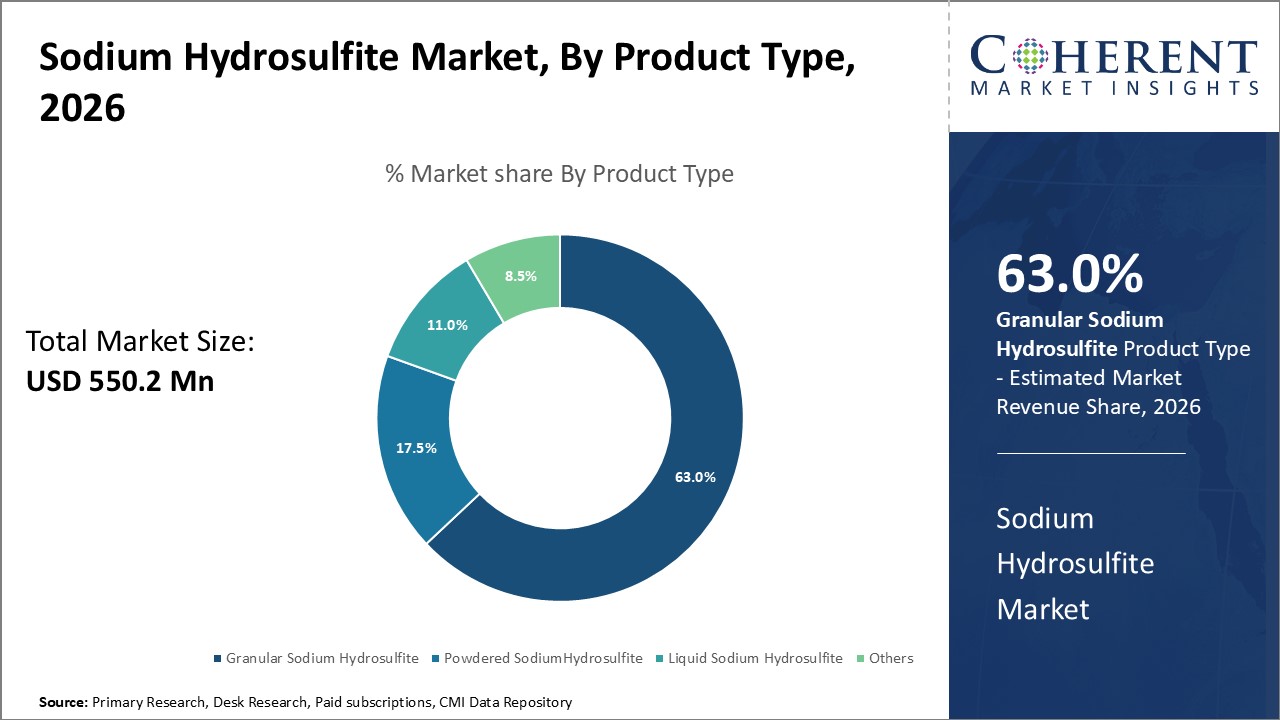
Sodium Hydrosulfite Market Insights, By Product Type
Granular Sodium Hydrosulfite dominates the market share due to its ease of handling, superior solubility properties, and cost-effectiveness in large-scale industrial applications. This product type is favored in textile bleaching and water treatment for its reliability and consistent performance. The fastest-growing subsegment is Liquid Sodium Hydrosulfite, driven by increasing demand in specialized applications like pharmaceuticals and electronics manufacturing, where precise dosing and better control are critical.
Sodium Hydrosulfite Market Insights, By Application
Textile and Dyeing remains the dominant segment, accounting for the largest market share, due to the ongoing trend toward sustainable and environmentally friendly fabric processing technologies. This segment’s demand growth is accelerated by fashion industries globally adopting green chemistry. Water Treatment emerges as the fastest growing application, supported by increasing regulatory mandates to reduce pollutants in industrial effluents; sodium hydrosulfite’s strong reducing capability makes it indispensable in dechlorination and heavy metal removal. Pulp and Paper, while mature, continues to provide steady demand. Electronics Manufacturing is growing steadily with increasing incorporation in semiconductor processing and printed circuit board manufacturing.
Sodium Hydrosulfite Market Insights, By End-User Industry
Industrial Manufacturing remains the largest end-user segment, mainly due to vast consumption in surface treatment, paper bleaching, and dye reduction applications across multiple sectors. This segment benefits from continuous modernization and capacity expansions in emerging economies. The Pharmaceuticals segment is the fastest-growing end-user, fueled by the rising integration of sodium hydrosulfite in reducing agents for drug synthesis and quality control protocols. The Food Industry uses sodium hydrosulfite primarily as a preservative and antioxidant; however, this segment grows moderately due to the increasing preference for natural alternatives.
Sodium Hydrosulfite Market Trends
The sodium hydrosulfite market trend leans heavily toward environmental compliance and sustainability.
In recent years, the introduction of eco-certified sodium hydrosulfite variants has allowed manufacturers to reduce environmental footprints significantly, evidenced by a reported 20% reduction in wastewater pollution parameters in Europe by 2025.
Additionally, digitization in logistics and inventory management via blockchain technology has enhanced operational transparency and reduced waste in supply chains, as seen in pilot projects across North America.
Diversification of usage into pharmaceuticals and electronics further indicates a market shift from traditional sectors, expanding both its industry scope and revenue sources.
Sodium Hydrosulfite Market Insights, By Geography
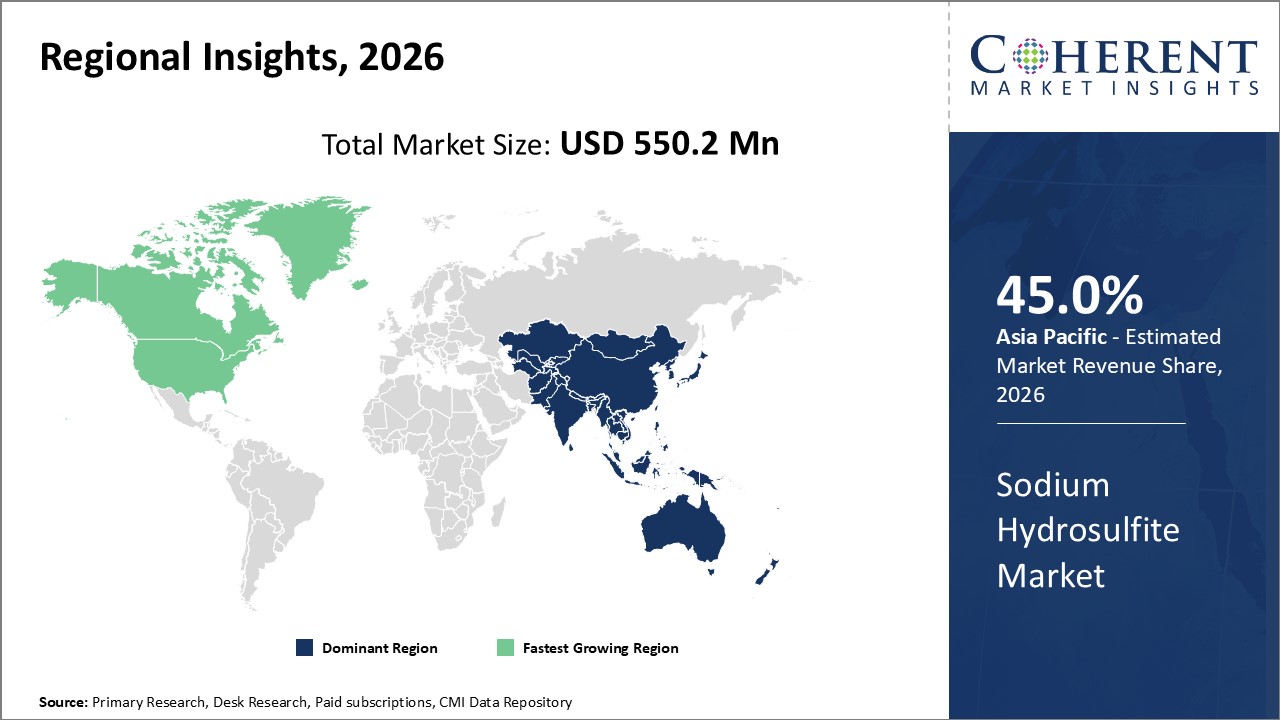
Asia Pacific Sodium Hydrosulfite Market Analysis and Trends
In the Asia Pacific region, the dominance in the Sodium Hydrosulfite market is overwhelmingly attributed to the region’s extensive chemical manufacturing infrastructure, burgeoning textile industry, and government incentives promoting environmentally sustainable manufacturing. This region held over 45% of the market share in 2025, driven primarily by China and India, which contribute more than 60% of Asia Pacific's sodium hydrosulfite production volume.
North America Sodium Hydrosulfite Market Analysis and Trends
North America exhibits the fastest growth, with a CAGR of 6.7% forecasted over 2026-2033. This growth is fueled by stringent environmental regulations compelling the adoption of cleaner chemical agents and the presence of advanced technology players optimizing supply chains and product formulations. Initiatives in the U.S. to reduce industrial wastewater contamination have particularly boosted sodium hydrosulfite consumption.
Sodium Hydrosulfite Market Outlook for Key Countries
USA Sodium Hydrosulfite Market Analysis and Trends
The USA’s sodium hydrosulfite market benefits from increasing demand in sectors like textiles, pulp and paper, and pharmaceuticals, with a strong focus on sustainable manufacturing. American companies are actively investing in research to develop high-purity sodium hydrosulfite grades conducive to biomedical applications. Strategic government regulations on waste treatment and chemical usage have led to a 10% annual increase in market revenue from 2023 to 2026, strengthening the country’s positioning as a crucial market player. Major corporations such as BASF SE have expanded their plants in the USA, improving supply capacity and advancing sustainability claims.
China Sodium Hydrosulfite Market Analysis and Trends
China’s sodium hydrosulfite market is the largest in Asia Pacific, driven by its dominant textile manufacturing base and rapid industrialization. The government’s "Made in China 2026" initiative encourages modern chemical practices, significantly enhancing production efficiency and output quality. In 2025, China accounted for over 35% of global sodium hydrosulfite production capacity, capitalizing on extensive coal and sulfur resources. Key players like Shandong Huarong Group have pursued expansions and technological upgrades, fostering competitive pricing and reinforcing China's stronghold in this market segment.
Analyst Opinion
Supply-side dynamics reveal that manufacturing capacity for sodium hydrosulfite is expanding notably in Asia Pacific, particularly in China and India, where new plants commissioned in 2025 increased regional production capacity by approximately 12%. This growth is heavily influencing market share dynamics, enabling a price stabilization observed through H1 2026.
Demand-side analytics underscore textile dyeing and bleaching as the prime application, contributing nearly 46% to total market revenue in 2025. Heightened demand from sustainable fashion brands leveraging sodium hydrosulfite for eco-friendly dye processes supports this trend with a 8.3% year-over-year consumption uptick.
Nano-segmentation estimates reveal the surge in specialty grades of sodium hydrosulfite for electronics manufacturing; these applications recorded a 15% increase in import volumes in 2025, suggesting a diversification in end-use sectors that amplifies overall market size and forecast reliability.
Pricing trends confirm relatively stable global sodium hydrosulfite prices in 2025, despite raw material cost volatility for sulfur derivatives, due to balanced supply-demand and strategic inventory management by leading market companies across Europe and North America.
- Current Industry Events of 2026
- Market Size Estimation
- Regional Breakdown
- Competitive Landscape
- Customer Intelligence
- Segmental Analysis
- Pricing Analysis
- Key Market Drivers, Challenges & Future Trends
- Customized Insights Section
Market Scope
| Report Coverage | Details | ||
|---|---|---|---|
| Base Year: | 2025 | Market Size in 2026: | USD 550.2 million |
| Historical Data for: | 2020 To 2024 | Forecast Period: | 2026 To 2033 |
| Forecast Period 2026 to 2033 CAGR: | 5.8% | 2033 Value Projection: | USD 780 million |
| Geographies covered: |
| ||
| Segments covered: |
| ||
| Companies covered: | Chemtex Speciality Ltd, Shandong Huarong Group, BASF SE, Evonik Industries AG, The Dow Chemical Company, Lianhui Material Technology Corporation, Redox Pty Ltd, Indian Chemicals & Enterprises, Guangxi Dongxl Co., Ltd., Zhengzhou Kedi Chemical Co., Ltd. | ||
| Growth Drivers: |
| ||
Sodium Hydrosulfite Market Growth Factors
The sodium hydrosulfite market's growth is primarily driven by escalating demand in the textile industry for eco-friendly bleaching and dyeing processes, which accounted for over 41% of market consumption in 2025. Additionally, stringent environmental regulations worldwide have augmented the adoption of sodium hydrosulfite as an effective reducing agent in wastewater treatment, where its usage increased by 10% in major industrial hubs from 2023 to 2026. Technological advancements enhancing the production efficiency and quality of sodium hydrosulfite also bolster market growth. Apart from this, rising applications in the electronics industry, particularly in semiconductor manufacturing for chemical reduction, have introduced an emerging growth avenue, reflected in a tripling of demand volumes between 2022 and 2025.
Sodium Hydrosulfite Market Development
In July 2026, Moleko unveiled a refreshed brand identity for its high-purity Sodium Hydrosulfide (NaHS) solution, reinforcing the company’s long-standing commitment to reliability, consistency, and customer-centric performance. The rebrand emphasized Moleko’s investments in advanced purification technologies, traceability systems, and environmentally responsible production processes—critical for industries such as mining, pulp and paper, leather processing, and chemical manufacturing.
In November 2023, Kemira expanded its ferric sulfate production line in Goole, United Kingdom, adding an additional 70,000 tons per year to support escalating market needs for coagulants amid increasingly stringent wastewater treatment regulations. The investment was driven by rising regulatory pressures placed on municipalities and industrial facilities to improve effluent quality—particularly regarding phosphorus, suspended solids, and heavy metal removal—which significantly boosted demand for high-performance inorganic coagulants.
Key Players
Leading Companies of the Market
Chemtex Speciality Ltd
Shandong Huarong Group
BASF SE
Evonik Industries AG
The Dow Chemical Company
Lianhui Material Technology Corporation
Redox Pty Ltd
Indian Chemicals & Enterprises
Zhengzhou Kedi Chemical Co., Ltd.
Several leading companies have strategically expanded their production portfolios, such as Chemtex Speciality Ltd’s 2025 initiative to enhance granular sodium hydrosulfite output, achieving a 10% volume increase and greater market penetration in Southeast Asia. Additionally, BASF SE’s collaboration with local textile manufacturers in Europe has enabled the deployment of cleaner bleaching agents, resulting in a 15% reduction in chemical waste disposal costs for clients. These moves are reflective of evolving market growth strategies focused on sustainability and innovation.
Sodium Hydrosulfite Market Future Outlook
The market’s future will hinge on the modernization of textile dyeing operations, demand for high-brightness paper, and continued expansion of kaolin bleaching applications. While textile demand may remain cyclical, improvements in eco-friendly dyeing processes and the shift toward sustainable bleaching chemicals will favor high-purity, low-residue hydrosulfite products. Automation in textile mills and environmental regulations will encourage producers to innovate safer, stable, and more efficient formulations, supporting moderately steady long-term growth.
Sodium Hydrosulfite Market Historical Analysis
Historically, sodium hydrosulfite consumption was driven by the textile dyeing industry, where it served as a key reducing agent. The market expanded with the growth of Asian textile production in the 1990s–2010s, particularly in China, India, Bangladesh, and Southeast Asia. The paper & pulp industry also contributed significantly due to its role in brightening recycled fiber. Over time, regulatory pressures and environmental concerns reduced the use of zinc-based hydrosulfite, pushing the market toward cleaner sodium- and formate-based variants.
Sources
Primary Research interviews
Textile dyeing specialists
Pulp & paper mill engineers
Chemical synthesis experts
Industrial bleaching firms
Databases:
AATCC Textile Chemical Data
TAPPI Pulp Brightness Reports
ICIS Reducing Agents Database
Magazines
Textile Today
Pulp & Paper International
- Chemical Weekly
Specialty Chemicals Magazine
Journals
Cellulose
Dyes and Pigments
Textile Research Journal
Industrial & Engineering Chemistry Research
Newspapers
The Hindu BusinessLine (Textiles)
Nikkei Asia (Manufacturing)
Reuters Chemicals
The Economic Times (Industry)
Associations
AATCC
TAPPI
Indian Chemical Council
China Dyestuff Industry Association
Get access to 250+ pages report
Every segment, forecast, competitor profile and data table behind the analysis above — available for instant download.
- ESOMAR Member
- ISO 9001:2015 Certified
- D-U-N-S Registered
- GDPR & CCPA Compliant
Missing comfort of reading report in your local language? Find your preferred language:
Transform your Strategy with Exclusive Trending Reports
Frequently Asked Questions
The dominant players include Chemtex Speciality Ltd, BASF SE, Evonik Industries AG, and Shandong Huarong Group, each leading through innovation, expanded production capacities,
The Sodium Hydrosulfite market size is projected to reach USD 780 million by 2033, highlighting sustained growth fueled by expanding applications in textiles, water treatment, and electronics sectors.
The textile and dyeing segment presents the largest growth opportunity, driven by increasing demand for eco-friendly bleaching and dyeing agents and the expanding sustainable fashion movement.
Market trends indicate a shift toward sustainable product grades, enhanced supply chain digitization, and diversification into pharmaceutical applications, facilitating a broader market scope and business growth.
The landscape is characterized by moderate competition, focus on product innovation and geographic expansion, while challenges include raw material price volatility and environmental regulatory compliance.
Market companies commonly employ strategies such as regional capacity expansion, strategic collaborations for sustainable product development, and enhanced supply chain transparency to capture emerging growth opportunities.