

Quaternary Ammonium Compounds Market Size and Forecast — 2026-2033
The Global Quaternary Ammonium Compounds Market size is estimated to be valued at USD 7.22 billion in 2026 and is expected to reach USD 11.1 billion by 2033, exhibiting a compound annual growth rate (CAGR) of 7.8% from 2026 to 2033.
Overview
Quaternary ammonium compounds (QACs or quats) are cationic surfactants widely used for their potent disinfectant, antimicrobial, and surface-active properties. These compounds are core ingredients in hospital-grade disinfectants, household cleaners, sanitizing wipes, fabric softeners, and industrial water-treatment chemicals. Quats function by disrupting microbial cell membranes, offering broad-spectrum activity against bacteria, viruses, fungi, and algae. Formulations vary across benzalkonium chlorides, alkyl dimethyl benzyl ammonium chlorides, and dialkyl quats, each suited for specific sanitization requirements. Their stability, compatibility with detergents, and efficacy on hard surfaces make quats essential in healthcare, food processing, hospitality, agriculture, and industrial hygiene.
Key Takeaways
Benzalkonium Chloride dominates the product type segment, owing to its versatility, and accounted for 33% of market share as of 2025. This segment’s leadership is reinforced by diverse applications ranging from disinfectants to personal care.
Water treatment exhibits strong potential from regulatory-driven adoption in emerging markets.
North America leads the regional market with an approximate 29% industry share, buoyed by high industrialization and strict regulatory frameworks requiring potent antimicrobial agents. Meanwhile, the Asia Pacific region emerges as the fastest-growing region with an expected CAGR outpacing others, attributed to expanding healthcare infrastructure and chemical production capacity.
Europe’s market growth is fostered by increased environmental standards boosting demand for eco-friendly QAC variants, while Latin America gains momentum from agricultural sector expansion reliant on QAC-based pesticides and sanitizers.
Quaternary Ammonium Compounds Market Segmentation Analysis
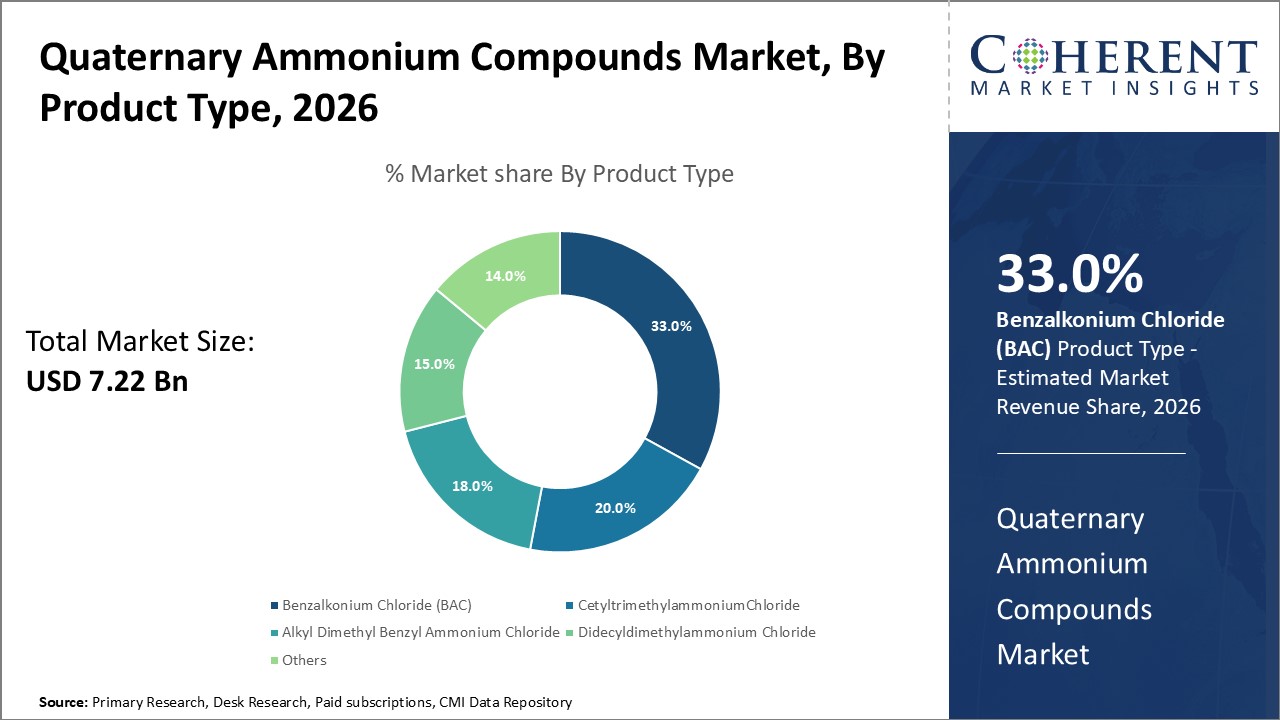
Quaternary Ammonium Compounds Market Insights, By Product Type
Benzalkonium Chloride dominates the market share. This dominance stems from its versatile antimicrobial properties, making it indispensable across disinfectants, personal care, and water treatment categories. Benzalkonium Chloride’s effectiveness against a broad spectrum of pathogens and compatibility with formulations drive its sustained preference. Alkyl Dimethyl Benzyl Ammonium Chloride is the fastest-growing subsegment, primarily due to innovations improving its chemical stability and lower toxicity profile, which expands its use in household and industrial cleaner applications. Cetyltrimethylammonium Chloride offers specialized efficacy in industrial water treatment and microbial control, while Didecyldimethylammonium Chloride is utilized extensively in textile processing for antimicrobial finishing.
Quaternary Ammonium Compounds Market Insights, By Application
The disinfectants & Sanitizers segment distinctly dominates the market share, largely due to global health concerns and regulatory mandates heightening demand for effective antimicrobial agents in healthcare and public spaces. The sector benefits from continuous innovations integrating QACs into ready-to-use disinfectants with extended residual activity. Water Treatment stands as the fastest-growing subsegment, spurred by increasing urbanization, expanding potable water treatment infrastructure, and environmental regulations limiting microbial contamination in industrial effluents. Personal Care applications, including antiseptic soaps and wipes, contribute robustly due to rising consumer hygiene awareness.
Quaternary Ammonium Compounds Market Insights, By End-User Industry
Healthcare leads the market share, given the critical need for infection control products driven by stringent hygiene standards and frequent sanitation protocols in hospitals, clinics, and medical device manufacturing. This segment's dominance is supported by a high preference for QAC-based surface disinfectants and sterilizing agents. The fastest-growing segment is Food & Beverage, buoyed by growing demands for food safety and microbial contamination control in processing plants, exemplified by an uptick of new sanitation guidelines launched in North America and Europe in 2025. Household end-users contribute substantially through cleaning and disinfecting products designed for consumer use, while Industrial adoption includes water treatment plants and manufacturing units requiring microbial control solutions.
Quaternary Ammonium Compounds Market Trends
One dominant trend is the development of greener, eco-conscious QACs that comply with stringent European Chemical Agency (ECHA) regulations implemented in 2025, prompting reformulations of major disinfectant products.
Another notable trend is diversification into novel application sectors such as anti-microbial textiles and biofilm control in wastewater treatment plants, which saw demand increase by 19% in Athe sia Pacific during 2026 alone.
Digitization in chemical production processes has also emerged, enabling enhanced quality control and faster product commercialization.
Quaternary Ammonium Compounds Market Insights, By Geography
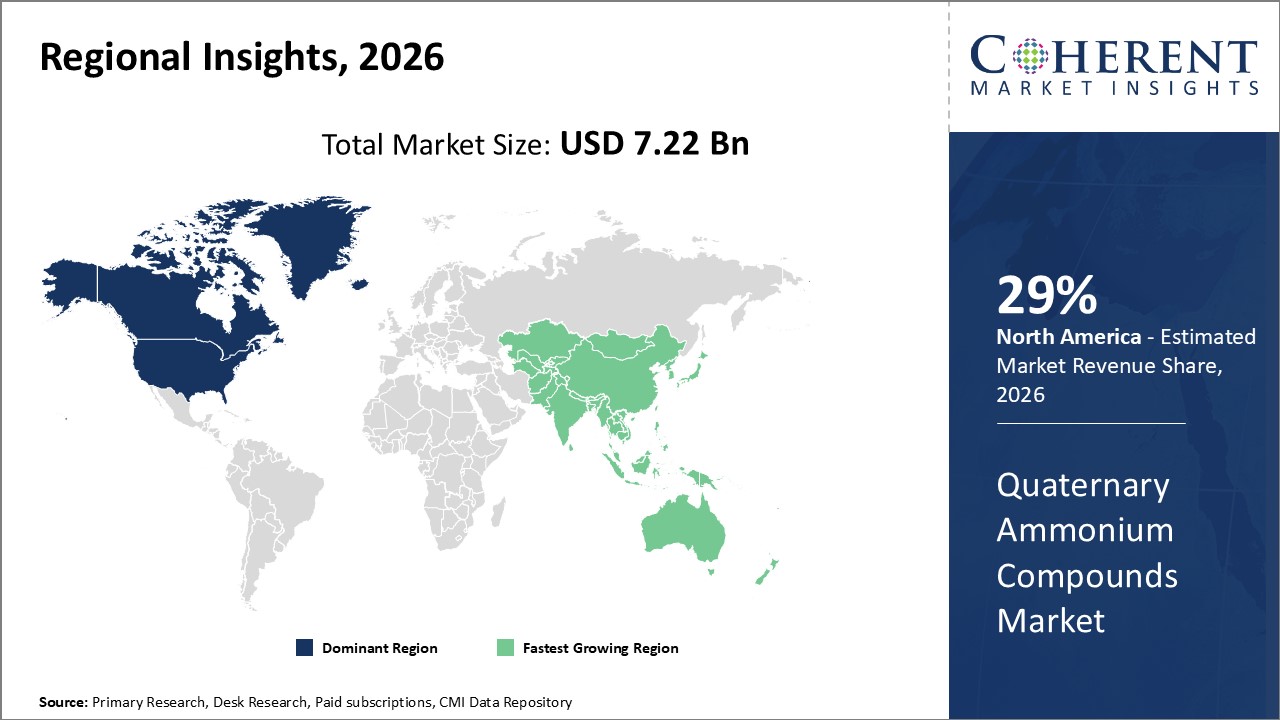
North America Quaternary Ammonium Compounds Market Analysis and Trends
In North America, dominance in the Quaternary Ammonium Compounds market is secured by robust industrial infrastructure, extensive healthcare facilities, and proactive regulatory bodies enforcing strict hygiene protocols. North America accounted for approximately 29% of the market share in 2025. Major companies like Lonza and BASF have deeply penetrated this market with advanced QAC formulations, benefitting from government-funded sanitation initiatives and extensive institutional end usage.
Asia Pacific Quaternary Ammonium Compounds Market Analysis and Trends
Meanwhile, Asia Pacific exhibits the fastest growth with a CAGR exceeding 9% forecast from 2026 to 2033, driven by expanding hospital infrastructure, rising industrial water treatment needs, and growing chemical manufacturing capabilities, especially in China, India, and Southeast Asia. Government incentives for domestic chemical production and public health campaigns have catalyzed this growth, while regional market players are scaling production to meet surging demand.
Quaternary Ammonium Compounds Market Outlook for Key Countries
USA Quaternary Ammonium Compounds Market Analysis and Trends
The USA's Quaternary Ammonium Compounds market is bolstered by extensive use in healthcare, institutional sanitation, and industrial water treatment sectors. The country’s stringent Environmental Protection Agency (EPA) regulations promote the use of effective QAC disinfectants, fueling high adoption rates among hospitals and public utilities. Notably, U.S. companies have accelerated R&D investments into biodegradable QAC solutions, aligning with consumer sustainability trends, which contributed to an 8% uptake increase in the sanitizer segment in 2025. The presence of leading market companies like Lonza and Stepan further solidifies the USA’s role as a major market influencer and innovator.
China Quaternary Ammonium Compounds Market Analysis and Trends
China’s Quaternary Ammonium Compounds market is expansive, driven by its vast manufacturing base and increasing domestic demand for sanitation and agricultural products. Noteworthy developments include state-level subsidies promoting advanced chemical production technologies, leading to a 15% increase in local QAC output capacity in 2026. Key domestic players such as Shandong Flesh Index Chemical and Jiangsu Purechem Chemical Co., Ltd. have enhanced export volumes, particularly targeting emerging economies in Southeast Asia and Latin America. Additionally, rising urbanization and healthcare infrastructure improvements have stimulated demand in the personal care and disinfectant sectors.
Analyst Opinion
Supply-side dynamics remain a critical driver, with global production capacity rising by approximately 5% annually due to expanded chemical manufacturing facilities, notably in Asia-Pacific, which accounted for over 48% of industry output in 2025. This aligns with the surge in demand for QACs in disinfectant production sectors, notably increasing exports from China to North America and Europe by 12% year-over-year.
Pricing volatility has been observed as raw material costs for alkylating agents and tertiary amines fluctuated due to supply chain disruptions in 2025, impacting overall market revenue. Despite this, improved process innovations have enabled some market players to maintain competitive pricing, supporting broader adoption in cost-sensitive markets.
Demand-side indicators highlight the accelerated adoption of QACs in emerging applications such as biofilm control in water treatment and surface sanitization in the hospitality industry, with sectoral usage increasing by over 16% in 2026 compared to 2023. This trend is complemented by regulatory frameworks obligating higher standards of microbial control, which intensifies purchases from institutional end-users.
Micro-market insights reveal that niche segments such as textile finishing and agriculture are witnessing a nascent but sharp demand increase, contributing nearly 9% to incremental market growth through diversified use cases. For instance, incorporation of QAC-based formulations in crop protection led to an 18% rise in usage rates in Latin America throughout 2025.
- Current Industry Events of 2026
- Market Size Estimation
- Regional Breakdown
- Competitive Landscape
- Customer Intelligence
- Segmental Analysis
- Pricing Analysis
- Key Market Drivers, Challenges & Future Trends
- Customized Insights Section
Market Scope
| Report Coverage | Details | ||
|---|---|---|---|
| Base Year: | 2025 | Market Size in 2026: | USD 7.22 billion |
| Historical Data for: | 2020 To 2024 | Forecast Period: | 2026 To 2033 |
| Forecast Period 2026 to 2033 CAGR: | 7.8% | 2033 Value Projection: | USD 11.1 billion |
| Geographies covered: |
| ||
| Segments covered: |
| ||
| Companies covered: | Zschimmer & Schwarz Group, Solvay S.A., Croda International Plc, Clariant AG, Olin Corporation, Wynca Group, FRS Chem, MACE Chemicals, Shandong Flesh Index Chemical, Jiangsu Purechem Chemical Co., Ltd. | ||
| Growth Drivers: |
| ||
Quaternary Ammonium Compounds Market Growth Factors
This has led to a substantial rise in disinfectant and sanitizer production, where QACs serve as key active ingredients. Increased industrial water treatment demand, especially in emerging economies, fuels market expansion as environmental regulations tighten discharge limits for microbial contaminants. Growth in the agricultural sector, with QACs improving pesticide formulation efficacy while reducing environmental impact, also significantly contributes to market gains. Additionally, innovations enhancing QACs’ biodegradability and safety profile have broadened acceptance in personal care and household products, underpinning sustained market revenue growth.
Quaternary Ammonium Compounds Market Development
In 2025, Croda International introduced its “EcoQuat” portfolio, a biodegradable quaternary ammonium compound (QAC) line designed for food-safe disinfectants, meeting stringent EU regulatory and environmental requirements. The launch supported manufacturers seeking high-efficacy sanitation solutions with improved biodegradability and reduced ecological impact.
In 2025, BASF and Solvay initiated a joint development program to create lower-impact QACs for next-generation disinfectants, focusing on reduced toxicity, enhanced environmental profiles, and compliance with evolving global safety standards. The collaboration aimed to deliver more sustainable, high-performance disinfectant actives for healthcare, food processing, and institutional hygiene applications.
Key Players
Leading Companies of the Market
Zschimmer & Schwarz Group
Solvay S.A.
Croda International Plc
Clariant AG
Olin Corporation
Wynca Group
FRS Chem
MACE Chemicals
Shandong Flesh Index Chemical
Jiangsu Purechem Chemical Co., Ltd.
Competitive strategies observed include strategic expansions in Asia by key players such as Stepan Company and BASF SE, enhancing local production hubs to capitalize on rapid regional demand growth. Similarly, Nouryon has pursued innovation-led differentiation by augmenting its portfolio with eco-friendly QAC variants, resulting in a 11% increase in B2B contract acquisitions in 2025. Lonza Group's vertical integration efforts have improved supply chain resilience, allowing for swift responsiveness to fluctuating market dynamics and a subsequent rise in market share within North America.
Quaternary Ammonium Compounds Market Future Outlook
The future of the QACs market will see sustained demand driven by the ongoing prioritization of sanitation in healthcare, food facilities, and consumer environments. Innovation will focus on low-toxicity, biodegradable formulations to meet stricter environmental regulations. Demand for high-purity and tailored QAC blends will grow in pharmaceuticals, biotech, and advanced cleaning systems. Global urbanization and rising institutional cleaning requirements will further support growth, while the Asia-Pacific region emerges as the fastest-growing consumer due to expanding healthcare and manufacturing infrastructures.
Quaternary Ammonium Compounds Market Historical Analysis
Historically, quaternary ammonium compounds have been widely used as disinfectants, sanitizers, and surfactants across healthcare, household cleaning, and industrial hygiene sectors. Growth accelerated during global health events and rising hygiene awareness, pushing consumption across hospitals, food processing units, and commercial cleaning services. Their strong antimicrobial performance, surface compatibility, and low cost fueled widespread adoption. Over time, QACs also became central to water treatment chemicals, fabric softeners, and agricultural biocides, providing a diversified demand base.
Sources
Primary Research Interviews:
Disinfectant Manufacturers
Hygiene Product Chemists
Water Treatment Specialists
Chemical Distributors
Household Cleaner Producers
Databases:
EPA Disinfectant Registry
ICIS Disinfectant Chemicals Data
WHO Hygiene Data
Magazines:
Cleaning & Maintenance Management
Chemical Weekly
Speciality Chemicals Magazine
Household & Personal Care Today
Water & Wastewater Magazine
Journals:
Journal of Surfactants and Detergents
Environmental Science & Technology
Journal of Applied Microbiology
Industrial & Engineering Chemistry Research
Journal of Water Process Engineering
Newspapers:
Reuters Health
Financial Express (Chemicals)
The Economic Times (Industry)
Business Standard (Manufacturing)
The Guardian (Environment)
Associations:
American Cleaning Institute (ACI)
European Surfactant Association
Water Quality Association
Chemical Industries Association
Global Hygiene Council
Get access to 250+ pages report
Every segment, forecast, competitor profile and data table behind the analysis above — available for instant download.
- ESOMAR Member
- ISO 9001:2015 Certified
- D-U-N-S Registered
- GDPR & CCPA Compliant
Missing comfort of reading report in your local language? Find your preferred language:
Transform your Strategy with Exclusive Trending Reports
Frequently Asked Questions
Leading companies include Stepan Company, Evonik Industries, Nouryon, Lonza Group, and BASF SE, each leveraging strategic expansions and innovative product development to capture substantial market share.
The market size is anticipated to grow from USD 7.22 billion in 2026 to USD 11.1 billion by 2033, reflecting a CAGR of 7.8%, driven by heightened demand for disinfectants and water treatment applications.
Healthcare and disinfectants & sanitizers applications offer the largest growth potential, propelled by stringent infection control mandates globally, supported by a 40% share in application revenue.
Trends will gravitate towards sustainable and biodegradable QAC formulations with broader adoption in emerging application areas such as food processing, sanitatio,n and medical textiles.
Ammonium Compounds market?
What go-to-market strategies are commonly adopted in the Quaternary Ammonium Compounds market?