

Antimicrobial Additives Market Size and Forecast
The antimicrobial additives market is estimated to be valued at USD 3.68 Bn in 2026 and is expected to reach USD 5.95 Bn by 2033, growing at a compound annual growth rate (CAGR) of 7.1% from 2026 to 2033.
Key Takeaways
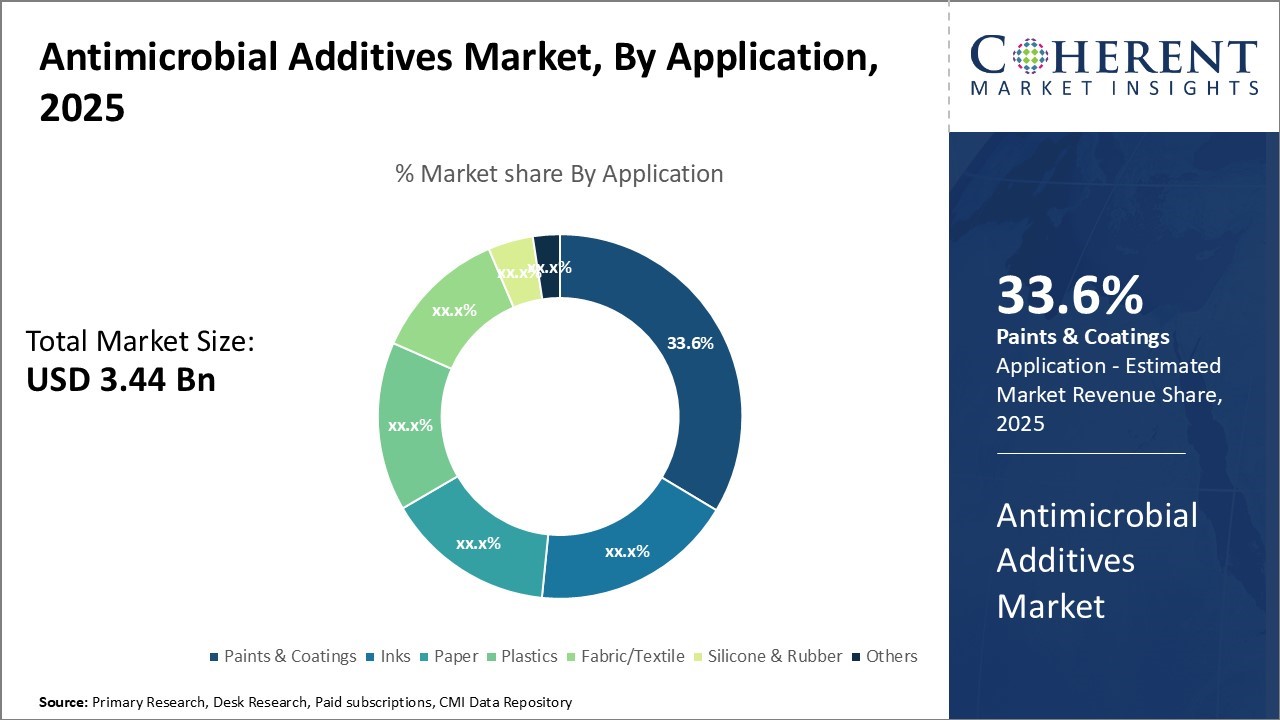
- By Application, Paints & Coatings contributes 34.6% share of the market owing to the growing in construction & renovation.
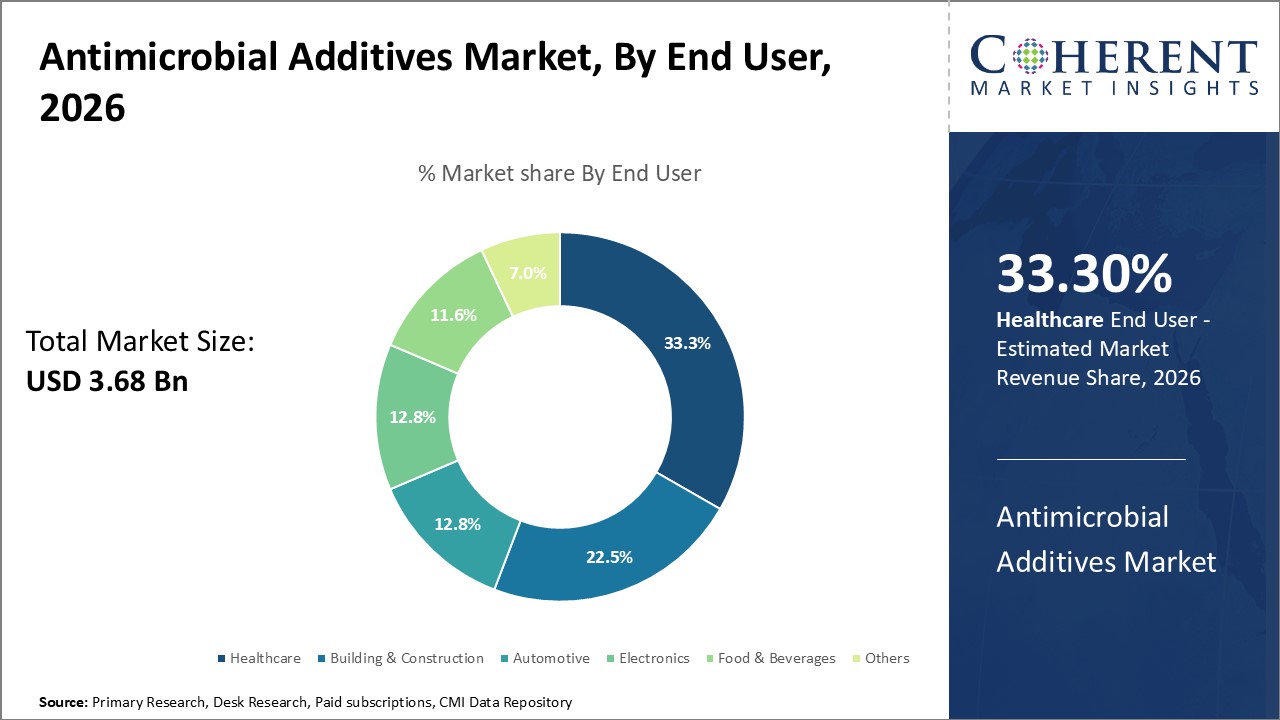
- By End User, Healthcare acquired the prominent market share of 42.7% in 2026 owing to the rapid expansion of single-use & disposable healthcare products.
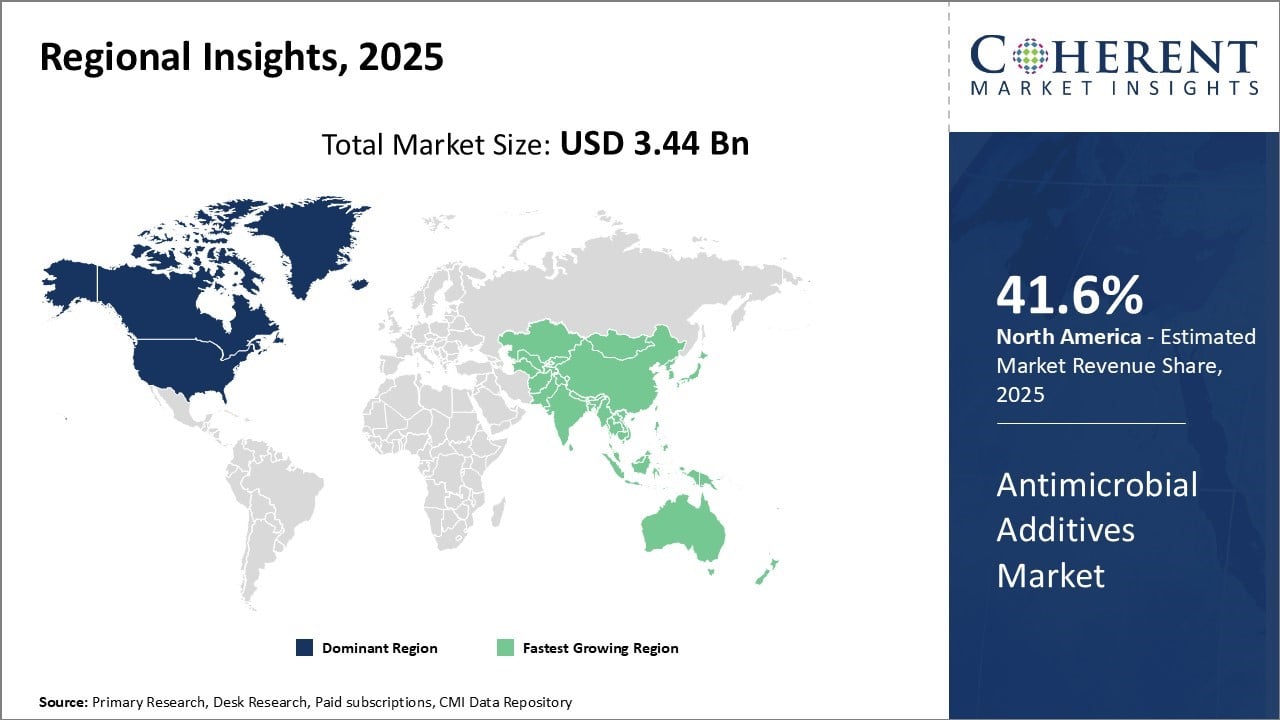
- By Region, North America hold the largest market share of 41.6% in 2026 as food safety & packaging.
Market Overview
The market is expected to witness significant growth during the forecast period. The growing awareness about health and hygiene is expected to drive the antimicrobial additives market demand. The regulatory framework is also supportive with regards to use of such additives in various industrial and consumer applications. Major industry players are investing in R&D to develop innovative products in order to capitalize on the lucrative growth opportunities offered by this market. Several product launches catering to different application segments are expected to further support the market expansion.
Current Events and their Impact on the Antimicrobial Additives Market
Current Events | Description and its impact |
Regulatory Policy Shifts |
|
Geopolitical Supply Chain Disruptions |
|
Global Health Initiatives |
|
End-user Feedback and Unmet Needs in the Antimicrobial Additives Market
End-user Feedback and Unmet Needs
- Demand for Broader-Spectrum Efficacy: End-users seek antimicrobial additives that combat a wider range of pathogens, including viruses, fungi, and drug-resistant bacteria. Many current formulations primarily target bacteria, leaving gaps in protection. Users across healthcare, packaging, and construction are requesting multi-functional additives that deliver consistent, long-lasting efficacy across various microbial threats.
- Need for Safe and Eco-Friendly Alternatives: There is growing concern about the environmental and health impact of traditional additives like triclosan or heavy metals. End-users are increasingly calling for plant-based or biodegradable antimicrobial solutions that meet strict safety regulations without compromising performance, especially in food contact, medical, and consumer product applications.
- Cost-Efficiency and Performance Balance: Industries emphasize the need for cost-effective antimicrobial additives that do not compromise on quality or durability. Some users report high costs for advanced formulations like nano-silver or bio-based agents. Manufacturers are being urged to deliver scalable solutions that offer affordability alongside reliable antimicrobial protection.
- Current Industry Events of 2026
- Market Size Estimation
- Regional Breakdown
- Competitive Landscape
- Customer Intelligence
- Segmental Analysis
- Pricing Analysis
- Key Market Drivers, Challenges & Future Trends
- Customized Insights Section
Segmental Insights
Antimicrobial Additives Market Insights, By Application
Paints & Coatings contribute the highest share of the market owing to the industry diversification & end-use growth
Increasing awareness of infection control and hygiene, especially in commercial, residential, and healthcare environments, is boosting demand for antimicrobial additives in paints and coatings. A surge in construction and renovation projects is encouraging the use of antimicrobial coatings to enhance surface protection and indoor air quality. Advancements in technology, such as nano-based and controlled-release additives, are improving the effectiveness and longevity of these coatings. For instance, PPG's JOHNSTONE'S brand launched Anti-Bacterial Matte paint, designed to be applied on walls throughout the home to actively prevent bacterial growth.
Antimicrobial Additives Market Insights, By End User
Healthcare contributes the highest share of the market owing to its Regulatory mandates & hygiene standards.
The urgent need to prevent healthcare-associated infections and combat antibiotic resistance is propelling growth in the healthcare segment of the antimicrobial additives market. Hospitals and clinics are increasingly adopting antimicrobial-treated equipment, surfaces, and packaging to enhance patient safety and reduce infection risks. The rising use of single-use medical supplies such as instruments, gloves, and gowns further boosts demand. Additionally, stringent hygiene regulations and the global expansion of healthcare infrastructure are prompting both developed and emerging countries to adopt advanced antimicrobial technologies. For instance, in October 2024, Unigloves, a leading hand protection expert, partnered with KluraLabs, a pioneer in antimicrobial solutions, to develop the CrossGuard antimicrobial nitrile glove—the first of its kind to eliminate 99.99% of specific bacteria within just 60 seconds. This is further accelerating the antimicrobial additives market demand.
Antimicrobial Additives Market Insights, By End User
Healthcare contributes the highest share of the market owing to its Regulatory mandates & hygiene standards.
The urgent need to prevent healthcare-associated infections and combat antibiotic resistance is propelling growth in the healthcare segment of the antimicrobial additives market. Hospitals and clinics are increasingly adopting antimicrobial-treated equipment, surfaces, and packaging to enhance patient safety and reduce infection risks. The rising use of single-use medical supplies such as instruments, gloves, and gowns further boosts demand. Additionally, stringent hygiene regulations and the global expansion of healthcare infrastructure are prompting both developed and emerging countries to adopt advanced antimicrobial technologies. For instance, in October 2024, Unigloves, a leading hand protection expert, partnered with KluraLabs, a pioneer in antimicrobial solutions, to develop the CrossGuard antimicrobial nitrile glove—the first of its kind to eliminate 99.99% of specific bacteria within just 60 seconds. This is further accelerating the antimicrobial additives market demand.
Regional Insights
North America Antimicrobial Additives Market Trends
North America dominates the antimicrobial additives market due to strong demand across consumer products, healthcare, food packaging, and construction sectors. The region’s leadership stems from its advanced healthcare infrastructure, strict FDA and EPA regulations, and growing awareness of hygiene and infection control. Manufacturers continue to prefer inorganic additives, especially silver and copper, for their proven effectiveness and durability. At the same time, ongoing innovations in nano- and bio-based technologies are driving the development of next-generation antimicrobial solutions in the region. For instance, Mitel, a Canadian leader in business communications, introduced the Mitel 6920t and 6930t IP phones, which are made of plastic and protected with BioCote® antimicrobial technology.
Asia Pacific Antimicrobial Additives Market Trends
Significant investments in healthcare infrastructure across Asia Pacific are driving the widespread use of antimicrobial compounds in medical devices, hospital furnishings, and surfaces. Growing awareness of infection control, especially after the pandemic, is prompting healthcare providers to adopt these additives to reduce microbial contamination and improve patient safety. Meanwhile, the rapid growth of packaged foods, ready-to-eat food, and agricultural films is accelerating the demand for antimicrobial coatings in food packaging and storage applications to enhance hygiene and shelf life.
United States Antimicrobial Additives Market Trends
American manufacturers are incorporating advanced antimicrobial additives like silver nanoparticles, copper biocides, and plant-based organic compounds. These innovations enhance safety, improve cost-efficiency, and require lower dosages. Growing consumer demand for eco-friendly alternatives is driving their use in household products, medical devices, pharmaceuticals, and food packaging. Concerns over harmful substances such as triclosan, tin, and arsenic are accelerating the shift toward greener solutions. For instance, in May 2022, antimicrobial goods like sanitizers and disinfectants beared the new, updated Design for the Environment (DfE) mark from the U.S. Environmental Protection Agency (EPA).
China Antimicrobial Additives Market Trends
Rising investments in hospital infrastructure and increased focus on infection control after the pandemic are shaping China’s antimicrobial additives market. Hospitals are actively adopting treated medical equipment, furniture, and surfaces to minimize microbial contamination and protect patients. Meanwhile, growing consumer demand for safer food and extended shelf life is driving the use of antimicrobial coatings in packaging. These coatings are widely applied in storage containers, agricultural films, and ready-to-eat meals to reduce spoilage and enhance overall food safety.
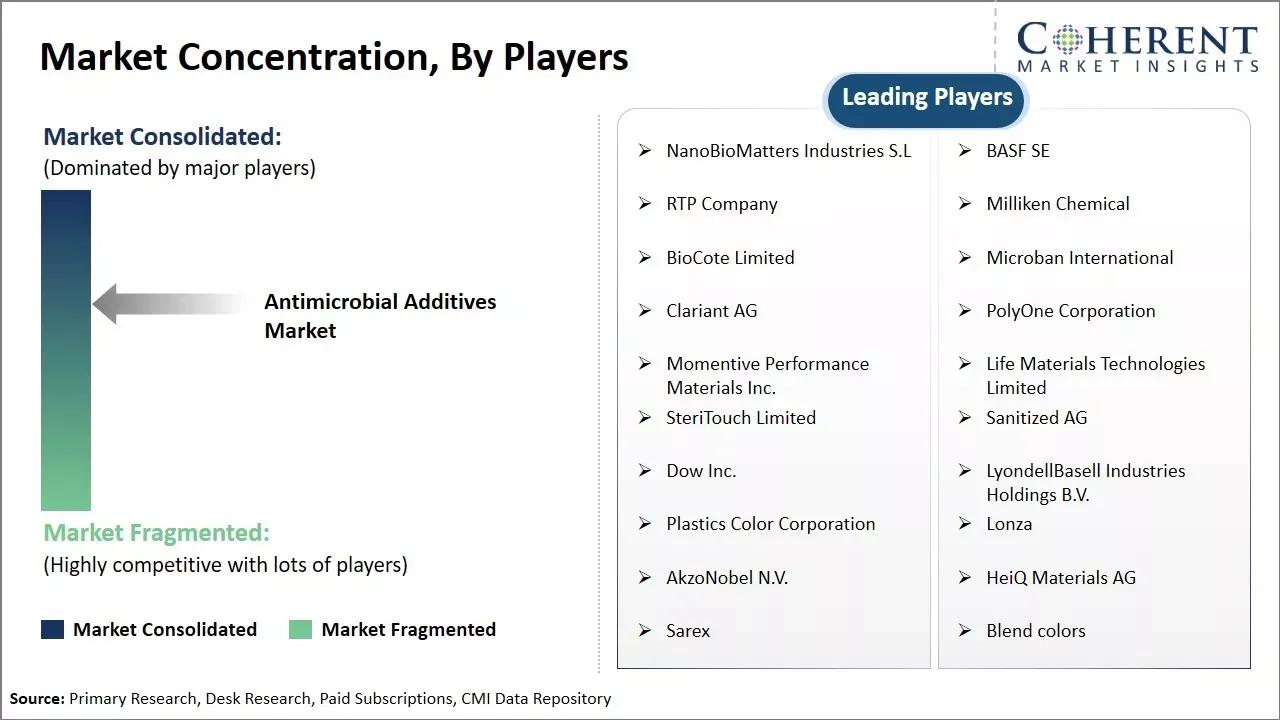
Market Concentration and Competitive Landscape
Antimicrobial Additives Market News
- In February 2025, German specialty chemicals company Lanxess opened the India Application Development Center (IADC), initially focusing on lubricant additives and material protection products, with plans for future expansion.
- In October 2023, TekniPlex Healthcare, leveraging its advanced materials science expertise to enhance patient outcomes, has launched antimicrobial medical compounds designed for use in a variety of patient-contact products, including catheters, connectors, gas hoses, syringes, and needle-free injectors like pens.
- In September 2023, Microban International has introduced its latest innovation, Ascera—a patent-pending, next-generation antimicrobial technology that features a nature-inspired active ingredient and is engineered for use in olefinic polymers and solvent-based coatings.
Market Report Scope
Antimicrobial Additives Market Report Coverage
| Report Coverage | Details | ||
|---|---|---|---|
| Base Year: | 2025 | Market Size in 2026: | USD 3.68 Bn |
| Historical Data for: | 2020 To 2024 | Forecast Period: | 2026 To 2033 |
| Forecast Period 2026 to 2033 CAGR: | 7.1% | 2033 Value Projection: | USD 5.95 Bn |
| Geographies covered: |
| ||
| Segments covered: |
| ||
| Companies covered: | NanoBioMatters Industries S.L, BASF SE, RTP Company, Milliken Chemical, BioCote Limited, Microban International, Clariant AG, PolyOne Corporation, Momentive Performance Materials Inc., Life Materials Technologies Limited, SteriTouch Limited, Sanitized AG, Dow Inc., LyondellBasell Industries Holdings B.V., Plastics Color Corporation, Lonza, AkzoNobel N.V., HeiQ Materials AG, Sarex, and Blend colors | ||
| Growth Drivers: |
| ||
| Restraints & Challenges: |
| ||
Antimicrobial Additives Market Trend
Rising Demand Across Hygiene-Sensitive Sectors
The antimicrobial additives market is witnessing strong growth across healthcare, food packaging, consumer goods, and construction industries. Post-pandemic hygiene awareness has accelerated the use of antimicrobial agents in surfaces, textiles, coatings, and plastics. Hospitals, schools, restaurants, and public spaces increasingly adopt these solutions to minimize contamination risks. Additionally, industries are embedding additives into products like paints, packaging films, and appliances to meet consumer expectations for cleaner, safer environments and to comply with stricter hygiene regulations.
Technological Advancements Driving Innovation
Innovation is a key trend shaping the antimicrobial additives market. Manufacturers are developing next-generation additives using nanotechnology, controlled-release systems, and bio-based compounds. These technologies enhance efficacy, extend the life of antimicrobial protection, and reduce the amount of active agent required. Smart antimicrobial materials that respond to microbial activity are also gaining traction. These innovations enable high-performance additives suitable for use in critical applications like medical devices, HVAC systems, and food-contact materials, while also supporting sustainability goals.
Antimicrobial Additives Market Opportunity
Growth in Hygiene-Focused Consumer Products
Rising consumer preference for hygiene-enhancing products offers a major opportunity for antimicrobial additives in personal care, household goods, and textiles. Shoppers increasingly seek items that provide long-lasting protection against bacteria and odors. This creates demand for antimicrobial additives in soaps, packaging, sportswear, kitchenware, and even baby products. Brands that integrate effective yet safe additives can enhance product value, improve market positioning, and meet evolving customer expectations around cleanliness, health, and sustainability.
Analyst Opinion (Expert Opinion)
- The antimicrobial additives market is evolving into a strategic pillar across hygiene-critical industries. What was once a functional enhancement in select medical devices is now a baseline expectation across surfaces, textiles, plastics, and packaging. The post-pandemic shift has fundamentally redefined consumer and institutional hygiene standards, making antimicrobial protection a “must-have” rather than a “nice-to-have.”
- Equally important is the packaging industry, especially in the food segment, where antimicrobial films and coatings are being used not just for preservation but as a branding advantage. Leading F&B brands in Japan and Germany have already integrated antimicrobial barrier layers into their ready-to-eat meal packaging to reduce spoilage and reassure consumers. In fact, antimicrobial additives in packaging have been shown to extend shelf life by up to 40–60% in certain perishable goods, according to peer-reviewed studies in the Journal of Food Protection.
- Yet, the greatest transformation is unfolding in the paints and coatings segment, driven by public infrastructure investments. Schools, airports, and public transport systems are deploying antimicrobial wall paints and metal coatings to reduce microbial load on high-touch surfaces. For example, New York’s MTA began applying copper-infused antimicrobial coatings on subway poles as part of its hygiene upgrade—a move now being replicated in transit systems in Toronto, Singapore, and Seoul.
- However, the market’s trajectory is not without friction. The regulatory environment is tightening, particularly in Europe, where compounds like zinc pyrithione and triclosan are facing bans or severe restrictions under REACH. This has two outcomes: first, it forces manufacturers to reformulate at higher R&D costs; second, it creates an opportunity for bio-based, plant-derived antimicrobial additives to penetrate the mainstream. Brands that invest early in green chemistry stand to own this next wave.
- In short, antimicrobial additives are at a technological and strategic inflection point. The market is shaping global hygiene infrastructure. Those players that balance regulatory compliance, material innovation, and cost-efficiency will not just grow—they will define the future of antimicrobial-enabled living environments.
Speak to the analyst
Want personalized insights?
Take the findings above to one of our principal consultants, or have the report rebuilt around the segments, geographies and competitors you actually track.
Market Segmentation
- Application Insights (Revenue, USD Bn, 2021 - 2033)
- Paints & Coatings
- Inks
- Paper
- Plastics
- Fabric/Textile
- Silicone & Rubber
- Others
- End User Insights (Revenue, USD Bn, 2021 - 2033)
- Building & Construction
- Healthcare
- Automotive
- Electronics
- Food & Beverages
- Others
- Regional Insights (Revenue, USD Bn, 2021 - 2033)
- North America
- U.S.
- Canada
- Latin America
- Brazil
- Argentina
- Mexico
- Rest of Latin America
- Europe
- Germany
- U.K.
- Spain
- France
- Italy
- Russia
- Rest of Europe
- Asia Pacific
- China
- India
- Japan
- Australia
- South Korea
- ASEAN
- Rest of Asia Pacific
- Middle East & Africa
- GCC Countries
- Israel
- Rest of Middle East & Africa
- North America
- Key Players Insights
- NanoBioMatters Industries S.L
- BASF SE
- RTP Company
- Milliken Chemical
- BioCote Limited
- Microban International
- Clariant AG
- PolyOne Corporation
- Momentive Performance Materials Inc.
- Life Materials Technologies Limited
- SteriTouch Limited
- Sanitized AG
- Dow Inc.
- LyondellBasell Industries Holdings B.V.
- Plastics Color Corporation
- Lonza
- AkzoNobel N.V.
- HeiQ Materials AG
- Sarex
- Blend colors
Sources
Primary Research Interviews
- Interviews with R&D heads at antimicrobial additive manufacturers
- Discussions with procurement managers from food packaging and healthcare device companies
- Consultations with regulatory compliance officers in plastics and coatings industries
Databases
- PubChem (for chemical profiles and toxicity data)
- Statista (for product category and industry-wise usage data)
- United States Patent and Trademark Office (USPTO)
- WHO Global Health Observatory
Magazines
- Paint & Coatings Industry Magazine
- Plastics Today
- Medical Device and Diagnostic Industry (MD+DI)
- Packaging World
Journals’
- Journal of Antimicrobial Chemotherapy
- Journal of Applied Polymer Science
- Journal of Food Protection
- ACS Applied Materials & Interfaces
Newspapers
- The New York Times (for public health-related updates)
- The Guardian (environmental and regulatory issues)
- The Wall Street Journal (industry investment and mergers)
- The Economic Times (Asia market developments and regulations)
Associations
- U.S. Food and Drug Administration (FDA)
- Environmental Protection Agency (EPA)
- European Chemicals Agency (ECHA)
- International Antimicrobial Council (IAC)
- Society for Protective Coatings (SSPC)
Public Domain Sources
- World Health Organization (WHO) reports
- REACH regulation database (European Union)
- U.S. Centers for Disease Control and Prevention (CDC)
- U.S. National Library of Medicine (PubMed)
- Organisation for Economic Co-operation and Development (OECD)
Proprietary Elements
- CMI Data Analytics Tool, and Proprietary CMI Existing Repository of information for last 8 years
Get access to 250+ pages report
Every segment, forecast, competitor profile and data table behind the analysis above — available for instant download.
- ESOMAR Member
- ISO 9001:2015 Certified
- D-U-N-S Registered
- GDPR & CCPA Compliant
Missing comfort of reading report in your local language? Find your preferred language:
Transform your Strategy with Exclusive Trending Reports
Frequently Asked Questions
The Antimicrobial Additives Market is estimated to be valued at USD 3.68 Bn in 2026, and is expected to reach USD 5.95 Bn by 2033.
The CAGR of the Antimicrobial Additives Market is projected to be 7.1% from 2026 to 2033.
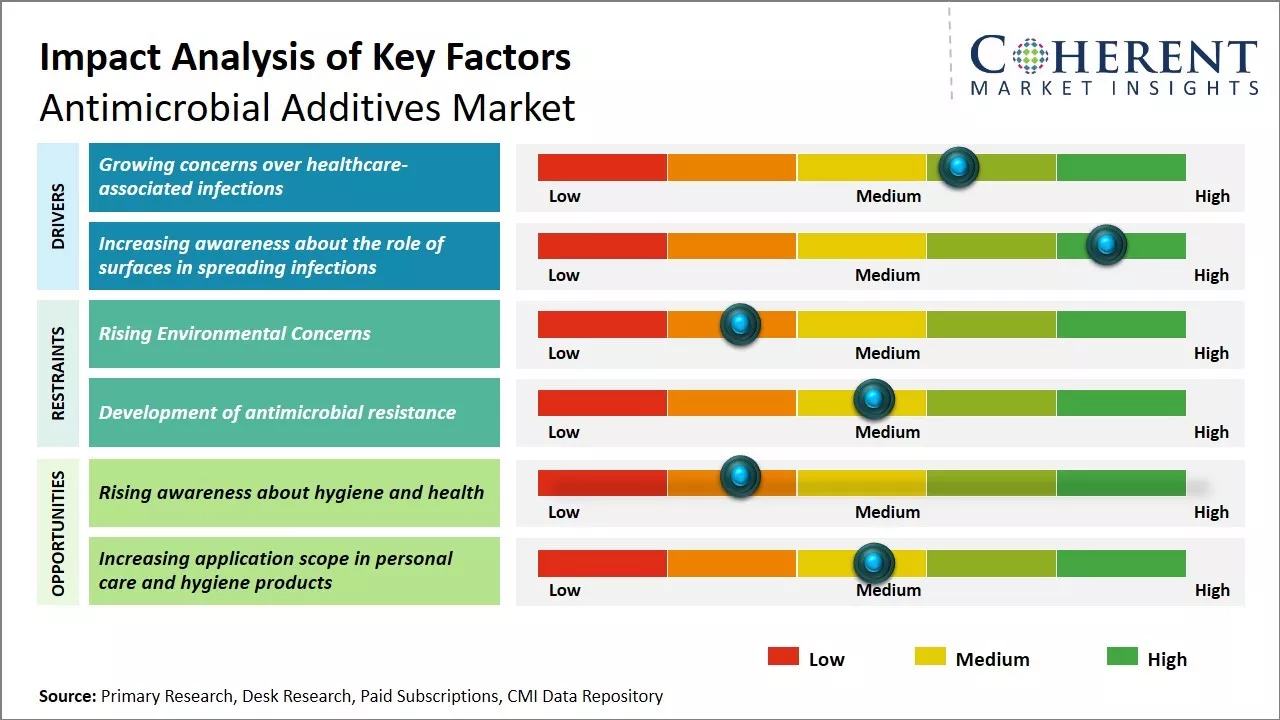
Growing concerns over healthcare-associated infections and Increasing awareness about the role of surfaces in spreading infections are the major factors driving the growth of the antimicrobial additives market.
Rising environmental concerns and development of antimicrobial resistance are the major factors hampering the growth of the antimicrobial additives market.
In terms of application, plastics is estimated to dominate the market revenue share in 2026.
NanoBioMatters Industries S.L, BASF SE, RTP Company, Milliken Chemical, BioCote Limited, Microban International, Clariant AG, PolyOne Corporation, Momentive Performance Materials Inc., Life Materials Technologies Limited, SteriTouch Limited, Sanitized AG, Dow Inc., LyondellBasell Industries Holdings B.V., Plastics Color Corporation, Lonza, AkzoNobel N.V., HeiQ Materials AG, Sarex, and Blend colors are the major players operating in the market.
North America is expected to lead the antimicrobial additives market.