

Global Powder Coatings Market Size and Share Analysis – Growth Trends and Forecasts (2026-2033)
The powder coatings market is estimated to be valued at USD 16.22 Bn in 2026 and is expected to reach USD 24.07 Bn by 2033, exhibiting a compound annual growth rate (CAGR) of 5.8% from 2026 to 2033.
Key Takeaways
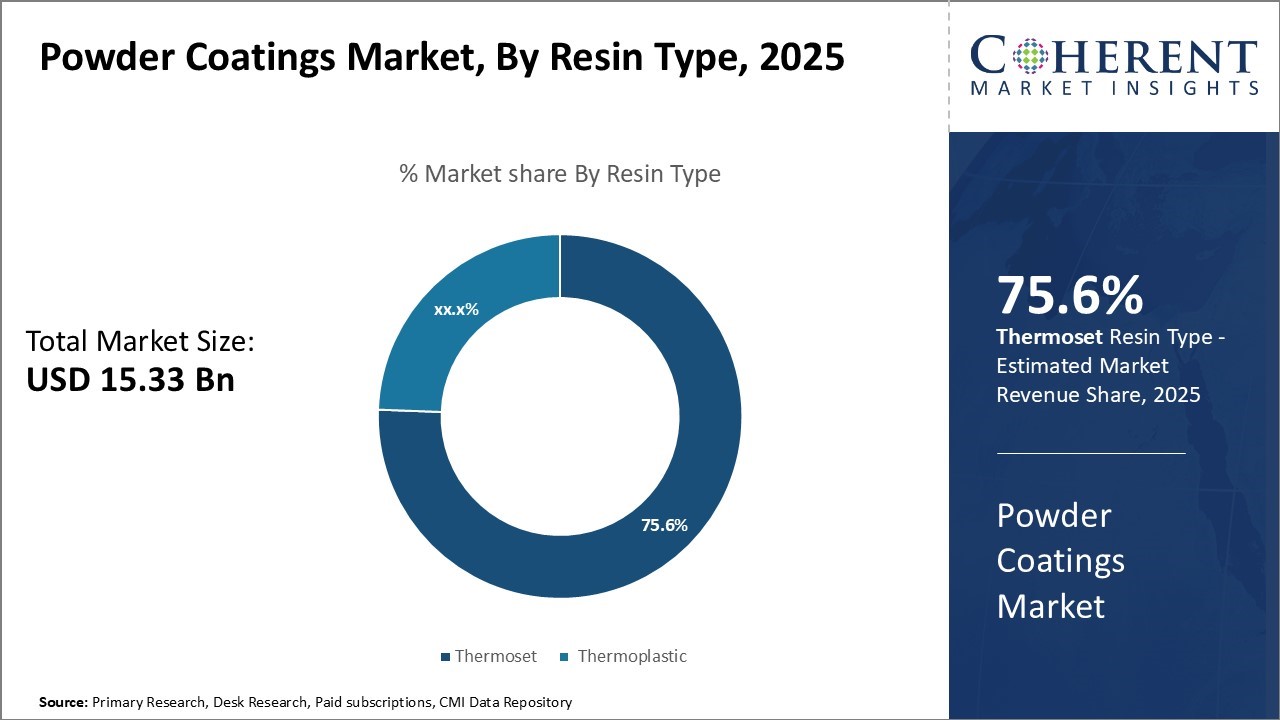
- In terms of Resin Type, Thermoset Segment is expected to contribute 76.6%share of the market in 2026. This is due to their exceptional durability and corrosion resistance.
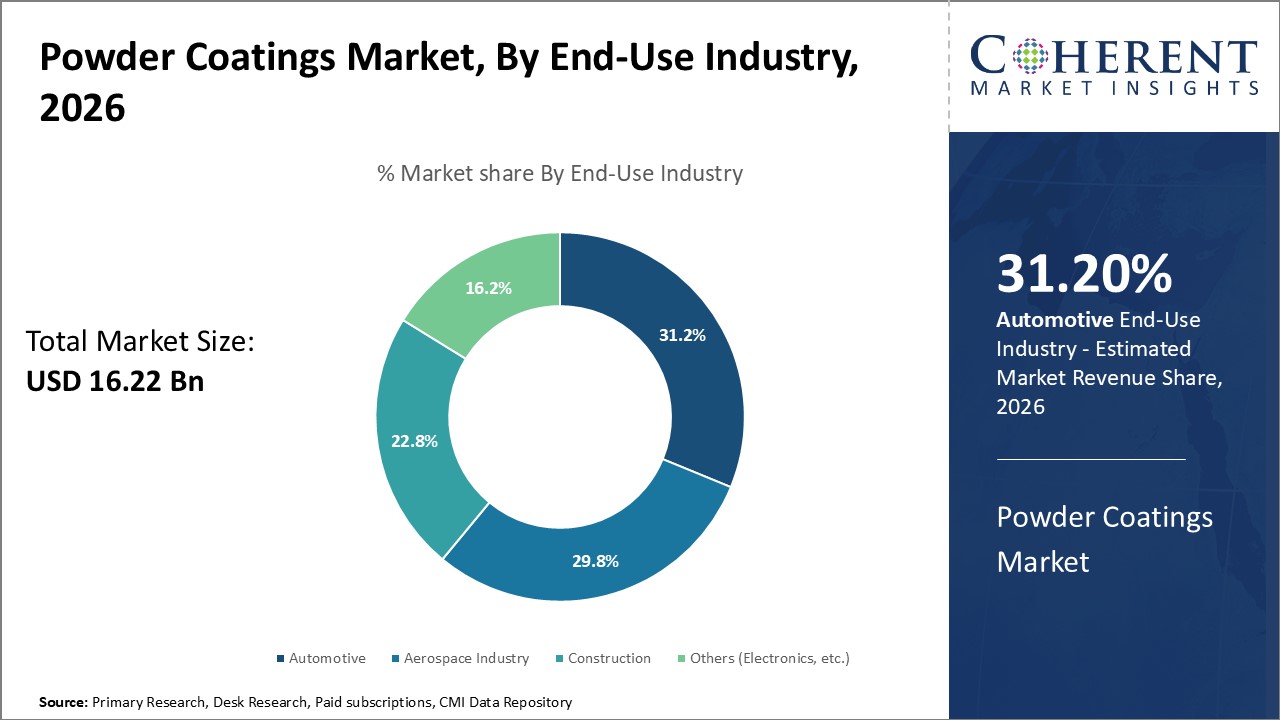
- In terms of End-Use Industry, Automotive Segment is expected to contributes 31.2%share of the market in 2026. This is due to stringent performance standards.
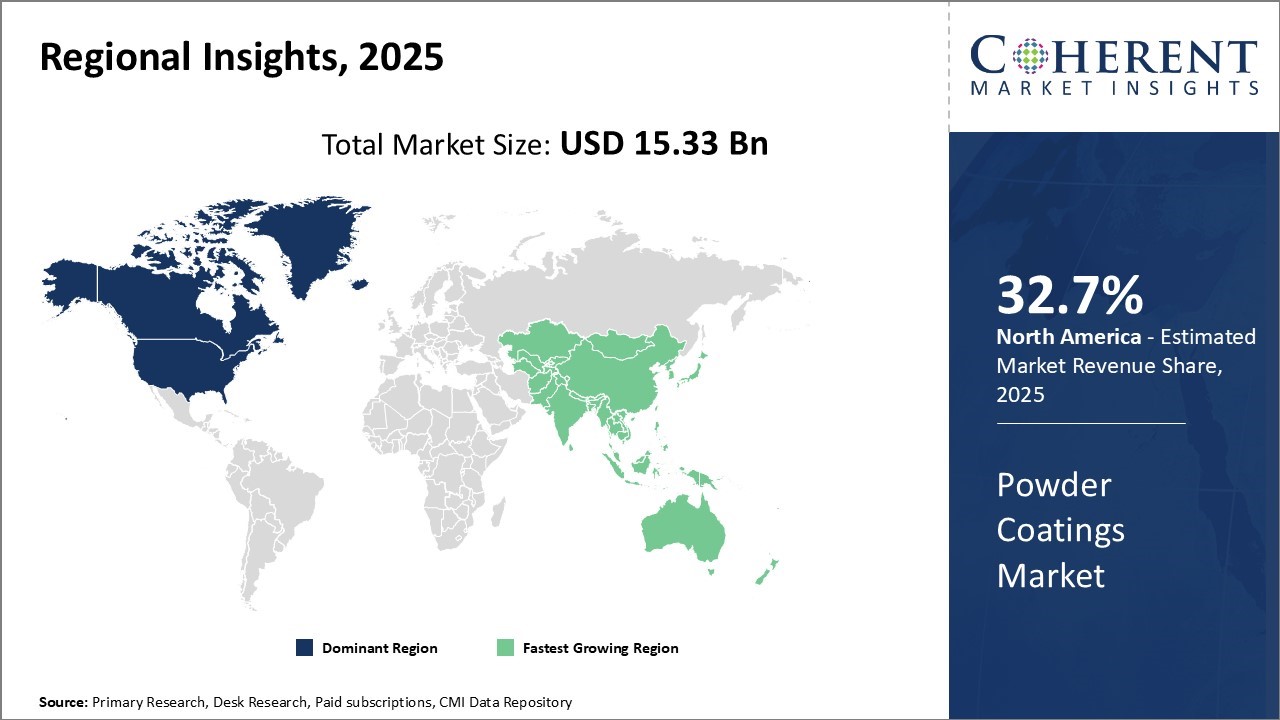
- North America has been the dominant region in the global powder coatings market with 32. 7%share in 2026. This is due to the presence of key players and a well-established industrial base.
Market Overview
The market is expected to witness positive growth over the forecast period. The demand for powder coatings from consumer appliances and construction industries has been increasing significantly. Powder coatings are vastly being adopted by manufacturers due to benefits like reduced wastage and easy application over liquid coatings. Also, stringent environment regulations restricting the use of VOCs are expected to propel the adoption of low emission powder coatings. Key players are focusing on developing bio-based and recycled material-based powder coatings to further increase their sustainability and market share. Growing construction and infrastructure development activities along with expanding consumer appliances industry in emerging nations will drive revenue generation in the global powder coatings market during the forecast time period.
Current Events and Its Impact on Powder Coatings Market
Current Events | Description and its impact |
Axalta Introduces ISCC PLUS Certified Bio-Based Powder Coatings in 2024 |
|
PPG Introduces ENVIROLUXE Plus Powder Coatings |
|
Pricing Analysis
Pricing dynamics in the global powder coatings market are determined by a host of interdependent factors such as raw material prices, technological innovations, government regulations, and demand for end-use applications. In 2025, powder coating prices averaged between $3.00 and $6.50 per pound based on the type of formulation (thermoset or thermoplastic), performance characteristics, and end-use industry.
Raw material costs—like epoxy, polyester resins, pigments, and curing agents—play a significant role in determining overall pricing. Price instability in crude oil derivatives and titanium dioxide, an important pigment, frequently results in price fluctuations. For instance, global supply chain disruptions in 2024 briefly caused raw material prices to jump, which manufacturers partly transferred to customers.
Pricing also differs according to customization and high-end properties. Functional coatings with antimicrobial performance, UV Coatings, or superior corrosion protection warrant premium prices. In contrast, bio-based or environmentally friendly powder coatings, increasingly in demand as VOC legislation tightens, have a cost 10–20% higher than traditional versions but pay dividends over time through sustainability credentials.
Geographically, Asia-Pacific still provides competitive prices as a result of reduced production and labor costs, although increasing environmental compliance is slowly raising prices. North America and Europe retain higher average prices because of more stringent regulatory environments and sophisticated product standards.
In total, pricing across the powder coatings industry is competitive but rising with innovation, raw material cost inflation, and rising demand from high-growth industries such as automotive, appliances, and infrastructure. Formulation efficiency and strategic sourcing are critical for manufacturers in terms of profitability.
- Current Industry Events of 2026
- Market Size Estimation
- Regional Breakdown
- Competitive Landscape
- Customer Intelligence
- Segmental Analysis
- Pricing Analysis
- Key Market Drivers, Challenges & Future Trends
- Customized Insights Section
Role of Artificial Intelligence (AI) in the Powder Coatings Market
Artificial Intelligence (AI) is increasingly changing the role of powder coatings business by increasing formulation precision, optimizing operational efficiency, and facilitating predictive maintenance in manufacturing processes. Formulation optimization is one of the most important applications of AI where machine learning programs review enormous amounts of data to determine the optimal blend of resins, pigments, and additives to achieve desired performance, sustainability, or cost objectives. This accelerates development cycles, minimizes testing, and produces more uniform product quality.
In manufacturing environments, AI systems are employed for automation of processes and quality assurance. As an example, computer vision technologies track real-time powder coating thickness, curing time, and surface imperfections, reducing the possibility of human error and ensuring consistency. Further, AI-based robotics are increasingly employed in automated spray applications, particularly for complex geometries in auto and appliance manufacturing, enhancing coating accuracy and minimizing overspray or material loss.
AI also plays an important role in predictive maintenance by scouring sensor readings from equipment like curing ovens or spray booths to identify anomalies ahead of potential failures. This reduces downtime and optimizes equipment lifespan. Additionally, AI software helps supply chain manufacturers forecast raw materials and market trends, reducing inventory expenses and increasing responsiveness to fluctuations in demand.
With sustainability and efficiency at the heart of the powder coatings sector, AI is likely to be instrumental in making green innovation possible, energy usage optimized, and the penetration of bio-based, low-VOC.
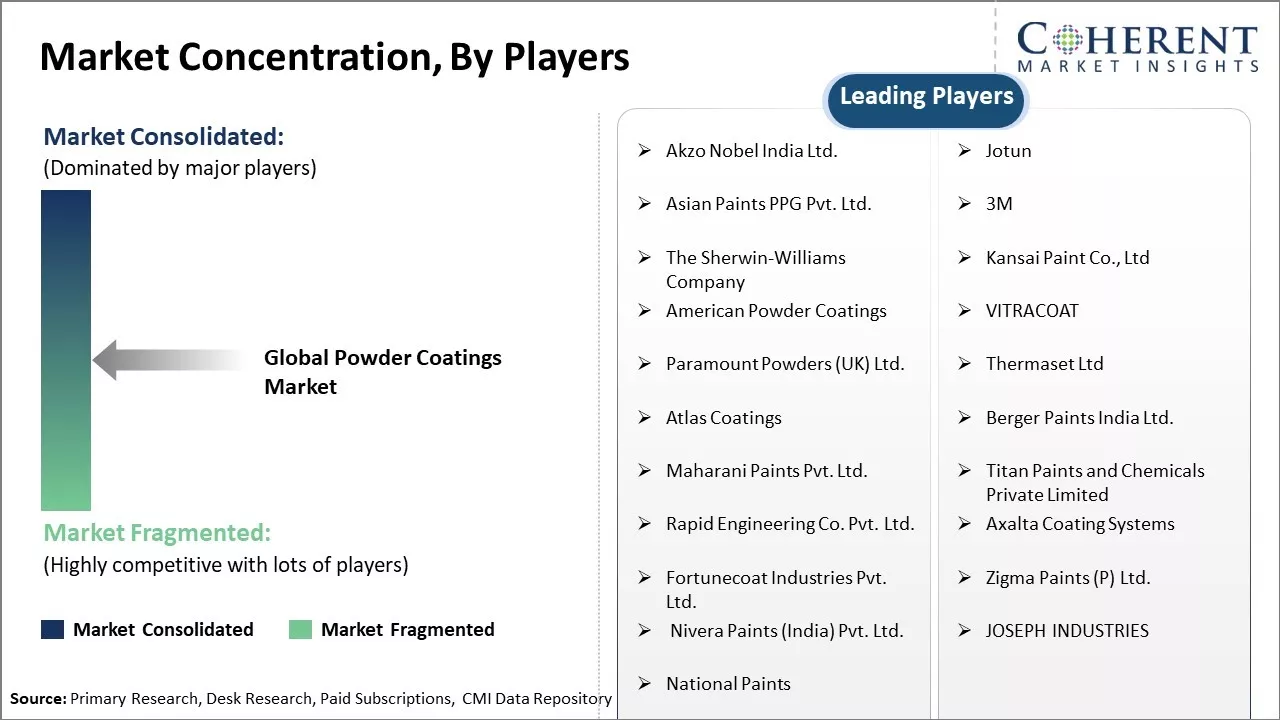
Market Concentration and Competitive Landscape
Market Driver
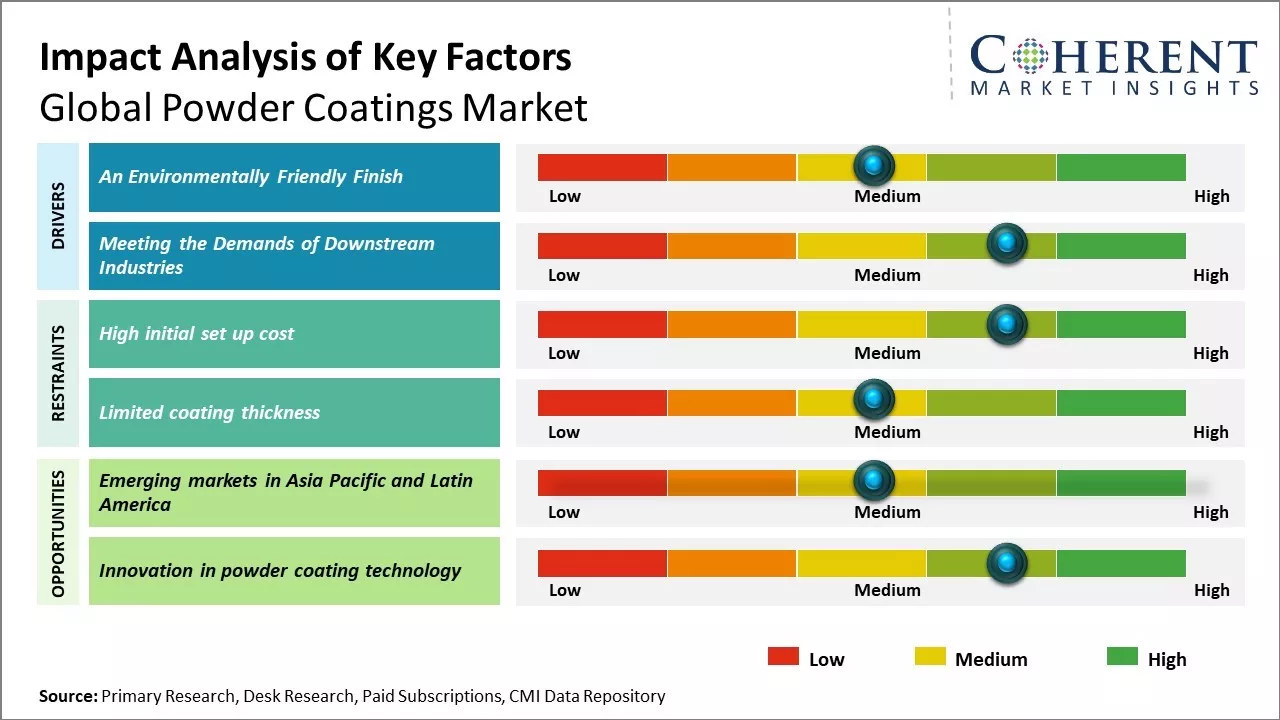
- An Environmentally Friendly Finish
Powder coatings are increasingly being demanded for their eco-friendly properties. Manufacturers across industries are moving towards powder coating as it allows for a dry, no-solvent process. Powder coatings cure at oven temperatures, making it a more sustainable alternative to liquid paints which release volatile organic compounds into the atmosphere. They can be easily reclaimed and reused, producing very little waste.
Powder coated products are also very durable and provide superior corrosion resistance. As environmental regulations are progressing, many countries have strict norms regarding VOC emissions. This is encouraging greater acceptance of powder coating technology. Sustainable finishing is no longer a novelty but a business necessity. Leading companies want to showcase their green credentials and powder coatings allow them to achieve that.
In June 2024, Arkema announced a breakthrough in manufacturing processes that integrate up to 40% post-consumer recycled PET from end-of-life packaging products into its powder coating resins. This innovation reduces the product carbon footprint by up to 20%, aligning with global sustainability goals.
- Meeting the Demands of Downstream Industries
The construction sector has always been a major consumer of powder coatings. Architectural applications such as fencing, shutters, and window frames need robust and long-lasting finishes that can withstand weathering. Powder coatings deliver on this requirement and their maintenance-free nature is additionally attractive.
In recent years, buoyant infrastructure development across developing economies has majorly driven powder coating intake in the construction industry. Another growth area has been residential fittings and appliances. More builders are offering powder coated fixtures as consumers seek homes with low maintenance exteriors and interiors. Even in developed markets, homeowners prefer powder coated interior components for their fade and abrasion resistant qualities.
The automotive industry too has risen as a prominent end-user. More OEMs are adopting advanced powder coating systems for achieving the stringent design aesthetics and protection requirements of contemporary vehicles. Other downstream sectors such as agricultural equipment and oil & gas equipment have emerged as opportunities for coating formulators to develop application-specific products.
Market Opportunities: Emerging markets in Asia Pacific and Latin America
The emerging markets in Asia Pacific and Latin America offer significant growth prospects for the global powder coatings market. These regions are undergoing rapid urbanization and industrialization which is driving increased infrastructure development and construction activities. Several countries in Asia Pacific such as India, Indonesia, Vietnam and Philippines are witnessing strong economic growth over the past decade.
According to World Bank data from 2021, India and Indonesia ranked among the top 10 economies in the world in terms of GDP growth. This robust economic expansion has tremendously boosted construction of residential and commercial buildings, factories, roads, bridges etc. which demands extensive use of powder coatings for their anti-corrosive and durable properties. The rising affluence of middle-class consumers has also increased domestic demand for powder coated home appliances, furniture and automobiles.
Segmental Insights
Powder Coatings Market Insights, By Resin Type
In terms of resin type, thermoset is expected to contribute 76.6% share of the market in 2026, owing to their exceptional durability and corrosion resistance. Thermoset resins undergo a chemical reaction when cured, resulting in a permanent hardened finish. The cross-linked polymer structure makes thermoset powder coatings highly durable and able to withstand abrasion, impact and weathering without degradation over time. They are often used in applications where longevity, chemical resistance or heat resistance are critical factors.
Thermoset powder coatings protect metal surfaces from corrosion caused by ultraviolet rays, moisture, chemicals and other environmental elements. They form a tough, long-lasting barrier against corrosion even in harsh, exterior conditions. Given their cost-effectiveness and superior protective properties, thermoset powder coatings remain the top choice for coating metal substrates in many industrial applications such as appliances, hardware, automotive and construction.
Powder Coatings Market Insights, By End-Use Industry
In terms of end-use industry, automotive is expected to contributes 31.2% share of the market in 2026, owing to stringent performance standards. Powder coatings in the automotive sector must meet tough technical requirements for appearance, layer thickness, corrosion protection, mechanical durability, and resistance to environmental stressors like chemicals, sunlight, and temperature fluctuations. They are used extensively in OEM applications like wheels, bumpers, aluminum castings, steel parts as well as refinish applications.
Powder coatings not only protect the vehicles from corrosion but also enhance aesthetics. They are favored by automakers due to their versatility, consistency and overall eco-friendliness compared to liquid coatings. Constant demand for durable, high-quality exteriors and interiors along with growing vehicle production globally will continue spurring market growth in the automotive end-use segment.
Powder Coatings Market - Regional Insights
North America Powder Coatings Market Analysis and Trends
North America has been the dominant region in the global powder coatings market for many years with 32.7% share in 2026. The presence of key players and a well-established industrial base have contributed to North America's leading position. The U.S. accounts for the major share due to the large automotive, construction, and appliances industries.
Major powder coating producers are headquartered in the region and have extensive supply chains to serve customers. The powder coatings market has seen steady growth supported by infrastructure development and investments in end-use sectors.
Leading countries update environmental regulations periodically, driving demand for sustainable powder coating technologies. While other regions are catching up, North America's early adoption and experience give it an advantage. The region's manufacturing expertise helps in developing customized product offerings.
Asia Pacific Powder Coatings Market Analysis and Trends
Asia Pacific has emerged as the fastest growing regional market for powder coatings in recent times. China is a major contributor to the region's expansion, with a burgeoning manufacturing sector and rapidly growing construction and automotive industries. Other developing Asian countries are also witnessing increased consumption. Powder coating production has increased substantially locally to meet this demand. At the same time, imports also contribute as local production has yet to match the requirement. This presents opportunities for international powder coating suppliers to establish local production sites or partner with regional producers.
Proximity to end-use industries gives Asia Pacific powder coating producers an edge in the cost of finished goods. While environmental regulations are not as stringent as Western nations yet, awareness is rising. Asia Pacific players have invested in developing products meeting global standards to target developed country markets as well. International certifications allow them to showcase their technical capabilities on par with global competitors. Considering future regulations and market potential, the Asia Pacific region will remain integral to the global powder coatings industry expansion.
Powder Coatings Market Dominating Countries
China Powder Coatings Market Analysis and Trend
China is the world's biggest market for powder coatings due to its enormous manufacturing industry, especially in the automotive, construction, and consumer appliances sectors. Government incentives for environmentally friendly coatings and urbanization have boosted demand. Domestic manufacturers enjoy inexpensive production and increasing domestic consumption.
United States Powder Coatings Market Analysis and Trend
The U.S. accounts for a large percentage in the powder coatings industry owing to strong demand from the auto, aerospace, and general industry sectors. Stringent environmental laws promoting low-VOC coatings favor the move from liquid to powder coatings. New product development and technological innovation in coatings also fuel market growth.
Germany Powder Coatings Market Analysis and Trend
Germany dominates the European market, supported by its dominant automotive and machinery manufacturing industries. The emphasis by the country on green manufacturing and tough EU environmental regulations has driven the growth of powder coating usage. German companies are also actively involved in innovating high-performance and bio-based powder coatings.
India Powder Coatings Market Analysis and Trend
India is becoming a high-growth market with fast industrialization, urban infrastructure development, and expanding consumer appliance requirements. The government's "Make in India" campaign and rising investments in the construction and transport industries are spurring local demand for powder coatings.
Japan Powder Coatings Market Analysis and Trend
Japan has a solid footing in the powder coatings sector, with its cutting-edge electronics and automotive sectors. Its focus on quality, energy efficiency, and sustainability has kept the demand going for technologically superior coating technologies.
Market Report Scope
Powder Coatings Market Report Coverage
| Report Coverage | Details | ||
|---|---|---|---|
| Base Year: | 2025 | Market Size in 2026: | USD 16.22 Bn |
| Historical Data for: | 2020 To 2024 | Forecast Period: | 2026 To 2033 |
| Forecast Period 2026 to 2033 CAGR: | 5.8% | 2033 Value Projection: | USD 24.07 Bn |
| Geographies covered: |
| ||
| Segments covered: |
| ||
| Companies covered: | Akzo Nobel India Ltd., Jotun , Asian Paints PPG Pvt. Ltd., 3M, The Sherwin-Williams Company, Kansai Paint Co., Ltd, American Powder Coatings, VITRACOAT , Paramount Powders (UK) Ltd., Thermaset Ltd, Atlas Coatings, Berger Paints India Ltd., Maharani Paints Pvt. Ltd., Titan Paints and Chemicals Private Limited, Rapid Engineering Co. Pvt. Ltd., Axalta Coating Systems, Fortunecoat Industries Pvt. Ltd., Zigma Paints (P) Ltd., Nivera Paints (India) Pvt. Ltd., and JOSEPH INDUSTRIES, National Paints | ||
| Growth Drivers: |
| ||
| Restraints & Challenges: |
| ||
Powder Coatings Market Recent Development
- In 2024, PPG Industries announced plans to lay off 1,800 employees in the U.S. and Europe and close plants as part of a cost-reduction program. The company also sold its architectural coatings business in the U.S. and Canada to American Industrial Partners for approximately $550 million.
- In June 2024, Arkema showcased new powder coating resins incorporating post-consumer recycled polyethylene terephthalate (PET) at the American Coatings Show. This innovation aligns with the growing trend towards sustainability in the coatings industry.
Key Takeaways from Analyst
- The powder coatings market is poised to grow at a steady pace in the coming years, driven by increasing demand from industries like appliances, automotive, and furniture. Powder coatings offer superior durability, weather resistance, and cost-effectiveness compared to wet paints, which is prompting more manufacturers to switch to this technology. The appliance industry will continue dominating powder coatings consumption, with demand rising from both developed as well as developing markets. Automotive OEMs are also increasingly using powder coatings for superior aesthetic appeal and longer lifespan of vehicles.
- Additionally, the fluidized bed powder coatings process is gaining traction for its ability to deliver uniform and high-thickness coatings, especially in applications requiring strong corrosion and impact resistance.
- The market opportunities are plenty, high capital requirement for setting up powder coating plants poses a challenge for small players. Stringent environmental regulations around VOC emissions are another restraint. The market also faces uncertainties over raw material price volatility. However, ongoing R&D to develop bio-based resins will help address sustainability concerns.
- The Asia Pacific region, spearheaded by China and India, offers the most attractive prospects led by growing manufacturing output in the region. North America and Western Europe are relatively mature markets but offer scope through value-added product development. Players are innovating with new textures, finishes, and color-changing powders to expand in construction and decorative markets. Consolidation among market participants is also expected to continue.
Market Segmentation
- Resin Type Insights (Revenue, USD Bn, 2021 - 2033)
- Thermoset
- Thermoplastic
- Coating Method Insights (Revenue, USD Bn, 2021 - 2033)
- Electrostatic Spray Coating
- Fluidized Bed Coating
- Electrostatic Fluidized Bed Process
- Flame Spraying
- End-use Industry Insights (Revenue, USD Bn, 2021 - 2033)
- Aerospace Industry
- Automotive
- Construction
- Others (Electronics, etc.)
- Regional Insights (Revenue, USD Bn, 2021 - 2033)
- North America
- U.S.
- Canada
- Latin America
- Brazil
- Argentina
- Mexico
- Rest of Latin America
- Europe
- Germany
- U.K.
- Spain
- France
- Italy
- Russia
- Rest of Europe
- Asia Pacific
- China
- India
- Japan
- Australia
- South Korea
- ASEAN
- Rest of Asia Pacific
- Middle East & Africa
- GCC Countries
- Israel
- Rest of Middle East & Africa
- Key Players Insights
- Akzo Nobel India Ltd.
- Jotun
- Asian Paints PPG Pvt. Ltd.
- 3M
- The Sherwin-Williams Company
- Kansai Paint Co., Ltd.
- American Powder Coatings
- VITRACOAT
- Paramount Powders (UK) Ltd.
- Thermaset Ltd.
- Atlas Coatings
- Berger Paints India Ltd.
- Maharani Paints Pvt. Ltd.
- Titan Paints and Chemicals Private Limited
- Rapid Engineering Co. Pvt. Ltd.
- Axalta Coating Systems
- Fortunecoat Industries Pvt. Ltd.
- Zigma Paints (P) Ltd.
- Nivera Paints (India) Pvt. Ltd.
- JOSEPH INDUSTRIES
- National Paints
Sources
Primary Research Interviews
- Powder coating manufacturers and suppliers
- E-commerce platform managers and digital sales directors
- Industrial coating applicators and service providers
- End-user industry procurement managers (automotive, furniture, appliances)
- Others
Databases
- IBISWorld Industry Research Database
- Others
Magazines
- Powder Coating Magazine
- Industrial Paint & Powder Magazine
- Coatings World Magazine
- American Coatings Association Magazine
- Others
Journals
- Journal of Coatings Technology and Research
- Progress in Organic Coatings
- Surface and Coatings Technology
- Others
Newspapers
- Chemical Week
- Paint & Coatings Industry News
- Industrial Distribution Magazine
- Manufacturing News
- Others
Associations
- Powder Coating Institute (PCI)
- American Coatings Association (ACA)
- European Powder Coatings Federation (EPCF)
- International Coatings Expo Association
- Others
Public Domain Sources
- U.S. Environmental Protection Agency (EPA) reports
- European Chemicals Agency (ECHA) publications
- International Trade Administration market reports
- World Trade Organization trade statistics
- Others
Proprietary Elements
- CMI Data Analytics Tool
- Proprietary CMI Existing Repository of information for last 8 years
Get access to 250+ pages report
Every segment, forecast, competitor profile and data table behind the analysis above — available for instant download.
- ESOMAR Member
- ISO 9001:2015 Certified
- D-U-N-S Registered
- GDPR & CCPA Compliant
Missing comfort of reading report in your local language? Find your preferred language:
Transform your Strategy with Exclusive Trending Reports
Frequently Asked Questions
The Powder Coatings Market size is estimated to be valued at USD 16.22 Bn in 2026, and is expected to reach USD 24.07 Bn by 2033.
The CAGR of the global Market is projected to be 5.8% from 2026 to 2033.
An environmentally friendly finish and meeting the demands of downstream industries are the major factors driving the growth of the global market.
The growth of the powder coatings market is primarily driven by increasing environmental regulations, demand for durable and cost-effective finishes, and the rising adoption of eco-friendly, VOC-free coating technologies across automotive, appliances, and architectural sectors.
Metallic and special effect powder coatings offer enhanced aesthetic appeal, texture, and reflectivity, making them popular in consumer-facing applications such as automotive, electronics, and furniture, where visual impact is a key differentiator.
Yes, powder coatings could uniquely address unmet needs like antimicrobial protection in healthcare, low-cure solutions for energy efficiency in manufacturing, and sustainable coatings for emerging markets such as electric vehicles and solar infrastructure.
High initial set up cost and limited coating thickness are the major factors hampering the growth of the global market.