

Biofuels Market Analysis & Forecast: 2026 to 2033
The global biofuels market size was valued at USD 293.82 Bn in 2026 and is expected to reach USD 551.06 Bn by 2033, growing at a compound annual growth rate (CAGR) of 9.4% from 2026 to 2033.
Key Takeaways
- Based on Feedstock Type, the Vegetable Oil-Based Biofuels segment is expected to lead the market with the largest share in 2026, due to affordability, availability, and established supply chains.
- Based on Fuel Type, the Biodiesel segment is estimated to account for 26% share of the market in 2026, driven by sustainability, easy adoption, and strong global mandates.
- Based on Application, the Transportation segment is projected to account for the highest share of the market in 2026, driven by road vehicles, aviation SAF adoption, and global blending mandates.
- Based on Production Technology, the First-Generation Biofuels segment is expected to lead the market with the greatest share of the market in 2026, due to cost-effectiveness, availability, and established infrastructure.
- Based on End-Use Industry, the Automotive segment is projected to hold a prominent share of the market in 2026, driven by blending mandates and widespread vehicle adoption.
- Based on Region, North America is set to lead the biofuels market in 2026, with 35% While, Asia Pacific is anticipated to be the fastest growing region.
Market Overview
The market is driven by several factors, including the increasing demand for renewable energy sources, government regulations and incentives promoting the use of biofuels, and the need to reduce greenhouse gas emissions. Biofuels, such as ethanol and biodiesel, are derived from renewable biomass sources such as corn, sugarcane, soybeans, and vegetable oils. They are considered an attractive alternative to fossil fuels as they help mitigate climate change, reduce dependence on fossil fuel imports, and support rural development.
Advancements in biofuel production technologies, such as second-generation biofuels from non-food feedstocks like agricultural residues, algae, and dedicated energy crops, are expected to contribute to the market growth. These advanced biofuels offer increased energy efficiency, improved environmental sustainability, and reduced competition with food production.
Current Events and Its Impacts on the Biofuels Market
Current Event | Description and its Impact |
US Inflation Reduction Act Implementation and Renewable Fuel Standard Updates |
|
EU REPowerEU Plan and Fit for 55 Package Enforcement |
|
Biofuel Production
Biofuel | Estimated Global Production (Billion Liters, 2025) | Key Regions Driving Output |
Biodiesel | ~46–48 | EU, U.S., Brazil, Asia |
Bioethanol | ~37–39 | U.S., Brazil, India |
Biogas | ~37–39 | EU, China, India |
Biojet Fuel (SAF) | ~37–39 | U.S., EU, Japan, Australia |
Biohydrogen | ~27–28 | Japan, South Korea, EU |
Total | ~185–190 | Global |
- Current Industry Events of 2026
- Market Size Estimation
- Regional Breakdown
- Competitive Landscape
- Customer Intelligence
- Segmental Analysis
- Pricing Analysis
- Key Market Drivers, Challenges & Future Trends
- Customized Insights Section
Segmental Insights
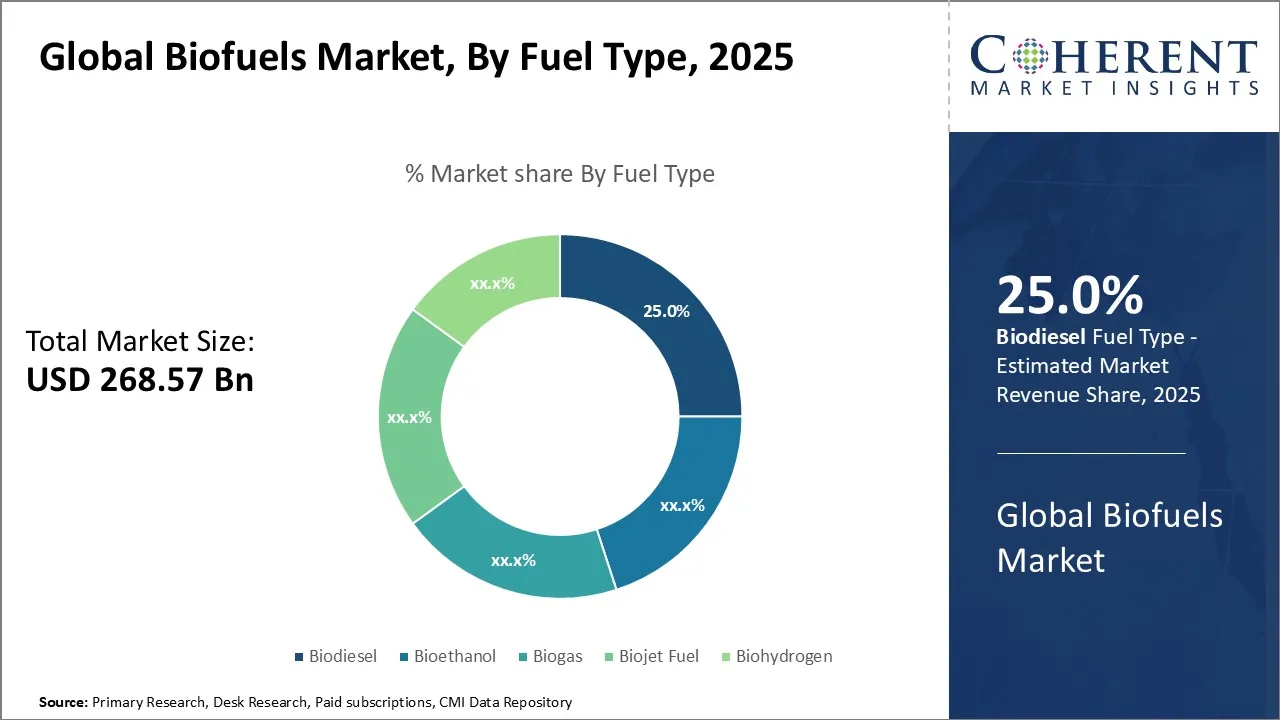
Biofuels Market Insights, By Fuel Type - Biodiesel Is Driven by Sustainability, Easy Adoption, And Strong Global Mandates
In terms of fuel type, the biodiesel segment is projected to capture 26% share of the market in 2026, because it is a cleaner, more sustainable alternative to petroleum diesel that lowers greenhouse gas emissions and makes energy more secure. It is easier to adopt because it works with current diesel engines and infrastructure. Biodiesel's market growth is also helped by strong government blending mandates, especially in Europe and Asia, and by rising sustainability goals in shipping and transportation.
For instance, in August 2026, by 2026, Indonesia plans to start its B50 biodiesel program, which will combine 50% palm oil-based biofuel with petroleum diesel. The plan shows that Indonesia wants to use more biodiesel, rely less on fossil fuels, and reach its sustainability goals.
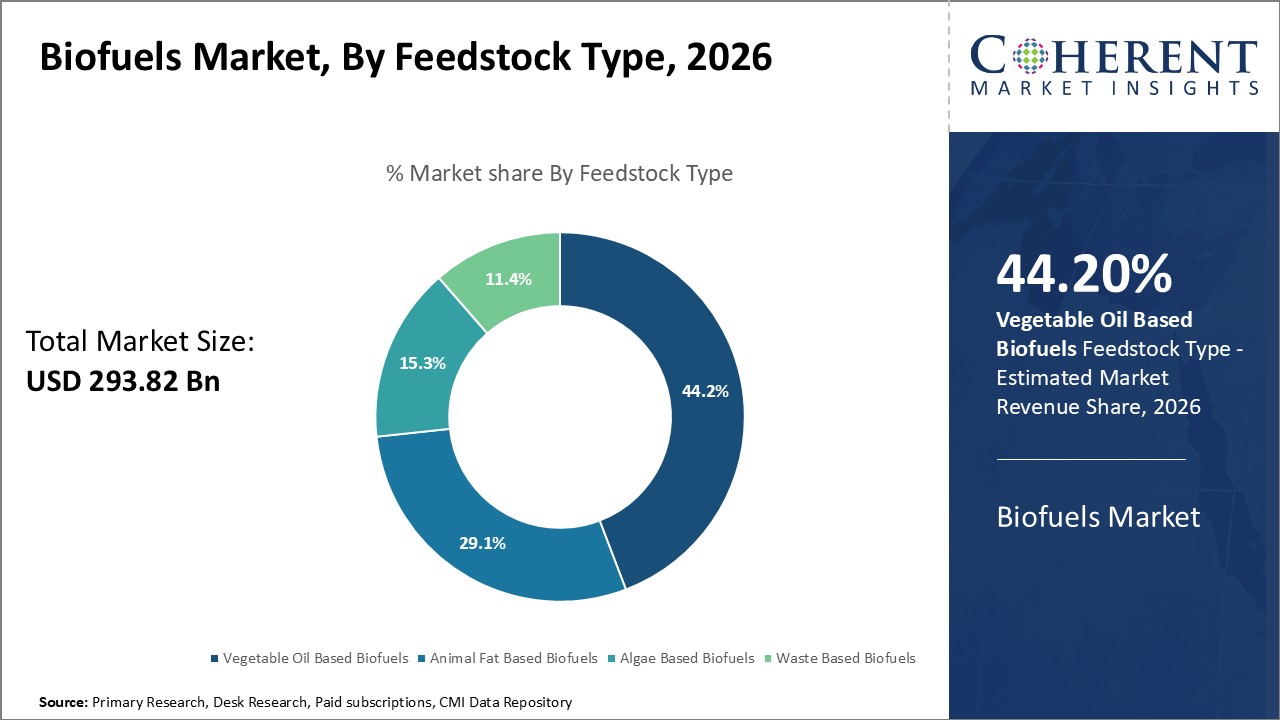
Biofuels Market Insights, By Feedstock Type - Vegetable Oil-Based Biofuels Leads Due To Affordability, Availability, And Established Supply Chains
In terms of feedstock type, the vegetable oil-based biofuels segment is expected to lead the market with the largest share in 2026, as they have well-established supply chains and can be made in large quantities. Soybean, palm, and rapeseed oils are easy to find and affordable, which makes them the best feedstock for biodiesel. Since they work with existing infrastructure and blending requirements, they will continue to be leaders. However, concerns about sustainability are driving growth in waste-based alternatives.
For instance, in June 2025, Eni announced that it will export vegetable oil from Côte d'Ivoire for the first time. The oil is made from rubber tree waste and meets ISCC-EU standards. The shipment is going to Enilive biorefineries to make advanced biofuels, which is a big step toward supporting transportation that is good for the environment.
Biofuels Market Insights, By Application - Transportation Dominance Is Driven by Road Vehicles, Aviation SAF Adoption, And Global Blending Mandates
In terms of application, the transportation segment is expected to hold the highest share of the market in 2026. Most bioethanol and biodiesel are used by cars and trucks, but increasingly, planes are using sustainable aviation fuel (SAF). Governments around the world enforce blending rules, which makes transportation the largest user. Shipping by sea is also becoming more popular, but road and air travel remained the main reasons people use biofuels in 2026.
For instance, in August 2025, India accelerated its ethanol blending program to mix biofuels with petrol and diesel, aiming to cut crude oil imports and reduce emissions. The initiative extends to heavy construction machinery alongside cars and trucks, reinforcing transportation as the largest consumer of biofuels. Government mandates highlight India’s push for energy security and sustainable mobility in 2025.
Biofuels Market Insights, By Production Technology - First-Generation Biofuels Leads Due To Cost-Effectiveness, Availability, And Established Infrastructure
In terms of production technology, the first-generation biofuels segment is projected to capture the greatest share of the market in 2026. First-generation biofuels, made from common crops like corn, sugarcane, and vegetable oils, are the most common type of biofuel. They are the market leaders as they have an extensive amount of infrastructure, are cost-effective, and are easy to find. First-generation fuels are still the main source of fuel around the world, even though there are concerns about their environmental impact and competition from newer generations. Second-generation biofuels are growing quickly with the help of the government and research and development.
For instance, in November 2025, TotalEnergies has started its biofuels project. They estimate that 97% of the world's biofuels still come from first-generation fuels made from crops like maize, wheat, sugarcane, and vegetable oils. The company wants to stop using vegetable oil feedstocks by 2030 and instead use waste-based advanced biofuels and invest in sustainable aviation fuel to cut down on emissions and competition for food.
Biofuels Market Insights, By End-Use Industry - Automotive Dominance Is Driven by Blending Mandates and Widespread Vehicle Adoption
In terms of end-use Industry, the automotive segment is expected to acquire the dominant share in 2026, driven by laws that require blending them into gasoline and diesel. Bioethanol and biodiesel are used by millions of cars around the world to meet emissions goals. Because of the demand for SAF, aviation is the fastest-growing sector. However, automotive remains expected to be the leading industry in 2026 simply due to its size and established consumption patterns.
For instance, in October 2026, In October 2026, BYD reached a major milestone by releasing its revolutionary Super Hybrid vehicle, which can run on biofuels. This was the company's 14 millionth new energy vehicle. The launch shows that BYD is working to expand its clean mobility options by adding biofuel technology to cars. This strengthens its position as a leader in sustainable transportation, along with electric and hybrid innovations.
Regional Insights
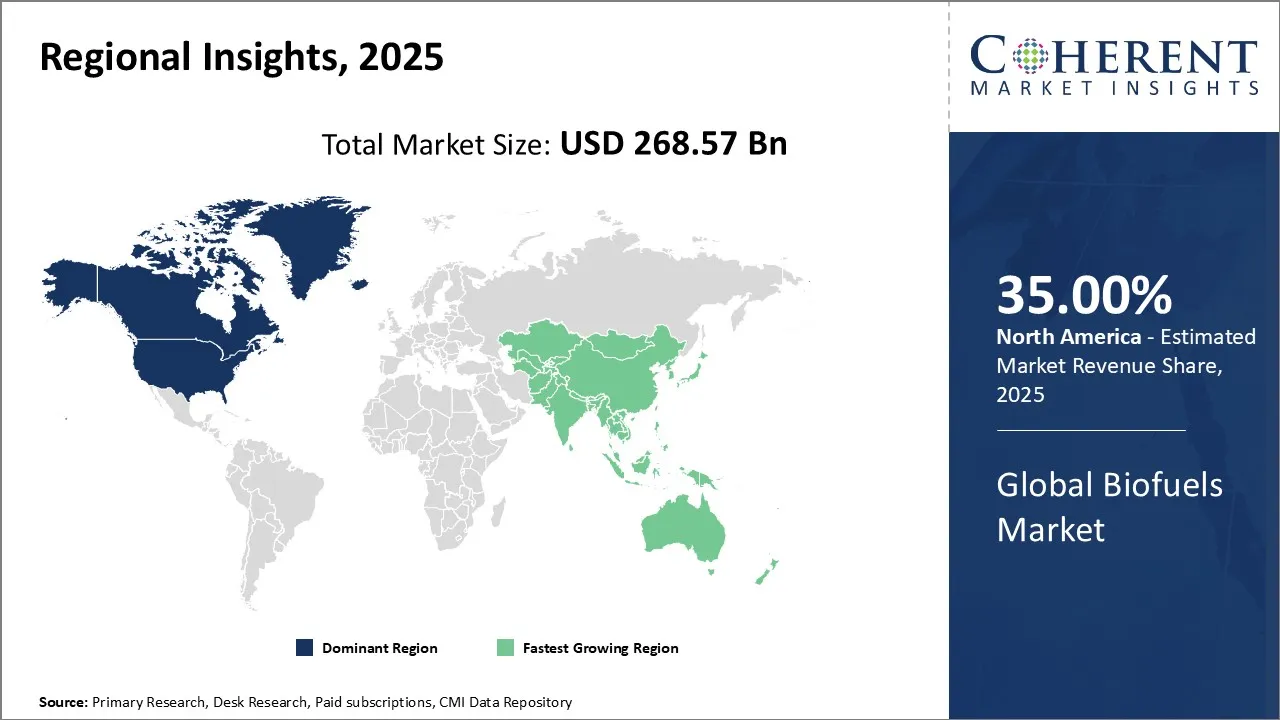
North America Biofuels Market Analysis & Trends
North America is expected to lead the market with 35% share in 2026, because of strong government policies like the U.S. Renewable Fuel Standard, the widespread use of ethanol in gasoline, and the growing use of biodiesel. There is an abundance of feedstocks available, especially corn and soybeans, which helps production. At the same time, growing sustainability goals and the need to reduce carbon emissions in the transportation sector keep demand high across the region.
For instance, in December 2026, American GreenFuels, one of Connecticut's biggest biodiesel producers, has grown its renewable energy manufacturing business. This shows that North America is going to require biofuels in 2026. The company's growth shows how committed the region is to sustainability, creating jobs, and using fewer fossil fuels. This is backed up by government policies like the Renewable Fuel Standard and rising goals for decarbonizing the transportation sector.
Asia Pacific Biofuels Market Analysis & Trends
Asia Pacific is projected to be the fastest growing region, because of high energy needs, government blending requirements, and a lot of agricultural feedstocks. Ethanol and biodiesel programs in countries like India, China, and Indonesia help the economy grow by cutting down on fossil fuel imports and emissions. The region has the fastest-growing biofuels market in the world because of rising transportation needs and goals for sustainability.
For instance, in November 2026, Petronas, EniLive, and Euglena have started building a new biorefinery in Malaysia. It will convert used cooking oil and vegetable oils into sustainable aviation fuel and biodiesel. The project, which started in 2026, shows how important Asia is becoming in renewable energy and helps the world cut emissions and use more biofuels.
Biofuels Market Outlook Country-Wise
The U.S. Biofuels Market Trends
In 2026, the U.S. has a significant amount of demand for biofuels driven by strong federal policies like the Renewable Fuel Standard, the fact that gasoline is often mixed with ethanol, and the fact that more people are using biodiesel. There are many varieties of feedstocks like corn and soybeans that make large-scale production possible. At the same time, sustainability goals and the need to cut carbon emissions in the transportation sector keep the demand for renewable fuels high across the country.
For instance, in October 2026, Honeywell launched a new technology in the U.S. that turns biomass into renewable fuels that are inexpensive and of high quality. The new idea, uses waste from farming and forestry to make more biofuels. The project strengthens North America's leadership in renewable energy, helps the world reach its decarbonization goals, and makes us less dependent on fossil fuels.
Japan Biofuels Market Trends
Japan is expected to be a major player in the biofuels market in 2026 as it aims to reduce carbon emissions from shipping and transportation, has strict goals for cutting emissions, and relies on energy imports. Government policies make it easier for people to use biofuels, and businesses are putting investments into sustainable aviation fuel and marine bio-blends.
For instance, in December 2026, Idemitsu, a Japanese refiner, and Kanematsu, a trading company, have started providing biofuel for ships that travel on the ocean. This fuel is made by mixing regular fuel oil with up to 24% fatty acid methyl ester (FAME). The project, which started in 2026, aims to lower greenhouse gas emissions from shipping. It plans to deliver 5,000 tons of bio-blended fuel by March 2026.
Market Report Scope
Biofuels Market Report Coverage
| Report Coverage | Details | ||
|---|---|---|---|
| Base Year: | 2025 | Market Size in 2026: | USD 293.82 Bn |
| Historical Data for: | 2020 To 2024 | Forecast Period: | 2026 To 2033 |
| Forecast Period 2026 to 2033 CAGR: | 9.4% | 2033 Value Projection: | USD 551.06 Bn |
| Geographies covered: |
| ||
| Segments covered: |
| ||
| Companies covered: | Archer Daniels Midland Company, Cargill, Incorporated, Neste Corporation, Renewable Energy Group, Inc., Poet, LLC, Valero Energy Corporation, BP plc, Royal Dutch Shell plc, Chevron Corporation, TotalEnergies SE, Repsol S.A., Cosan Limited, Wilmar International Limited, Raízen, and Green Plains Inc. | ||
| Growth Drivers: |
| ||
| Restraints & Challenges: |
| ||
Biofuels Market Drivers
- Renewable Energy Policies and Regulations: Government policies and regulations aimed at reducing greenhouse gas emissions and promoting renewable energy play a crucial role in driving the biofuels market. These policies often include mandates and targets for blending biofuels with conventional fuels, tax incentives, and subsidies for biofuel production and consumption. For instance, the European Union recently proposed its ReFuelEU initiative that mandates airlines use a minimum of 2% advanced sustainable aviation fuels by 2025 and 5% by 2032.
- Energy Security and Independence: Biofuels offer an opportunity to reduce dependence on fossil fuels and enhance energy security. Countries that rely heavily on imported fossil fuels may promote the use of biofuels as a means to diversify their energy sources and reduce reliance on foreign oil.
- Environmental Concerns: Biofuels are considered to be a more sustainable and environment-friendly alternative to fossil fuels. They have the potential to reduce greenhouse gas emissions and mitigate climate change. Biofuels can also help address local air quality issues by reducing emissions of pollutants such as sulfur and particulate matter. For instance, Brazil has a national blend mandate requiring a minimum of 27.5% ethanol blended with gasoline. The European Union EU too has set a target for renewable fuels to account for at least 13% of the energy used in the transportation sector by 2030.
- Technological Advancements: Advancements in biofuel production technologies, such as the development of more efficient conversion processes and the use of advanced feedstock, have contributed to the growth of the biofuels market. Technological innovations have increased the production efficiency of biofuels, making them more economically viable and competitive with fossil fuels. For instance, LanzaTech has developed a microbial technology that can convert waste carbon emissions into ethanol, preventing them from polluting the environment.
Biofuels Market Opportunities
- Advanced Biofuels: Advanced biofuels, also known as second-generation biofuels, offer significant opportunities for market expansion. These biofuels are produced from non-food feedstock such as agricultural residues, algae, and waste materials. Advanced biofuels have the potential to overcome some of the limitations associated with conventional biofuels such as competition with food crops and land use concerns.
- Aviation Biofuels: The aviation industry is actively exploring the use of biofuels as a means to reduce its carbon footprint. Aviation biofuels, also known as sustainable aviation fuels (SAF), can significantly reduce greenhouse gas emissions compared to traditional jet fuels. The growing demand for air travel and increasing environmental regulations in the aviation sector presents a significant opportunity for the biofuels market. For instance, Alaska Airlines has been using biofuels made from forest residuals since 2016 to reduce greenhouse gas emissions.
- Marine Biofuels: Similarly, the maritime industry is seeking alternatives to traditional marine fuels to meet environmental regulations and reduce emissions. Biofuels can be used as a substitute for conventional marine fuels, offering a sustainable solution. The International Maritime Organization's (IMO) regulations on sulfur emissions from ships create a favorable market opportunity for biofuels in the marine sector. For instance, according to the World Bank, the sustainable harvesting of marine plants for fuel could potentially meet 15-57% of current liquid transport fuel needs.
- Co-processing and Co-refining: Co-processing and co-refining involve blending biofuels with conventional fossil fuels in existing refineries and fuel production processes. This approach allows for the incremental adoption of biofuels in the existing infrastructure, providing a market opportunity without requiring significant infrastructure investments.
Analyst Opinion (Expert Opinion)
- The biofuels market is growing in a structural way as countries make blending rules stricter and speed up the switch to low-carbon fuels. Global use of liquid biofuels is still going up steadily. Ethanol is still the biggest part, due to strong production bases in the US and Brazil. At the same time, biodiesel and renewable diesel production is growing in Asia, Europe, and Latin America. Indonesia is now the world's largest generator of biodiesel, making tens of billions of liters every year. The EU also has a lot of capacity for making biodiesel from waste.
- Advanced biofuels, especially renewable diesel and sustainable aviation fuel (SAF), are becoming more popular swiftly due to government incentives and the aviation industry's goal to cut carbon emissions. SAF production capacity has grown by three times a year, but it still only makes up a small part of the total biofuel supply.
- The most important factor in cost and competitiveness continues to be the availability of feedstock. Regions with an abundance of palm oil, soy oil, sugarcane, maize, or waste oil streams have better project economics. But changes in sustainability requirements and unstable feedstock markets still pose operational risks.
- Policy certainty, more advanced fuel capacity, and rising long-term demand from the transportation and aviation sectors all support the industry's outlook.
Speak to the analyst
Want personalized insights?
Take the findings above to one of our principal consultants, or have the report rebuilt around the segments, geographies and competitors you actually track.
Recent Developments
- In September 2025, Australia pledged $735 million to start its biofuel industry. The goal is to increase the use of renewable energy and lower carbon emissions. The investment, which was announced in September 2025, will help projects that make biodiesel and sustainable aviation fuel. This will make Australia a leader in clean energy. The project shows how serious the country is about getting rid of carbon and making sure its energy supply is safe.
- In August 2025, Indian biofuels startup TruAlt announced that it will hold its first public offering (IPO). The company wants to raise funding to make more products and strengthen its position in India's rapidly growing renewable energy market. TruAlt's move shows that more and more investors are interested in biofuels as the country speeds up its switch to clean energy.
- In May 2025, Nippon Yuka Kogyo, a part of the NYK Group, announced the release of BioxiGuard, Japan's first antioxidant made just for marine biodiesel fuel. The new technology cuts down on oxidative degradation by about 50%, which makes fuel more stable and efficient. The development helps Japan's efforts to reduce carbon emissions from ships and makes biofuels more reliable for shipping.
Market Segmentation
- By Feedstock Type (Revenue, USD Bn, 2021 - 2033)
- Vegetable Oil-based Biofuels (e.g., Soybean Oil, Palm Oil, and Rapeseed Oil)
- Animal Fat-based Biofuels (e.g., Tallow and Poultry Fat)
- Algae-based Biofuels
- Waste-based Biofuels (e.g., Used Cooking Oil and Municipal Solid Waste)
- By Fuel Type (Revenue, USD Bn, 2021 - 2033)
- Biodiesel
- Bioethanol
- Biogas
- Biojet Fuel
- Biohydrogen
- By Application (Revenue, USD Bn, 2021 - 2033)
- Transportation (Road Vehicles, Aviation, and Marine)
- Power Generation
- Heating and Cooling
- Industrial Processes
- By Production Technology (Revenue, USD Bn, 2021 - 2033)
- First-generation Biofuels (Conventional Crop-Based)
- Second-generation Biofuels (Cellulosic Biomass)
- Third-generation Biofuels (Algae-Based)
- Fourth-generation Biofuels (Advanced Biofuels)
- By End-use Industry (Revenue, USD Bn, 2021 - 2033)
- Automotive
- Aviation
- Shipping and Maritime
- Agriculture
- Residential
- Manufacturing
- By Region (Revenue, USD Bn, 2021 - 2033)
- North America
- U.S.
- Canada
- Latin America
- Brazil
- Argentina
- Mexico
- Rest of Latin America
- Europe
- Germany
- U.K.
- Spain
- France
- Italy
- Russia
- Rest of Europe
- Asia Pacific
- China
- India
- Japan
- Australia
- South Korea
- ASEAN
- Rest of Asia Pacific
- Middle East & Africa
- GCC Countries
- Israel
- Rest of Middle East & Africa
- North America
- Top Companies in the Biofuels Market
- Archer Daniels Midland Company
- Cargill, Incorporated
- Neste Corporation
- Renewable Energy Group, Inc.
- Poet, LLC
- Valero Energy Corporation
- BP plc
- Royal Dutch Shell plc
- Chevron Corporation
- TotalEnergies SE
- Repsol S.A.
- Cosan Limited
- Wilmar International Limited
- Raízen
- Green Plains Inc.
Sources
Primary Research Interviews
- Biofuel Producers & Refiners
- Feedstock Suppliers (Corn, Sugarcane, Soybean, Algae)
- Biodiesel & Ethanol Plant Operators
- Bioenergy Technology Providers
- Renewable Fuel Policy Experts
- Transport & Aviation Fuel Procurement Managers
- Others
Databases
- Bloomberg Terminal
- Thomson Reuters Eikon
- IHS Markit
- Euromonitor International
- S&P Global Market Intelligence
- Others
Magazines
- Biofuels International Magazine
- Ethanol Producer Magazine
- Biodiesel Magazine
- Renewable Energy World
- Chemical Engineering Magazine
- Others
Journals
- Renewable Energy Journal
- Biomass & Bioenergy Journal
- Energy & Environmental Science
- Bioresource Technology Journal
- Others
Newspapers
- Financial Times
- The Wall Street Journal
- Reuters
- Bloomberg News
- The Guardian – Energy Section
- Others
Associations
- Renewable Fuels Association (RFA)
- Advanced Biofuels Association (ABFA)
- International Energy Agency (IEA) Bioenergy
- European Renewable Ethanol Association (ePURE)
- Global Bioenergy Partnership (GBEP)
- Others
Public Domain Sources
- U.S. Department of Energy (DOE) – Bioenergy Technologies Office
- International Energy Agency (IEA)
- European Commission – Directorate-General for Energy
- Food and Agriculture Organization (FAO) Statistics
- National Renewable Energy Laboratory (NREL)
- World Bank Open Data
- Others
Proprietary Elements
- CMI Data Analytics Tool
- Proprietary CMI Existing Repository of Information for the Last 8 Years
*Definition: Biofuels are renewable fuels derived from biomass such as plants, agricultural crops, or organic waste. They serve as alternatives to conventional fossil fuels and can be used in transportation, heating, and power generation. Biofuels are produced through various processes, including fermentation, transesterification, and thermochemical conversion, and offer the potential to reduce greenhouse gas emissions, enhance energy security, and promote sustainability in the energy sector.
Get access to 250+ pages report
Every segment, forecast, competitor profile and data table behind the analysis above — available for instant download.
- ESOMAR Member
- ISO 9001:2015 Certified
- D-U-N-S Registered
- GDPR & CCPA Compliant
Missing comfort of reading report in your local language? Find your preferred language:
Transform your Strategy with Exclusive Trending Reports
Frequently Asked Questions
The Biofuels Market is estimated to be valued at USD 293.82 Bn in 2026, and is expected to reach USD 551.06 Bn by 2033.
Limited availability and competition for sustainable feedstocks, land use change and environmental concerns, and technological and infrastructure challenges are the key factors hampering the growth of the biofuels market.
Increasing demand for renewable energy sources, government regulations and incentives, the need to enhance energy security, potential for rural development, and advancements in biofuel production technologies are the major factors driving the biofuels market growth.
The leading segments in the biofuels market is bioethanol .
The major players in the biofuels market are Archer Daniels Midland Company, Cargill, Incorporated, Neste Corporation, Renewable Energy Group, Inc., Poet, LLC, Valero Energy Corporation, BP plc, Royal Dutch Shell plc, Chevron Corporation, and TotalEnergies SE.
North America, particularly the U.S., held a significant market share in the biofuels market. However, market leadership can vary over time and is influenced by factors such as policy support, technological advancements, and regional demand.
The CAGR of the Biofuels Market is projected to be 9.4% from 2026 to 2033.