

Vegetable Oils Market Analysis & Forecast: 2026-2033
Vegetable Oils Market size is estimated to be valued at USD 4,29,524.2 Mn in 2026 and is expected to reach USD 8,67,309.0 Mn in 2033, exhibiting a compound annual growth rate (CAGR) of 10.6% from 2026 to 2033.
Key Takeaways
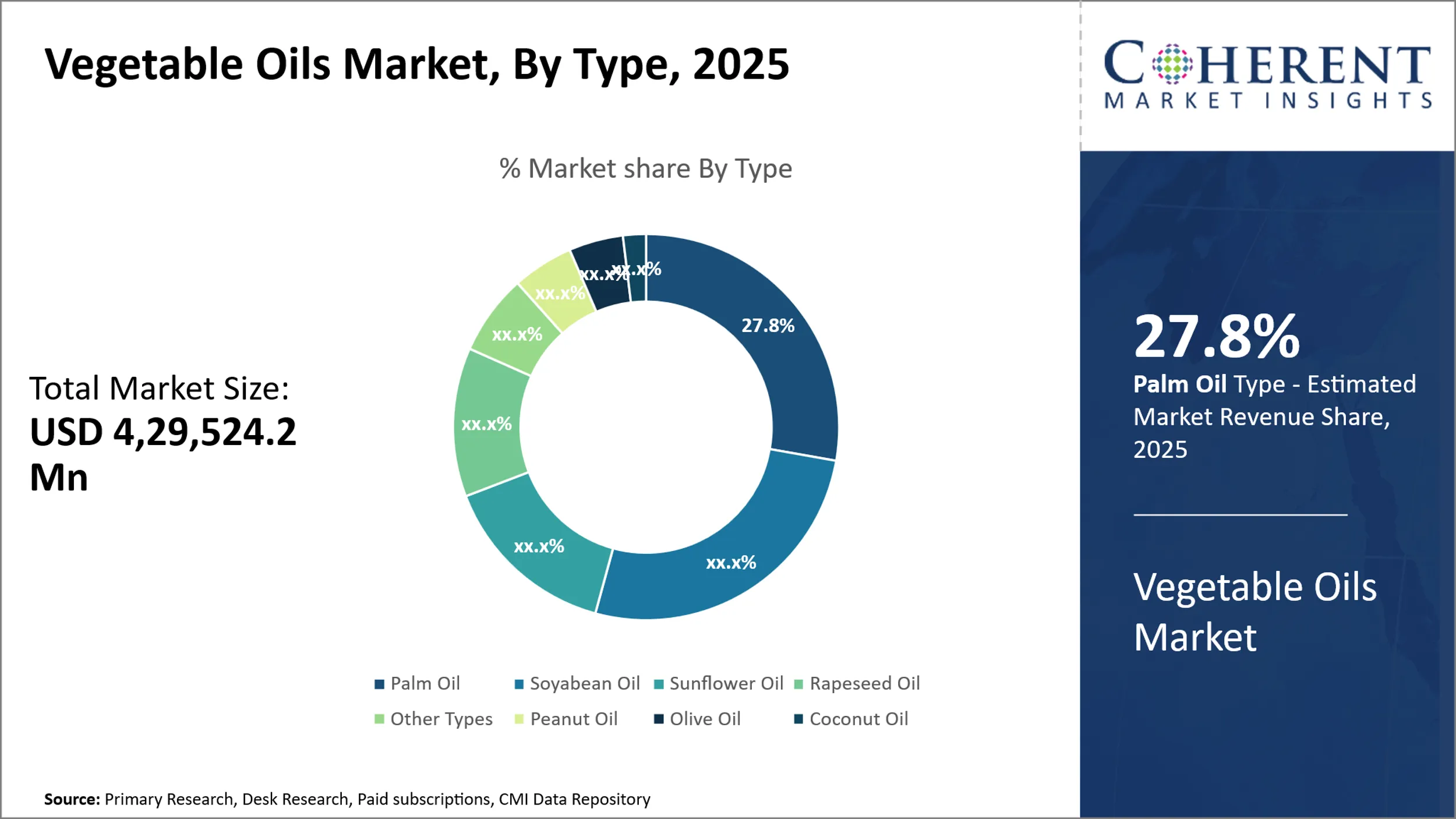
- By Type, Palm Oil is the dominant segment in the global vegetable oils market with 27.6% during the forecast period, owing to its superior yield per hectare and cost‑effectiveness, and is expected to maintain leading market share through 2033.
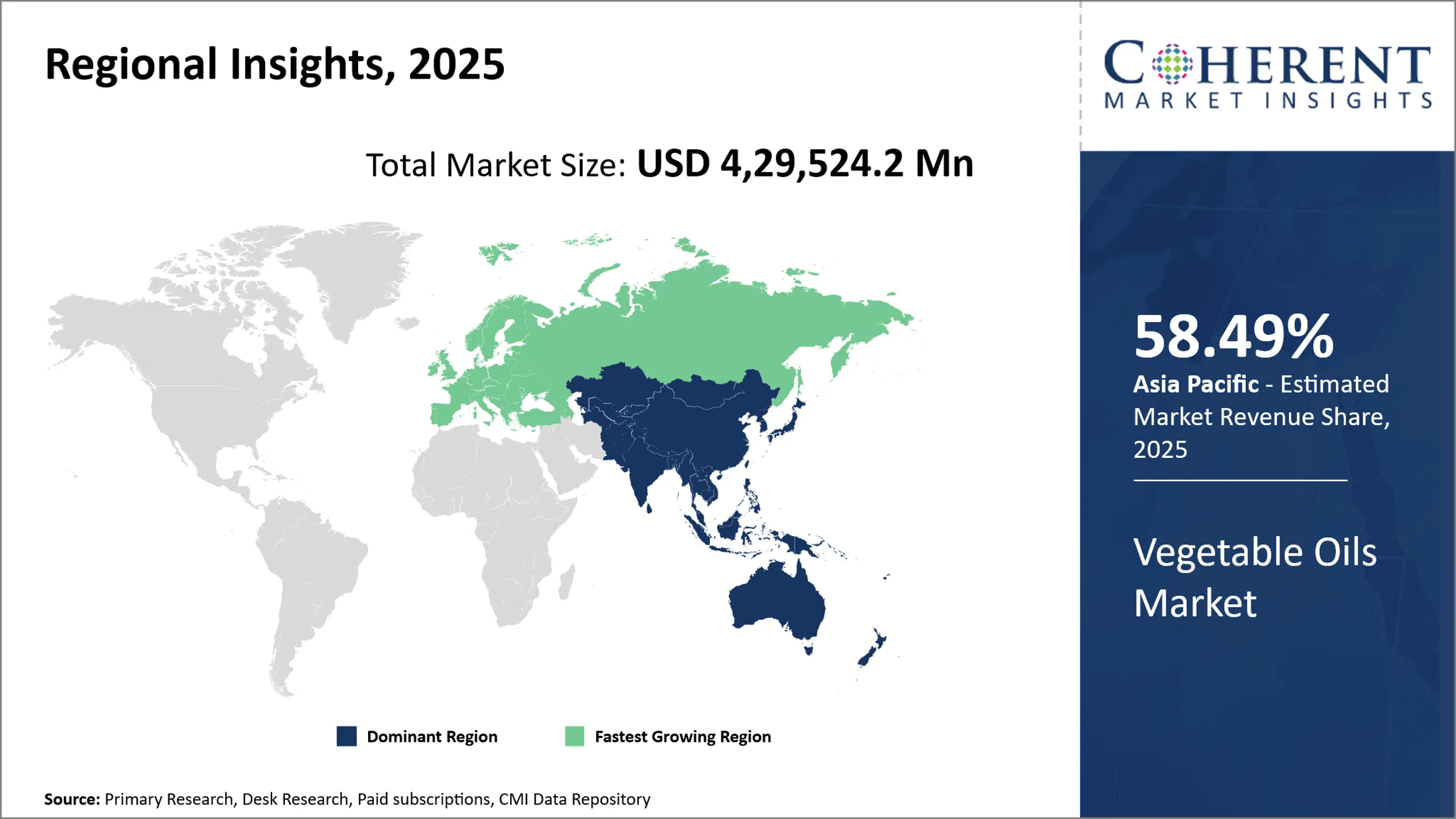
- Asia Pacific is projected to lead the market with 58.49% in 2026, driven by high usage in mayonnaise and fast‑food applications.
- North America is poised to hold the share of 11.84% share during period, owing to high consumption of mayonnaise and rising demand of fast food.
Market Overview
Growing awareness regarding the health benefits of vegetable oil is expected to drive growth of the market. Vegetable oils contain antioxidants that fight against free radicals, which can cause cell damage and cancer. They are also rich in phytosterols, which can reduce the risk of heart disease. Compared with animal fats, vegetable oils are considered healthier because they contain more monounsaturated and polyunsaturated fatty acids than saturated fatty acids, which are harmful to the body. They are also a good source of vitamin E and omega-3 fatty acids, which help the body to function properly.
Current Events and Its Impact on the Vegetable Oils Market
Event | Description and Impact |
Russia-Ukraine Conflict and Black Sea Disruptions |
|
Indonesian Palm Oil Export Policy Changes |
|
Climate Change and Weather Disruptions |
|
Pricing Analysis: Global Vegetable Oils Market
Oil Type | Region | Time Period | Average Price (US$/MT) | Key Influences |
Crude Palm Oil | Malaysia | Q1 2025 | $920 | Export policies, weather impacts |
Crude Palm Oil | Indonesia | Q1 2025 | $940 | Export policies, weather impacts |
Crude Palm Oil | India | Q1 2025 | $1,020 | Import demand, regional supply |
Crude Palm Oil | Indonesia | Q2 2025 | $1,050 | Export restrictions |
Crude Palm Oil | Malaysia | Q2 2025 | $980 | Steady production |
Soybean Oil | USA | Mid-2025 | $1,200 | Drought-induced supply constraints |
Soybean Oil | Brazil | Mid-2025 | $1,180 | Drought-induced supply constraints |
Extra Virgin Olive Oil | Europe/N. America | 2025 | $3,000–$5,500 | Specialty markets, premium quality |
Organic Coconut Oil | Europe/N. America | 2025 | $3,000–$5,500 | Specialty markets, premium quality |
- Current Industry Events of 2026
- Market Size Estimation
- Regional Breakdown
- Competitive Landscape
- Customer Intelligence
- Segmental Analysis
- Pricing Analysis
- Key Market Drivers, Challenges & Future Trends
- Customized Insights Section
Demand for Natural and Organic Oil
Demand for natural and organic vegetable oils is rapidly increasing as consumers prioritize health, sustainability, and clean-label products. Oils like cold-pressed coconut, extra virgin olive, and organic avocado are favored for their perceived nutritional benefits and environmentally friendly production methods. This trend is driving market growth in premium segments, especially in North America and Europe.
Segmental Insights
Global Vegetable Oils Market Insights, By Type
Based on type, the Palm Oil segment is expected to dominate with 27.6% share in the global market in 2026, and this is owing to the fact that they are the most effective crop worldwide in terms of oil production. Nearly one hectare of oil palm crop yields ten times higher oil than any other oilseeds.
Global Vegetable Oils Market Insights, By Application
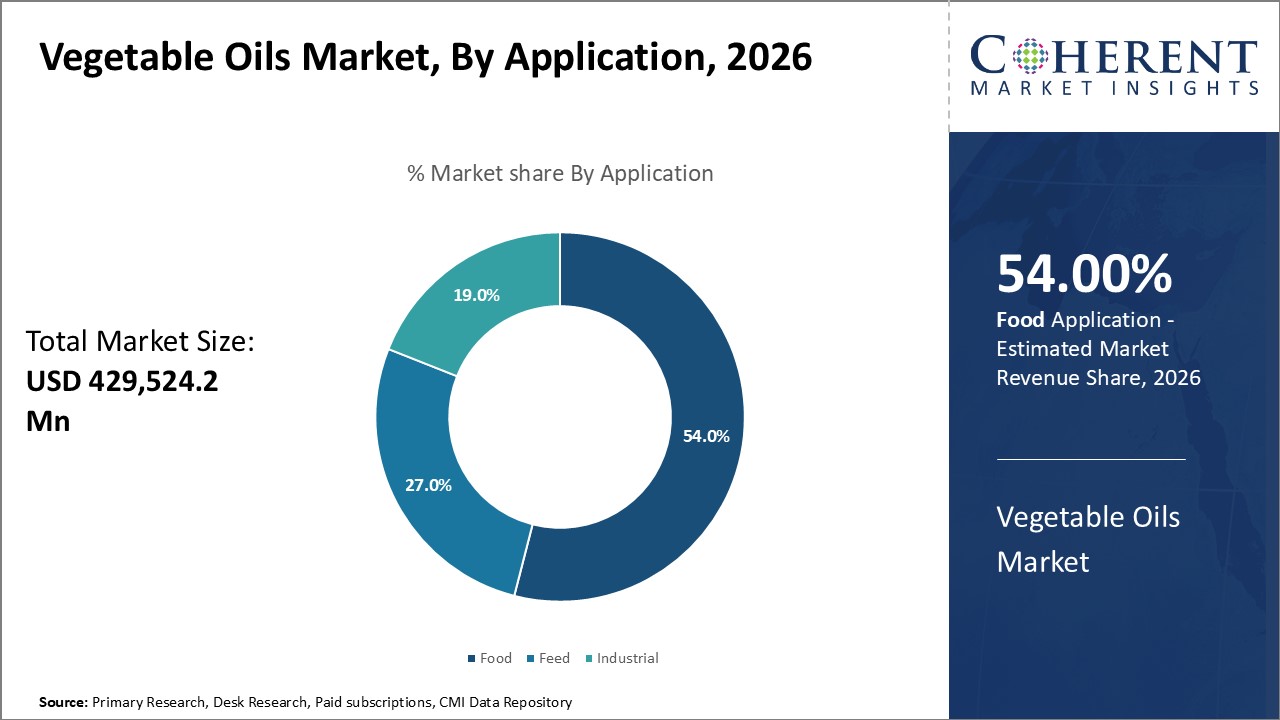
Based on application, the Food segment is expected to dominate the global market over the forecast period. The most commonly used vegetable oils for cooking are canola oil, sunflower oil, and soybean oil. They are good for frying, sautéing and roasting, as well as adding flavor to soups, sauces and salad dressings.
Regional Insights
North America Vegetable Oils Market Analysis and Trends
North America is expected to dominate the global vegetable oil market over the forecast period owing to the high consumption of mayonnaise along with the growing popularity of fast food. Vegetable oil is widely used in the preparation of mayonnaise. The US mayonnaise market was valued at USD 2,165 million in 2026, and it is projected to reach USD 2,546 million by 2032, registering a CAGR of 2.05% during the forecast period.
Europe Vegetable Oils Market Analysis and Trends
Europe is also expected to witness fastest growth in the global market owing to the high production of vegetable oil in the region. According to the Coherent Market Insights analysis, the volume of the Spanish oil market stood at 3,257 thousand metric ton in 2022, and it is projected to reach 3,810 thousand metric ton by 2032, registering a CAGR of 1.98% during the forecast period.
Dominating Countries
- Indonesia and Malaysia are the leading producers of palm oil—together accounting for over 85% of global output. Indonesia alone contributed around 57% of global palm oil production in 2023‑24, making it the undisputed top producer. Malaysia follows closely as the second-largest producer.
- Brazil, Argentina, the United States, and China are dominant in soybean oil production—with Brazil and Argentina being key exporters and the U.S. leading in domestic use and renewable diesel feedstock
Global Vegetable Oils Market Drivers
- Favorable government policies on usage of vegetable oil across various countries to augment market growth
Favorable government policies are playing a critical role in accelerating the vegetable oils market demand across multiple regions. Many countries are promoting the use of vegetable oils through incentives for sustainable agriculture, subsidies for oilseed cultivation, and mandates supporting their use in food processing, biodiesel blending, and industrial applications. Regulatory encouragement for healthier edible oil options and sustainable biofuel production is further boosting consumption. Additionally, trade liberalization measures and reduced import duties in key markets are improving availability and affordability. These supportive policy frameworks collectively enhance production, stimulate investment, and significantly strengthen the growth trajectory of the global vegetable oils market.
- Growing demand from lubricants, paints, and paper application to propel market growth
Vegetable oils are being increasingly used as lubrication in transportation and industrial sector. For example, they are used in chain saws, two-stroke engines, hydraulics, open gears, mining, mold releases, farming, and forestry equipment. Moreover, oleochemicals is a common ingredient used to manufacture industrial, household, and institutional cleaning products, such as fabric cleaners and softeners, automotive cleaners, surface cleaners, dishwashing, and care products, and industrial cleaners.
A major amount of palm oil production goes into production of oleochemical, making it one of the major applications. Hence, growing industrial application of vegetable oil is expected to foster market growth.
Global Vegetable Oils Market Opportunities
- Innovation and Plant-Based Trends
Advent of new sources and production method owing to the ongoing research and development activities is expected to offer significant growth opportunities.
Growing popularity of plant-based oil is expected to serve significant growth opportunities in the near future. Plant based oils are often used in baking, and they can be flavored with dried or fresh herbs to create a variety of dishes. They can also be mixed with other oils to form a blended vegetable oil, like olive oil and avocado oil.
Global Vegetable Oils Market Trends
- Growing trend of cold press oil
Cold press oil, also known as virgin oil, is the most natural and pure form of extracting oil from seeds like groundnut, sesame, and sunflower without using any heat treatments. The process involves crushing the oil seeds and nuts with steady and moderate pressure at room temperature.
The extraction process for cold pressed oil does not involve any high temperature or roasting and thus the oils obtained are rich in valuable unsaturated fatty acids, tocopherols, and phenolic compounds that help stabilize the oil against auto-oxidation and ensure that oil nutrients have not been destroyed during the process.
- Increasing focus on production capacity
The vegetable oils industry is witnessing a strong push toward expanding production capacity as manufacturers strive to meet rising demand from food processing, biodiesel, cosmetics, and nutraceutical sectors. Companies are investing in advanced extraction technologies, high-yield oilseed varieties, and new refining units to enhance output efficiency. This capacity expansion is crucial for strengthening supply security, stabilizing prices, and capturing a larger vegetable oils market share amid intensifying global competition. Additionally, government-backed incentives for oilseed cultivation and sustainable processing are accelerating production upgrades, enabling producers to scale operations and support both domestic consumption and export-oriented growth.
Market Report Scope
Vegetable Oils Market Report Coverage
| Report Coverage | Details | ||
|---|---|---|---|
| Base Year: | 2025 | Market Size in 2026: | USD 4,29,524.2 Mn |
| Historical Data for: | 2020 To 2024 | Forecast Period: | 2026 To 2033 |
| Forecast Period 2026 to 2033 CAGR: | 10.6% | 2033 Value Projection: | USD 8,67,309.0 Mn |
| Geographies covered: |
| ||
| Segments covered: |
| ||
| Companies covered: | Archer Daniels Midland Company, Sime Darby Plantation Berhad, Bunge Limited, Olam International Limited, Cargill Incorporated, Golden Agri-Resources, Kuala Lumpur Kepong Berhad, Fuji Oil Holding Inc., Wilmar International Limited, PT Astra Agro Lestari Tbk, and Avril Group | ||
| Growth Drivers: |
| ||
| Restraints & Challenges: |
| ||
Global Vegetable Oils Market: Key Developments
- In January 2025, Cargill introduced a new cold-pressed organic coconut oil line in North America, catering to rising consumer demand for natural and clean-label oils.
- In November 2024, IOI Corporation partnered with a blockchain firm to implement end-to-end traceability for its palm oil supply chain, enhancing transparency and compliance with sustainability certifications.
- In September 2024, Bunge Limited invested in AI-powered precision agriculture tools in Brazil, improving soybean and sunflower yields while minimizing fertilizer use and environmental footprint.
- In July 2023, Sime Darby Plantation announced completion of a pilot project using drone technology for pest monitoring and crop health assessment across Malaysian plantations, boosting yield forecasts for 2024.
Analyst Viewpoint
- The global vegetable oils market growth is fueled by rising demand for edible oils, biofuels, and industrial applications. Increasing health awareness and preference for unsaturated and specialty oils are driving innovation and diversification in product offerings.
- Technological advancements in sustainable farming, oil extraction, and refining are improving yield and quality, while digital tools enhance supply chain transparency and traceability, key factors for meeting evolving consumer and regulatory demands.
- Challenges include environmental concerns related to palm oil production, price volatility from geopolitical tensions, and climate change impacts affecting crop yields. Addressing these issues requires coordinated efforts across producers, policymakers, and technology providers.
- Regionally, Asia Pacific leads in production and consumption due to large populations and growing economies, while North America and Europe focus on premium and organic segments. Emerging markets in Latin America and Africa present promising growth opportunities fueled by expanding industrial use and biofuel mandates.
Speak to the analyst
Want personalized insights?
Take the findings above to one of our principal consultants, or have the report rebuilt around the segments, geographies and competitors you actually track.
Market Segmentation
- Global Vegetable Oils Market, By Type (Revenue, USD Mn, 2021 - 2033)
- Palm Oil
- Soybean Oil
- Rapeseed Oil
- Sunflower Oil
- Coconut Oil
- Peanut Oil
- Olive Oil
- Other Types
- Global Vegetable Oils Market, By Application (Revenue, USD Mn, 2021 - 2033)
- Food
- Feed
- Industrial
- Global Vegetable Oils Market, By Geography (Revenue, USD Mn, 2021 - 2033)
- North America
- U.S.
- Canada
- Latin America
- Brazil
- Argentina
- Mexico
- Rest of Latin America
- Europe
- Germany
- U.K.
- Spain
- France
- Italy
- Russia
- Rest of Europe
- Asia Pacific
- China
- India
- Japan
- Australia
- South Korea
- ASEAN
- Rest of Asia Pacific
- Middle East
- GCC Countries
- Israel
- Rest of Middle East
- Africa
- South Africa
- North Africa
- Central Africa
- Company Profiles
- Archer Daniels Midland Company
- Sime Darby Plantation Berhad
- Bunge Limited
- Olam International Limited
- Cargill Incorporated
- Golden Agri-Resources
- Kuala Lumpur Kepong Berhad
- Fuji Oil Holding Inc.
- Wilmar International Limited
- PT Astra Agro Lestari Tbk
- Avril Group
Sources
Primary Research Interviews
- Vegetable Oil Manufacturers and Producers
- Food Processing Industry Executives
- Agricultural Commodity Traders
- Retail Chain Procurement Managers
- Others
Databases
- FAOSTAT (Food and Agriculture Organization Statistics)
- USDA Foreign Agricultural Service Database
- Oil World Database
- IndexBox Market Intelligence Platform
- Others
Magazines
- Food Engineering Magazine
- Oil Mill Gazetteer
- Inform Magazine (AOCS)
- Food Processing Magazine
- Others
Journals
- Journal of the American Oil Chemists' Society
- European Journal of Lipid Science and Technology
- Food Chemistry Journal
- Others
Newspapers
- Financial Times
- The Wall Street Journal
- Reuters Agriculture News
- Bloomberg Agriculture
- Others
Associations
- International Association of Seed Crushers (IASC)
- American Soybean Association (ASA)
- European Vegetable Oil and Proteinmeal Industry (FEDIOL)
- National Oilseed Processors Association (NOPA)
- Others
Public Domain Sources
- World Bank Open Data
- UN Comtrade Database
- OECD Agriculture Statistics
- European Commission Agriculture Reports
Proprietary Elements:
- CMI Data Analytics Tool
- Proprietary CMI Existing Repository of information for last 8 years
Definition: Vegetable oils are a group of fats that are extracted from plants, seeds and nuts. They are used to help in texture, carry flavor within a dish and assist in cooking food. Common vegetable oils include Canola, Palm, Corn, Olive, Sunflower, Soybean and Rice Bran oil.
Get access to 250+ pages report
Every segment, forecast, competitor profile and data table behind the analysis above — available for instant download.
- ESOMAR Member
- ISO 9001:2015 Certified
- D-U-N-S Registered
- GDPR & CCPA Compliant
Missing comfort of reading report in your local language? Find your preferred language:
Transform your Strategy with Exclusive Trending Reports
Frequently Asked Questions
The Vegetable Oils Market size is estimated to be valued at USD 4,29,524.2 Mn in 2026, and is expected to reach USD 8,67,309.0 Mn by 2033.
The CAGR of the global Market is projected to be 10.6% from 2026 to 2033.
Vegetable oils are used in diverse applications including cooking and food processing, biofuels, cosmetics, pharmaceuticals, and industrial lubricants.
The Palm oil segment is the leading component segment in the market.
Growing deforestation due to increasing palm oil production is the major factor restraining the market.
Archer Daniels Midland Company, Sime Darby Plantation Berhad, Bunge Limited, Olam International Limited, Cargill Incorporated, Golden Agri-Resources, Kuala Lumpur Kepong Berhad, Fuji Oil Holding Inc., Wilmar International Limited, PT Astra Agro Lestari Tbk, and Avril Group.