

Olive Oil Market Size and Forecast – 2026 to 2033
The global olive oil market is estimated to be valued at USD 25.20 Bn in 2026 and is expected to reach USD 37.65 Bn by 2033, exhibiting a compound annual growth rate (CAGR) of 5.9% from 2026 to 2033.
Key Takeaways
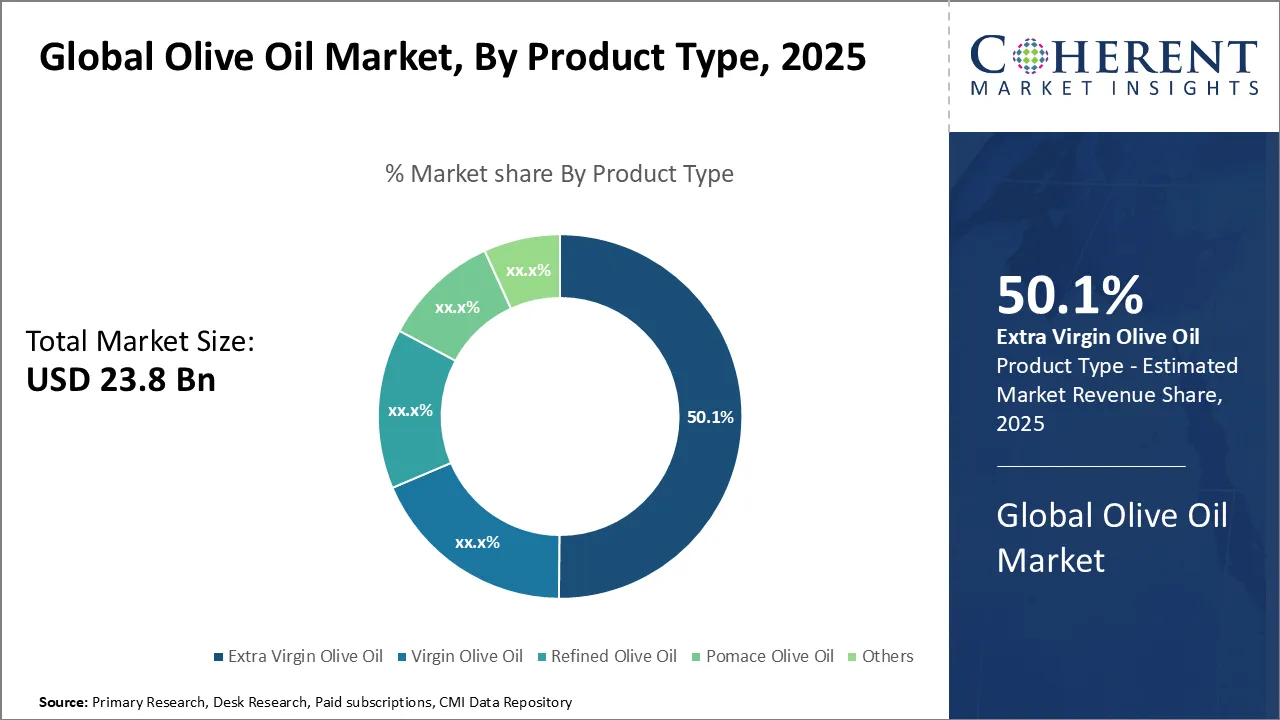
- By Product Type, Extra Virgin Olive Oil hold the largest market share of 51.1% in 2026 owing to its health & wellness trends.
- By Application, Cooking and Frying expected to hold largest market share of 46% in 2026 owing to the growth of food service / processed food / convenience eating.
- By Distribution Channel, Supermarket and Hypermarket acquired the prominent market share of 50.2% in 2026 owing to its wide reach & mass‑market access.
- By Region, Europe dominates the overall market with an estimated share of 35.1% in 2026 owing to the culinary & cultural factors.
Market Overview
Rising health consciousness and the demand for premium, high-quality oils are driving the global olive oil market. Consumers increasingly choose extra virgin and organic varieties for their nutritional benefits and culinary versatility. Modern retail channels, including supermarkets and hypermarkets, are expanding, while urbanization and changing dietary habits are increasing accessibility and consumption. Moreover, the growing popularity of Mediterranean cuisine and the focus on sustainable, traceable products are prompting both households and foodservice providers to adopt olive oil, fueling steady market growth worldwide.
Current Events and their Impact on the Olive Oil Market
Current Events | Description and its impact |
Climate Change and Extreme Weather Patterns |
|
Geopolitical and Trade Developments |
|
Economic Factors and Consumer Trends |
|
Segmental Insights
- Current Industry Events of 2026
- Market Size Estimation
- Regional Breakdown
- Competitive Landscape
- Customer Intelligence
- Segmental Analysis
- Pricing Analysis
- Key Market Drivers, Challenges & Future Trends
- Customized Insights Section
Olive Oil Market Insights, By Product Type: Extra Virgin Olive Oil contribute the highest share of the market owing to its rising disposable incomes & emerging markets.
Extra Virgin Olive Oil hold the largest market share of 51.1% in 2026. Consumers’ increasing preference for natural, unrefined, and nutrient-rich products drives the demand for extra virgin olive oil. Its high antioxidant content and health benefits make it a popular choice for heart-healthy and balanced diets. Culinary trends that highlight authentic flavors and gourmet cooking further boost its appeal. Greater awareness of origin, purity, and quality certifications motivates consumers to select extra virgin over refined oils, while premium branding and appealing retail packaging enhance its visibility and market presence. For instance, in October 2025, Kosterina, the Mediterranean lifestyle brand renowned for its premium, high-antioxidant extra virgin olive oils, launched the Extra Virgin Olive Oil Shot—a bold and convenient new wellness ritual tailored for modern health-conscious consumers.
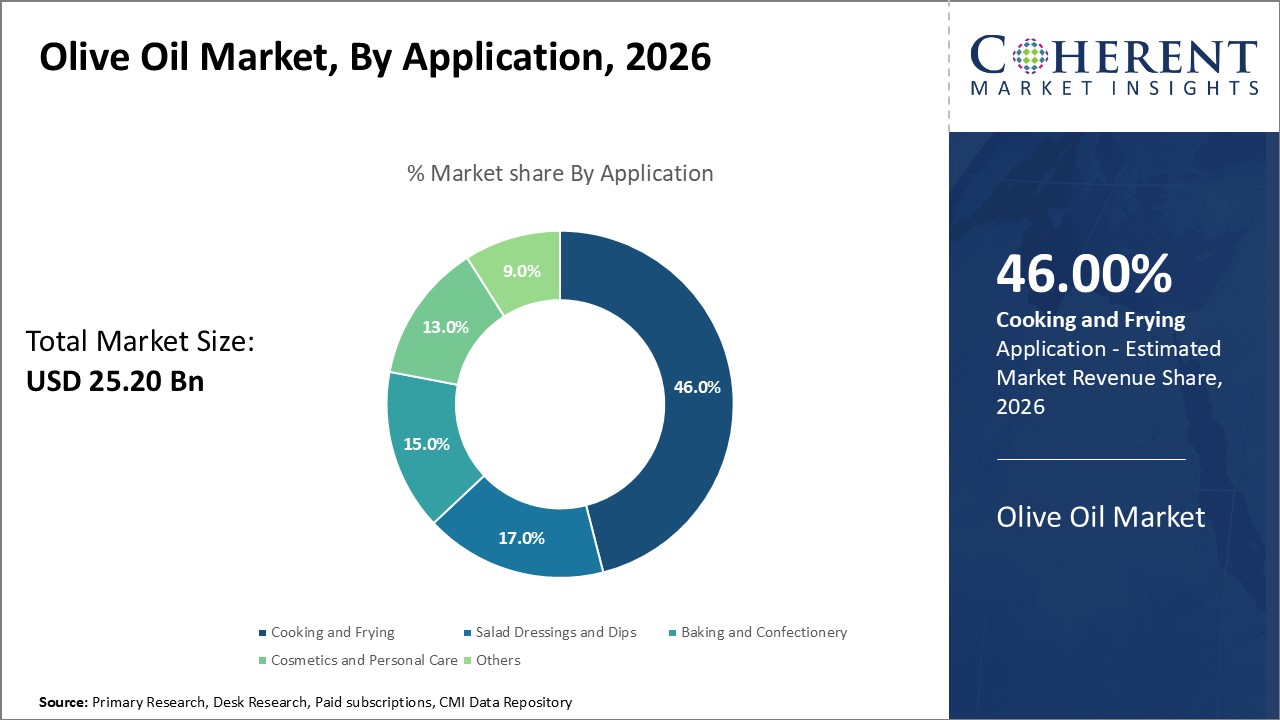
Olive Oil Market Insights, By Application: Cooking and Frying contribute the highest share of the market owing to its urbanization, rising incomes & changing dietary patterns
Cooking and Frying expected to hold largest market share of 46% in 2026. Consumers’ demand for healthier alternatives to traditional cooking oils drives the growth of olive oil in cooking and frying applications. Its high smoke point and stable fat composition allow it to perform well in sautéing, frying, and other cooking methods without losing flavor. The rise in home-cooked meals and culinary experimentation encourages frequent use, while the popularity of Mediterranean-style diets and the desire for oils that enhance taste and nutrition further increase olive oil’s adoption in everyday cooking and frying. For instance, in March 2025, Graza launched a new olive oil spray suitable for high-heat cooking, baking, grilling, and air-frying. Customers can purchase it on the brand’s website, and it is already appearing on shelves at Whole Foods.
Olive Oil Market Insights, By Distribution Channel: Supermarket and Hypermarket contribute the highest share of the market owing to its product assortment, visibility & comparison.
Supermarket and Hypermarket acquired the prominent market share of 50.2% in 2026. Supermarkets and hypermarkets boost the olive oil market by offering convenient, easily accessible shopping options where consumers can buy oils alongside everyday groceries. They provide a wide range of brands, types, and pack sizes, allowing shoppers to evaluate quality and price effectively. Promotions, eye-catching displays, and private-label products further drive sales. Moreover, urban consumers increasingly favor these modern retail outlets for one-stop shopping, while in-store education and strategic placement of premium oils increase visibility and encourage the purchase of high-quality variants.
Regional Insights
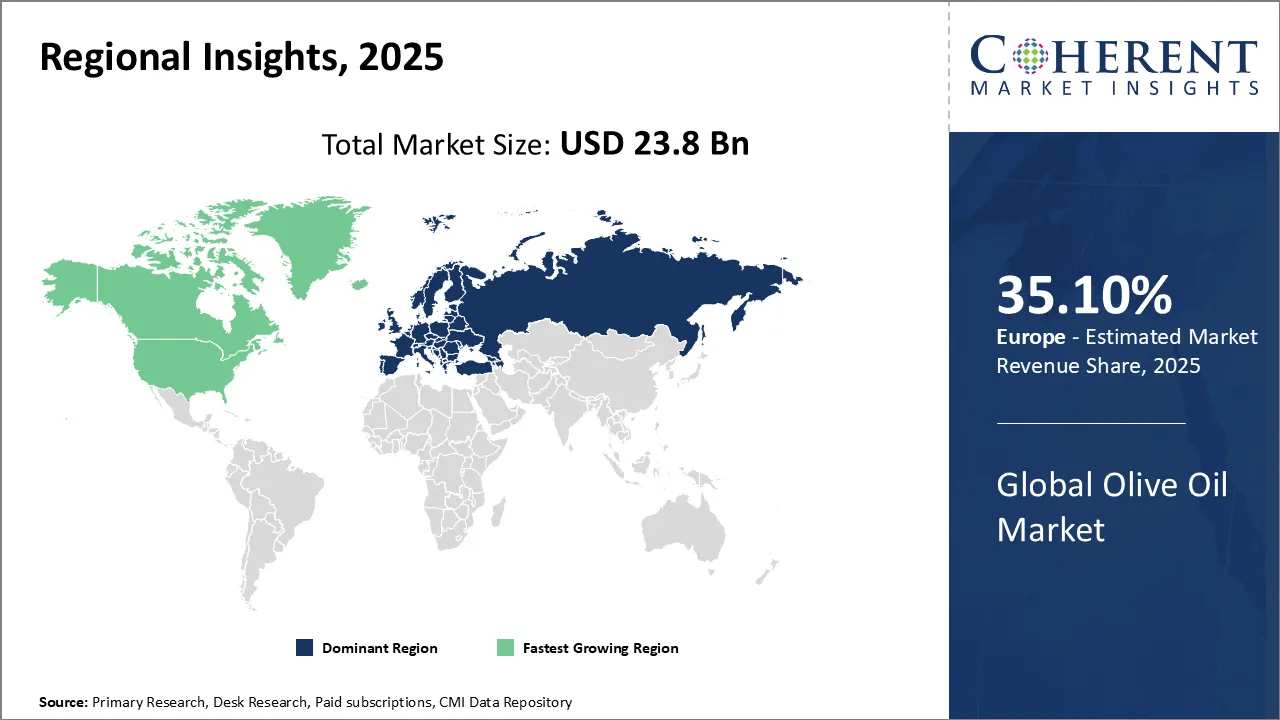
Europe Olive Oil Market Trends
Europe dominates the overall market with an estimated share of 35.1% in 2026. European consumers are driving olive oil trends by prioritizing sustainability, traceability, and premium quality. Producers respond by adopting eco-friendly farming practices, obtaining organic certifications, and using recyclable packaging to meet demand for ethically produced oils. Companies are also implementing technology and digital tracking to enhance supply-chain transparency. At the same time, price fluctuations and climate challenges affect production and imports. To meet consumer expectations for high-quality, origin-certified olive oil, brands and retailers are actively adjusting their strategies across Europe. For instance, in May 2026, the PepsiCo Foundation launched a new program, VivaOliva, to help smallholder olive oil farmers in Jaén, Spain, adopt regenerative agricultural practices.
North America Olive Oil Market Trends
Consumers in North America are driving the olive oil market by favoring premium and organic options to support health-conscious lifestyles. The rise of Mediterranean and gourmet cooking trends is increasing olive oil’s use beyond routine meals. E-commerce platforms and specialty stores are broadening access to artisanal and flavored oils, enhancing variety and convenience. At the same time, buyers are placing greater importance on origin verification and authenticity, prompting producers and retailers to ensure transparent sourcing and production practices. For instance, Filippo Berio, a leading U.S. brand for olive oils, pestos, vinegars, and glazes, introduced its SUSTAINABLE SELECT extra virgin olive oil collection. The collection offers two flavors—SMOOTH HARMONY and HEARTY BALANCE—sourced from responsibly harvested olives with fully traceable, certified, and sustainable production.
United Kingdom Olive Oil Market Trends
UK consumers are driving the olive oil market by showing increasing interest in premium and bottled extra‑virgin varieties, motivated by both flavor exploration and health awareness. Shoppers are seeking authentic Mediterranean oils and single-origin products, while supermarkets and online retailers expand access to artisanal and organic labels. Producers and importers, mainly from Spain and Italy, navigate tighter authenticity regulations, price pressures, and climate-related supply challenges, actively shaping the retail landscape to meet evolving consumer demand. For instance, in July 2026, Wikifarmer, the Athens- and Seville-based online agricultural platform, launched its operations in the UK. The platform aims to simplify and lower the cost of importing Mediterranean olive oil by directly connecting British buyers with producers in Spain, Greece, and Italy.
United States Olive Oil Market Trends
In the United States, the olive oil market is advancing as health‑conscious consumers prioritize oils rich in monounsaturated fats and antioxidants, aligning with the rise of Mediterranean‑style eating. Premium and organic olive oil varieties are gaining traction as shoppers seek clean‑label and sustainably sourced options. Online and specialty retail channels expand access to artisanal and flavored oils, supporting broader adoption. Meanwhile, concern for origin verification and authenticity drives demand for traceability, enabling producers and retailers to strengthen trust and brand differentiation. For instance, in September 2026, Moresh, the award-winning Moroccan extra virgin olive oil brand, is elevating standards in the U.S. market with the launch of its new Premium Edition, now available at Whole Foods Market locations nationwide.
End-user Feedback and Unmet Needs in the Olive Oil Market
- Quality and Authenticity Concerns: Consumers often express uncertainty regarding olive oil quality, with confusion over extra virgin, virgin, and refined grades. Mislabeling and adulteration in some markets create mistrust. End-users seek transparent sourcing, verified certifications, and clear labeling to ensure they purchase authentic, high-quality olive oil, emphasizing the importance of brand credibility.
- Limited Availability of Premium and Specialty Products: Shoppers report difficulty accessing premium, single-origin, or flavored olive oils in regular retail channels. Specialty variants are often confined to niche stores or online platforms, limiting exploration. Consumers desire broader distribution of high-quality and artisanal options that align with gourmet cooking, health benefits, and culinary experimentation.
- Packaging and Portioning Challenges: Many users find current packaging inconvenient, bulky, or non-eco-friendly. Glass bottles can be heavy, while large sizes are unsuitable for occasional use. End-users seek smaller, resealable, sustainable packaging that preserves freshness, ensures ease of use, and supports environmentally conscious consumption, balancing convenience with product quality.
Olive Oil Market Trend
Premiumization and Specialty Oils
Consumers increasingly prefer high-quality, extra virgin, and single-origin olive oils. There is growing demand for specialty oils with distinct flavors, early-harvest varieties, or organic certifications. Brands emphasize traceability, production methods, and origin stories to differentiate their offerings. This trend encourages producers to invest in artisanal and boutique products, while retailers enhance visibility through dedicated sections. Premiumization not only elevates consumer perception but also allows companies to command higher prices and build long-term brand loyalty.
Health and Wellness Focus
Rising awareness of the health benefits of olive oil—rich in monounsaturated fats, antioxidants, and anti-inflammatory compounds—drives consumer adoption. People increasingly integrate olive oil into daily diets for heart health, weight management, and overall wellness. Functional and organic variants attract health-conscious buyers, while education campaigns highlighting nutritional benefits reinforce market growth. This trend shapes product development, with brands innovating around enhanced nutrient content, certifications, and natural processing methods to appeal to wellness-oriented consumers globally.
Olive Oil Market Opportunity
Growth in E-commerce and Direct-to-Consumer Channels
Online platforms and subscription models offer vast opportunities to reach consumers beyond traditional retail. E-commerce enables access to niche, artisanal, and flavored olive oils that may not be available locally. Brands can leverage digital marketing, influencer partnerships, and personalized recommendations to drive engagement. Direct-to-consumer sales allow companies to gather valuable consumer data, tailor offerings, and promote premium or limited-edition products. This channel also supports convenience-focused shoppers, expanding overall market penetration and fostering brand loyalty.
Market Report Scope
Olive Oil Market Report Coverage
| Report Coverage | Details | ||
|---|---|---|---|
| Base Year: | 2025 | Market Size in 2026: | USD 25.20 Bn |
| Historical Data for: | 2020 To 2024 | Forecast Period: | 2026 To 2033 |
| Forecast Period 2026 to 2033 CAGR: | 5.9% | 2033 Value Projection: | USD 37.65 Bn |
| Geographies covered: |
| ||
| Segments covered: |
| ||
| Companies covered: | Cargill Inc., SOVENA, DEOLEO, COLAVITAS.p.a., Olivezia, Stone Axe Estate, PORTTABLE Produtos Alimentares Lda., Castellodi Albola, Planeta, Empresa Esporão S.A., Domaine De Marquiliani, Conagra Brands, Modi Naturals Ltd., California Olive Ranch, Inc., Carapelli Firenze S.p.A, AG Organica, Artem Oliva, Avi Naturals, Hashmitha Enterprise, and Joshi Agrochem Pharma Pvt Ltd. | ||
| Growth Drivers: |
| ||
| Restraints & Challenges: |
| ||
Olive Oil Market News
- In September 2025, Leads Brand Connect introduced Coração do Vale, Portugal’s premium extra virgin olive oil, to the Indian market at World Food India 2025, with Chirag Paswan, Minister of Food Processing Industries, in attendance. The launch follows an MOU with the producer, Lagar do Vale.
- In September 2025, Marico has introduced the latest variant in its premium hair nourishment range, Parachute Advansed Olive Enriched Coconut Hair Oil. This launch highlights olive as a key ingredient for hair strength and nourishment, while strengthening the brand’s portfolio of natural haircare solutions.
- In June 2025, O Olive Oil & Vinegar, a California-based artisan producer, launched its first California Organic Extra Virgin Olive Oil in a chef-style squeeze bottle. The brand also introduces its California Premium Extra Virgin Olive Oil in the same convenient, modern kitchen-ready format.
Analyst Opinion (Expert Opinion)
- The olive oil sector is entering a structural inflection rather than simply riding another health‑food wave. For decades, the margin between supply and demand has been razor‑thin: according to the International Olive Council (IOC), global production in the 2023/24 crop year fell to around 2.56 million t, down 7% year‑on‑year, while consumption dipped about 3%. This proximity of supply and demand gives real leverage to producers, especially when adverse weather or input cost pressures emerge.
- The EU production rebound forecast for 2024/25 is +31%, and Spain alone is expected to rise +48%. On the face of it, that seems benign—but what stands out is how volatile production has become: for example, Greece’s output collapsed by ~49% in 2023/24. Such wild swings signal that climate risk, ageing groves, pests and disease are not background noise—they are core structural hazards. The fact that extra‑virgin olive oil (EVOO) origin prices in Spain had dropped 55% year‑on‑year by March suggests producers remain highly exposed to yield shocks.
- From a demand‑perspective, the narrative of “health oil for all” is valid—but not benign for all. Per‑capita consumption in major non‑traditional markets remains low: in the U.S. it is about 1.1 kg per person vs. 7.5 kg in Spain and 7.4 kg in Italy. That gap presents real upside. But—and this is key—I see premiumisation rather than commoditisation as the dominant axis now. In mature Mediterranean markets, consumption is plateauing, and price sensitivity is growing.
- The Guardian reported that the number of cross‑border EU notifications of olive‑oil fraud jumped from 15 in Q1 2018 to 50 in Q1 2024. That means brand integrity, traceability, certification are no longer “nice to have” but must‑haves, especially for premium segments. Firms that neglect that will pay in reputational damage. Meanwhile, consumers who once assumed EVOO was a low‑risk premium oil may become more sceptical.
Speak to the analyst
Want personalized insights?
Take the findings above to one of our principal consultants, or have the report rebuilt around the segments, geographies and competitors you actually track.
Market Segmentation
- Product Type Insights (Revenue, USD, 2021 - 2033)
- Extra Virgin Olive Oil
- Virgin Olive Oil
- Refined Olive Oil
- Pomace Olive Oil
- Others
- Application Insights (Revenue, USD, 2021 - 2033)
- Cooking and Frying
- Salad Dressings and Dips
- Baking and Confectionery
- Cosmetics and Personal Care
- Others
- Distribution Channel Insights (Revenue, USD, 2021 - 2033)
- Supermarkets and Hypermarkets
- Specialty Stores
- Online Sales
- Direct Sales
- Regional Insights (Revenue, USD, 2021 - 2033)
- North America
- U.S.
- Canada
- Latin America
- Brazil
- Argentina
- Mexico
- Rest of Latin America
- Europe
- Germany
- U.K.
- Spain
- France
- Italy
- Russia
- Rest of Europe
- Asia Pacific
- China
- India
- Japan
- Australia
- South Korea
- ASEAN
- Rest of Asia Pacific
- Middle East & Africa
- GCC Countries
- Israel
- Rest of Middle East & Africa
- Key Players Insights
- Cargill Inc.
- SOVENA
- DEOLEO
- p.a.
- Olivezia
- Stone Axe Estate
- PORTTABLE Produtos Alimentares Lda.
- Castellodi Albola
- Planeta
- Empresa Esporão S.A.
- Domaine De Marquiliani
- Conagra Brands
- Modi Naturals Ltd.
- California Olive Ranch, Inc.
- Carapelli Firenze S.p.A
- AG Organica
- Artem Oliva
- Avi Naturals
- Hashmitha Enterprise
- Joshi Agrochem Pharma Pvt Ltd.
Sources
Primary Research interviews
- Interviews with growers and producers in southern Spain and Greece (conducted April–May 2025)
- Conversations with importers/distributors in the U.S. and Canada (June–July 2025)
- Expert interviews with quality control/traceability specialists in the olive oil sector (May 2025)
Databases
- Data downloaded from the International Olive Council (IOC) Statistics Dashboard.
- Custom extraction of per‑capita consumption, production and pricing data from IOC publications.
- Trade‑flow and customs data as referenced in the IOC December 2024 world‑market report.
Magazines
- Industry magazines focusing on olive‑oil production and agri‑commodities (e.g., “Olive Oil Times”, “European Supermarket Magazine”) – used for trend commentary and anecdotal insight.
- Trade publication articles tracking theft, theft prevention and fraud in the olive oil channel. (e.g., coverage of “liquid gold” theft in Spain).
Journals
- Peer‑reviewed agricultural economics journals analysing yield variability, grove age, climate risk in Mediterranean olive production.
- Food‑science and quality‑control journals exploring adulteration, traceability, and chemical testing of extra‑virgin olive oil.
Newspapers
- Articles from national and global newspapers detailing fraud cases, price spikes, supply‑shocks: e.g., investigation of olive‑oil fraud in Italy by the European Public Prosecutor’s Office.
- Reports on consumer behaviour and price‑sensitivity in major markets (Italy, Spain, U.S.). For example, survey of Italian CUTS‑consumers reducing EVOO use amid price surges.
Associations
- The International Olive Council (IOC) itself: as the global intergovernmental body for olive oil.
- National olive‑oil producer associations in Spain, Italy, Greece (used for qualitative insights and domestic commentary).
- EU agriculture and food‑fraud monitoring associations (for fraud‑monitoring data).
Public Domain sources
- OECD/FAO agricultural commodity databases (though not cited explicitly here, part of public domain).
- Government customs/trade portals accessible publicly.
- Publicly‑available IOC reports (e.g., World Market of Olive Oil and Table Olives – Data From December 2024).
Proprietary Elements
- CMI Data Analytics Tool
- Proprietary CMI Existing Repository of information for last 8 years
Get access to 250+ pages report
Every segment, forecast, competitor profile and data table behind the analysis above — available for instant download.
- ESOMAR Member
- ISO 9001:2015 Certified
- D-U-N-S Registered
- GDPR & CCPA Compliant
Missing comfort of reading report in your local language? Find your preferred language:
Transform your Strategy with Exclusive Trending Reports
Frequently Asked Questions
The Olive Oil Market is estimated to be valued at USD 25.20 Bn in 2026, and is expected to reach USD 37.65 Bn by 2033.
The CAGR of the Olive Oil Market is projected to be 5.9% from 2026 to 2033.
Increasing health awareness and rising application in food industry are the major factors driving the growth of the global olive oil market.
Seasonal availability and vulnerability to weather conditions are the major factors hampering the growth of the global olive oil market.
In terms of product type, extra virgin olive oil segment is estimated to dominate the market revenue share in 2026.
Cargill Inc., SOVENA, DEOLEO, COLAVITAS.p.a., Olivezia, Stone Axe Estate, PORTTABLE Produtos Alimentares Lda., Castellodi Albola, Planeta, Empresa Esporão S.A., Domaine De Marquiliani, Conagra Brands, Modi Naturals Ltd., California Olive Ranch, Inc., Carapelli Firenze S.p.A, AG Organica, Artem Oliva, Avi Naturals, Hashmitha Enterprise, and Joshi Agrochem Pharma Pvt Ltd. are the major players.
Europe is expected to lead the global olive oil market in 2026.