

Confectionery Market Size and Share Analysis - Growth Trends and Forecasts (2026–2033)
The global confectionery market size is estimated to experience a CAGR of around 5.6%, from USD 300.34 Bn in 2026 to around USD 440.21 Bn by 2033. The main factors driving market growth include increasing consumer preference for premium chocolates, sugar-free and low-sugar confectionery, functional confectionery, novel flavors, convenience snacking options, and personalized confections. Companies are developing healthy formulations, using more natural ingredients and packaging, and creating premium versions of their products to cater to changing consumer trends and build their foothold in the developed and emerging economies. In the U.S., the confectionery category produced around USD 55 Bn in retail sales in 2025, whereas 99.8% of U.S. households purchased confectionery at least once during the year.
Key Takeaways
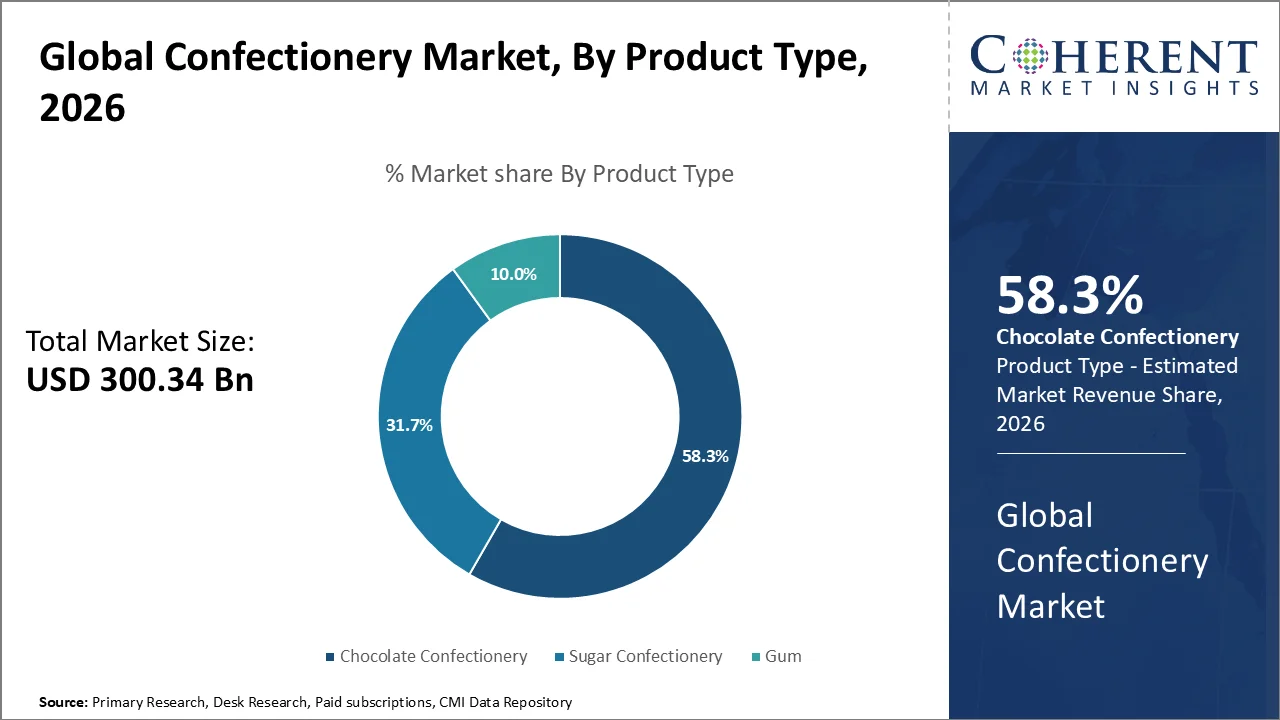
- The chocolate confectionery segment is likely to dominate the market with approximately 58.3% share in 2026. The segment’s growth is owing to the strong demand for premium chocolates, count lines, seasonal gifting products, innovative flavors, and convenient single-serve formats. The National Confectioners Association reported that chocolate represented 51.7% of total U.S. confectionery sales in 2025, while the four major confectionery seasons accounted for 63% of category sales, highlighting the importance of chocolate in everyday consumption and seasonal purchasing.
- The supermarkets and hypermarkets segment is expected to dominate the market with around 56.2% market share in 2026. The expansion in the segment can be attributed to broad range of products, heavy consumer traffic, shelf placements, competitive prices, offer bundling, and availability of domestic and international confectionery products. As per National Confectioners Association, around 71% of consumers considered price as one of their top three considerations while purchasing confectionery products, while 59% favored offer bundles like buy-one-get-one free for purchasing the products.
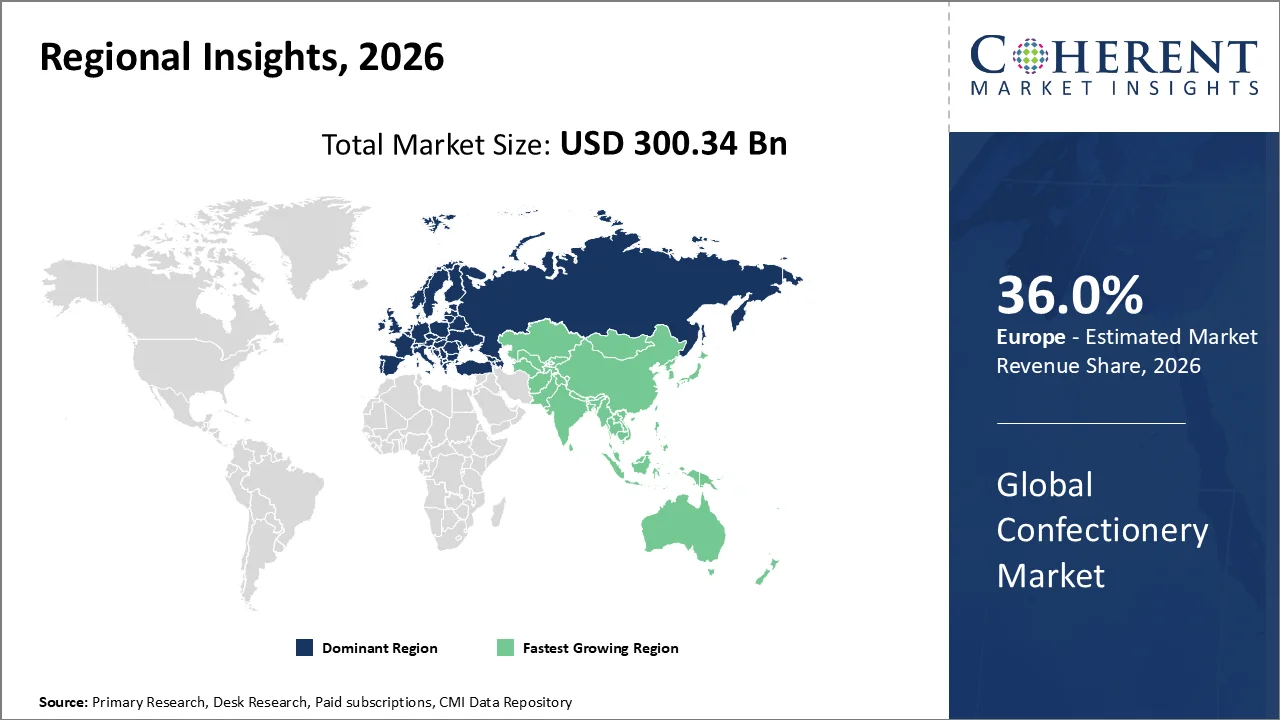
- Europe is expected to dominate the global confectionery market with approximately 36.0% share in 2026. The region’s leadership is supported by high per-capita chocolate consumption, established confectionery manufacturing capacity, strong seasonal and gifting demand, premium chocolate preferences, and extensive cross-border trade. CAOBISCO reported that the European chocolate, biscuit, and confectionery industry comprises more than 15,000 manufacturers, directly employs over 310,457 people, and generates annual turnover exceeding EUR 59.5 Bn.
Market Drivers
Premium and Multisensory Innovations Are Expanding the Confectionery Market
The confectionery market is being driven by consumers seeking distinctive flavors, textures, formats, and culturally inspired products rather than conventional chocolate and candy varieties. Manufacturers are increasingly introducing layered textures, sweet-and-savory combinations, freeze-dried candy, filled chocolates, hybrid chocolate-biscuit products, and products inspired by international flavors.
Barry Callebaut’s 2026 global study found that 57% of consumers changed their food and beverage preferences during the preceding year. The proportion increased to 71% among Gen Z and 65% among millennials, indicating that younger consumers are particularly receptive to new confectionery concepts, ingredients, and sensory experiences. The research covered 24,000 chocolate confectionery consumers across 24 markets.
In July 2026, the Hershey Company launched REESE’S PIECES with Chocolate Cookie across the U.S. The product combines a crispy chocolate-cookie center, peanut-butter flavor, and a crunchy candy shell, creating a layered and highly textured eating experience.
Mindful Indulgence and Portion Innovation are Reshaping Demand
Consumers are becoming more interested in indulging in confectionery without compromising their well-being. This is prompting manufacturers to come up with mini confections, bite-size confections, individually packed confections, confections with lower sugar content, fortified confections, and confections that use more natural ingredients.
According to Barry Callebaut, 38% of global consumers have found portion size as extremely important while buying chocolates and confectionery, while 44% consumers found it moderately important. Together, both these figures reveal that portion size is an important aspect in the purchase decision of around 82% of surveyed consumers.
In June 2026, Planet A Foods launched ChoViva No Added Sugar for confectionery manufacturers. The cocoa-free formulation contains no added sugar and uses maltitol to maintain the sweetness, texture, and melting characteristics expected from conventional chocolate.
Current Events and Their Impact on the Confectionery Market
Current Event | Description and its Impact |
U.S. FDA Advances Phase-Out of Petroleum-Based Food Colors—July 2026 |
|
EU Postpones and Simplifies Deforestation Regulation for Cocoa—December 2025 |
|
- Current Industry Events of 2026
- Market Size Estimation
- Regional Breakdown
- Competitive Landscape
- Customer Intelligence
- Segmental Analysis
- Pricing Analysis
- Key Market Drivers, Challenges & Future Trends
- Customized Insights Section
Segmental Insights
Why is Chocolate Confectionery Acquiring the Largest Share?
On the basis of product type, the chocolate confectionery segment is projected to account for the largest confectionery market share of approximately 58.3% in 2026. The segment’s growth is owing to the widespread consumption of chocolate tablets, count lines, boxed assortments, filled chocolates, seasonal products, and premium gifting formats. Strong brand recognition, frequent product innovation, broad price-point availability, and the association of chocolate with indulgence, celebrations, and gifting further support segment leadership.
Ferrero’s turnover increased by 4.6%, reaching EUR 19.3 billion in FY 2024/25, owing to innovations in its product portfolio, expansion into new markets, and investments in manufacturing facilities. Ferrero invested EUR 1.1 billion during the year, and the company has 36 manufacturing facilities across the world.
In June 2026, Mondelēz India launched the limited-edition Cadbury Dairy Milk Silk Dubai Chocolate. The product combines a Cadbury Silk chocolate shell with pistachio crème and crispy kadayfi pastry, creating a layered, multisensory format inspired by Middle Eastern kunafa chocolate.
Supermarkets and Hypermarkets Hold the Largest Market Share
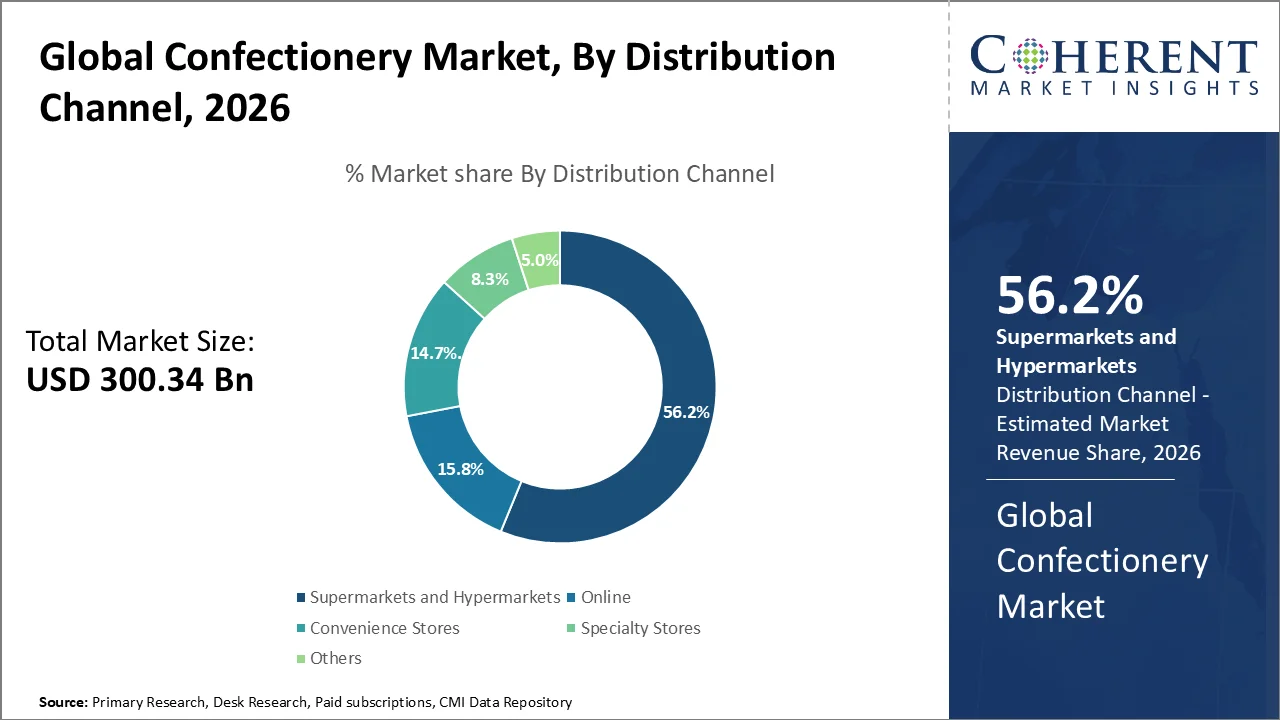
On the basis of distribution channel, the supermarkets and hypermarkets segment is projected to lead the confectionery market with approximately 56.2% share in 2026. The segment’s growth is owing to high consumer footfall, extensive brand and product assortments, dedicated seasonal displays, prominent checkout placement, competitive pricing, multipack availability, and the convenience of purchasing confectionery during routine grocery shopping.
Walmart reported approximately 280 million customer and member visits every week across more than 10,900 stores in 19 countries during FY 2026. The retailer generated USD 713 billion in annual revenue, while global e-commerce sales increased by 24%, showing how large retailers are combining extensive store networks with online ordering, pickup, and delivery services.
In April 2026, Marks & Spencer launched its Easter 2026 chocolate collection across M&S stores in the U.K. and Ireland. Developed with Lir Chocolates, the range included filled-shell eggs, pistachio products, salted-caramel variants, gooey chocolate centers, and hand-finished premium products.
Confectionery Market Trends
- The growing trend of taste for strong flavors and unique textures has led to an increase in the manufacturing of freeze-dried sweets, layering of filling and coating, sour and spicy blends, and fusion of candy types. According to the consumer research done by Mars in July 2026, about 71 percent of U.S. consumers favored taste textures, and about 60 percent preferred strong tastes.
- The move towards converting seasonal candies into more prolonged retail events is changing limited festivals into multiple month-long sales periods. According to the report by Mars in July 2026, about 57 percent of adults in America felt that Halloween was a season, not just a day, whereas about two-thirds of Americans wanted their favorite Halloween candy available throughout the year.
- The increasing adoption of price pack architecture is impacting the sizes and formulas of confectionery products due to the rise in cocoa prices and affordability issues of consumers. According to Mondelēz International, changes in price pack architecture accounted for 1.3 percentage points of volume/mix decline in the fourth quarter of 2025. The company is expanding pack sizes across critical price points and developing pralines, filled chocolates, and chocolate-bakery products that require comparatively lower cocoa volumes.
Regional Insights
Europe Dominates Owing to Established Chocolate Culture and Premium Manufacturing Base
Europe accounts for approximately 36.05% of the global confectionery market in 2026. The region’s dominance is owing to high confectionery consumption, strong seasonal and gifting traditions, mature supermarket networks, established premium chocolate brands, and extensive manufacturing capabilities across Germany, Switzerland, Belgium, France, Italy, and the U.K. The share is calculated from Europe’s 2026 value of USD 108.26 billion against the global market value of USD 300.34 billion.
Lindt & Sprüngli reported that all its European subsidiaries achieved double-digit organic growth in 2025. Growth exceeded 20% in Benelux, Central and Eastern Europe, the Nordic countries, Spain, and Portugal, demonstrating strong demand for premium chocolate across multiple European markets.
In June 2026, Ferrero announced an investment of EUR 60 million to expand its industrial and logistics capabilities in France. The investment includes EUR 30 million to support Nutella Cookies production at the Nieppe facility, EUR 15 million for industrial and environmental improvements at Villers-Écalles, and EUR 15 million for a new professional-format Nutella packaging line.
Asia Pacific is the Fastest-Growing Confectionery Market
Asia Pacific is expected to register the fastest growth in the confectionery market over the forecast period. The region’s growth is owing to its large young population, increasing disposable income, rapid urbanization, expanding organized retail and quick-commerce networks, and rising demand for branded, premium, gifting, and internationally inspired confectionery products. India, China, Japan, South Korea, and Southeast Asian countries are becoming important expansion markets for global chocolate and sugar-confectionery manufacturers. South Korea-based Orion reported that its consolidated sales increased by 7.4% during the first nine months of 2025, with overseas markets accounting for 68.8% of total sales.
In May 2026, LOTTE announced the launch of Raw Choco Pie Cheesecake across supermarkets and drugstores in Japan. The product combines a fresh cheesecake-style center with chocolate coating and was designed as a chilled variation of LOTTE’s established Choco Pie brand.
Strong Manufacturing Investment and Product Innovation are Accelerating the Confectionery Market in the United States
The U.S. confectionery market is witnessing sustained growth owing to strong domestic manufacturing capacity, established chocolate and candy brands, frequent seasonal purchases, extensive retail distribution, and continued investment in product innovation and marketing. Manufacturers are expanding production capabilities to support demand for premium chocolates, non-chocolate candy, portion-controlled products, and new flavor and texture combinations.
In March 2026, Mars Snacking announced a USD 100 million investment to expand its global headquarters in Chicago and create approximately 602 new full-time jobs. The expanded operation will bring together the company’s North American business, global functions, and innovation teams, strengthening the development and commercialization of brands such as M&M’S, Snickers, and other Mars confectionery products.
China Confectionery Market Trends
China is expected to witness strong growth in the confectionery market over the forecast period. The market’s expansion is owing to the rising demand for branded snacks, locally adapted flavors, premium chocolate, festival-oriented confectionery, gummies, and convenient single-serve products. Growth is also being supported by e-commerce, modern retail expansion, automated manufacturing, and product development tailored to Chinese consumer preferences.
In February 2026, Nestlé-owned Hsu Fu Chi commissioned a new intelligent gummy-production workshop in Dongguan as part of an investment of nearly RMB 200 million. The 14,000-square-metre facility has a daily production capacity of approximately 40 tonnes and uses automated guided vehicles, robotic material handling, AI-enabled systems, and automated warehousing.
Who are the Major Companies in Confectionery Industry
Some of the major key players in Confectionery Market are Nestlé S.A., Mars Inc., Ferrero Group, Meiji Co. Ltd, Candyrific, Elmer Chocolate, Mondelez International, Grupo Arcor, and The Hershey Company.
Key News
- In March 2026, Meiji announced an investment of approximately JPY 10 billion in its York, Pennsylvania plant to establish its first dedicated Hello Panda production line in the eastern U.S. Operations are scheduled to begin progressively from FY2027.
- In April 2026, Hershey launched the limited-edition Reese’s Marshmallow Cup and returned the Reese’s Strawberry PB&J Cup following consumer demand. Both products were introduced nationally in multiple pack sizes.
Market Report Scope
Confectionery Market Report Coverage
| Report Coverage | Details | ||
|---|---|---|---|
| Base Year: | 2025 | Market Size in 2026: | USD 300.34 Bn |
| Historical Data for: | 2020 To 2024 | Forecast Period: | 2026 To 2033 |
| Forecast Period 2026 to 2033 CAGR: | 5.6% | 2033 Value Projection: | USD 440.21 Bn |
| Geographies covered: |
| ||
| Segments covered: |
| ||
| Companies covered: | Nestle S.A., Mars Inc., Ferrero Group, Meiji Co. Ltd, Candyrific, Elmer Chocolate, Mondelez International, Grupo Arcor, and The Hershey Company. | ||
| Growth Drivers: |
| ||
| Restraints & Challenges: |
| ||
Analyst Opinion
- The confectionery market remains structurally resilient because consumers continue to view chocolate and candy as affordable treats despite pressure on household budgets. The National Confectioners Association reported that 44% of U.S. consumers consumed confectionery more than once per week in 2025. This indicates that habitual treating, emotional consumption, and small indulgence occasions will continue to support recurring demand across mature markets.
- Near-term market growth is likely to remain more price-led than volume-led, particularly in chocolate confectionery. Mondelēz International recorded 5.8% net revenue growth and 4.3% organic revenue growth in 2025, while its volume and product mix declined by 3.7%. This suggests that manufacturers must balance price increases with smaller packs, accessible price points, promotional efficiency, and value-oriented innovation to protect unit sales.
- Cocoa availability is beginning to improve, but raw-material volatility will remain the market’s principal structural challenge. The International Cocoa Organization estimated that global cocoa production increased by 7.6% to 4.70 million tonnes in 2024/25, shifting the market from a 489,000-tonne deficit in 2023/24 to a 49,000-tonne surplus. However, global cocoa grindings declined by 4.3% to 4.60 million tonnes, showing that high input costs continued to restrict processing activity and chocolate demand.
Speak to the analyst
Want personalized insights?
Take the findings above to one of our principal consultants, or have the report rebuilt around the segments, geographies and competitors you actually track.
Market Segmentation
- By Product Type (Revenue, USD Bn, 2021-2033)
- Sugar Confectionery
- Hard-boiled Sweets
- Caramels and Toffees
- Gums and Jellies
- Medicated Confectionery
- Mints
- Others
- Chocolate Confectionery
- Bagged Self lines
- Boxed Assortments
- Count line
- Seasonal Chocolate
- Tablets
- Gum
- Chewing Gum
- Bubble Gum
- Sugar Confectionery
- By Distribution Channel (Revenue, USD Bn, 2021-2033)
- Supermarkets and Hypermarkets
- Online
- Convenience Stores
- Specialty Stores
- Others
- By Region (Revenue, USD Bn, 2021-2033)
- North America
- U.S.
- Canada
- Latin America
- Brazil
- Mexico
- Argentina
- Rest of Latin America
- Europe
- Germany
- U.K.
- France
- Italy
- Spain
- Russia
- Rest of Europe
- Asia Pacific
- China
- India
- Japan
- Australia
- South Korea
- ASEAN
- Rest of Asia Pacific
- Middle East
- GCC
- Israel
- Rest of Middle East
- Africa
- South Africa
- Central Africa
- North Africa
- North America
Sources
Primary Research Interviews
- Confectionery manufacturers and brand owners
- Chocolate, sugar confectionery, and chewing gum producers
- Cocoa processors, sugar suppliers, and ingredient manufacturers
- Product development and food formulation specialists
- Procurement and supply-chain managers
- Supermarket, hypermarket, and convenience-store category managers
- Confectionery distributors, wholesalers, and importers
- E-commerce and quick-commerce retail executives
- Food safety, quality assurance, and regulatory professionals
- Key opinion leaders in chocolate and confectionery manufacturing
Databases
- World Bank
- Organisation for Economic Co-operation and Development (OECD)
- United Nations Comtrade Database
- International Trade Centre Trade Ma
- FAOSTAT
- Eurostat
- U.S. Department of Agriculture Foreign Agricultural Service
- International Cocoa Organization Statistics
- UN Industrial Development Organization Statistics
- National statistical agencies and customs databases
Magazines
- Candy Industry
- Confectionery Production
- The Manufacturing Confectioner
- Food Business News
- FoodNavigator
- Baking Business
- ConfectioneryNews
- Food Manufacture
Journals
- Food Chemistry
- LWT–Food Science and Technology
- Journal of Food Science
- Food Research International
- International Journal of Food Science & Technology
- Journal of Texture Studies
- Trends in Food Science & Technology
- Comprehensive Reviews in Food Science and Food Safety
Newspapers
- The Wall Street Journal
- Financial Times
- Reuters
- Bloomberg
- The Guardian
- The New York Times
- The Economic Times
- Nikkei Asia
Associations
- National Confectioners Association
- CAOBISCO—Association of Chocolate, Biscuits and Confectionery Industries of Europe
- International Cocoa Organization
- CHOCOSUISSE
- German Confectionery Industry Association
- International Chewing Gum Association
- World Cocoa Foundation
- European Cocoa Association
- Fine Chocolate Industry Association
- Retail and grocery trade associations across key countries
Public Domain Sources
- Company annual reports and investor presentations
- Company press releases and product-launch announcements
- Government food-industry and manufacturing statistics
- Import, export, and customs-trade databases
- Food safety and labelling regulations
- Cocoa, sugar, dairy, and edible-oil production statistics
- Patent databases such as WIPO, USPTO, and Google Patents
- Retailer annual reports and category-performance disclosures
- University food-science and confectionery research publications
- Sustainability and responsible-sourcing reports from manufacturers
Proprietary Elements
- CMI Data Analytics Tool
- Proprietary CMI Existing Repository of Information for the Last 10 Years
Get access to 250+ pages report
Every segment, forecast, competitor profile and data table behind the analysis above — available for instant download.
- ESOMAR Member
- ISO 9001:2015 Certified
- D-U-N-S Registered
- GDPR & CCPA Compliant
Missing comfort of reading report in your local language? Find your preferred language:
Transform your Strategy with Exclusive Trending Reports
Frequently Asked Questions
The global confectionery market is expected to reach approximately USD 440.21 Bn by 2033, increasing from USD 300.34 Bn in 2026.
Major players operating in the global confectionery market include Nestlé S.A., Mars Inc., Ferrero Group, Meiji Co. Ltd, Candyrific, Elmer Chocolate, Mondelez International, Grupo Arcor, and The Hershey Company.
High raw-material costs, volatile cocoa and sugar prices, rising packaging expenses, supply-chain disruptions, and increasing consumer concerns regarding sugar consumption are the key factors hampering market growth.
Increasing demand for premium confectionery, innovative flavors and textures, reduced-sugar products, convenient snacking formats, functional confectionery, plant-based ingredients, and sustainable packaging is driving market growth.
The global confectionery market is anticipated to grow at a CAGR of approximately 5.6% between 2026 and 2033.
Europe is expected to dominate the global confectionery market with approximately 36.0% share in 2026, supported by its established chocolate-manufacturing base, high consumption, premium brands, seasonal demand, and extensive cross-border trade.
Asia Pacific is expected to register the fastest growth over the forecast period, driven by rising disposable incomes, urbanization, young consumers, organized retail expansion, quick-commerce penetration, and increasing demand for branded and premium confectionery.