

Almond Drinks Market Size and Share Analysis - 2026 To 2033
The Almond Drinks Market size is anticipated to grow at a CAGR of 5.4%, from USD 5.52 Bn in 2026 to approximately USD 7.98 Bn by 2033. The primary growth drivers include rising consumer preference for plant-based beverages, increasing lactose intolerance and dairy allergies, growing adoption of vegan and flexitarian diets, and wider use of almond drinks in cereals, smoothies, coffee, bakery products, and functional beverages. The market is also supported by increasing demand for low-cholesterol, dairy-free, and clean-label nutritional products. According to the Good Food Institute’s analysis of SPINS data, U.S. retail sales of plant-based milk reached approximately USD 2.7 Bn in 2025, representing nearly 13% of total milk-category dollar sales.
Key Takeaways
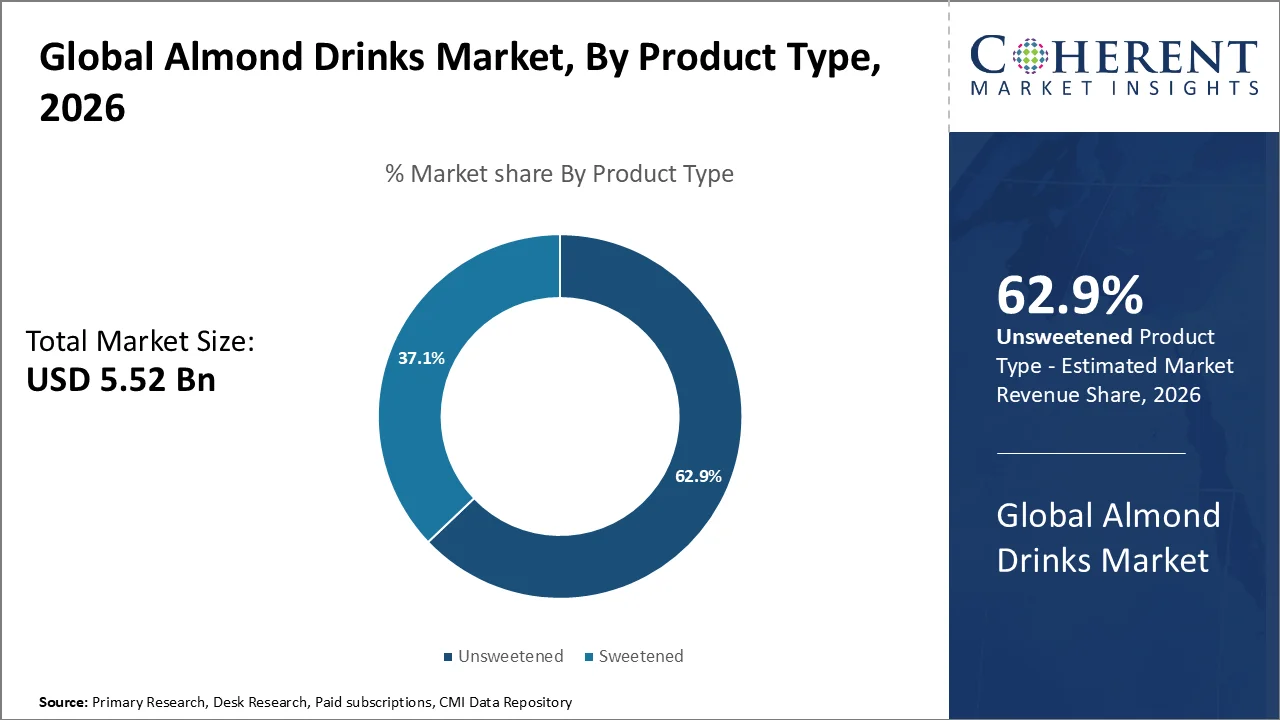
- The unsweetened segment is likely to dominate the Almond Drinks Market with an estimated 62.9% share in 2026. The growth of this category will be due to increased consumer preferences towards sugar-free beverages, increased label usage, rising concerns related to high sugar consumption, and demand for low-calorie beverages that can be consumed regularly. Based on statistics provided by CDC (U.S. Centers for Disease Control and Prevention), American adults intake an average of 17 teaspoons of added sugar daily, and sugar-sweetened beverages continue to be among the top contributors to the total added sugar consumption in the U.S. diet.
- The vanilla segment is predicted to lead the market by the year 2026 with a share of 41.4%. This is because of the common taste of the vanilla, the compatibility of the vanilla with the nutty taste of almonds and the preference for vanilla in various applications including cereals, coffee, smoothies, desserts, bakery products, etc. According to the 2026 analysis of Instacart of U.S. grocery orders in 2025, vanilla accounted for about 21% of ice cream orders in all 50 states of the United States.
- The supermarket segment is expected to dominate the distribution channel category with an estimated 38.5% share in 2026. The segment’s growth is owing to extensive shelf availability, refrigerated and shelf-stable product assortments, competitive pricing, private-label almond drink offerings, and consumers’ ability to compare multiple brands during routine grocery shopping. According to the Plant Based Foods Association, plant-based foods generated approximately USD 7.9 Bn in U.S. retail sales in 2025, while 60% of U.S. households purchased plant-based products and 78% of purchasing households made repeat purchases.
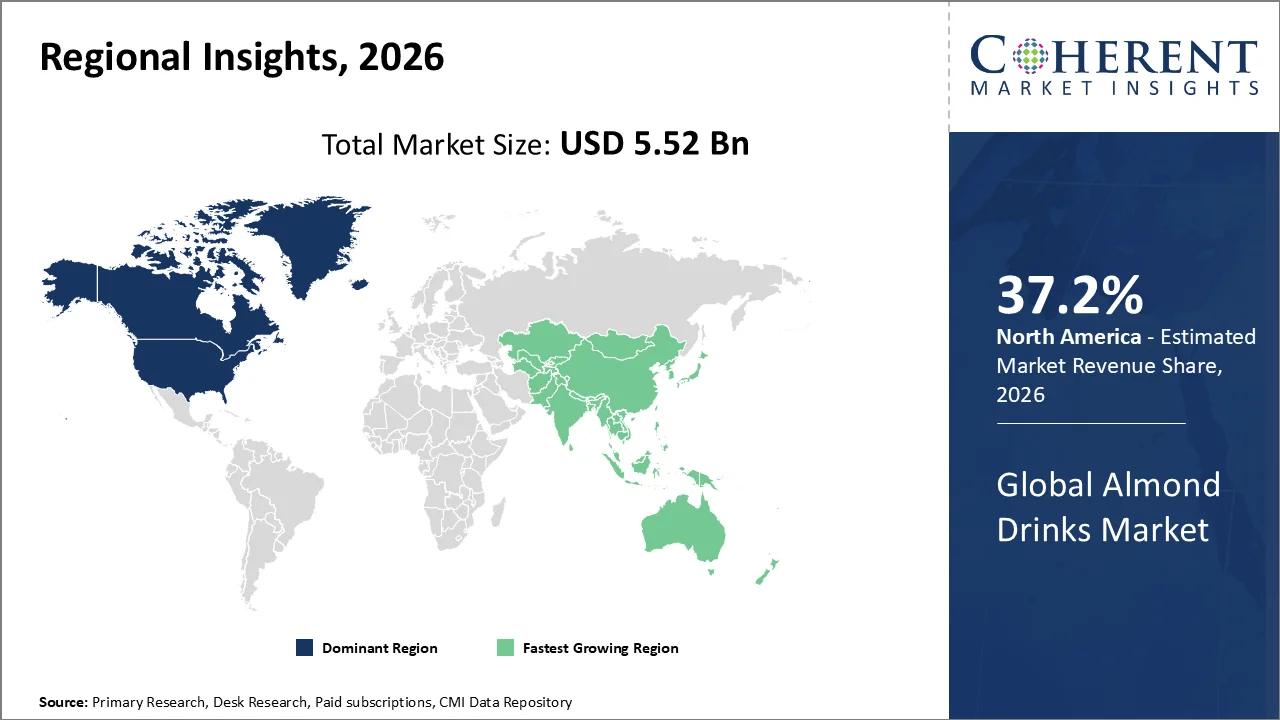
- The North American region is projected to dominate the global Almond Drinks Market, holding a projected market share of 37.2% by 2026. The growth in the North American region is because of various factors such as the highly developed market for plant-based beverages, wide availability of alternatives to milk products, branded almond drinks, and close access to an almond ecosystem. The USDA Economic Research Service forecasted that the US would produce nearly 3 Bn pounds of almonds in 2025, marking the second-largest ever produced, backed by a 9% increase year over year to 2,160 pounds per acre.
Market Drivers
Expanding Flexitarian and Dairy-Reduction Trends are Broadening the Almond Drink Consumer Base
The Almond Drinks Market is seeing a boost as the trend toward plant-based diets moves away from being an exclusively vegan diet to being one that can be followed by non-vegetarians. Almond drinks provide people with the means to cut down on the consumption of dairy products without having to cut out animal products altogether.
A Circana consumer study involving 1,076 U.S. adults found that 47% of Americans planned to consume more plant-based foods in 2025, while 45% intended to reduce their dairy consumption. Circana’s purchase data also showed that U.S. almond milk purchases increased by approximately 2.5% in June 2024 compared with June 2023, demonstrating continued consumer interest in almond-based dairy alternatives.
Wider Foodservice Availability is Increasing Almond Drink Consumption Occasions
The growing availability of almond-based drinks in coffee shops, cafes, fast-food restaurants, and drink parlors has created a variety of drinking choices beyond one’s household. Almond milk remains a choice for coffee, tea, shakes, smoothies, and seasonal drinks, creating a greater demand from the food service sector.
In November 2024, Starbucks waived the fee associated with using almond milk and other non-dairy options in company-owned stores in both the United States and Canada. It was found that swapping out the milk for almond, oat, soy, or coconut milk was the second most requested customizing option, after adding espresso. Starbucks further mentioned that nearly half of its customers in the U.S. who would be charged for customizing their beverages would save more than 10% on the beverages after waiving the additional cost.
Current Events and Their Impact on the Almond Drinks Market
Current Event | Description and its Impact |
United Kingdom Enforces Advertising Restrictions on Less Healthy Food and Drink Products (January 2026) |
|
European Union Packaging and Packaging Waste Regulation Begins General Application (August 2026) |
|
- Current Industry Events of 2026
- Market Size Estimation
- Regional Breakdown
- Competitive Landscape
- Customer Intelligence
- Segmental Analysis
- Pricing Analysis
- Key Market Drivers, Challenges & Future Trends
- Customized Insights Section
Segmental Insights
Why are Unsweetened Almond Drinks Acquiring the Largest Share?
On the basis of product type, the unsweetened segment is projected to account for the largest Almond Drinks Market share of approximately 62.9% in 2026. The segment’s growth is owing to increasing consumer efforts to reduce dietary sweetness and added-sugar intake, greater scrutiny of beverage labels, and the positioning of unsweetened almond drinks as low-calorie options for coffee, cereals, smoothies, and daily consumption.
The International Food Information Council’s December 2025 Spotlight Survey found that 78% of U.S. consumers believed reducing the overall sweetness of their diet was important. The survey also showed that 56% of consumers examine ingredient lists and 52% use Nutrition Facts labels to identify added sugars in foods and beverages. These purchasing behaviors favor almond drinks labelled “unsweetened,” “zero added sugar,” or “no added sugar.”
In February 2026, Blue Diamond Growers launched its new Blue Diamond Almond milk portfolio across U.S. retailers, including an Unsweetened Simple variant made with only three ingredients: water, almonds, and sea salt.
Why is Vanilla Acquiring the Largest Share?
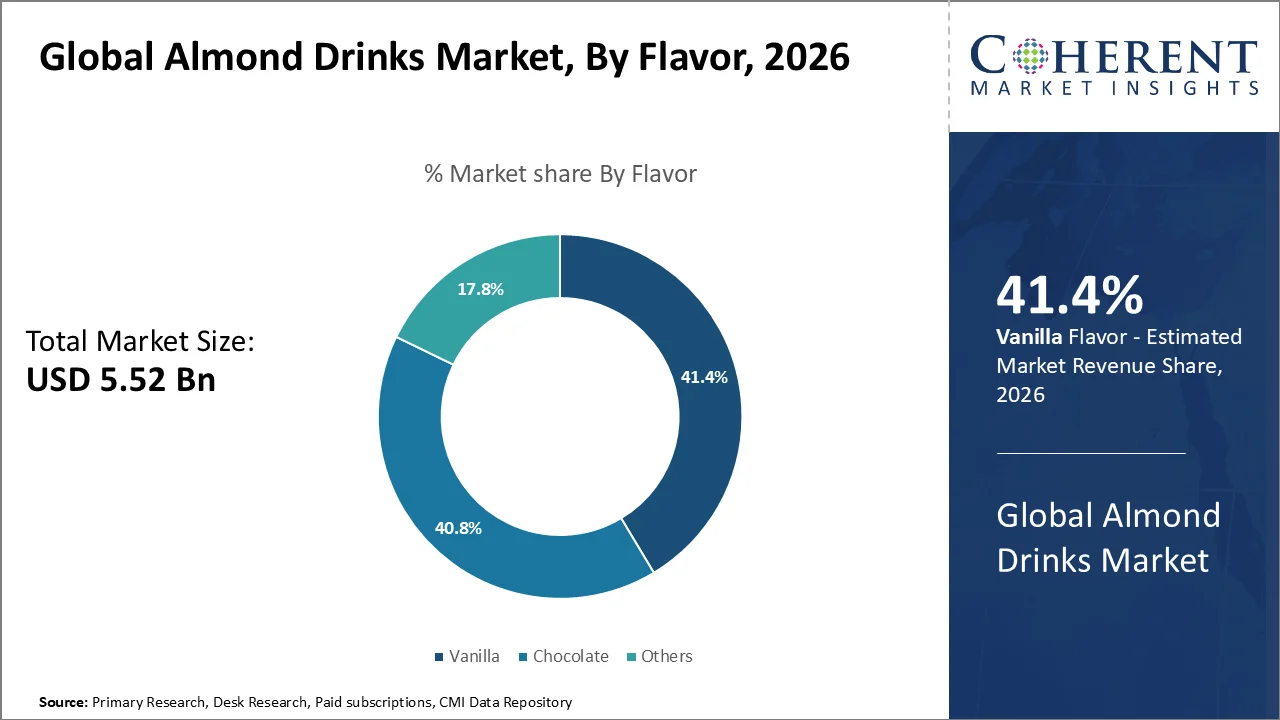
On the basis of flavor, the vanilla segment is projected to account for the largest Almond Drinks Market share of approximately 41.4% in 2026. The segment’s growth is owing to vanilla’s familiar taste, its ability to soften the naturally nutty profile of almonds, and its compatibility with coffee, breakfast cereals, smoothies, desserts, bakery products, and ready-to-drink beverages.
Kerry stated that its 2026 analysis examined hundreds of thousands of products and incorporated data from product launches, retail activity, menus, and social-media conversations. The program was developed through a global network of more than 1,200 scientists, 100 flavorists, and 250 marketing and consumer-insight professionals, providing strong industry validation of vanilla’s continued relevance in beverage formulation.
In January 2026, Califia Farms announced the launch of its new Vanilla Cold Brew with Almond milk as part of its expanded coffee and tea beverage portfolio.
Supermarkets Hold the Largest Market Share
On the basis of distribution channel, the supermarket segment is projected to lead the Almond Drinks Market with approximately 38.5% share in 2026. The segment’s growth is owing to extensive refrigerated and shelf-stable beverage assortments, greater product visibility, promotional pricing, private-label offerings, and consumers’ ability to compare almond drinks across brands, pack sizes, flavors, and nutritional profiles.
According to the U.S. Census Bureau's Advance Monthly Retail Trade Survey in February 2026, U.S. grocery stores made a total sales revenue of around USD 915.35 billion in 2025, which marks an increment of 2.7% from 2024. In addition, the total sales from food and beverage stores amounted to around USD 1.02 trillion.
In December 2025, Mooala announced the nationwide rollout of redesigned packaging across its plant-based milk portfolio, including its organic Simple Almond Milk range.
Almond Drinks Market Trends
- Increased interest in protein-enriched almond milk products has prompted companies to solve the problem of low protein level in ordinary almond drinks. In February 2026, So Good High Protein Almond Beverage from Life Health Foods was launched in India. It contains 10 grams of plant protein in one serving without added sugar, calcium, and vitamins. This new development expands the scope of almond drinks to include sports nutrition, weight control, and breakfasts.
- The increasing consumer preference for natural and minimally formulated almond drinks is resulting in beverages containing fewer ingredients, easily recognized ingredients, and reduced amounts of artificial preservatives, thickening agents, oils, and sugars. According to the Ingredion 2025 study, conducted among almost 14,000 people in 29 countries, 45% of people regarded nutrition, ingredients, and wellness as their top priority while making purchases. Gen Z and Millennials were also ready to spend 20–30% more on natural, organic, high-protein, and no-artificial-ingredient beverages.
- Increasing popularity of almond milk drinks in ready-to-drink protein shakes and coffee drinks is introducing novel consumption occasions other than milk substitution. In July, 2025, Premier Protein introduced Almond milk Non-Dairy Protein Shakes that offered 20 grams of protein, had up to 160 calories per serving along with 5 grams of sugar. Chocolate, vanilla and coffee flavored drinks were launched across the nation through different retail outlets.
Regional Insights
North America Dominates Owing to Mature Plant-Based Retail Demand and an Integrated Almond Supply Base
The North American region is expected to dominate the global Almond Drinks Market with its market share of around 37.2% in 2026. This dominance is credited to consumers' awareness regarding dairy substitutes, availability in supermarkets and food service establishments, strong brand presence, product innovations, and an established almond drinks production infrastructure in the country.
According to the insights released by Plant Based Foods Institute in June 2026, 67% of people in Western USA purchased plant based foods in 2025, and about 84 percent of them were repeat purchasers, which was the highest repeat rate among all regions in the nation.
In January 2026, Blue Diamond Growers announced a new partnership between Almond Breeze and the Jonas Brothers to launch a national U.S. advertising campaign.
Asia Pacific Almond Drinks Market Trends
Asia Pacific is expected to be the fastest-growing region in the Almond Drinks Market during 2026–2033. Regional growth is owing to increasing familiarity with plant-based beverages, expanding modern retail and e-commerce availability, rising health awareness, product localization, and growing demand for lactose-free and nutritionally fortified beverage alternatives across India, China, Japan, Australia, Vietnam, and Southeast Asia.
Rakuten Insight’s June 2025 Asia plant-based food study found that approximately 69% of surveyed consumers had tried plant-based alternatives, increasing from 67% in 2024. The highest growth was seen in India and Vietnam, whereas the most popular plant-based product was the plant-based milk, which showed that there was a growing market base of consumers for almond drinks in the region.
In July 2026, Australian food and beverage manufacturer Noumi Limited launched its MILKLAB plant-based milk range, including MILKLAB Almond, across India through a pan-India distribution partnership with Olympia Industries Limited.
Strong Domestic Almond Supply and Product Innovation are Supporting the U.S. Almond Drinks Market
The U.S. Almond Drinks Market is experiencing consistent growth because of the presence of an established plant-based beverages industry, extensive almond processing market in the country, widespread availability, and innovations in clean label, flavored, functional, and cafe-style almond drinks.
According to USDA Economic Research Service publications indicating that there were 2.01 billion pounds of almond exports by the US during the 2024/25 marketing period, which is a 1.1% increase from last year and the second-highest level ever recorded. The forecasted production growth rate for the coming year 2025/26 is estimated to be around 9%.
In August 2025, Califia Farms introduced a 48-ounce Horchata beverage combining almond milk, rice milk, real cinnamon, and cane sugar at a suggested retail price of USD 6.29. The launch demonstrates the growing use of almond drinks beyond conventional dairy replacement and into flavored, multicultural, and indulgent beverage occasions.
China Almond Drinks Market Trends
China is expected to record strong growth in the Almond Drinks Market owing to rising demand for health-oriented beverages, rapid e-commerce expansion, increasing urban consumption, and growing domestic capabilities in plant-based drink manufacturing and product innovation.
China’s domestic almond drink industry is also beginning to demonstrate export readiness. In November 2025, Inner Mongolia Plateau Almond Drink Co. launched its first export shipment to Japan, comprising 24,000 bottles or 1,200 cases of sugar-free and regular almond drinks. The company had developed more than 20 products and used low-temperature extraction and freshness-preservation technologies, indicating improving formulation, manufacturing, and quality-control capabilities within China’s almond drink sector.
Who are the Major Companies in Almond Drinks Industry
Some of the major key players in Almond Drinks Market are Fuerst Day Lawson, Pressery Inc., The Luz Almo company Pvt Ltd, Alpro, Provamel, MALK Organics, Dream, Nutriops S,L, Natura Foods, Rude Health, Blue Diamond Growers.
Key News
- In July 2025, Alpro announced the launch of its Alpro Bio portfolio in Germany, with retail availability beginning in August 2025. The range includes Alpro Bio Almond No Sugar and a new Organic Coconut-Almond Drink, both offered in one-litre cartons. The products were introduced through organic-specialty retailers and drugstores.
- In July 2025, Laboratorios Almond completed the absorption of its subsidiary Nutriops S.L. The consolidated company also expanded its portfolio with a new range of plant-based beverages and indicated that it expected double-digit business growth following the integration.
Market Report Scope
Almond Drinks Market Report Coverage
| Report Coverage | Details | ||
|---|---|---|---|
| Base Year: | 2025 | Market Size in 2026: | USD 5.52 Bn |
| Historical Data for: | 2020 To 2024 | Forecast Period: | 2026 To 2033 |
| Forecast Period 2026 to 2033 CAGR: | 5.4% | 2033 Value Projection: | USD 7.98 Bn |
| Geographies covered: |
| ||
| Segments covered: |
| ||
| Companies covered: | Fuerst Day Lawson, Pressery Inc., The Luz Almo company Pvt Ltd, Alpro, Provamel, MALK Organics, Dream, Nutriops S,L, Natura Foods, Rude Health, Blue Diamond Growers. | ||
| Growth Drivers: |
| ||
| Restraints & Challenges: |
| ||
Analyst Opinion
- The Almond Drinks Market is expected to become increasingly nutrition- and label-driven, with growth shifting toward unsweetened, fortified, and transparently formulated products. The June 2026 International Food Information Council survey found that 79% of U.S. consumers check nutrition or ingredient information at least sometimes, while 80% stated that front-of-package nutrition information influences their purchasing decisions. Consumers most frequently checked calories at 45%, total sugars at 44%, protein at 42%, and added sugars at 39%. These preferences are likely to strengthen demand for almond drinks with no added sugar, clear ingredient lists, and visible nutrient claims.
- Fortification with protein will be a key competitive edge for almond beverages as they battle dairy, soy, oat, and high protein functional beverages. According to an IFIC survey in April 2026, 55% of consumers looking at information about protein wanted protein sources to be clearly indicated on the ingredients panel, 52% wanted protein content to be clearly visible on the Nutrition Facts label, while 49% would like to see protein content indicated on the front of the package. This presents an opportunity for almond beverage companies to use pea, almond, or blended proteins.
- Almond drink manufacturers will need to strengthen raw-material sourcing and cost-management strategies, despite the availability of a large California almond crop. The USDA’s July 2026 outlook forecast U.S. almond production at approximately 2.7 billion pounds, based on 1.39 million bearing acres. However, the expected yield of 1,940 pounds per acre remained around 8% below the ten-year average, while the average almond price increased to approximately USD 2.60 per pound in 2025. These conditions indicate that input-cost pressure, weather-related yield variability, and grower economics may influence almond drink pricing and margins.
Speak to the analyst
Want personalized insights?
Take the findings above to one of our principal consultants, or have the report rebuilt around the segments, geographies and competitors you actually track.
Market Segmentation
- By Product Type (Revenue, USD Bn, 2021-2033)
- Unsweetened
- Sweetened
- By Flavor (Revenue, USD Bn, 2021-2033)
- Chocolate
- Vanilla
- Others
- By Distribution Channel (Revenue, USD Bn, 2021-2033)
- Hypermarket
- Supermarket
- Online Stores
- Others
- By Region (Revenue, USD Bn, 2021-2033)
- North America
- U.S.
- Canada
- Latin America
- Brazil
- Mexico
- Argentina
- Rest of Latin America
- Europe
- Germany
- U.K.
- France
- Italy
- Spain
- Russia
- Rest of Europe
- Asia Pacific
- China
- India
- Japan
- Australia
- South Korea
- ASEAN
- Rest of Asia Pacific
- Middle East
- GCC
- Israel
- Rest of Middle East
- Africa
- South Africa
- Central Africa
- North Africa
- North America
Sources
Primary Research Interviews
- Almond drink manufacturers and brand owners
- Plant-based beverage formulation specialists
- Almond growers, processors, and ingredient suppliers
- Procurement heads from food and beverage companies
- Supermarket and hypermarket category managers
- Plant-based beverage distributors and importers
- Foodservice, cafe, and quick-service restaurant procurement managers
- Packaging manufacturers and aseptic carton suppliers
- Food technologists, nutritionists, and sensory-analysis experts
- Key opinion leaders in plant-based nutrition and dairy alternatives
Databases
- World Bank
- Organisation for Economic Co-operation and Development (OECD)
- FAOSTAT
- UN Comtrade Database
- USDA Economic Research Service
- USDA National Agricultural Statistics Service
- Eurostat
- U.S. Census Bureau
- National Bureau of Statistics of China
- International Trade Centre Trade Map
- India Directorate General of Commercial Intelligence and Statistics
- Statistics Canada
- Australian Bureau of Statistics
Magazines
- BeverageDaily
- FoodNavigator
- DairyReporter
- Food Business News
- BevNET
- Food & Beverage Magazine
- New Food Magazine
- Packaging Europe
- Food Manufacture
- Progressive Grocer
Journals
- Food Chemistry
- LWT – Food Science and Technology
- Journal of Food Science
- Foods
- Nutrients
- International Journal of Food Science & Technology
- Journal of Food Processing and Preservation
- Plant Foods for Human Nutrition
- Food Research International
- Agricultural Water Management
- Journal of Cleaner Production
Newspapers
- The New York Times
- The Guardian
- The Wall Street Journal
- Financial Times
- Reuters
- Bloomberg
- The Economic Times
- China Daily
- The Hindu BusinessLine
- Nikkei Asia
Associations
- Almond Board of California
- International Nut and Dried Fruit Council
- Almond Board of Australia
- Plant Based Foods Association
- Plant-Based Foods Institute
- The Good Food Institute
- European Plant-Based Foods Association
- FMI – The Food Industry Association
- International Food Information Council
- International Society for Horticultural Science
- Association of Beverage Machinery Industry
Public Domain Sources
- Company annual reports and investor presentations
- Company product-launch announcements and press releases
- Government agricultural production and crop outlook reports
- Import and export databases for almonds and plant-based beverages
- Food and beverage retail-sales publications
- University research on plant-based milk formulation and nutrition
- Patent databases such as WIPO, USPTO, Espacenet, and Google Patents
- U.S. FDA food-labelling and plant-based milk guidance
- European Commission food, packaging, and sustainability regulations
- Health Canada and Canadian Food Inspection Agency publications
- China National Health Commission food-safety standards
- Foodservice menus, retailer listings, and supermarket product catalogues
- Sustainability and packaging reports from beverage-carton suppliers
Proprietary Elements
- CMI Data Analytics Tool
- Proprietary CMI Existing Repository of Information for the Last 10 Years
Get access to 250+ pages report
Every segment, forecast, competitor profile and data table behind the analysis above — available for instant download.
- ESOMAR Member
- ISO 9001:2015 Certified
- D-U-N-S Registered
- GDPR & CCPA Compliant
Missing comfort of reading report in your local language? Find your preferred language:
Transform your Strategy with Exclusive Trending Reports
Frequently Asked Questions
The Almond Drinks Market is expected to reach approximately USD 7.98 Bn by 2033, increasing from USD 5.52 Bn in 2026.
What is the compound annual growth rate of the Almond Drinks Market from 2026 to 2033?
Major players operating in the global Almond Drinks Market include Fuerst Day Lawson, Pressery Inc., The Luz Almo Company Pvt. Ltd., Alpro, Provamel, MALK Organics, DREAM, Nutriops S.L., Natura Foods, Rude Health, and Blue Diamond Growers.
The rising consumer preference for plant-based and dairy-free beverages, increasing incidence of lactose intolerance and milk allergies, growing adoption of vegan and flexitarian diets, and wider use of almond drinks in coffee, cereals, smoothies, bakery products, and functional beverages are driving market growth.
High almond procurement costs, fluctuations in raw-material availability, competition from oat, soy, and conventional dairy milk, and the relatively low protein content of standard almond drinks are the key factors hampering market growth.
The unsweetened segment is projected to dominate the market with an estimated 62.9% share in 2026, supported by increasing demand for products with no added sugar and lower calorie content.
The vanilla segment is anticipated to account for the largest flavor share, estimated at approximately 41.4% in 2026, owing to its familiar taste and compatibility with coffee, smoothies, cereals, desserts, and bakery applications.