

Coffee Market Size and Forecast – 2026 to 2033
Coffee Market is estimated to be valued at USD 153.02 Bn in 2026 and is expected to reach USD 214.16 Bn in 2033, exhibiting a compound annual growth rate (CAGR) of 4.9% from 2026 to 2033.
Key Takeaways
- By Product Type, Instant Coffee hold the largest market share of 36.2% in 2026 owing to the convenience & time-saving.
- By Distribution Channel, Off-trade expected to hold largest market share in 2026 owing to its growing at-home coffee consumption.
- By Region, Europe dominates the overall market with an estimated share of 35.58% in 2026 owing to the strong coffee-drinking culture.
Market Overview
Consumers are driving the expansion of the global coffee market by embracing diverse brewing methods, premium flavors, and convenient formats. They increasingly prepare coffee at home, fueling demand for capsules, specialty beans, and innovative instant coffee products, which are transforming retail offerings. Café culture and evolving trends like cold brew and ready-to-drink beverages sustain strong out-of-home consumption. Consumers also prioritize sustainability, ethical sourcing, and product traceability, shaping their purchasing decisions and encouraging brands to differentiate across regions.
Current Events and Its Impact on the Coffee Market
Current Events | Description and its impact |
Climate Change Effects on Coffee-Producing Regions |
|
Geopolitical and Trade Developments |
|
Labor Market and Social Issues in Coffee-Producing Nations |
|
Role of AI (Artificial Intelligence) in Coffee Industry
AI is reshaping the coffee industry by improving quality, efficiency, and customer experience across the entire supply chain. In farming, AI analyzes climate, soil, and crop data to optimize growing conditions and detect diseases early. During production and roasting, AI systems monitor temperature, timing, and flavor profiles to ensure consistent, high-quality results. In retail, AI personalizes recommendations, manages inventory, and streamlines ordering through smart assistants and automated platforms. For consumers, AI enhances online shopping with tailored suggestions and interactive tools.
In November 2025, Weaver’s Coffee & Tea, a division of Wild Card Roasters, introduced HAL 8122™, an advanced AI Assistant created with BizzTech.io. This collaboration blends specialty coffee expertise with cutting-edge artificial intelligence to transform the online coffee and tea buying experience. Weaver’s is proud to be the first in the industry to debut this innovative technology.
- Current Industry Events of 2026
- Market Size Estimation
- Regional Breakdown
- Competitive Landscape
- Customer Intelligence
- Segmental Analysis
- Pricing Analysis
- Key Market Drivers, Challenges & Future Trends
- Customized Insights Section
Segmental Insights
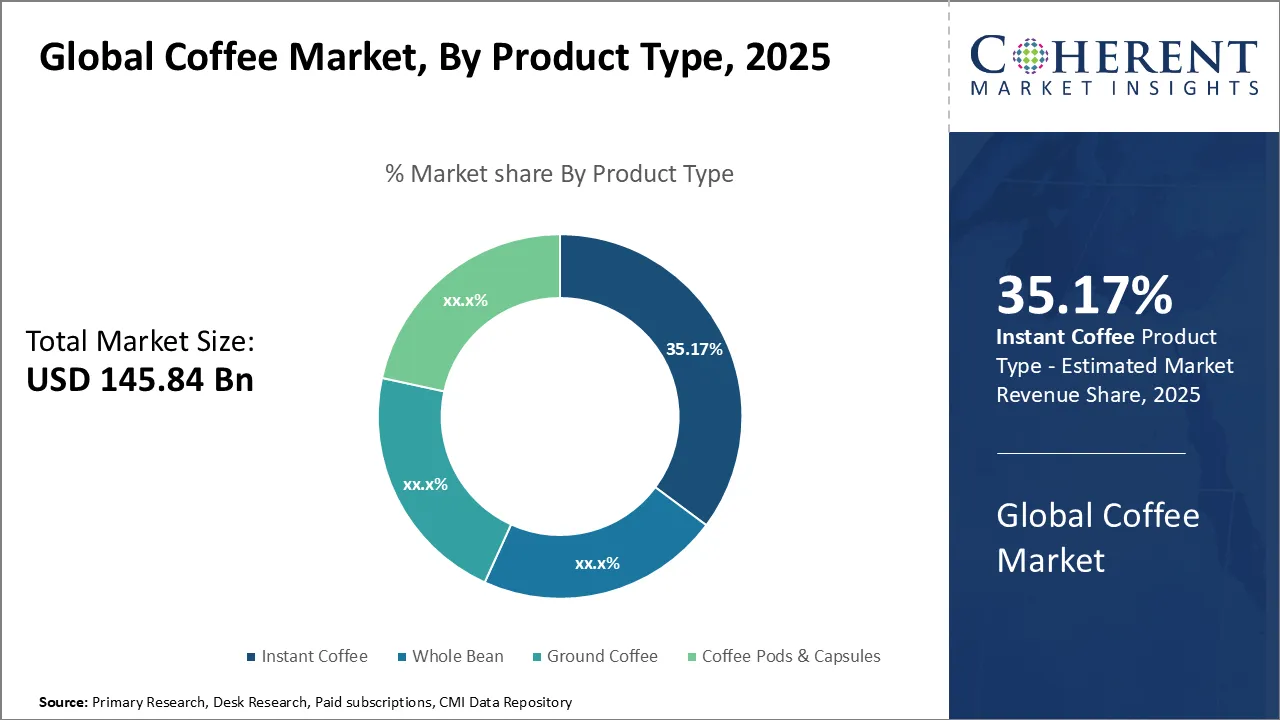
Coffee Market Insights, By Product Type: Instant Coffee contribute the highest share of the market owing to its urbanization & changing lifestyles.
Instant Coffee hold the largest market share of 36.2% in 2026. Consumers drive the growth of instant coffee with its unmatched convenience and quick preparation, fitting busy and on-the-go lifestyles. Urbanization and modern work routines boost demand, while affordability attracts price-conscious buyers. Improvements in freeze-drying and micro-grinding enhance flavor, appealing to quality-focused consumers. Its long shelf life and easy storage make it suitable for households and remote areas. Brands further accelerate adoption through marketing campaigns, innovative packaging, and functional variations like fortified or flavored options worldwide. For instance, in February 2025, Tata Coffee Gold launched Hazelnut Flavored Instant Coffee, blending premium coffee beans with a rich hazelnut flavor for a warm, aromatic, and indulgent daily brew.
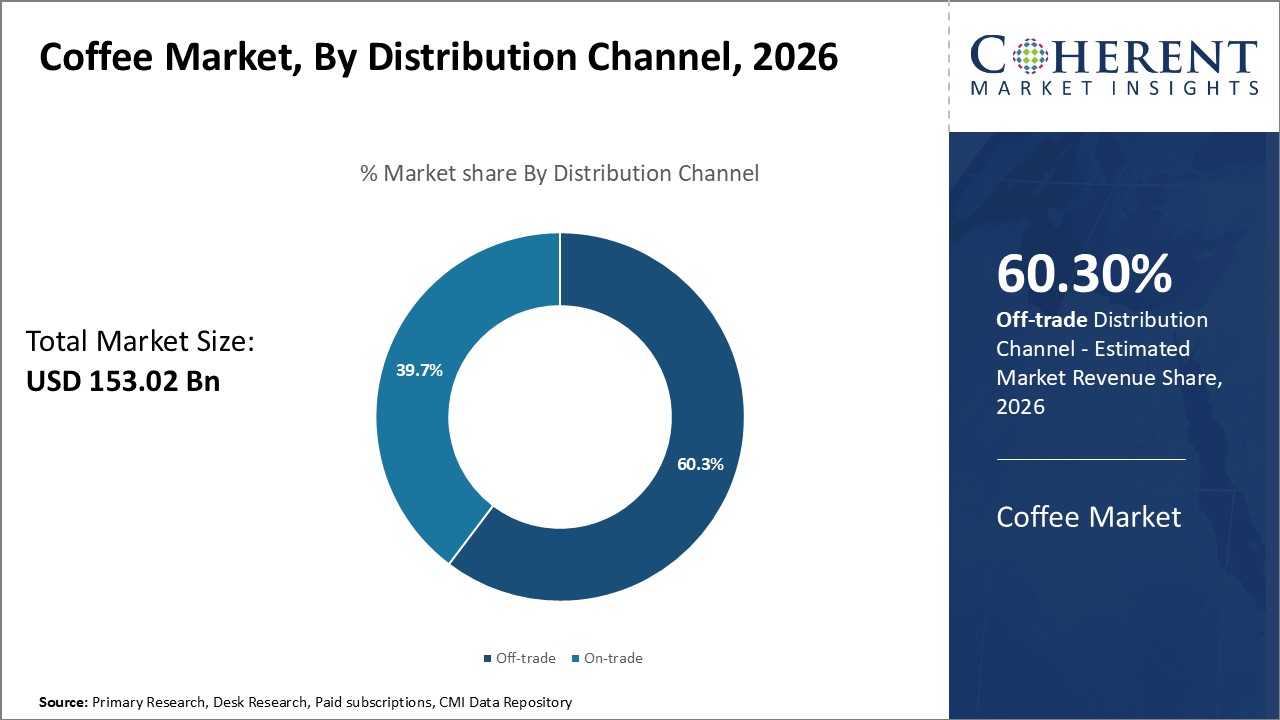
Coffee Market Insights, By Distribution Channel: Off-trade contribute the highest share of the market owing to its price sensitivity & value-seeking behavior.
Consumers drive the off-trade coffee market by increasingly choosing to brew coffee at home, supported by the wide availability of beans, ground coffee, capsules, and instant formats in supermarkets, hypermarkets, and online stores. They are drawn to retail channels for convenience, bulk buying options, and competitive pricing. Product innovations, such as specialty blends, functional coffee, and premium packaging, encourage trial and repeat purchases. Retailers boost demand through private labels, promotions, and loyalty programs, while e-commerce and modern retail expansion improve accessibility and sales. For instance, in February 2025, Heineken UK expanded Murphy’s Irish stout in the off-trade by launching 4x440ml and 10x440ml multipacks, which will be sold across grocery, wholesale, and convenience channels.
Regional Insights
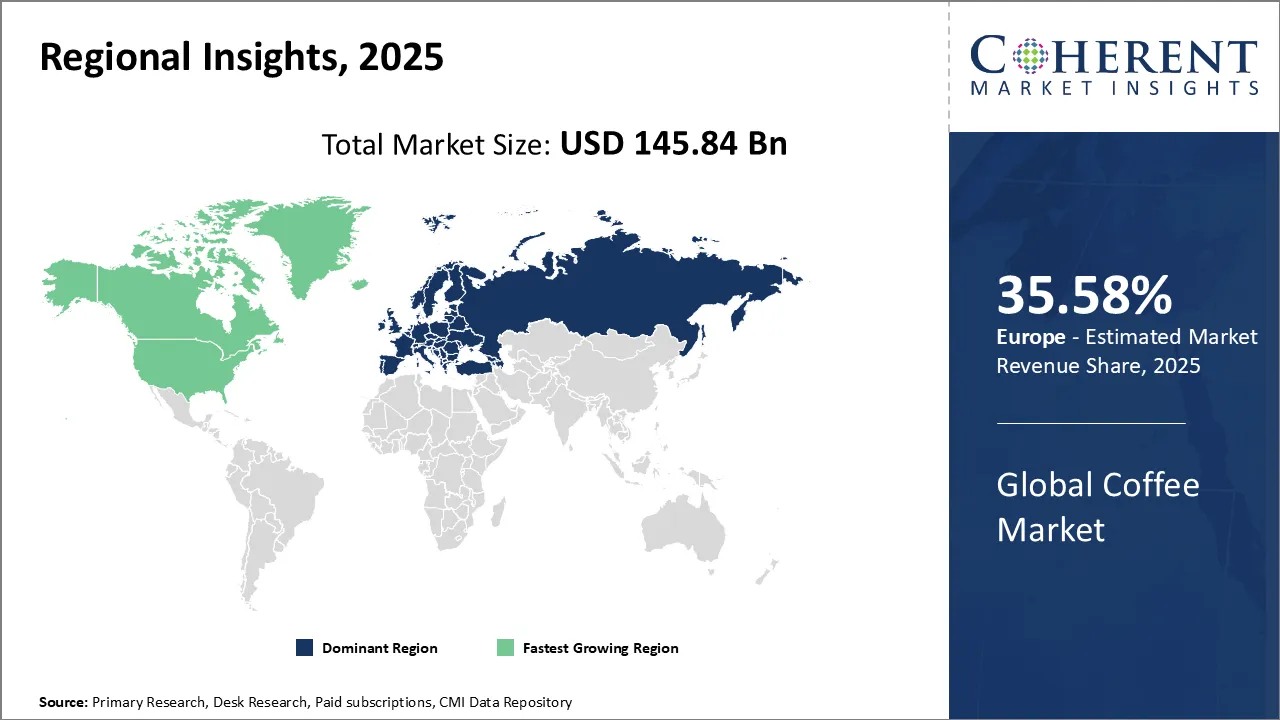
Europe Coffee Market Trends
Europe dominates the overall market with an estimated share of 35.58% in 2026. Consumers shape the European coffee market through a strong café culture and rising interest in premium and specialty coffee. They increasingly brew coffee at home using espresso machines, pods, and artisanal beans, while convenience drives demand for instant and ready-to-drink options. Environmentally conscious buyers prioritize sustainability, ethical sourcing, and organic certifications in their purchases. Brands keep the market dynamic by innovating flavors, functional ingredients, and packaging, while e-commerce platforms and modern retail channels expand accessibility to meet both traditional and emerging coffee preferences. For instance, in April 2026, Nescafé launched its Espresso Concentrated range in Europe, including the UK. Each bottle delivers 16 servings and comes in three flavors: vanilla, caramel, and classic.
North America Coffee Market Trends
Consumers drive the North American coffee market by seeking specialty and premium coffee experiences at home and on-the-go. They increasingly choose cold brew, ready-to-drink beverages, and single-serve pods for convenience and variety. Health-conscious buyers favor organic, low-caffeine, and functional coffee options. Expanding café culture and coffee chains support out-of-home consumption, while e-commerce platforms and subscription services make specialty and gourmet coffee widely accessible. Brands actively shape the market by innovating flavors, adopting sustainable sourcing, and developing attractive packaging. For instance, in February 2026, Barista Coffee Company, a leading Indian coffee chain, partnered with US Cranberries to launch a vibrant new range of cranberry-based beverages and desserts.
United Kingdom Coffee Market Trends
Consumers are shaping the United Kingdom coffee market by embracing premium, specialty, and ethically sourced coffee. They increasingly brew coffee at home using espresso machines, pods, and high-quality beans, while convenience drives their demand for instant and ready-to-drink beverages. Coffee shops, chains, and on-the-go options sustain strong out-of-home consumption. Socially conscious buyers prioritize sustainability, organic certifications, and fair-trade practices. Brands continue to diversify offerings and influence the market by innovating flavors, functional ingredients, packaging, and expanding through e-commerce and modern retail channels. For instance, in April 2026, Costa Coffee opened a new drive-through at Winsford Gateway, Cheshire, serving commuters and local workers from 5:30 am–10 pm (Mon–Sat) and 7 am–9 pm (Sun).
United States Coffee Market Trends
Consumers are driving the United States coffee market by demanding specialty and premium coffee, seeking diverse flavors and high-quality brewing experiences at home and on-the-go. They increasingly choose cold brew, ready-to-drink beverages, and single-serve pods for convenience and variety. Health-conscious buyers favor organic, low-caffeine, and functional coffee options. Expanding café culture and coffee chains sustain out-of-home consumption, while e-commerce platforms and subscription services make specialty and gourmet coffee widely accessible. Brands continue to energize the market through innovation in flavors, sustainability, and packaging. For instance, in July 2026, Javvy launched Protein Coffee in the US and Canada, combining clean protein with premium coffee to boost energy, focus, and flavor.
End-user Feedback and Unmet Needs in the Coffee Market
- Taste and Quality Expectations: Consumers often express dissatisfaction with inconsistent flavor profiles, especially in instant or mass-produced coffee. Many seek richer, fresher, and more authentic coffee experiences, including single-origin beans and artisanal roasts. Brands that fail to deliver consistent taste and aroma risk losing loyalty, highlighting an opportunity for improved roasting, packaging, and brewing solutions.
- Convenience and Preparation Ease: While instant and pod-based coffee meet convenience needs, some consumers still find preparation cumbersome or limiting. There is demand for faster, spill-free, and versatile brewing options suitable for work, travel, or small kitchens. Innovations like one-touch machines or ready-to-drink solutions could address this gap and enhance daily usability.
- Health and Functional Benefits: End-users increasingly seek coffee that aligns with wellness trends, such as low-caffeine, organic, or functional blends fortified with vitamins, adaptogens, or antioxidants. Many feel current options are limited or not clearly labeled, creating unmet needs for health-conscious products that combine taste, energy, and functional benefits.
Coffee Market Trend
Premiumization and Specialty Coffee
Consumers increasingly seek high-quality, single-origin, and specialty coffees that offer unique flavor profiles and authentic experiences. Artisanal roasting, micro-lots, and limited-edition blends are gaining popularity. Brands are responding with premium packaging, educational campaigns, and tasting experiences to differentiate themselves. This trend reflects a shift from purely functional consumption to experiential enjoyment, where consumers value craftsmanship, traceability, and distinct sensory experiences in their daily coffee rituals.
Convenience and Ready-to-Drink Options
Busy lifestyles continue to drive demand for convenience-oriented coffee products. Ready-to-drink (RTD) beverages, instant coffee, and single-serve capsules provide fast, accessible caffeine solutions at home, work, or on-the-go. Retailers and brands are expanding offerings with portable packaging, cold brews, and flavored options. This trend reflects consumer preference for time-saving solutions without compromising taste, while also creating opportunities for innovation in packaging, storage, and formulation to meet evolving mobility and lifestyle needs.
Coffee Market Opportunity
Expansion of Specialty and Premium Segments
Rising consumer interest in high-quality, single-origin, and artisanal coffee creates opportunities for brands to offer premium blends, micro-lots, and limited editions. Educational initiatives, tasting experiences, and storytelling around sourcing and roasting can enhance brand value. Companies can target discerning consumers seeking unique flavor profiles and authentic coffee experiences. The premium segment allows differentiation, higher margins, and brand loyalty, making it a strategic area for growth in both mature and emerging markets.
Market Report Scope
Coffee Market Report Coverage
| Report Coverage | Details | ||
|---|---|---|---|
| Base Year: | 2025 | Market Size in 2026: | USD 153.02 Bn |
| Historical Data for: | 2020 To 2024 | Forecast Period: | 2026 To 2033 |
| Forecast Period 2026 to 2033 CAGR: | 4.9% | 2033 Value Projection: | USD 214.16 Bn |
| Geographies covered: |
| ||
| Segments covered: |
| ||
| Companies covered: | The Kraft Heinz Company, Starbucks Coffee Company, The J.M. Smucker Company, Luigi Lavazza SPA, Nestle SA, The Coca-Cola Company, JAB Holding Company, Tata Global Beverages, Tchibo GmbH, and Strauss Group Ltd | ||
| Growth Drivers: |
| ||
| Restraints & Challenges: |
| ||
Coffee Market News
- In January 2025, Coffee Island has entered the Indian market through a partnership with Vita Nova, bringing its distinctive European coffee culture to one of the world’s most dynamic coffee markets.
- In November 2025, Starbucks Coffee Company has launched a Farmer Support Partnership (FSP) with Tata Starbucks to connect local farmers and agronomists in India to global best practices through open-source agronomy.
- In October 2025, The Horticultural Research Station (HRS), Yercaud, and NABARD have launched a project on profitable coffee processing and recycling coffee waste into biochar.
Analyst Opinion (Expert Opinion)
- Coffee market dynamics are shifting: quality, convenience and values are redefining competition — and many legacy players risk being left behind. For example, in the U.S., daily specialty‑coffee drinking recently surpassed traditional coffee: 46% of American adults reportedly consume specialty coffee every day, overtaking traditional coffee for the first time. This signals that consumers now treat coffee not simply as a routine beverage but as an experience, demanding richer flavor, provenance, and social legitimacy.
- At the same time, ready‑to‑drink (RTD), instant, and capsule formats are no longer niche — they are mainstream growth engines. Globally, RTD coffee sales are rising rapidly as busy lifestyles demand convenience. Companies that adapt to this shift — expanding RTD lines, investing in cold-brew or functional coffee variants — will likely capture market share from traditional roasters who cling to old‑school wholesale or bagged‑beans models.
- Sustainability, traceability and ethical sourcing have become baseline expectations rather than differentiators. In many developed markets, specialty coffee buyers now expect transparent origin, fair‑trade or certified sourcing, and environmentally sound packaging as standard. Brands that continue opaque supply‑chains or ignore eco‑credentials risk ceding consumers to more conscientious competitors — especially among younger, affluent and socially conscious buyers.
- The retail and direct‑to-consumer model is emerging as a structural advantage. With e‑commerce penetration accelerating (spurred by pandemic habits and increased home‑brewing), coffee companies that build strong D2C channels, subscription offerings, and direct-from-roaster relationships will enjoy higher margins, brand loyalty, and better control over consumer experience. Legacy distribution-heavy players may struggle to match this agility.
Speak to the analyst
Want personalized insights?
Take the findings above to one of our principal consultants, or have the report rebuilt around the segments, geographies and competitors you actually track.
Market Segmentation
- Global Coffee Market, By Product Type
- Whole Bean
- Ground Coffee
- Instant Coffee
- Coffee Pods and Capsules
- Global Coffee Market, By Distribution Channel
- On-trade
- Off-trade
- Supermarkets/hypermarkets
- Convenience Stores
- Specialist Retailers
- Other Off-trade Channels
- Regional Insights (Revenue, USD Mn, 2021 - 2033)
- North America
- U.S.
- Canada
- Latin America
- Brazil
- Argentina
- Mexico
- Rest of Latin America
- Europe
- Germany
- U.K.
- Spain
- France
- Italy
- Russia
- Rest of Europe
- Asia Pacific
- China
- India
- Japan
- Australia
- South Korea
- ASEAN
- Rest of Asia Pacific
- Middle East
- GCC Countries
- Israel
- Rest of Middle East
- Africa
- South Africa
- North Africa
- Central Africa
- North America
- Key Players Insights
- The Kraft Heinz Company
- Starbucks Coffee Company
- The J.M. Smucker Company
- Luigi Lavazza SPA
- Nestle SA
- The Coca-Cola Company
- JAB Holding Company
- Tata Global Beverages
- Tchibo GmbH
- Strauss Group Ltd.
Sources
Primary Research interviews
- Interviews with coffee growers and producers
- Discussions with distributors and wholesalers
- Conversations with café owners and baristas
- Surveys with coffee consumers
Databases
- International Coffee Organization (ICO) statistics
- FAOSTAT (Food and Agriculture Organization)
- United Nations Comtrade Database
- National agricultural databases (e.g., USDA for U.S., Ministry of Agriculture for relevant countries)
Magazines
- Barista Magazine
- Roast Magazine
- Coffee & Cocoa International
- Fresh Cup Magazine
Journals
- Journal of Food Science
- Journal of Agricultural and Food Chemistry
- International Journal of Food Science & Technology
- Coffee Science
Newspapers
- The New York Times – Food & Drink Section
- The Guardian – Food & Drink
- The Washington Post – Coffee & Lifestyle Sections
- Local newspapers covering coffee industry trends in key markets
Associations
- Specialty Coffee Association (SCA)
- National Coffee Association (NCA)
- European Coffee Federation (ECF)
- International Coffee Organization (ICO)
Public Domain sources
- Government reports on agriculture and trade
- Import/export statistics published by national governments
- Census data on coffee consumption
- Sustainability and environmental reports available publicly
Proprietary Elements
- CMI Data Analytics Tool
- Proprietary CMI Existing Repository of information for last 8 years
Get access to 250+ pages report
Every segment, forecast, competitor profile and data table behind the analysis above — available for instant download.
- ESOMAR Member
- ISO 9001:2015 Certified
- D-U-N-S Registered
- GDPR & CCPA Compliant
Missing comfort of reading report in your local language? Find your preferred language:
Transform your Strategy with Exclusive Trending Reports
Frequently Asked Questions
The Coffee Market is estimated to be valued at USD 153.02 Bn in 2026, and is expected to reach USD 214.16 Bn by 2033.
The CAGR of the Coffee Market is projected to be 4.9% from 2026 to 2033.
Increasing working population and growing demand for certified coffee products are fuelling the market.
The instant coffee segment is the leading component segment in the market.
Change in climatic conditions is the major factors restraining the market.
The Kraft Heinz Company, Starbucks Coffee Company, The J.M. Smucker Company, Luigi Lavazza SPA, Nestle SA, The Coca-Cola Company, JAB Holding Company, Tata Global Beverages, Tchibo GmbH, and Strauss Group Ltd.