

Genetically Modified Crops Market Size and Trends Forecast – 2026 - 2033
The genetically modified crops market is estimated to be valued at USD 27.66 Bn in 2026 and is expected to reach USD 40.78 Bn by 2033, exhibiting a compound annual growth rate (CAGR) of 5.7% from 2026 to 2033.
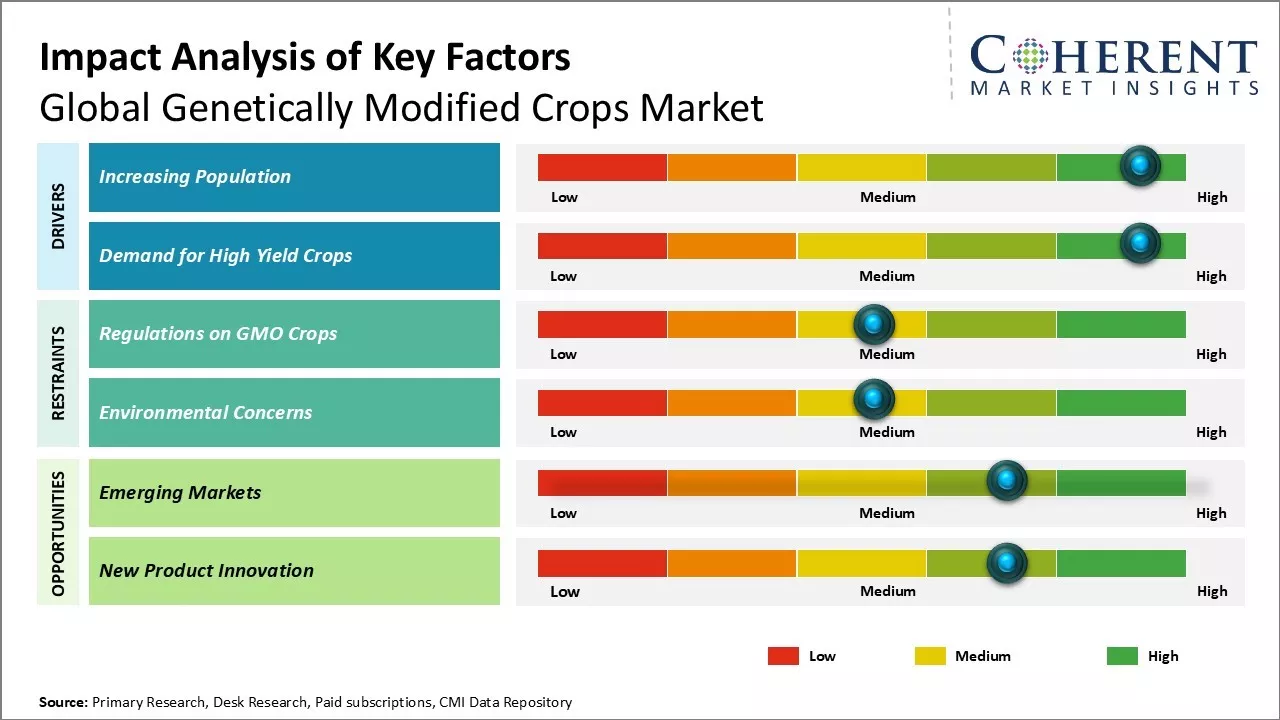
Key Takeaways of the Genetically Modified Crops Market
- Based on crop type, the corn segment is expected to contribute the highest share of the market with 47.9 % in 2026.
- Based on trait type, the herbicide tolerance segment is expected to contribute the highest share of the market with 35.1 % in 2026.
- Based on application, the food and feed segment is expected to contribute the highest share of the global genetically modified crops market with 41% in 2026.
- North America is expected to top the global market with 40. 6% share in 2026.
Market Overview
Increasing demand for food, owing to rapidly growing population has intensified the need for crops with higher yields. Genetically modified crops are engineered to resist pests and diseases, and exhibit tolerance to herbicides. This allows farmers to harvest higher yields and meet the rising food demand. Additionally, genetically modified crops help reduce the use of pesticides, lowering the production cost for farmers.
However, regulatory concerns and issues related to intellectual property rights continue to restrain the market.
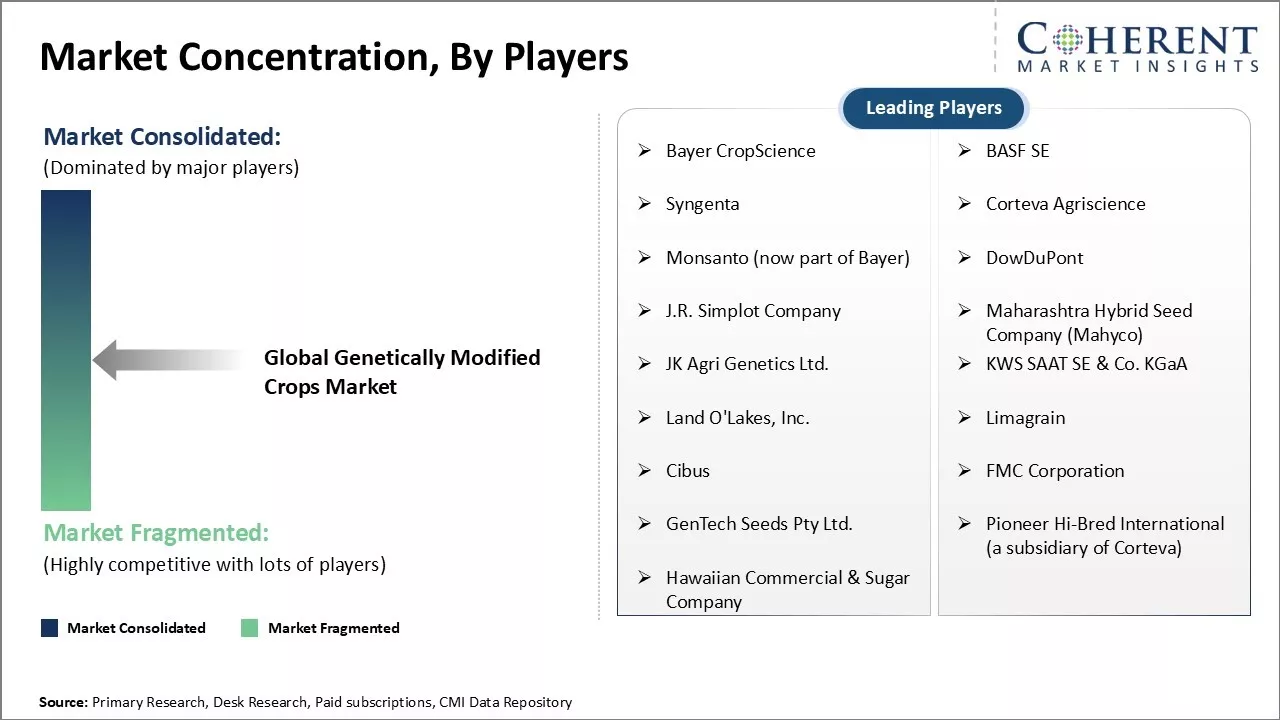
Market Concentration and Competitive Landscape
Current Events and Its Impact
Current Events | Description and its impact |
Regulatory Shifts in Major Agricultural Markets |
|
Technological and Collaborative Innovations |
|
- Current Industry Events of 2026
- Market Size Estimation
- Regional Breakdown
- Competitive Landscape
- Customer Intelligence
- Segmental Analysis
- Pricing Analysis
- Key Market Drivers, Challenges & Future Trends
- Customized Insights Section
Market Trends
Need for Enhanced Crop Yields and Resilience
The demand for genetically modified (GM) crops is propelled by the urgent need to enhance agricultural yields and resilience amid escalating environmental pressures. Climate-induced stressors—including prolonged droughts, unpredictable precipitation patterns, and heightened pest invasions—threaten global food security. GM crops address these challenges through engineered traits that bolster productivity and reduce losses.
For instance, herbicide-tolerant (HT) varieties like glyphosate-resistant soybeans enable efficient weed management, preventing yield losses of 20-30% in developing nations. Additionally, according to Farmnaut, precision technology could boost sustainable crop yields by up to 20% while reducing water use by 15%.
Regulations on GMO Crops
One of the major challenges for the global genetically modified crops market is the stringent regulations imposed on genetically modified crops by various governments and regulatory bodies across the world. Many countries such as India, Thailand and others have imposed complete bans on cultivation and sale of certain GM crops based on health, environment, and ethical concerns. Complying with these complex and diverse set of regulations across different markets require substantial investments of time and resources for GMO seed and crop producers and developers.
Segmental Insights
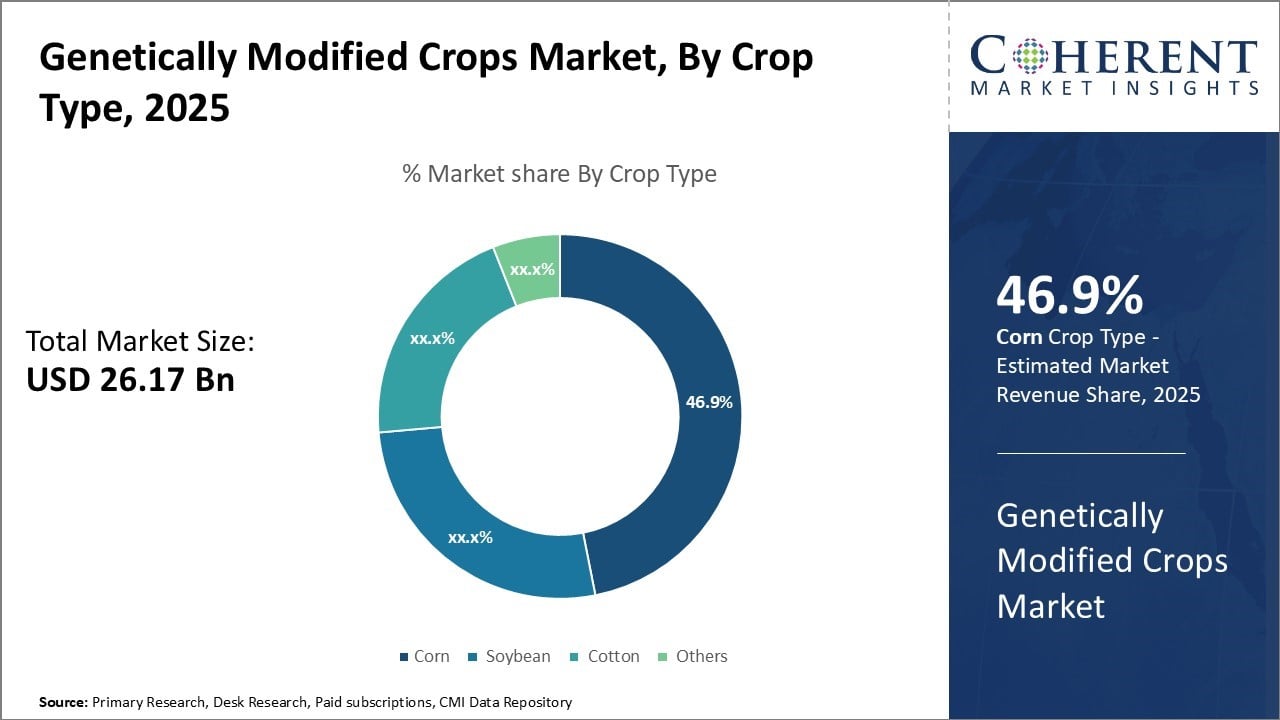
Genetically Modified Crops Market Insights, by Crop Type: Corn Dominates Due to its Versatility and Resilience
In terms of crop type, corn is expected to contribute 47.9% share of the market in 2026, owing to its versatility and resilience. Corn is widely grown globally as it adapts well to a variety of climatic conditions and soil types.
It is heat and drought tolerant, giving higher yields even in adverse weather. Corn serves as a staple food and feed crop in many countries, feeding both humans and livestock. As the most widely utilized grain, corn finds applications in various food and industrial products. Its derivatives like starch, sweeteners and corn oil are major raw materials for many industries.
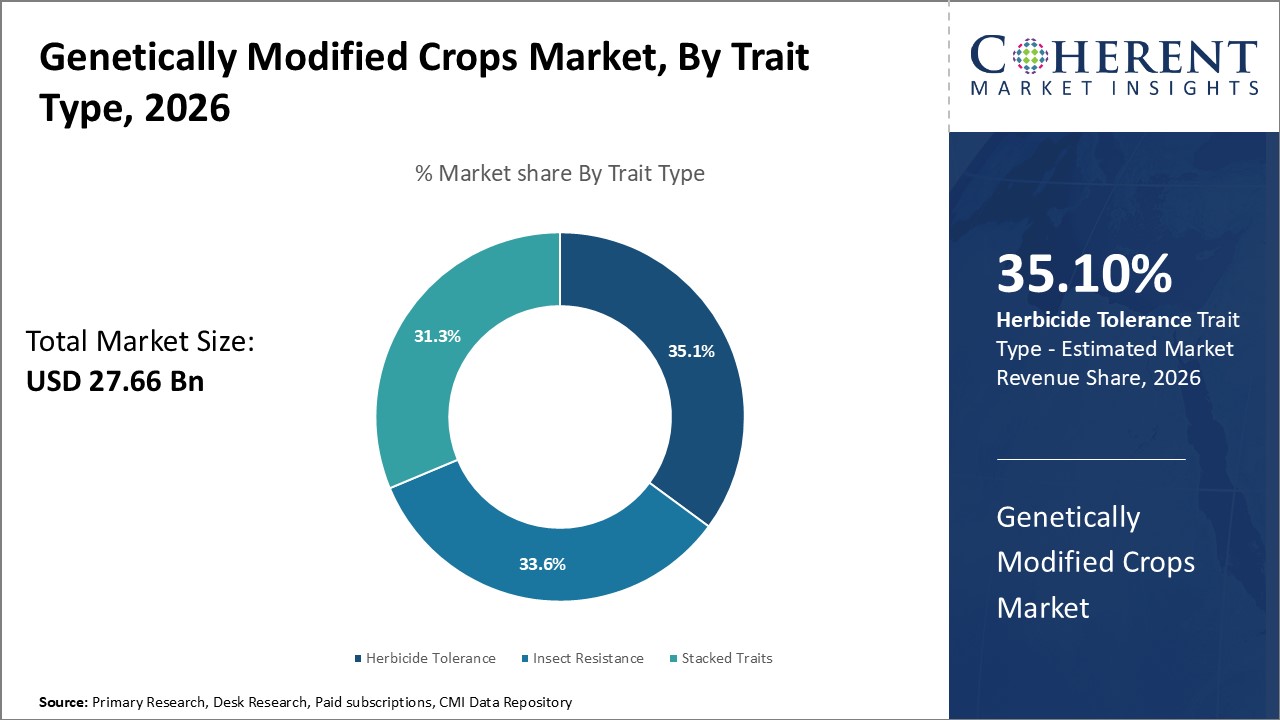
Genetically Modified Crops Market Insights, by Trait Type: Herbicide Tolerance Dominates Due to Weed Management Ease
In terms of trait type, herbicide tolerance is expected to contribute 35.1% share of the market in 2026, due to allowing easier weed management practices for farmers. Herbicide-tolerant seeds allow broad-spectrum post-emergence chemical application to eliminate weeds without affecting the crop.
This provides a cost-effective way for growers to control weeds that compete for water, light, and soil nutrients meant for crops. Not having to carefully distinguish crops from weeds by hand during spraying saves much effort and labor. Genes inserted into crops make them resistant to major herbicides like glyphosate.
Genetically Modified Crops Market Insights, by Application: Food and Feed Dominates Due to Meeting Basic Human Needs
In terms of application, food and feed is expected to contribute 41% share of the market in 2026, owing to fulfilling basic human needs.
As the world population continues growing, there is mounting pressure to increase agricultural yields to meet rising food demand, for instance, according to UN Organization, the world's population is expected to increase by nearly 2 billion persons in the next 30 years, from the current 8 billion to 9.7 billion in 2050. Genetically modified crops play a vital role in enhancing global food production through built-in resistances and higher nutrient contents.
Emerging Innovations in the Genetically Modified Crops Market
- CRISPR Gene Editing Revolution
- The most significant technological leap in genetically modified crops involves CRISPR-Cas9 gene editing technology. This precision tool enables scientists to make targeted modifications to plant DNA with remarkable accuracy. Unlike traditional genetic modification methods, CRISPR allows for precise insertion, deletion, or replacement of specific genetic sequences without introducing foreign DNA. Companies are leveraging this technology to develop crops with enhanced nutritional profiles, improved drought resistance, and extended shelf life.
- Precision Breeding Through Digital Agriculture
- The integration of artificial intelligence and machine learning with genetic modification is creating unprecedented opportunities for precision breeding. Advanced algorithms analyze vast genomic datasets to predict optimal gene combinations for specific environmental conditions and agricultural goals.
- This technological convergence enables the development of region-specific crop varieties tailored to local climate conditions, soil types, and pest pressures. Companies are utilizing satellite imagery, weather data, and soil sensors to inform genetic modification strategies, creating crops optimized for specific geographical regions.
Regional Insights
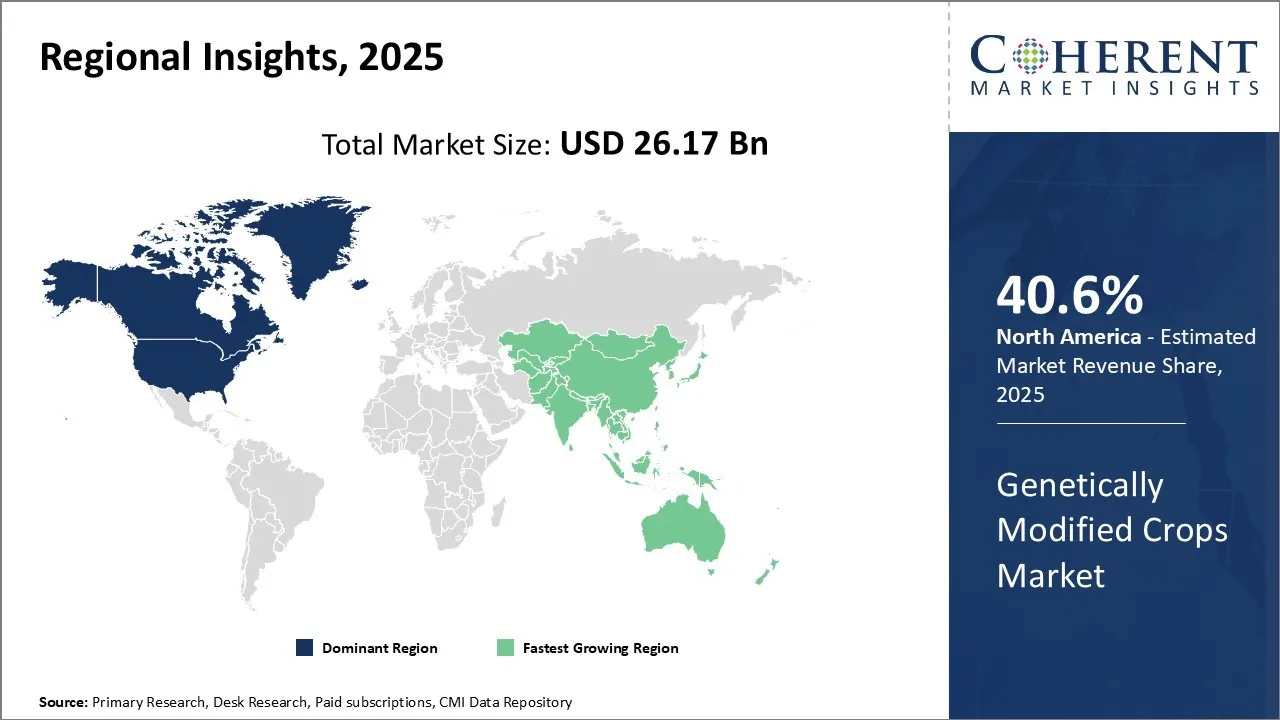
North America Genetically Modified Crops Market Analysis and Trends
North America's dominance in the global genetically modified crops market can be attributed to several factors with an estimated 40.6% share in 2026. The U.S. and Canada have been at the forefront of the adoption and commercialization of GM crops, driven by supportive regulatory frameworks, extensive research and development efforts, and the presence of major agricultural biotechnology companies.
For instance, in 2026, the United States Department of Agriculture (USDA) reported that more than 90 percent of U.S. corn, upland cotton, and soybeans are produced using GE varieties. GE crops are broadly classified in this data product as herbicide-tolerant (HT), insect-resistant (Bt), or stacked varieties that are a combination of both HT and Bt traits.
Asia Pacific Genetically Modified Crops Market Analysis and Trends
The Asia Pacific region is the fastest-growing market for GM crops, driven by the increasing demand for food and the need to enhance agricultural productivity. Countries like China, India, and Brazil have made significant strides in the development and adoption of GM crops, particularly for staple food crops like corn, soybean, and cotton. The growing population, rising incomes, and the need to address food security concerns have contributed to the rapid expansion of the genetically modified crops in the Asia pacific region.
For instance, in June 2026, the Food Standards Australia New Zealand (FSANZ) announced the evaluation of Application A1333, which seeks approval for the use of genetically modified (GM) purple tomatoes in food. The purple tomato, developed by Norfolk Healthy Produce Inc., has been genetically modified to generate natural blue pigments (anthocyanins) during ripening, resulting in its distinct purple skin and flesh.
Genetically Modified Crops Market Outlook for Key Countries
China Genetically Modified Crops Market Analysis and Trends
China is intensifying its efforts to enhance food security by expanding the cultivation of genetically modified (GM) crops. In December 2024, the country approved additional varieties of GM corn, soybeans, and cotton for domestic production, aiming to increase yields and reduce reliance on imports. The Ministry of Agriculture and Rural Affairs (MARA) has also issued safety certificates for several GM crop varieties, signaling a commitment to integrating biotechnology into agriculture
India Genetically Modified Crops Market Analysis and Trends
India's approach to GM crops is characterized by regulatory caution and public scrutiny. In May 2026, the government approved the commercialization of genetically modified rice varieties, a decision met with resistance from state governments and farmers' groups. For instance, Telangana's Agriculture and Farmers Welfare Commission urged the central government to withdraw its approval, citing potential harm to the state's paddy-based economy and concerns over agricultural sovereignty.
Argentina Genetically Modified Crops Market Analysis and Trends
Argentina has been a leader in adopting GM crops, with over 26 million hectares planted with genetically engineered soybeans, corn, and cotton. The country has established a progressive regulatory framework, allowing gene-edited crops that do not contain DNA from another species to be regulated as conventional plants. This approach has facilitated the approval of numerous GM crop varieties, positioning Argentina as a significant player in global agricultural biotechnology.
Brazil Genetically Modified Crops Market Analysis and Trends
Brazil continues to expand its acreage of genetically modified crops, particularly soybeans and corn. The country's regulatory environment supports the cultivation of GM crops, contributing to increased productivity and competitiveness in the global market. Brazil's adoption of GM technology has been instrumental in meeting the growing demand for agricultural products, both domestically and internationally.
Pricing Analysis of the Genetically Modified Crops Market
- Genetically Modified Corn (Maize)
- Conventional Corn Seed Baseline: USD 180-USD 320 per bag (80,000 seeds)
- Single Trait GM Corn: USD 220-USD 380 per bag (15-25% premium)
- Stacked Trait Systems: USD 280-USD 450 per bag (35-55% premium)
- Genetically Modified Soybeans
- Conventional Soybean Seed: USD 45-USD 75 per bag (140,000 seeds)
- First-Generation GM Soybeans: USD 55-USD 85 per bag (18-22% premium)
- Advanced Trait Soybeans: USD 65-USD 95 per bag (35-45% premium)
- Genetically Modified Cotton
- Conventional Cotton Seed: USD 85-USD 135 per bag (100,000 seeds)
- GM Cotton (Single Trait): USD 115-USD 165 per bag (25-35% premium)
- Stacked Trait Cotton: USD 145-USD 195 per bag (50-70% premium)
Market Report Scope
Genetically Modified Crops Market Report Coverage
| Report Coverage | Details | ||
|---|---|---|---|
| Base Year: | 2025 | Market Size in 2026: | USD 27.66 Bn |
| Historical Data for: | 2020 To 2024 | Forecast Period: | 2026 To 2033 |
| Forecast Period 2026 to 2033 CAGR: | 5.7% | 2033 Value Projection: | USD 40.78 Bn |
| Geographies covered: |
| ||
| Segments covered: |
| ||
| Companies covered: | Bayer CropScience, BASF SE, Syngenta, Corteva Agriscience, Monsanto (now part of Bayer), DowDuPont, J.R. Simplot Company, Maharashtra Hybrid Seed Company (Mahyco), JK Agri Genetics Ltd., KWS SAAT SE & Co. KGaA, Land O'Lakes, Inc., Limagrain, Cibus, FMC Corporation, GenTech Seeds Pty Ltd., Pioneer Hi-Bred International (a subsidiary of Corteva), and Hawaiian Commercial & Sugar Company | ||
| Growth Drivers: |
| ||
| Restraints & Challenges: |
| ||
Genetically Modified Crops Industry News
- In May 2025, Bayer introduced Preceon Smart Corn System hybrids, developed through biotechnology, are not currently available for commercial sale or commercial planting. Commercialization is dependent on multiple factors, including successful conclusion of the regulatory process. The information presented herein is provided for educational purposes only, and is not and shall not be construed as an offer to sell.
- In February 2025, Syngenta, a world leader in developing the next generation of biologicals products for agricultural use, is significantly expanding its biologicals research and development capabilities. It announced that it has acquired the Novartis repository of natural compounds and genetic strains for agricultural use, while Novartis maintains exclusive rights to repository for pharmaceutical use.
- In May 2025, Limagrain became a global player in GMOs. The group promoted GMOs for many years. Limagrain has also strengthened its presence in the plant biotechnology sector by participating in the creation of Innolea.
- In January 2025, Cibus, Inc., a leading agricultural technology company that develops and licenses plant traits to seed companies for royalties, announced that it has established production standards for its proprietary RTDS gene editing process. These standards, applicable to the company’s developed and advanced traits, represent the accomplishment of a critical goal as the company seeks to continue industrialization of plant breeding through its standardized timebound and predictable process.
Analyst View
- The genetically modified crops market continues to demonstrate robust momentum, driven by escalating global food security concerns and the urgent need to enhance agricultural productivity amid shrinking arable land. Rising population pressures, coupled with climate change challenges, are compelling farmers to adopt GM technologies that offer superior yield potential and enhanced resilience to environmental stresses.
- The integration of advanced biotechnology solutions, including drought-resistant and pest-tolerant varieties, represents a significant driver propelling market expansion across diverse agricultural segments.
- However, the market faces considerable headwinds from stringent regulatory frameworks and persistent consumer skepticism regarding GM food safety. Regulatory approval processes remain complex and time-intensive, creating barriers for market entry and product commercialization. Additionally, varying international trade policies and labeling requirements continue to fragment the global market landscape.
- Despite these challenges, substantial opportunities emerge from technological advancements in gene editing and precision agriculture. The development of next-generation GM crops with enhanced nutritional profiles and reduced environmental impact presents promising avenues for market growth. Furthermore, increasing acceptance in emerging economies creates new market penetration opportunities.
Speak to the analyst
Want personalized insights?
Take the findings above to one of our principal consultants, or have the report rebuilt around the segments, geographies and competitors you actually track.
Market Segmentation
- Crop Type Insights (Revenue, USD Billion, 2021 - 2033)
- Corn
- Soybean
- Cotton
- Others
- Trait Type Insights (Revenue, USD Billion, 2021 - 2033)
- Herbicide Tolerance
- Insect Resistance
- Stacked Traits
- Application Insights (Revenue, USD Billion, 2021 - 2033)
- Food and Feed
- Biofuels
- Others
- Regional Insights (Revenue, USD Billion 2021 - 2033)
- North America
- U.S.
- Canada
- Latin America
- Brazil
- Argentina
- Mexico
- Rest of Latin America
- Europe
- Germany
- U.K.
- Spain
- France
- Italy
- Russia
- Rest of Europe
- Asia Pacific
- China
- India
- Japan
- Australia
- South Korea
- ASEAN
- Rest of Asia Pacific
- Middle East
- GCC Countries
- Israel
- Rest of Middle East
- Africa
- South Africa
- North Africa
- Central Africa
- Key Players Insights
- Bayer CropScience
- BASF SE
- Syngenta
- Corteva Agriscience
- Monsanto (now part of Bayer)
- DowDuPont
- R. Simplot Company
- Maharashtra Hybrid Seed Company (Mahyco)
- JK Agri Genetics Ltd.
- KWS SAAT SE & Co. KGaA
- Land O'Lakes, Inc.
- Limagrain
- Cibus
- FMC Corporation
- GenTech Seeds Pty Ltd.
- Pioneer Hi-Bred International (a subsidiary of Corteva)
- Hawaiian Commercial & Sugar Company
Sources
Primary Research Interviews
- Agricultural biotechnology companies executives
- Seed manufacturers and distributors
- Farmers and agricultural cooperatives
- Regulatory affairs specialists
- Others
Databases
- USDA National Agricultural Statistics Service (NASS)
- International Service for the Acquisition of Agri-biotech Applications (ISAAA)
- FAO Statistical Database (FAOSTAT)
- Organisation for Economic Co-operation and Development (OECD) Agriculture Database
- Others
Magazines
- Seed World Magazine
- Farm Journal
- Successful Farming
- AgriMarketing Magazine
- Others
Journals
- Nature Biotechnology
- Plant Biotechnology Journal
- Others
Newspapers
- The Wall Street Journal
- Financial Times
- Reuters Agriculture News
- Bloomberg Agriculture
- Others
Associations
- Biotechnology Innovation Organization (BIO)
- International Seed Federation (ISF)
- CropLife International
- American Seed Trade Association (ASTA)
- Others
Public Domain Sources
- U.S. Environmental Protection Agency (EPA)
- European Food Safety Authority (EFSA)
- World Health Organization (WHO)
- United Nations Conference on Trade and Development (UNCTAD)
- Others
Proprietary Elements
- CMI Data Analytics Tool – Genetically Modified Crops Market
- CMI Existing Repository of Information for the Last 8 Years
*Definition: The global genetically modified crops market involves the cultivation and sale of food crops whose DNA has been modified using genetic engineering techniques. These crops are altered at the molecular level to enhance desired traits such as increased resistance to herbicides or improved nutritional content. Key players in this market develop and sell GM seeds and traits to farmers worldwide.
Get access to 250+ pages report
Every segment, forecast, competitor profile and data table behind the analysis above — available for instant download.
- ESOMAR Member
- ISO 9001:2015 Certified
- D-U-N-S Registered
- GDPR & CCPA Compliant
Missing comfort of reading report in your local language? Find your preferred language:
Transform your Strategy with Exclusive Trending Reports
Frequently Asked Questions
The genetically modified crops market is estimated to be valued at USD 27.66 Billion in 2026, and is expected to reach USD 40.78 Billion by 2033.
The CAGR of the genetically modified crops market is projected to be 5.7% from 2026 to 2033.
Increasing population and demand for high yield crops are the major factors driving the growth of the global genetically modified crops market.
Regulations on GMO crops and environmental concerns are the major factors hampering the growth of the global genetically modified crops market.
In terms of crop type, corn is estimated to dominate the market revenue share in 2026.
The main types of genetically modified crops in demand are herbicide-tolerant, insect-resistant, drought-tolerant, disease-resistant, and nutritionally enhanced crops.
Climate change is increasing demand for genetically modified crops that are drought-tolerant, heat-resistant, and resilient to extreme weather.