

Sunflower Oil Market Analysis & Forecast: 2026-2033
Sunflower Oil Market is estimated to be valued at USD 43,053.5 Mn in 2026 and is expected to reach USD 65,812.8 Mn in 2033, exhibiting a compound annual growth rate (CAGR) of 6.2% from 2026 to 2033.
Key Takeaways
- Based on Type, the High Oleic-Oil segment is expected to capture the highest share of 48.5% in 2026, driven by its stability, shelf life, and health appeal.
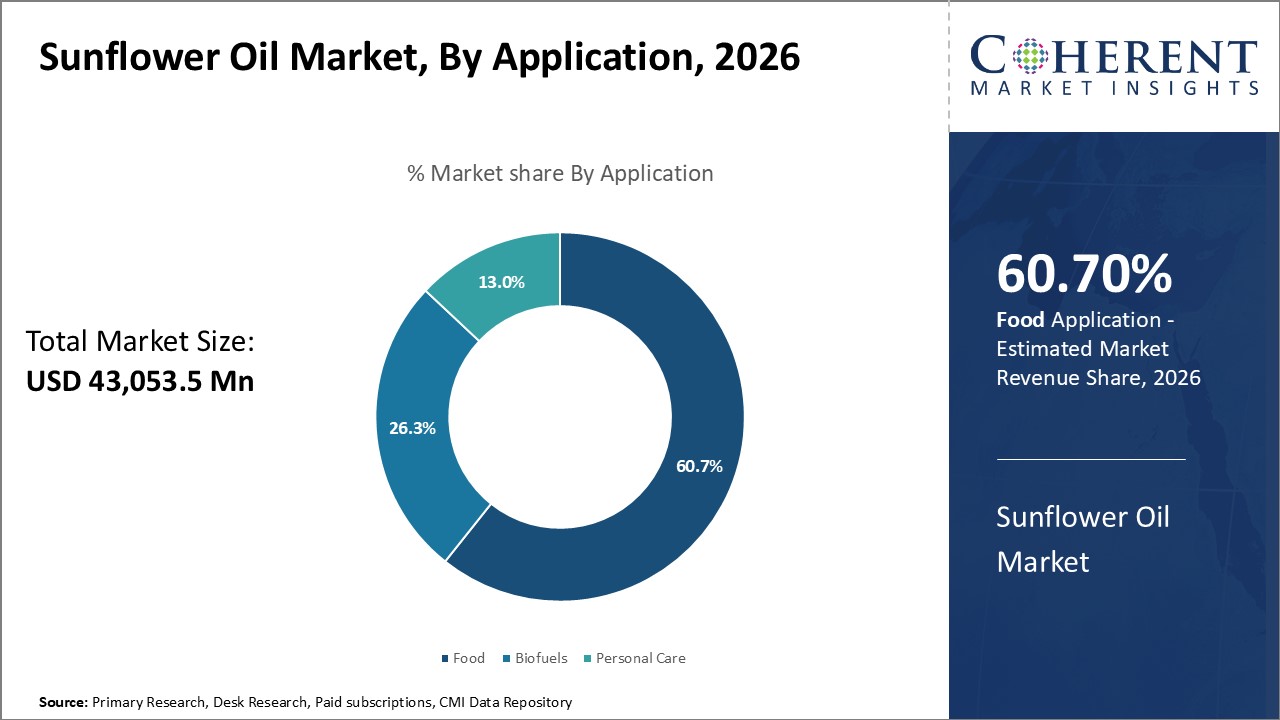
- Based on Application, the Food segment is projected to account for the largest share of the market in 2026, fueled by cooking, foodservice, and packaged foods.
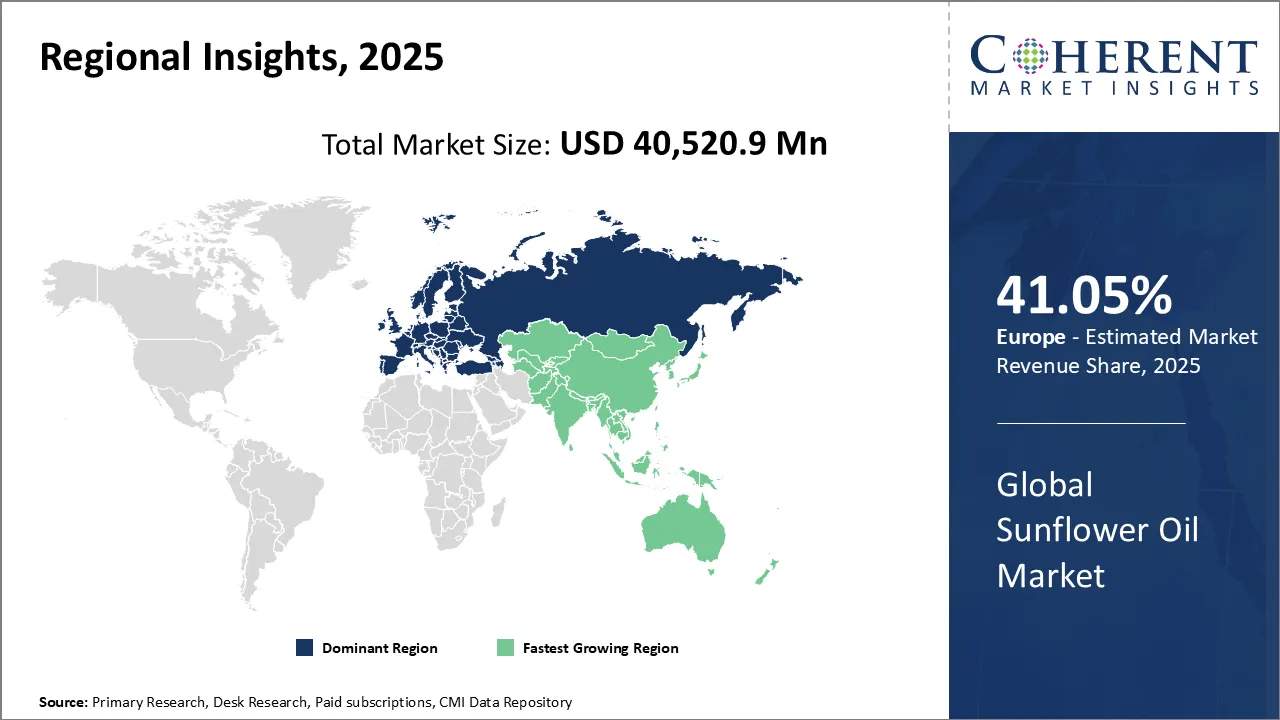
- Based on Region, Europe is set to lead the sunflower oil market in 2026 with 41.05% share. While, Asia Pacific is projected to be fastest growing region.
Market Overview
Sunflower oil market is one of the growing markets across the world. The market is experiencing a healthy growth rate due to the increasing health consciousness among consumers and their preference for light edible oils. The market is also driven by rising health awareness and adoption of healthy foods and ingredients, and the use of sunflower oil in biofuels.
Current Events and Its Impacts on the Global Sunflower Oil Market
Current Event | Description and its Impact |
Global Food Security Crisis and Policy Responses |
|
Climate Change and Weather Pattern Shifts |
|
Segmental Insights
- Current Industry Events of 2026
- Market Size Estimation
- Regional Breakdown
- Competitive Landscape
- Customer Intelligence
- Segmental Analysis
- Pricing Analysis
- Key Market Drivers, Challenges & Future Trends
- Customized Insights Section
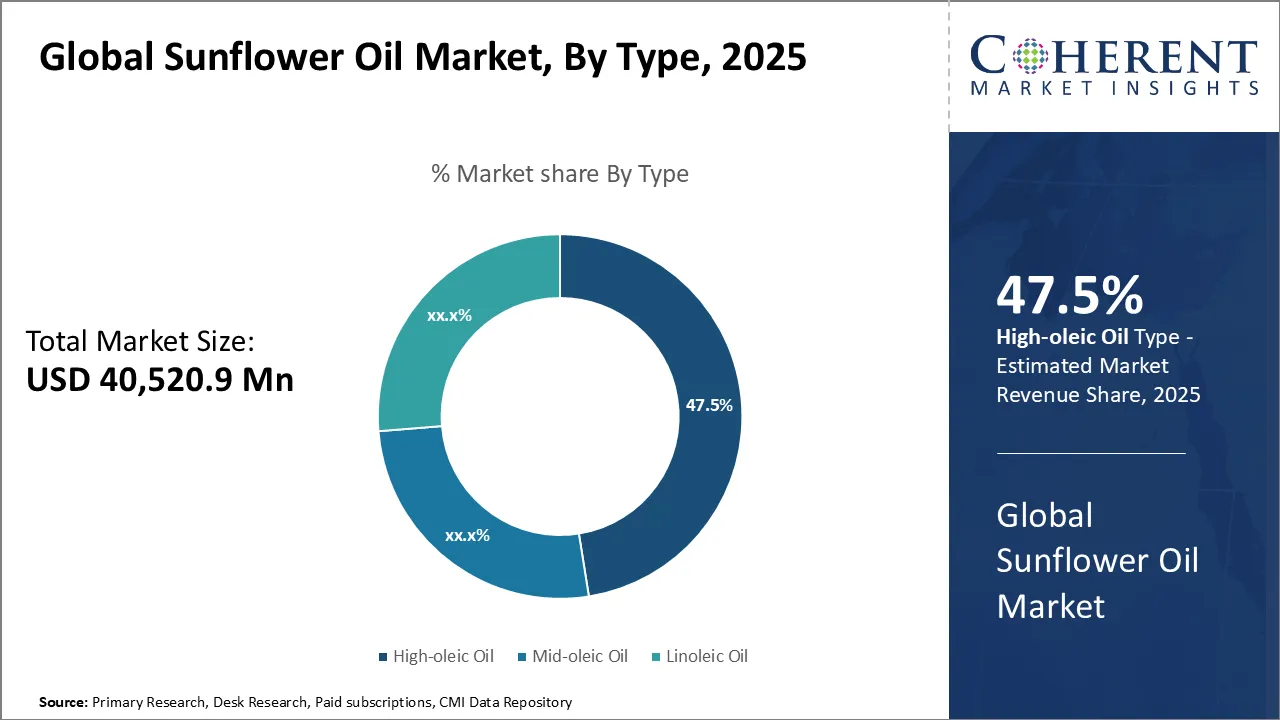
Global Sunflower Oil Market Insights, By Type: High-Oleic Sunflower Oil Dominance Is Driven by Its Stability, Shelf Life, And Health Appeal
In terms of type, the high-oleic oil segment is expected to lead the market with 48.5% share in 2026. Its superiority is due to its longer shelf life, oxidative stability, and suitability for industrial food processing and frying. Because it prevents rancidity and preserves flavor, food manufacturers favor it for packaged foods, baked goods, and snacks. Demand for heart-healthy oils high in monounsaturated fats has increased due to growing consumer awareness, with high-oleic oils clearly outperforming mid-oleic and linoleic oils.
Global Sunflower Oil Market Insights, By Application: Food Lead Is Fueled by Cooking, Foodservice, And Packaged Foods
In terms of application, the food segment is expected to hold the largest share of the market in 2026. The main drivers are cooking at home, food service (like restaurants and catering), and making packaged food. Sunflower oil is a common kitchen item around the world because it has a light taste, can be used in many ways, and is good for your health. The rise in demand for ready-to-eat meals, fried snacks, and convenience foods has made it even more of a leader.
For instance, in December 2024, Tata Simply Better has introduced its new sunflower oil, a kitchen game-changer for 2025. The oil is marketed as having a light taste, being versatile, and being good for your health. It is made to meet the needs of modern cooking. Tata's launch strengthens its presence in the food segment and in people's homes as demand for healthier oils grows.
Regional Insights
Europe Sunflower Oil Market Analysis & Trends
Europe is projected to lead the sunflower oil market with 41.05% share in 2026, as it is both a major producer and consumer. Growth is fueled by the widespread use of oils rich in unsaturated fats in home cooking, packaged foods, and food service, as well as people's preference for these oils. Europe's dominance in the global market is even stronger because it has established processing infrastructure and export capacity.
For instance, in September 2026, The Louis Dreyfus Company (LDC) has announced that it successfully bought the grain and oilseed businesses in Hungary and Poland. The move gives LDC a bigger presence in Europe's agricultural sector, especially in the production of sunflower seeds. This expansion is expected to improve supply chains and boost the processing and trade of sunflower oil, which will strengthen LDC's position in the global edible oil market.
Asia Pacific Sunflower Oil Market Analysis & Trends
Asia Pacific is anticipated to be the fastest growing region, due to people are becoming more health-conscious, cities are growing quickly, and people are making more money. China, India, and Japan are some of the countries that are driving consumption through cooking at home, packaged foods, and snacks. Asia-Pacific is the fastest-growing region in the world because of its growing food processing industries and the switch to healthier oils.
For instance, in July 2026, The Selangor Agricultural Development Corporation (PKPS) are scheduled to begin shipping sunflower oil, edible oil, and margarine to Australia under the Ehsan brand in July 2026. The first shipment will be about 30 tons, and the goal is to increase Selangor's income while also improving food security and Malaysia's presence in the global edible oil market.
Sunflower Oil Market Outlook Country-Wise
Belgium Sunflower Oil Market Trends
Belgium's sunflower oil market in 2026 will be driven by rising demand for healthier cooking oils, which is supported by strong imports and refining capacity. Belgium uses advanced refining and blending technologies for things like cooking, biofuels, cosmetics, and medicines. Sunflower oil's role in Belgium's food and industrial sectors is even stronger because EU consumers prefer sustainable, plant-based products.
For instance, in October 2026, The European Food Safety Authority (EFSA) given Kensing exclusive permission to use phytosterols from sunflowers. This approval lets the Belgian company sell its plant-based compounds all over the EU, which strengthens their role in functional foods and supplements. The move makes sunflower oil by-products stand out as important parts of heart-healthy and environmentally friendly diets.
China Sunflower Oil Market Trends
The market for sunflower oil in China is growing in 2026 because people are becoming more health-conscious and prefer light, cholesterol-friendly cooking oils. Strong imports from Kazakhstan, Ukraine, and Russia meet domestic demand, and the market is growing because more middle-class people are buying things and the food industry is using more of them. New ideas in logistics make China's role as a major importer of sunflower oil even stronger.
For instance, in September 2026, Kazakhstan Temir Zholy (KTZ) advanced up with a new way to send vegetable oil to China that makes the process more efficient and helps trade flow. Kazakhstan is a big producer of sunflower oil, so the new logistics system should help exports and make supply chains in the region stronger. This change shows that Asian markets are becoming more interested in sunflower oil.
Market Report Scope
Sunflower Oil Market Report Coverage
| Report Coverage | Details | ||
|---|---|---|---|
| Base Year: | 2025 | Market Size in 2026: | USD 43,053.5 Mn |
| Historical Data for: | 2020 To 2024 | Forecast Period: | 2026 To 2033 |
| Forecast Period 2026 to 2033 CAGR: | 6.2% | 2033 Value Projection: | USD 65,812.8 Mn |
| Geographies covered: |
| ||
| Segments covered: |
| ||
| Companies covered: | Archer Daniels Midland Company, Bunge Limited, Cargill Incorporated, Avril Group, KAISSA, Optimusagro Trade, Risoil SA, Gustav Heess Oleochemische GmbH, MWC Oil, and Delta Wilmar | ||
| Growth Drivers: |
| ||
| Restraints & Challenges: |
| ||
Global Sunflower Oil Market Drivers
Growing demand for sunflower due to its various health benefits to propel market growth
Sunflower oil is one of the healthiest cooking oils available in the market. It has a wide range of benefits, including anti-inflammatory properties and a high level of essential fatty acids, making it an excellent choice for all of food preparation needs. It’s also a great source of vitamin E, which is essential for healthy skin and hair. It can help lighten skin marks and scars and is a powerful moisturizing agent. It’s also high in antioxidants, which helps to reduce oxidative stress and protect against harmful effects of UV radiation.
Increasing use of sunflower oil in non-food applications to foster market growth
Sunflower oil is an important vegetable oil. It is used in many different food products and has been around for thousands of years. It can be made into a variety of products and is often used in baking, snack foods, health and dietary supplements as well as for cooking. It is also used in many industrial processes, as a fuel and for making paints and coatings. There are several types of sunflower oil, each with its own properties and benefits. These include high oleic, mid oleic and linoleic varieties. Sunflower oil is also used in various emulsion for body and face. So it has wide use in personal care and cosmetic sector as well.
Global Sunflower Oil Market Opportunities
Increasing use of sunflower oil for producing biodiesel is expected to serve major growth opportunities. Sunflower oil has high scope for offsetting petroleum diesel use, especially at the farm scale. The Oil composition of sunflower oil is similar to that of other vegetable oils, such as safflower and soy, and biodiesel from sunflower is projected to serve properties similar to biodiesel from soy.
Growing use of sunflower oil in multivitamins due to its numerous health benefits is expected to offer significant growth opportunities. Sunflower oil is a great way to add healthy fats to diet. They're higher in MUFAs and lower in PUFAs, which can make them less susceptible to oxidative damage during the refining process. In addition, sunflower oil has the ability to hydrate skin and improve its appearance. It can even help shrink pores and reduce the appearance of blemishes. Sunflower oil is a great source of Vitamin E which helps to reduce the risk of chronic diseases. It also increases immunity and improves the skin's barrier function.
Global Sunflower Oil Market Trends
Consumer is inclining towards healthier cooking oils for frying purposes
Increased consumption of healthy cooking oil, a rise in disposable income, and supportive government initiatives to promote sunflower cultivation are recent trends. Moreover, developing regions are witnessing rapid growth in food processing industry, which largely relies on the use of sunflower oil for improving taste and texture is again uplifting market growth.
Increased consumption of natural neutral oils is another trend
Natural neutral oils are healthier for consumption and provide more nutritional value. Moreover, increase in the use of sunflower oil in cosmetics as a vegan alternative to beeswax is again propelling market growth. The rise in clean beauty and vegan trends is projected to drive the global sunflower oil market in the coming years.
Analyst Opinion (Expert Opinion)
Production concentration, global trade flows, and the economics of refining still have significant effects on the sunflower oil market value. Russia and Ukraine together make the most sunflower oil in the world, with each making several million tonnes a year. This concentration makes people more aware of how the harvests in the area, the efficiency of the export terminals, and the availability of logistics. Ukraine and Argentina are still two of the biggest exporters of refined sunflower oil. This affects the supply and cost of sunflower oil in major importing areas around the world.
Prices have been very unstable from 2024 to 2025, with wholesale and retail indices showing big changes from month to month because of changes in seed availability, shipping costs, and policy. When sunflower seed prices go up or when other oilseeds like soy or rapeseed have trouble getting enough supply, crushing margins stay under pressure.
Strong use in home cooking, packaged foods, and food service channels supports demand. Consumers are also choosing unsaturated oils over traditional palm or blended oils more and more. Changes in import duties in major consuming countries, especially cuts in duties on crude edible oils, have changed sourcing strategies to favor crude imports. This has changed the incentives for local refining and affected short-term price levels.
Overall, the market is likely to stay sensitive to supply, with changes in trade policy, logistics issues, and the availability of seeds at certain times of the year continuing to affect pricing and buying decisions.
Speak to the analyst
Want personalized insights?
Take the findings above to one of our principal consultants, or have the report rebuilt around the segments, geographies and competitors you actually track.
Global Sunflower Oil Market: Key Developments
- In November 2025, Freedom Sunflower Oil started its "Coaching the Coach" campaign with cricket great Rahul Dravid. The goal of the initiative is to get people to check the amount of oil in a package before they buy it, which will make the edible oil market more open and aware. The campaign mixes sports with teaching people about the product, which helps Freedom's brand stand out in India's crowded sunflower oil market.
- In September 2025, the amount of land used to grow sunflowers in the U.S. went up by 72%. This was a big boost for the edible oil industry. The expansion is likely to improve the supply of sunflower seeds, which will help make more sunflower oil. Farmers are growing more sunflowers because there is a growing demand for healthier cooking oils and the market looks good.
Market Segmentation
- Global Sunflower Oil Market, By Type (Revenue, USD Mn, 2021 - 2033)
- Linoleic Oil
- Mid-oleic Oil
- High-oleic Oil
- Global Sunflower Oil Market, By Application (Revenue, USD Mn, 2021 - 2033)
- Food
- Biofuels
- Personal Care
- Global Sunflower Oil Market, By Geography (Revenue, USD Mn, 2021 - 2033)
- North America
- U.S.
- Canada
- Latin America
- Brazil
- Argentina
- Mexico
- Rest of Latin America
- Europe
- Germany
- U.K.
- Spain
- France
- Italy
- Russia
- Rest of Europe
- Asia Pacific
- China
- India
- Japan
- Australia
- South Korea
- ASEAN
- Rest of Asia Pacific
- Middle East
- GCC Countries
- Israel
- Rest of Middle East
- Africa
- South Africa
- North Africa
- Central Africa
- North America
- Key Companies Insights (Revenue, USD Mn, 2021 - 2033)
- Archer Daniels Midland Company
- Bunge Limited
- Cargill Incorporated
- Avril Group
- KAISSA
- Optimusagro Trade
- Risoil SA
- Gustav Heess Oleochemische GmbH
- MWC Oil
- Delta Wilmar
Sources
Primary Research Interviews
- Sunflower seed farmers / growers
- Oilseed crushing mill owners & operators
- Edible oil refiners (sunflower oil lines)
- Packers & private-label edible-oil brands
- Large retailers & foodservice buyers (procurement)
- Bulk traders / commodity merchandisers / exporters-importers
- Logistics & cold-chain providers for edible oils
- Agricultural commodity analysts & market consultants
- Government agriculture / trade officers (export controls, subsidies)
- Others
Databases
- Bloomberg Terminal
- Thomson Reuters Eikon
- Oil World (market intelligence service)
- USDA Foreign Agricultural Service (FAS) / PSD (production, supply & distribution)
- FAOSTAT (Food and Agriculture Organization)
- Euromonitor International
- S&P Global Market Intelligence
- UN Comtrade
- Others
Magazines
- World Grain
- FoodNavigator / FoodNavigator-Asia
- Oils & Fats International (OFI)
- The Grocer (edible oils / grocery retail coverage)
- Refining & Milling trade magazines
- Others
Journals
- Journal of Agricultural and Food Chemistry
- Journal of Food Science
- Lipids
- European Journal of Lipid Science and Technology
- Agricultural Systems / Crop Science journals (for yield, agronomy)
- Others
Newspapers
- Financial Times
- The Wall Street Journal
- Reuters
- Bloomberg News
- The Economic Times (India)
- Others
Associations
- International Sunflower Association (ISA) / regional sunflower associations
- National Sunflower Association (USA)
- FEDIOL — The European Vegetable Oil and Proteinmeal Industry Federation
- National oilseed / vegetable oil associations (country-level)
- International Trade Centre (ITC) trade bodies (relevant commodity groups)
- Others
Public Domain Sources
- FAO (Food and Agriculture Organization) / FAOSTAT
- USDA (United States Department of Agriculture) — FAS reports & WASDE where relevant
- UN Comtrade (international trade statistics)
- World Bank Open Data (macroeconomic / trade indicators)
- Eurostat (EU production & trade statistics)
- Country agriculture ministries / national statistical agencies (production, acreage, yields)
- Others
Proprietary Elements
- CMI Data Analytics Tool
- Proprietary CMI existing repository of sunflower-/edible-oil information (last 8 years)
Definition: Sunflower oil is one of the healthiest cooking oils. It’s also a great source of vitamin E, which is essential for healthy skin and hair. It can help lighten skin marks and scars and is a powerful moisturizing agent. It’s also high in antioxidants, which helps reduce oxidative stress and protect against harmful effects of UV radiation.
Get access to 250+ pages report
Every segment, forecast, competitor profile and data table behind the analysis above — available for instant download.
- ESOMAR Member
- ISO 9001:2015 Certified
- D-U-N-S Registered
- GDPR & CCPA Compliant
Missing comfort of reading report in your local language? Find your preferred language:
Transform your Strategy with Exclusive Trending Reports
Frequently Asked Questions
The Sunflower Oil Market is estimated to be valued at USD 43,053.5 Mn in 2026, and is expected to reach USD 65,812.8 Mn by 2033.
The CAGR of the Sunflower Oil Market is projected to be 6.2% from 2026 to 2033.
Growing demand for sunflower due to its various health benefits are fuelling market.
The Linoleic Oil segment is the leading component segment in the market.
Gap in production and supply is the major factors restraining growth of the market.
Archer Daniels Midland Company, Bunge Limited, Cargill Incorporated, Avril Group, KAISSA, Optimusagro Trade, Risoil SA, Gustav Heess Oleochemische GmbH, MWC Oil, and Delta Wilmar