

Phytonutrients Market Size and Forecast – 2026 to 2033
The Phytonutrients Market is anticipated to grow at a CAGR of 5.8% with USD 6.1 Bn in 2026 and is expected to reach USD 9.2 Bn in 2033. Consumers increasingly prioritize healthy lifestyles, which boosts demand for phytonutrients. Manufacturers expand functional food, dietary supplement, and plant-based nutrition offerings to meet growing consumer interest. According to our research, the global functional food market is expected to surpass USD 403.98 Bn by 2033.
Key Takeaways
- Carotenoids hold the largest market share of 37.8% in 2026 owing to the growing demand for natural ingredients. Carotenoids are widely used across dairy, bakery, confectionery, and beverage applications, with beta-carotene, annatto, and lycopene identified as key carotenoid-based natural colorants.
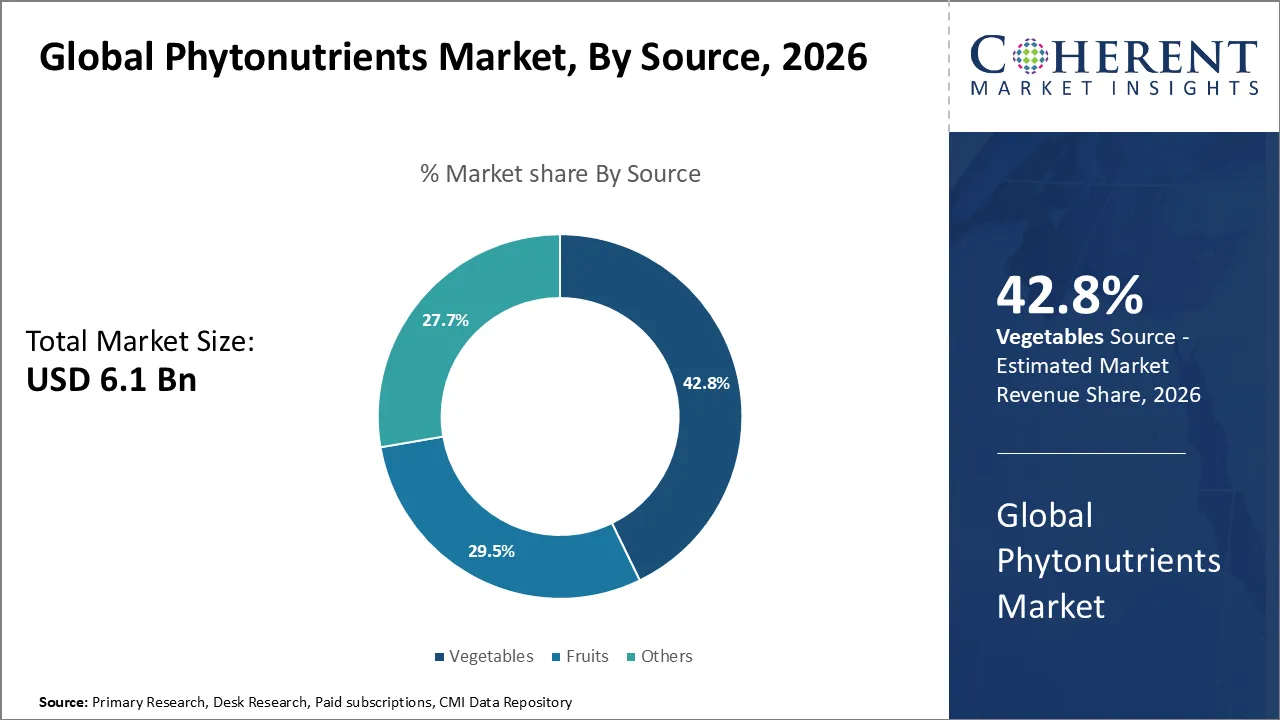
- Vegetables expected to hold largest market share of 42.8% in 2026 owing to its growing health and wellness awareness. According to the Global Wellness Institute, the global wellness economy grew by 7.9% from 2023-2024.
- Green acquired the prominent market share of 38.6% in 2026 owing to the increasing demand for chlorophyll and chlorophyll-rich ingredients.
- North America is expected to acquire the dominant share of 41.1% in 2026 owing to its expansion of functional foods and beverages.
Current Events and Their Impact on the Phytonutrients Market
Current Event | Description and its Impact |
U.S. FDA Policy Shift on Natural Food Colors |
|
FDA Safety and Purity Requirements for Natural Color Additives |
|
Segmental Insights
- Current Industry Events of 2026
- Market Size Estimation
- Regional Breakdown
- Competitive Landscape
- Customer Intelligence
- Segmental Analysis
- Pricing Analysis
- Key Market Drivers, Challenges & Future Trends
- Customized Insights Section
Vegetables expected to hold largest market share
Vegetables expected to hold largest market share of 42.8% in 2026 owing to its growing clean-label trend. The vegetables segment in the phytonutrients market grows as consumers increasingly recognize the importance of healthy diets and plant-based nutrition. Manufacturers respond to rising demand for natural, clean-label, and functional ingrexdients by incorporating vegetable-derived phytonutrients into dietary supplements, functional foods, beverages, and nutraceuticals. Consumers actively seek antioxidant-rich products containing polyphenols, flavonoids, carotenoids, and glucosinolates. Meanwhile, advances in extraction, processing, and preservation technologies enable manufacturers to retain valuable bioactive compounds and expand the commercial use of vegetable-based phytonutrients across multiple industries. For instance, As consumers prioritize health-focused foods, Takii is launching its premium Phytorich range of flavorful, phytonutrient-rich vegetables for European food industry players at Fruit Logistica.
Why is Carotenoids Acquiring the Largest Market Share?
Carotenoids hold the largest market share of 37.8% in 2026. The carotenoids segment in the phytonutrients market benefits from rising consumer demand for natural and plant-based ingredients, greater awareness of antioxidant and nutritional benefits, and expanding use in dietary supplements, functional foods, and beverages. Manufacturers increasingly use carotenoids such as beta-carotene, lutein, lycopene, and astaxanthin in eye-health, skincare, and wellness products. Consumers also drive growth by preferring clean-label formulations and natural food colors. In addition, nutraceutical companies expand carotenoid applications, while advances in extraction, stabilization, and delivery technologies improve product development. For instance, Portuguese company GRA Nutra has launched a fermentation-derived beta-carotene color for food and beverage applications in the US. The company introduced the new color as food manufacturers increasingly replace artificial dyes with clean-label alternatives across their supply chains.
Which Color segment dominates the market?
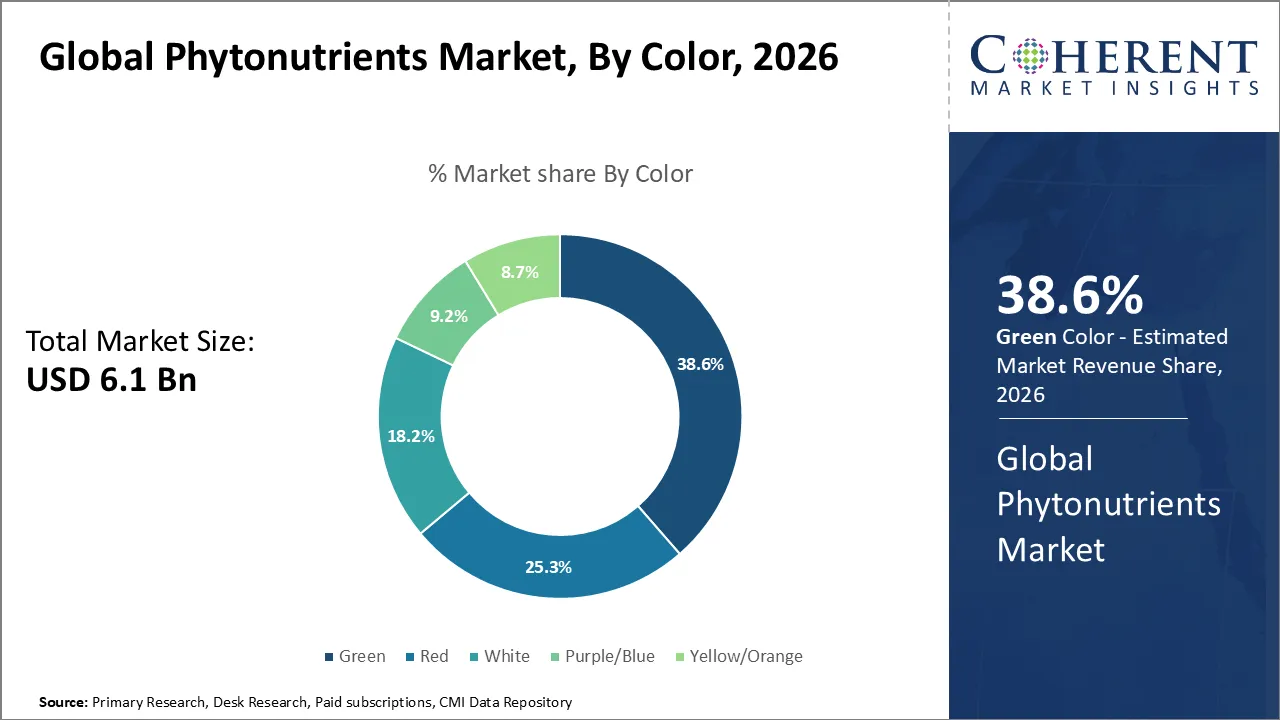
Green acquired the prominent market share of 38.6% in 2026. The green segment in the phytonutrients market expands as consumers increasingly choose natural, plant-based, and nutrient-rich products. Growing health consciousness encourages consumers to seek green vegetables, leafy plants, herbs, algae, and botanical extracts rich in chlorophyll, polyphenols, flavonoids, and other bioactive compounds. Manufacturers use these ingredients in functional foods, beverages, dietary supplements, nutraceuticals, and personal-care products. The clean-label movement further increases demand, while technological advances in extraction, processing, and stabilization enable manufacturers to preserve bioactive compounds and create innovative products for diverse applications.
Phytonutrients Market Trends
- Rising consumer preference for natural, plant-based, and clean-label ingredients: Natural sources are increasingly being investigated as sources of carotenoids for food, feed, nutraceutical and cosmeceutical applications. A 2022 peer-reviewed review identified β-carotene, lutein, astaxanthin, lycopene, zeaxanthin, bixin and capsanthin, among others, as natural carotenoids under active research and application.
- Growing interest in preventive health and wellness: Research on phytonutrients increasingly focuses on compounds such as carotenoids and polyphenols because of their potential biological activities. Carotenoid research covers applications related to eye, cardiovascular, metabolic, skin and neurological health, although the strength of evidence varies by compound and health outcome.
- Advances in extraction, encapsulation, stabilization and delivery technologies: A 2025 review identifies spray drying, freeze drying, electrospinning, lipid-based delivery systems and solid-liquid nanoparticles among technologies being investigated for carotenoid encapsulation. These approaches are being studied to address carotenoid instability caused by light, heat and oxygen and to improve solubility, stability and controlled release.
Regional Insights
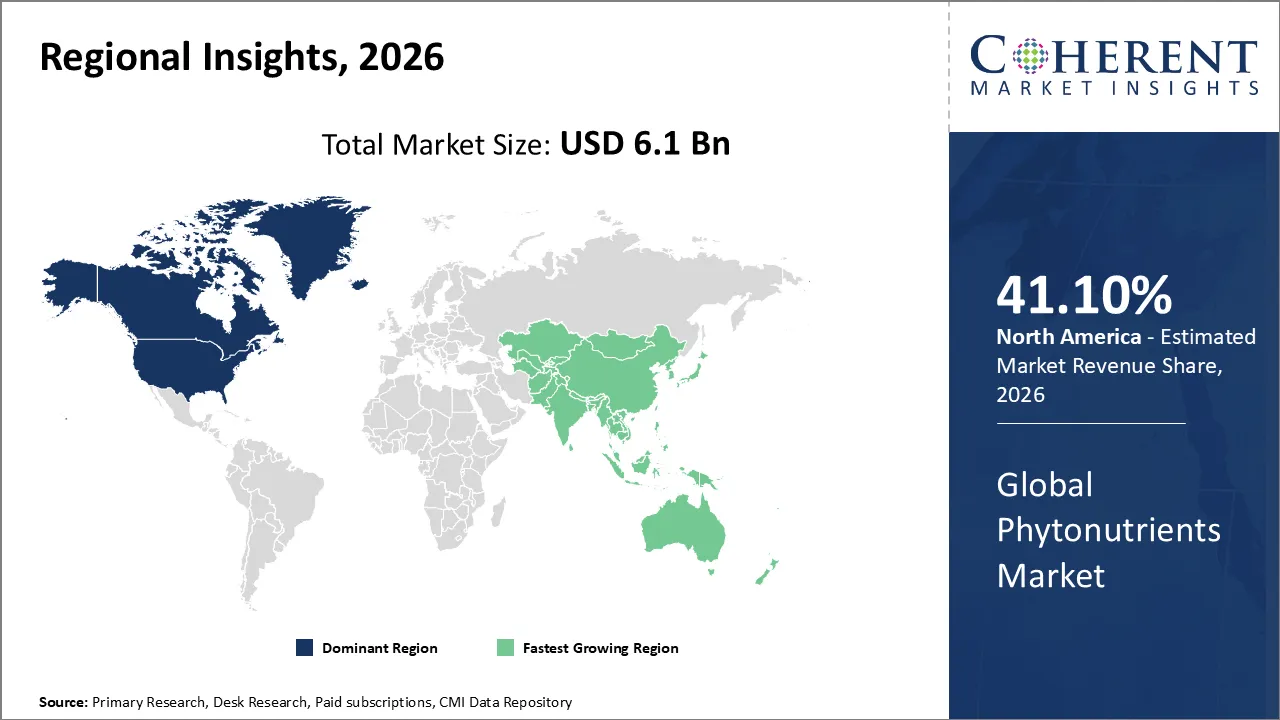
North America dominates owing to advanced food and ingredient industry
North America is expected to acquire the dominant share of 41.10% in 2026. The North American phytonutrients market expands as consumers prioritize health, nutrition, and preventive wellness. Rising demand for natural, plant-based, and clean-label ingredients encourages manufacturers to add phytonutrients to functional foods, beverages, dietary supplements, and nutraceuticals. Established food, nutrition, and supplement industries support continuous product innovation and commercialization across the region. Growing interest in plant-based diets and antioxidant-rich products further stimulates demand. Meanwhile, advances in extraction, formulation, stabilization, and delivery technologies help manufacturers develop stable, bioavailable phytonutrient products for diverse applications. For instance, Huel expanded its U.S. product portfolio with Ready-to-Drink beverages, Flavor Boosts, and reformulated Pre-blend Powders. The vegan products provide essential vitamins, minerals, protein, fats, carbohydrates, fiber, and phytonutrients while supporting convenient, nutritionally complete meals.
Asia Pacific Phytonutrients Market Trends
Rising consumer awareness of preventive healthcare and plant-based nutrition is driving the Asia Pacific phytonutrients market. Consumers increasingly demand functional foods, dietary supplements, nutraceuticals, and natural beverages containing antioxidants, carotenoids, flavonoids, and phytosterols. Higher disposable incomes, rapid urbanization, and evolving dietary preferences further stimulate product adoption. The region’s abundant botanical resources also support manufacturers, while expanding food and beverage industries and growing consumer preference for clean-label, natural, and plant-derived ingredients continue to create new market opportunities. Country Delight has launched 100% Pure Farm Honey, NMR-tested to ensure quality. The honey provides natural antioxidants and phytonutrients, offering a wellness-focused alternative to refined sugar.
United States Phytonutrients Market Trends
In the United States, growing consumer interest in preventive healthcare, functional foods, and plant-based nutrition drives the phytonutrients market. Consumers increasingly recognize the benefits of antioxidants, flavonoids, carotenoids, and polyphenols, boosting demand for dietary supplements and fortified foods. Manufacturers also incorporate phytonutrients into products as consumers seek clean-label and natural ingredients. Rising demand for sports nutrition, beverages, and personalized wellness products further supports market growth, while companies use product innovation and research to expand applications across food and healthcare industries. Dr. Wolff USA launched Plantur 21, a Nutri-Caffeine hair-care line for long hair, and Plantur 39, a Phyto-Caffeine range designed for hair over forty, bringing the popular German products to the U.S. market.
China Phytonutrients Market Trends
China’s phytonutrients market continues to expand as consumers increasingly prioritize preventive healthcare and plant-based nutrition. Manufacturers are adding carotenoids, flavonoids, polyphenols, and phytosterols to functional foods, dietary supplements, and fortified beverages to meet rising demand. A growing middle class is also increasing consumption of health-oriented products, while interest in natural and clean-label ingredients strengthens market opportunities. Companies are incorporating traditional Chinese medicine into innovative products, while advances in food technology and distribution networks further enhance product availability and support market development.
Who are the Major Companies in Phytonutrients Industry
Some of the major key players in Phytonutrients are FMC Corporation, Royal DSM N.V., Raisio Plc., Archer Daniels Midland Company, Cargill Inc., BASF SE, DowDuPont Inc., Kemin Industries, Chr Hansen A/S, and Sabinsa Corporation.
Key News
- In January 2026, Herbalife has launched SharpSpearmint in Indonesia, promoting balanced nutrition and healthy lifestyles that include regular physical activity and phytonutrient-rich foods.
Market Report Scope
Phytonutrients Market Report Coverage
Report Coverage | Details | ||
Base Year: | 2025 | Market Size in 2026: | USD 6.1 Bn |
Historical Data for: | 2020 to 2024 | Forecast Period: | 2026 to 2033 |
Forecast Period 2026 to 2033 CAGR: | 5.8% | 2033 Value Projection: | USD 9.2 Bn |
Geographies covered: |
| ||
Segments covered: |
| ||
Companies covered: | FMC Corporation, Royal DSM N.V., Raisio Plc., Archer Daniels Midland Company, Cargill Inc., BASF SE, DowDuPont Inc., Kemin Industries, Chr Hansen A/S, and Sabinsa Corporation. | ||
Analyst Opinion
- China’s phytonutrients market is being shaped less by generic “health and wellness” trends and more by the country’s established food-medicine culture. A 2025 peer-reviewed survey of 2,815 Chinese adults found that 96.1% of purchasers consumed food-medicine dual-purpose products primarily for healthcare, while 62.0% actively wanted to learn more about these ingredients. Yam and wolfberry were among the most frequently consumed products, showing that consumers already associate plant-derived ingredients with health benefits.
- The strongest opportunity lies in converting traditional botanical consumption into standardized phytonutrient ingredients. Historical evidence from 8,645 Chinese functional-food products found flavonoids, saponins, and polysaccharides among the most widely used functional ingredients. This demonstrates that Chinese manufacturers have already built formulation experience around plant bioactives; the next competitive step is likely to be greater extraction, purification, standardization, and incorporation into modern supplements, beverages, and functional foods.
- Digital commerce is becoming a critical accelerator for phytonutrient adoption because it allows ingredient-led products to reach consumers beyond traditional pharmacies and health-food stores. China recorded RMB 13.1 trillion in online physical-goods retail sales in 2025, equivalent to 26.1% of total consumer-goods retail sales, while online food sales increased 14.5%. We believe this channel shift particularly benefits differentiated phytonutrient formulations that can communicate specific functional benefits directly to consumers through digital platforms.
- China’s large and increasingly sophisticated functional-food ecosystem also gives phytonutrients a clear route beyond conventional supplements. Industry data indicate that functional foods account for more than 65% of China’s health-food market, with applications spanning nutritional supplementation, immune support, fatigue management, and blood-lipid regulation. In our assessment, carotenoids, polyphenols, phytosterols, and other plant bioactives will gain traction when manufacturers embed them into familiar everyday formats rather than positioning them solely as standalone supplements.
Speak to the analyst
Want personalized insights?
Take the findings above to one of our principal consultants, or have the report rebuilt around the segments, geographies and competitors you actually track.
Market Segmentation
- By Product type (Revenue, USD Bn, 2021-2033)
- Carotenoids
- Flavonoids
- Isothiocyanates
- Monoterpenes
- Organosulfur
- Phenolic
- Saponins
- By Source (Revenue, USD Bn, 2021-2033)
- Fruits
- Vegetables
- Others
- By Color (Revenue, USD Bn, 2021-2033)
- Green
- Red
- White
- Purple/Blue
- Yellow/Orange
- By Region (Revenue, USD Bn, 2021-2033)
- North America
- U.S.
- Canada
- Latin America
- Brazil
- Mexico
- Argentina
- Rest of Latin America
- Europe
- Germany
- U.K.
- France
- Italy
- Spain
- Russia
- Rest of Europe
- Asia Pacific
- China
- India
- Japan
- Australia
- South Korea
- ASEAN
- Rest of Asia Pacific
- Middle East
- GCC
- Israel
- Rest of Middle East
- Africa
- South Africa
- Central Africa
- North Africa
- North America
Sources
Primary Research interviews
- Food and beverage manufacturers
- Nutraceutical and dietary supplement manufacturers
- Phytonutrient ingredient suppliers
- Functional food and beverage companies
- Botanical extract producers
- Food technologists and formulation specialists
- Nutritionists and registered dietitians
- Research scientists specializing in phytochemicals and bioactive compounds
- Distributors and wholesalers of functional ingredients
- Industry experts and regulatory professionals
Databases
- USDA FoodData Central
- USDA Agricultural Research Service (ARS) databases
- USDA National Agricultural Library (NAL) Phytonutrients Resources
- PubMed
- National Center for Biotechnology Information (NCBI)
- NIH Office of Dietary Supplements databases and resources
- FDA Food and Dietary Supplement databases
- FAO Food Composition Databases
- WHO JECFA Database
- Dr. Duke’s Phytochemical and Ethnobotanical Databases
- European Food Safety Authority (EFSA) databases
Magazines
- Food Technology
- Nutrition Business Journal
- Nutraceuticals World
- Natural Products Insider
- Food Navigator
- Beverage Industry
- Food Processing
- Prepared Foods
- Functional Ingredients
Journals
- Journal of Agricultural and Food Chemistry
- Food Chemistry
- Nutrients
- Frontiers in Nutrition
- Phytochemistry
- Journal of Functional Foods
- Food Research International
- Critical Reviews in Food Science and Nutrition
- Nutrition Reviews
- International Journal of Molecular Sciences
- Antioxidants
- Foods
- Journal of Nutrition
- British Journal of Nutrition
Newspapers
- The New York Times
- The Wall Street Journal
- Financial Times
- The Guardian
- Reuters
- Bloomberg
- The Washington Post
- China Daily
- South China Morning Post
- The Economic Times
- The Hindu
- Business Standard
Associations
- Council for Responsible Nutrition (CRN)
- American Herbal Products Association (AHPA)
- International Food Information Council (IFIC)
- Institute of Food Technologists (IFT)
- American Society for Nutrition (ASN)
- International Association for Food Protection (IAFP)
- European Federation of Associations of Health Product Manufacturers (EHPM)
- Natural Products Association (NPA)
- International Nut and Dried Fruit Council (INC)
- United Natural Products Alliance (UNPA)
Public Domain sources
- U.S. Department of Agriculture (USDA)
- National Agricultural Library (NAL)
- U.S. Food and Drug Administration (FDA)
- National Institutes of Health (NIH)
- National Center for Biotechnology Information (NCBI)
- Centers for Disease Control and Prevention (CDC)
- U.S. Department of Health and Human Services (HHS)
- Food and Agriculture Organization of the United Nations (FAO)
- World Health Organization (WHO)
- European Food Safety Authority (EFSA)
- European Commission
- U.S. Census Bureau
- World Bank
- OECD
- National Bureau of Statistics of China
- Government of India
- Ministry of Health and Family Welfare, India
- Food Safety and Standards Authority of India (FSSAI)
Proprietary Elements
- CMI Data Analytics Tool
- Proprietary CMI Existing Repository of information for last 10 years
Get access to 250+ pages report
Every segment, forecast, competitor profile and data table behind the analysis above — available for instant download.
- ESOMAR Member
- ISO 9001:2015 Certified
- D-U-N-S Registered
- GDPR & CCPA Compliant
Missing comfort of reading report in your local language? Find your preferred language:
Transform your Strategy with Exclusive Trending Reports
Frequently Asked Questions
The phytonutrients market is projected to reach USD 6.1 Bn in 2026.
The market is expected to reach approximately USD 9.2 Bn by 2033.
The phytonutrients market is projected to expand at a CAGR of 5.8% between 2026 and 2033.
Carotenoids are expected to hold the largest share of the market in 2026.
Demand for carotenoids is supported by growing interest in natural ingredients and their applications in functional foods, nutraceuticals, lutein, lycopene, and astaxanthin are increasingly used in health-focused formulations.