

Poultry Market Analysis & Forecast: 2026-2033
Poultry Market is estimated to be valued at USD 327.02 Bn in 2026 and is expected to reach USD 421.72 Bn in 2033, exhibiting a compound annual growth rate (CAGR) of 3.7% from 2026 to 2033.
Key Takeaways
- According to Species Type, The Chicken Category is anticipated to account for the largest share of 52.2% for the Poultry market in 2026, as it is driven by consumer’s growing preference for chicken over other meats because of its perceived health benefits, affordability, and accessibility to ready-to-eat items.
- Asia Pacific is considered to be the most largest region with 38.40% market share by 2026 for Poultry market. Consumption of poultry, especially chicken meat and eggs, is increasing due to a move towards diets high in protein and health consciousness.
- According to region, Europe also holds the largest market share of 26.70% in the Poultry market by 2026. Due to health-conscious diets and advice to limit consumption of red meat, chicken is becoming more popular in this region as a lean protein source.
- Middle East is considered to be the third dominating region for Poultry market with 18.80% shares by 2026. In this region poultry is the most popular meat and its popularity is growing due to factors which includes cost, ease of use and health concerns.
Market Overview
The Poultry Market Size is fueled by the world’s population growth, increased disposable incomes, and a shift in dietary preferences toward foods high in protein. Global Poultry Market is expected to witness significant growth over the forecast period, owing to increasing global population and purchasing power of people. Poultry meat is the most preferred meat among beef, pork, and other red meat, and is comparatively less expensive. This is expected to boost growth of the Global Poultry Market over the forecast period.
For instance, in June 2025, Boehringer Ingelheim, a global leader in animal health, has announced the launch of its latest poultry vaccine in India a single-dose, next-generation solution that provides protection against Bursal, Newcastle and Marek’s disease.
Current Events and Its Impact on the Poultry Market
Event | Description and Impact |
Rising Production Costs |
|
Ban on Antibiotics for Growth Promotion |
|
Pricing Analysis
Poultry prices have experienced notable fluctuations in 2025, influenced by factors such as production levels, disease outbreaks, and global trade dynamics. Profit margins for poultry businesses have been directly impacted by these price changes. For instance, poultry prices in Brazil reached an all-time high of 8.83 BRL/kg in May 2025 before slightly declining to 7.45 BRL/kg in July 2025, yet prices are projected to rise again, potentially reaching 9.07 BRL/kg within a year.
In the United States, the USDA has forecasted a slight decrease in broiler prices to $1.27 per pound for 2025, down from $1.29 in 2024, while turkey prices are expected to decline further due to subdued demand, and egg prices, though elevated in 2024, are anticipated to moderate to $1.75 per dozen in 2025. These pricing trends reflect a complex interplay of supply recovery from avian influenza, varying demand across product categories, and the impact of global trade and input costs, resulting in a nuanced outlook for poultry pricing in major markets.
- Current Industry Events of 2026
- Market Size Estimation
- Regional Breakdown
- Competitive Landscape
- Customer Intelligence
- Segmental Analysis
- Pricing Analysis
- Key Market Drivers, Challenges & Future Trends
- Customized Insights Section
Role of Advanced Technology
- Advanced technology is playing a transformative role in the poultry industry, driving improvements in productivity, efficiency, and sustainability.
- The use of natural feed additives like probiotics and early disease detection made possible by innovations like camera-based weighing, AI-driven monitoring systems, and precision farming are improving flock health management, optimizing feed usage, and lowering dependency on antibiotics.
- The adoption of automation in processing plants is increasing operational efficiency, while vertical farming and alternative protein integration (such as lab-grown meat and plant-based substitutes) are expanding market offerings and reducing environmental impacts.
- These technological advancements are not only helping producers meet rising global demand for poultry but also supporting the industry's shift toward more sustainable and resilient production practices.
Segmental Insights
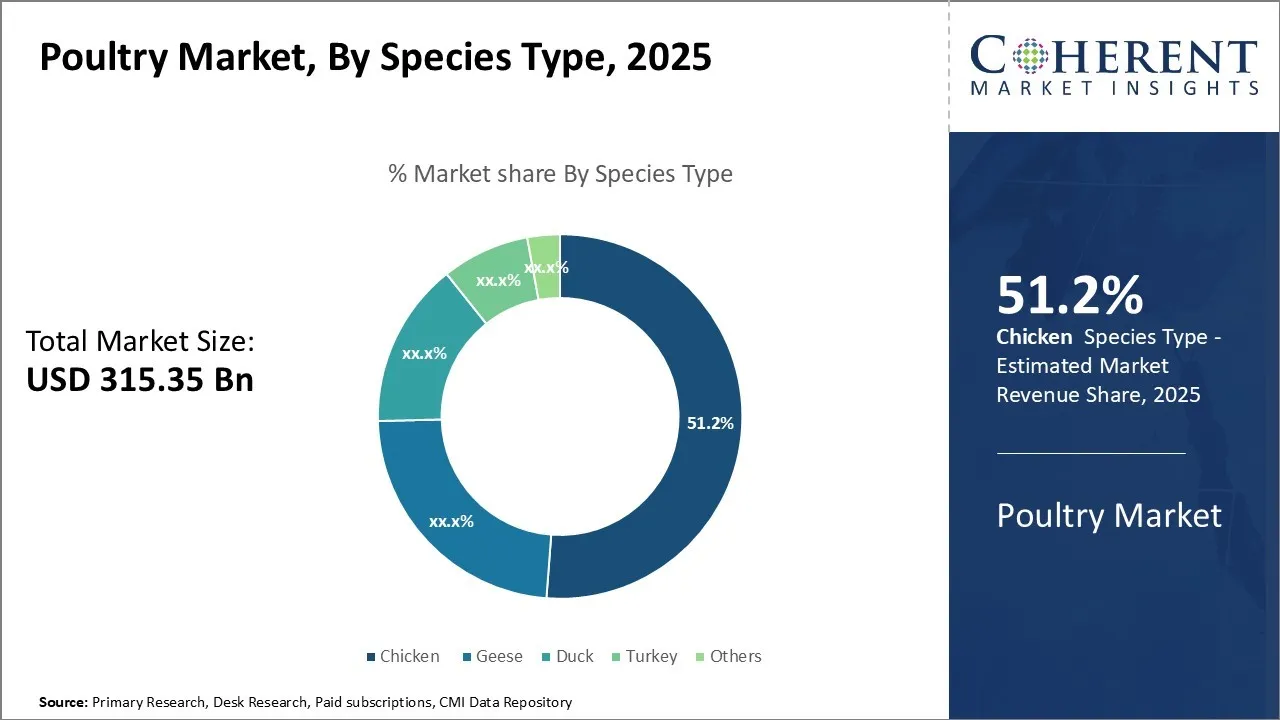
Poultry Market Insights, By Species Type
In terms of species type, the chicken segment is expected to contribute largest share of the Poultry market trends in 2026. The chicken segment dominates the poultry market, both globally and in India, due to its high demand as a versatile, affordable, and protein-rich food source. Globally, chicken accounts for the largest revenue share within the poultry market, expected to maintain dominance during the forecast period because of its widespread consumption and adaptability across cuisines.
For instance, in May 2026, Sunbird Poultry is proud to announce the launch of its premium all-natural young chicken line, designed to meet the growing demand for high-quality, humanely raised poultry products. As consumers increasingly seek food that’s better for the planet without compromising taste or nutrition, Sunbird Poultry sets a new standard in the industry.
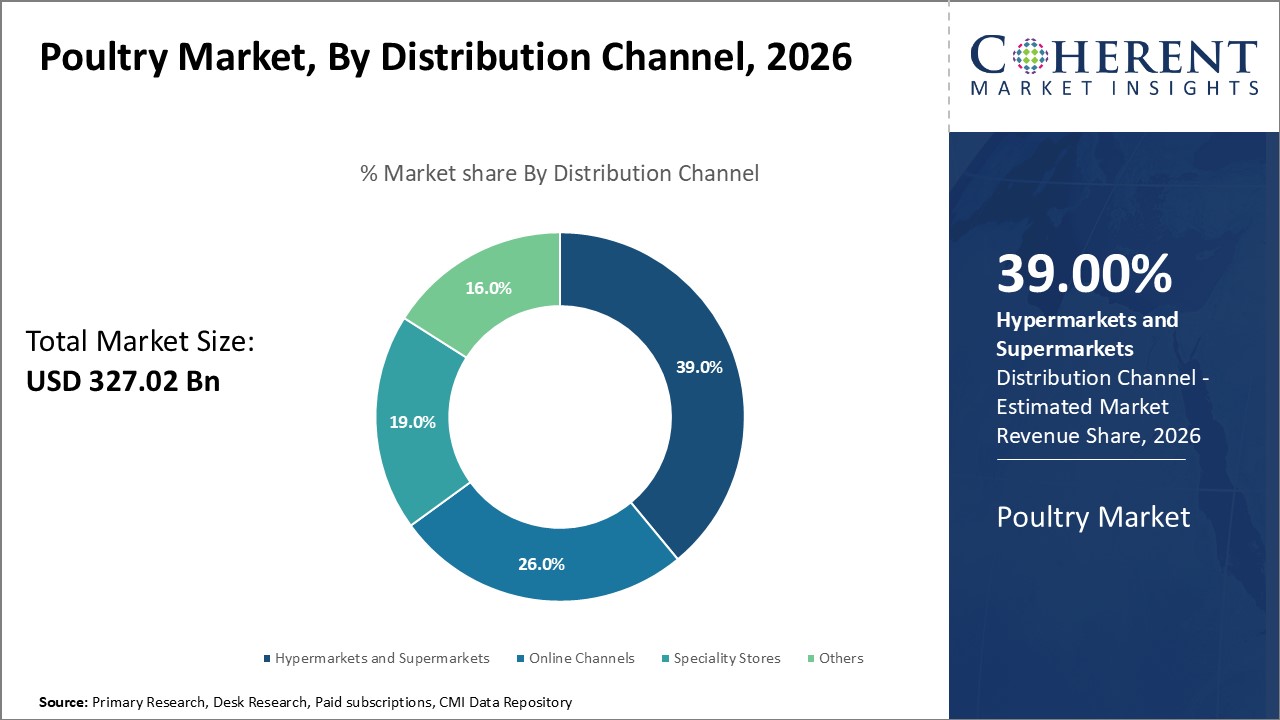
Poultry Market Insights, By Distribution Channel
In terms of distribution channel, the hypermarkets & supermarkets segment is expected to contribute largest share of the Poultry market trends in 2026. As the main retail location for a large range of poultry goods, the hypermarkets and supermarkets segment is crucial to the worldwide poultry market.
These massive retail establishments are appealing for one-stop shopping because they provide customers with convenience, a wide selection of products, and affordable prices. Supermarkets and hypermarkets are particularly prized for their strong supply chains and large shelf spaces, which enable them to provide a wide range of processed, frozen, and fresh poultry items to satisfy a variety of customer tastes.
Regional Insights
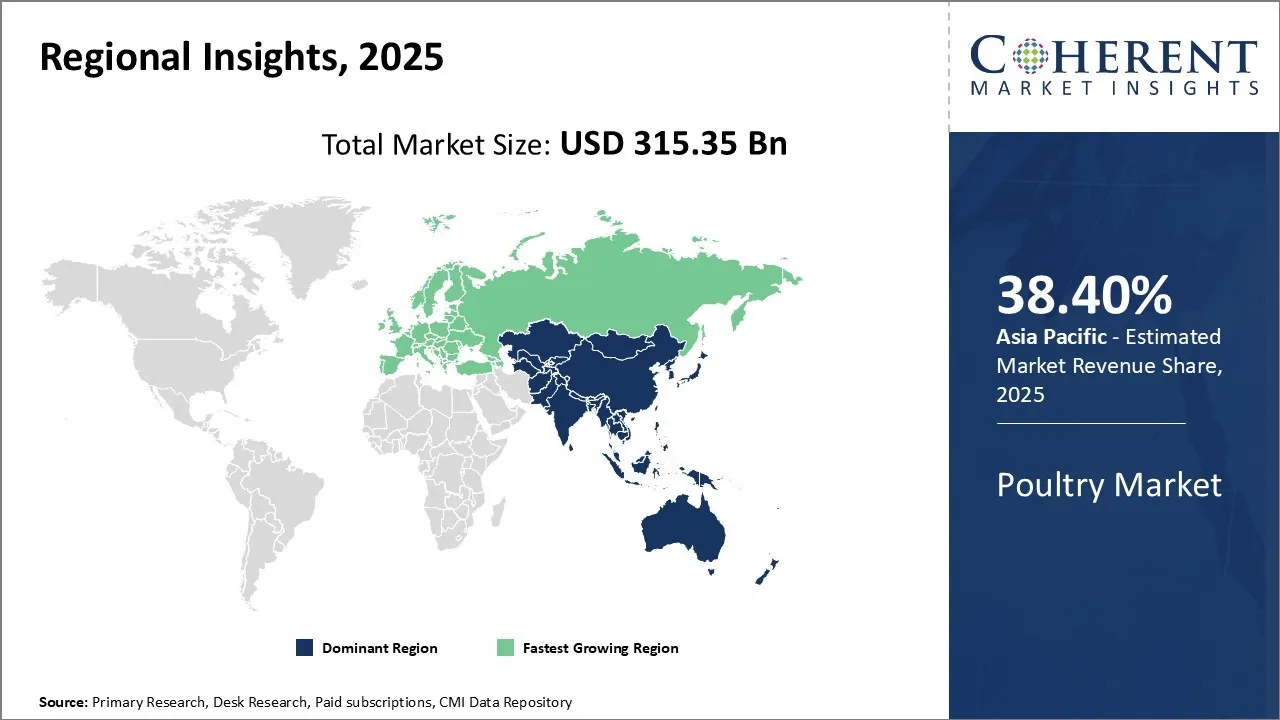
Asia Pacific Poultry Market
Asia Pacific accounted for the largest revenue share of 38.40% in the Global Poultry Market in 2026, and is expected to witness significant growth over the forecast period, owing to rising poultry consumption in countries such as China, India, Malaysia and Australia.
For instance, according to the Food & Agricultural Organization (FAO), the per capita consumption of poultry products pegged at 45.95 kg and 43.15 kg in Malaysia and Australia respectively, in 2022. These factors are expected to drive demand for poultry in Asia Pacific during the forecast period 2026-2032.
North America Poultry Market
The sector benefits from abundant feed resources, technological advancements, and a well-developed supply chain. Consumer preferences are shifting toward leaner meats and convenient products, fueling growth in both on-trade and off-trade channels, including supermarkets and rapidly expanding online grocery platforms.
Poultry Market In Europe
The European poultry market is experiencing steady growth, underpinned by rising meat consumption, stable economic conditions, and increasing health consciousness among consumers. The region is seeing a surge in demand for organic and antibiotic-free poultry products, driven by stricter regulations and a shift toward sustainable production practices. Technological advancements, such as camera-based weighing systems and artificial intelligence, are being adopted to enhance efficiency and product quality.
Poultry Market Dominating Countries
U.S Poultry Market
the US poultry industry is expanding, supported by elevated chicken production and increased broiler exports, particularly to markets like Mexico. The sector is leveraging technological advancements such as automation and precision farming to boost efficiency and address challenges like labor shortages and rising input costs.
India Poultry Market
India is one of the poultry markets with the quickest growth rates in the world because of its large and youthful population, increased income, and rapid urbanization. Chicken is the most widely consumed meat in India since it is inexpensive, versatile, and goes well with a variety of cooking techniques.
The Indian chicken sector is characterized by rapid modernization, increased investments in value-added products, cold storage, and integrated supply networks. Additionally, there is a growing emphasis on environmentally friendly methods for raising chickens, reflecting both consumer demand and industry efforts toward sustainability.
Poultry Market In China
China is the world’s largest producer and consumer of poultry meat, with chicken and duck being the primary products. The country’s poultry market is driven by high domestic demand, especially as consumers seek alternatives to pork due to periodic outbreaks of African swine fever. China’s poultry industry is rapidly modernizing, with significant investments in biosecurity, automation, and large-scale integrated operations to enhance productivity and food safety.
Market Report Scope
Poultry Market Report Coverage
| Report Coverage | Details | ||
|---|---|---|---|
| Base Year: | 2025 | Market Size in 2026: | USD 327.02 Bn |
| Historical Data for: | 2020 To 2024 | Forecast Period: | 2026 To 2033 |
| Forecast Period 2026 to 2033 CAGR: | 3.7% | 2033 Value Projection: | USD 421.72 Bn |
| Geographies covered: |
| ||
| Segments covered: |
| ||
| Companies covered: | Tyson Foods, Inc., JBS S.A., Pilgrim's Pride Corporation, Wens Foodstuff Group Co. Ltd., BRF S.A., Perdue Farms, Sanderson Farms, Baiada Poultry, Bates Turkey Farm, and Amrit Group. | ||
| Growth Drivers: |
| ||
| Restraints & Challenges: |
| ||
Poultry Market: Growth Drivers
- Increase in Production and consumption
Increasing production and consumption of meat poultry compared to other meat products is expected to drive growth of the Global Poultry Market over the forecast period. For instance, according to the American National Chicken Council Statistics, published in September 2022 the per capita consumption of total red meat was 111.5 pounds, whereas, per capita consumption of poultry meat was 115.1 pounds in 2022, across the globe.
- Growing Focus on Health Consciousness
The various health benefits related to the consumption of poultry products are projected to increase sales. For e.g., chicken is considered to be among the healthiest meat as its low in cholesterol and high in protein.
- Growing Focus on Animal Health
Increasing focus on animal health will also help the market growth. Increased cattle husbandry will almost certainly increase poultry feed demand. Growing demands for animal-based products will drive market demand higher.
Poultry Market: Restraints
- Poultry Diseases
Having a sick chicken is stressful enough, but knowing that their illness could affect the population adds to the stress of chicken care. Furthermore, not all chicken diseases can cross the species barrier, causing harm to not only humans, but also to other animals. This factor may constrain the growth of the poultry market in the upcoming period.
Poultry Market: Trends
Sustainability and health consciousness are increasingly influencing consumer choices, leading to higher demand for organic, clean-label, and minimally processed poultry products, especially in developed economies. Meanwhile, emerging markets are rapidly expanding poultry farming to meet growing protein needs, supported by government initiatives and investments in production infrastructure.
The enduring threat of avian influenza, geopolitical conflicts that impact trade flows, and the requirement for balanced supply expansion to prevent market instability are some of the industry's ongoing problems. Notwithstanding these obstacles, the poultry industry is anticipated to continue growing, with a substantial increase in global poultry market value anticipated over the coming years.
Poultry Market: Opportunities
The industry's dedication to innovation and sustainability presents yet another significant potential. Due to its reduced carbon footprint than other meat products, poultry is becoming more and more appealing to consumers who care about the environment, particularly in developed markets.
The use of cutting-edge technologies, such alternative protein integration, AI-driven monitoring, and precision farming, has increased productivity, animal health, and biosecurity while promoting the transition to organic and antibiotic-free poultry products.
Furthermore, the creation of substitute proteins such as lab-grown meat and plant-based alternatives is broadening the range of products available and creating new market niches. The poultry market is well-positioned for strong growth and diversity in the years to come because to these developments, ongoing investments in developing nations, and an emphasis on sustainable practices.
Poultry Market: Key Developments
- In May 2025, Sunbird Poultry announced the launch of a premium all-natural young chicken line, created to meet the growing demand for high-quality, humanely raised poultry products. Sunbird Poultry purchases its chicken from Lancaster, Pennsylvania, farms that strive for the best possible standards for both product quality and animal welfare. Antibiotics are not used in the slow-growing or raising of the hens. According to the company, they are fed a diet that is entirely vegetarian and non-GMO.
- In June 2025, The French agricultural cooperative Maïsadour is stepping up its commitment to structure a sustainable, profitable poultry sector that is rooted in the territories. The Cooperative is launching a plan to encourage the creation and the development of livestock buildings and support the new generation of farmers.
- In March 2025, Force of Nature Meats, a US meat brand founded on regenerative agriculture principles, is launching a chicken program it hopes will establish a new standard for poultry sourcing. In order to guarantee that consumers have access to premium chicken that is consistent with its beliefs, Force of Nature Meats uses the program to give breed selection, animal welfare, and environmental stewardship top priority when sourcing poultry.
Analyst Opinion
- The affordability and nutritional value of poultry meat and eggs, which continue to draw customers despite economic challenges and the high cost of other animal proteins, are the main drivers of this expansion.
- Poultry's position is also being strengthened by its smaller environmental impact than red meats, particularly as consumers and industry stakeholders place a higher value on sustainability.
- While industrialized regions like Europe are also anticipated to outperform global growth norms due to growing pledges to sustainable and organic production, robust demand in emerging markets particularly in Southeast Asia, Latin America, the Middle East, and Africa will be a major driver of expansion.
- The supply chain is becoming more productive and efficient thanks to technological developments like artificial intelligence, precision farming, and better disease management.
Speak to the analyst
Want personalized insights?
Take the findings above to one of our principal consultants, or have the report rebuilt around the segments, geographies and competitors you actually track.
Market Segmentation
- Global Poultry Market, By Species Type (Revenue, USD Bn, 2021 - 2033)
- Chicken
- Turkey
- Duck
- Geese
- Others
- Global Poultry Market, By Distribution Channel (Revenue, USD Bn, 2021 - 2033)
- Hypermarkets
- Supermarkets
- Online Channels
- Specialty Stores
- Others
- Global Poultry Market, By Region (Revenue, USD Bn, 2021 - 2033)
- North America
- U.S.
- Canada
- Latin America
- Brazil
- Argentina
- Mexico
- Rest of Latin America
- Europe
- U.K.
- Germany
- France
- Italy
- Spain
- Russia
- Rest of Europe
- Asia Pacific
- China
- India
- Japan
- ASEAN
- South Korea
- Australia
- Rest of Asia Pacific
- Middle East
- GCC
- Israel
- Rest of Middle East
- Africa
- North Africa
- Central Africa
- South Africa
- North America
- Company Profiles
- Tyson Foods, Inc.
- JBS S.A.
- Pilgrim's Pride Corporation
- Wens Foodstuff Group Co. Ltd.
- BRF S.A.
- Perdue Farms
- Sanderson Farms
- Baiada Poultry
- Bates Turkey Farm
- Amrit Group
Sources
Primary Research Interviews
- Poultry farmers (small-scale and commercial)
- Hatchery managers
- Feed manufacturers
- Poultry veterinarians
- Livestock extension officers
Databases
- USDA National Agricultural Statistics Service (NASS)
- National Egg Coordination Committee (NECC)
- World Bank Open Data (Livestock statistics)
- IndiaStat (for India-specific poultry data)
Magazines
- Poultry Times
- World Poultry
- Poultry International
- Poultry Business
- Indian Poultry Review
Journals
- Poultry Science (Oxford Academic)
- Journal of Applied Poultry Research
- World's Poultry Science Journal
- International Journal of Poultry Science
Newspapers
- The Hindu – Agriculture or Business section
- The Economic Times – Agribusiness section
- Business Standard – Livestock/Agri section
- Financial Express – Rural & Agribusiness
Associations
- World’s Poultry Science Association (WPSA)
- Poultry Federation of India
- All India Poultry Development & Services
- National Egg Coordination Committee (NECC)
- International Poultry Council (IPC)
Proprietary Elements
- CMI Data Analytics Tool, Proprietary CMI Existing Repository of information for last 8 years
*Definition: Poultry are domesticated birds raised for meat, eggs, and feathers. Popular birds of poultry include chickens, turkeys, ducks, geese, guinea flow, and squabs.
Get access to 250+ pages report
Every segment, forecast, competitor profile and data table behind the analysis above — available for instant download.
- ESOMAR Member
- ISO 9001:2015 Certified
- D-U-N-S Registered
- GDPR & CCPA Compliant
Missing comfort of reading report in your local language? Find your preferred language:
Transform your Strategy with Exclusive Trending Reports
Frequently Asked Questions
The Poultry Market size is estimated to be valued at USD 327.02 Bn in 2026, and is expected to reach USD 421.72 Bn by 2033.
The Global Market is estimated to reach USD 421.72 Bn by 2033.
Major players operating in the market include Tyson Foods, Inc., JBS S.A., Pilgrim's Pride Corporation, Wens Foodstuff Group Co. Ltd., BRF S.A., Perdue Farms, Sanderson Farms, Baiada Poultry, Bates Turkey Farm, and Amrit Group.
Among species type, chicken segment accounted for the largest revenue share accounting for 51.20% in 2026 in the market.
Increasing production and consumption of poultry meat compared to other meat products is one of the major factors that is expected to the market.
The CAGR of the Poultry industry is projected to be 3.7% from 2026 to 2033.
Among regions, Asia Pacific accounted for the largest market share in 2026.